bible
Bible Note: Judges 15:1-3 and the right for vengeance
 As I’m working through the Bible writing a kind of running commentary on it as I go, I continually encounter depths of the material I hadn’t encountered before. One such place is the Samson narrative–one of my favorite stories in the entire Bible. The following is an extended version of one of the notes I put in my running commentary:
In Judges 15:3, having discovered his wife was given to someone else, Samson notes that “this time” he has the right to take vengeance. What does this mean? Is Samson saying that he has a right ‘this time’ as opposed to last (when he took vengeance because of the Philistines getting the answer to his riddle through his wife)? Or does he mean that he has a right ‘this time’ in addition to the last time?
Added dimension: In 14:19 when he strikes down 30 Philistines he does so in the power of the Spirit of the LORD. Further dimension: 14:4 speaks of how the LORD was seeking to confront the Philistines.
It seems to me this must imply that God, in sovereignty, is guiding the events towards an end God desires. Given this, we may be tempted to say Samson’s right is indeed a right to vengeance–a divinely given one. But it is possible God is also using this (clearly) sinful man in spite of the sinfulness of his behavior, including his desire for vengeance (which belongs to God alone).
Which interpretation do you think is correct? Why?
Book Review: “Interpreting the Prophets” by Aaron Chalmers
 Aaron Chalmers’ Interpreting the Prophets
The book is laid across 6 chapters, each with a focus on a central aspect of interpreting and applying biblical prophecy. These are: (1) What is a prophet and what is a prophetic book?; (2) The historical world of the prophets; (3) The theological world of the prophets; (4) The rhetorical world of the prophets; (5) From prophecy to apocalyptic; and (6) Guidelines for preaching from the prophets.
There are many insights which will be valuable for both those wishing to engage with the prophets as laity and those interested in drawing out deep exegetical insights from the text. Chalmers’ work serves as a guide for reading without telling readers exactly what various passages are supposed to mean. It is the kind of text that encourages readers to move to the Word and explore it for themselves, laying a solid foundation for interpretation beforehand.
One example of the insights Chalmers provides is his critique of those who would see the prophetic literature as speaking primarily to our time. He notes that this approach of trying to match up biblical prophecies one-to-one with newspaper headlines is mistaken for a number of reasons, including making the texts largely irrelevant to its contemporary hearers. Throughout the book, there are a number of insets that highlight various additional details, like the Ancient Near Eastern background of the text or specific views about things like the dating of a book.
Interpreting the Prophets
The Good
+Excellent insets provide background information into the world of the Bible
+Incisive critique of some popular approaches to reading the prophets
+Practical advice for readers of the Scripture, pastors, and professionals alike
The Bad
-Very brief on several important points
Disclaimer: I was provided with a review copy of the book by InterVarsity Press. I was not required to provide any specific kind of feedback whatsoever, nor was the publisher involved in this review in any way.
Links
Be sure to check out the page for this site on Facebook and Twitter for discussion of posts, links to other pages of interest, random talk about theology/philosophy/apologetics/movies and more!
Book Reviews– There are plenty more book reviews to read! Read like crazy! (Scroll down for more, and click at bottom for even more!)
Source
Aaron Chalmers, Interpreting the Prophets
SDG.
——
The preceding post is the property of J.W. Wartick (apart from quotations, which are the property of their respective owners, and works of art as credited; images are often freely available to the public and J.W. Wartick makes no claims of owning rights to the images unless he makes that explicit) and should not be reproduced in part or in whole without the expressed consent of the author. All content on this site is the property of J.W. Wartick and is made available for individual and personal usage. If you cite from these documents, whether for personal or professional purposes, please give appropriate citation with both the name of the author (J.W. Wartick) and a link to the original URL. If you’d like to repost a post, you may do so, provided you show less than half of the original post on your own site and link to the original post for the rest. You must also appropriately cite the post as noted above. This blog is protected by Creative Commons licensing. By viewing any part of this site, you are agreeing to this usage policy.
Book Review: “The Bible Story Handbook” by John Walton and Kim Walton

John Walton and Kim Walton’s The Bible Story Handbook
The book has a great introduction that argues that we need to be teaching the actual point of the Bible stories we use in lessons in Sunday School, sermons, and the like rather than abstracting the stories and chopping them apart to draw out specific illustrations we’d like to have. This is a very challenging introduction, not because it is technical, but because we so often do see this done in teaching the Bible and we so often do it ourselves. For example, we might see the story of Jonathan and David as about friendship rather than about what God was doing through the people acting in the story. A more extreme example is from the authors: one of their children came home and had been taught the story of Cain and Abel in Sunday School. But the point of the story–which was told sans violence because of the age of the children–they were told was that Cain and Abel had bodies. That’s it.
It is this level of abstraction that John Walton and Kim Walton work against in the book, consistently arguing story-by-story that the point of the Bible is to teach us about God and God’s action in human history. The stories are each outlined in the same fashion. There is a subheading listing the passage that has what the Bible story is (i.e. Samson and Delilah) followed by the verses that will be discussed (i.e. Judges 16). Then, there is a “Lesson Focus” that outlines key parts of the lesson in a sentence or two, then has main focal points of the lesson in bullet points. After that there is a Lesson Application which hones the Lesson Focus in to what we might take from the lesson. Then, the biblical context of the lesson is highlighted (this section often begins the same if there are multiple lessons in the same book). After that, Interpretational Issues are addressed (such as Samson’s hair and his strength). Background information related to the text is given (such as looms and their usage at the time of the story). Finally, “Mistakes to Avoid” puts forward the key meaning of the text and highlights some errors related to interpretation that people often make related to the specific text.
These sections each have vital information and are certainly of great value for those who want to preach, teach, or explore God’s Word.
There are a few downsides to the book. At times, it seems the “Mistakes to Avoid” might not fully explain why certain interpretations are “mistakes” or why the preferred interpretation ought to be put forward. The book has very broad application but does focus on teaching the Bible stories to children. It would perhaps have been nice to have similar notes about how to direct the lesson towards adults. These are both largely just nitpicks about what is an otherwise phenomenal book.
The Good
+Extremely challenging to many presupposed ideas about how to tell and teach Bible stories
+Great selection of Bible stories
+A constant stream of firm exegesis yielding sometimes surprising insights
+Applicable immediately to teaching settings
The Bad
-Would have been nice to have more focus on teaching Bible stories to adults as well
-Some of the “mistakes to avoid” do not seem like mistakes after all
Conclusion
John Walton and Kim Walton have done a great service with The Bible Story Handbook
Disclaimer: Crossway provided me with a copy of the book for review. I was not obligated to provide any specific kind of feedback whatsoever, nor did they request changes or edit this review in any way.
Links
Be sure to check out the page for this site on Facebook and Twitter for discussion of posts, links to other pages of interest, random talk about theology/philosophy/apologetics/movies and more!
Book Reviews– There are plenty more book reviews to read! Read like crazy! (Scroll down for more, and click at bottom for even more!)
Source
John Walton and Kim Walton, The Bible Story Handbook
SDG.
——
The preceding post is the property of J.W. Wartick (apart from quotations, which are the property of their respective owners, and works of art as credited; images are often freely available to the public and J.W. Wartick makes no claims of owning rights to the images unless he makes that explicit) and should not be reproduced in part or in whole without the expressed consent of the author. All content on this site is the property of J.W. Wartick and is made available for individual and personal usage. If you cite from these documents, whether for personal or professional purposes, please give appropriate citation with both the name of the author (J.W. Wartick) and a link to the original URL. If you’d like to repost a post, you may do so, provided you show less than half of the original post on your own site and link to the original post for the rest. You must also appropriately cite the post as noted above. This blog is protected by Creative Commons licensing. By viewing any part of this site, you are agreeing to this usage policy.
Bible Note: Judges 14:14- Samson, a Riddle, and Dramatic Irony?
I’ve been reading through the Bible and making a kind of commentary on the whole thing as I go. Needless to say this has been a lengthy project!
A note from the NIV Study Bible on the Samson narrative–my current reading clued me in to something pretty interesting. I wonder how intentional this parallel might be. Here’s a note I put into my running Bible commentary:
“The NIV Study Bible (p. 380 note on 14:14) notes how this riddle could be foreshadowing Samson’s own fate- out of the eater (Samson), something to eat—Samson grinding grain after being blinded; out of the strong (Samson), something sweet—the joy of seeing their enemy cast down.”
What do you think? Is this parallel in the text? If so, is it intentional? What might we learn from its presences/lack thereof.
Sunday Quote!- Hidden Science in the Bible?
 Every Sunday, I will share a quote from something I’ve been reading. The hope is for you, dear reader, to share your thoughts on the quote and related issues and perhaps pick up some reading material along the way!
Hidden Science in the Bible?
Some see the Bible as a source of all knowledge. When we come to the very beginning of the Bible, what is it trying to teach us? Might it tell us what to believe about evolution? Could it reveal truths about science that no one knew until they were discovered later? These types of questions come to us very frequently in this age of science in which we invest so much into questions of a material nature.
John Walton, in his latest book, The Lost World of Adam and Eve, argues that these questions are largely misguided:
[God] did not hide information of that sort [scientific] in the text for later readers to be discovered. An assumption on our part that he did would have no reliable controls. For example, in the days when people believed in a steady-state universe, people could easily have gone to the Bible to find confirmation of that science. But today we do not believe the steady-state theory to be true… Such approaches cannot be adopted within an authority framework. (18, cited below)
Walton’s argument is compelling. The notion that the Bible necessarily has hidden throughout scientific insight just waiting to be found can never be arbitrated. Thus, it makes the Bible the tool of one generation and the laughing stock of the next. As we attempt to use the Bible to support various scientific notions, we may do much damage to the text.
How might we best approach the text in a way that does not leave us open to this uncontrollable theorizing? Is it possible to maintain the notion that the Bible does teach us about science? If not, why not? If so, to what extent?
Links
Be sure to check out the page for this site on Facebook and Twitter for discussion of posts, links to other pages of interest, random talk about theology/philosophy/apologetics/movies and more!
Sunday Quote– If you want to read more Sunday Quotes and join the discussion, check them out! (Scroll down for more)
Source
John Walton, The Lost World of Adam and Eve
SDG.
Really Recommended Posts 5/1/15- Abortion, Earthquake, and Apologetics!
 Another week, another round of great reading that I bring to you, dear readers! This week, we have a discussion of the Bible and abortion, the notion of “soul vultures” and the Nepalese Earthquake, Free Comic Book Day, the apologist E.J. Carnell, and some apologetics books!
Does Revelation 9:21 Prohibit Abortion?– Is it possible that there is a reference to drugs that caused abortions in the Bible? If so, what does the Bible say about abortion?
Twitter Attack on #SoulVultures and the Nepalese Earthquake– There has been a lot of pushback against Christians who have stated that Nepal needs the Gospel. It’s not as if Christians are not sending aid, but some people have incredibly and viciously attacked Christians for, well, being Christians. Here’s an insightful post on this. The site also has several more posts on the same topic.
Free Comic Book Day!– My friend over at No Apologies Allowed has made a comic encouraging people to get involved in apologetics for Free Comic Book Day. Check it out, and download a free comic!
Remembering E.J. Carnell: Some Reflections of a Great Apologist– I’m not well versed in the works of Carnell, but I have recently had a number of sources I trust cite his work favorably. Here’s a post giving some brief insights into his stance and thought.
Top 10 Apologetics Books– It’s always fun to put together “top ten” lists of favorites. Here, there is a top ten list of apologetics books. I have read almost all of them, and have been edified by many. What are your top ten?
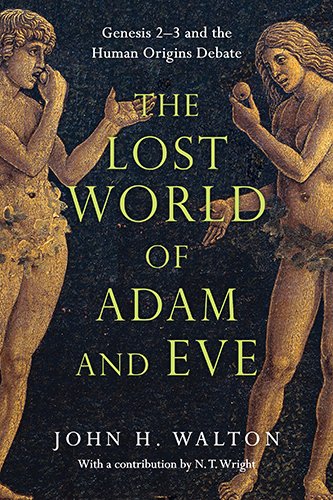
Book Review: “The Lost World of Adam and Eve” by John Walton
John Walton’s latest book, The Lost World of Adam and Eve
Walton argues that the Genesis creation account does not specifically tell us how Adam and Eve materially came to be but rather is an account of God giving them their functions as the image of God, ushering in order against the chaos. His view is one which sees Adam as archetypical head of humanity rather than necessarily being the first ever human. Adam and Eve were chosen by God to become God’s representatives in the world.
Many intriguing arguments are put forward by Walton once he has established what is the central thesis–that the text is concerned with functional, not material origins. These include reading Genesis 2 as a sequel to rather than recapitulation of Genesis 1, the use of the term “very good” and “good” in the text, the meaning of “formed from dust” and from the rib, the archetypal meaning of Adam and Eve, the real existence of this couple, the priesthood of the couple in sacred space, our role as bringing order from disorder, the “serpent” in the Garden, and more. Each chapter is filled with compelling arguments and sometimes surprising conclusions.
Because the worldview of the ANE was not concerned with material origins, the questions we often ask of the text like “Were Adam and Eve the first humans?”; “Are we all descended from Adam?” and the like are questions which the text is not intended to answer. These are questions from our background, not from the background of the text. Thus, Walton argues that there can be much openness to the answers to these questions. When we come to the New Testament discussions of Adam and Eve, Walton (and the contribution from NT Wright) argue that this is why the notion of federal headship (though not necessarily material/genetic headship) is probably in mind.
Readers who are unconvinced by the notion that we should apply ANE insights to our reading of the text will be challenged to support that claim. Walton cogently argues that although there is not a 1-to-1 correspondence between the worldview of the ANE and the Bible, it is highly questionable to assume that the writers and audience of the Bible would not have been influenced by their background and cultural understanding.
Regarding the science, Walton readily points out that he is not an expert in the area but defers largely to the experts. He applies the exegetical arguments to questions of original sin, federal headship, and the like in the context of modern scientific findings, though he does so in such a way that he retains his commitment to teach what the text does rather than trying to force it to speak of our concerns.
Many (most?) readers will find this book challenging on a number of levels because Walton so readily exposes our presuppositions about what the text should say. Very often Walton simply points readers back to the text to reveal how often we have our expectations bring meaning to the text rather than allowing it to speak for itself.
The Good
+Excellent insight into the ANE background of the Old Testament
+Strong exegetical argument with a commitment to understanding the text
+Coherent with the rest of Walton’s thought
+Challenges our presuppositions about the text
The Bad
-A bit difficult to pin down exactly what his view is of original sin
Conclusion
The Lost World of Adam and Eve
Disclaimer: I was provided with a review copy of the book courtesy of InterVarsity Press. I was not obligated to write any sort of review whatsoever. My thanks to the publisher for the copy.
Links
Be sure to check out the page for this site on Facebook and Twitter for discussion of posts, links to other pages of interest, random talk about theology/philosophy/apologetics/movies and more!
Origins Debate– Read a whole bunch more on different views within Christianity of the “origins debate.” Here I have posts on young and old earth creationism, intelligent design, theistic evolutionism, and more!
Source
John Walton, The Lost World of Adam and Eve
SDG.
——
The preceding post is the property of J.W. Wartick (apart from quotations, which are the property of their respective owners, and works of art as credited; images are often freely available to the public and J.W. Wartick makes no claims of owning rights to the images unless he makes that explicit) and should not be reproduced in part or in whole without the expressed consent of the author. All content on this site is the property of J.W. Wartick and is made available for individual and personal usage. If you cite from these documents, whether for personal or professional purposes, please give appropriate citation with both the name of the author (J.W. Wartick) and a link to the original URL. If you’d like to repost a post, you may do so, provided you show less than half of the original post on your own site and link to the original post for the rest. You must also appropriately cite the post as noted above. This blog is protected by Creative Commons licensing. By viewing any part of this site, you are agreeing to this usage policy.
Sunday Quote!- Adam and Eve and Inerrancy
Every Sunday, I will share a quote from something I’ve been reading. The hope is for you, dear reader, to share your thoughts on the quote and related issues and perhaps pick up some reading material along the way!
Adam and Eve and Inerrancy
Is it possible to deny the historicity of Adam and Eve and affirm biblical inerrancy? I’ve explored the issue of whether the historical Adam is a “gospel issue” before and concluded that it depends what is meant by the term. I was reading through John Walton’s The Lost World of Adam and Eve
…make the case that historical Adam is part of the authoritative message that the text provides… If someone were to contend that belief in a historical Adam was cultural… part of the framework of communication, then inerrancy would not apply… (201-202)
It is worth noting that Walton believes that Adam and Eve are indeed historical persons, though he believes they were archetypes rather than the only humans alive at the time or the first humans ever.
What do you think? Need we affirm a historical Adam in order to affirm inerrancy? Is there a burden of proof upon those who claim the two are necessarily linked? What is your view of the historical Adam?
Whatever your thoughts, The Lost World of Adam and Eve
Links
Be sure to check out the page for this site on Facebook and Twitter for discussion of posts, links to other pages of interest, random talk about theology/philosophy/apologetics/movies and more!
Sunday Quote– If you want to read more Sunday Quotes and join the discussion, check them out! (Scroll down for more)
Is the historical Adam a Gospel Issue?– What happens to the Christian faith should it turn out to be the case that there is no historic Adam? Can one remain Christian and not believe in an historic Adam?
Source
John Walton, The Lost World of Adam and Eve
SDG.
Sunday Quote!- Trading Off the Bible for Science?
 Every Sunday, I will share a quote from something I’ve been reading. The hope is for you, dear reader, to share your thoughts on the quote and related issues and perhaps pick up some reading material along the way!
Trading Off the Bible for Science?
Adam, the Fall, and Original Sin
One area that was fairly interesting was the discussion Hans Madueme offered of an interplay between the Bible and science:
There is a trade-off between what is biblically plausible and what is scientifically plausible. To the degree that the doctrine of the fall reflects the biblical story, to the same degree is it inversely faithful to the evolutionary story. (238, cited below)
I think the language of “trade-off” here might be viewed as a rhetorical flourish. The next phrase is equally weighted to seemingly back-load a specific reading of the story of the fall into what is “plausible” over and against that which is “scientifically plausible.” Although I think there may be something of a trade-off in some sense, in order for this qupte to be true there would have to be an inherent inverse relationship between evolution and the Bible. This may, in fact, be the case, but there are a number of steps that need to be proven before one can get to that point.
More intriguing, perhaps, is the notion that we could recast this “trade-off” between exactly how much science we want to read into the Bible and how biblically plausible we are. I would argue that the more we insist that the Bible is explicitly revealing specifics of exact empirical science, the more we do damage to the text. This is a position that does not see science and the Bible as in complete opposition to each other, nor does it see the Bible as scientifically inaccurate or as “non overlapping magisteria.” Instead, where the Bible speaks to scientific issues–if anywhere–those are affirmed. Where it doesn’t, we should not insist that it does.
What do you think? Is there really a trade-off between science and the Bible? If so, in what way?
Links
Be sure to check out the page for this site on Facebook and Twitter for discussion of posts, links to other pages of interest, random talk about theology/philosophy/apologetics/movies and more!
Sunday Quote– If you want to read more Sunday Quotes and join the discussion, check them out! (Scroll down for more)
Source
Hans Madueme, “The Most Vulnerable Part of the Whole Christian Account: Original Sin and Modern Science” in Adam, the Fall, and Original Sin
SDG.
adam, fall, original sin 238
Microview: “The Dominant Culture: Living in the Promised Land” by Martin Murphy
 Martin Murphy’s The Dominant Culture
Murphy’s book brings much of the book to life as he retells the stories with an eye for application in the present day. How do Israel’s stories point to truths in our own lives? The book proceeds effectively through the major stories of Judges, with a few comments on minor stories as well. The beauty of the way Murphy does this is that he doesn’t try to make a kind of direct correspondence between the nation of Israel as theocracy and our own world in a kind of one-to-one correspondence; rather, he draws from the stories of Judges to show how we live in a world in which each goes his/her own way, sin reigns, and we need repentance. These and other applications are drawn throughout the book with rather remarkable insight.
There are some downsides in the book, particularly with the marked reading of gender hierarchy into the narrative of Deborah. Here, it seems, Murphy goes off track of what is otherwise marvelous exegetical skill, as he must continually appeal to silence (by saying things like the Bible never says God approved of Deborah as a prophetess) rather than allowing the text itself to demonstrate that Deborah simply was a leader and prophet. The very fact that the author of Judges does not condemn a woman as a prophet and judge when they are quick to condemn other wicked practices (such as using the refrain of “everyone did as they pleased”) in fact seems to point in the opposite direction as that which Murphy goes regarding Deborah. This is, thankfully, just one unfortunate aberration of exegesis among what is otherwise a quite solid job navigating between the need to stay true to the text and draw out applications for today.
The Good
+Often shares insights that bring new light to familiar or unfamiliar texts
+Applicable interpretation rather than merely analytic
+Explains key terms in meaningful way
The Bad
-Unfortunate comments about Deborah and women in leadership
Conclusion
The Dominant Culture
I was provided with a copy of the book for review. I was not obligated by the publisher to write any type of review whatsoever.
Links
Be sure to check out the page for this site on Facebook and Twitter for discussion of posts, links to other pages of interest, random talk about theology/philosophy/apologetics/movies and more!
Book Reviews– There are plenty more book reviews to read! Read like crazy! (Scroll down for more, and click at bottom for even more!)
Source
Martin Murphy, The Dominant Culture

 J.W. Wartick - Reconstructing Faith