bible
Book Review: “Death Before the Fall” by Ronald Osborn
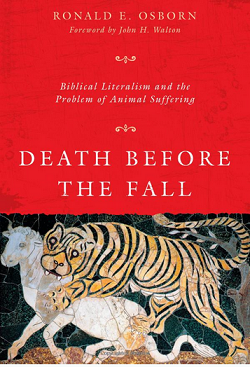
I eagerly anticipated the release of Ronald Osborn’s book, Death Before the Fall: Biblical Literalism and the Problem of Animal Suffering
The first part occupies the bulk of the book (100/179 pages of text). In it, Osborn first offers his interpretation of the creation account in Genesis 1. His take on it is that is fairly open to being taken in a number of ways. For example, having creatures come forth “from the earth” may be direct special creation, or a linguistic device aimed at describing the “open” status of creation–its ability to change and self-correct (see esp. 27-28).
After laying out the interpretation, Osborn sets out to show how “literalism” is a mistaken hermeneutic. He argues that literalism has been brought to the forefront due to Enlightenment ways of thinking. That is, biblical literalists are influenced by modernism and their readings tend to be highly reliant on that kind of rationalist epistemology (42ff). A major difficulty with literalism, he notes, is that it seems to ultimately lead to fideism: one’s view of what the “plain sense” reading of the Bible is must be taken as normative for all areas of inquiry (44; 45-46). Another difficulty is that literalism tends to actually go far beyond what the text says in order to defend a preferred interpretation of the text (56-57).
Scientific creationism, Osborn argues, is flawed because it isn’t a “progressive research program” but rather a “degenerative” one. That is, scientific creationism is simply adjusted in an ad hoc way to meet new challenges rather than predicting them (63ff). He rounds out this first part with a discussion of how literalism ultimately leads to circling the wagons and an “enclave mentality,” alongside various representatives of historical interpretation of Genesis–Barth, Calvin, Augustine, and Maimonides.
The second part focuses on animal suffering and approaches it from a number of angles. He begins the section with three difficulties with a “literalist” view of animal suffering and the Fall. Briefly, these are the notion that a flawless creation as put forward by some seems to simply be the winding up of a watch; that God is made to be a deceiver; and difficulties with how the curse is to be applied to animals (126ff). These are presented briefly but cogently and each offers a unique challenge to typical creationist readings of the text. Next, Osborn turns to explanations other than the Fall as reasons animals suffer. He turns to the book of Job and argues both that God may have created nature with predation and death and also that God’s answer to Job out of the whirlwind may be applied to animal suffering (154-155). Moreover, God’s choosing to participate in the world in the Incarnation helps to consummate all creation and bring it to completion (165).
A difficulty with the book is the sustained polemic against literalism/YEC. At times, Osborn shares great insights in the movement. Moreover, pointed criticism is surely needed in some form. Unfortunately, after some helpful introductory comments, he seems to degenerate into posturing against those with whom he disagrees. For example, after admitting that Gnosticism is rather ill-defined, he nevertheless goes on to compare literalism to Gnosticism and simply state that they each share certain features in common (86ff). I like to call this the “Gnostic fallacy” in which someone declares the ‘other’ to be a Gnostic in order to refute them. As Osborn himself notes, Gnosticism is hard to pin down, which also means it is very easy to twist various teachings into lining up with Gnosticism. I think this is honestly one example. [See comments for Osborn’s clarifying comments on this section.]
This section is understandable, and it is easy for someone like Osborn–a former YEC (like myself)–to want to lash out against these formerly held, and sometimes damaging, beliefs, but it is not a very helpful. I suspect it will alienate any readers he would perhaps hope to engage in dialogue, which leaves one wondering about the audience for the book.
Another difficulty with Osborn’s sustained critique of “literalism” is that he never provides much insight into how and/or when texts are to be read literally. That is, would the Gospels need to be read literally when they speak of Jesus dying on the cross and rising again? Osborn clearly affirms this, but doesn’t provide mechanisms which distinguish between “literalism” and simply proper exegesis which would allow for and engage with literal readings of the texts.
One further problem is that the book, despite purporting to be about Death Before the Fall, only briefly addresses this issue. The book really doesn’t provide anything more than most basic non-young earth literature does when it comes to the issue. As such, it is difficult to determine exactly how useful the book is when compared to other works.
Ultimately, Death Before the Fall: Biblical Literalism and the Problem of Animal Suffering
Readers who are interested in the topic of animal suffering and death before the fall are better served to pick up Michael Murray’s excellent and enthralling book, Nature Red in Tooth and Claw: Theism and the Problem of Animal Suffering
Links
Be sure to check out the page for this site on Facebook and Twitter for discussion of posts, links to other pages of interest, random talk about theology/philosophy/apologetics/movies and more!
Sunday Quote!- Do Trilobites Yield a Greater Good?– I discuss a very minor point in Murray’s work which shows how diverse its threads are for thinking on this topic.
Source
Ronald Osborn, Death Before the Fall: Biblical Literalism and the Problem of Animal Suffering (Downers Grove, IL: InterVarsit, 2014).
SDG.
——
The preceding post is the property of J.W. Wartick (apart from quotations, which are the property of their respective owners, and works of art as credited; images are often freely available to the public and J.W. Wartick makes no claims of owning rights to the images unless he makes that explicit) and should not be reproduced in part or in whole without the expressed consent of the author. All content on this site is the property of J.W. Wartick and is made available for individual and personal usage. If you cite from these documents, whether for personal or professional purposes, please give appropriate citation with both the name of the author (J.W. Wartick) and a link to the original URL. If you’d like to repost a post, you may do so, provided you show less than half of the original post on your own site and link to the original post for the rest. You must also appropriately cite the post as noted above. This blog is protected by Creative Commons licensing. By viewing any part of this site, you are agreeing to this usage policy.
Proverbs 31 destroys preconceived “Biblical Womanhood”
Deborah, leading the people of Israel
There are some who advocate a notion of “Biblical Manhood and Womanhood” with strict definitions of what roles men and women should occupy. Representative is John Piper, a leading voice in the movement named “Recovering Biblical Manhood and Womanhood.” In his essay “A Vision of Biblical Complementarity: Manhood and Womanhood Defined According to the Bible,” Piper writes about “biblical” manhood:
When my father came home he was clearly the head of the house… (32, cited below)
[W]hen there is no bread on the table, it is the man who should feel the main pressure to do something to get it there… a man will feel his personhood compromised if he… becomes dependent over the long haul… on his wife’s income. (42)
Shockingly, Piper even goes so far as to say that:
“[E]ven where a Christian wife may have to stand with Christ against the sinful will of her husband, she can still have a spirit of submission–a disposition to yield” (47).
Piper alleges that biblical womanhood follows this pattern:
A mature woman is glad when a respectful, caring, upright man… provides a pattern of appropriate initiatives in their relationship. (48)
[She is to follow] Biblical submission[, which] for the wife is the divine calling to honor and affirm her husband’s leadership and help carry it through… (53)
From Piper, we learn that “biblical” womanhood is to yield, to be led, not to be the head of the home, be provided for, indeed even to avoid situations in which a woman is closely leading a man in the office (52).
Proverbs 31 destroys this concept of what a “biblical” woman should be. In this astonishing passage, we read that the ideal woman:
1. Takes care when selecting products to purchase (31:13)
2. Brings food to her family (31:14)
3. Provides for her family (31:15)
4. Appraises and purchases land (31:16)
5. Brings profitable gain (31:18)
6. Works with tools of various trades (31:18)
7. Helps the poor and needy (31:20)
8. Crafts goods to be used by the family (31:22)
9. Crafts goods to sell and is shrewd in selling them (31:24; 18)
10. Speaks and instructs with wisdom (31:26)
11. Watches over the ways of the household (31:27)
12. Above all, she fears the Lord (31:30)
Now remember, this is an “ideal” and of course no woman could be or do all of these things. This passage illustrates aspects of what a biblical woman would be.
Recall, though, the roles that have been defined for women by some complementarians–people who hold a view in which man and woman occupy different roles in the home and church, with men as leaders. Which of these are found in the description of woman in Proverbs 31? Let’s just do a quick comparison of a few (Piper citations from above):
Piper: [I]t is the man who should feel the main pressure to do something to get [bread on the table]
Bible: “[The ideal wife/woman] gets up while it is still night; she provides food for her family...” (31:15a)
Do women not share the pressure in putting bread on the table when the Bible describes ideal womanhood as a provider of food for her family without excluding the husband?
Piper: When my father came home he was clearly the head of the house…
Bible: “She watches over the affairs of her household…”(31:27a)
Does watching over the affairs of the household have an unwritten, unspoken clause that excludes men?
Piper: [A] man will feel his personhood compromised if he… becomes dependent over the long haul… on his wife’s income.
Bible: “She considers a field and buys it; out of her earnings she plants a vineyard… She sees that her trading is profitable, and her lamp does not go out at night.” (31:16; 18)
Does the wife/woman’s managing money, earning it, buying fields, ensuring profit, and staying up late into the night focusing on this profitable gain compromise her husband’s personhood?
Also interesting are the things that are not said. It doesn’t say the ideal woman yields to her husband when he does wrong, she rather brings him good, not harm (31:12). Sin is a harmful cycle, and to say women are to rebuke it, but yield because a man is the leader is perpetuating that cycle.
The question, then, becomes this: where are those like Piper, who make the statements quoted above getting their ideas from? Is Proverbs 31 biblical womanhood when it contradicts these notions, or are the Scriptural quotes above instead to be defined as the properly biblical womanhood?
The question is ‘how do we define Biblical Womanhood’? The answer: A buyer, seller, purveyor, manufacturer, innovator, leader, provider, entrepreneur, and above all, one of God.
You ask “What is Biblical womanhood?” I’ll tell you: Proverbs 31.
Links
Be sure to check out the page for this site on Facebook and Twitter for discussion of posts, links to other pages of interest, random talk about theology/philosophy/apologetics/movies and more!
Check out my posts on egalitarianism – the belief that men and women are equally qualified and called in the church and home (scroll down for more).
On the Femnization of the Church– It is frequently alleged that the church is being “feminized” and that this is a bad thing. Check out this post, wherein I analyze this notion from a few different angles.
Source
John Piper, “A Vision of Biblical Complementarity: Manhood and Womanhood Defined According to the Bible” in Recovering Biblical Manhood and Womanhood edited by Piper and Grudem (Wheaton, IL: Crossway, 2006).
SDG.
——
The preceding post is the property of J.W. Wartick (apart from quotations, which are the property of their respective owners, and works of art as credited; images are often freely available to the public and J.W. Wartick makes no claims of owning rights to the images unless he makes that explicit) and should not be reproduced in part or in whole without the expressed consent of the author. All content on this site is the property of J.W. Wartick and is made available for individual and personal usage. If you cite from these documents, whether for personal or professional purposes, please give appropriate citation with both the name of the author (J.W. Wartick) and a link to the original URL. If you’d like to repost a post, you may do so, provided you show less than half of the original post on your own site and link to the original post for the rest. You must also appropriately cite the post as noted above. This blog is protected by Creative Commons licensing. By viewing any part of this site, you are agreeing to this usage policy.
Really Recommend Posts 6/27/14- Bible Literacy Quiz, YA Lit, and more!
 Another week, another slew of posts for you to add some extra reading to your plate! This time around, we have a comic about self-deception, a quiz for you to test yourself, some young adult literature, and more! Let me know what you thought of the posts, and if you liked them, let the authors know on their blogs!
How to Spot a VBS Volunteer (Comic)– I found this hilarious because it speaks so well of my time as a VBS Volunteer many moons ago. I had an absolute blast though, which is something left off the comic. There’s a reason we keep going back: we love the kids, we love what we got to do, despite our eyes twitching from the caffeine (my preferred stimulant was Mountain Dew). Do you have a fun VBS Story? Share it below!
[Not your Sunday School’s] Biblical Literacy Quiz– Speaking of VBS, how about brushing up on some Bible literacy questions? Warning: this won’t be as easy as just answering “Jesus!” every time. Post your grade here! Let’s have some fun with this and maybe motivate ourselves to read more.
Why Neil deGrasse Tyson should stick to science– The host of “Cosmos” has attempted ironic philosophical critiques of philosophy, metaphysics, and more. Here’s a post arguing he should stick to science–if that.
Common Routes to Self-Deception (Comic)– Do you catch yourself following one of these common paths to pulling the wool over your own eyes? How might we work to prevent self-deception? Check out this thought-provoking comic.
Steelheart: Helping Heroes Along– Brandon Sanderson’s latest YA literature has people abuzz. For good reason? Check out this analysis from a worldview perspective by Anthony Weber.
Darwin’s Finches Show Rule Constrained Variation in Beak Shape– Here’s some heavy reading for you. Could it be that variation operates through certain constraints? What might this imply for evolution? What do you think?
Sunday Quote!- A Biblical Answer to Economic Woes?
 Every Sunday, I will share a quote from something I’ve been reading. The hope is for you, dear reader, to share your thoughts on the quote and related issues and perhaps pick up some reading material along the way!
A Biblical Answer to Economic Woes?
I’m reading The Poverty of Nations: A Sustainable Solution
The goal of this book is to provide a sustainable solution to poverty in the poor nations of the world, a solution based on both economic history and the teachings of the Bible.
The introduction sounds great, but I admit that I’m a bit skeptical about its scope. Is it really the case that the Bible may be treated as an economics textbook? Or perhaps the point is, instead, that we are to care for the poor and the rest is all economic theory. Anyway, it raises two primary concerns for me:
1. Does the Bible actually propose any sort of economic policy or am I going to get a bunch of verses pulled out of context to make the Bible into an econ textbook?
2. Is there such a thing as a list of 78 factors (the authors identified this many factors as essential to economic growth and stability) that could be applied to all countries everywhere and somehow solve all economic problems?
Now, I’m not at all far into the book (about 9% based on my Kindle), so it may blow me away. Perhaps the Bible will be used contextually and instead simply note how we are to care for the poor, etc. Perhaps the economic approach will make quite a bit of sense and be very adaptable. That said, I can’t wait to dive in and read more to see whether it may convince me. For now, what are your thoughts? Is there a “Biblical” Answer to Economic woes?
Links
Be sure to check out the page for this site on Facebook and Twitter for discussion of posts, links to other pages of interest, random talk about theology/philosophy/apologetics/movies and more!
Sunday Quote– If you want to read more Sunday Quotes and join the discussion, check them out! (Scroll down for more)
Source
Wayne Grudem and Barry Asmus, The Poverty of Nations: A Sustainable Solution
SDG.
Really Recommended Posts 6/20/14- textual criticism, Krauss, and more!
 I’ve put together what I think is a pretty diverse array of topics for you, dear reader, to peruse. Check them out, and let me know what you thought of them! If you liked their post, let them know, too! Comments keep we bloggers going!
Gospel Truth? 10 Quick Questions– Here’s an interesting way to approach evaluation of rival Scriptural traditions–how might we determine whether one is true? What do you think of this list of questions about revealed truth? While you’re at it, Saints and Sceptics (they’re British!) is a great site that is well worth your time to follow and read on a regular basis.
Lawrence Krauss debates “A Universe From Nothing” with an Astrophysicist– Check out this review and commentary on a debate in which Lawrence Krauss continues to press his redefined version of “nothing” to try to explain the existence of the universe. This time, he debates an astrophysicist. Hint: it doesn’t go well.
Towards a Deeper Theology of Women: 4 Contributions of Women Scholars– Both men and women were created in the image of God. As such, they are each capable of contributing to theology and teaching. Check out this list of four contributions of women scholars, complete with some reading to pick up along the way!
Free Bible Icons– The title isn’t the catchiest, but these digital icons for every book of the Bible (and groupings therein) are fun, free, and a great thing to just print off and use as book markers in your Bible. Moreover, they’re just fun to look at.
Evangelical Textual Criticism– How might evangelicals engage in textual criticism? Here’s a site that explores that while also providing a number of resources like bibliographies for study, conference reminders, and the like. For an example of how this plays out, check out this post on Codex Bezae.
Question of the Week: Favorite Name in the Bible
 Each Week on Saturday, I’ll be asking a “Question of the Week.” I’d love your input and discussion! Ask a good question in the comments and it may show up as the next week’s question! I may answer the questions in the comments myself.
Favorite Bible Name
My wife and I are eagerly anticipating our firstborn, and part of that, of course, is picking out names. Because of this, I have had names on my mind, and I thought I’d ask you, dear reader, for your own thoughts:
What’s your favorite name in the Bible? I’m not asking for your favorite person, but rather the name you enjoy the most. Why is that one your favorite?
I look forward to reading your answers!
Links
Be sure to check out the page for this site on Facebook and Twitter for discussion of posts, links to other pages of interest, random talk about theology/philosophy/apologetics/movies and more.
Question of the Week– Check out other questions and give me some answers!
SDG.
Really Recommended Posts 6/13/14- Defining Faith, Bible Popularity, Aquinas, and more!
Check out these posts from all over the web, collected for your own viewing pleasure by yours truly. If you enjoyed the posts, drop them a comment! Let me know what you think here. Thanks for stopping by, now go read!
The Least Popular Book in the Bible– I found this to be one of the most fun posts I have read in a long time. I really encourage you to check it out. But Don’t Cheat! Leave a guess as to which Bible book is least popular before you head over and find out! The post also gives reasons to read the book, so you may get some good reading in.
Is the Bible’s Definition of Faith Opposed to Logic and Evidence?– In light of the recent debate between Boghossian and McGrew on “Is Faith a False Epistemology?” (see my summary and analysis here), I found this post extremely insightful. What does the Bible say about faith? What kind of definitions does it give? Check out this great post on these questions.
Aquinas’ First Way (image)– Be sure to zoom in on this one! It’s a pictorial way to look at the “First Way” of Aquinas to reason to the existence of God. I think there are a couple problems with the exposition, particularly in speaking of water as only potentially cooling, but it is a good, basic introduction. Check it out.
Did Jesus Ride Two Animals Into Jerusalem?– How might we reconcile apparent differences in reports over how Jesus rode into Jerusalem? Check out this post to read up on a few ways, alongside some analysis. It’s well worth the time spent!
Book Review: The New Perspective on Mary and Martha– Drawing from Luke 10:38-42, Mary and Martha are often seen as quintessential examples of how to focus on Christ. But what message do we often get about/from them? Is there a corrective for some of the wrong pictures we may have? This review gives some insight into these and other questions.
Book Review: “To the Ends of the Earth” by Michael Haykin and C. Jeffrey Robinson Sr.
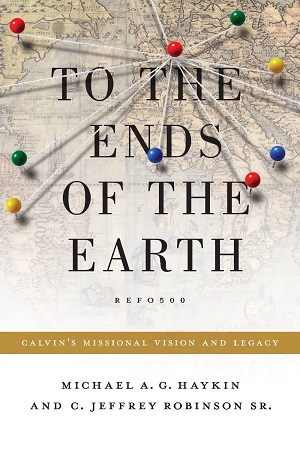 The question of “Why evangelize?” is one which is often leveled against Calvinism. After all, it is reasoned, if people are fore-ordained to be elect or one of the damned, then why bother to go out and evangelize them? Interestingly, this is a charge which I think may be leveled against virtually any view of foreknowledge, so the Calvinist answers given in To the Ends of the Earth: Calvin’s Missional Vision and Legacy
Contents
The book begins with a survey of the arguments made to suggest that Calvinism would not endorse evangelism or makes evangelism pointless. Clearly, the charge has come from many fronts throughout the history of the church. Then, Haykin and Robinson introduce the primary reason for others’ concerns about Calvinism’s evangelical prospects: that Calvin believed God had ordained some to be elect, and others to be damned, before the foundations of the world.
The authors defend the doctrine, taking on many of the key “all” passages which some argue make explicit the openness of salvation to all individual people. Calvin is brought to his own defense alongside a number of modern Calvinist theologians, ably presenting the Calvinist case for exegesis of these key passages, which basically is that when “all” or “world” is used, it is referring to the breaking open of salvation for all tribes and nations as opposed to merely the chosen people of Israel. The book goes beyond these basics and also outlines how other passages might be understood in this context.
Next, the authors turn to an exposition of Calvin’s theology of missions. Part of this theology was the notion that a Christian life lived was a profound witness to the Gospel. Word and deed were central to Calvin’s missions theology. This missional activity was to be for all people (Kindle location 993). Prayer was also central to Calvin’s theology, as he believed that it might be used by God to bring about change in persons (rather than change in God).
Historical Reformed missions are surveyed in the next sections. Calvin taught many going into France and certain torture and death if discovered, and even made significant efforts towards (ultimately failing) missions into Brazil. These efforts showed that through his actions, Calvin himself valued global missions.
Later Calvinist traditions and persons also demonstrated the urge to missions that the Reformer’s theology compelled. The Puritans sought to evangelize and frequently prayed for the same, though they may not have had the success of other contemporaries. Calvinist Baptists in England feverishly evangelized and planted churches, while also demonstrating concern for global evangelism (Kindle loc. 1420ff). Jonathan Edwards, contrary to some opinions, was also focused on missions by developing his own missional theology and also going on a mission to Native Americans himself.
The book closes with thoughts on “developing missional passion” through observations about Samuel Pearce, a theologian known in his time for fervent prayer and love of missions. Central to Pearce’s theology was the cross; Christ crucified was “his darling theme from first to last”; while the other primary theme of his life was a “passion for the salvation of his fellow human beings” (Kindle loc. 1978).
Evaluation
To the Ends of the Earth is a great, pithy read on a topic that should be of interest to many from a diverse array of backgrounds. It has appeal which goes beyond Calvinism in the way it demonstrates missions ought to be of central importance and also in its justification of missions even in light of the notion that there really do exist an elect people. Of course, the thrust of the book is to demonstrate that Calvinist theology does not undermine the need or motivation for missions. Those interested in that topic will find the most to benefit from the book. Regardless of one’s level of interest, however, the book generates its own avenues for exploration by introducing several little-known figures and historical events for further reading. It is short enough to enjoy in a single afternoon (as I did), yet deep enough to keep one’s mind occupied for some time afterwards.
Perhaps the greatest weakness of the book, however, is its length in that there is little ultimate exposition of the counter-arguments to those who would fault Calvinism with lack of evangelical fervor. That is, readers are often left to tie the arguments off themselves instead of having them drawn out and defended. This, however, is a minor fault in what is an otherwise excellent book, regardless of one’s position on the arguments made therein. It was well worth the read, in my humble opinion.
Links
Be sure to check out the page for this site on Facebook and Twitter for discussion of posts, links to other pages of interest, random talk about theology/philosophy/apologetics/movies and more!
Source
Michael Haykin and C. Jeffrey Robinson, Sr., To the Ends of the Earth: Calvin’s Missional Vision and Legacy
Disclaimer: I received a review copy of the book through Crossway. I was not obligated by the publisher to give any specific type of feedback whatsoever.
SDG.
——
The preceding post is the property of J.W. Wartick (apart from quotations, which are the property of their respective owners, and works of art as credited; images are often freely available to the public and J.W. Wartick makes no claims of owning rights to the images unless he makes that explicit) and should not be reproduced in part or in whole without the expressed consent of the author. All content on this site is the property of J.W. Wartick and is made available for individual and personal usage. If you cite from these documents, whether for personal or professional purposes, please give appropriate citation with both the name of the author (J.W. Wartick) and a link to the original URL. If you’d like to repost a post, you may do so, provided you show less than half of the original post on your own site and link to the original post for the rest. You must also appropriately cite the post as noted above. This blog is protected by Creative Commons licensing. By viewing any part of this site, you are agreeing to this usage policy.
Dinosaurs, Noah’s Flood, and Creationism- An ecological challenge
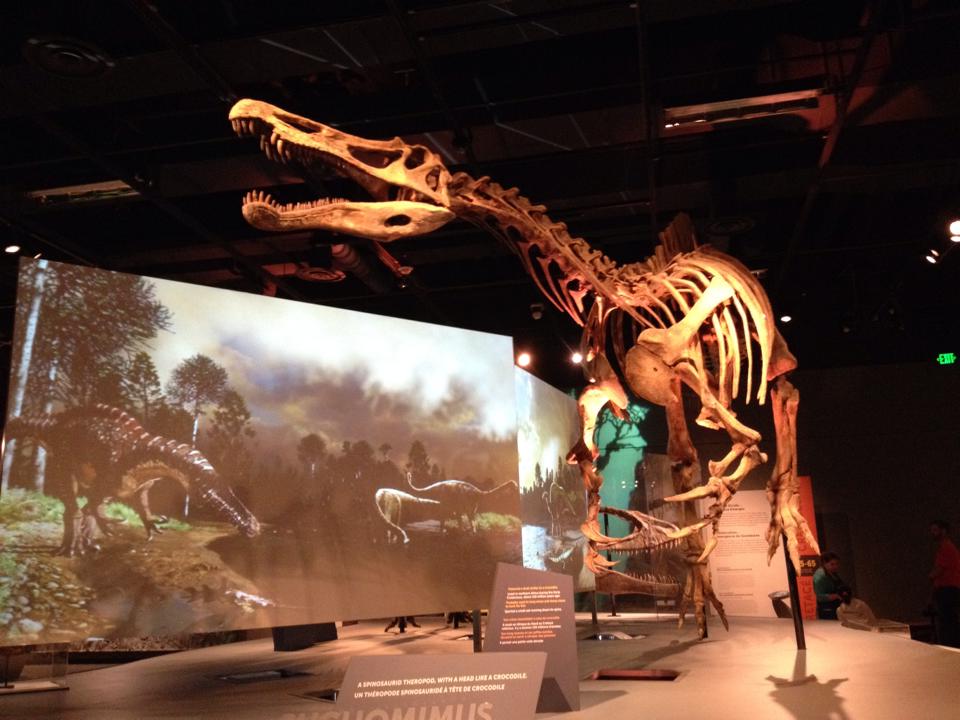 I recently visited the Science Museum of Minnesota to check out the exhibit “Ultimate Dinosaurs” which features a number of dinosaurs which aren’t typically displayed in North America. I heard one other museum-goer talking about how they always thought that dinosaurs just were dinosaurs–that they were the same all over the Earth. But they weren’t! In fact, there is great diversity in the types of dinosaurs found in different parts of the world. Some are found all over North America; others are restricted to small parts of Africa or South America.
That got me thinking on creationism. A standard young earth creationist account of the history of the world would state that dinosaur fossils are found where they lay because the Flood put them there. Many YEC accounts are catastrophic in nature, arguing that the Flood recreated the surface of the Earth and left most or all of the layers of sediment we now observe. The dinosaurs (and other creatures) we find were swept up in the Flood and then laid down once the water had settled.
Pictured above and left, there is a fossil of a Suchomimus. Suchomimus was a fish-eating dinosaur which has only been found in Niger, Africa. According to standard scientific explanations, it lived in the Early Cretaceous period, about 121-112 million years ago. According to a young earth creationist account, this dinosaur died either during the Flood or migrated to the location it was found after the Flood. Either way, this was no more than a few thousand years ago. Pictured below and to the right, there is a fossil of a Tyrannosaurus Rex. It lived in the Late Cretaceous period, about 66-67 million years ago and ranged across what is now North America. Again, a young earth creationist account would have it dying during the flood or going extinct afterwards.
 The Young Earth Creationist Explanation- A problem?
The young earth creationist (YEC) account is once more generally based upon the notion that the Noachian Deluge deposited these fossils where they are now found. The Flood is to explain how these fossils ended up in their present locations.
The fact that dinosaurs are found in different parts of the planet–and only in those parts–suggests an interesting problem for YECs: How is it that such a catastrophic event managed to destroy the surface of the Earth and then remake it through layers while creating the illusion of localized ecosystems at different points in history?
Such a challenge should not simply be dismissed. YEC literature sometimes suggests that the fossilized ecosystems which are proposed in different parts of the world at different (millions of years ago) times are merely products of the Flood depositing the fossils where they now lay. For example, according to YEC literature, many scientists believe that there was an ancient sea over North America merely because the Flood happened to deposit a bunch of mosasaur fossils and other marine life in a certain layer of the sediment it laid down.
The observed evidence, however, goes against this notion. Consider the Suchomimus (pictured above, left) once more. It has been found only in a localized area in what is now Africa. It is nearly certain it was a fish eater. This notion is not a mere product of accidental laying down of fish fossils near and around where Suchomimus has been found. Instead, it is based upon observational evidence. First, its large claws seem perfectly adapted to snagging large lungfish along the shore (large lungfish fossils have been found in the same area). Second, its narrow skull lined with extremely pointy teeth suggest a fishy diet, as it is once more adapted to eating them. Third, and most telling, fish fossils have been found with tooth marks from Suchomimus on their bones.
So what? How does this bring up a problem for YEC? Well, to put it simply, it demonstrates that the localized ecosystem found near and around Suchomimus is not a mere random product of fossils being jumbled together and then deposited during the Flood. Instead, predator and prey are found in a localized environment with other fossil specimens that fit neatly into the same ecosystem. But on the YEC account, how could this happen? Surely it would be an astounding happening if an entire ecosystem were swept away by the Flood, jumbled up with others along with sediment and the like, subjected to tidal waves across the surface, and then neatly deposited in a localized area, preserving that same ecosystem.
 A Possible Alternative
Some YECs (such as Kurt Wise) have instead suggested that the Flood did not destroy the whole surface of the Earth but was rather providentially brought about by God along with catastrophic plate tectonics. On this scenario, water rapidly rose and covered the face of the Earth, bringing with it sediment and the like which rapidly buried such localized ecologies.
Setting aside difficulties with such a scenario related to the means by which it would have allegedly occurred, it should be clear that this explanation is at least somewhat more palatable. It doesn’t turn ecosystems into mere fictions. However, this scenario doesn’t solve everything. For example, why are there separate and distinct ecosystems, one atop the other, in the same place? Going to North America, Tyrannosaurus Rex has been found across much of what is now North America. Again, we find prey with T-Rex tooth marks in their bones and the like. We have preserved ecosystems from this time. But different places (like the inland sea I discussed here) feature what appears to be a marine environment. Moreover, different layers, like those exposed through glaciation in the upper Midwest, show entirely different (and seemingly more primitive) marine lief. This raises a number of issues, most of which are relevant for any alleged Flood scenario.
First, if the Flood was a sudden event which covered the face of the Earth and thus preserved ecosystems in place, how did it manage to kill off and bury so much marine life? It seems like it must have been gentle enough to preserve the fossil evidence, so why did the marine life not simply swim away and get scattered across other layers as it died? Second, how do we have distinct and separate ecosystems preserved in different layers, one atop the other? Again, the suggestion was that ecosystems were preserved in place–so why do some places have different ecosystems above one another? Third, why are the types of sediment laid down distinct for each ecosystem? If the sediment was all due to one event, then why does the sediment type match the ecosystems which it buries?
 The Balance of Evidence
At this point, I think we must remember that we may evaluate such claims from a number of angles. First, the YEC explanations seem very ad hoc–that is, they are invented by adjusting the Flood scenario (or some other device like distant starlight moving faster)–in order to explain away the difficulties rather than pursuing the evidence. It is reactionary rather than investigative. [I edited this line after some insight from a comment below.]
Second, realistically, which portions of the YEC explanation might be found in the Bible, if any? Having read the accounts of the Flood and Creation many times, I have to say I have never once spotted a place wherein it discusses the distribution of dinosaurs, the way the Flood laid down sediment, or any number of things put forward by YECs.
Third, when YECs and others are offering alternative scientific explanations–i.e. an explanation for “how did this [dinosaur] get here?”–they must deal with the fact that we’re looking for the most likely explanation. As I discussed in another post on dinosaurs and creationism, the proposed alternative YEC explanation is very clearly more complex and less likely than that of the one already offered–that the dinosaurs simply existed at different times and/or in different places over the course of history. We should be honest in our evaluations of evidence and look to see which explanation is more likely. Remember, we should be investigating the evidence while trying to stay free of any a priori assumptions about what must have happened and instead look at the evidence to see which explanation best fits. As I pointed out in the post linked above, proposing a global catastrophic Flood as the alternative hypothesis demands an enormous burden of proof.
Links
Be sure to check out the page for this site on Facebook and Twitter for discussion of posts, links to other pages of interest, random talk about theology/philosophy/apologetics/movies and more!
“Oceans of Kansas,” Unexpected Fossils, and Young Earth Creationism– I discuss the alleged findings out out-of-sequences fossils in the fossil record and how YEC explanations fail to show they are attributable to a global catastrophic Flood.
What options are there in the origins debate? – A Taxonomy of Christian Origins Positions– I clarify the breadth of options available for Christians who want to interact on various levels with models of origins. I think this post is extremely important because it gives readers a chance to see the various positions explained briefly.
The photographs in this post were taken by me at the Science Museum of Minnesota with permission. Any use of these pictures should be only with express, written consent. The map is an image created by BBC and I do not claim any rights over it but use it through fair use.
SDG.
——
The preceding post is the property of J.W. Wartick (apart from quotations, which are the property of their respective owners, and works of art as credited; images are often freely available to the public and J.W. Wartick makes no claims of owning rights to the images unless he makes that explicit) and should not be reproduced in part or in whole without the expressed consent of the author. All content on this site is the property of J.W. Wartick and is made available for individual and personal usage. If you cite from these documents, whether for personal or professional purposes, please give appropriate citation with both the name of the author (J.W. Wartick) and a link to the original URL. If you’d like to repost a post, you may do so, provided you show less than half of the original post on your own site and link to the original post for the rest. You must also appropriately cite the post as noted above. This blog is protected by Creative Commons licensing. By viewing any part of this site, you are agreeing to this usage policy.
Sunday Quote!- Scripture Reports Things that Didn’t Happen?
 Every Sunday, I will share a quote from something I’ve been reading. The hope is for you, dear reader, to share your thoughts on the quote and related issues and perhaps pick up some reading material along the way!
Scripture Reports Things that Didn’t Happen?
I finished reading Four Views on The Historical Adam recently, and it gave me a lot of food for thought. The only view which categorically denied the existence of an historical Adam was written by Denis Lamoureux. Regarding the reports of the natural world found in the Bible, he wrote:
God’s very words… in the [Bible] do not align with the physical reality in the Book of [Nature]. To state the problem more incisively, Holy Scripture makes statements about how God created the heavens that in fact never happened. (54, cited below)
I think it is pretty clear this is a highly contentious claim. Interested readers should read the book to get the full context, but basically Lamoureux was saying that some aspects of the physical world found recorded in Scripture do not line up with reality. What did he do with this statement? Immediately after this text, Lamoureux wrote:
So, to ask the question once more, “Did God lie in the Bible?” Again, my answer is “No! The Lord accommodated in the Bible.” (54)
In other words, his answer was that God accommodated to the scientific beliefs of the people in their time in order to convey spiritual truths.
It seems to me that this way out is questionable, and each of the other authors commented on it. Three quick issues I have are that the reading of the various texts Lamoureux cites do not support his claim; that the notion that God intentionally brought about recording of falsehoods in God’s Word requires a stronger answer than accommodation; and that although accommodation is a valid category, the linking of theological truths to specific claims about natural history makes the reading of accommodation in regards to Adam problematic.
What are your thoughts? Do you think there is accommodation in the Bible? Is accommodation a strong enough answer for the claim that God may have allowed false statements recorded in God’s Word? Are there other alternatives you prefer?
Links
Be sure to check out the page for this site on Facebook and Twitter for discussion of posts, links to other pages of interest, random talk about theology/philosophy/apologetics/movies and more!
Source
Denis Lamoureux, “No Historical Adam: Evolutionary Creation View” in Four Views on The Historical Adam eds. Matthew Barrett and Ardel Caneday (Grand Rapids, MI: Zondervan, 2013).

 J.W. Wartick - Reconstructing Faith
