book review
Book Review: “Bound for the Promised Land” by Oren Martin
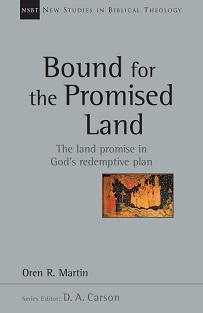
Oren Martin’s Bound for the Promised Land
The book advances a broad argument for this thesis by surveying what the Bible has to say about the land promise and its fulfillment. Martin does not offer a comprehensive look at every verse in the Bible that deals with the land promise, but rather puts forward a canonical view in which he surveys what various books of the Bible say about the promise and puts them in perspective alongside each other. He thus develops the promise from Eden in Genesis through Abraham, into Canaan, exile, through prophetic hope of return, the ushering in through Christ, and the ultimate consummation in the New Creation.
The book isn’t going to blow readers away with stunning insights. Frankly, that can be a good thing when it comes to theology texts. Martin’s exegesis is sound, based on firm principles and clearly drawn from the texts themselves. By connecting these verses to wider canonical strands, he demonstrates that his position is capable of dealing with the whole teaching of the Bible on the land promise rather than isolating it and trying to trump these threads with individual out-of-context verses.
Though not stunning or necessarily new, the insights Martin puts forward provide a great resource for those interested in eschatology and the issues raised by dispensationalists regarding the land promise. Martin does not support the dispensational view and argues cogently that it cannot be supported by the texts that teach on the land promise. The notion that we must take the land promise “literally” does not do full justice to the texts themselves and cannot account for the broadness of teaching on the topic.
Bound for the Promised Land
The Good
+Clearly outlines presuppositions the author maintains throughout the study
+Solid exegesis
+Canonical view gives picture of whole teaching of Bible on topic
+Applicable insights put forward
The Bad
-Skims over arguments very briefly at points
Disclaimer: InterVarsity Press provided me with a copy of the book for review. I was not obligated to provide any specific kind of feedback whatsoever, nor did they request changes or edit this review in any way.
Source
Oren Martin, Bound for the Promised Land
Links
Be sure to check out the page for this site on Facebook and Twitter for discussion of posts, links to other pages of interest, random talk about theology/philosophy/apologetics/movies and more!
Book Reviews– There are plenty more book reviews to read! Read like crazy! (Scroll down for more, and click at bottom for even more!)
SDG.
——
The preceding post is the property of J.W. Wartick (apart from quotations, which are the property of their respective owners, and works of art as credited; images are often freely available to the public and J.W. Wartick makes no claims of owning rights to the images unless he makes that explicit) and should not be reproduced in part or in whole without the expressed consent of the author. All content on this site is the property of J.W. Wartick and is made available for individual and personal usage. If you cite from these documents, whether for personal or professional purposes, please give appropriate citation with both the name of the author (J.W. Wartick) and a link to the original URL. If you’d like to repost a post, you may do so, provided you show less than half of the original post on your own site and link to the original post for the rest. You must also appropriately cite the post as noted above. This blog is protected by Creative Commons licensing. By viewing any part of this site, you are agreeing to this usage policy.
Robert Sawyer’s “The Neanderthal Parallax” – Faith, Scientism, and Humanity
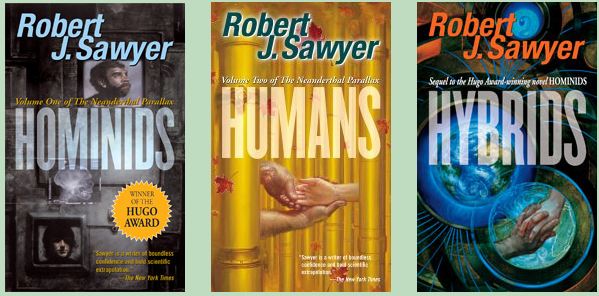 I recently finished reading Robert Sawyer’s trilogy “The Neanderthal Parallax.” I found the plot intriguing, but the worldview issues the books brought up had great difficulties in how they were conveyed and the kind of hidden premises smuggled in. Every story has a worldview, and the worldview of these books was surprisingly hostile and disingenuous particularly to Christians. I have enjoyed Robert Sawyer’s work in the past, but feel forced to interact with these books in a fairly critical fashion. There will be SPOILERS in what follows. I’ll not summarize the plot, but interested readers can see summaries on Wikipedia. I have written a review of the books here.
Faith
Perhaps the most unfortunate aspect of the books is that Sawyer seemingly did not put anything close to the amount of research and care into his portrayal of faith as he did his portrayal of biology, cosmology, and the like. On the latter topics, great detail is put into explaining aspects of various sciences and even invented science that Sawyer employs to support the plot. But people of faith are put up as frequently hypocritical but also lacking in erudition and thoughtfulness.
The central faith figure is Mary Vaughan, a specialist in ancient genetics. She consistently is put forth as the faithful counterweight to the faithlessness of the Neanderthals. However, she is a Roman Catholic who reveals objects to parts of her church’s official doctrines. She rejects the doctrine of original sin, for example. Having her put forward as the example of a religious person makes this even more difficult to swallow. I’m not suggesting that there are no people who have great cognitive dissonance in their beliefs–obviously many people do. The problem is that Sawyer uses Mary as the central image of Christianity throughout the novels, but she is woefully inept at even holding to the faith she claims for herself.
At one point in Humans, Ponter is talking to Mary at the Vietnam Memorial about life after death(188-207). He simply asserts that if you can’t see something it doesn’t exist. But of course this is as absurd as he claims “Gliskins'” (homo sapiens sapiens as opposed to the Neanderthals) belief in things like God is. I cannot see my own thoughts, yet they exist. Neither can I observe other people’s mental life, yet I am not irrational in believing that the people around me are also having thoughts.
In Hominids, Ponter speaks to Mary about the Gliskins’ viewing of a Mass taking place and again basically asserts that Christian belief in deity is absurd on its face. Mary struggles to articulate even the slightest defense of the Incarnation and other central Christian doctrines. Again, plenty of believers would struggle in this fashion, but Sawyer uses Mary as a kind of foil for all of Christianity. She’s got the best defenses Christians have to offer, and she can’t do anything but stutter when challenges to her faith are raised.
At several points, Big Bang Cosmology is challenged as something the Gliskins cling to because of their necessity of belief in a finite universe to support deity. Yet not only was Big Bang Cosmology initially rejected by the scientific community for this and other reasons (and only later accepted due to the mounting evidence for it), but even were the universe infinite, it would hardly follow that it is uncreated, as Ponter asserted without challenge. Sawyer seems to be unaware of–or at least makes his characters ignorant of–the entirety of Scholastic thought on the topic of continuous creation. Thomas Aquinas admitted this as a possibility. Thus, for Christians it is hardly an either/or of either eternal universe or finite universe. Either fits in with various strands of historic Christian theology. But again, Sawyer seems to have been either ignorant of this or willfully ignoring it to portray belief in deity in a more negative and indefensible light.
All of this wouldn’t be as unfortunate if Sawyer didn’t put discussions like this forward as if they were the best defenses Christians could come up with for their positions. Had they been simply believers who were also uninformed or insincere, it would not be as great an error. But Sawyer paints these interactions as though the defenses are the best Christians can come up with. As we have just surveyed very briefly, this is mistaken. I enjoyed the stories Sawyer put forward here, but his portrayal of people of faith is deeply flawed.
Religious Experience
Sawyer uses the books to explore the notion of a God part of the brain which, when triggered, can set off religious experiences. In Humans, it is discovered that Gliskins have a part in their brain which is able to have “religious experiences” triggered through electromagnetic interaction, while Neanderthals do not have a corresponding part of their brains.
A central scene in the entire series is near the end of Hybrids in Times Square, New York City. The Earth’s magnetic field is resetting and it triggers religious experiences, UFO sightings, and the like among the crowd gathered as this part of the Gliskin (homo sapien, remember) brain is triggered. People are crying out to their deities, fending off invading aliens, and the like all over Times Square. From this, Mary Vaughan’s faith is finally shattered:
The Pope had some ‘splainin’ to do.
All religious leaders did…
“It’s all a crock, isn’t it?” [Mary] said [to Ponter].
…”Look, I’ve changed my mind. About our child… Our daughter should not have the God organ…” (389)
Thus, we find that in Sawyer’s universe, the notion that we can induce religious experiences in the brain (and other types of experience like UFOs) means that these experiences are baseless in reality. Mary decides that her child should not have the capacity to have religious experience because it is all “a crock.” The Pope and others have some “‘splainin’ to do.” Presumably they are expected to take this as some kind of major challenge to their respective faiths.
The main problem with this is that we can conceivably trigger all sorts of things in the brain. It does not seem too outlandish to suppose that if we triggered a certain part of the brain, we might bring up a memory. If we extrapolate more, Sawyer’s vision of electromagnetically triggered religious experiences could be on par with memories as well, which could (in this scenario) be triggered in the same way. Should we start to distrust our perceptions or memories if we are able to trigger them with various impulses? Certainly not. This way lies (true) madness: distrust in our own memories and senses.
So what is left? What does the notion that religious experiences might be triggered by various brain activity demonstrate? Just that: religious experience may be triggered through manipulation. Full stop. This doesn’t in any way undercut evidence for theism or other beliefs from religious experience any more than our capacity to trigger scents, sounds, or memories would undercut our rational basis for believing this things to be real (or about real events).
Social Ills?
Sawyer uses the trilogy to attack all kinds of perceived and real social ills, from our treatment of the environment to gun control laws, and the like. But the question is how can he realistically put forward any kind of inter-cultural critique when the whole view he puts forward in the books is ultimately subjective. Mary Vaughan suffers a grotesque act of violence in a rape scene, but this is only used as an instrument in the plot (see my discussion here). Any moral critique Sawyer offers through his characters falls hollow because his only basis for it is some vague concept of pragmatism and self-preservation. Thus, it seems there is no ultimate basis for his criticisms of various ethical wrongs, and his use of several of these as mere instruments to advance the plot betrays this inability to provide an objective basis for right and wrong.
Conclusion
I’ve already written much on the difficulties with worldview in these novels. There are many more I could discuss. Again, I want to emphasize that it is very true that many Christians and believers would struggle to articulate their faith, be unable to defend various aspects of it, and not agree with at least some teachings of their church body. The problem is that Sawyer portrays this as the best Christianity can come up with. I was deeply disappointed to see that the overall thrust of the books was ultimately a kind of attack on my own faith, without any reasonable portrayal or interaction with stronger versions of it. Would that Sawyer had put the time into his depiction and study of faith as he had with the science behind this science fiction. For further reading, check out my reviews of the trilogy.
Links
Be sure to check out the page for this site on Facebook and Twitter for discussion of posts, links to other pages of interest, random talk about theology/philosophy/apologetics/movies and more!
Book Reviews: “The Neanderthal Parallax” – Hominids, Humans, and Hybrids by Robert Sawyer– I wrote a review of the trilogy on my other interests site. This review brings up some of the other worldview issues in the books, in addition to a brief summary of the plot outline and look at the science fiction elements.
Aliens that believe in God: The theological speculations in Robert Sawyer’s “Calculating God”– I write about a different Robert Sawyer book that I did enjoy quite a bit, Calculating God. I even wrote a second post discussing abortion, fundamentalism, and other issues the book raised.
Source
Robert Sawyer, Hominids (New York: Tor, 2002).
—, Humans (New York: Tor, 2003).
—, Hybrids (New York: Tor, 2003).
SDG.
——
The preceding post is the property of J.W. Wartick (apart from quotations, which are the property of their respective owners, and works of art as credited; images are often freely available to the public and J.W. Wartick makes no claims of owning rights to the images unless he makes that explicit) and should not be reproduced in part or in whole without the expressed consent of the author. All content on this site is the property of J.W. Wartick and is made available for individual and personal usage. If you cite from these documents, whether for personal or professional purposes, please give appropriate citation with both the name of the author (J.W. Wartick) and a link to the original URL. If you’d like to repost a post, you may do so, provided you show less than half of the original post on your own site and link to the original post for the rest. You must also appropriately cite the post as noted above. This blog is protected by Creative Commons licensing. By viewing any part of this site, you are agreeing to this usage policy.
Book Review: “The Bible Story Handbook” by John Walton and Kim Walton

John Walton and Kim Walton’s The Bible Story Handbook
The book has a great introduction that argues that we need to be teaching the actual point of the Bible stories we use in lessons in Sunday School, sermons, and the like rather than abstracting the stories and chopping them apart to draw out specific illustrations we’d like to have. This is a very challenging introduction, not because it is technical, but because we so often do see this done in teaching the Bible and we so often do it ourselves. For example, we might see the story of Jonathan and David as about friendship rather than about what God was doing through the people acting in the story. A more extreme example is from the authors: one of their children came home and had been taught the story of Cain and Abel in Sunday School. But the point of the story–which was told sans violence because of the age of the children–they were told was that Cain and Abel had bodies. That’s it.
It is this level of abstraction that John Walton and Kim Walton work against in the book, consistently arguing story-by-story that the point of the Bible is to teach us about God and God’s action in human history. The stories are each outlined in the same fashion. There is a subheading listing the passage that has what the Bible story is (i.e. Samson and Delilah) followed by the verses that will be discussed (i.e. Judges 16). Then, there is a “Lesson Focus” that outlines key parts of the lesson in a sentence or two, then has main focal points of the lesson in bullet points. After that there is a Lesson Application which hones the Lesson Focus in to what we might take from the lesson. Then, the biblical context of the lesson is highlighted (this section often begins the same if there are multiple lessons in the same book). After that, Interpretational Issues are addressed (such as Samson’s hair and his strength). Background information related to the text is given (such as looms and their usage at the time of the story). Finally, “Mistakes to Avoid” puts forward the key meaning of the text and highlights some errors related to interpretation that people often make related to the specific text.
These sections each have vital information and are certainly of great value for those who want to preach, teach, or explore God’s Word.
There are a few downsides to the book. At times, it seems the “Mistakes to Avoid” might not fully explain why certain interpretations are “mistakes” or why the preferred interpretation ought to be put forward. The book has very broad application but does focus on teaching the Bible stories to children. It would perhaps have been nice to have similar notes about how to direct the lesson towards adults. These are both largely just nitpicks about what is an otherwise phenomenal book.
The Good
+Extremely challenging to many presupposed ideas about how to tell and teach Bible stories
+Great selection of Bible stories
+A constant stream of firm exegesis yielding sometimes surprising insights
+Applicable immediately to teaching settings
The Bad
-Would have been nice to have more focus on teaching Bible stories to adults as well
-Some of the “mistakes to avoid” do not seem like mistakes after all
Conclusion
John Walton and Kim Walton have done a great service with The Bible Story Handbook
Disclaimer: Crossway provided me with a copy of the book for review. I was not obligated to provide any specific kind of feedback whatsoever, nor did they request changes or edit this review in any way.
Links
Be sure to check out the page for this site on Facebook and Twitter for discussion of posts, links to other pages of interest, random talk about theology/philosophy/apologetics/movies and more!
Book Reviews– There are plenty more book reviews to read! Read like crazy! (Scroll down for more, and click at bottom for even more!)
Source
John Walton and Kim Walton, The Bible Story Handbook
SDG.
——
The preceding post is the property of J.W. Wartick (apart from quotations, which are the property of their respective owners, and works of art as credited; images are often freely available to the public and J.W. Wartick makes no claims of owning rights to the images unless he makes that explicit) and should not be reproduced in part or in whole without the expressed consent of the author. All content on this site is the property of J.W. Wartick and is made available for individual and personal usage. If you cite from these documents, whether for personal or professional purposes, please give appropriate citation with both the name of the author (J.W. Wartick) and a link to the original URL. If you’d like to repost a post, you may do so, provided you show less than half of the original post on your own site and link to the original post for the rest. You must also appropriately cite the post as noted above. This blog is protected by Creative Commons licensing. By viewing any part of this site, you are agreeing to this usage policy.
Book Review: “Creative Church Handbook” by J. Scott McElroy
 How do we integrate the arts into our lives in the church?
As someone who is interested in the way we can more completely integrate our faith into our lives, this is a question that has interested me for some time. When Creative Church Handbook
The book is, well, a handbook for starting up, organizing, and thriving in arts ministries in your church. It is organized in a logical fashion, with an introduction providing reasons for supporting arts ministries and ways to get leadership on board, followed by numerous chapters on building said ministry, ideas for specific types of arts ministries, and moving the ministry beyond the church walls.
The chapters on setting up an arts ministry are wonderful because they provide a number of different concepts of what that ministry might look like, along with how to overcome potential challenges which may come up and advice on how to avoid burning people out or scaring them off. McElroy does a good job of envisioning the issues which may come up like funding, integration into worship, and the like.
The chapters on what an arts ministry may look like are where the rubber really hits the road as generalized suggestions about things like creating live artworks in worship are intertwined with concrete examples from successful arts ministries.
One downside to the book is that there is little if any mention of several art forms like music and technical arts. McElroy acknowledges this in the Preface and notes that, in part, it is because music has been integrated fairly well into worship and the technical arts are, well, technical and would require a different type of book. However, it seems to me that much of McElroy’s advice in this book could be modified slightly to apply to these other forms of the arts. The copy I received was a pre-release and so I was unable to evaluate the index as this was not included.
Overall, I would highly recommend Creative Church Handbook
I received a review copy of the book from InterVarsity Press. I was not obligated by the publisher to give any specific type of feedback whatsoever.
Links
Be sure to check out the page for this site on Facebook and Twitter for discussion of posts, links to other pages of interest, random talk about theology/philosophy/apologetics/movies and more!
Source
J. Scott McElroy Creative Church Handbook
SDG.
——
The preceding post is the property of J.W. Wartick (apart from quotations, which are the property of their respective owners, and works of art as credited; images are often freely available to the public and J.W. Wartick makes no claims of owning rights to the images unless he makes that explicit) and should not be reproduced in part or in whole without the expressed consent of the author. All content on this site is the property of J.W. Wartick and is made available for individual and personal usage. If you cite from these documents, whether for personal or professional purposes, please give appropriate citation with both the name of the author (J.W. Wartick) and a link to the original URL. If you’d like to repost a post, you may do so, provided you show less than half of the original post on your own site and link to the original post for the rest. You must also appropriately cite the post as noted above. This blog is protected by Creative Commons licensing. By viewing any part of this site, you are agreeing to this usage policy.
Book Review: “Mapping Apologetics” by Brian Morley
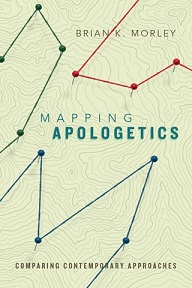 Although there is widespread agreement over the need to have a defense of the faith (a biblical charge–1 Peter 3:15-16), there is much disagreement over exactly how that defense should proceed. Brian Morley’s Mapping Apologetics
There are few books that deal exclusively with apologetic methodology by outlining various approaches. Perhaps the most comprehensive is Faith Has Its Reasons
After a couple introductory chapters on apologetics in the Bible and history, the following chapters each highlight individuals who are major contemporary proponents of different apologetics methods. Included are such people as Cornelius Van Til, Alvin Plantinga, E.J. Carnell, Richard Swinburne, William Lane Craig, and John Warwick Montgomery, just to name a few.
Each of these chapters presents an extended overview of the apologist’s method of defending the faith along with several quotes and often detailed analysis of their primary arguments with examples. Thus, readers are given the resources to compare and contrast the various approaches on the level of the actual arguments and counter-arguments presented.
The people chosen are each major contributors to their specific variety of apologetics, so both those who are well-versed in apologetics and those who are just beginning will get insights from top defenders of the faith. I personally have an MA in Christian Apologetics, and I was familiar with each author, but the way that each was presented gave me a good refresher on their method and primary arguments–and sent me scampering to re-read some of my favorites!
The book includes some great follow-up questions after each chapter to help readers review the material in the chapter, along with useful further reading sections for those interested in learning more about specific defenders. Each chapter also includes criticisms of the specific type of apologetic the individual puts forward. These are often only about 1 1/2 to 2 pages, though, and it would have been nice to have a bit more space dedicated to the critiques and rebuttals to each approach. Morley also very quickly dismisses the fideistic approach as being “unbiblical” with only a brief argument. Although I am not at all a fideist, I do think that the approach has at least some merit and the aforementioned work by Boa and Bowman has some great insights into how it might also offer some insights into apologetics.
Mapping Apologetics
The Good
+Great summaries of top apologists from multiple methodological approaches
+Invaluable insight into different apologetics methodologies
+Helpful review questions and resource lists
The Bad
-Dismisses fideism too quickly
-Could stand to have more reflection on criticisms of each position
Disclaimer: InterVarsity Press provided me with a copy of the book for review. I was not obligated to provide any specific kind of feedback whatsoever, nor did they request changes or edit this review in any way.
Links
Be sure to check out the page for this site on Facebook and Twitter for discussion of posts, links to other pages of interest, random talk about theology/philosophy/apologetics/movies and more!
Book Reviews– There are plenty more book reviews to read! Read like crazy! (Scroll down for more, and click at bottom for even more!)
Source
Brian Morley, Mapping Apologetics
SDG.
——
The preceding post is the property of J.W. Wartick (apart from quotations, which are the property of their respective owners, and works of art as credited; images are often freely available to the public and J.W. Wartick makes no claims of owning rights to the images unless he makes that explicit) and should not be reproduced in part or in whole without the expressed consent of the author. All content on this site is the property of J.W. Wartick and is made available for individual and personal usage. If you cite from these documents, whether for personal or professional purposes, please give appropriate citation with both the name of the author (J.W. Wartick) and a link to the original URL. If you’d like to repost a post, you may do so, provided you show less than half of the original post on your own site and link to the original post for the rest. You must also appropriately cite the post as noted above. This blog is protected by Creative Commons licensing. By viewing any part of this site, you are agreeing to this usage policy.
“Dune” by Frank Herbert- Prophecy, Religion, and the Messiah
 Bless the Maker and His water. Bless the coming and the going of Him. May His passage cleanse the world. May He keep the world for his people.
Dune has been called “Science Fiction’s Supreme Masterpiece.” I say that this tagline is accurate. The depth of the saga is breathtaking, and its majesty is at times overpowering. Here, I’ll take a look at some key themes in the book from a Christian perspective. There will be SPOILERS in what follows.
Prophecy
Prophecy is found throughout the various factions in Dune. The Bene Gesserit is a school composed of women who are working to bring about a prophesied man–but to use him for their own ends. The Fremen, inhabitants of the desert, also have prophecies of one who would bring their world–Arrakis–to fertility and unite the Fremen against their enemies.
Prophecy has a function, which will be fulfilled one way or another. Often, this involves the conscious working of persons towards the fulfillment. This is unlike prophecy in the Bible, which is sometimes fulfilled in quite unexpected ways or even has double applications (such as the virgin birth).
Religion
Religion is a theme throughout the book, as there are many different philosophies of life on offer, but few which seem genuine. Herbert’s vision of religion is that it is essentially a function of humanity and one which is constructed through the interplay of power and belief. For example, in one biographical entry about Paul Atreides, the protagonist, the Princess Irulan writes:
You cannot avoid the interplay of politics within an orthodox religion. The power struggle permeates the training, educating and disciplining of the orthodox community… the leaders of such a community… must face that ultimate internal question: to succumb to complete opportunism as the price of maintaining their rule, or risk sacrificing themselves for the sake of the orthodox ethic. (401)
Hebert also channels much wariness about any engagement of politics and religion throughout the book. Representative is a saying allegedly from the Muad’Dib–the name given to Paul Atreides after he is seen as the fulfillment of various prophecies: “When law and duty are one, united by religion, you never become fully conscious, fully aware of yourself. You are always a little less than an individual” (408).
Yet this is not to say there is no genuine belief in the world of Dune. Debates over determinism and divinely decreed futures are placed throughout the book, and Paul Atreides himself struggles with his own role as an apparent Messiah.
The religious mixture of Buddhism, Islam, and Christianity found in the various factions provides much food for discussion and engagement for those who want to dialogue on these topics. How should we interact with those of other faiths? What lines of correlation may we see in other religions and how might we use these to engage believers in other faith traditions? These are questions which arise in Dune, and Herbert also offers challenges to believers to see what harm might be in their beliefs and to search out those aspects of their faith which lead astray from the truth.
Truth
There are many more philosophical, theological, and political questions which could be asked after reading a masterwork like Dune. A fundamental issue is that of truth. The issues of religion and prophecy listed above make one read the world of the work with a rather ambiguous eye: there seems to be some deception, but some truth, in various aspects of the different factions’ belief systems and what they present to the world as the truth.
From a Christian perspective, there is but one truth and that is found in Jesus Christ. Similarly, even on the world of Arrakis, we find that there is an objective standard of truth, it just isn’t always cut-and-dried as to how we might discern it. It is a reflection of the fallenness of the real world in which often the truth is intermingled with lies. We should work ever towards seeking the truth and working to bring it forward.
Conclusion
Weeks after reading Dune, I can still feel the hot sand under my feet, and still smell the Spice in the air. It is a simply incredible read which demands hours of reflection afterwards. I recommend it highly to you, dear readers. It will get your mind going, and it will also perhaps force some thought into one’s own faith and life–are we living a genuine life of faith, or have we turned it into a perversion?
Links
Be sure to check out the page for this site on Facebook and Twitter for discussion of posts, links to other pages of interest, random talk about theology/philosophy/apologetics/movies and more!
A Solar System and Cosmos Filled with Life?- A reflection on Ben Bova’s “Farside” and “New Earth”– I explore the notion that life should be expected all over the place in a post that looks at some of Bova’s most recent works.
“Fitzpatrick’s War”- Religion, truth, and forgiveness in Theodore Judson’s epic steampunk tale– I take a look at the book Fitzpatrick’s War, a novel of alternative history with steampunk. What could be better? Check out some of the worldview issues brought up in the book.
I have discussed the use of science fiction in showing how religious persons act. Check out Religious Dialogue: A case study in science fiction with Bova and Weber.
Source
Frank Herbert, Dune (New York: Ace, 1990). Originally printed 1965.
SDG.
——
The preceding post is the property of J.W. Wartick (apart from quotations, which are the property of their respective owners, and works of art as credited; images are often freely available to the public and J.W. Wartick makes no claims of owning rights to the images unless he makes that explicit) and should not be reproduced in part or in whole without the expressed consent of the author. All content on this site is the property of J.W. Wartick and is made available for individual and personal usage. If you cite from these documents, whether for personal or professional purposes, please give appropriate citation with both the name of the author (J.W. Wartick) and a link to the original URL. If you’d like to repost a post, you may do so, provided you show less than half of the original post on your own site and link to the original post for the rest. You must also appropriately cite the post as noted above. This blog is protected by Creative Commons licensing. By viewing any part of this site, you are agreeing to this usage policy.
Book Review: “Bulls, Bears, and Golden Calves” by John Stapleford
 John Stapleford’s Bulls, Bears and Golden Calves
Often, when I read about someone putting forward a “Christian” view of economics, I get worried because what happens all too frequently is that the “Christian” view is taken to be equivalent to some existing economic theory and then anyone who disagrees with that theory is seen as being sub-biblical. By contrast, Stapleford does a fantastic job of never giving into the temptation to endorse wholly any one system, noting the impact of human sin and the real injustices that are possible in any economic system. Thus, he successfully navigates a kind of balancing act between liberal and conservative economic views throughout the book.
That said, his often incisive criticism of various economic systems from different angles is sure to challenge almost any reader. In favor of pure free market economies? Stapleford notes that these are the best way to increase overall wealth in a system, but calls them out for often falling victim to greed or ignoring the poor. All in favor of socialist systems? Stapleford argues that these systems can trample the rights of the individual while also making it difficult to anticipate and plan for the needs of societies. No one is safe from the cogent analysis offered in this book.
After outlining numerous ethical theories and practices that Christians can apply to the public square and economics, the book proceeds with a number of practical chapters that apply these to specific situations, whether it is international economics, the environment, and more. The topics treated are extremely wide-ranging and the analysis offered continues to be challenging and insightful throughout. Just as an example, the chapter on gambling points out the failure of several arguments put forth to attempt to ethically justify the practice, while also pointing to numerous injustices in the system. This kind of detailed analysis is found throughout the book on every topic Stapleford touches.
That said, the main downside of the book just is its broadness. At times, readers may feel blown away by how much information is being fed to them. The sheer amount of data can feel a bit overwhelming. Also, because of the broadness of the book, some of the solutions offered feel over-simplified and may leave readers wishing for more analysis.
Overall, Bulls, Bears, and Golden Calves is a simply phenomenal read that will challenge all readers to live out a Christian life in the realm of economics.
The Good
+Eye-opening facts about numerous economic practices
+Excellent chapters on specific economic issues with applicable insights
+Bridges the seeming gap between liberal and conservative views in multiple places
+Consistently puts forth a Christian and holistic view of economics
The Bad
-Sheer amount of data can be overwhelming
-Some solutions offered seem over-simplified
Conclusion
I would highly recommend Bulls, Bears and Golden Calves
Disclaimer: I received a review copy of this book from InterVarsity Press. I was not obligated to provide any specific type of feedback or review nor was I required to give a positive review.
Source
John Stapleford, Bulls, Bears and Golden Calves
Links
Be sure to check out the page for this site on Facebook and Twitter for discussion of posts, links to other pages of interest, random talk about theology/philosophy/apologetics/movies and more!
Book Reviews– There are plenty more book reviews to read! Read like crazy! (Scroll down for more, and click at bottom for even more!)
SDG.
——
The preceding post is the property of J.W. Wartick (apart from quotations, which are the property of their respective owners, and works of art as credited; images are often freely available to the public and J.W. Wartick makes no claims of owning rights to the images unless he makes that explicit) and should not be reproduced in part or in whole without the expressed consent of the author. All content on this site is the property of J.W. Wartick and is made available for individual and personal usage. If you cite from these documents, whether for personal or professional purposes, please give appropriate citation with both the name of the author (J.W. Wartick) and a link to the original URL. If you’d like to repost a post, you may do so, provided you show less than half of the original post on your own site and link to the original post for the rest. You must also appropriately cite the post as noted above. This blog is protected by Creative Commons licensing. By viewing any part of this site, you are agreeing to this usage policy.
Book Review: “Total Church” by Tim Chester and Steve Timmis
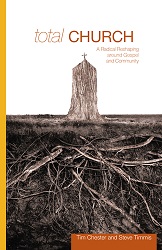 Tim Chester and Steve Timmis aim to present a gospel-centered vision of the local church as a fellowship community oriented towards missions in Total Church: A Radical Reshaping around Gospel and Community.
The notion that the church must be community- and gospel- oriented is absolutely central to the whole book. Time and again examples are put forward towards how the house church can make a huge impact on individuals. The authors rightly emphasize the notion that sometimes measuring success by pure numbers is misleading and, yes, misguided. Throughout the book, a commendable call is issued to seek using the gospel of Christ and making missions a priority in church.
Many stories are provided throughout the book to help make these insights into a practical application. They are appreciated because it gives readers some hands-on ways to deal with situations. I also enjoyed much of the discussion on youth groups and “children’s church.” Basically, it was argued that we cannot simply make the kids a separate unit from the rest of the church. Youth groups cannot just be a game night, because once the youths get past that, “real, adult” church is so vastly different. We need to emphasize the truths of Christianity throughout our children’s lives from the very earliest stages.
The book, however, has some deeply problematic elements. First, the view put forward of counseling and psychology was, frankly, disturbing. There’s a lot going on in this chapter, but it really seems to come down to the authors saying that “secular” psychological treatment doesn’t help, only the gospel can. We just need to embrace the truths of the gospel and all will be well. One representative quote: “The Bible addresses the entire range of problems we experience in living in this world… It addresses all the basic and essential issues of what it means to be human, both in our sin and in our salvation” (Kindle location 1802; all references are to Kindle locations hereafter). Later, this is made into an application that if we just focus on Christ, our sufferings won’t seem significant. At the end of all of this, there is a vague reference to how some kind of counseling outside of church might also be needed, but it is too little, too late, too vaguely stated.
I think this is a deeply misguided attempt to describe a “Christian” view of counseling which simply is–ironically–not outlined in the Bible. Choosing a couple quotes about how our present suffering can be alleviated or overcome by God does not mean that going to “secular” [whatever that means–and in exclusion of the reality of Christian] psychologists and therapists is a poor decision. Yes, we should try to deal with and help with these issues in the context of a community of faith. But God forbid that we approach someone who self-harms [one example they used] and just tell them that their problem is reducible to a spiritual problem, as the authors do: “The term ‘spiritual’ is not simply another category alongside biological, physical, environmental, upbringing, or relationships. Each of those forms of suffering, passive or active, is always and at some point a spiritual and theological issue” (1881). This seems clearly reductionistic and potentially damaging. I felt this whole section was quite disturbing.
Second, there is a very dim view of academic theology put forward. The authors complain that academic theology is often just for academics and compare the probably legendary story of medieval debates over the number of angels on the head of a pin to modern evangelical theological journals as “no less obscure” (2159)! This is another huge difficulty in the book because it ignores the wide implications of “obscure” theology being done in academia for the church at large. By reducing theology to the task merely of the local church (2148), it seems there is something of a denial of the Holy Spirit’s work in guiding the church at large, and, yes, a danger of local churches simply deciding that soul-destroying heresy is sound theology without any support from those “obscure” academics. A blithe dismissal of this enterprise relegates authors like Augustine, Aquinas, Calvin, and more into the scrap heap of obscurity.
Third, the book largely dismisses the enterprise of apologetics as dealing with issues of the mind and instead argues that “The problem is not that we cannot know God. The problem is that we will not know God. It is a problem of the heart rather than the head” (2344). Later, this leads the authors to the claim that the goal of apologetics must be to “demonstrate that unbelief is a problem of the heart rather than a problem with the head” (2419). Apologetics is envisioned as not being intellectually engage but rather engaged with trying to show people the relational problems they have with God (2467). Not only does this reduce apologetics quite a bit in scope, but it also performs some serious psychoanalysis of those who do not believe by saying that the ultimate problem with every non-Christian is that they somehow have some passionate anger against God.
Now, unless we are to assume that all of these people are lying to us, plenty of atheists throughout history have grounded their rejection quite clearly in intellectual issues. Numerous modern studies have shown that the people leaving the church often do so because of perceived anti-intellectualism or a failure to engage the mind. The task of apologetics can not, and dare not do this, be reduced to vague exploration of the heart rather than the mind. We must engage with the intellectual attacks on Christianity and put forward our position in a winsome manner.
Fourth, the Chester and Timmis often say they are not saying their position is the only way to do something, but then continually pound the notion that their way is the only biblical or gospel-oriented way so often that one wonders whether they do believe other approaches might work. The discussion of the biblical warrant for house churches is but one example, where, after asserting that there is nothing inherently wrong with larger churches, the authors compares them to pagan temples founded due to Constantine’s making Christianity the civil religion of the Roman Empire [a historical reality that should be questioned, as it was not the official or exclusive religion until Theodosius I, though this is a complex topic not worth getting deeply into here] (1255). If one approach is “biblical” and other other is merely capitulation to replicate paganism, which one is acceptable? Speaking inclusive approaches but following up with things like this makes me wonder whether there is much generosity happening towards those with whom the authors disagree.
The kindle edition of the book also has some typos, such as replacing “initially” with “Initial” (yes, capitalized in the middle of sentences) at several places in the text. Another one is this portion: “I have used the Initial person, but not to trumpet my experience… I have used the Initial person to show that what I am describing is not impossible rhetoric or unrealistic idealism… At Initial they expressed concern that we did not have an accountability structure over and outside us…” (2782). Looking at the print edition on Amazon, I find that it says “first” in all these places. I don’t know if this is the same with all Kindle editions or just the one I received for review.
The Good
+Several good insights into how we might build communities in church
+Emphasis on holistic approach to youths and children
The Bad
-Extremely problematic discussion of counseling
-Often paints an inclusive picture, but then contradicts it with exclusion
-Some questionable exegesis
-Largely dismisses academic theology
-Largely undermines the majority of Christian apologetics
Conclusion
Total Church: A Radical Reshaping around Gospel and Community was, unfortunately, not what I had hoped for. Will readers get insights into founding house churches and making communities therefrom? Yes. But unfortunately there is an awful lot of baggage to go along with those insights, including, but not limited to, rejection of massive amounts of Christian academic theology, undercutting Christian apologetics, distorting a Christian view of therapy and psychological treatment, sometimes questionable exegesis, and more.
Crossway provided me with a copy of the book for review purposes. I was not obligated by the publisher to write any kind of review whatsoever.
Links
Be sure to check out the page for this site on Facebook and Twitter for discussion of posts, links to other pages of interest, random talk about theology/philosophy/apologetics/movies and more!
Book Reviews– There are plenty more book reviews to read! Read like crazy! (Scroll down for more, and click at bottom for even more!)
Source
Tim Chester and Steve Timmis, Total Church: A Radical Reshaping around Gospel and Community (Wheaton, IL: Crossway).
SDG.
——
The preceding post is the property of J.W. Wartick (apart from quotations, which are the property of their respective owners, and works of art as credited; images are often freely available to the public and J.W. Wartick makes no claims of owning rights to the images unless he makes that explicit) and should not be reproduced in part or in whole without the expressed consent of the author. All content on this site is the property of J.W. Wartick and is made available for individual and personal usage. If you cite from these documents, whether for personal or professional purposes, please give appropriate citation with both the name of the author (J.W. Wartick) and a link to the original URL. If you’d like to repost a post, you may do so, provided you show less than half of the original post on your own site and link to the original post for the rest. You must also appropriately cite the post as noted above. This blog is protected by Creative Commons licensing. By viewing any part of this site, you are agreeing to this usage policy.
Book Review: “Faith, Freedom, and the Spirit” by Paul Molnar
 Paul Molnar’s Faith, Freedom and the Spirit
The book is packed with insights into numerous topics, whether readers are interested in learning more about Barth and Torrance (and Rahner) or the relations within the Trinity, Molnar sweeps broadly but takes the time to dissect many topics in helpful ways.
A primary topic is how we relate to God, and through Barth (though alongside other theologians), Molnar argues that God is perfectly free in relation to us and frees us through grace. It is not our work that saves us but rather God entirely and miraculously revealing Himself to us through Christ by the power of the Spirit.
Throughout the entire book, the aforementioned theologians are highlighted, often providing readers with lengthy quotes and expositions of their positions in order to lend more detail and analysis to topics related to the Trinity.
There seems to be a bit bit too much discussion of various other scholars’ dissent from Molnar’s position or misunderstanding it. At times it reads as though there are journal articles put into the book rather than developing as a book itself. Responses to specific authors seem to often be esoteric rather than helpful, though I’m sure in the broader project Molnar is tracing, it makes sense.
Another downside is that it seems that at a few points the “low hanging fruit” is that which is engaged. For example, Molnar’s discussion of eternal subordination was interesting–in particular his insight from Barth and Torrance about how such a position confuses the immanent and economic Trinity–but then he went on to focus on specific views of select scholars which were blatantly subordinationist in the Arian sense rather than on some of the more nuanced approaches of others. Another example is his discussion of natural theology, which did not seem to take into account the various ways in which Barth’s attack on the notion are undermined by other considerations.
Overall, Faith, Freedom and the Spirit
The Good
+Insight into many aspects of the economic and immanent Trinity
+Deeply thought-provoking
+Solid critique of some views of the Trinity which (potentially or actually) stray from orthodoxy
The Bad
-A few too many rabbit trails make it feel like pieced-together journal articles at times
-Fails to distinguish adequately between types of apologetics
-At times feels repetitious
I received a review copy of the book from InterVarsity. I was not required to give any kind of review whatsoever. My thanks to the publisher for the book.
Links
Be sure to check out the page for this site on Facebook and Twitter for discussion of posts, links to other pages of interest, random talk about theology/philosophy/apologetics/movies and more!
Book Reviews– There are plenty more book reviews to read! Read like crazy! (Scroll down for more, and click at bottom for even more!)
Source
Paul D. Molnar, Faith, Freedom and the Spirit (Downers Grove, IL: InterVarsity, 2015).
SDG.
——
The preceding post is the property of J.W. Wartick (apart from quotations, which are the property of their respective owners, and works of art as credited; images are often freely available to the public and J.W. Wartick makes no claims of owning rights to the images unless he makes that explicit) and should not be reproduced in part or in whole without the expressed consent of the author. All content on this site is the property of J.W. Wartick and is made available for individual and personal usage. If you cite from these documents, whether for personal or professional purposes, please give appropriate citation with both the name of the author (J.W. Wartick) and a link to the original URL. If you’d like to repost a post, you may do so, provided you show less than half of the original post on your own site and link to the original post for the rest. You must also appropriately cite the post as noted above. This blog is protected by Creative Commons licensing. By viewing any part of this site, you are agreeing to this usage policy.
Book Review: “The Lost World of Adam and Eve” by John Walton
 John Walton’s latest book, The Lost World of Adam and Eve
Walton argues that the Genesis creation account does not specifically tell us how Adam and Eve materially came to be but rather is an account of God giving them their functions as the image of God, ushering in order against the chaos. His view is one which sees Adam as archetypical head of humanity rather than necessarily being the first ever human. Adam and Eve were chosen by God to become God’s representatives in the world.
Many intriguing arguments are put forward by Walton once he has established what is the central thesis–that the text is concerned with functional, not material origins. These include reading Genesis 2 as a sequel to rather than recapitulation of Genesis 1, the use of the term “very good” and “good” in the text, the meaning of “formed from dust” and from the rib, the archetypal meaning of Adam and Eve, the real existence of this couple, the priesthood of the couple in sacred space, our role as bringing order from disorder, the “serpent” in the Garden, and more. Each chapter is filled with compelling arguments and sometimes surprising conclusions.
Because the worldview of the ANE was not concerned with material origins, the questions we often ask of the text like “Were Adam and Eve the first humans?”; “Are we all descended from Adam?” and the like are questions which the text is not intended to answer. These are questions from our background, not from the background of the text. Thus, Walton argues that there can be much openness to the answers to these questions. When we come to the New Testament discussions of Adam and Eve, Walton (and the contribution from NT Wright) argue that this is why the notion of federal headship (though not necessarily material/genetic headship) is probably in mind.
Readers who are unconvinced by the notion that we should apply ANE insights to our reading of the text will be challenged to support that claim. Walton cogently argues that although there is not a 1-to-1 correspondence between the worldview of the ANE and the Bible, it is highly questionable to assume that the writers and audience of the Bible would not have been influenced by their background and cultural understanding.
Regarding the science, Walton readily points out that he is not an expert in the area but defers largely to the experts. He applies the exegetical arguments to questions of original sin, federal headship, and the like in the context of modern scientific findings, though he does so in such a way that he retains his commitment to teach what the text does rather than trying to force it to speak of our concerns.
Many (most?) readers will find this book challenging on a number of levels because Walton so readily exposes our presuppositions about what the text should say. Very often Walton simply points readers back to the text to reveal how often we have our expectations bring meaning to the text rather than allowing it to speak for itself.
The Good
+Excellent insight into the ANE background of the Old Testament
+Strong exegetical argument with a commitment to understanding the text
+Coherent with the rest of Walton’s thought
+Challenges our presuppositions about the text
The Bad
-A bit difficult to pin down exactly what his view is of original sin
Conclusion
The Lost World of Adam and Eve
Disclaimer: I was provided with a review copy of the book courtesy of InterVarsity Press. I was not obligated to write any sort of review whatsoever. My thanks to the publisher for the copy.
Links
Be sure to check out the page for this site on Facebook and Twitter for discussion of posts, links to other pages of interest, random talk about theology/philosophy/apologetics/movies and more!
Origins Debate– Read a whole bunch more on different views within Christianity of the “origins debate.” Here I have posts on young and old earth creationism, intelligent design, theistic evolutionism, and more!
Source
John Walton, The Lost World of Adam and Eve
SDG.
——
The preceding post is the property of J.W. Wartick (apart from quotations, which are the property of their respective owners, and works of art as credited; images are often freely available to the public and J.W. Wartick makes no claims of owning rights to the images unless he makes that explicit) and should not be reproduced in part or in whole without the expressed consent of the author. All content on this site is the property of J.W. Wartick and is made available for individual and personal usage. If you cite from these documents, whether for personal or professional purposes, please give appropriate citation with both the name of the author (J.W. Wartick) and a link to the original URL. If you’d like to repost a post, you may do so, provided you show less than half of the original post on your own site and link to the original post for the rest. You must also appropriately cite the post as noted above. This blog is protected by Creative Commons licensing. By viewing any part of this site, you are agreeing to this usage policy.

 J.W. Wartick - Reconstructing Faith