book review
Book Review: “My Christian Apology” by Martin Murphy
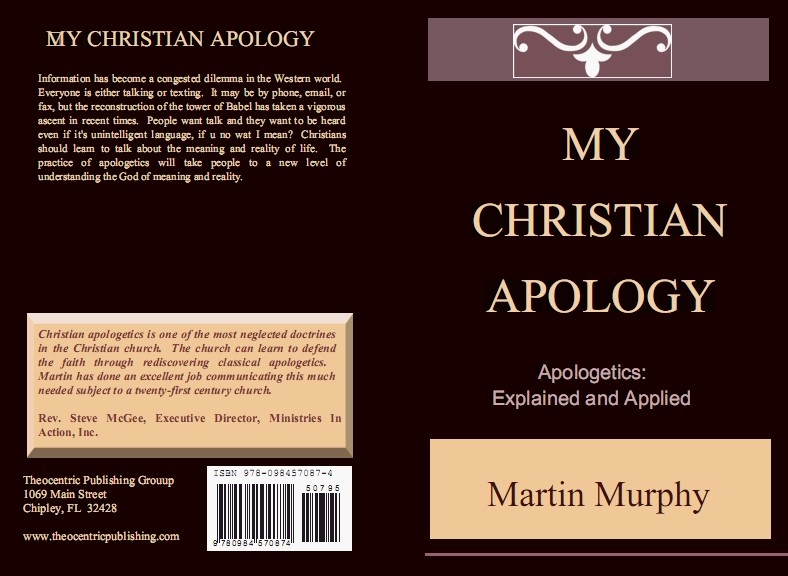 My Christian Apology by Martin Murphy provides some unique insight into apologetics. Rather than focusing upon arguments for the existence of God or methodology at the expense of historical understanding, Murphy grounds both arguments and method in history.
The book starts off with some introductory notes. What is apologetics? How do we communicate apologetics? These sections provide the groundwork of many apologetics texts. But Murphy quickly differentiates his work from most standard introductions to apologetics. His book focuses largely on epistemology and its relation to apologetics.
Murphy does a great job of making these concepts accessible to general readers. He defines epistemology (19) and then gradually eases the reader into its various applications to apologetics (19ff). A central theme throughout is that unbelievers and Christians have common grounds from which they can start discussions. One of these common grounds is Natural Law, which Murphy goes into at length (65ff). Natural Law has been repudiated by many modern thinkers, but it is grounded in Scripture and has a great theological base. I’ve reviewed a Lutheran book on the topic which I think helps show how useful Natural Law is. Murphy points out that Natural Law can provide a basis for knowledge of God. “If we know we are transgressors then we know we have violated the law of God” (73). This knowledge is not saving knowledge, but it provides a basis for judgment (84) and, I think, a possible common ground for apologetics.
Another strength of Murphy’s work is the focus upon historical apologetics. He cites Jonathan Edwards at length and in numerous places while exploring Edwards’ applications to apologetics (see 20-21, 29, 36, etc.). He also emphasizes the works of Southern Presbyterians in the area of apologetics. The historical background is a great quality of the work and one that I think Christian Apologists often fail to emphasize or utilize.
There is some emphasis on theology in My Christian Apology as well. Murphy’s discussion of natural law leads to a drawing out of the “noetic effects of sin.” Again, the points Murphy raises are clear and concise. Some readers will disagree, but all will be challenged. I find this account eminently plausible and I think that even those who disagree need to at least account for the Biblical case for original sin.
Martin Murphy’s My Christian Apology is a brief work that has a ton of great information packed into it. Questions that other basic apologetics books tend to avoid are treated with precision and lucidity. The emphasis on historical apologetics leads to many insights readers won’t find in other introductory works. I recommend that readers use this book along with other basic apologetics books in order to develop a more well-rounded apologetic method.
Source:
Martin Murphy, My Christian Apology (2010).
SDG.
——
The preceding post is the property of J.W. Wartick (apart from citations, which are the property of their respective owners) and should not be reproduced in part or in whole without the expressed consent of the author. All content on this site is the property of J.W. Wartick and is made available for individual and personal usage. If you cite from these documents, whether for personal or professional purposes, please give appropriate citation with both the name of the author (J.W. Wartick) and a link to the original URL. This blog is protected by Creative Commons licensing. By viewing any part of this site, you are agreeing to this usage policy.
Book Review: “Hidden Treasures in the Book of Job” by Hugh Ross
 Hidden Treasures in the Book of Job
Ross begins with an exhortation to Christian leaders to stop avoiding the issue of Creation and to come up with a reasonable “strategy of engagement. Christians who take the Bible as a trustworthy revelation from God need to study science and engage with scientists at the highest academic and research levels” (12). I pray Ross’s words will not fall on deaf ears.
Ross goes on to point out the historical backdrop of the book. The debaters present, Job, Eliphaz, Zophar, and Bildad were “likely the intellectual powerhouses of their day…” (28). Along with Elihu, who most likely recorded the book, they comprise the major characters. Interestingly, Eliphaz was named as a Temanite. Teman, Ross points out, “was famous in the ancient world for its exceptionally wise scholars” (28). Contrary to some who may accuse Ross of demeaning the historical value of Scripture, it is clear that he affirms the historical realism of the Book of Job.
Interestingly, HTBJ doesn’t start with the scientific questions; it dives in to “timeless questions” about God. Ross points out answers given throughout Job about the reason for death (39-40), the shorter lifespans of humans (40-41), blessings for the wicked (43ff), and more. Ross provides an argument about what is often called “natural evil.” He points out Job’s rejection of a “direct cause-and-effect relationship between destructive natural events and the people affected by them” and goes on to argue that scientifically, these “acts of God” are necessary for life (49). Hurricanes, for example, bring a number of benefits (51).
Ross quickly moves into scientific questions throughout the book of Job. He argues that God’s challenges to Job and friends reject naturalism, deism, evolutionism, and young-earth creationism (54). Job specifically points out that God continually interacts with creation. Perhaps most interestingly, Ross points out that in Job the Bible specifically points towards the Big Bang–with language of God “stretching out the heavens.” This, thousands of years before any scientific evidence existed (56-58). Not only that, but the book also alludes to dark matter. Rather than treating darkness as the “absence of light” as was the belief historically, Job points out the actual existence of darkness and its separation from light. Here again there is evidence that Job lines up powerfully with science (60-63).
Another fascinating aspect of the Book of Job, argues Ross, is its ability to speak to current situations like Global Warming (63ff).
Central to Ross’ argument in HTBJ is the thesis that the book of Job can be used as an interpretive backdrop for the Genesis creation account. Ross argues that Job 38-39 can be read in their entirety as a creation account (72). This opens the gate for interpreting other creation accounts through the lens of Job 38-39. He points out that there are areas of Moses’ creation account that Job makes explicit. Some of these points include a correct interpretation of “heavens and earth” (74); an outline of when plants were created (78-79); and perhaps most interestingly, one of the best explanations of the problem of light before the sun I’ve ever seen (80-84). Ross argues that, contrary to most interpretations, the Genesis account does not explicate that there was no sun before light, but rather that the light had been hidden by the atmosphere (82-83). Again, this would serve as powerful scientific confirmation of the Bible.
Ross is unafraid to pull his punches. He takes on the question of the extent of the flood (92ff) and argues convincingly that the flood was localized to all of humanity. Perhaps the most controversial point Ross makes is in regards to one of the best arguments for young-earth creationism–death and the Fall. Often, the young-earth argument is that the Bible excludes any possibility of death before the Fall. Ross argues that, given Job 38-39’s creation account, that interpretation can no longer be valid. He urges that Job 38:39-41 coincides with creation day five, and because these verses include death before the fall, this argument for a young-earth is unsuccessful. Ross’s argument here will really depend upon how convincing his assertion is that all of Job 38-39 lines up with the days of creation. Ultimately, I think, most young-earth creationists will remain unconvinced and argue that only the early part of Job 38 is a creation account. In Ross’s favor is the continuing tense (it appears as though the verbs throughout the section are in the Qal stem). But Ross doesn’t make this argument. Thus, it seems that this part of Ross’s argument will be convincing only to those willing to agree that Job 38-39 are, in their entirety, a creation account.
Later, Ross soundly demolishes the young-earth argument that Job provides evidence for dinosaurs living with humans. He convincingly argues that the behemoth is a hippopotamus (178-180) and the leviathan a crocodile (180-183).
Ross doesn’t leave the book of Job without discussing what seems like its primary question: suffering. He presents evidence that Job argues for both a greater good theodicy along with a free-will defense (190ff). Both of these sections are interesting, if brief.
There are many areas of interest within HTBJ I have left unexplored. Ross focuses extensively on soulish creatures and the differences between humans and animals. Most interestingly is Ross’s explication of the list of 10 “soulish” creatures named in Job and their import for humans (150-165). Suffice to say that there is much more content in the book worth reading.
There were times as I read Hidden Treasures in the Book of Job that I was filled with marvel at the magnificence of creation. At one point I stood up and surprised my wife, saying “Can you believe what God has made? And we know it from the Book of Job! Can you believe this!?” as I described some of the things Ross reveals in the book. There are some astounding ways that the Bible lines up with the evidence we have from cosmology, astronomy, biology, and other sciences. While some Christians may remain unconvinced by Ross’s argument for interpreting Genesis 1 through the lens of all of Job 7-39, the book deserves a reading and response by even those who disagree. Ultimately, readers of Hidden Treasures in the Book of Job will come away with some powerful evidence from science for the truths of Scripture–and vice versa.
Disclaimer: I was provided with a review copy of this book by Reasons to Believe. You can learn more about this science-faith think tank at reasons.org.
Source: Hugh Ross, Hidden Treasures in the Book of Job
SDG.
——
The preceding post is the property of J.W. Wartick (apart from citations, which are the property of their respective owners) and should not be reproduced in part or in whole without the expressed consent of the author. All content on this site is the property of J.W. Wartick and is made available for individual and personal usage. If you cite from these documents, whether for personal or professional purposes, please give appropriate citation with both the name of the author (J.W. Wartick) and a link to the original URL. This blog is protected by Creative Commons licensing. By viewing any part of this site, you are agreeing to this usage policy.
Book Review: “Who Made God?” by Edgar Andrews
 Who Made God?
Interestingly, Andrews gets the title of the book out of the way quickly. Andrews argues against the common atheistic retort, “Well if God made everything, who made God?” He writes, “Because cause and effect is only proven for the physical world, we can no longer insist that cause and effect are relevant when it comes to the origin of a spiritual entity like God.” I am not sure about the strength of this response. It seems to potentially put God outside the rules of logic, something of which most theists are very wary. A more convincing response, in my opinion, is to simply point out that the concept of God includes necessity. Theistic arguments are designed to show just this–that God is the uncaused ground of being.
Who Made God, however, quickly jumps into stride and doesn’t look back. Andrews lucidly argues that while science can describe events and put them to the test, it cannot explain things in the sense of a comprehensive explanation. Science, for example, “doesn’t tell us why there is [a force of gravity]” (30).
Without slowing down Andrews jumps into a clear explanation of String Theory and its attempts to be a “theory of everything.” Even were science to unify into a theory of everything, however, Andrews point would still stand. The theory would offer descriptions of how things happen, but it wouldn’t explain why the theory itself worked. He also offers a few critiques of string theory, such as the counter-intuitive nature of the theory (48).
Andrews continues on, offering God as a “hypothesis.” He argues that “the methodology of science” can be applied to God (58-59). He argues that Victor Stenger’s God: the failed hypothesis fails on a number of levels. Stenger claims that God “should be detectable: (1) by scientific ‘models’; (2) by scientific measurements… (3) by scientific ‘methods'” (67). Against this, Andrews points out that Stenger is trying to exclude God from existence by “having it both ways.” Stenger argues that God should be detectable, but cannot be because the measurements of science are restricted to the physical. Obviously, this begs the question against theism.
Andrews also addresses nothing, by which I mean the redefinition of “nothing” into “something” often done by atheists (see the debate between Lawrence Krauss and William Lane Craig). He points out that they often use “nothing” to reference vacuum and/or empty space or dark matter. But this is either deliberately misleading or just incomprehensible (97ff). As the atheists who say this often admit themselves, this “empty” space is hardly “nothing.” It is full of energy. But beyond space, beyond the existence of our universe, outside of space and time–that is what is meant by “nothing” (105).
The God hypothesis is vindicated when it comes to the evidence from astronomy and physics. The low entropy state of our universe (117-118), along with its origin (98ff) both point to a creator. Andrews moves on to argue that the origin of the laws of nature must also point to the God hypothesis (138-153). He then goes on to argue that our biological origins, the information found in cells, and the diversity of life have their best explanation with God. To cover these arguments fully would double the size of this review, but I found these arguments just as exciting as the rest of Who Made God. A sampling: proteins and DNA must have information in order to function correctly (181ff); origin of life theories can only be explained with the God hypothesis (196ff); evolution is nonfalsifiable (214-216); natural selection is a tautology (219-220); junk DNA isn’t junk (234ff); mutations really only help within dynamic populations and cannot lead to new species (230ff [through 240]). Andrews isn’t finished there, however, he tackles arguments for and against mind/body dualism (250ff).
Another strength of Who Made God is the format. There is a summary of each chapter prior to its contents, along with definitions of important terms. Humor is found throughout the work as the author tells funny stories or makes witty comments about the arguments. These aspects increase the readability of the book to a great degree.
This is not to say the book is without faults. Andrews’ treatment of the Ontological Argument was a bit abrupt. I’ve written on the argument before (see my posts here and here). Andrews’ critiques don’t apply to the most current versions of the argument. The most commonly used ontological argument is the modal version developed by Alvin Plantinga and others. This version of the argument doesn’t appeal to human ideas, but to modal necessity and possibility. To his credit, Andrews does point out that some philosophers find the argument compelling.
Another issue with Who Made God is the sometimes unconventional use of philosophical terms. For example, Andrews defines “phenomenology” as “The way phenomena… manifest themselves” (27). Phenomenology, however, is most commonly used (in philosophy) as the study of consciousness. Outside of philosophy, it generally refers to conscious experience or sense experience, not so much about the phenomena themselves. While the definition is not wrong, it caused some confuse, and may confuse other readers familiar with the other, more conventional uses. Another uncommon definition was given for “Monism.” Most often, the term refers to the idea that all of reality is one [i.e. it is all material, or all immaterial]. Andrews definition makes sense in context (he defines it as “The idea that mind is nothing more than the brain at work” [257] but that definition in philosophy of mind is more often used for “reductionism” which Andrews defines differently as well).
However, neither of these negatives outweigh the significant positives found throughout Who Made God. You know that I’m nitpicking when my main critique focuses on a couple unconventional definitions, particularly when Andrews uses valid definitions that simplify the terminology for the reader.
Edgar Andrews’ Who Made God is unique among the slew of apologetics books written at a popular level in that it offers a nearly comprehensive argument for Christianity based upon various scientific theories. Despite a few small flaws, I unreservedly recommend this book to all Christians looking to increase their knowledge of biology, physics, and astronomy. Andrews clearly and succinctly explains several scientific theories in terms which are easy to understand, while also showing the relevance for the “God hypothesis.” Readers will come away convinced that when it comes to science, their faith stands on firm ground. Books with scopes this broad most often shine their lights upon lots of topics and illumine none. Readers will find that Who Made God illumines nearly every topic it touches, bringing new insight and clarity into often confusing issues.
Source: Edgar Andrews, Who Made God?
Disclaimer: I was provided with a review copy free of charge by EP books. My thanks to both Edgar Andrews and EP books.
SDG.
——
The preceding post is the property of J.W. Wartick (apart from citations, which are the property of their respective owners) and should not be reproduced in part or in whole without the expressed consent of the author. All content on this site is the property of J.W. Wartick and is made available for individual and personal usage. If you cite from these documents, whether for personal or professional purposes, please give appropriate citation with both the name of the author (J.W. Wartick) and a link to the original URL. This blog is protected by Creative Commons licensing. By viewing any part of this site, you are agreeing to this usage policy.
Book Review: “No Other God: A Response to Open Theism” by John Frame
 I recently finished No Other God
Areas of Agreement
One of the strengths of Frame’s book is how clear his thinking is. His style of argumentation is precise, and he clearly lays out what he considers evidence for his positions. He is unafraid to make statements with huge implications.
A particularly interesting aspect of Frame’s work was a brief historical look at the roots of Open Theism, leading it back to the Socinianism. Frame points out that advocates of Open Theism tend to portray their view as the “new theology on the block” despite the fact that it has been around (and rejected) for quite some time.
I believe Frame is correct when he argues against the centralization of any one attribute of God. Specifically, the centralization of love on Open Theism tends to ignore other important attributes of God (49ff). (Interestingly, Frame’s own account of God unnecessarily over-emphasizes Sovereignty, though he disguises this by calling it “Lordship.)
Frame levels strong critiques against Open Theism’s reading of Scripture. Open Theists tend to advocate the “straightforward” reading of texts which help their case. One of Open Theist’s favorite passages is God testing Abraham. Yet Frame rightly notes that if there is a straightforward reading of the text, then God did not know the present truth of Abraham’s heart, whereas Open Theists attempt to use this to support God not knowing the future (47). Further, if God was trying to figure out how Abraham would act in the future, then He was trying to do something He couldn’t (determine what the libertarian free choices of humans would be) according to Open Theism. So the story’s straightforward reading does not work to support Open Theism. Frame urges a similar examination of other passages, though he doesn’t expand on it.
Areas of Disagreement
Despite these areas of agreement, I vehemently oppose Frame’s position on several issues. Most notably, on theistic determinism, compatibilism, and libertarianism.
First, libertarianism. Frame correctly notes that the core of Open Theism is the assumption of libertarianism. Yet his critique of libertarianism is wrongheaded. He caricatures libertarians as believing that choices are made in the absence of any motivation. He writes, commenting on the libertarian view, “if our decisions are caused by anything or anyone (including our own desires), they are not properly our decisions… to be responsible, we must be able to do otherwise” (121). Yet this is explicitly not libertarianism. Peter van Inwagen, for example, explicates libertarianism by saying “…that someone’s acts are undetermined does not entail that they are uncaused” (van Inwagen, An Essay on Free Will, Oxford: 1983, p. 14).
But Frame explicitly centers his critique of libertarianism on a contra-causal account of freedom, saying, for example, “If guilt presupposed libertarian freedom, then in order to show that Hubert [a man accused of robbing a bank] is guilty, the prosecutor would have to show that his decision to rob a bank had no cause…” (126). But again, libertarians deny this very type of contra-causal freedom, so Frame is arguing against a straw man. Because Frame thinks libertarianism is so utterly central to Open Theism, this means that the core of his critique fails to hit home.
The problem with Frame’s counter against libertarianism is that it barely touches the surface of the philosophical arguments for the position. He correctly rails against the idea that our actions are just random occurrences, but incorrectly assumes that this is libertarianism.
Finally, the greatest area of disagreement I have with Frame is on his view of omnidetermination. Consider the following two quotes:
“The uniform witness of Scripture is that the evils of this life come from God” (140).
“…[I]t is important to see that God does in fact bring about the sinful behavior of human beings, whatever problems that may create in our understanding” (68).
I’d be curious to see how Frame reconciles these assertions with the constant witness of Scripture that God is just; fair; good; opposed to evil; etc. Frame utilizes several verses to support his position, but he makes primary those which say God uses “all things” and verses which say calamities are from God. But regarding the former, this can easily refer simply to permissive will, and regarding the latter, the verses he uses are out of context (and even were one to grant the “straightforward reading,” one could counter by saying the calamities are not every evil action, but merely those things which God uses–i.e. storms, other nations, etc.–to instruct His people). Frame, like many theological determinists, is not building even on sand, but on a void. Literally saying that God causes evil is so utterly repugnant and contrary to Scripture that this view overshadows all the good things Frame has to say.
Conclusions
Ultimately, No Other God is on target in a few ways, but it is wildly gunning the wrong direction on too many issues. Frame’s philosophical case against libertarianism is off the mark, he fails to deal with the strong philosophical arguments for libertarianism, and his view that God literally causes evil is baseless. Interestingly, while I went in reading this book looking for some good arguments against Open Theism, I came out with the realization that theological determinism is a far more dangerous doctrine indeed.
SDG.
Check out other posts about Open Theism here.
John Frame,No Other God
——
The preceding post is the property of J.W. Wartick (apart from citations, which are the property of their respective owners) and should not be reproduced in part or in whole without the expressed consent of the author. All content on this site is the property of J.W. Wartick and is made available for individual and personal usage. If you cite from these documents, whether for personal or professional purposes, please give appropriate citation with both the name of the author (J.W. Wartick) and a link to the original URL. This blog is protected by Creative Commons licensing. By viewing any part of this site, you are agreeing to this usage policy.
Book Review: Natural Law: A Lutheran Reappraisal
 Natural Law: A Lutheran Reappraisal
The individual essays presented in NLL are almost all extremely strong. The topics covered include the views of early Lutherans on natural law (including Luther and the authors of the Confessions) , the view of several later Lutheran individuals (like Barth and Forde), and a kind of “applied ethics” section which uses natural law in individual instances.
The strength of many of these essays is a credit to the Lutheran scholarship which went into the work. The insight into Lutheran thinkers’ views on natural law helps to refute some notions that Lutherans do not “believe in” natural law. In fact, it seems the opposite is the case. “Luther,” argues Thomas Pearson, “understands natural law not as a Christian teaching, but as an observation of human nature in general” (63). Later, Carl Rockrohr expands on this idea to view natural law as a place of common ground for evangelism (196-197).
NLL really shines when it demonstrates that even topics which may at first seem unimportant (like an essay on Friedrich Stahl’s rejection of natural law) can serve to develop a modern view of natural law (Jacob Corzine argues in the aforementioned essay that Stahl’s critique helps ground a Christian natural law theory not in reason but in God [115]).
The applied ethics section of NLL has its ups and downs. “Natural Science, Natural Rights, and Natural Law: Abortion in Historical Perspective” by Korey D. Maas is a simply amazing critique of abortion which presents the case for pro-life not as a religious issue, but as one which can be established on common grounds of natural law (228ff). On the other hand, Albert Collver III’s argument against the ordination of women struggles because it only presents one Lutheran view on the issue (more on that below). The section (and book) concludes with Matthew Cochran’s great summing up and case for the use of natural law as a “Way Forward” for discussions of epistemology and natural law (see esp. 274ff).
The strength of NLL is therefore found in the fact that the essays manage to cohere to the point of building off one another. Whether this was intentional or not, it strengthens the whole work. The early essays provide the framework for the later developments into applied ethics.
This is not to say the book is without faults. One such fault is the woefully inadequate glossary. While the terms included are defined in detail, some terms are inexplicably left out. For example, while the glossary takes lengths to define idealism, it makes no mention of “epistemology,” a concept which was referenced several times. This makes the book seem at times unsure of its purpose. Is it written for the layperson or the professional, the philosopher or the theologian? It includes study questions and a glossary, which suggests use as a textbook in undergraduate (or high school) theology classes, but the very nature of the essays included and the inadequacy of the glossary suggests that only those already familiar with some of the issues will get the most bang for their buck. A final criticism I would level against the book is that while it does present essays from various Lutheran traditions, it is clearly founded specifically upon LCMS teaching. This is unsurprising, given that it is published by Concordia Publishing House (the official publishing arm of the LCMS), but this could cause some confusion when the book devotes an entire chapter to a critique of a different Lutheran tradition (the ELCA). This small shortcoming can also be seen when the book only presents a complementarian view of natural law (that is, a view that natural law excludes women from the ministry) despite the fact that other Lutheran traditions (for example, the NALC or ELCA) are egalitarian (ordain women).
NLL is a simply fantastic work. Lutherans looking to learn about the concept of natural law would be well served to pick the book up and read it cover-to-cover. Those outside of the Lutheran tradition would surely find NLL useful as well, as the essays on applications of natural law can serve as foils for the development of one’s own position. For those wishing to explore the important issue of natural law, I recommend the book highly.
SDG.
——
The preceding post is the property of J.W. Wartick (apart from citations, which are the property of their respective owners) and should not be reproduced in part or in whole without the expressed consent of the author. All content on this site is the property of J.W. Wartick and is made available for individual and personal usage. If you cite from these documents, whether for personal or professional purposes, please give appropriate citation with both the name of the author (J.W. Wartick) and a link to the original URL. This blog is protected by Creative Commons licensing. By viewing any part of this site, you are agreeing to this usage policy.
Book Review: New Proofs for the Existence of God by Robert Spitzer
Robert Spitzer’s New Proofs for the Existence of God (hereafter NPEG) presents in rigorous detail, five arguments for the existence of God, a section discussing the plausibility of multiverse/string universe scenarios, and some philosophical discussion on methodology.
Before continuing the review, I should note that the “New” in NPEG is nuanced. Spitzer notes this himself (my guess is that it was a marketing technique. “New” refers to the evidence from cosmology and further research in philosophy which lend new power for these arguments.
Chapter 1 presents a cosmological argument. Spitzer cogently argues that “(1) If there is a reasonable likelihood of a beginning of the universe… and (2) if it is apriori true that ‘from nothing, only nothing comes,’ then it is reasonably likely that the universe came from something which is not physical reality” (Spitzer, 45). This conclusion is supported by explorations of current cosmological theories about the origins of the universe.
Chapter 2 presents the teleological argument, which Spitzer bases on the universal constants. The argument leads to the conclusion that “the odds against an anthropic condition occurring are astronomically high, making any life form… exceedingly improbable.” It is a probabilistic argument, the likes of which I defend in my article Past, Probability, and Teleology (Hope’s Reason 2011-1).
Following chapter 2 is a chapter which discusses the possibilities of inflationary cosmology and the string multiverse written by Bruce Gordon. It is extremely technical and will provide readers with cogent arguments against the possibility of a multiverse scenario circumventing the previous arguments.
Chapter 3 presents Spitzer’s metaphysical argument for the existence of God, which is full of sound argumentation along with some interesting Thomistic Philosophy wherein he discusses God’s simplicity in the most coherent way I have read. I greatly encourage readers to look into this chapter, if only for the discussion of this oft-neglected doctrine.
Spitzer follows this with Chapter 4’s metaphysical argument derived from Bernard Lonergan’s Insight, which is a subtle version of the argument from reason. This chapter was particularly good because it focuses on a little-used type of arguments for the existence of God–that if our universe is intelligible, that can only be explained by God’s existence.
Chapter 5 is an argument from contingency similar to the Leibnizian cosmological argument.
Chapter 6 engages the question of method in philosophy along with whether atheism is actually rational. I was intially put off by the title of this chapter (“Methodological Considerations and the Impossibility of Disproving God”), but happened throughout the book, I was pleasantly surprised by the rigorous arguments and enlightening conclusions Spitzer laid out.
Finally, the last two chapters outline some more considerations about the universe and the relation of humans and God.
NPEG was a surprising read for me. I went in with neutral expectations, and those were blown away. Spitzer’s knowledge of the topics in the work runs deep, and his writing style is clear and cohesive. It is genuinely exciting to read. Readers will be challenged by the arguments for the existence of God, and engaged in the details and philosophical explanations of these arguments. I highly recommend this work to those interested in advanced books on arguments for God’s existence.
——
The preceding post is the property of J.W. Wartick (apart from citations, which are the property of their respective owners) and should not be reproduced in part or in whole without the expressed consent of the author. All content on this site is the property of J.W. Wartick and is made available for individual and personal usage. If you cite from these documents, whether for personal or professional purposes, please give appropriate citation and provide a link to the original URL. By viewing any part of this site, you are agreeing to this usage policy.
“The Shack” Reviewed by a Conservative (With Poll)
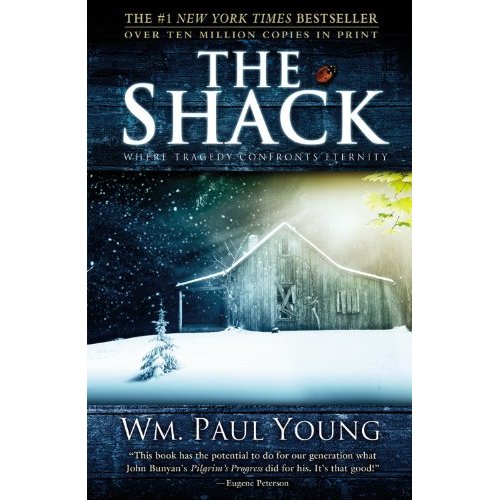
The Shack
I went in with some strong biases against the book. I’d heard from others that it is pretty terrible theology and borderline (or actual) heresy. Needless to say I wasn’t expecting to enjoy it, but, like any good work will do, The Shack proved my biases wrong.
The plot is fairly simple. A man, Mackenzie, has a horrific tragedy happen to his daughter; this tragedy affects his whole family in negative ways; then he receives a letter from God (?) asking him to come to the place the tragedy happened to talk about things. The rest of the narrative revolves around this discussion. One note I should make as a reviewer is that Young’s prose is fantastic. His descriptions of everyday events and locations inject a reality into the story that is necessary to get readers hooked, and he writes about the uncommon and the supernatural with stunning beauty.
The plot serves as just the background for what the book seems (to me) to be; The Shack is a stirring work of philosophical and theological investigation of the nature of God, the problem of evil, and our hope in Christ.
Readers who have read the work or read anything about it probably already know that God is portrayed in the work as three “persons” in a very literal way. The Father, “Papa”, is a motherly black woman, Jesus is a plain-looking middle-eastern workman, and the Holy Spirit changes her (?) form throughout the work. I feel it is necessary to address this, because this is perhaps the most controversial part of the book. It seems to me, at least, that the idea of God coming to people where they are should not be such a hot issue. Christ Himself describes God’s action in terms of a hen gathering chicks beneath her wings (Luke 13:34). God appeared in various forms throughout the Old and New Testaments (burning bush, still voice in the wind, incarnate Christ, etc.). I find it dubious at best to claim that God does not/can not appear otherwise to individuals–perhaps as a mother to those in need (and this would line up well with the Christian background of religious experiences, cf. Perceiving God by William Alston).
These three persons serve to drive the narrative of The Shack while also making claims about the various works of the persons of God. There are many points throughout the book where I found myself nodding as Young wrote a wonderful insight about the work of God. Young’s answers to some of the most poignant questions of humanity resound throughout the work. One of the most stirring moments is a chapter in which Mackenzie is asked to decide which of his children goes to hell. This is meant to reflect the way Mackenzie (and some Christians) seem to put God in the judgment seat, arbitrarily determining who goes to heaven and who is damned to hell. Mackenzie begs to be condemned instead of his children, and in a powerful turnabout, he is told that this is exactly how God feels. He became incarnate to die for our sins, to give the opportunity for all to be saved, loving all God’s children perfectly (p. 165). Moments like this occur throughout The Shack.
Another thing I must share is The Shack‘s answer to religious diversity. Jesus says that those who love Him come from every background, including other religions. This leads Mackenzie to ask, “Does that mean… that all roads will lead to you?” Jesus answered, “Not at all… Most roads don’t lead anywhere. What it does mean is that I will travel any road to find you” (184). Should Christians agree with this answer? I leave it open to the reader to answer this question. Suffice to say that The Shack will challenge readers from all walks of Christian life.
I finished the book in the span of a day. I set it down late at night, realizing I couldn’t be the same Christian I was before. The Shack grabbed me and wouldn’t let go. The questions Young asks through Mackenzie are questions all Christians must face, and the answers he provides focus on one thing: the Love of God. There are definitely things that made me uncomfortable while reading The Shack, but there are other things I realized were suddenly made clear. Treating The Shack like a theological treatise is unfair. It’s not a doctrine book, it’s a work of Christian fiction, and it excels in its niche, asking questions, giving answers, and leaving it to the reader to decide whether he/she agrees or disagrees. This is a fantastic work and I highly recommend it to my readers. You don’t have to agree with what Young says in The Shack to make the book worth reading, but you should read it.
The Shack
Book Review: The Elusive God by Paul K. Moser
I’m going to write more on the ideas present in this book, as I find them vastly important, but because of time constraints and the fact that I want to put up a normal review for this book, I figured I would post a review first.
The Elusive God by Paul K. Moser was, for me, an exercise in frustration. I was very excited to get a hold of the book, as I felt the topic it explored would be truly interesting. I had very high expectations. It was certainly interesting and Moser makes some good points throughout the book. The Elusive God seems repetitive in some aspects and misses the mark on some vital theological issues, but, ultimately, it is worth a read by anyone interested in this question within theism.
Moser attempts to tackle the rather impressive problem of why God, if He exists, is not obviously evident at all times. He argues that evidence of God’s reality would be “purposively available” to humans, which means “available in a manner and only in a manner suitable to divine purposes in self-revelation” (2). Moser’s key point is that such questions as “Do we humans know God exists?” must be rephrased because if that (perfectly loving, etc.) God exists, then we should consider how God would interact with humans (4). Thus, argues Moser, such questions should be rephrased as “Are we humans known by God in virtue of (among other things) our freely and agreeably being willing (i) to be known by God and thereby (ii) to be transformed toward God’s moral character of perfect love as we are willingly lead by God in volitional fellowship with God, thereby obediently yielding our wills to God’s authoritative will?” (4, Moser’s emphasis). But even this question must be seen in light of a third rendering of the question “Do we humans know God Exists?” which is “Are we humans known by God in virtue of… our freely being willing to receive an authoritative call to… fellowship with God…?” (4). This page has most of what Moser will expand on for the rest of the book.
From these modifications of the question “Does God exist?” (my rendering of the question), one can essentially draw out what Moser’s argument is. God, if God exists, is a morally perfect, loving being, so rather than asking why God doesn’t simply reveal himself to us indiscriminately, we should model ourselves to be agents capable of receiving His authoritative call. Thus, the question “Does God exist?” can only be answered if we humans cease asking this question as a kind of non-interactive, sterile question, but instead ask it in the terms of being a truly life changing or reinventing question.
Moser argues that “…we gain evidentially and thus cognitively as we turn from (that is, “repent” of) our selfish ways in order to get in line with a perfectly loving God…” (27, Moser’s emphasis). Central to Moser’s argument is the idea that evidence of God’s existence as God allows for it would have to be capable of being rejected (39). In other words, God would not force people to believe in Him or coerce them into belief by doing something as blatant as writing “BELIEVE IN ME- GOD” in the sky or something of the sort (he refers to this as “spectator evidence”–evidence that doesn’t ultimately mean anything in the life-changing way, which, Moser argues, is necessary for God’s loving purposes [see p.47, 35, 149, 93, etc.]). God would be “…a God of intended redemption as reconciliation of humans to God” (47).
Further, argues Moser, there is no reason that God should provide us with the kind of “spectator evidence” (see above) that we may desire for evidence, but rather, God, being the absolute authority in the universe, could make demands with authority, as well as making demands about the state of being that those whom He would reveal himself are in.
Moser seems to really avoid any kind of analytic nature to his philosophizing (which is greatly aggravating to me, as I vastly prefer arguments to be laid out analytically and then expanded on, but this is a mere preference), but he does present an argument for the existence of God in an analytic fashion:
“The transformative gift [is defined as] via conscience, a person’s (a) being authoritatively convicted and forgiven by X of all that person’s wrongdoing and (b) thereby being authoritatively called and led by X both into noncoerced volitional fellowship with X in perfect love and into rightful worship toward X as wrothy of worship and, on that basis, transformed by X from (i) that person’s previous tendencies to selfishness and despair to (ii) a new volitional center with a default position of unselfish love and forgiveness toward all people and of hope in the ultimate triumph of good over evil by X” (134-135) Which leads to:
“1. Necessarily, if a human person is offered, and unselfishly receives, the transformative gift, then this is the result of the authoritative leading and sustaining power of a divine X of thoroughgoing forgiveness, fellowship in perfect love, worthiness of worship, and triumphant hope (namely, God).
“2. I have been offered, and have willingly unselfishly received, the transformative gift.
“3. Therefore, God exists” (135).
Central to his discussion of this argument is the assertion that “We… can’t separate God’s existence… from God’s… character” (135).
While I don’t personally find this argument to have any evidential value for anyone but the subject of such a transformative gift, I am still pondering whether it is useful in the field of apologetics at all. I think this is a large part of the problem with most of Moser’s work: it doesn’t seem as though it will do anything to convince anyone who is not already sure that God exists.
Not only that, but the book is exceedingly repetitive. It weighs in at about 280 pages, but it honestly could probably have been reduced to about 1/10th that, 28 pages, and still have been as effective in getting the point across. Even as I was writing this review, going over the parts I underlined or wrote notes on, it is very clear that certain points are simply repeated many, many times throughout the book.
One may note that I didn’t even write about most of the last part of the book. This is because the latter part of the book involves Moser outlining what he thinks philosophy should be now that one acknowledges the existence of God. I’m not sure I stand convinced. Certainly Christian philosophy should be oriented around theistic beliefs and what it means if God exists and the promise of Christ is true, but that doesn’t mean that other pursuits are somehow excluded from usefulness. I think that if God does indeed exist (as I believe He does, very strongly), then, necessarily, any knowledge at all would relate to God in some way. Thus, any philosophical pursuit would be essentially related to God.
A final note I’d like to make before my conclusion is that Moser’s view of Christ seems wrong. He appears to downplay the divinity of Christ (though he does refer to him as Lord in a couple places), but he also apparently argues for some kind of belief that those outside of Christianity are saved. On page 198 he claims that people of other faiths may be worshiping the same God as we are, which is absolutely contrary to Scripture (Jesus answered, “I am the way and the truth and the life. No one comes to the father, except through me.” John 14:6). He also criticizes N.T. Wright for his (in my opinion, phenomenal) work on the historicity of Christ. Moser suggests that Wright doesn’t give us any reason to think that Jesus is good news now. I honestly don’t see this at all from Wright’s work. I think that Moser is reading into it in a rather large way. Wright’s task in such works as “Jesus and the Victory of God” seems to be more focused on what happened historically, from a historian/apologist’s viewpoint, than on an evangelical witness. Wright does, however, provide ample reasons for thinking that Jesus is good news now in his work “The Resurrection of the Son of God” and “The Challenge of Jesus.”
Overall, I think that Moser makes some interesting points, but many of them smack in some ways of “choice theology” which I firmly oppose (i.e. somehow making ourselves acceptable to God’s call). I do, however, believe that Moser has some things that can be used effectively by the apologist here. I would rework some of what he says for my own use, but that’s a task that I will tackle some other day. I think that The Elusive God is an okay read, but its redundancy is frustrating and his argument doesn’t seem at first glance as though it is going to be useful for the average apologist without some extensive effort. One who wants to get the main points Moser makes in this book could just as easily pick up the work “God is Great, God is Good” edited by Craig and Meister, as Moser presents a condensed version of the argument therein.
The Elusive God is, however, an essential read, in my opinion, for the Christian philosopher. It addresses a question not often discussed in philosophical discourse, and while I’m still unsure of how useful the book will be, it has forced me to think about the major points for several weeks now. I think Moser really has something with his concept of “purposively available evidence” but I’m trying to figure out whether it is question begging.
Book Review: The Recalcitrant Imago Dei by J.P. Moreland
This is the first of what will probably be many book reviews. Yes, it is indeed just another way to put easy content up on my site. Since school started I have less time for this, but I’m still reading as much as I can. Any feedback would be wonderful. I’ll post the review criteria at the bottom of this review, and probably make an individual post about it so the criteria can be easily accessed. Also, any suggestions for other categories to review would be appreciated (or suggestions to remove categories).
J.P. Moreland’s The Recalcitrant Imago Dei is a work that outlines a case against naturalism based on what a Christian would define as the “image of God.” These recalcitrant (as far as naturalism is concerned) facts include consciousness, free will, rationality, a substantial soul, objective morality, and intrinsic value.
J.P. Moreland has, I believe, outlined a rather magnficent critique of naturalism in this work. Chapter by chapter, he lays out philosophical defeaters for naturalism that are based on some of the most basic facts of human life. Each chapter contains clear, though often intellectually challenging, arguments against naturalism based on such things as consciousness or free will.
The chapter on Consciousness was, I believe, great, but I’ve read almost all the material in other works (specifically, J.P. Moreland’s Consciousness and the Existence of God and William Lane Craig/Moreland’s Blackwell Companion to Natural Theology). I believe that current apologists are certainly on to something when they consider the argument from consciousness, which I would consider a rather impressive defeater of naturalism. Moreland’s version of the argument is actually an argument for theism, and as far as I’m concerned, that makes it even better.
The next chapter considers the case of the freedom of the will. I believe that Moreland is correct in suggesting that naturalism generally, and physicalism specifically are almost certainly defeaters of the freedom of the will. Morelands argument in this chapter is again similar to some of his other works (here it would be Philosophical Foundations for a Christian Worldview), but there is some material here that is both not recycled and very useful. I believe that this is a chapter I will continue to open to in my debates with physicalists.
One argument that continues to pique my interest is the argument from rationality. In this chapter, Moreland doesn’t so much employ an argument from reason for the existence of God as he uses the existence of reason as a defeater for naturalism. I believe many of the aspects of the argument from reason tend to mirror some of the teleological argument’s claims, and because of this I generally am biased against it, but I find Moreland’s methodology of using it against naturalism rather than as a proof for God quite interesting and will probably use it in application.
The chapter on the substantial soul is, I believe, less useful as an argument against naturalism (I think naturalists who argue that the soul is a physical object are, well, generally ignored nowadays), but the chapter contains several pages of highly useful definitions. It’s another chapter I will almost certainly continue to open to in order to clearly outline my responses.
Objective morality is a continual problem that I don’t see naturalism having any way around. I’m a huge advocate of the moral argument, and while Moreland doesn’t advance any specific moral argument in this chapter, he uses the idea of objective morality as a defeater for naturalism (and vice versa). Further, he argues that naturalism has no way to give humans intrinsic value, due to the idea that, according to naturalism, humans are merely animals and have no significant differences between them and, say, a dog as far as the physical world is concerned. His discussion in this chapter and the previous chapter on the errors of various philosophers using species relations when they should be discussing genus relations is highly interesting, though I’m unsure of the applicability.
The appendix has a few useful things, but it is mostly just Moreland observing various philosophical trends. He does offer an argument against naturalistic dismissivism that I will probably make use of in the future.
Overall, The Recalcitrant Imago Dei is a fantastic work. Although some portions of it are clearly recycled, including almost an entire chapter, it is a work that I will almost certainly use again and again. Moreland’s style of writing is almost always clear, but he sometimes suffers from an overuse of philosophical terms that are usually obvious in meaning, but could probably have been better said in a simpler fashion (like qualia, desiderata, etc.). I got this book hoping it would have some good arguments in it to help formulate a general critique of naturalism and I was not disappointed. I recommend this book highly, but be aware of the fact that it is certainly not easy reading.
Contents:
Naturalism, Theism and Human Persons: Identifying the Central Crisis of Our Age —1
Naturalism, Consciousness and Human Persons —16
Naturalism, Free Will and Human Persons —41
Naturalism, Rationality and Human Persons —67
Naturalism, a Substantial Soul and Human Persons —104
Naturalism, Objective Morality, Intrinsic Value and Human Persons —143
Appendix: Dismissive Naturalism: Responding to Nagel’s Last Stand —165
Scores:
Quality of Arguments (if it applies): 8
Overall Content: 9
Difficulty: 7
Clarity: 9
Theology/Doctrine: N/A- other than fairly fundamental Christian belief, this doesn’t really have enough to judge the work based on Doctrinal or Theological stances
Value (price): 8- Amazon has it for around 30-40$ The book’s actual material (before the notes/index start) comprise 180 pages. Normally I think this is a little low for a 40$ book, but there is no wasted space here.
Relevance: 9
Review Criteria:
The Quality of arguments is just what it says. Obviously this is subjective. Do I think the arguments presented in the book (if there are any) are valid and/or useful?
Overall Content is a general judge of how good I felt the book is.
Difficulty is the amount of work it takes to get through the work. Higher values don’t necessarily mean the book is better, just more difficult to read.
Clarity simply outlines how clear I believe the author was.
Theology/Doctrine is my judgment, clearly based on my presuppositions, of how good I felt the author’s theological or doctrinal content was (if there is any).
Value is a determination of whether I believe the book is worth the asking price.
Relevance outlines whether I think the book has real-life applications. A low score in this doesn’t necessarily mean the book is bad, just that I believe there may not be much to use. In other words, a book could score low on this criterium, but I might still find it quite good.

 J.W. Wartick - Reconstructing Faith