books
Book Review: “Material Beings” by Peter van Inwagen
 Peter van Inwagen presents a discussion of composition in his work, Material Beings
there are no tables or chairs or any other visible objects except living organisms (1).
This sounds odd to a great many people, and he acknowledges this. The thesis, however, solves many of the standard problems of composition. Specifically, van Inwagen seeks to answer, specifically, the special composition question: “In what circumstances is a thing a (proper) part of something?” (21). He surveys traditional answers to this question and finds them wanting. Some have argued simply that “contact” is enough to deduce when an object is composed of other objects, but van Inwagen utilizes a series of thought experiments to show this cannot be right (33ff). Specific types of physical bonding fair no better (61ff) while nihilism (there are no composite objects) and universalism (one can’t compose something, because if there are disjoint xs they compose something [74]) fall victim to a number of difficulties (72ff).
Van Inwagen therefore suggests that one way to show that things are composed is:
(there is a y such that the xs composes y) iff the activity of the xs constitutes a life (or there is only one of the xs) (82).
He goes on to define what he means by life (87ff). Against those who argue that his answer violates ordinary beliefs, van Inwagen proposes various linguistic fixes to allow for everyday language to still be “correct” without violating his suggested answer to the composition question. Thought experiments about artifacts (constructs of people/other living things) help bolster his points (124ff).
After these sections, van Inwagen turns to questions over how to identify life as well as offering attempts to deal with various dilemmas presented to materialists. This composes most of the rest of his work, but more on that shortly.
Van Inwagen’s analysis of the problem of composition seems quite sound, and while his proposed modifications of everyday language to fit into the philosophical answer he has proposed may seem a bit odd to many, they seem to answer the charges his opponent may level against him regarding such questions. Furthermore, his proposed answer gets past the difficulties of the other answers which have been proposed. The most intuitive answer, “contact,” van Inwagen shows is at least fraught with difficulties.
That said, there are some significant problems with van Inwagan’s approach, most of which stem from those which he, being a materialist, has presented to himself and other materialists.
First, he takes life as the basic indicator for when things are composed. But van Inwagen does little to clearly define life, only briefly touching on what it means to be “alive.” Although he devotes several chapters towards various problems about life, his basis for seeing something as alive or not is fairly weak. There is significant debate in scientific literature on what it means for something to be living (or indeed if “living” is a category at all separate from “nonliving”). While one can hardly fault van Inwagen for not dealing directly with these heavy issues in biology and philosophy of science, it is hard to feel comfortable accepting his thesis without a better understanding of what he means by “life.”
Second, van Inwagen has to resort to some extremely implausible positions regarding life. The reason van Inwagen must deal with such problems, I charge, is exactly because he is a materialist. [Astute readers will note that van Inwagen is a theistic materialist, but the problems I raise here go against any materialists who wish to hold to his analysis.]
One place to identify van Inwagen’s problematic approach is in section 12. He writes, “…the fact that I am a thinking being shows that there is at least one composite material object…” (120). He continues, “What is the ground of my unity? …It seems to me to be plausible to say that what binds [the simples which compose me] together is that their activites constitute a life…” (121).
These thoughts start to reveal the serious cracks in his view. He holds that he himself is a material object, which he takes to be demonstrated by the fact that he is thinking. Yet then he argues that what binds him together is the fact that he’s alive. But this is exactly what he is seeking to demonstrate via his observation that he is thinking. But what is “he”? He is a material object. Thus, we have the argument, tied to his thesis:
1) Only those things which are living are composite objects
2) I think
3) Thinking things must be alive [implicit premise given his conclusion on p. 120]
4) Therefore, I am alive
5) Therefore, I am a composite object
Now, wholly apart from whether or not “simples” can be thinking objects, this argument seems unsound. For, on materialism, what justifies 3? Why think that whatever thinks is alive? I’ve already noted that there are philosophers of science and biologists who seem to think there isn’t such a distinction as alive/nonliving (see, for example, Iris Fry’s work, The Emergence of Life on Earth). This therefore reflects the problem I’ve noted already: without a clearer definition of “life,” it is hard to analyze van Inwagen’s thesis.
Yet one may also question the second premise. Why suppose that “I think?” Materialists cannot be substance dualists and must therefore justify personhood in purely materialistic ways. As I’ve argued elsewhere, it seems that materialists almost must deny that there are such things as subjects. Yet van Inwagen just makes the assumption that “I think.” What is “I” on his view? Finally, why think that 1 is true?
One can see the great difficulties with his position illustrated when he turns to thought experiments about when human life begins. Van Inwagen argues that we cannot be the same as the zygote which was our intial state because it splits from A into B and C, neither of which is identical to A (152ff). He argues that the zygote ceases to exist. One instantly wonders how it is that “I” am therefore the same person as I was yesterday, or years ago when all the material which composes me is different. Van Inwagen’s answer is his thesis (above) with the supposition that life actively continues itself. But then one wonders why he doesn’t consider a zygote alive, because it clearly self-organizes, continues itself, etc. In fact, when one examines van Inwagen’s definitions of life, one sees that a zygote meets every criteria. They maintain themselves, they are individuating events, they are “jealous events,” etc. (see his brief discussion 87-90). So why suppose that the zygote isn’t alive?
Again one can observe van Inwagen’s frustrations with brain transplants (section 15). Eventually, he resorts to a mock discourse in which he uses question-and-answer format to try to deal with some extremely illogical consequences of his own naturalism (196ff).
Similar confounding issues arise with the “vagueness of composition,” unity and thought, and the identity of material objects. One can see that van Inwagen’s materialistic bias truly undermines his position in each of these problems. If one holds to substance dualism, one can easily answer any of these problems. Not only that, but his “proposed answer” makes much more sense conjoined with substance dualism, which allows one to make sense of the persistence of persons, living things, etc. without any of the counter-intuitive solutions to which van Inwagen must adhere.
Thus, it seems to me that Material Beings is an excellent book which will provoke much thought, but that its author is, unfortunately, trapped within his own materialism. If he’d think outside the [brain] box, the seemingly insurmountable problems he honestly faces find solutions.
Source:
Peter van Inwagen, Material Beings
SDG.
——
The preceding post is the property of J.W. Wartick (apart from citations, which are the property of their respective owners) and should not be reproduced in part or in whole without the expressed consent of the author. All content on this site is the property of J.W. Wartick and is made available for individual and personal usage. If you cite from these documents, whether for personal or professional purposes, please give appropriate citation with both the name of the author (J.W. Wartick) and a link to the original URL. If you’d like to repost a post, you may do so, provided you show less than half of the original post on your own site and link to the original post for the rest. You must also appropriately cite the post as noted above. This blog is protected by Creative Commons licensing. By viewing any part of this site, you are agreeing to this usage policy.
Christian Apologetics/Philosophy Book Gift List Christmas 2011
 Brian Auten over at Apologetics 315 has an excellent post which outlines some great gift choices for Christian apologists. I thought it was an great idea and wanted to expand on it. Thus, welcome to the inaugural, annual Christmas Christian Apologetics and Philosophy Book Gift List! That is a mouthful!
The following list suggests several books for beginner and intermediate readers, a couple for advanced readers, and 2 books I think that anyone interested in apologetics or philosophy of religion will enjoy.
Beginner/Intermediate
Hugh Ross, Hidden Treasures in the Book of Job– A phenomenal book about the scientific intelligence of the book of Job, the oldest book in the Bible. See my review here.
Komoszewski, Sawyer, and Wallace, Reinventing Jesus– This book is, in my opinion, the best introductory work on apologetic issues related to the historicity of the New Testament. I can’t recommend it highly enough–it covers gnosticism, the canon, the Gospels, etc. It’s simply phenomenal.
Gary Habermas, The Case for the Resurrection of Jesus– Habermas’ defense of the historicity of the resurrection is top-notch, easy to understand, and, I’ve found, irrefutable. The best part about it is that it focuses on three easy-to-remember facts about Jesus.
William Lane Craig, Reasonable Faith– An intermediate-level book on natural theology, Craig here presents a convincing, reasoned defense of theism generally and Christianity specifically. This was the book which got me into apologetics. I highly recommend it. Beginners will be happy to know Craig has distilled his work here into his readable On Guard.
Paul Copan, True for You But Not For Me– I read this book for a class and admit I went into it with some skepticism, but it quickly astonished me with how well Copan explains all kinds of issues related to Christian apologetics. The
Greg Koukl, Tactics– This book provides a background for apologetic method. Koukl’s insight will quickly train readers to analyze arguments, find fallacies, and point them out, all with a kind of gentleness and respect which is fitting for the Christian Apologist. I recommend this book very highly. No collection is complete without it.
Advanced
Stephen Parrish, God and Necessity– Parrish’s phenomenal work of philosophy of religion surveys the notions of contingency and necessity. He analyzes various theistic arguments, offers an ontological argument, and finds that only in the necessity of deity can we explain the existence of all things. The scope of this work is immense–it covers a broad array of metaphysical issues. I recommend it highly.
Linda Zagzebski, Divine Motivation Theory– Zagzebski explores a range of issues regarding metaethical systems and finds that divine command theory needs modification. She offers her own theory for the grounding of morality in the divine, which is backed by motivations, not commands. There’s a reason Zagzebski is getting recognition and causing stirs in the world of philosophy of religion. Check out my review of the book.
The Top 2
Douglas Groothuis, Christian Apologetics– I believe this book will quickly become the definitive work on Christian Apologetics. It’s comprehensive, eminently readable, and convincing. Beginners might be scared off by the sheer size of the book, but it provides enough background to appeal to any reader. The succinct nature of the arguments, the reasoned defenses of the premises, and the immense ground the book covers will make it appealing to all.
Edgar Andrews, Who Made God?– I have to agree with Brian Auten (see the article linked above)–this book is simply phenomenal. Readers at any level will find new ideas of great interest. Andrews covers a wide range of issues, all of which are of interest to Christian apologists and philosophers. See my review.
Book Review: “Existential Reasons for Belief in God” by Clifford Williams
 Clifford Williams’ Existential Reasons for Belief in God (hereafter ERBG) is one of the most unique philosophy of religion books this reader has experienced. Rather than engaging in systematic arguments for the existence of God based upon sensory experience or philosophical reflection on the cosmos, Williams focuses on the subject of his subtitle: A Defense of Desires & Emotions for Faith.
Williams argues that “Christians need a conception of faith that is at least as much need-based as reason-based” (13). By uniting these into one concept Christians can help acquire and sustain faith (13). Need has been too often cast aside or ridiculed when it comes to faith (12).
After these introductory remarks, Williams jumps into detailed argument on the topic. Throughout the work he focuses on the concept that “people acquire their faith partly because they feel that it meets… existential needs and partly because they think that it makes sense or is true” (17, emphasis his). He begins his argument by surveying various types of needs people have (20ff). In chapter 3, Williams presents an existential argument for believing in God:
1. We need [various things like cosmic security, meaning, awe, delight in goodness, etc.]
2. Faith in God justifies these needs.
3. Therefore, we are justified in having faith in God. (32)
Clearly, this is not the typical argument for the existence of God. It’s not an argument for God’s existence at all. Williams recognizes this fact and argues that there is a distinction between evidential and existential reasons for belief. “In evidential justification for believing in God, one believes in God because of what one takes to be good evidence for doing so ” (41). By contrast, “The existential argument… says that faith in God is justified solely because it satisfies certain needs” (41). The argument, therefore, is not to show God exists, but to show that one can rationally believe in God.
Williams argues that such existential justification is permissible for a number of reasons. First, it helps clarify what nature is–it is not merely a faith based on aspects of reality but is instead a faith which is aimed at meeting certain needs (41). Second, people use existential reasoning in other instances–for example when they need to eat, they know that they are justified in going to meet that need (41).
Objections to this reasoning will, of course, be raised. The first objection is that “the existential argument does not guarantee truth” (61). With this objection, one sees the distinction between evidential and existential arguments becoming very clear. Williams returns to the food analogy. The existential argument there would be “1. Humans get hungry; 2. Eating food assuages hunger; 3. Therefore, eating food is justified” (63). Here the argument is not to establish the existence of food but rather to establish that eating food is justified (63). Similarly, with the existential argument for God, the argument is to establish the justification for believing in God (63-64). The argument presupposes, to some extent, the existence of God, and justifies that very belief (64).
Another interesting implication of the distinction between existential and evidential reasons for belief is that they can be combined to form a cumulative type of argument for the existence of God. Williams presents such an argument, which combines these types of reasoning:
1. We [have various existential needs.]
2. The best explanation for the presence of these needs in humans is that there is a God who has put them into humans.
3. Faith in God satisfies these needs.
4. Therefore, we are justified in believing there is a God in whom we can have faith. (67)
But, it may be objected, this argument justifies belief in any type of God! Consider someone who wants to believe in “Tyrant George” because they need humans to be tortured. They could be justified in believing in such a deity based upon their in-built needs. Williams frankly admits that this objection has its merit. The existential argument should be combined with reason (88). But he also takes issue with the “need” to torture. He delimits criteria which define “needs.” These criteria are:
1. Needs must be felt by many others… most people, if not all.
2. Needs must endure…
3. Needs must be significant…
4. Needs must be part of a constellation of connected needs, each of which meets the other criteria…
5. Needs must be felt strongly (89).
Why, however, should we believe these criteria? Williams argues that these criteria are independently verified and that they have been found useful in a number of settings, including psychology, courtrooms, and in assessment of unusual phenomena (90).
A third objection notes that not everyone feels existential needs. Williams challenges this notion and argues that most people will be aware of having the various needs he has outlined (119). Finally, it may be objected that we can satisfy these needs without faith. Williams counters by presenting a various tests wherein subjects may find temporary satisfaction in varied cases but their ultimate needs are not met (133ff).
Williams also surveys various thinkers–from Pascal to William James to Freud–and what they had to say about needs. He offers critiques of several theories while advancing his own.
There are those who may be thinking this is, so far, an entirely fideist account. Williams begs to differ and provides several reasons for why faith and emotion can work with the mind and reason to bring about a satisfactory, fulfilling faith (chapter 8). He concludes by showing various ways needs can draw us toward and away from God. Ultimately, “We humans find ourselves with certain deep and abiding needs… We need meaning… We need to kneel, so we kneel” (183).
One interesting thing to note throughout the book is that Williams continually underscores his points with excerpts written by people who have had various existential needs met by faith. These illustrations are also used to show various objections or difficulties people have when their needs aren’t met. They give ERBG a unique feel to it–one that is more intimate than most philosophy works. They’re also useful in that they give readers a concrete example for his argument.
Those coming from a very evidentialist view of apologetics and philosophy will have difficulties with this book, as this reader can attest to. It’s hard to admit that needs and emotions have their place in a rational world, but Williams does an excellent job focusing the reader on this fact. Too often, the focus is only upon a posteriori arguments based upon the world as opposed to those based upon the human condition. Williams adequately defends existential reasons for belief, and–perhaps most importantly–presented them in a way to which evidentialists can relate and understand. He acknowledged difficulties in the argument and responded to many key objections. Hopefully, Williams has reopened an avenue for philosophers of religion to explore. Too long have they ignored the usefulness of existential reasoning.
Source:
Clifford Williams, Existential Reasons for Belief in God (Downers Grove, IL: InterVarsity Academic, 2011).
SDG.
——
The preceding post is the property of J.W. Wartick (apart from citations, which are the property of their respective owners) and should not be reproduced in part or in whole without the expressed consent of the author. All content on this site is the property of J.W. Wartick and is made available for individual and personal usage. If you cite from these documents, whether for personal or professional purposes, please give appropriate citation with both the name of the author (J.W. Wartick) and a link to the original URL. This blog is protected by Creative Commons licensing. By viewing any part of this site, you are agreeing to this usage policy.
Book Review: “Man and Woman: One in Christ” by Philip Payne
 Philip Payne’s book Man and Woman, One in Christ
Summary of Contents
Paul’s Background
Payne notes that Paul was taught by Gamaliel, who was far more egalitarian than his contemporaries. Given this background, it is implausible that Paul had a low view of women (37).
Galatians 3:28
Those opposed to egalitarians (basically, egalitarians are people for women pastors, complementarians are those opposed to women pastors) often portray the position as having its only support in Galatians 3:28. Philip Payne does not base the egalitarian position on this verse alone, but he does argue that the passage provides a strong basis for the egalitarian position. Payne writes, “The natural implication of the equality of male and female in Paul’s teaching is that the gifts of women for ministry in the church should be recognized, welcomed and exercised in all areas of church life, including… church leadership” (104).
1 Corinthians 7- the equal rights of men and women in marriage
In 1 Corinthians 7, Paul explicitly parallels the obligations, rights, and conditions of men and women in marriage. Payne notes a large number of verses in which Paul uses the same language for both men and women (105-106). Not only that, but Paul specifically challenges the concept that men should be the spiritual leaders in the home in 1 Cor. 7:14 (107).
1 Corinthians 11
Payne’s book quickly turns to an extremely in-depth exegesis of the core verses related to the debate over women in church leadership. To put this into concrete terms, Payne’s analysis of 1 Timothy 2:8-15 covers eight chapters and 142 pages; 1 Corinthians 14 has nearly 50 pages dedicated to it, 1 Corinthians 11 is covered by over 100 pages. Payne does not set theology or exegesis to the side in favor of emotional appeals, as some complementarians tend to accuse egalitarians of doing. Rather, he centralizes the Bible as the inerrant Word of God and unswervingly demands that all sides conform to what the Bible teaches, no matter how difficult that teaching may be.
Regarding 1 Corinthians 11, Payne notes that the analogy regarding the “head” of woman does not imply authority, as complementarians must hold. Rather, “source” is a better exegetical and philological fit (113ff, see especially 131, 133). Payne further argues that the proper application of 1 Corinthians 11 would draw out the respect and honor men and women should have for each other as equals (214-215).
1 Corinthians 14:34-35
Rather than mincing words, I’ll jump right to the point: Payne argues that these verses are an interpolation. I’ll cover my own thoughts in the section below “Analysis/Critique,” but for now, I’ll focus on Payne’s argument.
Payne notes that there are a number of ways offered to interpret the passage, but he argues that the only plausible interpretation of the text is that women must be silent, no matter what, in every circumstance. The reasoning is lengthy, but the primary rationale behind this interpretation as most plausible is the it reiterates the prohibition three times, which, in the 1st Century, would have been seen as an absolute prohibition (218-219). Complementarians who allow women to sing in worship, therefore, are inconsistent in their interpretation of this passage, because they add a qualification which is not in the text (221).
Payne, however, argues the text is an interpolation. The evidence is both internal and external. First, the external evidence. The movement of the text itself hints that it was an interpolation which was placed in different parts of 1 Corinthians depending on the textual lineage (227ff). There is also a distigme which is used elsewhere to mark interpolations that is in the last line of 14:33, the correct place to mark 14:34-35 as an interpolation (232ff). Bishop Victor, between AD 541-544, corrected the text to omit 14:34-35 as an interpolation (246ff). Victor’s acumen for detecting interpolations is noteworthy, because he also omits the Trinitarian interpolation in 1 John 5:7-8 (246). MS88 omits the text, likely because it was copied from a manuscript which lacked the interpolation (249). Clement reflects a text without the verses (250-251). He notes other evidence as well (251ff). Payne also notes 9 lines of internal evidence for the text being an interpolation (253ff).
1 Timothy 2:8-15
These verses occupy the largest treatment in MWOC. The key to properly interpreting this passage, argues Payne, is the context and the church situation to which it is addressed. Context is always important in properly interpreting the Bible, but with letters it is even more important. Payne approvingly quotes Raymond Collins on this point, “…it is the epistolary genre that is most conditioned by the coordinates of time and space, historical and relational circumstances… They are ad hoc compositions whose essential import relates immediately and directly only to the situation that dictated their composition” (291).
Payne asserts that scholars know the situation in Ephesus–there was a preponderance of false teaching (296ff). Because of this, it is important to read the letter as a letter designed to put a stop to these teachings. Paul’s prohibition of women’s teachings is tied directly to the fact that false teachers had been praying upon women (299ff). The phrase Paul uses, “I am not permitting” “indicat[es] a new, case-specific injunction in response to a problem in Ephesus that does not carry the weight of church tradition” (321).
Payne also highlights the importance of the Greek word oude as conjoining the prohibitions Paul makes in this passage. The word is used throughout the Pauline corpus to “join together expressions that reinforce or make more specific a single idea” (338). Because of this, it is important to note that the word is used to conjoin the prohibitions in 1 Timothy 2:12. The prohibitions are “to teach” and “to assume authority.” Thus the prohibition is not Paul saying women cannot teach or assume authority over man… rather it is “Women should not teach in conjunction with assumed authority” (348-356).
But does authenteo mean “assume authority”? Complementarians generally must argue that it means simply “have authority.” Payne destroys such arguments, citing etymological (363-365) and document (365-373) evidence to demonstrate the word means “assume authority [to oneself-385ff].” Payne also deconstructs the complementarian argument to the contrary, showing that Paul used other words to refer to authority in a basic sense (373-380).
Importantly, Payne draws out the implications of Paul’s exhortations to women to learn quietly. This was the proper position of students. Paul is not telling women they have no place in the church, he’s calling them to learn in a proper fashion before teaching (see 316-317 for an example of this argument).
Thus, Payne concludes that Paul is not prohibiting women from teaching in the church. In the face of the counter-evidence of Paul’s affirmation of women teachers (61-68), the specific context of 1 Timothy, and the proper translation of the Greek words, the text should be read as a temporal restriction on teaching by women in a church struggling with false teachings being spread by women.
…And More
I have not even begun to draw out all of Payne’s arguments in MWOC. There are many more lines of reasoning including Paul’s affirmation of women in positions of ministry, Paul’s theological axioms which imply equality of man and woman, “salvation through childbirth,” Ephesians 5:21-33 and Colossians 3:18-19 with husband-wife relationships, Titus 1:5-9 and 1 Timothy 3:1-13 and the requirements for deacons and overseers, etc., etc. I cannot emphasize how broad Payne’s line of argument is, and how lucidly he explains his points. The book simply must be read by anyone interested in the topic.
Analysis/Critique
There are so many points Payne makes in MWOC that it would be impossible to cover them all. I found Payne’s arguments largely persuasive. That said, I have a few minor notes.
First, I am not convinced that 1 Corinthians 14:34-35 is an interpolation. I also think Payne dismisses the possible egalitarian readings of the passage too quickly (219ff). That said, Payne’s arguments are extremely powerful. I would have dismissed such arguments before reading this book, but now I’d say I’m very close to agreeing with Payne that these verses are an interpolation.
However, I wish that Payne had did a bit more work on the text to at least investigate the exegetical possibilities. I believe very few complementarians would be willing to accept that these verses are an interpolation, so if Payne had offered other possible interpretations, complementarians might find his case stronger. However, it is the case that complementarians who desire to use this passage to exclude women from the ministry now have the burden of proof upon them to demonstrate that it is not an interpolation, and they must do so with the same careful attention to the internal and external evidence which Payne utilized.
Initially I thought Payne might be overstating the case from Galatians 3:28, but he drew out enough parallel passages that it seems pretty convincing that egalitarians can interpret other passages in light of the Galatians verse (Payne does not use this method–he deals directly with the texts said to undermine egalitarianism… I’m merely suggesting that Payne’s work on Galatians 3:28 would allow egalitarians to be justified in utilizing it as a kind of “proof text” by which others must be judged).
Conclusion
Payne’s sustained positive argument for the equality of man and woman essentially convinced me of the egalitarian position over a year and a half ago. I have only recently finished the book, but when I first got it and skimmed through the arguments, I realized every argument I’d been using as a complementarian had an egalitarian answer. Not only that, but Payne’s critique of the complementarian position undermined the theological position which I’d held my entire life. I think it takes a great deal of intellectual integrity to read books which challenge one’s fundamental beliefs, and I have experienced it firsthand. I challenge readers on both sides of the issue to read this book.
Man and Woman, One in Christ provides an insurmountable challenge to the complementarian position. Any scholar working on the topic in the future must interact with this magnificent work. I simply must recommend it over and over again. I am thoroughly convinced that egalitarianism has a much stronger Scriptural and theological basis than the complementarian position, and MWOC is one of the works which lead me to that position. Payne’s thorough and thought-provoking analysis of the texts themselves demonstrates the Biblical accuracy of the egalitarian position. His work is one with which all must contend. The issue of women in the ministry is one we [the church] cannot get wrong. A thoughtful, open-minded approach to the Biblical issues is necessary. Let us make men and women one again.
Source
Philip B. Payne, Man and Woman, One in Christ
SDG.
——
The preceding post is the property of J.W. Wartick (apart from citations, which are the property of their respective owners) and should not be reproduced in part or in whole without the expressed consent of the author. All content on this site is the property of J.W. Wartick and is made available for individual and personal usage. If you cite from these documents, whether for personal or professional purposes, please give appropriate citation with both the name of the author (J.W. Wartick) and a link to the original URL. This blog is protected by Creative Commons licensing. By viewing any part of this site, you are agreeing to this usage policy.
Book Review: “The Cell’s Design” by Fazale Rana
 Arguments for intelligent design often hinge upon what mechanistic, naturalistic means “cannot explain.” The arguments go something like “See feature x, how can naturalistic mechanisms explain x? They cannot. Therefore, ID is true.” There is something to be said for this type of argument. If one simply cannot explain a specific thing by means of the mechanisms suggested, one must look for different means. That said, if the case for intelligent design rested only upon negative arguments, it would not be as robust as if it also had positive evidence.
Fazale Rana’s book, The Cell’s Design
Rana’s argument is an argument from analogy. He draws heavily from William Paley’s “watchmaker” example (If one came across a watch in the sand, they’d know it was designed… Paley argued that one could similarly conclude that life was designed). Rana doesn’t ignore the arguments raised against such analogical reasoning, but confronts them head on. After identifying several criteria which allow proper analogical reasoning (30ff), Rana makes his case for the Creator.
The first line of evidence comes from the machines in the cell. Again, Rana’s approach is analogical, rather than negative. The machine-like nature of the flagellum, along with other motor-like cellular functions presents an argument: “Organisms display design. Therefore, organisms are the product of a creator” (86).
The case doesn’t rest merely upon molecular machines. Rather, that is but one of the many lines of evidence. Rana draws out the implications of several “chicken-and-egg” paradoxes. These include the “mutual interdependence of DNA and proteins” (99), the origin of proteins themselves (100ff), and more (105ff). These systems present a kind of “irreducible complexity in which the system depends on the system to exist” (108).
Other elements of design are present in the cell as well. Aquaporins intricate and detailed workings illustrate the design that is present in the system (111ff). Other detailed, intricate designs (such as collagen, mRNA, and the breakdown of proteins) hint at the need for a designer. But the reasoning is not only supported by the details, it is also bolstered by the structural composition of the cell (126ff). The analogy of cells to machines is strengthened further by the quality control systems within the cell (198ff). Again, the reasoning is analogical–these things are designed, therefore they need a designer.
“Information can’t be separated from the activity of an intelligent agent” (142). The numerous examples of information in the cell lead to the inference of an agent. But it is not only the information’s presence that hints at a designer. Here Rana’s case really builds on and develops the work of other ID theorists. The information alone could be enough to infer an agent, but one must also account for the fact that cellular information follows rules like syntax, semantics, and pragmatics (144ff). It is not merely information, it is the use of that information and the rules governing that use that strengthen the case for an agent behind the information.
One of the most amazing parts of The Cell’s Design is the chapter called “A Style All His Own.” Darwinian evolution, if rewound, would come out different ways every time. Different mutations would occur, which would lead to different organisms. What is not expected, on Darwinism, is a convergence pattern in evolution. When the same templates keep showing up through independent routes of development, it provides strong evidence for a designer. Yet this “molecular convergence” is exactly what scientists have discovered again and again. On pages 207-214 Rana writes, with citations from scientific journals, of no less than 100 examples of molecular convergence. As a reader, one can’t help but be stunned as they go through these pages. Over and over, there is evidence that the same designs show up in different places, independently, throughout nature. As Rana writes, “if life emanates from a Creator, it’s reasonable to expect he would use the same designs repeatedly…” (215). And this repetition of design is found in life’s most basic components: DNA (216ff).
Rana does not ignore detractors arguments against his position. One counter-argument to Rana’s conclusions is the presence of poorly-designed mechanisms in nature. Yet Rana effectively nullifies these examples, citing how many of them have turned out to be optimally tuned for life, and how others may be expected to be equally tuned (258ff).
The Cell’s Design is an extremely difficult read, but it does not leave readers who are not scientists to flounder. Rana’s second and third chapters provide some basic biological understanding which readers must have to understand the argument throughout the rest of the book. There is also a 12-page glossary at the back of the book which will let those unfamiliar with the terminology follow along. That said, this is not an easy book. The argument is heavily scientific and involves an exploration, in extreme detail, of the mechanisms and machines at work in the cell. The book presents a fantastic case for ID, but not at the expense of the details.
Finally, it is important to underscore the reasoning behind Rana’s conclusions. His argument is abductive. He explicitly outlines it:
1) X is observed
2) If Y were true, then X would be expected.
3) There is good reason to believe that Y is true.
In the case of the cell:
1) Design is observed in biochemical systems.
2) If life stemmed from the direct work of a Creator, the elegant design of biochemical systems would be expected.
3) There is good reason to believe that life is the product of a Creator (276, these arguments are an exact quote).
After reading through The Cell’s Design, this reader cannot help but agree with this argument. Over and over again, Rana has drawn out the exquisite design in the cell. The positive evidence is there, life is designed.
The Cell’s Design presents a phenomenal case for a designer of life. Those interested in exploring intelligent design should add this book to their list. It is not an easy read, by any means, but it provides some explicit, positive evidence for the conclusion that a Creator exists. Those wishing to deny this fact will find much with which they must contend in Rana’s work. I recommend it without reservation.
Source:
Fazale Rana, The Cell’s Design
Disclaimer: I was provided with a review copy of this book by Reasons to Believe. You can learn more about this science-faith think tank at reasons.org.
SDG.
——
The preceding post is the property of J.W. Wartick (apart from citations, which are the property of their respective owners) and should not be reproduced in part or in whole without the expressed consent of the author. All content on this site is the property of J.W. Wartick and is made available for individual and personal usage. If you cite from these documents, whether for personal or professional purposes, please give appropriate citation with both the name of the author (J.W. Wartick) and a link to the original URL. This blog is protected by Creative Commons licensing. By viewing any part of this site, you are agreeing to this usage policy.
Book Review: “My Christian Apology” by Martin Murphy
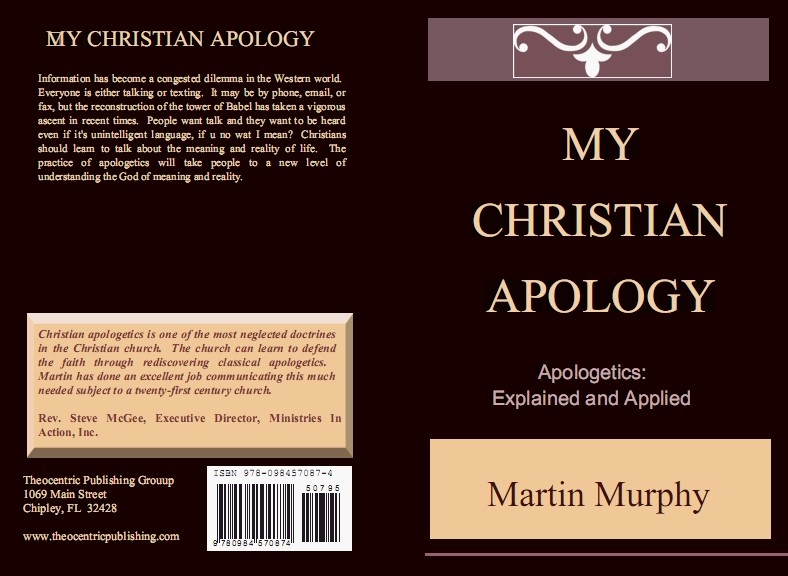 My Christian Apology by Martin Murphy provides some unique insight into apologetics. Rather than focusing upon arguments for the existence of God or methodology at the expense of historical understanding, Murphy grounds both arguments and method in history.
The book starts off with some introductory notes. What is apologetics? How do we communicate apologetics? These sections provide the groundwork of many apologetics texts. But Murphy quickly differentiates his work from most standard introductions to apologetics. His book focuses largely on epistemology and its relation to apologetics.
Murphy does a great job of making these concepts accessible to general readers. He defines epistemology (19) and then gradually eases the reader into its various applications to apologetics (19ff). A central theme throughout is that unbelievers and Christians have common grounds from which they can start discussions. One of these common grounds is Natural Law, which Murphy goes into at length (65ff). Natural Law has been repudiated by many modern thinkers, but it is grounded in Scripture and has a great theological base. I’ve reviewed a Lutheran book on the topic which I think helps show how useful Natural Law is. Murphy points out that Natural Law can provide a basis for knowledge of God. “If we know we are transgressors then we know we have violated the law of God” (73). This knowledge is not saving knowledge, but it provides a basis for judgment (84) and, I think, a possible common ground for apologetics.
Another strength of Murphy’s work is the focus upon historical apologetics. He cites Jonathan Edwards at length and in numerous places while exploring Edwards’ applications to apologetics (see 20-21, 29, 36, etc.). He also emphasizes the works of Southern Presbyterians in the area of apologetics. The historical background is a great quality of the work and one that I think Christian Apologists often fail to emphasize or utilize.
There is some emphasis on theology in My Christian Apology as well. Murphy’s discussion of natural law leads to a drawing out of the “noetic effects of sin.” Again, the points Murphy raises are clear and concise. Some readers will disagree, but all will be challenged. I find this account eminently plausible and I think that even those who disagree need to at least account for the Biblical case for original sin.
Martin Murphy’s My Christian Apology is a brief work that has a ton of great information packed into it. Questions that other basic apologetics books tend to avoid are treated with precision and lucidity. The emphasis on historical apologetics leads to many insights readers won’t find in other introductory works. I recommend that readers use this book along with other basic apologetics books in order to develop a more well-rounded apologetic method.
Source:
Martin Murphy, My Christian Apology (2010).
SDG.
——
The preceding post is the property of J.W. Wartick (apart from citations, which are the property of their respective owners) and should not be reproduced in part or in whole without the expressed consent of the author. All content on this site is the property of J.W. Wartick and is made available for individual and personal usage. If you cite from these documents, whether for personal or professional purposes, please give appropriate citation with both the name of the author (J.W. Wartick) and a link to the original URL. This blog is protected by Creative Commons licensing. By viewing any part of this site, you are agreeing to this usage policy.
Book Review: “Hidden Treasures in the Book of Job” by Hugh Ross
 Hidden Treasures in the Book of Job
Ross begins with an exhortation to Christian leaders to stop avoiding the issue of Creation and to come up with a reasonable “strategy of engagement. Christians who take the Bible as a trustworthy revelation from God need to study science and engage with scientists at the highest academic and research levels” (12). I pray Ross’s words will not fall on deaf ears.
Ross goes on to point out the historical backdrop of the book. The debaters present, Job, Eliphaz, Zophar, and Bildad were “likely the intellectual powerhouses of their day…” (28). Along with Elihu, who most likely recorded the book, they comprise the major characters. Interestingly, Eliphaz was named as a Temanite. Teman, Ross points out, “was famous in the ancient world for its exceptionally wise scholars” (28). Contrary to some who may accuse Ross of demeaning the historical value of Scripture, it is clear that he affirms the historical realism of the Book of Job.
Interestingly, HTBJ doesn’t start with the scientific questions; it dives in to “timeless questions” about God. Ross points out answers given throughout Job about the reason for death (39-40), the shorter lifespans of humans (40-41), blessings for the wicked (43ff), and more. Ross provides an argument about what is often called “natural evil.” He points out Job’s rejection of a “direct cause-and-effect relationship between destructive natural events and the people affected by them” and goes on to argue that scientifically, these “acts of God” are necessary for life (49). Hurricanes, for example, bring a number of benefits (51).
Ross quickly moves into scientific questions throughout the book of Job. He argues that God’s challenges to Job and friends reject naturalism, deism, evolutionism, and young-earth creationism (54). Job specifically points out that God continually interacts with creation. Perhaps most interestingly, Ross points out that in Job the Bible specifically points towards the Big Bang–with language of God “stretching out the heavens.” This, thousands of years before any scientific evidence existed (56-58). Not only that, but the book also alludes to dark matter. Rather than treating darkness as the “absence of light” as was the belief historically, Job points out the actual existence of darkness and its separation from light. Here again there is evidence that Job lines up powerfully with science (60-63).
Another fascinating aspect of the Book of Job, argues Ross, is its ability to speak to current situations like Global Warming (63ff).
Central to Ross’ argument in HTBJ is the thesis that the book of Job can be used as an interpretive backdrop for the Genesis creation account. Ross argues that Job 38-39 can be read in their entirety as a creation account (72). This opens the gate for interpreting other creation accounts through the lens of Job 38-39. He points out that there are areas of Moses’ creation account that Job makes explicit. Some of these points include a correct interpretation of “heavens and earth” (74); an outline of when plants were created (78-79); and perhaps most interestingly, one of the best explanations of the problem of light before the sun I’ve ever seen (80-84). Ross argues that, contrary to most interpretations, the Genesis account does not explicate that there was no sun before light, but rather that the light had been hidden by the atmosphere (82-83). Again, this would serve as powerful scientific confirmation of the Bible.
Ross is unafraid to pull his punches. He takes on the question of the extent of the flood (92ff) and argues convincingly that the flood was localized to all of humanity. Perhaps the most controversial point Ross makes is in regards to one of the best arguments for young-earth creationism–death and the Fall. Often, the young-earth argument is that the Bible excludes any possibility of death before the Fall. Ross argues that, given Job 38-39’s creation account, that interpretation can no longer be valid. He urges that Job 38:39-41 coincides with creation day five, and because these verses include death before the fall, this argument for a young-earth is unsuccessful. Ross’s argument here will really depend upon how convincing his assertion is that all of Job 38-39 lines up with the days of creation. Ultimately, I think, most young-earth creationists will remain unconvinced and argue that only the early part of Job 38 is a creation account. In Ross’s favor is the continuing tense (it appears as though the verbs throughout the section are in the Qal stem). But Ross doesn’t make this argument. Thus, it seems that this part of Ross’s argument will be convincing only to those willing to agree that Job 38-39 are, in their entirety, a creation account.
Later, Ross soundly demolishes the young-earth argument that Job provides evidence for dinosaurs living with humans. He convincingly argues that the behemoth is a hippopotamus (178-180) and the leviathan a crocodile (180-183).
Ross doesn’t leave the book of Job without discussing what seems like its primary question: suffering. He presents evidence that Job argues for both a greater good theodicy along with a free-will defense (190ff). Both of these sections are interesting, if brief.
There are many areas of interest within HTBJ I have left unexplored. Ross focuses extensively on soulish creatures and the differences between humans and animals. Most interestingly is Ross’s explication of the list of 10 “soulish” creatures named in Job and their import for humans (150-165). Suffice to say that there is much more content in the book worth reading.
There were times as I read Hidden Treasures in the Book of Job that I was filled with marvel at the magnificence of creation. At one point I stood up and surprised my wife, saying “Can you believe what God has made? And we know it from the Book of Job! Can you believe this!?” as I described some of the things Ross reveals in the book. There are some astounding ways that the Bible lines up with the evidence we have from cosmology, astronomy, biology, and other sciences. While some Christians may remain unconvinced by Ross’s argument for interpreting Genesis 1 through the lens of all of Job 7-39, the book deserves a reading and response by even those who disagree. Ultimately, readers of Hidden Treasures in the Book of Job will come away with some powerful evidence from science for the truths of Scripture–and vice versa.
Disclaimer: I was provided with a review copy of this book by Reasons to Believe. You can learn more about this science-faith think tank at reasons.org.
Source: Hugh Ross, Hidden Treasures in the Book of Job
SDG.
——
The preceding post is the property of J.W. Wartick (apart from citations, which are the property of their respective owners) and should not be reproduced in part or in whole without the expressed consent of the author. All content on this site is the property of J.W. Wartick and is made available for individual and personal usage. If you cite from these documents, whether for personal or professional purposes, please give appropriate citation with both the name of the author (J.W. Wartick) and a link to the original URL. This blog is protected by Creative Commons licensing. By viewing any part of this site, you are agreeing to this usage policy.
Book Review: “No Other God: A Response to Open Theism” by John Frame
 I recently finished No Other God
Areas of Agreement
One of the strengths of Frame’s book is how clear his thinking is. His style of argumentation is precise, and he clearly lays out what he considers evidence for his positions. He is unafraid to make statements with huge implications.
A particularly interesting aspect of Frame’s work was a brief historical look at the roots of Open Theism, leading it back to the Socinianism. Frame points out that advocates of Open Theism tend to portray their view as the “new theology on the block” despite the fact that it has been around (and rejected) for quite some time.
I believe Frame is correct when he argues against the centralization of any one attribute of God. Specifically, the centralization of love on Open Theism tends to ignore other important attributes of God (49ff). (Interestingly, Frame’s own account of God unnecessarily over-emphasizes Sovereignty, though he disguises this by calling it “Lordship.)
Frame levels strong critiques against Open Theism’s reading of Scripture. Open Theists tend to advocate the “straightforward” reading of texts which help their case. One of Open Theist’s favorite passages is God testing Abraham. Yet Frame rightly notes that if there is a straightforward reading of the text, then God did not know the present truth of Abraham’s heart, whereas Open Theists attempt to use this to support God not knowing the future (47). Further, if God was trying to figure out how Abraham would act in the future, then He was trying to do something He couldn’t (determine what the libertarian free choices of humans would be) according to Open Theism. So the story’s straightforward reading does not work to support Open Theism. Frame urges a similar examination of other passages, though he doesn’t expand on it.
Areas of Disagreement
Despite these areas of agreement, I vehemently oppose Frame’s position on several issues. Most notably, on theistic determinism, compatibilism, and libertarianism.
First, libertarianism. Frame correctly notes that the core of Open Theism is the assumption of libertarianism. Yet his critique of libertarianism is wrongheaded. He caricatures libertarians as believing that choices are made in the absence of any motivation. He writes, commenting on the libertarian view, “if our decisions are caused by anything or anyone (including our own desires), they are not properly our decisions… to be responsible, we must be able to do otherwise” (121). Yet this is explicitly not libertarianism. Peter van Inwagen, for example, explicates libertarianism by saying “…that someone’s acts are undetermined does not entail that they are uncaused” (van Inwagen, An Essay on Free Will, Oxford: 1983, p. 14).
But Frame explicitly centers his critique of libertarianism on a contra-causal account of freedom, saying, for example, “If guilt presupposed libertarian freedom, then in order to show that Hubert [a man accused of robbing a bank] is guilty, the prosecutor would have to show that his decision to rob a bank had no cause…” (126). But again, libertarians deny this very type of contra-causal freedom, so Frame is arguing against a straw man. Because Frame thinks libertarianism is so utterly central to Open Theism, this means that the core of his critique fails to hit home.
The problem with Frame’s counter against libertarianism is that it barely touches the surface of the philosophical arguments for the position. He correctly rails against the idea that our actions are just random occurrences, but incorrectly assumes that this is libertarianism.
Finally, the greatest area of disagreement I have with Frame is on his view of omnidetermination. Consider the following two quotes:
“The uniform witness of Scripture is that the evils of this life come from God” (140).
“…[I]t is important to see that God does in fact bring about the sinful behavior of human beings, whatever problems that may create in our understanding” (68).
I’d be curious to see how Frame reconciles these assertions with the constant witness of Scripture that God is just; fair; good; opposed to evil; etc. Frame utilizes several verses to support his position, but he makes primary those which say God uses “all things” and verses which say calamities are from God. But regarding the former, this can easily refer simply to permissive will, and regarding the latter, the verses he uses are out of context (and even were one to grant the “straightforward reading,” one could counter by saying the calamities are not every evil action, but merely those things which God uses–i.e. storms, other nations, etc.–to instruct His people). Frame, like many theological determinists, is not building even on sand, but on a void. Literally saying that God causes evil is so utterly repugnant and contrary to Scripture that this view overshadows all the good things Frame has to say.
Conclusions
Ultimately, No Other God is on target in a few ways, but it is wildly gunning the wrong direction on too many issues. Frame’s philosophical case against libertarianism is off the mark, he fails to deal with the strong philosophical arguments for libertarianism, and his view that God literally causes evil is baseless. Interestingly, while I went in reading this book looking for some good arguments against Open Theism, I came out with the realization that theological determinism is a far more dangerous doctrine indeed.
SDG.
Check out other posts about Open Theism here.
John Frame,No Other God
——
The preceding post is the property of J.W. Wartick (apart from citations, which are the property of their respective owners) and should not be reproduced in part or in whole without the expressed consent of the author. All content on this site is the property of J.W. Wartick and is made available for individual and personal usage. If you cite from these documents, whether for personal or professional purposes, please give appropriate citation with both the name of the author (J.W. Wartick) and a link to the original URL. This blog is protected by Creative Commons licensing. By viewing any part of this site, you are agreeing to this usage policy.
Book Review: Is There a God? by Richard Swinburne
 The purpose of Is There a God?
ITG starts off with a chapter aptly titled “God.” In this chapter (modeled after his longer work, The Coherence of Theism), Swinburne outlines the properties and concept of God. It should be noted that Swinburne’s view of God differs from classical theism in two major ways. First, Swinburne’s conception of God does not involve knowledge of the future. His reasoning is that it is logically impossible to know that which does not yet exist (the future), so God is omniscient, but does not know the future. Going into great detail for an argument against that notion would take me too far away from this review, but suffice to say that I find the argument wrong for at least two reasons: 1) There are many coherent ways to envision the future as possible knowledge; 2) A timeless view of God would definitely entail foreknowledge, because all time would be equally present to such a deity. Second, Swinburne’s view of God differs in that he believes God’s existence is contingent, not necessary (he does believe that God is necessary in the sense that his existence does not cease–the necessity/contingence is the difference between modern and Aristotelian contingency–thanks to Tim McGrew and Chris Reese for pointing this out). Again, I disagree, but I find Swinburne’s view coherent.
Swinburne then turns in chapter two to the nature of explanation and argues that we often take personal explanations as valid even within scientific inquiry. Further, he puts much weight upon the simplicity of a theory, which leads into his third chapter, which argues for the simplicity of theism as an explanation for much of our known data. These chapters sum up his work in The Existence of God.
Swinburne then turns to other arguments for the existence of God, such as the cosmological argument and the teleological argument. In chapter 6, he provides a theodicy–an explanation of evil on theism. While I’ve read some pretty harsh critiques of Swinburne’s view on the problem of evil in the past, I found his argument here very compelling, personal, and interesting. His argument is largely a “greater good” type of argument–evils allow for things like heroism–but it is the most compelling version of such a theodicy I have read. I’m still not sure about whether I would incorporate this argument into my own apologetic, but I find Swinburne’s account compelling. (More on this topic can be found in his Providence and the Problem of Evil.)
The last chapter of ITG deals with Swinburne’s discussion of miracles and the argument from religious experience. Swinburne has been hugely influential in the field of arguing for the existence of God from religious experience, and this chapter sums up his argument. He argues that “we ought to believe that things are as they seem to be (in the epistemic sense) unless and until we have evidence that we are mistaken” (115). He then goes on to apply this to theistic experiences and concludes that “the overwhelming testimony of so many millions of people to occasional experiences of God must… be taken as tipping the balance of evidence decisively in favor of the existence of God” (120). (Swinburne’s arguments here are developed in his book, The Existence of God.)
I find two downsides to ITG. First, the concise nature of the work means that those interested in his arguments will need to go beyond the book to fully explore the issues. However, this is barely a downside because that is exactly what the book is meant to be: an introduction.
The second is that Swinburne doesn’t offer a very comprehensive “Guide to Further Reading” in his chapter of the same title. For example, about the question for the existence of God, Swinburne only offers two books arguing against God’s existence for further reading. Furthermore, the two books he suggests are heavy philosophical texts not at all comparable to ITG. I would have liked to see Swinburne offer some suggestions for equally philosophical explorations on the positive side of the theistic question. (I recommend the Blackwell Companion to Natural Theology edited by William Lane Craig and J.P. Moreland and God and Necessity by Stephen Parrish as two “heavier” books on the side of theism.)
Richard Swinburne’s Is There a God?
———
The preceding post is the property of J.W. Wartick (apart from citations, which are the property of their respective owners) and should not be reproduced in part or in whole without the expressed consent of the author. All content on this site is the property of J.W. Wartick and is made available for individual and personal usage. If you cite from these documents, whether for personal or professional purposes, please give appropriate citation and provide a link to the original URL. By viewing any part of this site, you are agreeing to this usage policy.
Book Review: New Proofs for the Existence of God by Robert Spitzer
Robert Spitzer’s New Proofs for the Existence of God (hereafter NPEG) presents in rigorous detail, five arguments for the existence of God, a section discussing the plausibility of multiverse/string universe scenarios, and some philosophical discussion on methodology.
Before continuing the review, I should note that the “New” in NPEG is nuanced. Spitzer notes this himself (my guess is that it was a marketing technique. “New” refers to the evidence from cosmology and further research in philosophy which lend new power for these arguments.
Chapter 1 presents a cosmological argument. Spitzer cogently argues that “(1) If there is a reasonable likelihood of a beginning of the universe… and (2) if it is apriori true that ‘from nothing, only nothing comes,’ then it is reasonably likely that the universe came from something which is not physical reality” (Spitzer, 45). This conclusion is supported by explorations of current cosmological theories about the origins of the universe.
Chapter 2 presents the teleological argument, which Spitzer bases on the universal constants. The argument leads to the conclusion that “the odds against an anthropic condition occurring are astronomically high, making any life form… exceedingly improbable.” It is a probabilistic argument, the likes of which I defend in my article Past, Probability, and Teleology (Hope’s Reason 2011-1).
Following chapter 2 is a chapter which discusses the possibilities of inflationary cosmology and the string multiverse written by Bruce Gordon. It is extremely technical and will provide readers with cogent arguments against the possibility of a multiverse scenario circumventing the previous arguments.
Chapter 3 presents Spitzer’s metaphysical argument for the existence of God, which is full of sound argumentation along with some interesting Thomistic Philosophy wherein he discusses God’s simplicity in the most coherent way I have read. I greatly encourage readers to look into this chapter, if only for the discussion of this oft-neglected doctrine.
Spitzer follows this with Chapter 4’s metaphysical argument derived from Bernard Lonergan’s Insight, which is a subtle version of the argument from reason. This chapter was particularly good because it focuses on a little-used type of arguments for the existence of God–that if our universe is intelligible, that can only be explained by God’s existence.
Chapter 5 is an argument from contingency similar to the Leibnizian cosmological argument.
Chapter 6 engages the question of method in philosophy along with whether atheism is actually rational. I was intially put off by the title of this chapter (“Methodological Considerations and the Impossibility of Disproving God”), but happened throughout the book, I was pleasantly surprised by the rigorous arguments and enlightening conclusions Spitzer laid out.
Finally, the last two chapters outline some more considerations about the universe and the relation of humans and God.
NPEG was a surprising read for me. I went in with neutral expectations, and those were blown away. Spitzer’s knowledge of the topics in the work runs deep, and his writing style is clear and cohesive. It is genuinely exciting to read. Readers will be challenged by the arguments for the existence of God, and engaged in the details and philosophical explanations of these arguments. I highly recommend this work to those interested in advanced books on arguments for God’s existence.
——
The preceding post is the property of J.W. Wartick (apart from citations, which are the property of their respective owners) and should not be reproduced in part or in whole without the expressed consent of the author. All content on this site is the property of J.W. Wartick and is made available for individual and personal usage. If you cite from these documents, whether for personal or professional purposes, please give appropriate citation and provide a link to the original URL. By viewing any part of this site, you are agreeing to this usage policy.

 J.W. Wartick - Reconstructing Faith