C.S. Lewis
Book Review: “The Way of Dante: Going Through Hell, Purgatory, and Heaven with C.S. Lewis, Dorothy L. Sayers, and Charles Williams” by Richard Hughes Gibson
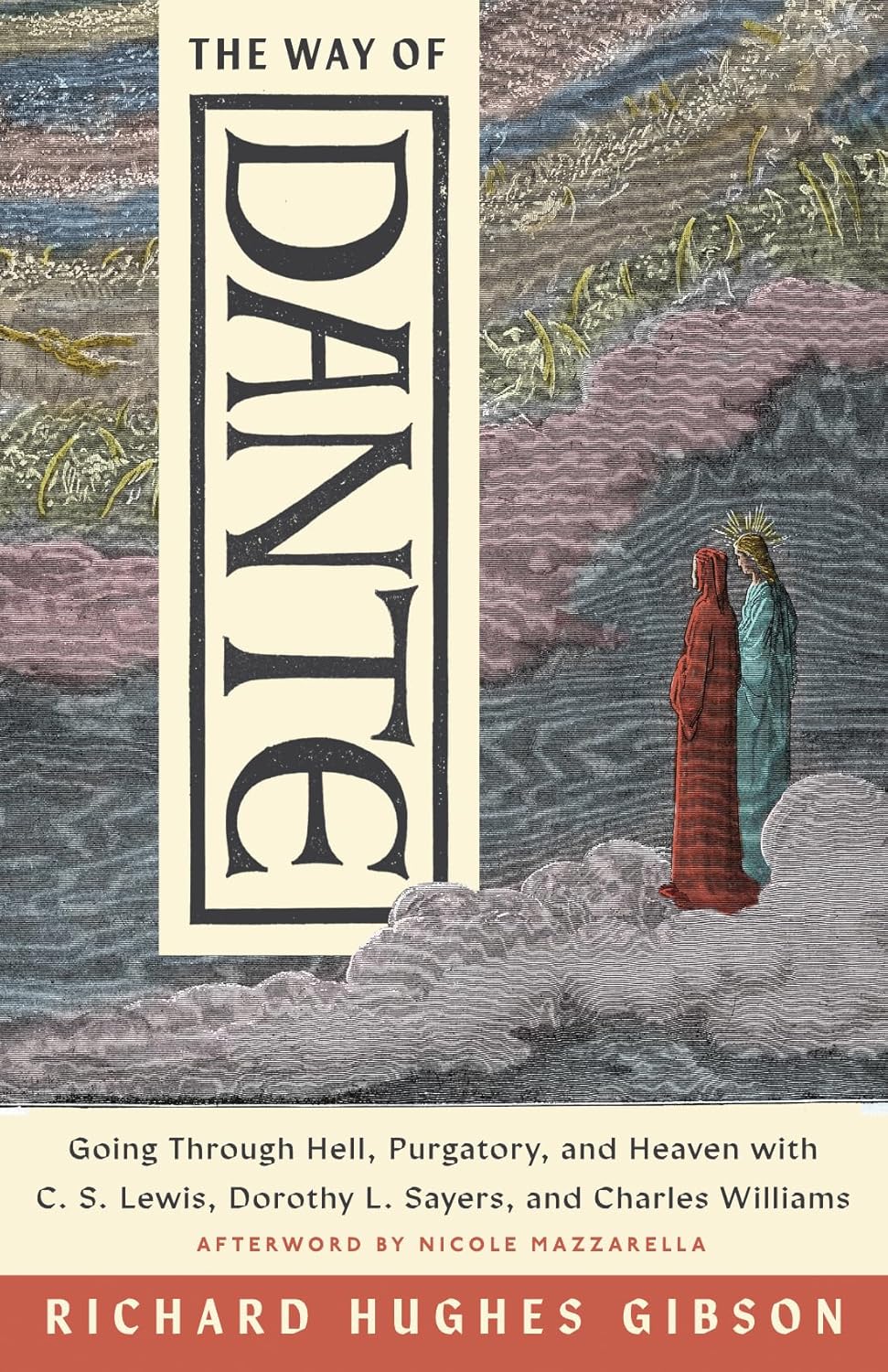
The Way of Dante explores how Dante’s works influenced C.S. Lewis, Dorothy L. Sayers, and Charles Williams. Richard Hughes Gibson leads readers through an introduction to these thinkers, followed by a number of chapters highlighting each and how Dante inspired them.
Gibson leads readers across a wide array of topics related to these authors. The topics relate directly to the notions of hell, purgatory, and heaven (as noted in the book’s subtitle). Readers are presented with the writers’ wide array of thoughts and interactions on these topics, from reflections on the concept of hell to how a concept of the glory of heaven might be most adequately described.
By way of critique, I would note that I think the book is a bit in search of its audience. Gibson seems to assume at least some amount of background knowledge not just of Dante’s works but also of scholarship related to all of the authors mentioned. This assumption of background knowledge allows Gibson to dive into deeper themes more quickly, but can leave the reader feeling a bit lost without guidance. For example, a whole chapter dedicated to allegory notes not just the use of allegory in Dante, but also interplay between authors Sayers and Lewis on the topic of allegory. But readers are mostly left to their own devices to know the finer points of what the debate is even about. Also, because the book is exploring the interactions between three major Christian thinkers and Dante, there’s a necessary brevity to the points Gibson makes. But this brevity surely makes the book less useful to the scholar (the one with all the relevant background necessary to understand or know all the references being made) who may be looking for deeper insights. In short, the book leaves readers to dive into the deep end, sink or swim.
The Way of Dante touches on a lot of interesting themes. Readers will find quite a bit to digest here, though it can feel disorienting at times with the way the information is presented.
SDG.
Book Review: “C.S. Lewis in America” by Mark A. Noll
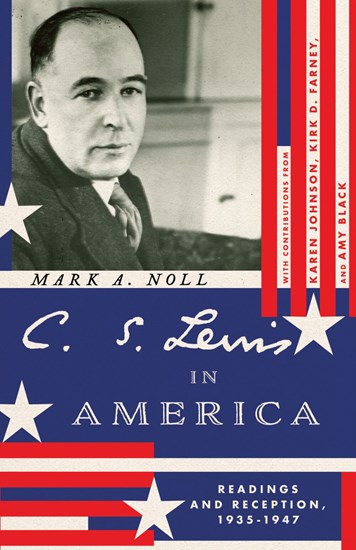
C.S. Lewis in America: Readings and Reception, 1935-1947 is a fascinating look at how C.S. Lewis was received in the United States as he published theological and other works. Mark Noll is one of the most prodigious and intriguing historians of the church in America writing today. The book is mostly focused on the question of how Lewis was received in America, but other contributors introduce a number of other topics that broadens the appeal even more.
Noll’s comments are centered around the initial, largely positive American Catholic response to Lewis, then on his reception among secular writers, and finally on Lewis’s reception among American evangelicals. Responses to these chapters focus on race and religion in America at the time of Lewis, the interplay of The Catholic Hour and The Lutheran Hour on American audiences, and the way Lewis helped foster ways of communication with Christian themes. These responses introduce a number of additional topics that are sometimes only tangentially related to C.S. Lewis, but are all well worth the time to read.
C.S. Lewis in America is a fascinating read, especially for those wanting to know more about C.S. Lewis’s reception. Noll and the other contributors introduce a number of topics that make the book quite readable and with broader appeal.
All Links to Amazon are Affiliates links
Links
Be sure to check out the page for this site on Facebook and Twitter for discussion of posts, links to other pages of interest, random talk about theology/philosophy/apologetics/movies and more!
Book Reviews– There are plenty more book reviews to read! Read like crazy! (Scroll down for more, and click at bottom for even more!)
SDG.
——
The preceding post is the property of J.W. Wartick (apart from quotations, which are the property of their respective owners, and works of art as credited; images are often freely available to the public and J.W. Wartick makes no claims of owning rights to the images unless he makes that explicit) and should not be reproduced in part or in whole without the expressed consent of the author. All content on this site is the property of J.W. Wartick and is made available for individual and personal usage. If you cite from these documents, whether for personal or professional purposes, please give appropriate citation with both the name of the author (J.W. Wartick) and a link to the original URL. If you’d like to repost a post, you may do so, provided you show less than half of the original post on your own site and link to the original post for the rest. You must also appropriately cite the post as noted above. This blog is protected by Creative Commons licensing. By viewing any part of this site, you are agreeing to this usage policy.
Book Review: “The Medieval Mind of C.S. Lewis” by Jason M. Baxter
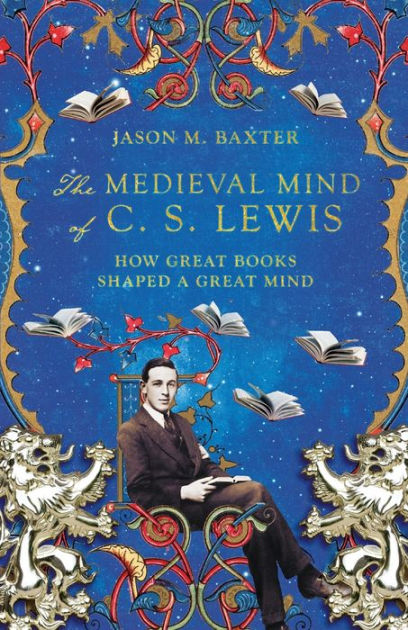
C.S. Lewis was a man deeply influenced by myth. In The Medieval Mind of C.S. Lewis, Jason M. Baxter shows how Medieval thought and “great books” shaped C.S. Lewis’s mind and thought.
The book’s short length (165 pages of text) belies the deep insights found throughout. Baxter is clearly well-versed with medieval thought, and he brings this knowledge to bear on the life, thought, and works of C.S. Lewis. Whence some of Lewis’s insights about mysticism, death, and apologetics? The answer is medieval thought. Baxter traces medieval influence on C.S. Lewis’s life, but also highlights how influential this same thought was on his works, both theological, apologetical, and more. It is beyond clear, having read the book, that Lewis was deeply committed to medieval thinking, and used that thought to critique his modern world.
I especially enjoyed how Baxter made the insights in each chapter feel somewhat applicable to today. Rather than just outlining a one-to-one correspondence of Lewis with Medieval thought, he also highlights how that thought could have impact on our own lives. For example, in the chapter on prayer, much discussion is spent on the numinous experience, ultimately bringing it home with the analogy of Lucy from Narnia as an example of how to pray. Insights like this can be found throughout the book.
The Medieval Mind of C.S. Lewis is useful both to those interested in exploring the background to Lewis’s thought and to those who wish to learn more about Medieval Christianity and thought. It’s an intriguing look at deep topics.
Disclaimer: I was provided with a copy of the book for review by the publisher. I was not required to give any specific kind of feedback whatsoever.
All Links to Amazon are Affiliates links
Links
Be sure to check out the page for this site on Facebook and Twitter for discussion of posts, links to other pages of interest, random talk about theology/philosophy/apologetics/movies and more!
Book Reviews– There are plenty more book reviews to read! Read like crazy! (Scroll down for more, and click at bottom for even more!)
SDG.
——
The preceding post is the property of J.W. Wartick (apart from quotations, which are the property of their respective owners, and works of art as credited; images are often freely available to the public and J.W. Wartick makes no claims of owning rights to the images unless he makes that explicit) and should not be reproduced in part or in whole without the expressed consent of the author. All content on this site is the property of J.W. Wartick and is made available for individual and personal usage. If you cite from these documents, whether for personal or professional purposes, please give appropriate citation with both the name of the author (J.W. Wartick) and a link to the original URL. If you’d like to repost a post, you may do so, provided you show less than half of the original post on your own site and link to the original post for the rest. You must also appropriately cite the post as noted above. This blog is protected by Creative Commons licensing. By viewing any part of this site, you are agreeing to this usage policy.
Susan Pevensie, C.S. Lewis, and Enchantment
C.S. Lewis’s Chronicles of Narnia is one of the most instantly recognizable and beloved series of children’s stories of all time. In the series, there is a land called Narnia into which human children occasionally stumble, frequently to epic and long-lasting effect. Susan Pevensie is one of these children. She’s the eldest daughter of the Pevensie clan, one of four children to enter Narnia in The Lion, the Witch, and the Wardrobe. She goes on to eventually become Queen Susan the Gentle.
Later, however, when readers encounter The Last Battle, an apocalyptic exploration of Narnia that includes many of Lewis’s own beliefs, we discover that Susan is, astonishingly, not with the other Pevensies. Susan, we are told by her somber brother Peter, “is no longer a friend of Narnia.” Apparently, she has taken to calling the former adventures in Narnia as just some games the kids played when they were younger, and she’s now much too grown-up for that sort of thing. Susan, we’re told, is much more interested in “nylons and lipstick and invitations” than she is in anything like Narnia.
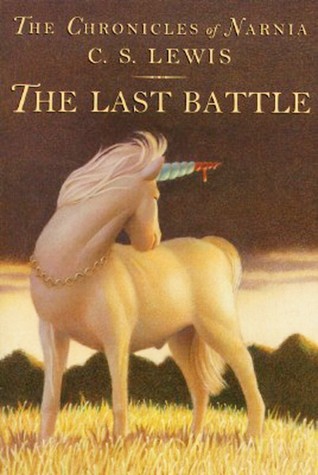
I remember the first time I read this section. I was sitting in my parochial grade school, using the free time I had during the day to voraciously read anything that came my way. This book, I’d been waiting for. I’d been scared of reading it, because the cover with the unicorn, horn bloodied, was more than a little alarming. But I’d dived in, and discovered one of the strangest adventures I’d read. I didn’t know what to make of it, what with the deceitful animals, people who ignored reality right there in front of them, and more. But then Susan hit, and it hit me like a load of bricks. Surely Susan would never forget Narnia! It felt like a betrayal. Susan, who so practically believed what she saw. Susan, who thought of bringing coats into the always-winter Narnia. Susan, who was always the reasonable one. Susan, who was the Gentle. She was no longer a friend of Narnia? How was this possible? And how was it possible that Susan, who’d literally grown into adulthood as a Queen of Narnia, pretended it was all just a game? Was this the kind of horrifying thing that would happen to me when I grew up?
There has been a lot written about the problem of Susan. A friend shared a Youtube video that explained many of the problem(s) away by contextualizing some of the things within Lewis’s own world that he may have been referencing. I enjoyed it, but some of the explanation didn’t sit right with me because it felt so much like explaining away rather than simply contextualizing. A wonderful post on Tor.com, “The Problem(s) of Susan” by Matt Mikalatos, highlighted many of the issues I have with Susan as an adult. Mikalatos concludes:
“Jack [C.S. Lewis], believe me, if Susan looks for Aslan, she’ll find him. If she asks a question, he’ll answer. If she—even in her old age, even years and years from now—finds herself finds herself alone in that great house, and wanders into the old guest room and gently, not quite believing, raps her knuckles on an ancient wardrobe door, believe me, Jack, Aslan will be waiting to throw it open. And then at last the true happily ever after can begin.”
I love that, and I think it sits so well with me as an adult. Perhaps it is true that Lewis himself didn’t allow himself an expansive enough vision of Narnia–nay, Aslan’s–power. That’s something to think about.
The child in me wonders, though, if Lewis has outwitted me again. Perhaps that scene with Susan isn’t written for the adults–it’s for the children. It’s for children who, like me, would be stunned to think that Susan could forget Narnia. It’s a scene about the loss of enchantment, and one that teaches children to never let go of the enchantment of our own world–our own Narnia. A world in which God the Son entered human flesh and gave himself to die for us.
The notion of enchantment, wonder, and myth is absolutely central to Lewis’s writings throughout his life, whether from his younger period as an atheist, or as an old man. The idea that he might be sneaking this concept into one of his most powerful–and powerfully confusing–works doesn’t seem entirely impossible. If so, then Susan is a heartrending example of the loss of enchantment. Instead of Aslan’s call, she holds out for invitations to parties; instead of donning a bow, she cares deeply for nylons. It’s a tragic story, even as it stretches the limits of imagination given the character Susan has been established to be. Perhaps it is Susan’s nature as Susan the Gentle which leads her into disenchantment–she pursues the trappings of ostensible adulthood in order to continue to act as protector to her siblings. Her mannerisms and dedication lead her, tragically, towards disenchantment. It’s an awful story, and a jarring one. Perhaps it’s meant to be.
I don’t think that’s what Lewis was doing, but I wonder. Could C.S. Lewis have been playing a final twist, a final call towards enchantment for us–as children? A call to not give up on the world, and to realize that faith and hope really are powerful. I suppose I’ll always wonder whatever happened to Susan. Mikalatos’s answer is the one that resonates most with me. But I also like the idea of enchantment–as it feels exactly like something Lewis would do. Perhaps it is.
Links
Be sure to check out the page for this site on Facebook and Twitter for discussion of posts, links to other pages of interest, random talk about theology/philosophy/apologetics/movies and more!
SDG.
——
The preceding post is the property of J.W. Wartick (apart from quotations, which are the property of their respective owners, and works of art as credited; images are often freely available to the public and J.W. Wartick makes no claims of owning rights to the images unless he makes that explicit) and should not be reproduced in part or in whole without the expressed consent of the author. All content on this site is the property of J.W. Wartick and is made available for individual and personal usage. If you cite from these documents, whether for personal or professional purposes, please give appropriate citation with both the name of the author (J.W. Wartick) and a link to the original URL. If you’d like to repost a post, you may do so, provided you show less than half of the original post on your own site and link to the original post for the rest. You must also appropriately cite the post as noted above. This blog is protected by Creative Commons licensing. By viewing any part of this site, you are agreeing to this usage policy.
Book Review: “Splendour in the Dark: C. S. Lewis’s Dymer in His Life and Work” by Jerry Root

C. S. Lewis’s writings loom large in the church today, whether because of the massive influence of The Chronicles of Narnia or his spiritual works like Mere Christianity. Jerry Root brings attention to one of his lesser-known works Dymer, a narrative poem that was written before Lewis converted to Christianity. In Splendour in the Dark, Root argues that Dymer shows Lewis’s development of spiritual growth, intellectual prowess, and writing skill in ways that reverberate through his later works.
The book begins with an annotated edition of the narrative poem, Dymer, itself (annotations from David C. Downing). This narrative poem encompasses over 100 pages of the book and is a valuable resource. The annotations from Downing consistently provide insights and points of interest for readers. The text itself is an interesting narrative though, as Downing and Root each note, it has its faults. What it does show, however, is a remarkable elasticity of thought and willingness to explore deep issues at work in Lewis’s earlier life.
Root’s chapters are composed of 3 lectures with responses about Dymer. Root highlights the importance of the narrative poem in Lewis’s life, as he had it come upon him all at once, but waited for some time before publishing it 11 years later (133). Lewis’s fascination with writing and classics included the belief that one should use “literary form to match what it was he [Lewis] wanted to say” (138). One can see this throughout his works. Lewis saw the importance of form to function and message.
The concept of mutability and change is present in Dymer as well, and Root argues that this theme is in Lewis’s notion that “reality is iconoclastic” (143ff, see also 230). The necessity of change means that indoctrination will ultimately fail (145), and that those structures humans attempt to make to endure will fall. Lewis’s fascination with myth looms large throughout the poem, and certainly in his later works (173ff). Root continues to draw from Dymer to show Lewis’s influences on his later works, though he doesn’t explicitly make those connections at times. Readers will need some familiarity and appreciation for Lewis’s works to get the most out of this book.
Each chapter has a response from another scholar in a related field. These responses are largely affirmations of what was in the lecture they append.
Fans of C. S. Lewis should consider Splendour in the Dark a must-read. It brings attention to one of his lesser-known works while also providing thoughtful analysis and application to everyday life for Christians. Recommended.
Disclaimer: I was provided with a copy of the book for review by the publisher. I was not required to give any specific kind of feedback whatsoever.
Links
Be sure to check out the page for this site on Facebook and Twitter for discussion of posts, links to other pages of interest, random talk about theology/philosophy/apologetics/movies and more!
Book Reviews– There are plenty more book reviews to read! Read like crazy! (Scroll down for more, and click at bottom for even more!)
SDG.
——
The preceding post is the property of J.W. Wartick (apart from quotations, which are the property of their respective owners, and works of art as credited; images are often freely available to the public and J.W. Wartick makes no claims of owning rights to the images unless he makes that explicit) and should not be reproduced in part or in whole without the expressed consent of the author. All content on this site is the property of J.W. Wartick and is made available for individual and personal usage. If you cite from these documents, whether for personal or professional purposes, please give appropriate citation with both the name of the author (J.W. Wartick) and a link to the original URL. If you’d like to repost a post, you may do so, provided you show less than half of the original post on your own site and link to the original post for the rest. You must also appropriately cite the post as noted above. This blog is protected by Creative Commons licensing. By viewing any part of this site, you are agreeing to this usage policy.
Book Review: “Becoming C.S. Lewis: A Biography of Young Jack Lewis (1898-1918)” by Harry Lee Poe
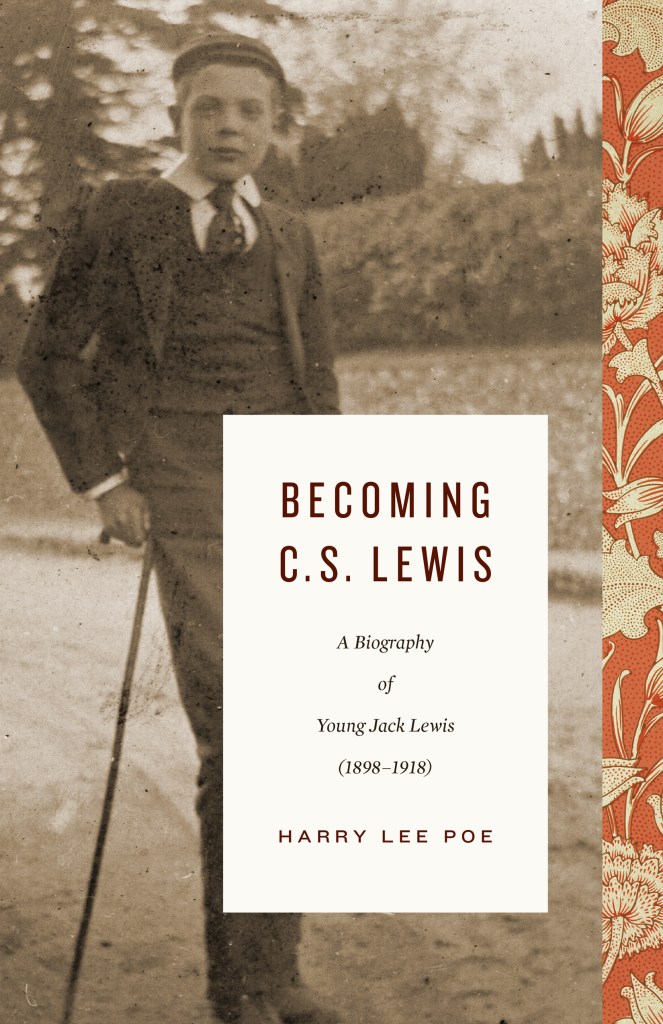
C.S. Lewis is a champion of the faith whose life story is familiar and oft-retold. Having read a couple biographies of Lewis, I was a bit skeptical of yet another biography of the man coming out–and a multi-volume one at that! What could be added? But then I saw that Harry Lee Poe wrote it, and having enjoyed some works from him in the past, I decided to give Becoming C.S. Lewis: A Biography of Young Jack Lewis (1898-1918) a try.
One thing that immediately sets the biography apart is that it is a look specifically at C.S. Lewis’s younger years. Harry Lee Poe argues persuasively that these early years of Lewis’s life were both incredibly formative and essential to understanding the man he would become. one major aspect of this book is showing Lewis’s own path of faith. The notion of Lewis going from an atheist to a Christian is well-known, but his move from being a Christian to an atheist is less commonly discussed. It’s clear from Poe’s work that Lewis essentially experienced a kind of milquetoast faith that did not appeal to him whatsoever, while eagerly pursuing certain vices as well. Some sordid details of his predilections are touched upon in this regard, and this helps readers understand Lewis more fully as well.
Another aspect of Lewis’s early life that Poe documents as being extremely important to the later man is his burgeoning interest in classics and myth. Whether it was in translating for himself some classic works or his own intense reading through various myths about King Arthur, Lewis’s interest in myth was found and nourished from an early age. There is little question that it stuck with him for the rest of his life and became essential to understanding the man he became. Lewis’s complex familial relations are also touched upon throughout this biography, as the influence of his brother and family on his life is drawn out by Poe in some detail.
Poe writes this biography in a voice that immediately grabs the reader. He is both sympathetic to the subject while also not excusing character flaws. His writing is well-suited to biography and as one reads Becoming C.S. Lewis, one feels as though one is engaged in a conversation with the author about the fascinating subject.
Becoming C.S. Lewis is a fascinating, detailed look at the earliest parts of C.S. Lewis’s life. Poe is a skilled author with a deep knowledge of the subject, and that makes this biography a must-read for those even remotely interested in the life, theology, or fiction of C.S. Lewis. Highly recommended.
Disclaimer: I was provided with a copy of the book for review by the publisher. I was not required to give any specific kind of feedback whatsoever.
Links
Be sure to check out the page for this site on Facebook and Twitter for discussion of posts, links to other pages of interest, random talk about theology/philosophy/apologetics/movies and more!
Book Reviews– There are plenty more book reviews to read! Read like crazy! (Scroll down for more, and click at bottom for even more!)
SDG.
——
The preceding post is the property of J.W. Wartick (apart from quotations, which are the property of their respective owners, and works of art as credited; images are often freely available to the public and J.W. Wartick makes no claims of owning rights to the images unless he makes that explicit) and should not be reproduced in part or in whole without the expressed consent of the author. All content on this site is the property of J.W. Wartick and is made available for individual and personal usage. If you cite from these documents, whether for personal or professional purposes, please give appropriate citation with both the name of the author (J.W. Wartick) and a link to the original URL. If you’d like to repost a post, you may do so, provided you show less than half of the original post on your own site and link to the original post for the rest. You must also appropriately cite the post as noted above. This blog is protected by Creative Commons licensing. By viewing any part of this site, you are agreeing to this usage policy.
Book Review: “Richard Dawkins, C.S. Lewis, and the Meaning of Life” by Alister McGrath
Alister E. McGrath, in Richard Dawkins, C.S. Lewis, and the Meaning of Life, constructs a pithy look at the titular question through the lenses of two of the most famous (or infamous, depending your leanings) thinkers of the last century.
This short volume features four chapters about, respectively, why meaning matters, reasoned belief, whether there is a God, and what human nature is. C.S. Lewis and Richard Dawkins almost could not be more far afield in their answers to these questions, but McGrath does a good job integrating thoughts of each of them into the text so that readers can understand some of the answers they gave.
What may surprise readers at times is how Dawkins’s views effectively take to extremes some of Lewis’s cautions. For example, Dawkins is highly critical of myth and the notion of letting it control our lives. But Lewis isn’t an ignorant fool simply because he was a Christian. Lewis himself offers cautions regarding the way that myths can lead to stigmatization and false beliefs (13). On another extreme, Dawkins purports to believe that science is proof and effectively nothing else is. But Lewis notes that the very concept of proof is illusive even on some physical questions. Do we need to discount the possibility of any true beliefs simply because we cannot prove them?
What is perhaps most interesting is the very brief synthesis of thought McGrath offers near the end, where he notes that while these thinkers disagree sharply on the meaning of various questions, they agree that there are problems in the way of pursuing human goals and that there are limitations on human nature. For Dawkins, the primary thing in the way, so to speak, is our own genetic and evolutionary past, to which we may be dancing whether we want to or not. For Lewis, the captivity of sin has engulfed us and prevented us from pursuing goals.
Ultimately, McGrath leaves the questions open ended at the close of the book. What he accomplishes in Richard Dawkins, C.S. Lewis, and the eaning of Life is to get readers to consider these deep questions and perhaps how they may relate to each other. He also opens up avenues for further exploration.
Disclaimer: I was provided with a copy of the book for review by the publisher. I was not required to give any specific kind of feedback whatsoever.
Links
Be sure to check out the page for this site on Facebook and Twitter for discussion of posts, links to other pages of interest, random talk about theology/philosophy/apologetics/movies and more!
Book Reviews– There are plenty more book reviews to read! Read like crazy! (Scroll down for more, and click at bottom for even more!)
SDG.
——
The preceding post is the property of J.W. Wartick (apart from quotations, which are the property of their respective owners, and works of art as credited; images are often freely available to the public and J.W. Wartick makes no claims of owning rights to the images unless he makes that explicit) and should not be reproduced in part or in whole without the expressed consent of the author. All content on this site is the property of J.W. Wartick and is made available for individual and personal usage. If you cite from these documents, whether for personal or professional purposes, please give appropriate citation with both the name of the author (J.W. Wartick) and a link to the original URL. If you’d like to repost a post, you may do so, provided you show less than half of the original post on your own site and link to the original post for the rest. You must also appropriately cite the post as noted above. This blog is protected by Creative Commons licensing. By viewing any part of this site, you are agreeing to this usage policy.
Book Review: “Seasoned Speech: Rhetoric in the Life of the Church” by James E. Beitler III
 Rhetoric is a discipline that is rarely taught or even discussed anymore, even in scholarly circles. James E. Beitler III attempts to show the importance of rhetoric not just to Christian witness but to a full Christian life in Seasoned Speech: Rhetoric in the Life of the Church. He does this by outlining how five major Christian voices used rhetoric in their lives: C.S. Lewis, Dorothy L. Sayers, Dietrich Bonhoeffer, Desmond Tutu, and Marilynne Robinson.
C.S. Lewis is discussed in light of how he used rhetoric and worship to see the goodwill of Advent. His persuasive style and study of rhetoric helped him to become one of the most revered thinkers of the 20th century. C.S. Lewis addresses audiences on their own terms, adopted a humble stance, and cultivated communities. Again, this was centered around goodwill–the ultimate well-being of humanity through resurrection life with God (36-37). Dorothy Sayers used rhetoric and credal worship to emphasize the “energy of Christmastide” as Beitler puts it. Through vivid depictions and tranquil scenes, she made a rhetoric-filled argument for Christianity. Sayers’s He That Should come stirred up controversy in her own time, and Beitler quotes a remarkable defense Sayers offered of her portrayal of Christmas in which she talks about Christ being born “into this confused, coarse, and indifferent world… He was a real person, born in blood and pain like any other child, and dying in blood and pain, like the commonest thief…” The lifelike depictions of Sayers language comes through in the chapter dedicated to her, and shows how the persuasive rhetoric of her Christian witness played out.
Dietrich Bonhoeffer is used by Beitler to exemplify the use of preaching the Word and epiphanic identification–the hiddenness and reality of Christ the God-man. The “strange glory” of epiphany is that Christ comes to be identified with us–to be a human person. Even more radically, Bonhoeffer’s rhetoric led to the identification with Jewish Christians and taking a stand against those who would refuse to do so in Nazi Germany. Preaching, for Bonhoeffer, involved bringing the Word to the hearers ears, which would itself lead to identification with the Word. The word of God itself “is the exclamation point that we do not need to add,” said Bonhoeffer (115-116).
The chapter on Desmond Tutu was particularly fascinating, both in noting how Tutu’s wholly religious rhetoric led to calls for repentance and reconciliation and also how that same religious fervor led to accusations of divisiveness and triumphalism during the end of Apartheid in South Africa. Tutu’s prophetic rhetoric issued a stirring call for repentance from racial division and unity of the body of Christ. Marilynne Robinson has become a significant voice in Christianity through her fiction, which, through the Gilead Trilogy, uses rhetoric to make “faith’s unseen realities more believable and faith’s central questions more significant for unbelievers” and believers (162-163). Beitler notes the use of themes in the trilogy that help usher in a sense of ethos of Easter that makes sense of Christianity in real-world ways.
Throughout the book, Beitler does a good job of putting forward the ideas of those speakers/writers he wishes to highlight while allowing his own narrative and writing to take a back seat. Seasoned Speech is itself an execise in rhetoric, calling readers to a better appreciation of and for both the content of the writings and speeches of the people highlighted but also to go forth and learn more. I, for one, ended up putting holds on a number of works about and by several of the authors discussed, and I look forward to continuing to learn about their “seasoned speech” (a reference to Colossians 4:6).
Seasoned Speech: Rhetoric in the Life of the Church is a remarkable call to enjoy and learn from several fascinating thinkers in recent Christian history. It is the kind of book that calls for reading and re-reading and absorbing. I highly recommend it.
Disclaimer: I was provided with a copy of the book for review by the publisher. I was not required to give any specific kind of feedback whatsoever.
Links
Be sure to check out the page for this site on Facebook and Twitter for discussion of posts, links to other pages of interest, random talk about theology/philosophy/apologetics/movies and more!
Book Reviews– There are plenty more book reviews to read! Read like crazy! (Scroll down for more, and click at bottom for even more!)
SDG.
——
The preceding post is the property of J.W. Wartick (apart from quotations, which are the property of their respective owners, and works of art as credited; images are often freely available to the public and J.W. Wartick makes no claims of owning rights to the images unless he makes that explicit) and should not be reproduced in part or in whole without the expressed consent of the author. All content on this site is the property of J.W. Wartick and is made available for individual and personal usage. If you cite from these documents, whether for personal or professional purposes, please give appropriate citation with both the name of the author (J.W. Wartick) and a link to the original URL. If you’d like to repost a post, you may do so, provided you show less than half of the original post on your own site and link to the original post for the rest. You must also appropriately cite the post as noted above. This blog is protected by Creative Commons licensing. By viewing any part of this site, you are agreeing to this usage policy.
Book Review: “Haunted by Christ: Modern Writers and the Struggle for Faith” by Richard Harries
 Haunted by Christ is a riveting look at how modern writers dealt with lingering doubts, anger, sorrow, and the question of Christianity. Richard Harries asks readers to engage with several writers to ask them questions that might not normally be asked, and he challenges readers in ways that are intricately tied into these authors’ lives.
First, it is worth pointing out that the concept of “modern” here is being used in the technical sense, related to modernism. Harries sets this period starting with Fyodor Dostoevsky (1821-1881) and Closing in the early 20th century. The authors Harries surveys are Dostoevsky, Emily Dickinson, Gerard Manley Hopkins, Edward Thomas, T.S. Eliot, Stevie Smith, Samuel Beckett, W.H. Auden, William Golding, R.S. Thomas, Edwin Muir and George Mackay Brown, Elizabeth Jennings, Graham Greene with Flannery O’Connor, Shusaku Endo, and Evelyn Waugh, C.S. Lewis and Philip Pullman, and Marilynne Robinson. Readers familiar with the works of these authors will know they run the gamut from skeptics to devout Christians. What ties them together, in Harries reading, is that their works are “haunted” by the supernatural, and specifically through a grappling with the person of Jesus Christ.
As a reader, I was unfamiliar with many of the authors, not having read much from the modernist movement. (This line makes me want to say sorry to my English teachers.) Nevertheless, Harries gives enough biographical information on each author to understand the points he’s making. Indeed, most of the information in the book is biographical, as Harries draws out each authors’ struggle with faith and coming to terms with the person of Jesus Christ. Even the skeptics surveyed clearly interact with Christianity, even if in negative ways.
I found several chapters of particular interest. Seeing C.S. Lewis’s and Philip Pullman’s competing mythologies set alongside each other for examination was fascinating. The chapter on W.H. Auden and his quiet, almost “polite” faith drew to light the great impact culture can have on one’s perception of religion and the work of God. The chapter on Golding makes me want to read more from him, despite not enjoying The Lord of the Flies. Emily Dickinson as “smouldering volcano” was an insightful look at a phenomenally successful poet. Each chapter had something that struck me, though the book also left me wishing I did know more about the authors and their works. I suspect Harries would be pleased to know his work led me to reach out and start reading some of these other works.
The biographical way Harries writes integrates worldview questions into the writings of each author. It never felt as though he subverted their own personal narratives, however. He didn’t pull punches in describing the way a skeptic like Pullman spoke about religion. Nor did he cover up aspects of authors’ lives that some might find unappealing. It’s an honest, almost unyielding book. It made me uncomfortable at times, but in ways that challenged me to learn and understand.
Haunted by Christ is a fascinating work. Harries offers insight and vision into Christianity in ways that I hadn’t really thought of before. It made me want to read many of the authors mentioned. And it made me want to know what someone who actually was more familiar with these authors might think. Recommended.
Disclaimer: I was provided with a copy of the book for review by the publisher. I was not required to give any specific kind of feedback whatsoever.
Links
Be sure to check out the page for this site on Facebook and Twitter for discussion of posts, links to other pages of interest, random talk about theology/philosophy/apologetics/movies and more!
Book Reviews– There are plenty more book reviews to read! Read like crazy! (Scroll down for more, and click at bottom for even more!)
SDG.
——
The preceding post is the property of J.W. Wartick (apart from quotations, which are the property of their respective owners, and works of art as credited; images are often freely available to the public and J.W. Wartick makes no claims of owning rights to the images unless he makes that explicit) and should not be reproduced in part or in whole without the expressed consent of the author. All content on this site is the property of J.W. Wartick and is made available for individual and personal usage. If you cite from these documents, whether for personal or professional purposes, please give appropriate citation with both the name of the author (J.W. Wartick) and a link to the original URL. If you’d like to repost a post, you may do so, provided you show less than half of the original post on your own site and link to the original post for the rest. You must also appropriately cite the post as noted above. This blog is protected by Creative Commons licensing. By viewing any part of this site, you are agreeing to this usage policy.
Book Review: “Mad or God?” by Pablo Martinez and Andrew Sims
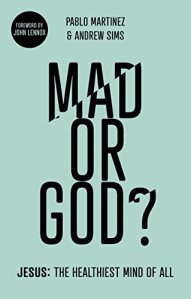 C.S. Lewis’s famous trilemma is central to Martinez and Sims’s investigation in Mad or God? That trilemma states:
A man who was merely a man and said the sort of things Jesus said would not be a great moral teacher. He would either be a lunatic… or else he would be the devil of hell…” (cited on page xi)
The trilemma, then, is that Jesus is, as many have put it, mad, bad, or God (or Liar, Lord, or Lunatic). In Mad or God?, Martinez and Sims examine the claim in light of whether Jesus can be read as a madman. What’s interesting is that, unlike many works on the trilemma (or ones which reference it), this one is written by two who have expertise in the topic. According to the author blurbs, Pablo Martinez is a psychiatrist and Andrew Sims is a “world-renowned authority on the study of the symptoms of the mind (psychopathology).”
The book is centered around chapters which examine Jesus’s words in the Gospels and looking at whether, from a psychiatric standpoint, they qualify as various forms of psychopathy. These chapters examine, then, whether Jesus was mentally disturbed, psychotic, suffered from mental impairment, had a questionable character, lived a consistent life, sustained healthy relationships, was tested by adversity, had a positive influence, and made claims that might be sustained.
Each chapter is fairly short and gets straight to the heart of the claim. While acknowledging the difficulty with psychoanalysis of people who are long-dead, the authors work with the information on hand–the words and acts of Jesus in the Gospels. For example, in the chapter on psychosis, the authors outline the symptoms of psychopathy and look at the accusation of the same for Jesus. Of particular interest is the reaction of Jesus’s family, which the authors argue is understandable given the claims Jesus was making. Then, the authors go through individual symptoms of psychosis and argue that Jesus does not cohere with these symptoms. This is essentially the model for each chapter of the book, making it an easy reference for those interested in the trilemma argument. If someone says that Jesus was mentally impaired, flip to that chapter and see why we may trust he was not. If they wish for positive evidence of soundness of mind, a perusal of the chapters on relationships and consistency will serve.
An objection that might immediately come up to this work is that if the Gospels are not trustworthy historical accounts of Jesus’s words, then the whole argument falls apart. Sims and Martinez essentially leave this argument to others, and indeed there are many, many works which seek to answer this objection. Essentially, this book’s aim is to show that if we take the words and actions of Jesus as having been reported in a trustworthy manner, then it is clear that Jesus is not a lunatic.
Mad or God? is a unique and pithy look at one of the most popular arguments for the deity of Christ. With its short length, it does not comprehensively deal with every issue that may come up, but as a quick reference for those wishing to make this argument, it is excellent.
Links
Be sure to check out the page for this site on Facebook and Twitter for discussion of posts, links to other pages of interest, random talk about theology/philosophy/apologetics/movies and more!
Book Reviews– There are plenty more book reviews to read! Read like crazy! (Scroll down for more, and click at bottom for even more!)
SDG.
——
The preceding post is the property of J.W. Wartick (apart from quotations, which are the property of their respective owners, and works of art as credited; images are often freely available to the public and J.W. Wartick makes no claims of owning rights to the images unless he makes that explicit) and should not be reproduced in part or in whole without the expressed consent of the author. All content on this site is the property of J.W. Wartick and is made available for individual and personal usage. If you cite from these documents, whether for personal or professional purposes, please give appropriate citation with both the name of the author (J.W. Wartick) and a link to the original URL. If you’d like to repost a post, you may do so, provided you show less than half of the original post on your own site and link to the original post for the rest. You must also appropriately cite the post as noted above. This blog is protected by Creative Commons licensing. By viewing any part of this site, you are agreeing to this usage policy.

 J.W. Wartick - Reconstructing Faith