christian apologetics
A Vision for Christian Apologetics to World Religions
 Christian Apologists seem to only rarely focus upon world religions. Perhaps that is because many Christian apologists feel uncomfortable interacting with other religions. It is easy to be weighed down by fears that one might say something wrong and be deemed either ignorant or bigoted. It may also be simply that Christian apologists don’t feel they have the expertise do operate in this area. It is my goal in this post to paint in broad strokes and provide areas of development for Christian apologetics and theology regarding world religions. Because I’m painting in broad strokes, I’ll be raising many questions I’ll leave unanswered for now. I’ve included links at the end of the post for those interested in reading more.
A Vision for Christian Apologetics and World Religions
It has been said that evangelicalism needs a theology of religions. What does the existence of other religions mean? Do they have truths? How do we interact with them? These questions must be addressed by Christians who desire to explore the reality of their faith. Christian apologists, in particular, must be learned enough to know what position they take on these issues before they seek to defend their faith.
The study of another religion should not be done superficially. It is a good start to have a general volume on “world religions” and then read each religion’s respective section, but it is not nearly enough for the Christian apologist to do if the apologist desires to interact with believers from these other religions. A study of another religion, particularly for those interested in witnessing to them, must be more in-depth. The holy book(s) of the other religion is(are) necessary reading. But one cannot stop there. Few religions are based upon one book. Christians can readily acknowledge this, having had much thought and belief defined through tradition, apostolic and patristic. Similarly, when a Christian studies another religion, he or she must be willing to delve into the religion, to understand it from an insider’s perspective.
It is not enough for the apologist to read books about other religions, seeking to find fast and easy ways to refute them. Rather, the Christian apologist must engage with believers of other faith, acknowledging shared truths where they exist and seeking to understand the differences. Certainly, apologists must know the areas of weakness in other religions so that they can point these out as they debate and dialog on the religions. What I’m suggesting is that this cannot be the only thing Christians know about other religions. They must not be satisfied merely by knowing a series of arguments against those from other religions. Rather, they must be willing and able to engage with those in other religions.
Thus, this vision for Christian Apologetics to World Religions is a vision not just of debate but of dialog; a vision of give-and-take. The Gospel will not be heard where it is beat into people. It will not be heard where the only avenues for its witness are arguments. Paul wrote,
Although I am a free man and not anyone’s slave, I have made myself a slave to everyone, in order to win more people. (1 Corinthians 9:19)
The attitude of the apologist is a servant’s heart–one that seeks to understand. In understanding, he or she will win many. Thus, when apologists approach another religion, they must understand that religion enough to engage with those who believe it and who live it. The Christian apologist must not deceive, but rather seek to understand. In understanding, Christians will understand more about their own faith, and be better able to spread it to those of other faiths.
There are five major things to keep in mind when doing apologetics regarding world religions:
- Know what the other believes. Never assume you know their faith as much as they do.
- Read their book. Nothing will open up avenues for discussion as much as the knowledge that you have read the books they find holy.
- Know Christianity. If you don’t know what you yourself believe, how are you to share that with others? As you engage with people of other faiths, you must continue to learn about your own faith and its answers to the questions others pose.
- Preach the Gospel. The goal should not only be to rebut the others assertions and beliefs. It should be to guide the other towards Christ crucified and the salvation provided for by God.
- Build a Genuine Relationship. It isn’t enough to simply engage in dialog; one must show they are interested in what the other has to say and what they believe. They must also be more than an occasional debate partner; they must build a relationship and become a friend. I’m not suggesting deception here, the relationship must be genuine. By showing a Christlike life to others, we can show them the intimate joys of Christianity.
Going forward, it is time to turn to a method for Christian Apologists to learn about other religions.
 Studying a Religion: A Method of Learning for Christian Apologists
- Read general discussions about the religion. A book on world religions is a good place to start, but be aware that these are, by necessity, generalized.
- Read what other Christians have said about the religion. Neighboring Faiths by Winfried Corduan is a simply phenomenal resource which surveys the world religions from a Christian perspective.
- Read the holy books of the religion with which you are going to interact. If you wish to engage a Muslim, read the Quran. If you want to interact with a Taoist, read the Tao Te Ching. As you read these books, keep in mind that you will find truths in other religions due to God’s natural revelation to all people.
- Seek out believers from the religion, and engage with them in discussion. Ask them what they believe, but don’t allow your questions to be that general. Instead, focus on specifics. For example, “If I were seeking to learn more about your religion and beliefs, how would I go about doing so?”; “What is[are] your favorite passage[s] from your holy book, and why?” Questions like these will show them you’re not seeking to attack but to understand.
- Read web sites dedicated to explaining other religions to those seeking. In this way, you will get a basic introduction to the religion while also viewing it from an insider’s perspective.
- Read other Christians who have engaged these religions in dialog and mission work.
- Consider responses from scholars within the religion to Christians working in that field. Be familiar with arguments for and against the positions you seek to put forward.
- Above all, read God’s word. Only by being familiar with the Bible will one become an effective apologist and missionary. Jesus’ words will draw people from all backgrounds, and the Bible’s richness and truth will gain a hearing from all nations.
This list is, of course, not comprehensive. It merely provides avenues for research.
What to do with the knowledge?
Christians must engage with those of other faiths. Seek out those who are willing to discuss their faith with you. You will find that many interesting discussions will follow and you will learn much about yourself and Christianity in the process. Never stop seeking truth. All truth is from God. If someone from another faith says something which challenges you, seek the answer. There are thousands of years of Christian writing out there just waiting to be tapped. Not only that, but simple searches online will turn up innumerable apologetic resources. Do not let the discussions turn into debates only. Debates are good when there is an audience of people who may be swayed one way or the other, but in individual conversation, your goal should be to spread the Gospel, not to win an argument.
Become a prayer warrior. Do not let a day go by where you do not pray for those with whom you are engaged in discussions about the faith.
Tap your fellow resources. There are many other Christians working in the areas of religions, and they are willing to help. Do not be afraid to ask for it when needed.
Conclusion
The vision for Christian apologetics and world religions I’ve put forth here is admittedly vague, but I hope it will provide a way forward for those interested in dialog with those of other faiths. This vision has followed five primary thoughts: know the other’s faith, read their book, know Christianity, preach the Gospel, and build a genuine relationship. The most important thing to remember is that as a Christian it is your duty to spread the Gospel. Do not let yourself come in its way.
Resources
Some argue that there is no real way to tell whether any religions are true. That is not the case. There are some very real ways to determine truth in a religious paradigm. Check out this post: “Can we evaluate worldviews? How to navigate the sea of ideas.”
What about the truth found in other religion? How do we relate that to Christianity? Kenneth Samples is an amazing writer in this area. Check out this post in which he provides a way forward for thinking about other religions from a Biblical perspective: “Thinking Biblically About the World’s Religions.”
I highly recommend Winfried Corduan’s book Neighboring Faiths.
What about some of those unanswered questions–what about the unevangelized? This is matter of considerable debate and there are numerous books on the topic. I would recommend “What About Those Who Have Never Heard?” for an introduction to these views. For those wanting to explore inclusivism further, see No Other Name by John Sanders. Those interested in exclusivism/particularlism, see Is Jesus the Only Savior? by Ronald Nash.
SDG.
——
The preceding post is the property of J.W. Wartick (apart from citations, which are the property of their respective owners) and should not be reproduced in part or in whole without the expressed consent of the author. All content on this site is the property of J.W. Wartick and is made available for individual and personal usage. If you cite from these documents, whether for personal or professional purposes, please give appropriate citation with both the name of the author (J.W. Wartick) and a link to the original URL. If you’d like to repost a post, you may do so, provided you show less than half of the original post on your own site and link to the original post for the rest. You must also appropriately cite the post as noted above. This blog is protected by Creative Commons licensing. By viewing any part of this site, you are agreeing to this usage policy.
“A New Vision for Natural Theology” A Book Review of “The Open Secret” by Alister McGrath
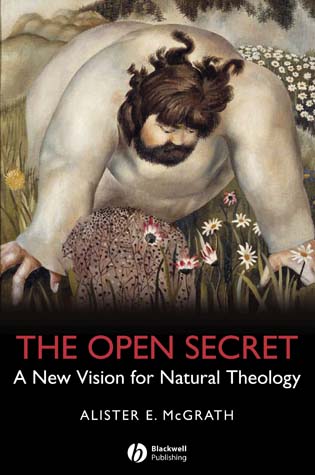 Alister McGrath is a well-known name in Christian philosophy, science, and apologetics. His book, The Open Secret
Natural theology, according to McGrath, is not just a way to argue for the existence of God. Rather, “The enterprise of natural theology… is one of discernment, of seeing nature in a certain way…” (3). He argues that natural theology in fact should not be viewed as a system to prove the existence of God. Rather, it “addresses fundamental questions about divine disclosure and human cognition and perception. In what way can human beings, reflecting on nature by means of natural processes, discern the transcendent?” (5, emphasis his). Natural theology can be seen as an entire worldview, put forth to view the world in a certain way (17).
McGrath, after outlining his vision thus, turns to the human experience of the transcendent. He focuses on three thinkers- Iris Murdoch, Roy Bhaskar, and John Dewey (41ff). He then turns to various ways humans have accessed the transcendent (59ff) and includes an evaluation of the psychology of perception (80ff).
He once more emphasizes the need to see natural theology as a type of “seeing” (115) and turns to Jesus to demonstrate the approach McGrath favors. Jesus’ parables are a model for natural theology, argues McGrath. They are “open… the interpretation is generally left indefinite and imprecise… the imagery of the parables is readily grasped [but] their meaning is often veiled…” (120-121). Similarly, nature itself is easy to grasp, but it has hidden meanings which can only be perceived by viewing the world in a certain way (126ff).
The Enlightenment approaches to natural theology have been largely unsuccessful historically and are in need of modification (140ff).
A Christian approach to natural theology should focus on “seeing” God in the natural. God has chosen to “self-disclose in history and nature” (178) and natural theology can reveal God in nature (178ff). Christian natural theology is “eschatological… The fading beauty and goodness of the world are to be interpreted in the light of the hope of their restoration and renewal” (206).
Natural theology must also break out of its boundaries. It is not just the realm of philosophical reflection, but also opens many points of contacts with the world. It is “about perceiving nature in a certain way” (221). Beauty, goodness, and truth are all aspects of reality which can be drawn out through a Christian Natural Theology (222ff). Again,
“natural theology… cannot be regarded as ‘proving’ God’s existence. Rather, it insists that the existence of a God such as that proposed by the Christian tradition makes sense of what may be observed of the world. Such an approach holds that there is an accumulation of considerations which, though not constituting logical proof (how could experience prove anything in such a way?), is at the very least consistent with the existence of a creator God (233).
The goal is not proof but a demonstration of consistency, which will “reinforce the plausibility” of Christianity (234).
Beauty and goodness draw out the reality of the Christian vision of the world. Beauty must not be neglected in natural theology (262ff). Beauty “can… call us, seeking a response” (283). Goodness underlies the resonance with natural law and the moral truths that can be seen as built in to “the fabric of the universe” (293ff).
McGrath concludes by urging readers to see natural theology as a key to open the “mysteries” and “hidden meaning” of nature’s “open secret” (314-315). Natural theology is primarily a vision–a way of viewing the world. The goal of the natural theologian, therefore, is to show how the reality of the world resonates best with a Christian worldview.
There is little to find at fault in McGrath’s powerful work. The Open Secret has enormous depth and breadth. Few areas of development are left unexplored. As one who has great interest in natural theology and who frequently discusses it, this reader must agree with McGrath that the arguments of natural theology often don’t work as proofs so much as pointers. Few are willing to embrace Christianity due only to an argument from natural theology, but the arguments themselves can be used to show how Christianity touches and explains many aspects of reality. McGrath’s vision is really an expanded “cumulative case”; one which focuses not just on many arguments, but brings the beauty of the world and its inherent goodness (while acknowledging ugliness and evils) into the folds of natural theology.
Alister McGrath’s The Open Secret provides a vision for the development and integration of natural theology into the arts, the sciences; indeed, into every aspect of life. It is a vision that will resonate with readers and drive them to see Christianity as an integrated whole. The book is, without a doubt, a must read.
Source
Alister McGrath, The Open Secret
SDG.
——
The preceding post is the property of J.W. Wartick (apart from citations, which are the property of their respective owners) and should not be reproduced in part or in whole without the expressed consent of the author. All content on this site is the property of J.W. Wartick and is made available for individual and personal usage. If you cite from these documents, whether for personal or professional purposes, please give appropriate citation with both the name of the author (J.W. Wartick) and a link to the original URL. This blog is protected by Creative Commons licensing. By viewing any part of this site, you are agreeing to this usage policy.
Guest Post: “The Vision of Literary Apologetics” by Holly Ordway
Why is apologetics, the defense of the Christian faith, important?
In one sense, Christianity needs no defense. God, who is Father, Son, and Holy Spirit, does not depend for His existence on our belief. However, many people who do not know the living God are separated from Him in part by intellectual obstacles. Removing those obstacles by showing that Christianity indeed makes sense on a rational level is an act of love and care for our neighbor. Defending the faith also builds up a strong foundation for believers. A securely built house has a solid, well-built foundation, so that the vagaries of wind and weather don’t damage it or cause distress to the inhabitants. It’s natural to have questions and doubts – think of the disciples, asking Jesus “increase our faith!” or the man who cries out “Lord, I believe: help my unbelief!” Apologetics helps strengthen the foundations by providing answers to questions and doubts, so that the Christian can grow stronger in his or her faith.
What about “literary apologetics”?
 Literary apologetics is that mode of apologetics that functions through the use of the Imagination in stories, poetry, drama, and song. Imagination is a mode of knowing; it is the twin sister of Reason. Imagination that is not grounded in Reason can become what JRR Tolkien called “morbid fantasy,” unhealthy and unhelpful; conversely, Reason that is not supported by Imagination can become sterile, rigid, and unfruitful. Literature is particularly well suited to bring these two often-separated sisters together, so that Reason and Imagination can illuminate the path to truth.
Stories, poetry, and drama can help us to both comprehend the truth (with our intellect) and apprehend it (imaginatively and emotionally). As with rational argument, literature cannot in itself bring a person to know Christ, but it can open doors, challenge assumptions, and most importantly provide a glimpse of experienced truth. Stories invite readers to indeed “taste and see that the Lord is good” (Psalm 34:8).
Literature can best fulfill this role when the author is committed both to expressing the truth and to creating a good story. The best literary apologists – CS Lewis, JRR Tolkien, GK Chesterton, Dorothy Sayers, and others, just to name those of the past century – did not set out to wrap a moral in a story, or explicitly to promote Christianity through their fiction writing. Rather, they believed fully and deeply, and sought to glorify God in all that they did – and so their stories show the truth, in deep and satisfying ways.
Today, we need a new generation of Christian writers who will do what those great writers did. We need well-informed, thinking Christians, who know their Scripture and theology, are committed to living out the Christian life in word and deed, and show forth that living truth in their work.
We need writers who will immerse themselves in the best writing of centuries past and learn from it, and be able to draw on that rich treasury of imagery to do new things.
We need writers who are willing and eager to view writing as a God-given calling, and to joyfully pursue the craft and art of it with dedication and hard work.
Fortunately, we do not have to start from scratch! We have the works of Lewis, Tolkien, Chesterton, MacDonald, and others to study and learn from. Going further back, we have an absolute treasure chest of writers: Coleridge, Donne, Herbert, Hopkins, Shakespeare, Chaucer, Spenser, Dante, to name just a few.
 We are not limited to the great writers of the past, however. We have people who even now are taking up the challenge of writing to draw people through the imagination to know Christ. In England, the poet and scholar Malcolm Guite (www.malcolmguite.com) is doing marvelous work with poetry. In my own blog, Hieropraxis (www.hieropraxis.com), I am attempting to cultivate an appreciation for literature and literary apologetics, as well as writing my own poetry.
To be an effective literary apologist means a commitment to the craft of writing, so that the great and glorious truth of our faith is presented to the world in the most beautiful, powerful, gripping, and transformative ways possible. It also means a commitment to community. Just as Lewis and Tolkien were part of the Inklings, commenting and critiquing each others’ work, so too the writers of today need the kind of community where “iron sharpens iron.”
In the Cultural Apologetics program that I head up at Houston Baptist University (link: hbu.edu/maa), we pay close attention to literature and the arts in the service of apologetics. In addition to myself as a ‘literary apologist,’ Dr. Michael Ward (author of Planet Narnia: The Seven Heavens in the Imagination of C.S. Lewis) is now on our full-time faculty for the MA in Apologetics, teaching on CS Lewis and Imaginative Apologetics and also on Literature and Apologetics. In addition to helping apologists learn how to use imaginative means to present apologetics arguments, we hope also to encourage Christian writers to do new creative work. The Thesis option for our MA can be either an academic thesis or a creative one.
I think we’re at the beginning of great things for literature in the service of God. My friends, let’s go further up and further in!
Dr. Holly Ordway is a poet, academic, and Christian apologist. She is the chair of the Department of Apologetics and director of the MA in Cultural Apologetics at Houston Baptist University, and the author of Not God’s Type: A Rational Academic Finds a Radical Faith
The Moral Argument: Mistakes to Avoid and Practical Advice
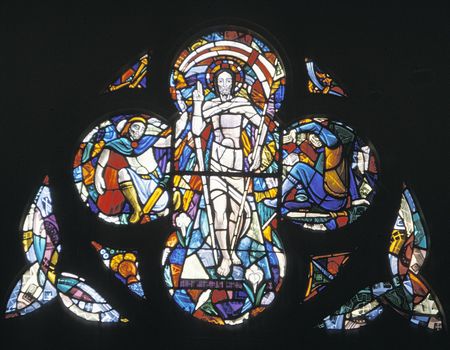 The moral argument has experienced a resurgence of discussion and popularity of late. Some of this may be due to the increased popularity of apologetics. Philosophical discussions about metaethics also seem to have contributed to the discussions about the moral argument. Regardless, the argument, in its many and varied forms, has regained some of the spotlight in the arena of argumentation between theism and atheism. [See Glenn Peoples’ post on the topic for more historical background.]
That said, it is an unfortunate truth that many misunderstandings of the argument are perpetuated. Before turning to these, however, I’ll lay out a basic version of the argument:
P1: If there are objective moral values, then God exists.
P2: There are objective moral values.
Conclusion: Therefore, God exists.
It is not my purpose here to offer a comprehensive defense of the argument. Instead, I seek to lay out some objections to it along with some responses. I also hope to caution my fellow theists against making certain errors as they put the argument forward.
Objections
Objection 1: Objective moral values can’t exist, because there are possible worlds in which there are no agents.
The objection has been raised by comments on my site (see the comment from “SERIOUSLY?” here), but I’ve also heard it in person. Basically, the objection goes: Imagine a world in which all that existed was a rock. There would clearly be no morality in such a universe, which means that P2 must be false. Why? Because in order for there to be objective moral values, those values must be true in all possible worlds. But the world we just imagined has no morality, therefore there are no objective moral values!
The objection as outlined in italics above is just a more nuanced form of this type of argument. What is wrong with it? At the most basic level, the theist could object to the thought experiment. According to classical theism, God is a necessary being, so in every possible world, God exists. Thus, for any possible world, God exists. Thus, to say “imagine a world in which just a rock exists” begs the question against theism from the start.
But there is a more fundamental problem with this objection. Namely, the one making this objection has confused the existence of objective morals with their obtaining in a universe. In other words, it may be true that moral truths are never “activated” or never used as a judgment in a world in which only a rock exists, but that doesn’t mean such truths do not exist in that universe.
To see how this is true, consider a parallel situation. The statement “2+2=4” is a paradigm statement for a necessary truth. Whether in this world or in any other world, it will be the case that when we add two and two, we get four. Now consider again a world in which all that exists is a rock. In fact, take it back a step further and say that all that exists is the most basic particle possible–it is indivisible and as simple as physically possible. In this universe, just one thing exists. The truth, “2+2=4” therefore never will obtain in such a world. But does that mean “2+2=4” is false or doesn’t exist in this world? Absolutely not. The truth is a necessary truth, and so regardless of whether there are enough objects in existence to allow it to obtain does not effect its truth value.
Similarly, if objective moral values exist, then it does not matter whether or not they obtain. They are true in every possible world, regardless of whether or not there are agents.
Objection 2: Euthyphro Dilemma- If things are good because God commands them, ‘morality’ is arbitrary. If God commands things because they are good, the standard of good is outside of God. This undermines the moral argument because it calls into question P1.
Here my response to the objection would be more like a deflection. This objection only serves as an attack on divine command theory mixed with a view of God which is not like that of classical theism. Thus, there are two immediate responses the theist can offer.
First, the theist can ascribe to a metaethical theory other than divine command ethics. For example, one might adhere to a modified virtue theory or perhaps something like divine motivation theory. Further, one could integrate divine command ethics into a different metaethic in order to preserve the driving force of divine commands in theistic metaethics while removing the difficulties of basing one’s whole system upon commands. In this way, one could simply defeat the dilemma head-on, by showing there is a third option the theist can consistently embrace.
Second, one could point out that the dilemma doesn’t actually challenge P1 at all. All it challenges is the grounds for objective morals. Certainly, if the theist embraced the horn of the dilemma in which that which is “good” is grounded outside of God, there would be a problem, but very few theists do this (and for them it seems unlikely the moral argument would be convincing). If the theist embraces the other horn–that what God commands is good/arbitrary–then that would not defeat objective morals anyway, because one could hold that even were God’s decisions arbitrary, they were still binding in all possible worlds. While this would be a bit unorthodox, it would undermine the concern that the Euthyphro dilemma serves to defeat P1. Combined with the first point, it seems this dilemma offers little to concern the theist.
All morality is relative
I prefer Greg Koukl’s tongue-in-cheek response to this type of argument: steal their stereo! If someone really argues that there is no such thing as right and wrong, test them on it! Don’t literally steal their things, but do point out inconsistencies. Everyone thinks there are things that are wrong in the world and should be prevented. If someone continues to press that these are merely illusory ideas–that things like rape, domestic abuse, murder, slavery, genocide are in fact amoral (without any moral status)–then one may simply point out the next time they complain about a moral situation. Such is the thrust of Koukl’s remark–everyone will object if you steal their stereo. Why? Because it is wrong, and we know it.
Advice to other Christians
The moral argument brings up some extremely complex metaethical discourse. While it is, in my opinion, one of the best tools in the apologist’s kit for talking to the average nonbeliever/believer to share reasons to believe, one should familiarize oneself with the complexities facing a fuller defense of the argument so they do not come up empty on a question or objection someone might raise. As always, do not be afraid to acknowledge a great question. For example, one might reply to something one hasn’t researched enough to feel comfortable answering by saying: “Great question! That’s one I haven’t thought about. Could I get back to you in a few days?”
As with any philosophical topic, the more one researches, the more questions will arise, the more interesting branches in the path one will approach, and the more one realizes that philosophy is an astoundingly complex topic. For those theists who wish to use the moral argument, I suggest doing so with a courteous, humble manner. The argument is an attempt to answer some of the hardest questions facing anyone: does God exist? is God good? what does it mean for something to be good? do objective morals exist?
Thus, theists using this argument should be prepared for some serious study. Be ready to answer some hard questions. Be open to great discussion. Above all, always have a reason.
SDG.
——
The preceding post is the property of J.W. Wartick (apart from citations, which are the property of their respective owners) and should not be reproduced in part or in whole without the expressed consent of the author. All content on this site is the property of J.W. Wartick and is made available for individual and personal usage. If you cite from these documents, whether for personal or professional purposes, please give appropriate citation with both the name of the author (J.W. Wartick) and a link to the original URL. If you’d like to repost a post, you may do so, provided you show less than half of the original post on your own site and link to the original post for the rest. You must also appropriately cite the post as noted above. This blog is protected by Creative Commons licensing. By viewing any part of this site, you are agreeing to this usage policy.
Jephthah, Human Sacrifice, and God: What should we make of Judges 11:29-40?
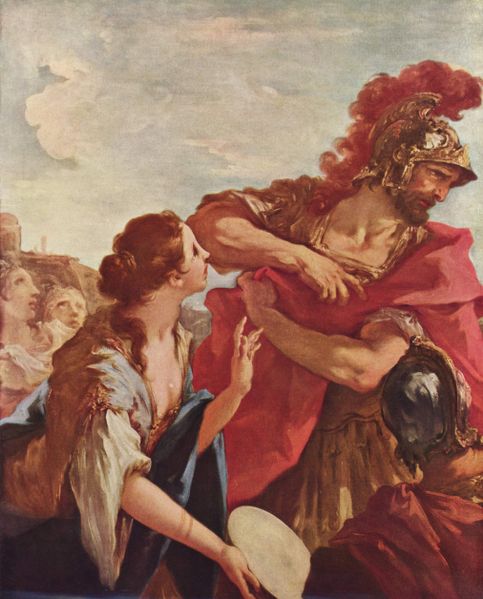
The story of Jephthah is one of the most difficult stories in the Bible. For those who don’t know it, Jephthah, an Israelite, is about to go to war against Israel’s enemies. He vows that if God grants him victory, he will sacrifice whatever comes from his door to greet him first. He wins the battle, and when he returns, his daughter runs out to meet him. She asks one last wish–that she may mourn her lack of marriage for two months. The story ends explaining that this is the reason Israelites (at the time of the writing of Judges) commemorate Jephthah’s daughter.
Understandably, the narrative raises many questions. I view the image here, a gorgeous painting by Giovanni Antonio Pellegrini, and it wrenches at my heart. Think of Jephthah’s anguish! The language in the Bible stirs the emotions:
When Jephthah returned to his home in Mizpah, who should come out to meet him but his daughter, dancing to the sound of timbrels! She was an only child. Except for her he had neither son nor daughter. When he saw her, he tore his clothes and cried, “Oh no, my daughter! You have brought me down and I am devastated. I have made a vow to the LORD that I cannot break.” (Judges 11:34-35)
The questions, as I noted, are many. Foremost of those which come to mind: “Why would God let this happen?” Another common question about this passage are “Does God allow human sacrifice?”
I’ve written on the passage before, but I think my responses were inadequate. Therefore, I have decided to reexamine this story and see what we can glean from it. Part of these thoughts are due to a conversation I had with an old friend.
Human Sacrifice
First, the question of human sacrifice. Throughout the Bible, God specifically condemns human sacrifice (cf. Leviticus 18:21; Lev. 20:2-5; Deuteronomy 18:10). One point some make is to try to draw the near-sacrifice of Isaac into the mix, but it is contextually clear that God did not intend for Isaac to be sacrificed (see Paul Copan’s excellent work on this story in his Is God a Moral Monster?). Furthermore, it is important to note that the book of Judges is a historical book, and it therefore is not prescribing the actions described therein, any more than other historical texts are prescribing the historical accounts depicted in them (see my “Description is not Prescription”). Yet those passages which are prescriptive all expressly forbid human sacrifice (again, see Lev. 18:21; 20:2-5, Dt. 18:10). Therefore, God forbade human sacrifice, He did not condone it.
Why Not Prevent It?- Context
It is therefore clear that God does not condone human sacrifice. Why, then, does God not intervene in the case of Jepthah and prevent this horrific event from occurring? As a friend noted, it would be quite simple for God to cause one of Jephtah’s servants or, indeed, anything else alive to have come from the door first. Why, then, does God not do this?
There is no simple response to this question. Instead, it is important to note several important points before I offer a possible answer. First, God has given humans free will. The nature of libertarian free will is such that it cannot be undone. Think of it this way: If God were to give us free will only until we tried to do something wrong, and in such cases God intervened and overcame our freedom to cause us to do good, we would not have genuine freedom. We’d really have a kind of pseudo-freedom. As long as we only chose what is good, we would be free, but we could not choose otherwise.
Second, think of what Jepthah had done to begin with. When he vowed that he would sacrifice the first thing to come out to meet him, it seems quite apparent that he had in mind human sacrifice, for a few reasons. It doesn’t seem likely that, for example, a cow walking through his doorway would count as coming to meet him. He specified that his sacrifice would be the first to come meet him. In fact, one might surmise he could have guessed it might be his own daughter–who is more likely to go running out to see him after a battle than his beloved child? There was no shortage of local cultures in the area who offered their children as sacrifices, and indeed the practice had corrupted Israel itself at a few points in history, so Jephthah may have been thinking of such a practice in order to bring about victory.
Third, Jephthah was an outcast. He had been driven from the land before because of his questionable parentage (Judges 11:1-3). The Israelites turned to him only in the time of their dire need, and Jephthah was clearly tempted by their offer to be their leader (Judges 11:4-11). Even given the small amount of context we have for this narrative, we can see that Jephthah desired greatly to be given headship over Israel. It is possible that, in his lust for power, foolishly made a vow to offer one of his household in exchange for the victory.
Fourth, we’ve already seen that it is expressly forbidden to offer human sacrifices. Yet Jephthah makes his vow with full knowledge of the likely consequences.
Finally, Jephthah’s vow offers a dilemma of sorts to a God who acts in history. If God wishes to prevent the human sacrifice, he must cause the defeat of Israel. This would not be just the destruction of Israel, but it would force God to go back on His promise to bring salvation through Israel, which it is impossible for God to do (Numbers 23:19). Not only that, but it would prevent God’s plan of redemption to take place. Yet if God does grant the Israelites victory, He knows that Jephthah will offer a sacrifice of whoever first steps from his house.
 Why not prevent it? -Solutions
From these quick thoughts we can see a number of possible answers. First, Jephthah made a vow which he would choose to fulfill in full knowledge that it would almost certainly be a human member of his household whom he would sacrifice. His vow was contingent upon the victory of Israel, whose defeat would have prevented God’s plan of salvation for all humankind. Therefore, Jephthah, by freely making this sinful vow, forced its conclusion. God did not prevent it from occurring because to do so would either destroy free will or prevent the Redemption.
Furthermore, some have argued that Jephthah’s vow to God superseded all else. (I myself made this argument in the original post.) I think this is wrong. God’s eternal moral commands would have superseded the vow. In fact, Jesus Himself commands His followers not to make vows, but rather to let their “yes” be “yes” and their “no” be “no” (Matthew 5:33-37). Jesus actually says that those who believe that a vow to God would supersede all else are wrong–they should not be making the vow in the first place! Thus, Jephthah’s vow was doubly sinful, because it essentially guaranteed a heinous act (human sacrifice) and because he should not have made such a vow to begin with. In fact, it should be noted that if Jephthah had acted in accordance with the Bible, he should have broken the vow! God expressly forbade human sacrifice, and when Jephthah saw that it was his daughter–or had it been any other human–who came to meet him, he should have realized his vow was made foolishly. One could even argue that God did indeed act in such a way as to try to get Jephthah to realize his error. The fact that it was Jephthah’s daughter who greeted him should not have only horrified him but made him realize that his vow was sinful to begin with, and so should not be upheld. Upon the realization that keeping his vow would cause him to break God’s Law, Jephthah should not have said “I must keep this vow” and therefore increase his sin–rather he should have said “I will break this vow, and prevent a horrific sin.” But again, with his freedom, he chose not to.
Jephthah’s story is, in fact, just the kind of story typified throughout Judges, and indeed throughout human history–that of God using sinful people to bring about His ends. Samson, another judge, was a violent and lustful man, yet God used him to save the Israelites on a number of occasions. In the Joseph narrative (Genesis 37ff), God used the evil actions of Joseph’s brothers to bring about a great good (Gen. 50:20). Similarly, Jephthah’s greed lead him to make a vow which he should not have kept which condemned at least one human to death.
Jephthah’s free decisions brought about the death of his daughter. That is why the Bible reports this stirring story–it teaches us that our free will has consequences. That is why the painting of Jephthah is so striking–we can relate to the horror of Jephthah’s realization of his own sinfulness. We’ve each committed our own sins and had to deal with the consequences. God is not a divine vending machine who will intervene when we make mistakes, or when we choose horrifying acts. He has already provided us with an objective reality–the discernment to tell what is right from wrong. Not only that, but He has also provided a Savior, His Son Jesus, to rescue us from all evil–even death itself. God has provided an infinite good to all human persons by providing a means for their salvation. Whosoever will be saved shall be saved.
The story also teaches us once more that God works through imperfect people. Although Jephthah was a sinful man with greedy intentions, he was still used by God to bring about a great good–the preservation of Israel, which itself paved the way for God’s redemptive act.
A Final, Philosophical Note
Those who may desire to press the objection still should investigate the philosophical basis of their claim. Presumably, they are arguing that:
P1- God is obligated to prevent evil (or some certain types of evil).
What justifies that claim? If God has given us free will, there are evils God cannot prevent–those which we choose to bring about. Further, what justifies the claim that God must intervene in every situation with x amount of evil? More specifically, why is God obligated to prevent Jephthah’s daughter from being the first to leave the house (again, I think that it was a series of free choices which brought Jephthah to this unfortunate event, and I disagree with those who think that God could just supersede free will whenever necessary, but I’ll grant it for a moment)? Is God obligated to prevent every evil?
I’m sure there are arguments that could be made to try to support the premise that “God is morally obligated to prevent all (or certain types of) evils” but I don’t think they would be more plausible than P2: “God has created free creatures” and P3: “Freedom cannot be limited.” I would accept a more restricted sense of:
P1′- God is morally obligated to prevent all evils which He is able to prevent and which do not provide for some greater good and which, if prevented, do not lead to other evils with similar or greater impact, etc.”
Those who would seek to continue objecting that God, in the Jephthah narrative, should have intervened, must defend their restricted sense of P1, while rebutting P2 and P3, and showing that P1 is more plausible than P1′. It therefore seems that philosophically, exegetically, and theologically, the Jephthah narrative, while poignant, does not threaten God’s character. God works through human history to bring about the Redemption, using imperfect, sinful people to bring about an infinite good. Furthermore, God has given us the good of freedom, but we choose too often to abuse it. Jephthah illustrates this misuse in a heart-rending fashion which serves as a definitive reminder to those who read it that they should heed God’s word and use their freedom not for greed or gain but for the furtherance of God’s Kingdom.
SDG.
——
The preceding post is the property of J.W. Wartick (apart from citations, which are the property of their respective owners) and should not be reproduced in part or in whole without the expressed consent of the author. All content on this site is the property of J.W. Wartick and is made available for individual and personal usage. If you cite from these documents, whether for personal or professional purposes, please give appropriate citation with both the name of the author (J.W. Wartick) and a link to the original URL. If you’d like to repost a post, you may do so, provided you show less than half of the original post on your own site and link to the original post for the rest. You must also appropriately cite the post as noted above. This blog is protected by Creative Commons licensing. By viewing any part of this site, you are agreeing to this usage policy.
Christian Apologetics/Philosophy Book Gift List Christmas 2011
 Brian Auten over at Apologetics 315 has an excellent post which outlines some great gift choices for Christian apologists. I thought it was an great idea and wanted to expand on it. Thus, welcome to the inaugural, annual Christmas Christian Apologetics and Philosophy Book Gift List! That is a mouthful!
The following list suggests several books for beginner and intermediate readers, a couple for advanced readers, and 2 books I think that anyone interested in apologetics or philosophy of religion will enjoy.
Beginner/Intermediate
Hugh Ross, Hidden Treasures in the Book of Job– A phenomenal book about the scientific intelligence of the book of Job, the oldest book in the Bible. See my review here.
Komoszewski, Sawyer, and Wallace, Reinventing Jesus– This book is, in my opinion, the best introductory work on apologetic issues related to the historicity of the New Testament. I can’t recommend it highly enough–it covers gnosticism, the canon, the Gospels, etc. It’s simply phenomenal.
Gary Habermas, The Case for the Resurrection of Jesus– Habermas’ defense of the historicity of the resurrection is top-notch, easy to understand, and, I’ve found, irrefutable. The best part about it is that it focuses on three easy-to-remember facts about Jesus.
William Lane Craig, Reasonable Faith– An intermediate-level book on natural theology, Craig here presents a convincing, reasoned defense of theism generally and Christianity specifically. This was the book which got me into apologetics. I highly recommend it. Beginners will be happy to know Craig has distilled his work here into his readable On Guard.
Paul Copan, True for You But Not For Me– I read this book for a class and admit I went into it with some skepticism, but it quickly astonished me with how well Copan explains all kinds of issues related to Christian apologetics. The
Greg Koukl, Tactics– This book provides a background for apologetic method. Koukl’s insight will quickly train readers to analyze arguments, find fallacies, and point them out, all with a kind of gentleness and respect which is fitting for the Christian Apologist. I recommend this book very highly. No collection is complete without it.
Advanced
Stephen Parrish, God and Necessity– Parrish’s phenomenal work of philosophy of religion surveys the notions of contingency and necessity. He analyzes various theistic arguments, offers an ontological argument, and finds that only in the necessity of deity can we explain the existence of all things. The scope of this work is immense–it covers a broad array of metaphysical issues. I recommend it highly.
Linda Zagzebski, Divine Motivation Theory– Zagzebski explores a range of issues regarding metaethical systems and finds that divine command theory needs modification. She offers her own theory for the grounding of morality in the divine, which is backed by motivations, not commands. There’s a reason Zagzebski is getting recognition and causing stirs in the world of philosophy of religion. Check out my review of the book.
The Top 2
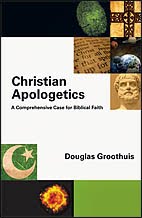
Douglas Groothuis, Christian Apologetics– I believe this book will quickly become the definitive work on Christian Apologetics. It’s comprehensive, eminently readable, and convincing. Beginners might be scared off by the sheer size of the book, but it provides enough background to appeal to any reader. The succinct nature of the arguments, the reasoned defenses of the premises, and the immense ground the book covers will make it appealing to all.
Edgar Andrews, Who Made God?– I have to agree with Brian Auten (see the article linked above)–this book is simply phenomenal. Readers at any level will find new ideas of great interest. Andrews covers a wide range of issues, all of which are of interest to Christian apologists and philosophers. See my review.
Apologetics and the Search for Truth
 Apologetics must be not only a defense of but also a search for the truth. A parallel I would draw is one I heard in the movie, “The Bible vs. The Book of Mormon.” In that movie, they discuss the role which Mormon apologists have taken on: that of defending a falsehood, and essentially just telling believers they must keep the faith and ignore/lie about the evidence. Christian apologists must never allow themselves to value fideism over reasoned faith. If conclusive evidence undermines an article of faith, it must be abandoned.
What am I suggesting? Apologetics is not just a static defense of each point of Christianity, rather, it is a defense seeking truth. Some will immediately bristle upon reading this and argue there are some beliefs Christians cannot compromise. I agree. There are truths, which, if shown to be false, would lead to the falsehood of Christianity. But if evidence existed which conclusively proved God did not exist, then Christianity would be false, no matter what we would desire. That said, it seems to me that there is an overwhelming weight of evidence showing that God does indeed exist. Not only that, but there is a huge amount of evidence for the resurrection of Jesus. So again, we return to the position of the apologist: defending truths.
Perhaps an example might help draw out the implications of my points. Take Young Earth Creationism. Many apologists continue to defend this position, yet there is conclusive evidence both in the cosmic background radiation from the Big Bang and in the dating of rocks on earth and from space that the world is much older than a Young Earth position would have us believe. Not only that, but throughout the history of Christianity, a Young Earth position has not been a serious article of faith. The conclusive evidence against the Young Earth position should lead Christian apologists to continue to seek to understand the world God created–along different lines as necessary.
It is telling that Paul himself wrote in 1 Corinthians 15:14 that “…if Christ has not been raised, our preaching is useless and so is your faith.” He goes on to clearly explicate the implications of this historical fact for Christianity. Christianity is based upon seeking truth. If it were the case that central truth claims of Christianity were factually incorrect, than “our preaching is usless” and “so is [our] faith.” Christian apologists should therefore continue to seek truth, and defend it. The order of operation is not: pick a belief, decide it is true, and defend it. Rather, the apologist must operate in a completely opposite fashion: seek to discover truth, believe in that truth, and defend it.
So, fellow apologists, I issue you a challenge: let nothing be unexplored. When you get the questions you cannot answer, do not fall on fideism, but investigate the truth. All truths are God’s truths, and we should not fear them.
To those who detract apologetics as a defense of falsehoods, I also issue a challenge: Have you actually explored the truth claims of Christianity? Have you engaged the arguments for theism? Have you investigated the evidence for the Resurrection of Christ? If not, you also need be consistent–leave no stone unturned in your search for truth.
While there almost certainly are apologists who defend their specific theological point against any and all scientific and philosophical evidence, what I am suggesting is a methodological apology: one which actively defends truth, but without putting all the weight upon one position; one which continues to seek truth, wherever it is found; a methodology which not only defends the truth, but finds it. What is truth? That which God has wrought.
SDG.
——
The preceding post is the property of J.W. Wartick (apart from citations, which are the property of their respective owners) and should not be reproduced in part or in whole without the expressed consent of the author. All content on this site is the property of J.W. Wartick and is made available for individual and personal usage. If you cite from these documents, whether for personal or professional purposes, please give appropriate citation with both the name of the author (J.W. Wartick) and a link to the original URL. If you’d like to repost a post, you may do so, provided you show less than half of the original post on your own site and link to the original post for the rest. You must also appropriately cite the post as noted above. This blog is protected by Creative Commons licensing. By viewing any part of this site, you are agreeing to this usage policy.
Can we evaluate worldviews? How to navigate the sea of ideas.
Think about it this way: worldviews are supposed to be reality. If a worldview does not match reality, how can it be reality?

I recently began a series on the truth claims of Mormonism. In that post, I asserted that there is positive evidence against the truth of the Book of Mormon. However, there is an important step to take before offering arguments against other religions. Namely, one must establish that evidence against the truth claims of a religion should rationally lead one to abandon that religion. (A related but similar point would be the positive evidence for religion leading to rational belief.)
Thus, before I continue to offer critiques of other religions, I offer some epistemic groundwork.
Truth Claims and Worldviews
First, it must be noted that worldviews are not mere matters of feeling, regardless of what the supporters of the varied views claim. For example, if one says “You can’t analyze what I believe, it’s just a matter of faith” they are making a claim about reality–that their faith cannot be analyzed. Similarly, if one claims “Israelites sailed to the Americas from the Middle East,” [Mormonism] or “There is no God” [atheism] they have made a claim about reality.
Such truth claims are capable of analysis, by definition. Statements are true or false. All worldviews make claims about reality, which are therefore true or false. Simply stating that one’s belief is “just faith” or “obvious” does not exclude it from making claims.
 How Do We Evaluate The Claims of Worldviews?
One’s beliefs should conform to reality, if one seeks to be rational. Certainly, one could say “To heck with the evidence, I’m going to believe x, y, and z! I don’t care if I can’t support the belief and that there is strong evidence against x, y, and z.” But if one were to say this, one would abandon their reason. Their heart could believe, but their mind could not. Ultimately, all truth claims can and should be put to the test.
Testing the claims of varied worldviews is no easy task. There must be objective criteria, otherwise one view will be favored over another. One cannot simply make their own view the default and argue that only by filtering truth claims through their position can truth be attained. Atheism, by no means, provides a neutral basis for evaluating religions, as I’ve argued elsewhere. In fact, atheism must past the standards for truth claims, just as any religion must. If one remains an atheist despite positive evidence to the contrary (or despite reasons to disbelieve the claims of varied atheistic worldviews like materialism), one abandons reason just as if one clung to a false faith.
Testing Worldviews as Hypotheses
In his monumental work,Christian Apologetics, Douglas Groothuis argues that worldviews can be proposed as hypotheses. Worldviews present themselves as answers to explain the phenomena we experience (Groothuis, Christian Apologetics, 49). Groothuis therefore presents criteria for evaluating worldviews as though they were hypotheses about the world. Kenneth Samples similarly draws out nine tests which can be used to determine whether the claims of a worldview are true in his book A World of Difference (page numbers from that text, citation below). From these proposed methods, we can derive tests to evaluate competing worldviews:
1) Coherence– if a religion is contradictory, it simply cannot be true. For example, if a religion claimed that “Person Z is god, and person Z is not god,” that religion would be incoherent (Samples, 33). Furthermore, “If a worldview’s essential propositions are coherent… it is more likely to be true than if its essential propositions are not related in this way” (Groothuis, 55).
2) Balance– “A valid worldview will be ‘neither too simple nor too complex.’ All things being equal, the simplest worldview that does justice to all aspects of reality deserves preference (Samples, 33-34).
3) Explanatory Power and Scope– Does the worldview explain what we experience in enough detail? If a worldview does not explain our world, or it cannot account for certain phenomena, then it is lacks explanatory power (Samples, 34). Worldviews which make propositions which they cannot account for lose credibility (Groothuis, 53).
 4) Correspondence– Does the worldview match the facts we know about the world to our experience of the world? If we know that the worldview in question promotes claims we know are false, it does not match reality (Samples, 34-35). Think about it this way: worldviews are supposed to be reality. If a worldview does not match reality, how can it be reality? We are able to test factual claims through empirical and scientific methods, so if a worldview continually is able to establish its essential claims by means of these methods, it is more likely to be true (Groothuis, 55).
5) Verification– Can this worldview be falsified? Worldviews which cannot be found to be false cannot be found to be true either.
6) Pragmatic Test– Can we live by this worldview? This test is less important, but still has credibility–we must be able to live out the worldview in question (Samples, 35-36). But worldviews should also be fruitful in the development of greater intellectual and cultural discoveries (Groothuis, 57).
7) Existential Test– Like the pragmatic test, this one is not as important as whether the view is factual, but it is still helpful. If worldviews do not account for inherent human needs, it is possible the view is false (Samples, 36). Again, this is not necessary for a worldview, but it helps measure a view’s completeness.
8 ) Cumulative Test– Does the worldview gain support from all the previous criteria? If a worldview is able to satisfy all the criteria, it gains credibility (Samples, 36-37).
9) Competitive Competence Test– If the worldview satisfies the previous criteria with more evidential power than other worldviews, it gains credibility over and against them (Samples, 37).
10) Radical ad hoc readjustment– Groothuis presents this as a negative test for worldviews. “When a worldview is faced with potentially defeating counterevidence, an adherent may readjust its core claims to accommodate the evidence against it. Various theories and worldviews can legitimately refine their beliefs over time, but radical ad hoc readjustment reveals a deep problem…” (Groothuis, 57). There is, as Groothuis pointed out, a line between refining belief and simply readjusting belief in an ad hoc way. If, for example, it were discovered that Jesus did not rise from the dead, then Christianity would be false (more on that below). If, however, one simply adjusted Christianity to say “Jesus spiritually rose from the dead,” that would constitute a desperate, ad hoc measure to preserve the worldview and count as discrediting Christianity.
These tests present objective criteria for testing worldviews. If, for example, one wished to deny their worldview had to be coherent, they’d have to affirm that which they denied, for in denying that criterion, they were attempting to make their view more coherent. The testing of worldviews is a legitimate task, and indeed one in which people should engage. Some things, if falsely believed, are harmless (for example, if one believed it rained yesterday when it did not). Worldviews, however, if falsely believed, are damaging on any number of levels. If one believed God didn’t exist when, in fact, He did, then one would be doing a great evil by not acting upon the truth of God’s existence (and the contrary). Thus, the testing of worldviews is no task to be skimmed over, but one which should be approached with fear and trembling. The criteria outlined above allow people to engage in this task and evaluate the realm of ideas.
Christianity Encourages Exploration of Reality
What I find extremely interesting is that Christianity, unlike many world religions, doesn’t discourage the discovery of truth, nor does it evade evidence by claiming that it is merely a faith or feeling. Rather, the founders of Christianity explicitly stated that it is based upon certain truth claims, and that if those claims are false, then Christianity is worthless. Paul, for example, wrote “And if Christ has not been raised, your faith is futile; you are still in your sins” (1 Corinthians 15:17). The truth of Christianity rests exactly upon a testable claim: Jesus rose from the dead. If He did not, Christianity is false. Christianity’s scope and explanatory power are superior- it can account for the existence of contingent objects, persons, consciousness, life, and the like. Christianity corresponds to reality, satisfies existential and pragmatic needs, is simpler than many other explanations, its coherent, and it matches all the criteria. Christianity expects its adherents–and outsiders–to test the faith and discover whether it is true. I have found, personally, that it pasts these tests over and over.
Conclusion
Whether one agrees or not, it is simply the case that religions make claims about reality. These claims are, in turn, true or false. Not only that, but they must match with reality in several important ways. Christianity not only adheres to these tests, but it encourages them. It also passes these tests. Does your worldview?
Sources
Douglas Groothuis, Christian Apologetics (Downers Grove, IL: InterVarsity, 2011).
Kenneth Samples, A World of Difference (Grand Rapids, MI: Baker, 2007).
Image Credit
I took this picture at Waldo Canyon near Manitou Springs, Colorado on my honeymoon. Use of this image is subject to the terms stated at the bottom of this post. The other image is the book cover from Samples’ book.
SDG.
——
The preceding post is the property of J.W. Wartick (apart from citations, which are the property of their respective owners) and should not be reproduced in part or in whole without the expressed consent of the author. All content on this site is the property of J.W. Wartick and is made available for individual and personal usage. If you cite from these documents, whether for personal or professional purposes, please give appropriate citation with both the name of the author (J.W. Wartick) and a link to the original URL. This blog is protected by Creative Commons licensing. By viewing any part of this site, you are agreeing to this usage policy.
Really Recommended Posts 10/22
 Why Do Atheists Talk So Much About Religion?– A short, interesting post with a self-explanatory title. Check it out.
Ah, Richard Dawkins, when will he learn that attacking people doesn’t make their views wrong? His buddy PZ Myers has actually attacked me personally as well, but that’s beside the point. Check out Max Andrews’ thoughts on Dawkins refusing to debate Craig. Dawkins, of course, enlists the help of his yes man Myers.
Undesigned Coincidences and the Historicity of the New Testament– This is a great apologetics video making the rounds. The “undesigned coincidences” argument is one which is slowly seeing a revival–in part due to Dr. Tim McGrew, a friend of mine and a phenomenal philosopher. Check it out.
A Review of “The Magic of Reality”– Dawkins has been adamant that we should not indoctrinate our children. Yet his new book is intended to do just that: indoctrinate children with atheism. Check out this timely review over at Deeper Waters.
Sharing the Gospel – 10 Surprisingly Simple Tips for Talking with Cult Members (part 1)– it is what it says… some great hints for witnessing when the cults come a-knockin’.
The Book of Mormon, 1/18– part one of a series in which an apologist reads through the Book of Mormon. Great stuff.
William Lane Craig vs. Stephen Law- Thoughts and Links
Recently, William Lane Craig debated Stephen Law on the topic “Does God exist?” Remember the topic as I review the debate.
Craig 1
William Lane Craig presented a different set of arguments from his normal 5. This time, he argued the cosmological and moral arguments along with the argument from the resurrection. My guess is that the short time allowed was the reason for this change of strategy. Craig argued that actual infinites cannot exist in reality. He pointed out that transfinite math simply does not allow addition or subtraction of infinity, because it is absurd, but in the real world, if an infinite did exist, nothing could prevent it from having things added or taken away. Thus, Craig concluded, there cannot be an infinite past.
He then briefly outlined the empirical case for a finite past, citing Borde, Guth, and Vilenkin’s paper which shows that every model of the universe’s past must account for entropy, and therefore must be finite. I don’t want to get sidetracked from my review of the debate here, but so many people seem to either ignore or miss the point of this argument. It’s not that entropy only disallows an infinite universe that is one state, rather, entropy disallows an infinite past for oscillating universe models, bubble universes, and any other types of strategies people have tried to raise in order to rebut cosmological arguments. I recently got an e-mail in which someone said I’m being dishonest by only referencing the Big Bang as evidence for a finite universe, when there may have been previous universes. Well that’s simply wrong, even if there were previous universes, they would have to take entropy into account. If the past is infinite, all the energy available for the generation of universes would have been used up.
Anyway, Craig went on to argue the moral argument: If objective moral values exist, then God exists. They do, so God does. A great point Craig made is that any argument against the existence of objective moral values must rely upon premises which aren’t as plausible as the objective morals themselves. That’s an excellent point that many tend to ignore.
As far as the resurrection is concerned, Craig presented the “three facts” argument. He pointed out that three facts are agreed upon throughout scholarship on the topic: that the tomb was found empty, different individuals saw appearances of Jesus alive after his death, the disciples’ belief in Jesus resurrection despite having every predisposition to the contrary. These facts, argued Craig, are best explained by Jesus’ resurrection.
Law 1
Law began by arguing about animal suffering. He said that the extraordinary amount of suffering which is experienced by animals every day is such that it can weigh against the existence of God. He noted that some people dismiss this as “merely animals” but argued, “I wonder if they’d say the same thing if I took a red hot poker to their… cat.” Note how Law distorted his original argument, however. Certainly, I’d be extraordinarily angry with Stephen Law if he took a hot poker to my cat (I don’t have one any more but I used to). But the reason would be because Law is a moral agent. He is capable of knowing what he’s doing, and would clearly have to be sadistic in order to do such an action. If, however, an eagle came and carried my cat away, I would be extremely upset, but I would not accuse the eagle of having done a morally wrong action, because the eagle is not a moral agent. Yet Law used that very emotional image of himself–a moral agent–as an analogy for animal suffering. There’s clearly a major issue with such an argument.
Law went on to argue that there’s no reason to think that the God whose existence Craig is arguing for is not an evil god. Here I think Law had some decent points… for arguing against bare theism, but not against Christianity (see “Analysis” below). He argued that for certain theodicies, there can be parallel arguments constructed for an evil god. He also noted that Craig’s arguments could work just as well for an evil god (a notable exception would be the moral argument, more on that later… and it’s pretty hard to see how the resurrection would fit into his ‘evil god’ scenario). Law also argued that if the good in the world refutes an evil god, the evil in the world should refute a good God. Law didn’t do anything to rebut Craig’s arguments for the existence of God.
Craig 2
Craig quickly attacked Law’s appeal to emotion with animal suffering. He noted that it was very much anthropopathism to assume that animals had the same response to suffering as humans. In fact, he went on to note three hierarchies of suffering, and pointed out that animals do not have the capacity to be aware of the fact that they are suffering. So despite the suffering of animals, they are not even aware of that fact–something which Craig credited to God’s mercy. Animal suffering, he argued, is also necessary for a number of reasons, one of which is the stability of ecosystems. Without predation, all life on earth would be wiped out. Thus, it is fair to say that animal suffering fits into the divine plan.
Craig countered Law’s argument about the ‘evil god’ by noting that the moral argument specifically rebuts Law’s assertions. Not only that, but Law was arguing against a kind of theism which does not exist. Christians don’t survey the world and conclude God is good, rather, they believe God is good because that’s the type of being God is, necessarily.
Craig presented a number of reasons for thinking a good God would allow evil, which would therefore discount the rebutting evidence of evil. He also agreed with Law that looking at the world alone would lead to a draw, but that, as already noted, the moral argument and the type of being God is would defeat an ‘evil god’ scenario.
Law 2
Law argued that Craig had made a straw man of his position by saying that theism is not inductive. Then he went on to argue that the moral argument is the only one Craig can rely on to establish the goodness of God. He cited Swinburne as a Christian who did not believe objective morality relies on God. He ended his second segment by arguing that surely there is enough evil in the world to make the existence of God improbable.
Craig 3
Craig noted that Law has a strange kind of atheism which grants the existence of God but attacks the character. He pointed out that Law had still not rebutted any of his arguments, but focused merely on the character of God. He also pointed out that appealing to Swinburne was a mere appeal to authority and that he could cite a number of atheistic philosophers who agreed with his premises.
Law 3
Law argued that there are no objective moral values (curious, considering the citations Craig read in the debate). He then attempted to rebut the argument from the resurrection by citing an instance where a number of people believed they saw a UFO when it was really the planet Venus.
Craig Conclusion
Craig once more noted that Law had yet to rebut any of his arguments and that Law persisted in maintaining a strange atheism in which God exists, but may or may not be good. He noted that Law’s attempt to rebut the resurrection did not take into account the religio-historical context of that event and that all claims of experience must be measured by objective criteria, which the resurrection passes. He concluded that because his arguments stood undefeated, God exists.
Law Conclusion
Law basically said “why not believe in an evil god?” and argued that Craig still did not justify objective morals.
Analysis
Law came in with a pretty interesting argument which was unfortunately not the topic of the debate. I think it would be really interesting to see Law vs. Craig on a topic like “Is God good?” His arguments had some weight, but I think Craig did an excellent job rebutting them while remaining on track. Law essentially ignored the cosmological argument and put the topic of the debate aside in favor of arguing about whether God is good. As far as the topic of the debate goes, it’s clear that Craig established the existence of God. In fact, Law was essentially granting that point (in the Q&A he argued that it is not the case that because he didn’t rebut the arguments, he agrees God exists… but it is important to note that he did not rebut the arguments so, on the face of it, it seems that the arguments stand unchallenged). As far as Law’s good points go, I think he had the best points I’ve seen an atheist raise in a debate with Craig so far, but Craig was able to adequately rebut them while sustaining his primary argument: that God exists.
Finally, on the “evil god” hypothesis: Law failed to realize that the concept of “greatest possible being” is central to Christian theism and did not take that into account. Craig perfectly illustrated this when he acknowledged that a “creator” on its own cannot be shown to be good or evil, but went on to point out that that doesn’t affect Christian theism, which holds that God is the greatest possible being. Law was, in a sense, arguing against “bare theism,” which is, as he points out, incoherent. Yet Craig was arguing to establish the Christian God–the greatest conceivable being. Law’s arguments therefore seem to only underscore the coherence of Christian theism, by demonstrating that only with a correct concept of God can theism be coherent.
[The following section in brackets added after the post was up and had several comments.]
[I’d like to point out more explicitly why Law’s argument doesn’t work. The reason is because his concept of ‘god’ is incoherent. Theism claims that God is the greatest possible being. But Law is arguing that this being could be evil. Each of his arguments about the evil god were designed to argue that God ‘could be’ evil. But then Law would have to assert that evil is a property such that it makes beings great. I don’t see how he could argue this. He’d have to first argue the ontological reality of evil–which would establish the existence of objective morality and thus back up Craig’s moral argument. Then he’d have to argue that evil is, in fact, a property. Finally, he’d have to establish that evil is a great-making property. I don’t see any way he could possibly do this, and the burden of proof is definitely upon him to show these concepts are coherent. Unless and until he does that, his arguments are simply incoherent.]
Links
Stephen Law, his evil god, and radical skepticism– I analyze Stephen Law’s evil god challenge further and conclude that it entails radical skepticism.
http://www.premier.org.uk/unbelievable– follow the rest of Craig’s tour through England.
Download the debate at Apologetics 315.
Check out more analysis of the debate at Thinking Matters.
Was Stephen Law Guilty of a Bait and Switch?
An analysis of Law’s argument for an “evil god.”
Doug Geivett writes about “The Missing Ontological Argument” and Law’s misunderstanding of theism.
SDG.
——
The preceding post is the property of J.W. Wartick (apart from citations, which are the property of their respective owners) and should not be reproduced in part or in whole without the expressed consent of the author. All content on this site is the property of J.W. Wartick and is made available for individual and personal usage. If you cite from these documents, whether for personal or professional purposes, please give appropriate citation with both the name of the author (J.W. Wartick) and a link to the original URL. This blog is protected by Creative Commons licensing. By viewing any part of this site, you are agreeing to this usage policy.

 J.W. Wartick - Reconstructing Faith