Christian movie review
“Ender’s Game”: Fear and Hope in the Face of Annihilation- A Christian look at the film
 Ender’s Game is one of my all-time favorite books, so it was with some great anticipation that I looked forward to the release of the film. Here, we shall investigate some of the major themes that the film adaptation brings up in its portrayal of this epic science fiction novel. There will be MAJOR SPOILERS for the film in what follows.
Children and Violence
The first and most pervasive feature throughout the film is that of the boundaries crossed when placing children in situations which they should be protected from. It is much like the Hunger Games [I want to clarify: Ender’s Game was written long before Hunger Games and so any connections flow from Card to Collins!] in this regard, though Orson Scott Card’s book and the film take it much deeper.
The first and perhaps most poignant example of this is found early in the film, when Ender thinks he has been washed out from the possibility of command and so he no longer has the protection of adults monitoring him to make sure he is safe. He is approached by a group of bullies, but he uses his strong tactical sense to shame them into fighting him one-on-one. Then, he ruthlessly beats down one of the larger boys and continues kicking him while he is down. He does this, he explains later, because he wanted to make it so that his enemy could never come back and hurt him again. The key, for Ender, is to ensure not just that the enemy is unable to fight back now, but that they will be unable to do so ever. This survival instinct leads Colonel Graff to believe that Ender is right for battle school. But it leaves the viewer wondering about justice.
Elsewhere, the film deals rather pointedly with bullying. Ender continues to be alienated by his fellow students and they react with two common bullying tactics: they ostracize him and eventually, one tries to physically harm him. One scene shows how one can break the grip of bullying: by simply reaching out to the one who is bullied. The camera shifts to a top-down view and shows as one-by-one, students begin to sit next to Ender and abandon the bully. If we teach our youths to do the same: to reach out to understand instead of to conform to the pattern of the world and ignore the downtrodden, we could make steady strides against bullying.
The scenes of violence involving the children also do something that very few scenes of violence with adults are able to convey: the complete horror that is involved in such activities. One cannot help but be gripped by sorrow when one sees children reacting violently to each other. Very often, movies are unable to capture the wrongness of violence. I do not think it is far afield to suggest that blockbusters are even worse at doing so. One can imagine the amount of collateral damage wrought in a movie like “The Avengers,” yet the heroes are glorified and the violence justified by the end. “Ender’s Game” incredibly portrays the real awfulness of violence of human against human, and even of human against environment or nature. It is raw, powerful, and gut-wrenching.
Ends Justify…?
The viewer wonders throughout the entire film whether the cost is too high. Colonel Graff and Major Anderson engage in a brief dialogue on the question late in the story. Anderson notes that using children used to be a war crime, but Graff counters by arguing that humanity must do what they have to in order to ensure survival. In a way, his reasoning takes Ender as a foil. Both he and Ender agree upon the notion that the ends may justify the means.
However, the film doesn’t end with that message. Instead, Ender is forced to confront the reality that he has been used–lied to–in order to bring about the utter extinction of an entire alien sentient race. When faced with this truth, he reacts with extreme remorse and anger. Graff tries to reason with Ender, suggesting once more that they struck the enemy in such a way so as the enemy might never strike them back. But Ender suddenly realizes–with horror–that this is insufficient reason to justify his wiping out an entire species. He reacts angrily and is eventually sedated. The viewer is left to reflect upon the sheer enormity of what has happened. An entire sentient race has been extinguished by the activity of a child who was deceived into thinking he was merely playing games.
The child realizes it is horrible; the adults are the ones rejoicing.
From Death, Life: From Xenocide, Hope
I’ve already pointed out the way “Ender’s Game” depicts violence in such a way as to prevent it from being gloried. I’ll admit I was unsure of how I would react to the big reveal towards the end, when Ender discovers that he has been fooled into exterminating the “Buggers” [Formics–the alien race]. I wasn’t sure if the movie would depict it in such a way as to make the audience cheer and delight in the destruction of the enemy. However, I was totally blown away by the way it showed the scene. I couldn’t but be horrified when Ender turned to Graff and the other commanders of Earth’s military and said triumphantly, “Game Over.” I knew the twist that was coming, and that perhaps made it even more horrifying to me. Ender thought he was playing games, but those in charge knew he was not and cheer gleefully in the complete annihilation of a species which wasn’t even acting the aggressor any longer.
That alone would be an incredibly powerful message to leave viewers with, but Orson Scott Card did not write a book[and, by extension, the movie it spawned] that merely shows the horrors of such violence. Instead, the seeds of hope are scattered therein. The very end of the film shows the birth of life from death. One of the “Bugger” Queens has survived, and one egg for a new queen has been preserved. The Buggers had been trying to communicate with Ender, and they succeeded in getting him to find their last hope for preservation. Ender realizes almost immediately what he should do: take the egg to a place it will be safe. The film ends with Ender’s voice echoing the future story: that he would seek out a new home for the Buggers so that they could begin life anew.
Conclusion
“Ender’s Game” is a fantastic film. It is one with powerful messages for today. Yes, it has the moral message against bullying, and people who walk away only with that will have done well. But more deeply–and more powerfully because of this–it also shows the absolute horrors of violence. Harming others is not in any way glorified in this film. Ender realizes the wrongness of his own actions too late. Yet viewers are not spoon-fed this message. Indeed, the story begs to be debated. Do the ends justify the means in this case? Or perhaps Ender is right–understnading is more important. The themes provide much for anyone who watches the film to discuss.
Yet the most powerful message is saved for the very end: Life comes from death. It is brought about by an outsider, using means which could not have been predicted. And that is the most powerful and true message of all. It is a message which Christianity teaches: hope comes from the most hopeless situation, and it comes from the least expected direction, provided by God.
Links
“Ender’s Game” by Orson Scott Card: A Christian Reflection– I analyze a number of themes from the classic science fiction novel. It is extremely important to look into the
The Importance of Being Ender: A Closer Look at Orson Scott Card’s Modern Classic– Check out this look at the book by Anthony Weber at one of my favorite blogs, “Empires and Mangers.” It is well worth the read and also ha some very interesting links for more discussion of the book.
You liked Ender’s Game? Check out John Carter.
The Image is one of the official movie posters. I claim no rights to it.
SDG.
——
The preceding post is the property of J.W. Wartick (apart from quotations, which are the property of their respective owners, and works of art as credited; images are often freely available to the public and J.W. Wartick makes no claims of owning rights to the images unless he makes that explicit) and should not be reproduced in part or in whole without the expressed consent of the author. All content on this site is the property of J.W. Wartick and is made available for individual and personal usage. If you cite from these documents, whether for personal or professional purposes, please give appropriate citation with both the name of the author (J.W. Wartick) and a link to the original URL. If you’d like to repost a post, you may do so, provided you show less than half of the original post on your own site and link to the original post for the rest. You must also appropriately cite the post as noted above. This blog is protected by Creative Commons licensing. By viewing any part of this site, you are agreeing to this usage policy.
“Les Miserables”: A Christian reflection
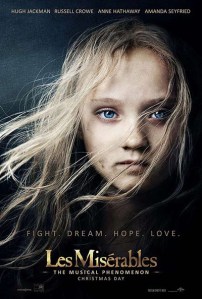
“Les Misérables
Natural Law and Human Dignity
One of the most clear themes throughout the movie is the challenge raised in balancing natural rights, natural law, and human dignity. Jean Valjean starts off the movie as a prisoner. He has been imprisoned for 19 years–5 for stealing a loaf of bread, and 14 for trying to escape. These prisoners are essentially slaves. Their personhood is denigrated, and Javert, the Inspector, insists on calling them merely by their numbers. During this scene, the prisoners sing of calling for Jesus to save them, but complain that Jesus has not heard them. Yet God is not dead in this story, as we shall see below.
Several questions are raised here. It seems clear that the human dignity and therefore the natural rights of these people is being violated by the way they are treated, as well as the cruelty of the punishment for petty crimes. Not only that, but it seems that natural law is being violated in that the poor continue to cry out for help to no avail. They need food, shelter, and the like. They are willing to work but can’t find any. The movie provides a poignant commentary on the violations of natural law, rights, and human dignity that continue to be found in our own society.
Javert is the story’s foil for natural law. He brings in a kind of Kantian certainty about moral questions. For him, the law is morally right, and one cannot violate the law. Yet it becomes clear through the film that Javert’s view is actually that which is mistaken. He is operating under a skewed vision of natural law which cannot stand up to scrutiny. His view equates natural law with the law of the land. Valjean grants Javert mercy and Javert later does the same for Valjean, but unlike Valjean, Javert cannot understand mercy. For him, the law of the land is always absolute. Finally, he cannot reconcile his view of the law with the realities of the world which include not just natural law but also the redemptive mercy that God has embedded in it and he kills himself.
Jean Valjean is not the only person whose very worth is questioned. Fantine suffers immensely in the story. She is reduced to selling her hair, then her teeth, and finally her body when she loses her job. Again, her very humanity is threatened by her treatment. She is dehumanized and forced to give up hope. However, Jean Valjean, as she is dying, comes to her aid and promises to take care of Cosette, her daughter. This gives her hope, and restores some of her human dignity.
Redemption
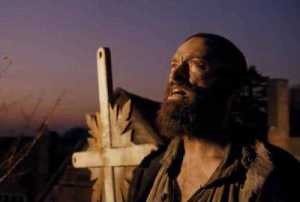
Despite the apparent hopelessness in many scenes, it becomes clear that evil has not won the day. Indeed, Jean Valjean is given another lease on life by Bishop Myriel, who is an extremely positive example of Christian concern for other persons. The Bishop saves Valjean from imprisonment and torture and tells him that he has saved him. He tells Valjean God has a plan for him and in an extremely poignant scene, Valjean struggles with his feelings of hatred and anger in a church. He cannot seem to reconcile the mercy shown to him by the Bishop with his view of the world. It is Valjean’s initial view which loses out. His anger and hatred are given over to providing hope and taking care of the needy. He becomes a moral hero, despite the necessity of his continuing to flee from the authorities.
Ultimately, the grounding for human dignity and rights is found not in the tribulations of the world but in God’s justice in the hereafter. The epic closing scene depicts all the dead lined up in heaven praising God and glorying in redemption. Without this, the movie would be nearly hopeless. Instead, Jean Valjean is guided into the afterlife by Fantine and Bishop Myriel. The explicit Christian elements in this final redemption are clearly portrayed, crucifixes are prominent and it is the Bishop into whose hands Valjean is accepted.
 Salvation and God
It seems clear from the story of “Les Miserables” that God is operating even in the darkness and bitterness of the poor, the downtrodden, and the weary. Jean Valjean comes to realize that God’s plan can be carried out even by him in the mercies that he is able to show by taking care of Cosette and giving to the poor. His struggle over the fact that Bishop Myriel did not condemn him leads him to a view of reality that is a stark contrast with that of Javert’s view, noted above.
Jean Valjean sees the world through the eyes of one to whom mercy has been shown. He realizes that he did not deserve the mercy he was given, but he instead lets it change him forever. He fights against the evils of the world and ultimately, at the end of his life, he realizes that is what he was called to do.
One cannot help but see how stories of all the characters interweave in such a way as to show foreknowledge and planning. Valjean is shown mercy, but to what end? Ultimately, the end is to provide hope into a world with little hope (Fantine) and to save the life of a girl (Cosette). The way these people are brought together provides an abundance of grace and mercy, but not without suffering.
The characters cry out to God throughout the film, asking where He is or why He has allowed some evil. But it becomes clear that their eyes have been focused upon the suffering here-and-now instead of God’s plan for salvation. Without the foreknowledge of God, it is easy to see the ills of this world as reason to hate God. Indeed, that is exactly what some people do. But in “Les Miserables,” God’s plan wins in the end: he brings his people to salvation and they sing in heaven at the end of the film.
Other Themes
Water is a recurring theme in “Les Miserables.” As a Christian I could not help but think of baptism. Valjean is baptized in the rain, but Javert uses water to bring about his own destruction.
There are crosses featured prominently throughout the movie. The barricade behind which the revolutionaries fight has coffins on the front during the battle. However, at the end of the movie, when all the dead are lined up and singing in the glory of heaven and God’s presence, there is a cross prominently featured. When Jean Valjean struggles with the mercy Bishop Myriel showed to him, crosses are featured all over the screen. All of this seems to tie into the themes of redemption, God’s will, and salvation noted above.
Christians, or people who claim to be Christians, are not always good people. Javert’s skewed view of justice prevented him from taking into account God’s mercy. The innkeeper and his wife claim to be Christians but spend their lives trying to swindle and steal from others. This is a reflection of the truth. Jesus himself noted that there will be weeds among the wheat (Matthew 13:24-30). That is, there will be those who claim to be among the saved who are not and may even seek to destroy the saved.
Victor Hugo
Victor Hugo was not necessarily a friend of organized religion. His religious beliefs changed throughout his life. It seems he became frustrated with the suffering of the people and the inactivity of organized churches in response to this suffering. Some have pegged him as a deist, though a bit of exploration turns up hints that he may have maintained theism through his life. Regardless of Hugo’s own spiritual state, it is clear from the film “Les Miserables” that Christianity is largely beneficial. Not only that, but the story is such an epic tale of redemption with Christian themes interwoven throughout that I can’t help but think (having, admittedly, not read the book) of the extremely positive overall impression I had of the power of Christianity to change people.
Conclusion
“Les Misérables
SDG.
——
The preceding post is the property of J.W. Wartick (apart from citations, which are the property of their respective owners, and works of art as credited) and should not be reproduced in part or in whole without the expressed consent of the author. All content on this site is the property of J.W. Wartick and is made available for individual and personal usage. If you cite from these documents, whether for personal or professional purposes, please give appropriate citation with both the name of the author (J.W. Wartick) and a link to the original URL. If you’d like to repost a post, you may do so, provided you show less than half of the original post on your own site and link to the original post for the rest. You must also appropriately cite the post as noted above. This blog is protected by Creative Commons licensing. By viewing any part of this site, you are agreeing to this usage policy.
Pixar’s “Brave”- A Christian Perspective
 Disney Pixar’s “Brave
Brief Plot Overview
Brave follows Merida, a princess whose father in some ways endorses her Tom boyish ways, while her mother tries to get her to be the perfect princess. Conflict rages when Queen Elinor, her mother, tells Merida she is to be wed to one of the firstborn sons of the other clan leaders. Merida would rather marry in her own time and for love, while still being able to pursue her love of archery and other warrior’s tasks.
Ultimately, Merida seeks the help of a witch, to whom she was led by will-o’-the-wisps (in this movie, spirits which lead you to your fate), in order to change her mother. Her lack of specificity leads to her mother being turned into a bear. King Fergus, her father, is known for having his leg cut off in an epic battle with Mor’du, the demon bear, and so her mother’s shape turns her into a mortal enemy of her father. Merida thus has to balance keeping her mother safe with trying to turn her back before the change becomes permanent. Not only that, but the tribes are bordering on open war as they desire to have Merida’s betrothal announced.
Merida manages to calm the tribes with a speech somewhat guided by her mother-bear. In the speech she endorses marriage for the sake of love instead of arrangement. The climax comes when her mother-bear is discovered and King Fergus leads the tribes to pursue her, thinking the bear has killed his wife. As they are about to kill Queen Elinor-bear, Mor’du arrives. Elinor-bear fights Mor’du to protect Merida and eventually defeats him, but sustains great injury to herself. Merida manages to undo the spell by finally admitting that it was she herself who did this to her mother, turning her into a bear because of her own pride (before she had been saying it wasn’t her fault). Her mother returns to herself, and the tribes leave, convinced that one should marry for their own love. Happy endings all around.
Brief Review
I liked the movie a lot but I can’t help but think it was missing something. Merida herself is little involved in the climax; instead, it is her mother who pulls all the weight. Because her mother spends much of the movie unable to talk, it is hard to relate to the character as much as it is to Merida. It seems, in some sense, by the end, that although Merida has experienced a coming-of-age, she is still very reliant upon her parents.
Further, it seemed to me that they could have developed Merida’s own character more before the plot began to roll in full swing. The action scenes experienced with Merida were wonderful, but they were few and far between. It would have been significantly more interesting to have Merida developed further in order to make her into a character that is only hinted at in those beautiful scenes where she climbs a mountain, defying fear; or where she races through a forest, landing arrows on every target. The movie, it seemed, wavered between trying to appeal to the adults in the crowd and the children, and ultimately never found a voice. Unlike “Up” or some other huge successes from Pixar, “Brave” was good, not great. Overall, I can’t help but feel I wanted more. When one sees a teaser image like the one featured here, it seems the movie should have so much more of that epic imagery than it did.
Themes To Discuss
Reconciliation
Perhaps the most important theme in Brave is that of reconciliation. Initially, Merida is convinced that the way to change her mother back is to repair the tapestry she destroyed due to her anger. However, she continues to deny that she is at fault for what her mother turned into. She blames the witch, saying she didn’t know that her mother would become a bear. She just wanted to change Elinor’s mind.
Yet it is only when her mother’s change is seemingly permanent that she realizes the truth. She repents to her mother, in perhaps the most heartfelt scene in the movie, saying “I did this to you…” while she weeps. It is here, I think, that the Christian can draw out a theme from the film. It is too easy to blame the ills we bring about on others. Yet we are called to repentance. Without sincere sorrow and repentance for our sins, we are not reconciled. It is when we say, “I have sinned against You” that we are truly repentant. And, like Elinor, Christ has given his life for our sake. Despite the grievances we bring to God, God reaches out and saves us.
Fate(?)
There was little focus on what was meant by “fate” in the film. The only references to it were in the context of Merida struggling to change her fate. It was unclear what was intended, then, by fate. If it is changeable, it seems it is hardly fate. Here, “fate” seemed more a vague plot device than anything to do with the reality of the world portrayed.
Evil
There was a bit of confusion over good and evil. The witch in the film was more bumbling than cruel. She did not (as far as the movie reveals) intentionally turn Mor’du into a demon bear forever, nor did she intentionally nearly cause Elinor to become a permanent bear. In some sense, one could say she brought about the reconciliation refereed to above.
Again, Mor’du initially seems a great evil, but one can’t help but feel sorry for him, particularly when at the scene of his death his spirit (?) nods a thanks to Elinor and then becomes a will-o’-the-wisp.
Overall, “evil” in the film is slightly ill-defined. This doesn’t mean it is bad, but it does make it hard to really jump on board with one side or the other.
Conclusion
Ultimately, it seems the primary theme of the movie is indeed reconciliation. Good vs. Evil is a theme, but the lines are fairly unclear. Instead, the movie reflects on Merida’s coming of age and her reconciliation with her mother. A good flick, but not a great one.
As always, I’d love to hear your own thoughts on the movie from a Christian perspective. What did you think?
Brief Note for Parents
The film has some violence and action sequences. The witch is scary but not wholly evil. The notion of spirits changing one’s fate is vague and ill-defined. The humor is probably understandable for about an 8-year-old level.
The film, in my opinion, is not one to be terribly worried about as far as content is concerned. It is clearly fictional and ultimately is resolved by a reconciliation between mother and daughter.
Links
See my other reflections on movies.
RE: Brave and Matthew 18:15-35– another excellent Christian reflection on the movie. A slightly different angle than my own work.
Engaging Culture– my guide for drawing out Christian themes and discussions from movies.
SDG.
——
The preceding post is the property of J.W. Wartick (apart from citations, which are the property of their respective owners) and should not be reproduced in part or in whole without the expressed consent of the author. All content on this site is the property of J.W. Wartick and is made available for individual and personal usage. If you cite from these documents, whether for personal or professional purposes, please give appropriate citation with both the name of the author (J.W. Wartick) and a link to the original URL. If you’d like to repost a post, you may do so, provided you show less than half of the original post on your own site and link to the original post for the rest. You must also appropriately cite the post as noted above. This blog is protected by Creative Commons licensing. By viewing any part of this site, you are agreeing to this usage policy.
Harry Potter and the Deathly Hallows: Part 2, A Christian’s thoughts
 I’ve made no secret of the fact that I’m a huge Harry Potter fan. I think the books are phenomenal, and the movies have often been just as great. What interests me, as usual, is how the Christian can relate to this extraordinarily popular series.
Harry Potter and the Deathly Hallows, Part 2 released over the weekend. I was at the midnight showing with my fiancee. The best description I can give of our feelings when it ended is this: bittersweet. The series is over. The books and movies are no longer coming. This is the end! Or is it?
THERE ARE MAJOR PLOT SPOILERS BELOW
And that is the feeling I got throughout the movie. Is death the end? The movie takes little time to get going. Soon, viewers are thrust into the epic final conflict in which Harry Potter rushes to destroy all the horcruxes (pieces of the evil Lord Voldemort’s soul) in order to finally defeat his enemy. Things get going fairly well. Harry shows up at Hogwarts again with resounding support. He quickly uses his allies to take back the school and set it up for a final showdown with evil. As his friends battle the forces of darkness closing in around them, Harry searches frantically for another horcrux while Hermione and Ron locate a basilisk fang–one of the only things capable of destroying these pieces of soul.
But once both Harry and Hermione/Ron have achieved their missions, the goal is still only close at hand. They must destroy Nagini, Voldemort’s snake (and another horcrux). They immediately set off to find the snake and witness the murder of Professor Snape–who turns out to be a double-agent after all. The fact that he killed Dumbledore turns out to not show his final betrayal, but the depth of his loyalty. But from Snape’s dying memories, Harry gleans the truth: Harry himself is an unintentional horcrux. When Voldemort killed Harry’s parents, he sealed part of his soul inside Harry. So Harry must die if evil is to be defeated.
Harry goes willingly to his death. He meets Voldemort among his followers, and allows himself to be killed. But it turns out that this is not the end. Dumbledore had sealed the Resurrection Stone inside a gift to Harry. This stone allows Harry to speak with his dead friends and family. Harry, once dead, is made alive once more after a discussion with Dumbledore [thanks to an astute reader for making this point more clear]. Harry awakens in a pivotal scene in which Voldemort is announcing his victory over all wizards, and he and Voldemort battle in a final, epic showdown in which Harry overcomes evil once and for all.
Christians reading this should be sensing some interesting underlying themes here. Harry Potter is innocent–he’s thrust into the events upon him. He willingly goes to his death, knowing it is literally the only way to defeat evil. And, once he’s died, he is resurrected, back to finally bring about his victory over Voldemort. Yeah, it seems Rowling might have borrowed a bit from the story of Jesus.
What explains the astounding popularity of the Harry Potter series? J.K. Rowling has weaved a series of books which tie together in sometimes amazing ways. What seem like random details and “fluff” in one book turn out to be of immense importance later in the series. Each book, mostly self-contained, features a different thrust. Yet they are all tied through broad overarching themes. But could it be that there is another theme, oft-ignored in discussions of Harry Potter? It seems so. The climax of the series occurs in the death and resurrection of Potter. The Christian story culminates in the same. Potter is fiction, but his tale, so wonderfully complex, leads us to the story of Christ. He had to die for the sake of all–Voldemort would have overcome. Jesus, similarly, had to die for the sake of all–lest sin and the devil overcome.
This parallelism with Christianity was not revealed until the final book, yet perhaps it can explain how Rowling was able to make the conclusion to her epic so satisfying. She was telling a story we all knew. She was telling us, in a very different way, what must happen for evil to be overcome. Her story is fiction, Christianity’s story is real. What we want to believe in (Harry Potter) is what many of us do believe (Christianity). Whether intentional or not (and I think it was intentional), Rowling wrote a story which resonates deeply with Christianity’s own. And her fiction points us towards the greater reality.
Christians, I encourage you to read and watch Harry Potter. The books and movies are just phenomenal pieces of literature and filmography. Think of the themes that are woven throughout the books. Think of the final showdown between good and evil. And think of Jesus while you do so. You’ll find that within Potter, we discover hidden truths of our own faith.
But hey, you don’t really have to think of all these themes. And it’s highly questionable whether these parallels are intentional or not. It’s okay to just enjoy the movies anyway. My point is that, as a Christian, I saw these themes. And I found it thrilling.
SDG.
——
The preceding post is the property of J.W. Wartick (apart from citations, which are the property of their respective owners) and should not be reproduced in part or in whole without the expressed consent of the author. All content on this site is the property of J.W. Wartick and is made available for individual and personal usage. If you cite from these documents, whether for personal or professional purposes, please give appropriate citation with both the name of the author (J.W. Wartick) and a link to the original URL. This blog is protected by Creative Commons licensing. By viewing any part of this site, you are agreeing to this usage policy.
“Black Swan”: A Christian Analysis
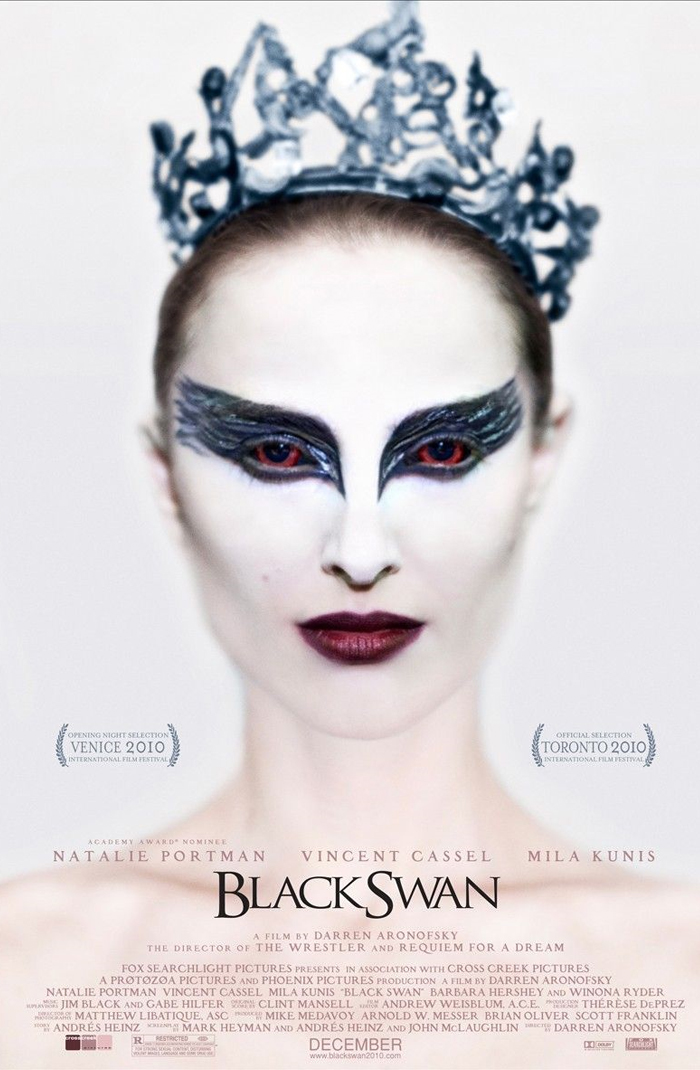 “Black Swan” is, in a word, “disturbing.” There is no doubt that the film is well made, and that Natalie Portman pulls off a stunning performance. Rather than reviewing it as a movie worth seeing, I thought I’d comment on it from a Christian perspective. In what follows, there will be spoilers.
What kind of thoughts can the Christian take away from a movie like “Black Swan”? I think the most obvious point is that the Christian can reflect on the nature of sin. What will things of this world drive us to? In her pursuit of perfection, Nina (Natalie Portman) is driven to the depths of her soul’s darkness. She is lead to violent fantasies (it’s unclear as to whether much of the violence is real or not) and to sexual depravity. It all culminates in her self-destruction, sacrificing her life for the “perfect” performance of “Swan Lake.”
I think we can see similar themes in our own lives as Christians. We often pursue worldly passions–among them a well-paying career; a sexual sin; an addiction; or the like–rather than focusing on that which matters: our Lord. Yet Christians even have this very idea built into the fabric of their belief system: we are sinners, with the capacity for great evil within us. Indeed, we are “originally sinful” and “totally depraved”, by nature we are sinful and unclean. “Black Swan” poignantly portrays this. An innocent girl is driven to the depths of hell in her pursuit of the world. It’s maddening, it’s horrifying, it’s disturbing. Despite this, in a way, the story draws us in. We can relate to the obsession with the world in ways that should scare us. Perhaps that’s why I found “Black Swan” so frightening. It wasn’t a horror movie by any means–it has its thrills and chills–but mostly, the fear is of the reality that could be. Could we become the “Black Swan” ourselves?
Now, I’m not suggesting “Black Swan” is a Christian film. It has sin of almost every imaginable kind portrayed, sometimes graphically. My point is that Christians can take away a message from the movie. The pursuit of the world will lead only to darkness… a “perfection” which can only destroy.
———
The preceding post is the property of J.W. Wartick (apart from citations, which are the property of their respective owners) and should not be reproduced in part or in whole without the expressed consent of the author. All content on this site is the property of J.W. Wartick and is made available for individual and personal usage. If you cite from these documents, whether for personal or professional purposes, please give appropriate citation and provide a link to the original URL. By viewing any part of this site, you are agreeing to this usage policy.

 J.W. Wartick - Reconstructing Faith