christian
Faith is Messy

Longtime readers of this blog will know that I’ve taken a kind of hiatus from some kinds of posts. I’ve mostly been posting a ton of book reviews. Part of that is because I have been reading all the time, trying to expand horizons and learn more. Another aspect of it is that my views have been changing, meshing, melding, and morphing over time, to the point that I kept thinking I should post on things and then being loathe to confidently put forward ideas that I wasn’t convinced were true.
I am hoping that pattern stops now. I have a lot of things going on in my personal life, but I also have a lot I’d like to write on and reflect on with you. If you’re a longtime reader, thanks so much for sticking with me through this, and I hope you’ll continue to read and comment going forward! If you’re new here, welcome! I hope you’ll bear with me on this journey.
First, there are still going to be a lot of book reviews. It’s a thing I like doing and that I like to think I’m fairly good at. Second, I’m still very interested in a lot of the things I wrote on before: apologetics, science and Christianity, and theology (especially Bonhoeffer!). I’ll still be writing on those things.
Faith is messy. That’s maybe the biggest thing I’ve learned on my own walk. It’s easy to have a set list of specific, explicit instructions about how the way things ought to be. It’s easy to stay in the position that you’re right and everyone around you is, at best, mistaken, or at worst actively deceiving others. It’s easy to subscribe to a view and never let it be questioned. Some people can live with that–and I’m not trying to judge them. I can’t live that way, though. I have to question, to poke and prod and find out if the ideas work. I don’t want to spend my life living behind a set of doctrinal statements that I’ve not at least tried to confirm for myself. I’ll be writing a lot more about this going forward.
So what do I mean that faith is messy? I mean that, for me, many of the things I was taught at various levels–all the way through graduate school–turned out to be much more complex than I thought at the time. Questions about what it means to affirm inerrancy, questions about hell–and heaven!, questions about what it means to live as a Christian today. I asked questions about my own Christian identity, and what it means to be orthodox.
I lost a lot of friends. I don’t know if it was because I was asking questions that were too difficult, or if it was that I felt some anger and lashed out when the answers I received seemed too simple to deal with the complexity I saw. Either way, I don’t begrudge them–but it doesn’t make it any easier.
Those are just some of the issues I’ve struggled with, and the struggle has been highly formative. I hope you’ll join with me as I write about some of my faith journey, and maybe even comment, and walk with me. I hope to explore the faith even more fully as I write and reflect on my journey, and I want you to join me.
I’ve decided to rebrand my blog a bit, too. Instead of “Always Have a Reason” – I’m naming the site “Reconstructing Faith.” It is one thing to deconstruct faith–that’s easy to do. But here, I’m going to be doing the hard work, hopefully with your help, of reconstructing faith.
Book Review: “The Liturgy of Creation: Understanding Calendars in Old Testament Context” by Michael LeFebvre
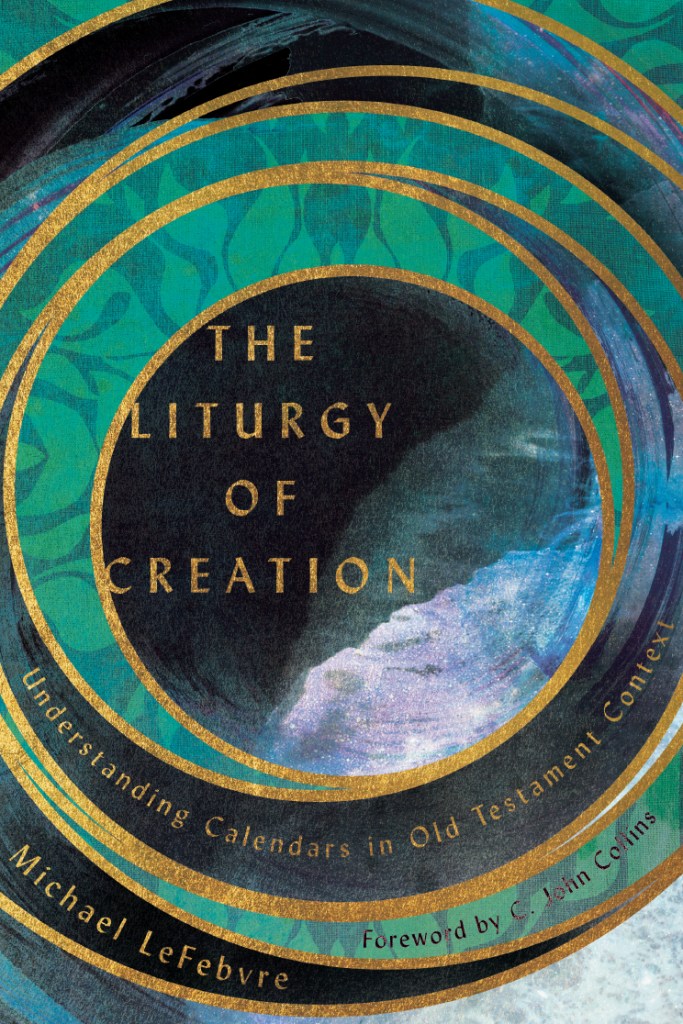
The common saying that “the more you know, the more you know you don’t know” applies perhaps especially well to theology. It shouldn’t be surprising, as it is a topic that attempts to make sense of the infinite. Questions in Christianity about creation abound. Modern debates are often more heat than light, with apparently no way to come to an understanding. Michael LeFebvre’s The Liturgy of Creation: Understanding Calendars in Old Testament Context is a book that can help to break that deadlock and help readers learn about some of the context and meaning of key Old Testament passages.
The core of LeFebvre’s thesis is that the Old Testament narratives center around key aspects of everyday life in their temporal contexts. Specifically, the heavenly lights and the agricultural cycle–which crops could be grown when, harvest time, etc.–helped ground those who spoke and wrote the Old Testament in ways that they would understand. From this, LeFebvre notes that we do the Old Testament damage when we insist upon it providing a kind of modern journalistic approach to dates and dating. The way festivals and days were used in the Old Testament helped provide information to those who heard it about how life ought to be lived and how labor and worship go hand-in-hand.
LeFebvre makes this argument over the course of three major parts. Part I- Israel’s Calendars examines the way calendars were used in the Bible and what reference points they had for understanding time. Part II – Festivals and Their Stories surveys the festivals mentioned throughout the Old Testament and why they were celebrated, grounding them both in the context of the Old Testament text and the time and places in which they occurred. Part III – The Creation Week examines the creation week with the insights gained from Parts I and II in mind.
Part I is a deep exploration of how ancient Israel would have read time, showing not only the use of the stars, the moon, and the sun, but also the way seasons ran throughout the region as ways that people measured their own lives and ways of going about living. LeFebvre is fairly comprehensive in his look at all the stories in the Old Testament that have dates as well as bringing up every festival and examining its importance and usage in the Old Testament. Readers will likely find much to examine and benefit from throughout these first two parts.
It is in part III where the rubber meets the road and LeFebvre applies his insights into timing throughout the Old Testament to the specific questions about the week of creation. The days themselves are laid out in such a way as to correspond to his theses about how Israel ordered itself. LeFebvre makes a strong argument that these creation days are not intended to be read in light of modern science and forced into such a box. Instead, they are intended to give order to creation and one’s own life, providing a reason for Sabbath as well as an understanding of all creation within the context of God’s ordered running of the seasons and universe.
The Liturgy of Creation is an excellent look at what the calendars, seasons, and dates in the Old Testament mean in their own context. LeFebvre brings light to some of the more difficult questions in interpretation, while also challenging readers to examine their own assumptions about the text. Highly recommended.
Disclaimer: I was provided with a copy of the book for review by the publisher. I was not required to give any specific kind of feedback whatsoever.
Links
Be sure to check out the page for this site on Facebook and Twitter for discussion of posts, links to other pages of interest, random talk about theology/philosophy/apologetics/movies and more!
Book Reviews– There are plenty more book reviews to read! Read like crazy! (Scroll down for more, and click at bottom for even more!)
SDG.
——
The preceding post is the property of J.W. Wartick (apart from quotations, which are the property of their respective owners, and works of art as credited; images are often freely available to the public and J.W. Wartick makes no claims of owning rights to the images unless he makes that explicit) and should not be reproduced in part or in whole without the expressed consent of the author. All content on this site is the property of J.W. Wartick and is made available for individual and personal usage. If you cite from these documents, whether for personal or professional purposes, please give appropriate citation with both the name of the author (J.W. Wartick) and a link to the original URL. If you’d like to repost a post, you may do so, provided you show less than half of the original post on your own site and link to the original post for the rest. You must also appropriately cite the post as noted above. This blog is protected by Creative Commons licensing. By viewing any part of this site, you are agreeing to this usage policy.
Book Review: “Myths and Mistakes in New Testament Textual Criticism” edited by Elijah Hixson and Peter J. Gurry
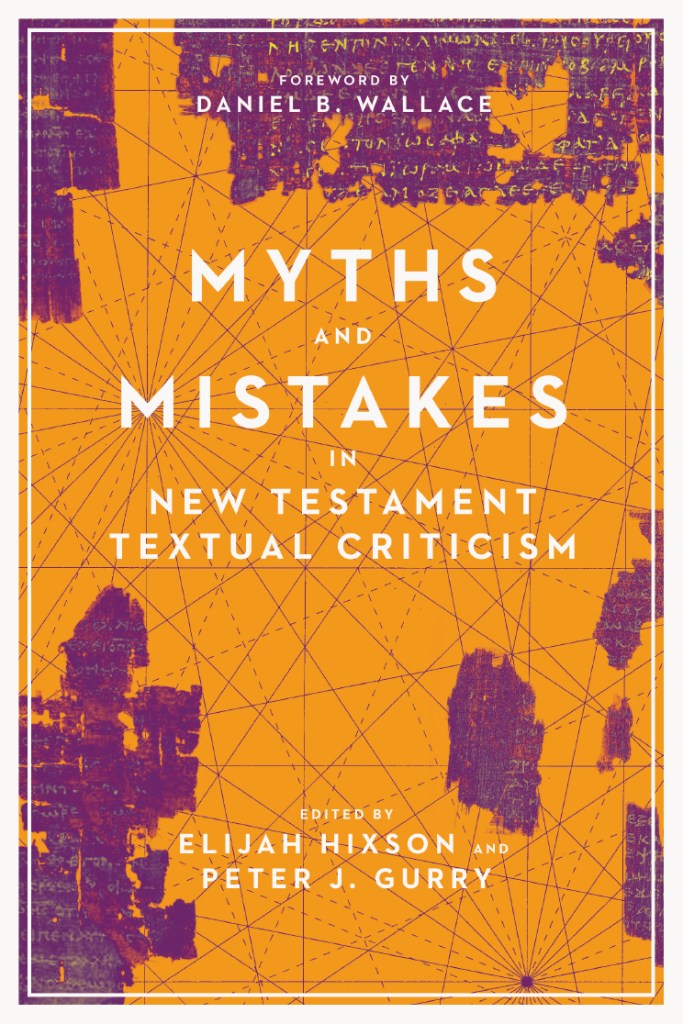
Sometimes a book comes along that makes you as a reader realize that everything you thought you knew about a certain topic was wrong. Myths and Mistakes in New Testament Textual Criticism is sure to be one of those books for many people. The editors, Elijah Hixson and Peter J. Gurry put together a collection of essays that challenge common assumptions and “knowledge” about New Testament textual criticism to the point of overturning expectations and forcing readers to re-think their research. Make no mistake, if you’re not an expert in this specific field–and perhaps even if you are–this book is going to challenge your preconceptions and even what you thought you knew.
After a foreword by renowned textual critic Daniel Wallace and an introduction that opens up the themes of the book, Timothy N. Mitchell’s chapter on autographs (entitled “Myths about Autographs: What they Were and How Long They May Have Survived”) is the first to set a major challenge to assumptions about the New Testament text. The autographic text is considered to be the original text. Thus, an autograph, in the mind of those interested in Christian apologetics or the transmission of the New Testament, is often what is affirmed as being the copy that was inspired or inerrant or the goal of textual criticism to find. Various apologetists have made claims about the autographs surviving long enough to produce many copies over decades (or even centuries) (27). Yet Mitchell points out that some have argue that the concept of a single original itself is mistaken (28). The way documents were disseminated in the ancient world was very different from the way we spread documents, and the same “original” may have been produced several times, with minor edits or even major ones depending on the audience. Specific examples in the ancient world are cited, which challenge the very concept of a single autographic text. Another difficulty would be the concept of multiple autographs. Copying an original for the author to keep was a common practice, but then which would be the autograph–the one sent to one or another person, or the one kept by the author (39-41)? The claims about longevity of the authographs also meet serious challenges, due to climate, persecution, and many other possible problems with thinking that any supposed original text could have survived centuries.
Note that all of these challenges–which are detailed, of course in the book–are all from the first non-introductory chapter alone. There are more than 10 additional chapters outlining many, many assumptions about NT textual criticism and the errors they make. Chapter three outlines questions about the number of NT manuscripts as well as why having more manuscripts might not be better. If all we had was a multiplicity of error-ridden manuscripts, that would hardly be better than just a few very precise ones. Chapter four notes the common errors in citation of numbers of other ancient literature’s manuscript evidence vs. that of the NT (this will have those involved in apologetics–like me–checking their numbers). The next two chapters deal with dating manuscripts and the immense difficulties with getting at which MSS are earlier than other ones at times. Additionally, earlier manuscripts aren’t always better than later manuscripts, in part because later manuscripts might be based on manuscripts that are even earlier than the earliest extant manuscripts!
Questions about who made copies of the NT are another common myth-making scenario. As is often the case in the book, the issue is much more complex. Many claim that the copies were made by untrained hands just scrawling what they could from the NT on whatever they had at hand, while others claim the opposite is true–trained hands copied them and ensured few errors. The truth is somewhere in between. Myths about how scribes made errors are abundant, and attempts to discern scribal intent are shown to be often impossible, but at other times somewhat easier to demonstrate. The number of variants is wildly huge in the claims about how many there are, and the way they are counted is often misstated. Too often, apologists and others claim that variant counts include misspellings, but this is not the case–the huge number of variants would only increase astronomically were misspellings included in the count! Questions about how much of the NT really could be constructed from the patristics are also addressed, and the answer is a somewhat interesting middle ground once again, in which the question of tradition looms large. Canonicity, translations modern and ancient, and more are addressed as well.
All of this is to say the book is an absolute treasure trove of information for those interested in any way in the textual reliability of the New Testament. It is tempting in any day and age to seek certainty, but Christians–and hopefully others–ought to really be seeking after truth. This book helps get at that, providing ways forward for additional research while also blowing open the doors of understanding both hyper-critical and overly optimistic myths about the possibility of getting at the “original” New Testament.
Myths and Mistakes in New Testament Textual Criticism is an invaluable resource for those interested in textual criticism. It points out many major errors that persist in common knowledge while also opening many avenues for new research. There are few times I think a book comes along that everyone should read, but this is one that anyone with even the slightest interest in the reliability of the New Testament ought to read, mark, and inwardly digest.
Disclaimer: I was provided with a copy of the book for review by the publisher. I was not required to give any specific kind of feedback whatsoever.
Links
Be sure to check out the page for this site on Facebook and Twitter for discussion of posts, links to other pages of interest, random talk about theology/philosophy/apologetics/movies and more!
Book Reviews– There are plenty more book reviews to read! Read like crazy! (Scroll down for more, and click at bottom for even more!)
SDG.
——
The preceding post is the property of J.W. Wartick (apart from quotations, which are the property of their respective owners, and works of art as credited; images are often freely available to the public and J.W. Wartick makes no claims of owning rights to the images unless he makes that explicit) and should not be reproduced in part or in whole without the expressed consent of the author. All content on this site is the property of J.W. Wartick and is made available for individual and personal usage. If you cite from these documents, whether for personal or professional purposes, please give appropriate citation with both the name of the author (J.W. Wartick) and a link to the original URL. If you’d like to repost a post, you may do so, provided you show less than half of the original post on your own site and link to the original post for the rest. You must also appropriately cite the post as noted above. This blog is protected by Creative Commons licensing. By viewing any part of this site, you are agreeing to this usage policy.
Book Review: “The Victory of the Cross: Salvation in Eastern Orthodoxy” by James R. Payton, Jr.
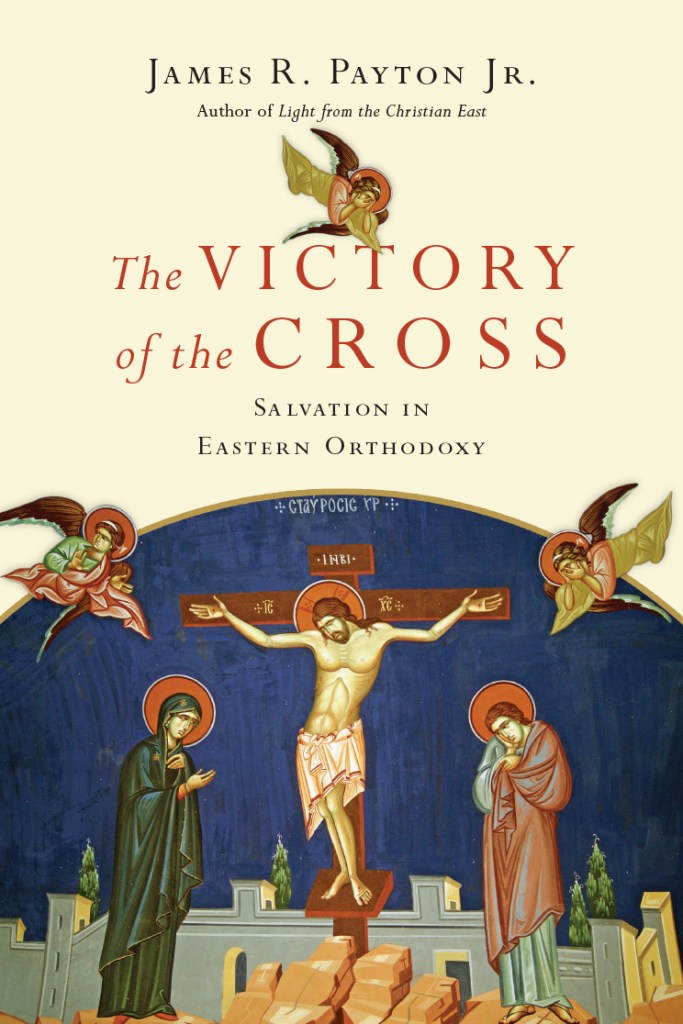
Eastern Othodoxy is often an almost impenetrable system of thought for Christians of different theological persuasions. James R. Payton, Jr.’s The Victory of the Cross: Salvation in Eastern Orthodoxy seeks to dispel some of that confusion by focusing closely on a specific theological question–salvation–and explaining it from an Eastern Orthodox perspective.
James R. Payton, Jr. comes at these controversial questions from the perspective of an evangelical with a deep understanding of the Orthodox faith. He explores some of the major themes in Eastern Orthodoxy related to salvation and brings light to them for those who might not have any real understanding of how Orthodoxy views certain topics. After a brief introduction, Payton sets the stage with a discussion of the cross, then walks readers through what might be a somewhat familiar path of going from a chapter on the need for salvation (also viewed in Orthodoxy as universal, though their view of original sin is less a culpable sin than a tendency towards sin) and moving into the focus on the savior, Christ. The way God saved humanity is one that is debated in non-Eastern circles as well, and here Payton focuses largely on the awe that the salvation brought with Christ inspires. One of the most controversial–perhaps only for its strangeness to non-Orthodox ears–aspects of Orthodox theology related to salvation is deification. An entire chapter is dedicated to that concept, along with a following chapter on “becoming like God” on the path to salvation.
Payton does an excellent job of grounding Eastern Orthodox beliefs in its practice and highlighting how much Orthodoxy draws from Church Fathers as well as orthopraxy. What is so often lost in many forms of Christianity today is the practice of lived faith. There’s a sense of “Yeah, I’m saved, and I read my Bible and go to church, and that’s it.” But Eastern Orthodoxy’s view of salvation does not allow such a surface level faith, at least not when done rightly. Instead, it demands a whole life committed to Christ and infused with the divine in contemplation and, indeed, in one’s own life. Payton’s work helps explain those aspects of Eastern Orthodoxy which may be strange to those who haven’t encountered it before while also ably highlighting the depth of the practice of faith and a life focused on the sign of the Cross.
The Victory of the Cross is a fascinating, adept introduction to the nature of salvation in Eastern Orthodoxy. It will serve readers not only as a way to springboard discussions into Eastern Orthodoxy, but also as a path to coming to a better understanding of the richness of the Christian tradition worldwide.
Disclaimer: I was provided with a copy of the book for review by the publisher. I was not required to give any specific kind of feedback whatsoever.
Links
Be sure to check out the page for this site on Facebook and Twitter for discussion of posts, links to other pages of interest, random talk about theology/philosophy/apologetics/movies and more!
Book Reviews– There are plenty more book reviews to read! Read like crazy! (Scroll down for more, and click at bottom for even more!)
SDG.
——
The preceding post is the property of J.W. Wartick (apart from quotations, which are the property of their respective owners, and works of art as credited; images are often freely available to the public and J.W. Wartick makes no claims of owning rights to the images unless he makes that explicit) and should not be reproduced in part or in whole without the expressed consent of the author. All content on this site is the property of J.W. Wartick and is made available for individual and personal usage. If you cite from these documents, whether for personal or professional purposes, please give appropriate citation with both the name of the author (J.W. Wartick) and a link to the original URL. If you’d like to repost a post, you may do so, provided you show less than half of the original post on your own site and link to the original post for the rest. You must also appropriately cite the post as noted above. This blog is protected by Creative Commons licensing. By viewing any part of this site, you are agreeing to this usage policy.
Sunday Quote!- Answering Questions about Faith from Biblical Language Alone?
Occasionally, on Sunday, I will share a quote from something I’ve been reading. The hope is for you, dear reader, to share your thoughts on the quote and related issues and perhaps pick up some reading material along the way!
Answering Questions about Christian Doctrine from Biblical Language Alone?
I’ve started to read a massive work on the development of the doctrine of the Trinity during what is called the Arian Controversy: The Search for the Christian Doctrine of God : The Arian Controversy 318-381 by R.P.C. Hanson. It’s already been eye-opening in a number of ways, and I thought a quote to help illustrate one of those points would be helpful. As the early church began to dispute the doctrine of the Trinity in earnest, it became clear that simply appealing to biblical language was not enough:
The theologians of the Christian Church were slowly driven to a realization that the deepest questions which face Christianity cannot be answered in purely biblical language, because the questions are about the meaning of biblical language itself. (xxi)
Hanson’s point here is that each side of this controversy appealed to biblical language and even tradition to support their claim to be orthodoxy. When faced with such discord, the Christian church was forced to come to a decision point, and Hanson notes that this decision was “to form dogma” (ibid). The Christian Church had to come to realize the necessity of coming to agreed upon interpretations of the biblical language, because the questions that were being raised were about that language itself.
This raises, of course, many additional questions, some of which are uncomfortable. For example: If such hugely important doctrinal questions could not be resolved simply by appeal to the biblical language, what does this mean for some forms of sola scriptura? It seems that some formulations of that doctrine clearly allow for tradition and even dogma to decide questions of interpretation, but more extreme forms surely cannot adequately defend orthodox Christian doctrine. Another question that it raises is: What kind of controversies does the church have now that each side appeals to biblical language on but can find no ultimate resolution there?
The Search for the Christian Doctrine of God has already been challenging and enlightening. It’s a behemoth at 900+ pages, but it seems well worth the time investment.
Links
Be sure to check out the page for this site on Facebook and Twitter for discussion of posts, links to other pages of interest, random talk about theology/philosophy/apologetics/movies and more!
On Christian Music– I wrote a post about the label “Christian music” and how that can lead to a number of difficulties with discernment.
Christian Discernment Regarding Music: A Reflection and Response– I reflect in depth on how we can use our discernment properly when it comes to music.
Sunday Quote– If you want to read more Sunday Quotes and join the discussion, check them out! (Scroll down for more)
Eclectic Theist– Check out my other blog for my writings on science fiction, history, fantasy movies, and more!
SDG.
“Debate on the Evidences for Christianity” – Alexander Campbell vs. Robert Owen (1829) Part 4- Historical Apologetics Debates
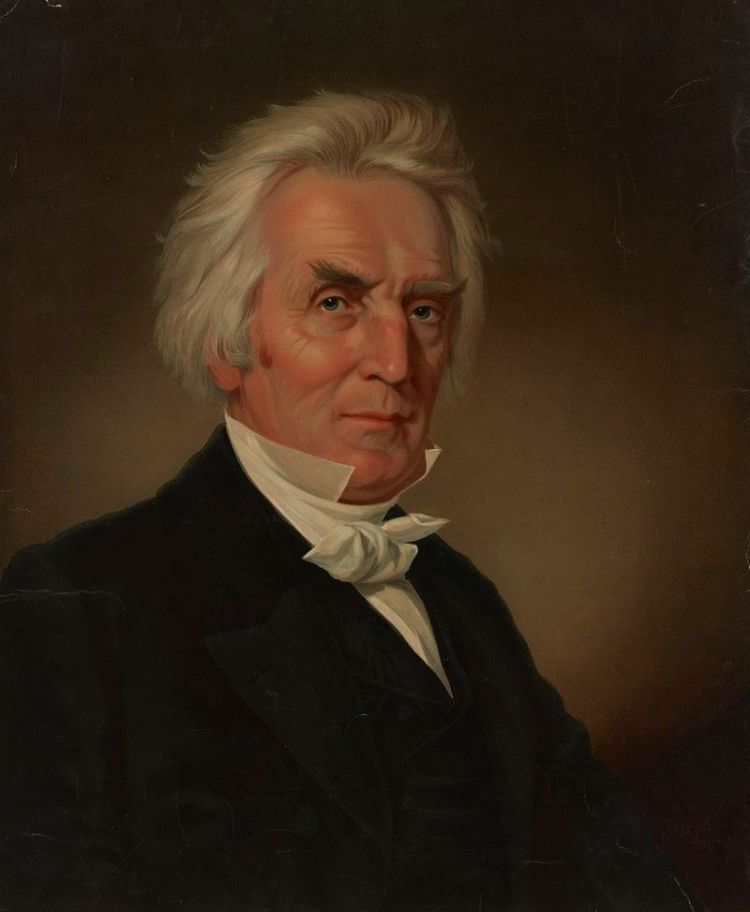
Alexander Campbell (1788-1866) was a Scots-Irish immigrant in the United States who debated Christianity with a few well-known skeptics. One of his best known debates was with Robert Owen (1771-1858), who argued in favor of agnosticism. This debate was published as “Debate on the Evidences of Christianity” (1829, see link for download). Here, will look at what answers Campbell gave and where his arguments might have been improved. Owen was a fine opponent whom Campbell himself acknowledged as a worthy scholar.
Debate on the Evidences for Christianity Part IV
We left off last time at an intermission (page 40) and pick up there. The moderators interject here to try to reign in the conversation, asking Owen and Campbell to limit the discussion in this afternoon (think about it–multiple days-long debates!) to the first proposition at question, namely “that all religions have been founded in ignorance” (40). Owen begins his defense of the proposition.
First, Owen flatly states that he would not have to defend the proposition that all religions ever are ignorant if humans were not themselves kept in ignorance of “what manner of beings they were, how they were formed at birth, and how their characters were afterword produced for them” (40-41). This bold claim has interest to us today–what more have we learned about these questions than Owen and Campbell might have known in 1829? It seems clear we know more about at least a few of these questions, though one could argue that psychology, anthropology, and biology have digressed–that position would be interesting to see defended. Nonetheless, what does it say that religions persist to this day, almost 200 years later, with possibly more knowledge of these questions than Owen had?
Owen goes on, here making a much more interesting claim: he states that he will demonstrate that humans are different from whatever any religion supposes them to be and that none of the religions apply to humans as they truly are (41). What is interesting to reflect on at this point in the debate is how frequently Owen makes these lofty, impossible to prove claims. Is he really going to survey every religion ever in existence to demonstrate individually that they are all impossible to reconcile with what he believes is human nature? No, of course not. But keep an eye on modern debates over the existence of God or the nature of Christianity as well–how often do the interlocutors in those debates make similarly grand claims without support?
Owen goes on to claim that to prove his contention, we need only to look at ourselves and the facts that we know of right now (41). Here he makes one of the first relevant points to Christianity specifically in the debate so far (though he does so as an attack on “all” religions, apparently): he argues that human beings come into the world entirely ignorant of the state of things and without control over their formation, and concludes from that any religion that teaches humanity is by nature sinful or “bad” (as he puts it) is therefore mistaken. Specifically, Owen asserts that “no being… can ever be made to become responsible for [its] nature” (ibid).
Owen goes on to stress his previous argument that no one is in control of the circumstances of their birth, such that it is an accident of history that people are born into places in which they believe whatever religion they believe (41-43). He asks, “Who amongst us decided that he should be taught to speak English, be instructed in the Christian religion and belong to his particular sect?” (43). He then appeals to the commonality of all humanity in being accidents of birth to find unity: all the things which separate us, he asserts, can be attributed to the accidents of circumstance (I’m using the phrase “accident” here to substitute for his wordier descriptors). Thus, we can turn to our neighbors and unite with them over our shared humanity. It is a powerful call to a humanist faith in the unity of all humankind.
Campbell rises to meet this mixed challenge. And he does so with startling clarity:
Let us try this position with a reference to our existing institutions : all schools and colleges have been founded and predicated on the ignorance of man ; all testimony has been predicated on the ignorance of man; all the books that have ever been printed are predicated on the ignorance of man? Are not these facts? But does the existence of these facts cast any opprobrium [censure], obloquy [public verbal abuse], or disparagement upon books, human testimony, or seminaries of instruction?— These terms, then, have nothing in their nature or import calculated to engender a prejudice against religion. (45)
Campbell goes on in to frankly concede Owen’s point that all religions are founded in ignorance, so long as it is taken by that to mean that all religions are founded on humans who do not have the capacity to control the place of their birth, the circumstances thereof, etc. But rather than concluding that this means the are all false or unnecessary, Campbell flips the narrative on its head and says that this ignorance itself shows the need for religion! The reason, he asserts, is because religion helps us to sort out the many things that happen as accidents of birth and provides a basis for morality and rational sorting out of all the myriad of details that we are made aware of throughout our lives. ” If, then, [people] need a religion at all, they need it because of their ignorance. It was instituted to remove human ignorance, and the necessity of supernatural revelation has ever been predicated on that ignorance” (45).
The question of what human knowledge is gained and what is necessary is “thorny,” as Campbell notes, and he goes on to state that Owen’s position effectively makes all human capacities and reasoning necessary based upon the way Nature operates on them. But nature itself does not explain all things, and the capacity for our observation of all things is not limitless. Metaphysical truths, like many principles of mathematics which seem unquestionable, can become difficult when the test of observation is applied, but that does not undermine the possibility for their truth.
Moreover, Campbell argues that we are not entirely products of circumstance: Owen himself went against the nature of British society from which he sprang. The ceding of all knowledge to circumstance has led to a number of ideas that are difficult to reconcile with reality, according to Campbell. Among these are those philosophers who came to deny right and wrong; others who denied the existence of the physical world; and many other difficult positions. Then, Campbell goes on a somewhat lengthy discourse about not just Owen’s 12 principles (introduced before) but also on how philosophers in general tend to pick a favored principle (or set thereof) and reduce all human activity and thought down to that–an exercise that is often futile, according to Campbell (47-49).
With this, Campbell concludes, and the two retired for the day. We, too, will leave off here (page 51) and pick it up later. For now, think on how the debate of this day played out: Owen asserts that all religions are founded on ignorance due to circumstances of birth. Campbell concedes the point but notes that if that is the argument, all human institutions are also founded in the same ignorance, such that it is hardly a reason to dismiss religion specifically. Moving on, Campbell argues that religion is necessary exactly for the reason Owen asserts it ought to be condemned. A fascinating day for the debate, don’t you agree?
Questions
- Do we know more about what manner of beings humans are, how we are formed at birth, and how characters are produced than Owen and Campbell did in the 1800s? Is it historical hubris to suggest we might? And, if so, what does that say for Owen’s thesis that if we just knew about these questions, all humanity would disavow all religions as ignorance?
- What do you think of Campbell’s counter-charge that religion is, in fact, made necessary by humanity’s ignorance?
- Should the bare fact of accident of birth be an argument against a position–religion, philosophy, etc.?
Links
Be sure to check out the page for this site on Facebook and Twitter for discussion of posts, links to other pages of interest, random talk about theology/philosophy/apologetics/movies and more!
Apologetics Read-Through: Historical Apologetics Read-Along– Here are links for the collected posts in this series and other read-throughs of apologetics books (forthcoming).
Dead Apologists Society– A page for Christians interested in the works of historical apologetics. There is also a Facebook group for it.
SDG.
——
The preceding post is the property of J.W. Wartick (apart from quotations, which are the property of their respective owners, and works of art as credited; images are often freely available to the public and J.W. Wartick makes no claims of owning rights to the images unless he makes that explicit) and should not be reproduced in part or in whole without the expressed consent of the author. All content on this site is the property of J.W. Wartick and is made available for individual and personal usage. If you cite from these documents, whether for personal or professional purposes, please give appropriate citation with both the name of the author (J.W. Wartick) and a link to the original URL. If you’d like to repost a post, you may do so, provided you show less than half of the original post on your own site and link to the original post for the rest. You must also appropriately cite the post as noted above. This blog is protected by Creative Commons licensing. By viewing any part of this site, you are agreeing to this usage policy.
“The Man in the High Castle” – A Christian Reflection on the Finale

Amazon recently released the final season of “The Man in the High Castle” and it was full of revelations, deeply moving moments, and the intense buildup fans of the series have come to expect. Here, I’d like to discuss the finale in light of a Christian worldview. There will, of course, be major spoilers for the whole series since we are talking about the finale.
The Breaking of Swords
The climactic scene in the final episode shows the revelation that John Smith has died, and upon finding out about it, Bill Whitcroft, the newly-minted leader of the Nazis in the United States immediately throws off his swastika and calls off the attack on the Western States. An immensely powerful scene follows, in which hordes of bombers suddenly turn aside from violence. The people who are watching in anticipation of their almost certain deaths look on in awe as the bombers turn away and their lives are saved. They set down their weapons on the battlements as the music swells with emotion. It was a conscious choice–a choice for peace rather than war, for turning aside from violence, for the breaking of swords.
The scene also makes me think of a recently released book entitled Beating Guns, in which the authors talk about political topics related to gun control, but also about the eschatological hope of literally beating guns into plowshares. In fact, one of the authors has a group that does that literal act, having truly turned a number of weapons into various garden implements and tools.
Each of these acts–literally working to beat guns into garden tools or choosing to go the way of peace instead of the way of destruction–demonstrates something about Christian eschatological hope that is often missed in the broader discussions of end-times theorizing. Too often, Christians obsess over details of alleged end times prophecy but miss the fact that Jesus has already come and that calls us to a radical renewal and change of the world–one that calls us to peace and overwhelming love.
The call to peace is powerful, and some of the greatest Christian thinkers have made it central to their theology. For example, Dietrich Bonhoeffer wrote of a radical call to peace that went against security. Rather than having the security that comes with force of arms, Christians are called towards a life that turns the other cheek and trusts in God.
Evil Begets Evil
John Smith is a kind of ultimate tragic figure. There’s an absolutely stunning sequence in this final season as Helen Smith discovers what John is doing. Interspersed with flashbacks showing how John initially tried to resist the Nazi regime until ultimately capitulating to it and even watching his friend get shipped off to a concentration camp, we discover with Helen that John Smith, as he gains control of the United States, is planning for a continuation of the Final Solution. A particularly chilling moment is when she discovers the map for where the concentration camps would be placed. Helen realizes this is for real–John is planning to not just continue but also magnify the atrocities that the Nazis perpetrated.
Finally, Helen confronts John on their ill-fated train ride. She asks him: “How did we get here–you and me, how did we get here?” She has come to the realization, fully owning that what she has done, and what her husband has done, is an incredible evil–a crime that will be remembered throughout all history. When she calls it a “crime” John Smith says, “I know.” She replies, “It has to stop.” His response is absolutely horrifying, not because it is utterly evil–it is–but because of how we can see that this kind of evil is something people can almost fall in to. He says: “I don’t know how.”
He has gotten so used to the state of affairs that he is inoculated to it. Evil is simply a way of living, it is how they live. It has supported and propped up their lives. It is so incredibly easy for we as humans to give in to evil. We allow it to become a norm. We look the other way when we see injustice and we accept it as a fact of life. People will, after all, do horrific things. What can we do?
But we cannot do this. We cannot accept evil as it stands. We must not. We are called to do better. We must tear down unjust institutions, acknowledging that they are part of what makes it so that we “don’t know how” to do any different. We must call for reform, for a setting down of arms, a march of peace. We cannot ever allow ourselves the comfort of that hideous evil to hide behind: ignorance.
A March of Saints?
The ending of the series is surprisingly ambiguous. I kind of loved it. We see the quantum machine opening up, apparently allowing people from all sorts of alternate worlds come in. The march of people coming in from all over is a stark contrast to the restrictive control that the Nazis have been trying to impose. It’s a kind of march of saints as people go looking for each other from across worlds. It is beautiful.
Links
Be sure to check out the page for this site on Facebook and Twitter for discussion of posts, links to other pages of interest, random talk about theology/philosophy/apologetics/movies and more!
Also see my other looks into television (scroll down for more).
SDG.
——
The preceding post is the property of J.W. Wartick (apart from quotations, which are the property of their respective owners, and works of art as credited; images are often freely available to the public and J.W. Wartick makes no claims of owning rights to the images unless he makes that explicit) and should not be reproduced in part or in whole without the expressed consent of the author. All content on this site is the property of J.W. Wartick and is made available for individual and personal usage. If you cite from these documents, whether for personal or professional purposes, please give appropriate citation with both the name of the author (J.W. Wartick) and a link to the original URL. If you’d like to repost a post, you may do so, provided you show less than half of the original post on your own site and link to the original post for the rest. You must also appropriately cite the post as noted above. This blog is protected by Creative Commons licensing. By viewing any part of this site, you are agreeing to this usage policy.
Sacrifice and Sacrament in Dan Simmons’s “Hyperion”
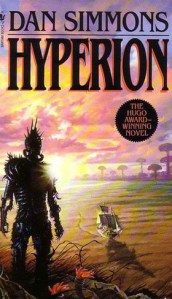 Hyperion by Dan Simmons is a Hugo Award-Winning science fiction novel that reads like a kind of modern Canterbury Tales. The theological depth and beauty of Simmons’s Hyperion is as profound as it is repelling. The stories told in the novel range from horrifying and vulgar to profound and deep. Each traveler has their own purpose for being on the journey, and Simmons draws readers in with these tales. Here, we’ll discuss one story that moved me deeply. There are, of course, SPOILERS in what follows.
Sacrifice and Sacrament
One story, in particular, sticks out for me. That is the story of the “cruciform” told by Lenar Hoyt, a Roman Catholic priest who tells the story of Paul Duré, a priest who was exiled to the planet Hyperion and researches a strange population there. As readers go on, they see through Duré’s eyes, that the people he’s researching are apparently immortal, and that they follow the way of the “cruciform.” This leads Duré to believe he has found something that will bring life to the Christian church at large–rock solid evidence that Christianity is true and that everyone should follow it.
But as the story goes on, we discover that the immortality of these people is something much more horrifying. The “cruciform” is really a kind of parasitic organism that sustains the host humans while draining their will to do anything other than serve it. The price of immortality is unconscionably high. Pain removes the cruciform creatures, but it manipulates the others into killing the host only to resurrect them from whatever is left so that it can continue living. Duré, unwittingly, had consigned himself to an endless existence serving the cruciform.
Duré, though, discovers a way out: he burns himself continually so that the cruciform will at last remove itself from his body. Hoyt finds him and is able to end his years of endless torment by removing the cruciform and allowing him to die at long last. The cruciform was a mockery of Christian salvation and resurrection hope, something Duré himself came to realize. His own death was a kind of sacred sacrament, a burning away of the evil of artificially discovered immortality that brought nothing but misery and a deliverance into the eternal life after.
Duré wrote, in one of the entries after he realized the abomination that was the cruciform:
If the church is meant to die, it must do so–but do so gloriously, in the full knowledge of its rebirth in Christ. It must go into the darkness not willingly but well–bravely and firm of faith–like the millions who have gone before us, keeping faith with all those generations facing death in the isolated silence of death camps and nuclear fireballs and cancer wards and pogroms, going into the darkness, if not hopefully, then prayerfully that there is some reason for it all, something worth the price of all that pain, all those sacrifices. All those before us have gone into the darkness without assurance of logic or fact or persuasive theory, with only a slender thread of hope or the all too shakable conviction of faith. And if they have been able to sustain that slim hope in the face of darkness, then so must I… and so must the Church. (91)
The sure and provable scientific fact that Duré had been seeking when he found the cruciform initially confirmed his faith before the horror of it made him literally burn it away. But what he found in its stead was a newfound hope, however slim, that in the face of darkness and evil, without the most persuasive evidence, his faith could sustain him. It’s a profound commentary on Christian hope, and one that should be read fully to experience.
Links
Be sure to check out the page for this site on Facebook and Twitter for discussion of posts, links to other pages of interest, random talk about theology/philosophy/apologetics/movies and more!
Book Reviews– There are plenty more book reviews to read! Read like crazy! (Scroll down for more, and click at bottom for even more!)
SDG.
——
The preceding post is the property of J.W. Wartick (apart from quotations, which are the property of their respective owners, and works of art as credited; images are often freely available to the public and J.W. Wartick makes no claims of owning rights to the images unless he makes that explicit) and should not be reproduced in part or in whole without the expressed consent of the author. All content on this site is the property of J.W. Wartick and is made available for individual and personal usage. If you cite from these documents, whether for personal or professional purposes, please give appropriate citation with both the name of the author (J.W. Wartick) and a link to the original URL. If you’d like to repost a post, you may do so, provided you show less than half of the original post on your own site and link to the original post for the rest. You must also appropriately cite the post as noted above. This blog is protected by Creative Commons licensing. By viewing any part of this site, you are agreeing to this usage policy.
Book Review: “George MacDonald in the Age of Miracles” by Timothy Larsen
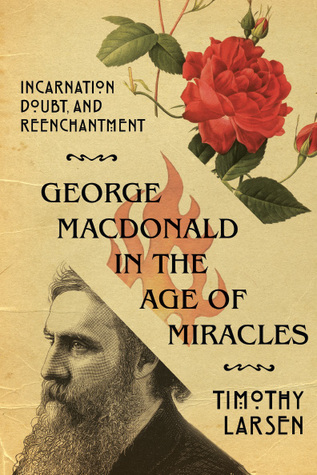
George MacDonald in the Age of Miracles is a series of lectures and responses on the Scottish poet/author/pastor and his legacy for our time.
The book is a publication of part of the Hansen Lectureship series, a series of lectures dedicated to the legacies of C.S. Lewis, J.R.R. Tolkien, Dorothy L. Sayers, George MacDonald, Charles Williams, G.K. Chesterton, and Owen Barfield. Essentially, it is to provide a “means of escape for prisoners”–speaking theologically, the lectureship is to provide ways to escape from our narrow-minded self-centeredness and “be equipped for practical deeds in real life” (5).
Larsen’s contribution to this series focuses on George MacDonald, and he does so in three lectures that emphasize MacDonald’s look at the incarnation, his discussion of the crisis of doubt, and the re-enchantment of the world. Each lecture has several highlights. I was particularly struck by the second lecture about the crisis of doubt, which related through MacDonald’s characters and poetry the struggle of the Victorian era’s own awakening to new challenges to traditional theology and thought. MacDonald used his characters to show that doubting was not something to be attacked or undermined, but rather was a part of faith formation, particularly in an era with new challenges.
George MacDonald in the Age of Miracles is a brief but fascinating look at the works of MacDonald and how his legacy can impact us to this day. Recommended.
Disclaimer: I was provided with a copy of the book for review by the publisher. I was not required to give any specific kind of feedback whatsoever.
Links
Be sure to check out the page for this site on Facebook and Twitter for discussion of posts, links to other pages of interest, random talk about theology/philosophy/apologetics/movies and more!
Book Reviews– There are plenty more book reviews to read! Read like crazy! (Scroll down for more, and click at bottom for even more!)
SDG.
——
The preceding post is the property of J.W. Wartick (apart from quotations, which are the property of their respective owners, and works of art as credited; images are often freely available to the public and J.W. Wartick makes no claims of owning rights to the images unless he makes that explicit) and should not be reproduced in part or in whole without the expressed consent of the author. All content on this site is the property of J.W. Wartick and is made available for individual and personal usage. If you cite from these documents, whether for personal or professional purposes, please give appropriate citation with both the name of the author (J.W. Wartick) and a link to the original URL. If you’d like to repost a post, you may do so, provided you show less than half of the original post on your own site and link to the original post for the rest. You must also appropriately cite the post as noted above. This blog is protected by Creative Commons licensing. By viewing any part of this site, you are agreeing to this usage policy.
Book Review: “All Things New: Revelation as Canonical Capstone” by Brian J. Tabb
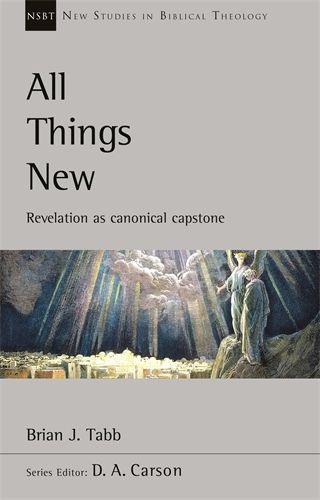
Revelation inspires extremes of opinions. Today, people heatedly argue over its meaning, what is to be taken literally, when its events will/have/should happen. It was challenged on its canonicity in the Reformation and before. What can be done to bring some light to this mysterious, complex book? Brian J. Tabb attempts, in All Things New, to provide a way forward in reading Revelation not as an obscure, impenetrable text, nor as a newspaper to tell us about the end times, but rather as a capstone of Scripture that highlights theological themes throughout the whole Bible.
Tabb notes in the introduction the disputed nature of Revelation. Rather than trying to refute all the positions with which he disagrees, he instead seeks from the beginning to build a reading of Revelation that makes sense of its place in Scripture.
First, Tabb turns to how Revelation reveals the Triune God, highlighting the use of language throughout the Bible to demonstrate how the book reveals God’s Triuine nature. This first part is a fascinating section as Tabb draws on broad swathes of Scripture to show that the author of Revelation drew from all over the Bible to demonstrate the Trinity as well as the work of the divine Persons. Next, Tabb turns to themes in Revelation of suffering for God, witnessing, and worship. The third part focuses on judgment, salvation, and restoration. Here again Tabb’s argument is holistic, seeking to show how the author of Revelation drew from Biblical imagery to make their argument about these themes. It is important to note the way that the author of Revelation uses this language, which seems to work against the notion that they took everything literally themselves, picking and choosing from throughout the canon to make their points. Finally, part four shows Revelation’s view of the word of God as trustworthy, prophetic, and true.
Tabb’s work here is admirable in that he has written a book that could benefit readers of many different views related to the book of Revelation and its meaning. All Things New is a helpful book in clarifying the meaning and purpose of one of the most debated and confusing books in the canon.
Disclaimer: I was provided with a copy of the book for review by the publisher. I was not required to give any specific kind of feedback whatsoever.
Links
Be sure to check out the page for this site on Facebook and Twitter for discussion of posts, links to other pages of interest, random talk about theology/philosophy/apologetics/movies and more!
Book Reviews– There are plenty more book reviews to read! Read like crazy! (Scroll down for more, and click at bottom for even more!)
SDG.
——
The preceding post is the property of J.W. Wartick (apart from quotations, which are the property of their respective owners, and works of art as credited; images are often freely available to the public and J.W. Wartick makes no claims of owning rights to the images unless he makes that explicit) and should not be reproduced in part or in whole without the expressed consent of the author. All content on this site is the property of J.W. Wartick and is made available for individual and personal usage. If you cite from these documents, whether for personal or professional purposes, please give appropriate citation with both the name of the author (J.W. Wartick) and a link to the original URL. If you’d like to repost a post, you may do so, provided you show less than half of the original post on your own site and link to the original post for the rest. You must also appropriately cite the post as noted above. This blog is protected by Creative Commons licensing. By viewing any part of this site, you are agreeing to this usage policy.

 J.W. Wartick - Reconstructing Faith