christian
“The Rocks Don’t Lie” by David Montgomery: Chapters 8-10
 After a 5 year hiatus, I decided to continue my look at David Montgomery’s work, The Rocks Don’t Lie. For a refresher, the book is from the perspective of a geologist as he looks at Noah’s flood in light of geology, but he also includes material on contemporary accounts and some reflections on faith.
Chapters 8-10
There is no question that there are flood stories across many times and cultures. Indeed, some young earth creationists cite this as the single best evidence for a global flood. What is most interesting, however, is the total similarity between some earlier flood stories from the same Ancient Near Eastern time and place as what the Noahic deluge story would later originate. Montgomery surveys this early history, noting the amazing discovery of more ancient flood myths in Sumerian writings. At least 3 different flood stories were discovered in these ancient fragments, and they yielded many similarities with the biblical flood account (153ff). Alongside discoveries like this, the rise of deism threatened Christianity and led to some reactionary responses to both the discoveries and the age. On the other hand, many Christian theologians moved to see Genesis as “a synopsized or allegrical explanation of how the world came to be rather than a comprehensive history of everything that ever existed” (167).
Other issues with the Genesis flood account as history began to be realized by other Christian theologians. The question of how to fit all the animals on the ark became a major issue (169). Some began to abandon both the idea of a local flood as well as the idea of a global flood, seeing the story as a theological point rather than literal history, though the idea failed to gain much steam (170). Another response was more reactionary and came with it the rejection of much of the evidence against a global flood–the birth of the creationist movement.
Montgomery interacts with modern creationism by pointing to the Creation Museum from Answers in Genesis, noting how much of the alleged evidence presented there is in stark contrast to what we can learn from geology now. After a brief look at the museum, he looks at the history of modern creationism, noting, as many others have, its roots in Seventh Day Adventism and reactionary fundamentalism. Time and again in the history of creationism, Montgomery notes how science has been misrepresented or ignored. For example, he uses a graph showing radiocarbon dating and its correlation with known samples, demonstrating the reliability of the method for certain ages (192-193).
These chapters once again show the range of Montgomery’s book and the importance of looking into many different angles of investigating the flood and other biblical accounts. It isn’t enough to just do what so many creationists insist upon and just read the accounts at a surface level, importing our own assumptions about what the text should mean and say as we go. The fact that many flood stories predate the biblical story and share details must lead one to account for that in their worldview. Similarly, a reactionary approach will not do.
Links
“The Rocks Don’t Lie” by David Montgomery: Preface and Chapter 1– Montgomery surveys the intent of the book and how his own investigation of the flood led him to some surprising results. He expected a straightforward refutation of creationism, but found the interplay with science and faith to be more complex than he thought.
“The Rocks Don’t Lie” by David Montgomery: Chapters 2-3– First, Montgomery gives a survey of the basics of geology. Then he notes some serious problems with young earth paradigms related to the Grand Canyon and fossils in the Americas as well as on mountains.
“The Rocks Don’t Lie” by David Montgomery: Chapter 4– Montgomery surveys a number of early flood geological theories and shows how theological interpretations continued to change as evidence was discovered through time.
“The Rocks Don’t Lie” by David Montgomery: Chapters 5-7– A brief early history of the study of geology and paleontology is provided, and early theories about the flood begin to form alongside them.
Be sure to check out the page for this site on Facebook and Twitter for discussion of posts, links to other pages of interest, random talk about theology/philosophy/apologetics/movies and more!
Book Reviews– There are plenty more book reviews to read! Read like crazy! (Scroll down for more, and click at bottom for even more!)
SDG.
——
The preceding post is the property of J.W. Wartick (apart from quotations, which are the property of their respective owners, and works of art as credited; images are often freely available to the public and J.W. Wartick makes no claims of owning rights to the images unless he makes that explicit) and should not be reproduced in part or in whole without the expressed consent of the author. All content on this site is the property of J.W. Wartick and is made available for individual and personal usage. If you cite from these documents, whether for personal or professional purposes, please give appropriate citation with both the name of the author (J.W. Wartick) and a link to the original URL. If you’d like to repost a post, you may do so, provided you show less than half of the original post on your own site and link to the original post for the rest. You must also appropriately cite the post as noted above. This blog is protected by Creative Commons licensing. By viewing any part of this site, you are agreeing to this usage policy.
“Didaskolos” by Bertil Gärtner, Part 1, in “Women Pastors?”edited by Matthew C. Harrison and John T. Pless
 I grew up as a member of the Lutheran Church-Missouri Synod, a church body which rejects the ordination of women to the role of pastor. The publishing branch of that denomination, Concordia Publishing House, put out a book entitled Women Pastors? The Ordination of Women in Biblical Lutheran Perspective edited by Matthew C. Harrison (who is the current President of the LCMS) and John T. Pless. I have decided to take the book on, chapter-by-chapter, for two reasons. 1) I am frequently asked why I support women pastors by friends, family, and people online who do not share my position, and I hope to show that the best arguments my former denomination can bring forward against women pastors fail. 2) I believe the position of the LCMS and other groups like it is deeply mistaken on this, and so it warrants interaction to show that they are wrong. I will, as I said, be tackling this book chapter-by-chapter, sometimes dividing chapters into multiple posts. Finally, I should note I am reviewing the first edition published in 2008. I have been informed that at least some changes were made shortly thereafter, including in particular the section on the Trinity which is, in the edition I own, disturbingly mistaken. I will continue with the edition I have at hand because, frankly, I don’t have a lot of money to use to get another edition. Yes, I’m aware the picture I used is for the third edition.
Didaskolos: The Office, Man and Woman in the New Testament
Gärtner’s chapter begins by asking and answering a question “Does the New Testament contain any direct teaching about the relationship between man and woman in the office of the ministry? The answer to this question is an unequivocal yes” (27). Such a statement suggests that he will demonstrate that there is a verse, somewhere, that specifically teaches about the relationship between man and woman in the office of the ministry. After all, his claim is that one can unequivocally say that yes, the New Testament does contain such direct teaching. As we explore this chapter, we will return to this question a few times and ask whether Gärtner’s claim is correct.
Gärtner states that the ministry must be set into a larger New Testament context. Addressing 1 Corinthians 14:34 and 1 Timothy 2:12, intriguingly again pointed to as the apparent proof against women pastors, he states that a view that teaches that those verses are “intended to correct some irregularities” at the time of the writings of the letters “does not correspond with the material Paul presents” (27). To prove this, he notes that in 1 Corinthians, Paul “deals with a number of questions which have been put to him by the congregation” (ibid). He uses the example of eating meat sacrificed to idols and says that Paul “places the question in the larger context” because it “is considered in relation to the doctrine of God as the only God…” (27-28).
Expanding on the context, Gärtner appeals to the choosing of the apostles, Jesus’ conception of marriage and creation, the Christian as new creation, and heresy in Corinth in order to make his argument that women are excluded from the ministry. We’ll briefly sketch out his argument. Jesus’ apostles, Gärtner argues, are all men (29). He notes that these apostles are “leaders of the new people of God,” something important we will consider below. He also states that “although the most esteemed women… who were part of the closest circle of disciples, were present in Jerusalem during the Passover festival, it was only the apostles themselves who were invited to be present at the Last Supper… By immemorial custom both women and children shared in this dinner fellowship. Yet, this is the time that Jesus breaks that tradition and gathers only the twelve around Him” (ibid). Regarding Jesus’ concept of marriage and creation, Gärtner walks through Matthew 19:3ff in which Jesus discusses marriage (30-31). The Christian as new creation Gärtner states, after pointing to texts talking about the Christian as new creation, that “in the life of the church, the true relationship between male and female can take place” (31). Regarding Heresy in Corinth, Gärtner paints an image of the Corinthians as seeing themselves getting direct revelation from God and having everything spiritualized such that people could set above “the fundamental command of fellowship and love to the neighbor.” Then, he states that Paul teaches that “salvation rests upon creation” and that the “office” (he doesn’t, on p. 33, specify which one or the definition thereof) “is related to the order of creation; and according to the order of creation, the human race is divided into man and woman” (32-34).
There are already a number of interesting issues to explore in Gärtner’s essay. First, the question of what “office” he is referencing throughout is quite relevant. Though it is possible to divert conversation in important issues by constantly punting to definitions, the notion of “office” is a central aspect of Gärtner’s argument so far, yet it remains undefined. We do not find him providing his own definition of ordination, as Hamann did, and so are left to simply guess exactly what he means by the word throughout the essay. As Hamann found in trying to define ordination and the ministry, it is extremely difficult to find the modern idea of what a pastor is in the New Testament (Hamann ultimately admitted his own definition could not be found therein). But because Gärtner is so focused on showing that women may not hold the “office,” one must ask what that office itself is. One would not find the answer in Gärtner’s essay. The closest he comes is by stating it is the “office of the ministry” (27). Second, Gärtner’s admission that the apostles are leaders of the new people of God is particularly on point because one of the arguments against using Junia (Romans 16:7) as an example of a woman leading is that apostles are merely ones sent by God (turning the Greek literal than using it as it is throughout the NT, as an office. Gärtner here concedes this point, and so the fact that Junia was a woman apostle overthrows his entire position.
Third, Gärtner’s argument about only the Twelve being at the Last Supper is not part of the biblical text. Indeed, he even says that women were not invited to it, specifically (31). Yet in the accounts of the Last Supper, there is no such clear exclusion. Gärtner’s point relies upon an argument from silence, excluding those who were not explicitly mentioned. Yet if we used the exact same kind of argumentation, all kinds of contradictions in the NT occur. For example, Mark 16:5 mentions only one young man (angel) at the tomb of Jesus. Gärtner’s methodology would insist that this would entail there was only one angel. Yet Luke 24:4 and John 20:12 each state there were two. But if we use the lack of explicit mention to exclude those not mentioned, as Gärtner does in relation to the Last Supper, we have a direct contradiction in the Bible. Of course that is a poor argument for a contradiction, because having two angels means that at least one was present. The silence regarding the second angel does not exclude his presence in the tomb. Similarly, just because no women or children or other followers of Jesus are explicitly mentioned in the accounts of the Last Supper (though Matthew and Mark both use the generic term “disciples” and then mention specifically the Twelve as for sure being there, thus making it rather clearly open to others being there as “disciples” who had helped prepare for the Passover), one cannot exclude them any more than one could seriously charge Mark and Luke with a contradiction. Another way to think about it is this way: All of the Twelve were Jewish. Does this mean that pastors must be Jewish? After all, it is quite clear that no Gentiles were among the Twelve. So Jesus only invited Jews to dine with him at the Last Supper, suggesting that no Gentiles may be pastors, right? No. Gärtner wouldn’t agree, I’m sure, but then his point about the Twelve being men must also be conceded as incidental.
Fourth, Gärtner’s point about the new creation is to merely assert his point: that male and female are most exactly expressed in the church. But of course verses like Galatians 3:28, also Pauline, point to the reality that such distinctions as male and female in the body of Christ are not germane. Yet even if one disagrees with me on that point, Gärtner does nothing to make this aspect of his argument anything more than an assertion. Fifth, Gärtner does little to demonstrate that the heresy in Corinth is that which he asserts, and even less to show that even if he is correct that it all goes back to an kind of charismatic overthrow of the order of creation, that that has anything to do with women pastors. He simply assumes his readers will make a connection for him. But there doesn’t seem to be any relevant connection between his notion of the alleged heretical teaching at Corinth and that of women pastors. He doesn’t even argue for it. Sixth, allowing for the heresy in Corinth to be part of the interpretation actually works against him, because, as has been argued, it certainly seems possible that 1 Corinthians 14:34-35 is part of that heresy that Paul then argues against.
Thus far, context has done little for Gärtner.
Links
Be sure to check out the page for this site on Facebook and Twitter for discussion of posts, links to other pages of interest, random talk about theology/philosophy/apologetics/movies and more!
Book Reviews– There are plenty more book reviews to read! Read like crazy! (Scroll down for more, and click at bottom for even more!)
SDG.
——
The preceding post is the property of J.W. Wartick (apart from quotations, which are the property of their respective owners, and works of art as credited; images are often freely available to the public and J.W. Wartick makes no claims of owning rights to the images unless he makes that explicit) and should not be reproduced in part or in whole without the expressed consent of the author. All content on this site is the property of J.W. Wartick and is made available for individual and personal usage. If you cite from these documents, whether for personal or professional purposes, please give appropriate citation with both the name of the author (J.W. Wartick) and a link to the original URL. If you’d like to repost a post, you may do so, provided you show less than half of the original post on your own site and link to the original post for the rest. You must also appropriately cite the post as noted above. This blog is protected by Creative Commons licensing. By viewing any part of this site, you are agreeing to this usage policy.
A Brief Biblical Proof for Women Pastors – with Alice Guinther

A picture of my wife, the Reverend Elizabeth Wartick. Source: “Living Lutheran,” (Published by the ELCA: Chicago) March 2018 issue, page 27.
God has placed in the church first of all apostles, second prophets, third teachers, then miracles, then gifts of healing, of helping, of guidance, and of different kinds of tongues. (1 Corinthians 12:28, ESV)
In this list, Paul ranked various gifts in the church in this way 1) Apostles 2) Prophets 3) Teachers (etc…)
P1. There are biblical examples of women prophets in both the Old and New Testaments. (eg. Judges 4:4; Exodus 15:20; Acts 21:9)
P2. In the ranked list, the spiritual gift of prophet is ranked above that of teacher, a role that we find biblical examples of women filling.
C1: We therefore find women in higher ranked roles than the role of teacher. Therefore, it is biblically correct for a woman to be a prophet.
P3. But women cannot teach because we believe the bible says so. 1 Timothy 2:12 states that a woman cannot have authority over a man, and teaching is having authority.
P3.1 But the role of prophet is higher-ranked than teaching.
P3.2 According to the Bible women have held the God ordained/blessed role of Prophet, and that is ranked higher in Paul’s list than teacher. Being a prophet is having authority; women had authority over men as prophet. But how can that be, if women are not to have authority over men?
C2: Women cannot both have authority over men as prophet, and not have authority over men as (lower ranking) teachers (law of non-contradiction). Woman cannot both have/not have authority. Ǝx: Wx [Ax & ~Ax] (there exists an x such that x is a woman [x has authority AND x does not have authority])
C3. It is incoherent to claim that a woman may not have teaching authority, because it has been shown that women can have the higher authority of prophet.
C4. Therefore women may teach.
Q.E.D.
Co-Author Credit:
I wrote this with significant help and insight, including major revisions and entire construction of multiple premises/conclusions (as well as all symbolic logic) from Alice Guinther.
Alice Guinther holds a BA in Philosophy from the University of Colorado Boulder, Where she is the department assistant for Journalism and Media Studies. She is a published artist and illustrator, and has a review published in Priscilla Papers.
SDG.
Remembering Bonhoeffer, 2018: Bonhoeffer was Not an [American] Evangelical, but he was an Evangelical Lutheran

Today is the anniversary of the execution of Dietrich Bonhoeffer by the Nazis, April 9, 1945. As I hope to do each year, I’d like to share a brief thought on Bonhoeffer’s life and legacy on this date.
Bonhoeffer and Evangelicalism(s)
One of the ways that Bonhoeffer is most frequently abused is by the assumption or argument that he was an evangelical, particularly of the American variety (eg. inerrancy and the like). In honor of the day of his death, I’d like to continue to disabuse people of that notion and instead note that he was actually a 20th century German Lutheran influenced by (but not uncritically accepting of) Neo-Orthodoxy. Here are some of his words about the creation account, specifically Genesis 1:6-10, from “Creation and Fall”:
Here the ancient image of the world confronts us in all its scientific naivete [my fault for lack of correct letters]. To us today its ideas appear altogether absurd. In view of the rapid changes in our own knowledge of nature, a derisive attitude that is too sure of itself is not exactly advisable here; nevertheless in this passage the biblical author is exposed as one whose knowledge is bound by all the limitations of the author’s own time. Heaven and the sea were in any event not formed in the way the author says, and there is no way we could escape having a very bad conscience if we let ourselves be tied to assertions of that kind. The theory of verbal inspiration will not do. The writer of the first chapter of Genesis sees things here in a very human way. [DBW 3:47-48].
Of course, as always, Bonhoeffer’s words must be understood in a much wider context than they are presented here. It is almost never a good idea to read even whole paragraphs from Bonhoeffer in isolation, because his thought is so dense that it cannot adequately be presented in sound bites. Those quotes which often are used as sound bites are either fabrications (eg. the “Not to act is to act…” quote that has yet to have an actual source found) or the exceptions (and even then I’d be very careful). Bonhoeffer throughout this work demonstrates that the Genesis is God’s Word but he means it in a sense that is very aligned to Luther, though not necessarily Lutheranism: that it is God’s Word because it ultimately teaches us about God and Christ. He strongly argues that God remains God and that God’s Word creates and brings life, but he does not demand that the text of Scripture meet his own modern standards of scientific accuracy and even suggests that yes, it would be silly to think it could.
So no, Bonhoeffer is not a modern evangelical, though he certainly was evangelical in the sense that it was used before the modern use: that of the evangelical Lutheran church. Though many (conservative) Lutherans would reject much of his thought, I’ve yet to encounter a thinker as wholly Lutheran among modern thinkers to date. He was a wonderful–dare I say, beautiful–man who applied his incredibly deep theology to his life, even unto death.
I thank God for Dietrich Bonhoeffer.
(February 4, 1906- April 9, 1945)
-4/9/1945
-4/9/2018
Book Review: “The Myth of Equality” by Ken Wytsma
 It is difficult for me to state how important I believe Ken Wytsma’s book, The Myth of Equality, is. Wytsma’s work is half about showing that we–and by we I generally mean WASPs- White Anglo-Saxon Protestants–have bought into serious misinformation or myths about equality and half about showing what we can do about it.
Part I of the book, entitled “The Story of Race,” is a well-researched, broad look at racism in the United States. Wytsma shows how the notions of race became so ingrained in our worldview–despite the United States being a nation, mostly, of immigrants. Then, he demonstrates that institutions have existed throughout the history of the United States that have influence stretching into today. This section is perhaps the most important for building up his overall case, as many express doubts about these very conclusions. The notion that slavery was “back then” and has little-to-no impact on today is one that I have run into many times. Wytsma shows that this is a completely mistaken idea. From the immediate re-enslavement of black people in the south through the use of convicts’ labor, the collapse of Reconstruction, to redlining and the war on Drugs, time and again Wytsma doesn’t just outline the woes of our country, but shows how these institutions’ have influence that reaches into today. The facts, details, and data are all brought to bear, however briefly, to demonstrate his points. Not only that, but he provides ways to do more research for those interested.
Part II moves from the “what” of inequality to the “what can we do about it?” Wytsma argues that racial justice does absolutely belong in conversations in church. Biblically, justice is at the center of the truths of Christianity. Racial reconciliation is a worthy end goal for all people of faith. Citing respected theologians like C.S. Lewis and Dietrich Bonhoeffer, Wytsma shows that the call to obedience and finding justice apply to all Christians.
Part III, called “The Challenge of Privilege,” brings forward that difficult topic of privilege, that many refuse to even acknowledge as an issue. Wytsma challenges us to see how we lie to ourselves and how the way we perceive things can reinforce racism and make it so that we don’t even see it as it happens.
I cannot recommend The Myth of Equality highly enough. It should be required reading for anyone who wishes to have any kind of informed opinion in discussions of race, inequality, and Christianity. From dismantling the lies we tell ourselves about race to encouraging us to seek justice and showing some avenues to do so, the book is an invaluable asset.
Disclaimer: I was provided with a copy of the book for review by the publisher. I was not required to give any specific kind of feedback whatsoever.
Links
Be sure to check out the page for this site on Facebook and Twitter for discussion of posts, links to other pages of interest, random talk about theology/philosophy/apologetics/movies and more!
Book Reviews– There are plenty more book reviews to read! Read like crazy! (Scroll down for more, and click at bottom for even more!)
SDG.
——
The preceding post is the property of J.W. Wartick (apart from quotations, which are the property of their respective owners, and works of art as credited; images are often freely available to the public and J.W. Wartick makes no claims of owning rights to the images unless he makes that explicit) and should not be reproduced in part or in whole without the expressed consent of the author. All content on this site is the property of J.W. Wartick and is made available for individual and personal usage. If you cite from these documents, whether for personal or professional purposes, please give appropriate citation with both the name of the author (J.W. Wartick) and a link to the original URL. If you’d like to repost a post, you may do so, provided you show less than half of the original post on your own site and link to the original post for the rest. You must also appropriately cite the post as noted above. This blog is protected by Creative Commons licensing. By viewing any part of this site, you are agreeing to this usage policy.
Racism and Ignorance in American Christianity

A Map of Redlining of Chicago, credit: University of Chicago Library – https://www.lib.uchicago.edu/e/collections/maps/chigov/
I have had an incredibly formative last couple of years, and one of the things that I have been researching and learning about is the issue of race in the United States. I have to admit my own extreme ignorance of the topic going in, and I definitely do not claim to have become an expert in the topic. I still feel I am only beginning to learn about the many interconnected ways race impacts the way we think and act in the United States, as well as the deep history of racial tensions in our country.
I admit, to my shame, that I had kind of rolled my eyes at some of the discussions of race and its impact today. After all, slavery ended in 1865 with the 13th Amendment, right? Why are people still complaining about it? Why do people complain about things that happened before people today were even alive? I ignorantly–foolishly–assumed that we had gotten over it. That I could say that because something happened more than a hundred years ago, we could safely say it was relegated to our past as something that no longer impacted us. I was deeply, badly mistaken and I apologize for my ignorance.
As I read many of the books that have become formative for me, I shared things that I learned and was alarmed to see many people reacting the way I used to. I shouldn’t have been surprised, as I had done the same, but I was and am nevertheless. I’d see people scoff at the term “systemic racism” and dismiss it as a myth. I’d witness bald incredulity when I mentioned how some of the reasoning used regarding people of color to defend slavery parallels arguments today about refugees and immigrants. People would ask for facts, but when provided with them, would filter them through their existing biases–as we all must–and find that the facts did not, in fact, provide evidence for broad, systemic racism. And, as I write this, I know many of these examples will be dismissed as merely trying to appeal to emotions or pandering to liberalism.
Yet I cannot be silent. I cannot continue to learn about the deep, abiding ways our country has managed to continue to recast issues of race in ways that negatively impact people of color. Over some indefinite period, I would like to share with you parts of my journey. My hope is that you will find it informative and interesting, and perhaps we can talk about the issues we need to work to change. I hope we can work together to bring healing and understanding where there has been very little of either. I hope we can change so that American Christianity is not silent in the face of these systemic wrongs, but rather seen as a powerful group of people working together to crush inequity.
I want to issue a true challenge to those who read this. Do not remain in ignorance. It’s not enough to simply rush to search for an article online to “refute” every fact you are uncomfortable with. And yes, I’m as guilty of this as anyone. But time and again in discussions of issues related to inequality–whether race or gender–I find that when I present historical facts based upon digging through many books on the topic, the response is frequently a link to an article that demonstrates little-to-no understanding of those facts and distorts their context. Such historical ignorance is unfortunately common–again, I admit it in myself as something I am seeking to amend–but it is something we must seek to remedy. I want you to join me in this resolution:
When discussing issues of race and faced with a fact or statistic that makes me uncomfortable, I will not rush to find a way to make the fact more comfortable for me as a first reaction.
We need to be uncomfortable. We need to find out things about the past of our country–and perhaps even our ancestors or, even more importantly, ourselves–that make us uncomfortable and make us realize change is needed.
Links
Be sure to check out the page for this site on Facebook and Twitter for discussion of posts, links to other pages of interest, random talk about theology/philosophy/apologetics/movies and more.
SDG.
——
The preceding post is the property of J.W. Wartick (apart from quotations, which are the property of their respective owners, and works of art as credited; images are often freely available to the public and J.W. Wartick makes no claims of owning rights to the images unless he makes that explicit) and should not be reproduced in part or in whole without the expressed consent of the author. All content on this site is the property of J.W. Wartick and is made available for individual and personal usage. If you cite from these documents, whether for personal or professional purposes, please give appropriate citation with both the name of the author (J.W. Wartick) and a link to the original URL. If you’d like to repost a post, you may do so, provided you show less than half of the original post on your own site and link to the original post for the rest. You must also appropriately cite the post as noted above. This blog is protected by Creative Commons licensing. By viewing any part of this site, you are agreeing to this usage policy.
Book Review: “Theistic Evolution: A Scientific, Philosophical, and Theological Critique” Part 4: Theistic Evolution and the Old Testament
 Crossway has published a book entitled Theistic Evolution: A Scientific, Philosophical, and Theological Critique edited by J.P. Moreland, Stephen C. Meyer, et al. The book is mammoth- right around 1000 pages of text. As the title suggests, it purports to give a comprehensive refutation of the position of theistic evolution. Due to its huge size and scope, I’ve decided to break my review up into multiple posts. I do not claim to be an expert in every field this book touches upon–that would be impossible. Instead, I’ll offer comments on those areas I took notes and had interactions with in my own reading.
For this part, I will focus on the chapter on the Old Testament.
The Old Testament and Theistic Evolution
John D. Currid’s chapter is entitled “Theistic Evolution is Incompatible with the Teachings of the Old Testament.” Such a title shows that Currid’s purpose is not just to say that other science-faith positions are easier to align with the Bible, but rather that TE is explicitly excluded because it is directly incompatible with the Old Testament. There is no way Currid could fairly be expected to refute every possible way TE could be constructed, but it is clear that his task is to show that the major ways that TEs read the Old Testament on creation are not just mistaken but actually in some way are incompatible with the texts themselves. To his credit, that is what he attempts to do in this chapter.
After a brief story about an early controversy over TE and some comments on scholars who continue to embrace TE, Currid dives into his examination of some of the main TE ways to read the Old Testament. First, he examines the work of John Walton. I have read and reviewed much of Walton’s work, including several posts here (scroll down to browse). Walton is an expert on the Ancient Near East and much of his work is tied up into his thesis that we must take this ANE context into account as we read the biblical text. Currid’s strategy for approaching Walton’s interpretation is to claim that the ANE documents are not solely interested in functions but rather do teach about the material origins of the cosmos (844). To back up this claim, Currid surveys a number of texts from the ANE and says that they are clearly focusing on the physical origins of the universe. He also argues that Genesis 1-3 seems to be clearly focused on physical origin as well (850ff).
Currid’s analysis here is mistaken, however. For one thing, he himself admits that in Genesis 1:2 and thereafter “the universe and, in particular, the earth is pictured in the process of creation” (850). Because Currid states plainly that this Genesis account is about “putting things in their right places,” this seems to contradict his claim that the focus of Genesis 1-3 is primarily about physical origins or that it ought to at least in part be taken as such. His own analysis of the text effectively grants Walton’s point, that physical creation is here being ordered by function. Indeed, it is telling that Currid does not look more deeply at Walton’s own points regarding individual days of creation. As Walton argues, if we take these as physical creation events we find that they contradict our own observations of the material world. For example, there is no solid expanse in the sky, as the text speaks of on the second day of creation. Yet Currid’s own look at the days in context of Walton’s view (851) is merely to list individual things he believes were physically created on each day, completely missing Walton’s own explicitly stated point about why those verses cannot be about physical creation. It seems that here Currid has failed to demonstrate that TE is directly incompatible with the Old Testament.
Next, Currid turns his analysis to those who view Genesis 1-3 as myth “in the sense of a legendary story without determinable basis in fact or history” (851ff). This view sees the creation account(s) not as scientific but rather as a shared basis for telling stories about the purpose of creation–a mythic meaning for those stories. Currid begins his critique of this position by asking “Why does Genesis 1-3 contain so many elements that appear to be literal history if in fact it was borrowed from an ancient Near Eastern myth?” (852). But of course that is exactly what is at question on this view! That is, he can’t simply assert that Genesis 1-3 is literal history and then claim that because it “appear[s] to be literal history” it can’t be mythic. That’s just begging the question. To his credit he goes on to claim that the author of Genesis was practicing demythologization to turn the ANE mythic tale into “monotheistic, non-mythic orthodoxy” (853). To support this, he notes places where he believes there is anti-mythic polemic in the creation account(s). While I think it true that there is certainly some polemic here, one thing that Currid failed to consider is whether the polemic is anti-mythic in the sense he means–that is, is it against legendary stories that don’t have a determinable basis in fact or history–or is the polemic rather against polytheistic paganism of the groups surrounding Israel? That is, could the story not be both mythic and polemical? I think it certainly could be, and the bare possibility of this being its purpose undermines the claim that the Old Testament is incompatible with this specific view of Theistic Evolution.
The third position Currid considers is that the account is theological or figurative rather than a literal creation account. This reading is of course tied up in the previous two, to the point that it shows how diverse TE and indeed non-TE readings of Genesis 1-3 are. Nevertheless, Currid presses on and argues that “Genesis 1-3 bears all the markings of Hebrew historical narrative” (860). Yet Currid does not, at any point, demonstrate whatever he defines as “Hebrew historical narrative” is some kind of literal, objective history. As someone who has studied historiography, I find myself quite skeptical of this position and wonder what Currid’s view of “history” is. Nevertheless, if Currid is right, this still doesn’t demonstrate a complete incompatibility between TE and Genesis 1-3. After all, one could perhaps read it historically but take its objective meaning as different from whatever Currid believes.
The chapter ends on some analysis of etiological readings of Genesis 1-3. These are readings that see the Old Testament as written in response to various events or observations about the world around the authors. As I admittedly have little experience of or reading in etiology regarding the accounts here, I’ll leave Currid’s analysis as it stands.
Overall, it should be clear that Currid fails to establish his central thesis: that TE is incompatible with the Old Testament. Indeed, both Walton’s theory and the mythic theory come out largely unscathed from his rebuttal. Walton’s thesis is effectively granted by Currid’s own analysis. Regarding the mythic thesis, Currid simply offers an alternative explanation rather than a thorough rebuttal. Thus far, at least, TE seems theologically sound.
Disclaimer: I was provided with a copy of the book for review by the publisher. I was not required to give any specific kind of feedback whatsoever.
Links
Be sure to check out the page for this site on Facebook and Twitter for discussion of posts, links to other pages of interest, random talk about theology/philosophy/apologetics/movies and more!
Book Reviews– There are plenty more book reviews to read! Read like crazy! (Scroll down for more, and click at bottom for even more!)
SDG.
——
The preceding post is the property of J.W. Wartick (apart from quotations, which are the property of their respective owners, and works of art as credited; images are often freely available to the public and J.W. Wartick makes no claims of owning rights to the images unless he makes that explicit) and should not be reproduced in part or in whole without the expressed consent of the author. All content on this site is the property of J.W. Wartick and is made available for individual and personal usage. If you cite from these documents, whether for personal or professional purposes, please give appropriate citation with both the name of the author (J.W. Wartick) and a link to the original URL. If you’d like to repost a post, you may do so, provided you show less than half of the original post on your own site and link to the original post for the rest. You must also appropriately cite the post as noted above. This blog is protected by Creative Commons licensing. By viewing any part of this site, you are agreeing to this usage policy.
Book Review: “A Subversive Gospel: Flannery O’Connor and the Reimagining of Beauty, Goodness, and Truth” by Michael Bruner
 I love fiction, though I typically stick to science fiction, fantasy, and some mystery/thriller when I read fiction. I haven’t gotten as much into what is most typically called “literary fiction” but I had heard of Flannery O’Connor and knew one of my English teachers in high school was a big fan. When I saw this book about O’Connor and how her fiction showed the Christian Faith, I was extremely interested. Having read the book, I rushed off to pick up a collection of O’Connor’s short fiction. That should probably tell you whether I thought this book was worth reading or not.
Bruner’s look at O’Connor’s fiction is both semi-biographical and applicable. He traces O’Connor’s writings through her descriptions of herself and what she was thinking at the time. He shows how she integrated her faith into her writing, often in somewhat subversive ways. O’Connor dealt with the tough questions of the times–questions like race and pain that never go away–through the lens of fiction. O’Connor was writing in a southern and often racist context and showed how she dealt with this problem from a Christian perspective. Sometimes this took the form of showing evil for what it is–mindless and wrongheaded. Other times this meant showing a character in a positive light who might not be a traditional protagonist
Alongside these issues, Bruner also examines the influences on O’Connor’s writings and sheds particular light on the impact of Baron von Hugel. The latter’s writings were also infused with Catholic faith and perhaps inspired some of the directions O’Connor took with her own fiction.
If there’s one strike in the book it is that it was, at times, difficult to follow the flow due to my own unfamiliarity with O’Connor’s writings. The book was surely written with those who have at least some familiarity with O’Connor’s work in mind, so this is but a minor complaint, but readers who go in blind to O’Connor’s body of work should be aware of the possibility for some confusion here.
Bruner’s A Subversive Gospel is an enlightening work that will send readers to O’Connor’s work with new lenses. Or, if they, like me, haven’t encountered her works before, it may send them to the library to explore this intriguing character in greater depth. Recommended.
The Good
+Insights into O’Connor’s life as a writer
The Bad
-At times somewhat obscure for those without intimate awareness of O’Connor’s body of work
Disclaimer: I was provided with a copy of the book for review by the publisher. I was not required to give any specific kind of feedback whatsoever.
Links
Be sure to check out the page for this site on Facebook and Twitter for discussion of posts, links to other pages of interest, random talk about theology/philosophy/apologetics/movies and more!
Book Reviews– There are plenty more book reviews to read! Read like crazy! (Scroll down for more, and click at bottom for even more!)
SDG.
——
The preceding post is the property of J.W. Wartick (apart from quotations, which are the property of their respective owners, and works of art as credited; images are often freely available to the public and J.W. Wartick makes no claims of owning rights to the images unless he makes that explicit) and should not be reproduced in part or in whole without the expressed consent of the author. All content on this site is the property of J.W. Wartick and is made available for individual and personal usage. If you cite from these documents, whether for personal or professional purposes, please give appropriate citation with both the name of the author (J.W. Wartick) and a link to the original URL. If you’d like to repost a post, you may do so, provided you show less than half of the original post on your own site and link to the original post for the rest. You must also appropriately cite the post as noted above. This blog is protected by Creative Commons licensing. By viewing any part of this site, you are agreeing to this usage policy.
Book Review: “The Lost World of Israelite Conquest” by John Walton and J. Harvey Walton
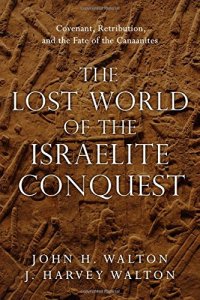 The Lost World of the Israelite Conquest is another fantastic work from the pen of John Walton, this time writing with his son, J. Harvey Walton. Walton has a number of these introductory works that focus on revealing the world of the Ancient Near East to his readers to help make sense of the Bible. In this work, the authors take on the question of what we are to make of the conquest narratives in the Bible.
There are often several perspectives Christians take in response to these accounts, as the authors note: they may argue that God is in control of all things and if God chooses to use one people to massacre another, that is God’s will; they may instead argue that the accounts are Israel’s political use of God to justify their own acts; others soften the first perspective but note how morally bankrupt the Canaanites are, arguing that they deserved destruction; or they may argue that the accounts don’t actually teach about genocide at all, but are rather, properly interpreted, rhetoric. The authors of The Lost World of the Israelite Conquest argue, instead, that when we properly understand the Ancient Near Eastern (ANE) context of these passages, their meaning becomes more clear.
Perhaps one of the most radical propositions in the book, from the modern apologetic perspective, is that there is an entire section dedicated to the argument that “The Canaanites are not depicted as guilty of sin” (31ff). They are not saying the Canaanites are perfect, but rather that the Bible does not highlight the sinfulness of the Canaanites over and against any other group of people. Thus, to argue that the Canaanites were particularly guilty of sin, or that they took what was rightfully Israel’s, is mistaken. They establish this through both looking at the Bible’s own words about the Canaanites, and by evaluating the ANE context of these accounts. After arguing, briefly, that the Conquest accounts are a recapitulation of the creation accounts, the authors delve deeply into the translation of the Hebrew word, “Herem.” The word, contextually, often allows those who are “herem”‘d to continue existing. Thus, the authors argue, the meaning of the term is not destruction of individuals but rather the destruction of identity: to “herem” something is to “remove from use” that something. Thus, they argue, the Canaanites were not all put to the sword or killed; rather, their identity was subsumed into Israelite identity.
Another important point the authors make is that wars in the ancient world were fought in different ways and often with different goals or ideals of outcomes than we have today. A people’s deity was depicted fighting alongside that people, and these wars were often over identity as people.
The authors, then, reject the popular apologetic argument today that the accounts are hyperbolic in scope and thus can be seen as something like mere skirmishes. Instead, they argue that the conquest accounts are writing about war as the people of the ANE fought it, with the purposes and in the contexts in which they fought those wars. Overall, I found the authors’ theses pretty convincing. It certainly does away with some of the simpler dismissals of the accounts as merely hyperbolic. However, I wonder how the authors might respond to a more nuanced and extended argument like that of K. Lawson Younger, Jr.’s Ancient Conquest Accounts. In that work, Younger draws upon archaeological data as well as analysis of the battles as described in the biblical texts to show, in part, that the accounts are not genocide but rather wars waged against strongholds and fortresses in rather strategically advanced ways. To anticipate a reply, I believe the Waltons might argue that such analysis could easily be incorporated into their own account, for so long as one is not trying to establish the accounts as merely hyperbolic, one may align oneself with their own perspective.
Other recent works like Did God Really Command Genocide? by Paul Copan and Matthew Flannagan offer robust defenses of the hyperbolic approach to interpreting the text. The authors did address Copan directly and I believe this book, though the index of Lost World… doesn’t feature either author, making it difficult to confirm. Responding to Copan, they argue that at least part of his approach is anachronistic and reads a modern view of demonic powers onto the Hebrew text. I think it would have been helpful, though, to have a longer discussion of the hyperbolic interpretation. Indeed, the subject index doesn’t even have the word “hyperbole,” though it was mentioned several times. It will be interesting to see how modern defenders of the hyperbolic interpretation interact with the Walton thesis.
Overall, The Lost World of the Israelite Conquest is a broad, thought-provoking book. Though readers familiar with the field will certainly be left wanting more questions answered, they will benefit as much as any other reader due to the expertise on ANE context that is brought to bear on these difficult passages. I read the book and would say I feel largely convinced by it, though either due to my own adherence to the hyperbolic view or something else, I still have questions about their thesis. I am firmly convinced, though, that any reader with interest in this topic must pick up and read this important work.
The Good
+Fascinating application of ANE context to difficult topic
+Broad focus with many lines of evidence applied to question
+Sheds fresh light on the topic
+Opens many lines of further inquiry
The Bad
-Could use more discussion of some modern alternatives
-Index seems somewhat incomplete
Disclaimer: I was provided with a copy of the book for review by the publisher. I was not required to give any specific kind of feedback whatsoever.
Links
Be sure to check out the page for this site on Facebook and Twitter for discussion of posts, links to other pages of interest, random talk about theology/philosophy/apologetics/movies and more!
SDG.
——
The preceding post is the property of J.W. Wartick (apart from quotations, which are the property of their respective owners, and works of art as credited; images are often freely available to the public and J.W. Wartick makes no claims of owning rights to the images unless he makes that explicit) and should not be reproduced in part or in whole without the expressed consent of the author. All content on this site is the property of J.W. Wartick and is made available for individual and personal usage. If you cite from these documents, whether for personal or professional purposes, please give appropriate citation with both the name of the author (J.W. Wartick) and a link to the original URL. If you’d like to repost a post, you may do so, provided you show less than half of the original post on your own site and link to the original post for the rest. You must also appropriately cite the post as noted above. This blog is protected by Creative Commons licensing. By viewing any part of this site, you are agreeing to this usage policy.
Apologetics Guided Reading: George Park Fisher “Manual of Christian Evidences” Chapter 8

All rights reserved.
I am leading a guided reading of the Manual of Christian Evidences by George Park Fisher. It is freely available online and will serve as a base for discussing Christian apologetics throughout this series. The chapters are short and readable. I encourage you to join in by reading the chapters and commenting with your thoughts. When I discuss the book, I will be citing page numbers from the edition linked above.
Chapter 8
Fisher here argues that the way we find the Gospels to be genuine/authentic is the same way we find other documents authentic, namely the “early reception of writings as genuine by those who had the means of knowing, early traditions… which are not justly liable to suspicion, references to them, quotations from them, at a time when, if they were spurious, this fact could not have been concealed, internal marks in the works themselves indicative of their authorship or date of composition…” (47). In typical fashion, Fisher does not here draw out these arguments in much detail. He provides an overview, then a few details on selected points.
Next, Fisher provides one of his lengthier discussions of anything, tracing various early Christians lives and their connections to the authenticity of the Gospels. He notes that many of these early Christians referenced the Gospels offhandedly just as they do the Old Testament. Their treatment of the set of works about Christ and those accepted as Hebrew Scriptures is, in other words, similar enough that we may conclude they thought of them as equally authoritative.
The work Fisher mentions called “The Teaching of the Twelve Apostles” is more commonly referred to as the Didache. One thing to be careful of reading historical apologetics is that sometimes information in them is out of date (i.e. a reference to an allegedly ancient document that we later discover was a forgery or something else). This is not one of those cases, as the Didache is indeed quite ancient (and typically dated to within the 1st Century AD). Thus, we have perhaps a little more surety over its dating than Fisher did when he wrote the Manual, and its confirmation of the probable existence of the Gospels is quite valuable. It is possible the references to the Gospel were, in fact, references to the oral tradition that was written down as the Gospels, and many modern scholars have argued that’s what happened. But in either case, the Didache provides a confirmation of very early knowledge of Christ as well as some early Christian teachings.
The Gospels each have references to real places and events that, as Fisher notes, are introduced without design and certainly allow us to date them quite early. The place names, names of people, and events all serve as earmarks for the authenticity of the Gospels, and though some very specific details are still debated, overall the impression of authenticity is overwhelming. Finally, Fisher argues that the Johannine Epistles and Gospel share enough important details and linguistic factors to agree that they’ve the same author.
Chapter 8 is thus one of the most robust chapters in the book, and certainly one of the most intriguing so far. Though it doesn’t have any astonishing “new” or rediscovered arguments, it does provide a solid outline for a defense of the authenticity of the Gospels.
What did you think of this chapter? Do offhanded remarks about places and people give more authenticity to an ancient work?
Links
Be sure to check out the page for this site on Facebook and Twitter for discussion of posts, links to other pages of interest, random talk about theology/philosophy/apologetics/movies and more!
Apologetics Read-Through: Historical Apologetics Read-Along– Here are links for the collected posts in this series and other read-throughs of apologetics books (forthcoming).
Dead Apologists Society– A page for Christians interested in the works of historical apologetics. There is also a Facebook group for it.
SDG.
——
The preceding post is the property of J.W. Wartick (apart from quotations, which are the property of their respective owners, and works of art as credited; images are often freely available to the public and J.W. Wartick makes no claims of owning rights to the images unless he makes that explicit) and should not be reproduced in part or in whole without the expressed consent of the author. All content on this site is the property of J.W. Wartick and is made available for individual and personal usage. If you cite from these documents, whether for personal or professional purposes, please give appropriate citation with both the name of the author (J.W. Wartick) and a link to the original URL. If you’d like to repost a post, you may do so, provided you show less than half of the original post on your own site and link to the original post for the rest. You must also appropriately cite the post as noted above. This blog is protected by Creative Commons licensing. By viewing any part of this site, you are agreeing to this usage policy.

 J.W. Wartick - Reconstructing Faith