christian
Book Review: “The New Testament in Color: A Multiethnic Bible Commentary”
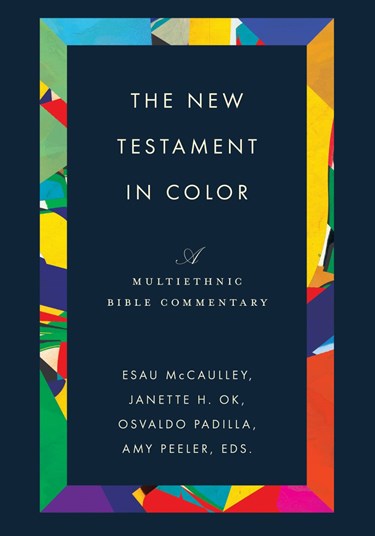
The New Testament in Color: A Multiethnic Bible Commentary is an attempt to bring together people from many different backgrounds to offer commentary on the New Testament.
After an introduction, readers get essays on African American, Asian American, Hispanic, Turtle Island, and Majority-Culture biblical interpretation. Then, the book launches into individual authors offering commentaries on each book of the New Testament. Interspersed are a few selected essays on gender in the New Testament, resources for the mental health of the oppressed in the NT, multilingualism, and immigrants in the Kingdom of God.
The commentaries on individual books of the Bible are usually close to chapter-by-chapter, with authors seemingly getting a good amount of leeway with how focused they ought to be verse-by-verse. The format lends itself to deeper discussion of individual topics each author wants to write about, but makes it a bit less useful if one is looking specifically for a verse-by-verse commentary.
The commentary itself is consistently excellent and thought-provoking. I recall especially one moment while reading the commentary on Luke in which the author, Diane G. Chen, whose parents are Chinese, reflected on the passage about treasures in heaven (Luke 12:13-34). Chen wrote about her parents teaching her to save, live within her means, and how to balance that with the concern of a safety net turning into worldliness and power. Time and again insights are offered into the Bible that spring from the cultural traditions of the authors included. The contributors hail from all over the world, with many different background represented.
There are a number of ways a commentary like this could have been formatted. I think about the series of Reformation Commentaries in which individual verses or sections are given comments from multiple different Reformers. I’m glad the editors chose a mode which allowed the authors to give running commentary on entire books of the Bible as it allows readers more insight into the thoughts and breadth of ideas of each individual author.
The New Testament in Color serves as a fantastic resource and, frankly, a fascinating read. I highly recommend it for those interested in diving deeply into what the Bible is telling us today.
All Links to Amazon are Affiliates
Links
Be sure to check out the page for this site on Facebook!
Book Reviews– There are plenty more book reviews to read! Read like crazy! (Scroll down for more, and click at bottom for even more!)
SDG.
——
The preceding post is the property of J.W. Wartick (apart from quotations, which are the property of their respective owners, and works of art as credited; images are often freely available to the public and J.W. Wartick makes no claims of owning rights to the images unless he makes that explicit) and should not be reproduced in part or in whole without the expressed consent of the author. All content on this site is the property of J.W. Wartick and is made available for individual and personal usage. If you cite from these documents, whether for personal or professional purposes, please give appropriate citation with both the name of the author (J.W. Wartick) and a link to the original URL. If you’d like to repost a post, you may do so, provided you show less than half of the original post on your own site and link to the original post for the rest. You must also appropriately cite the post as noted above. This blog is protected by Creative Commons licensing. By viewing any part of this site, you are agreeing to this usage policy.
Learning about Reformation History: “Melanchthon: The Quiet Reformer” by Clyde L. Manschreck
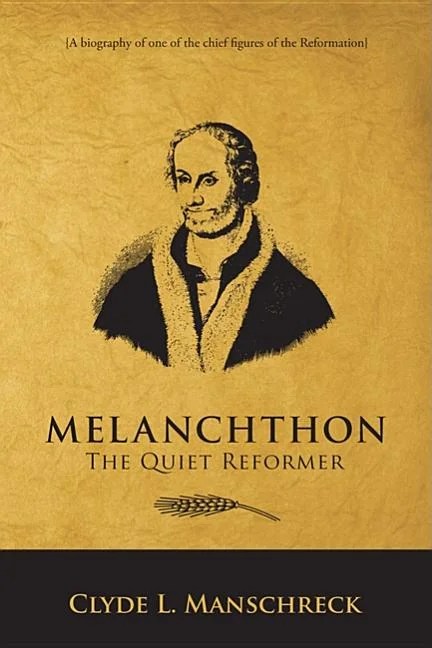
I have long wondered about Philip Melanchthon. He seemed to get vilified in a lot of Lutheran circles I ran in, but he also was clearly at the forefront of Lutheran theology at the time of its formation. Luther rarely seemed to have said anything negative about Melanchthon, but the charge was that he turned away from Lutheranism later in his life and compromised. Enter Clyde L. Manschreck’s excellent biography, Melanchthon: The Quiet Reformer. Manschreck presents a fascinating, balanced perspective on Melanchthon, one of the most intriguing of Reformation persons.
Manschreck starts off, appropriately enough, with looking at how Melanchthon has been treated historically. Surprisingly few biographies exist of the Reformer, especially compared to other luminaries of the period who had less of an impact. After his death, there was criticism from three fronts: he was too Lutheran for Catholics, too Calvinist for Lutherans, and too Catholic for Calvinists. That’s oversimplifying it a bit, but it becomes clear that his legacy was marred by attacks from all sides. So who was the man, and what did he really believe–and was he an infamous compromiser?
Manschreck moves very swiftly past Melanchthon’s early life, almost immediately settling into the time that brought him to Wittenberg. But as Manschreck paints the picture of Melanchthon’s time there, first as an extraordinary lecturer with phenomenal skill and later as a Reformer, we also get deep insight into his character and beliefs. Melanchthon, like many early Lutherans (and a huge amount of the surrounding population) believed in astrology. It’s a strange thing when you look back on it, but it was conceived as a kind of science. Melanchthon was a firm believer, even lamenting the sign a child-in-law was born under when he came to dislike them. Melanchthon also was a champion for public schools, creating the first publicly funded schools across Germany, and advocated for (and got) living wages for teachers. His reasoning was that if a teacher had to work yet another job to just be able to eat or live, the wouldn’t be able to focus on bettering their mind and, in turn, their students’ minds.
Melanchthon and Luther hit it off almost immediately, and Melanchthon joining the Reformation was an organic thing, rather than something one can just point to a single moment as the moment of changing of heart. He clearly believed in the arguments of justification, and ultimately became one of the primary (or the primary) authors of much of the Lutheran Confessions. Setting the writing of these alongside the circumstances in which they occurred makes them more understandable. The Augsburg Confession being prepared to try to, in part, make it clear that their movement wasn’t heretical and could be defended on Scriptural grounds is a fascinating story. Additional clarification due to attempts to unite with other Reformers–attempts that ultimately failed with Zwingli and Calvin–is also set in its historical perspective. The writing of the Confessions should not be separated in understanding from their historical circumstances.
Fascinating historical details about Melanchthon’s life can be found in abundance. Did you know that he had no small amount of correspondence with Henry VIII? The latter desired Melanchthon’s comments on his marriage, hoping the Reformer might be open to giving him an out. Even when Melanchthon failed to deliver for Henry VIII, the King realized the political expediency of an alliance and, perhaps, even was swayed ever so slightly towards some Protestant points. Manschreck makes it clear Henry VIII’s interest was almost certainly political–how to get out of an undesired marriage in a desirable way.
Ultimately, Manschreck paints Melanchthon as a man of convictions who was willing to change his beliefs as he learned more. One of the most obvious examples was Melanchthon’s shift towards a kind of spiritualized view of real presence regarding the Lord’s Supper. What’s interesting with this is that Manschreck is able to document that Luther was aware of this shift and yet explicitly did not condemn it, despite multiple means and opportunities to do so. Was it out of respect for Melanchthon? Or was it a recognition that Melanchthon’s position was somewhere within the Lutheran fold (a fold that is anachronistic to apply to the situation anyway)? I don’t know, but it is worth reading the whole account, including Luther’s non-condemnation. Perhaps Melanchthon could be somewhat welcomed back into Lutheran teaching on some level? Again, I know not. But what’s clear is that Melanchthon sought to go back to the source (the ad fontes of the Reformation and Renaissance) and to understand Scripture’s teaching without trying to invent new doctrines.
Melanchthon: The Quiet Reformer is a superb biography that is well worth the read by any wishing to learn more about one of the most important figures of the early Reformation. I found it informative, balanced, and of interest to even broader world events.
Links
Reformation Theology– Check out all my posts on various topics related to the Reformation (scroll down for more).
SDG.
——
The preceding post is the property of J.W. Wartick (apart from quotations, which are the property of their respective owners, and works of art as credited; images are often freely available to the public and J.W. Wartick makes no claims of owning rights to the images unless he makes that explicit) and should not be reproduced in part or in whole without the expressed consent of the author. All content on this site is the property of J.W. Wartick and is made available for individual and personal usage. If you cite from these documents, whether for personal or professional purposes, please give appropriate citation with both the name of the author (J.W. Wartick) and a link to the original URL. If you’d like to repost a post, you may do so, provided you show less than half of the original post on your own site and link to the original post for the rest. You must also appropriately cite the post as noted above. This blog is protected by Creative Commons licensing. By viewing any part of this site, you are agreeing to this usage policy.
Book Review: “Thriving with Stone Age Minds: Evolutionary Psychology, Christian Faith, and the Quest for Human Flourishing” by Justin L. Barrett with Pamela Ebstyne King
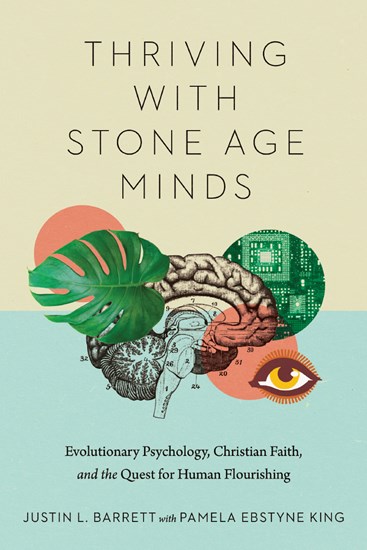
Thriving with Stone Age Minds is a fascinating journey into looking at a combination of evolutionary psychology and Christian faith.
First, this book is not located in the space of debating Christianity and evolution. It simply assumes mainstream science is correct and that Christianity remains viable given that. Frankly, that makes the book more useful, in my opinion, than it would have been if it spent pages trying to justify those premises. There is an introductory chapter that goes over some basic assumptions and background knowledge necessary for at least diving in to the later chapters.
Next, there’s the question of what it means to “thrive.” The definition is more complex than a reader may think, especially when one is attempting to balance both evolutionary and Christian theological assumptions. Thriving in this space means there can be gaps in understanding, and that finding a niche means more than successful procreation and passing on of genetic code. Humans also tend to expand into whatever space they find and modify nature to suit their needs; this creates a kind of nature-niche gap that is crossed repeatedly by humans, but might not also yield thriving.
The authors go over various features of human anatomy and what those features might suggest about human nature. For example, humans have large white sclerae in our eyes that allows others to see where we’re directing our attention. The nature-niche gap also refers to how quickly humans are moving various aspects of our lives ahead of nature. For example, our nutrition is linked to our evolutionary past, when finding sugar and fat-rich foods would have been important sources of large nutritional importance; but they are hyper-abundant now and our bodies and minds haven’t been trained or evolved to combat this massive availability.
Some focus of the book is on contrasting the pace of revolutionary change and adaptation and the extremely rapid advancement of technology and–tying into the above–diet and availability of food. Evolutionary psychology can help us understand some of the gaps in understanding and the necessity of learning more about how technology is changing our minds and bodies. Each chapter has a number of ways to focus on the concept of thriving and tying it into both Christian theology and evolutionary biology.
Thriving with Stone Age Minds is a highly recommended read. It rewards careful reading and spurs quite a bit of thought.
All Links to Amazon are Affiliates
Links
Be sure to check out the page for this site on Facebook and Twitter for discussion of posts, links to other pages of interest, random talk about theology/philosophy/apologetics/movies and more!
Book Reviews– There are plenty more book reviews to read! Read like crazy! (Scroll down for more, and click at bottom for even more!)
SDG.
——
The preceding post is the property of J.W. Wartick (apart from quotations, which are the property of their respective owners, and works of art as credited; images are often freely available to the public and J.W. Wartick makes no claims of owning rights to the images unless he makes that explicit) and should not be reproduced in part or in whole without the expressed consent of the author. All content on this site is the property of J.W. Wartick and is made available for individual and personal usage. If you cite from these documents, whether for personal or professional purposes, please give appropriate citation with both the name of the author (J.W. Wartick) and a link to the original URL. If you’d like to repost a post, you may do so, provided you show less than half of the original post on your own site and link to the original post for the rest. You must also appropriately cite the post as noted above. This blog is protected by Creative Commons licensing. By viewing any part of this site, you are agreeing to this usage policy.
Bonhoeffer and the Challenge of Ecumenism
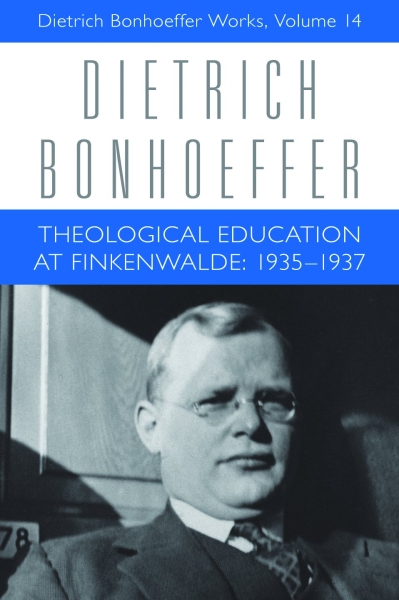
Ecumenism–the work of bringing unity to worldwide Christianity–is a constantly challenging work throughout the history of the church. Dietrich Bonhoeffer was deeply involved in ecumenical movements in his own time. One fascinating aspect of this is that while Bonhoeffer worked for ecumenism, he also was quite clear that the German Christian Church, which had been taken over by the Nazis, was no longer a Christian church and could not be designated as such. In calling out the German Christians, Bonhoeffer presented one of the great challenges of ecumenism: how to define “in” or “out” when it comes to Christianity.
The obvious and immediate objection here, of course, is that the German Christian church was actually being run by Nazis. Historical retrospect with 20/20 vision allows us to say that clearly, such a church had indeed lost the Gospel of our Lord Jesus Christ. However, at the time, such historical vision did not exist. Instead, we can see some of the challenges inherent in ecumenical work in a fascinating exchange Bonhoeffer had with Canon Leonard Hodgson[1]. The exchange can be found in Dietrich Bonhoeffer’s Works in English, Volume 14: Theological Education at Finkenwalede: 1935-1937. Bonhoeffer was invited by Hodgson in 1935 to come to the World Council of Churches as a visitor to the meeting of the Continuation Committee. Bonhoeffer declined, writing, “I should very much like to attend the meeting. But there is first of all the question if representativies of the Reichskirchenregierung [Reich Church Government (of the Nazi-sanctioned German Christian Church)] will be present, which would make it impossible for me to come” (DBWE 14, 68). Hodgson wrote back, imploring Bonhoeffer to attend. After noting that representatives of the German Christian church would be attending, Hodgson wrote, “I think you will understand our position when I say that we cannot, as a Movement [the World Council of Churches and the ecumenical movement], exclude the representatives of any Church which ‘accepts our Lord Jesus Christ as God and Saviour.’ Right from the start, there has been a general invitation to all such churches, and we cannot arrogate to ourselves the right to discriminate between them…” (Ibid, 69).
Defining a Christian church as one which “accepts our Lord Jesus Christ as God and Savior” seems like a reasonable step, especially within an ecumenical movement. But is it enough? That must always be the lingering question, and I’m not sure it is one I can answer. Bonhoeffer, however, answered Hodgson directly. After thanking Hodgson for the repeated invitation to attend, he wrote, “Can there be anything finer and more promising to a Christian pastor and teacher than to co-operate in the preparation for a great oecumenical[2] synod…?” But, then he went on to note that the Confessional Church in Germany did not believe the German Christian church did in fact believe that Jesus Christ is God and Savior. Wrote Bonhoeffer, “There may be single representatives…. who propound a theology which is to be called a Christian theology… But the teaching as well as the action of the responsible leaders of the Reich Church has clearly proved that this church does no longer serve Christ but that it serves the Antichrist… The Reich Church…. continues to betray the one Lord Jesus Christ, for no man can serve two masters…” (DBWE 14, 71-72).
It is hardly possible to issue a more direct and explicit statement than Bonhoeffer did regarding the status of the German Christian Church. He simply asserted: it serves the Antichrist. He went on to note the Confessional Church’s condemnation of the German Christian Church and some specific points thereof.
Hodgson, however, persisted. And his letter is one that highlights so many difficulties with ecumenism. Before diving in further, it is worth noting I am in favor of ecumenism, generally. Just as Bonhoeffer quoted Jesus’s words in John 17:21 to note that Christ wishes all of His followers to be one; so we should also wish for that and work towards it. However, where do lines get drawn, if at all? And surely, a church being taken over by a Nazi state is enough to draw the line? But even so, the historical difficulty of doing so, reflected in the words of Hodgson, should give us some fuel for thought in our own time.
Hodgson countered first by noting the 400+ years of the Ecumenical Movement, always seeking to unite the churches that had been separated. The Movement itself, Hodgson argued, must never act in behalf of individual church bodies; instead it worked as a kind of outside guiding body to bring those individual churches together. Hodgson highlighted that acceptance of Jesus Christ as God and Savior is the “one and only qualification” for a Christian church and that “the Movement has never taken upon itself to decide which churches conform to this definition and which do not” (DBWE 14, 78). He raised a neutral example of a Czechoslovakian National Church and internal debates with others over whether that church was Trinitarian or Unitarian. Turning to the Confessional and Reich church in Germany, Hodgson noted that the former appeared to have stated that the latter no longer accepted the sole criterion required by ecumenism. However, he also argued that the Reich church did not seem to see itself as outside the bounds of that confession; and who is the Ecumenical Movement to arbitrate such disagreements (Ibid)? After all, if they took up the question of the Confessional vs. Reich Church, where does it end? Could not various American churches raise charges against each other that, even while denying such a denial existed, one church does not really believe in Jesus Christ as God and Savior? Wrote Hodgson, “If we once begin doing this kind of thing, would there be any end to it?” (Ibid, 79). Finally, Hodgson wrote that the Movement doesn’t necessitate setting aside all differences. Instead, it allowed for people from different churches to stand side-by-side and even highlight differences; not with the goal of eliminating or washing them over, but with the goal of understanding and to “speak the truth in love” (Ibid, 80).
Bonhoeffer wouldn’t attend the conference, and while he would reach out to Hodgson four years later in 1939, Bonhoeffer would again be met with the kind of “open to interpretation” answer Hodgson gave in the letters of 1935.
This fascinating historical insight into arguing over the inclusion (or not) of a church literally overtaken by Nazis should serve as at least a partial warning to those interested in ecumenism. And, again, I am largely favorable to the idea. But is it possible that the definition defended by Hodgson is too broad? Or, is it possible that Bonhoeffer’s own certainty was too strong? I don’t think the latter is true. It should be possible for someone to look at a church body and say “the teaching as well as the action” of some church body, Christian leader, or whatever can be defined as no longer reflecting Christ as God and Savior. But how does one go about doing that? And how much should a body like the World Council of Churches stand back from seemingly intramural conflict?
Surely in today’s era, there are American churches that would label others as outside the bounds of Christianity or serving the Antichrist. Anti-LGBTQ+ church bodies might say that affirming church bodies are un- or anti-Christian and vice versa. The rise of Christian Nationalism begs the question of how one can serve two masters–the Nation State and Christ. The prominent sacrifices of orthopraxy for the sake of purported orthodoxy could yield countless other difficulties even as those who claim orthodoxy for themselves argue the contrary.
All of this is to highlight what is a very frustrating situation in which we find ourselves. It is one in which we cannot easily navigate our Lord’s wishes that we might truly be one. One temptation is to give it all up and say we may just have to wait for the eschatological future in which Christ will be all in all before any of this happens. But is it worth just giving up? I don’t think that’s the case, either. Instead, I think it is worth seeing this back-and-forth between Bonhoeffer and Hodgson about a church literally overrun by Nazis as a warning. What is confessed with lips must also be done in deed. What that means for ecumenism is something we must work out with fear and trembling.
[1] Fun fact- Hodgson unsuccessfully proposed to Dorothy L. Sayers. I couldn’t see that on Wikipedia and not share it.
[2] Simply an alternate spelling of ecumenical.
All Links to Amazon are Affiliates links
Links
Dietrich Bonhoeffer– read all my posts related to Bonhoeffer and his theology.
Be sure to check out the page for this site on Facebook and Twitter for discussion of posts, links to other pages of interest, random talk about theology/philosophy/apologetics/movies and more!
SDG.
——
The preceding post is the property of J.W. Wartick (apart from quotations, which are the property of their respective owners, and works of art as credited; images are often freely available to the public and J.W. Wartick makes no claims of owning rights to the images unless he makes that explicit) and should not be reproduced in part or in whole without the expressed consent of the author. All content on this site is the property of J.W. Wartick and is made available for individual and personal usage. If you cite from these documents, whether for personal or professional purposes, please give appropriate citation with both the name of the author (J.W. Wartick) and a link to the original URL. If you’d like to repost a post, you may do so, provided you show less than half of the original post on your own site and link to the original post for the rest. You must also appropriately cite the post as noted above. This blog is protected by Creative Commons licensing. By viewing any part of this site, you are agreeing to this usage policy.
“Bearing Sin as Church Community: Bonhoeffer’s Harmartiology” by Hyun Joo Kim- A fascinating look at the doctrine of sin through Bonhoeffer’s theology
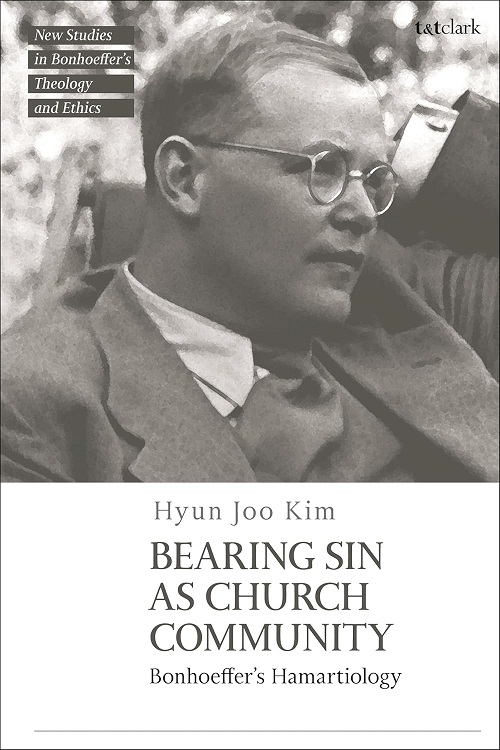
Dietrich Bonhoeffer’s theology continues to contribute enormously to discussions of theology today. What is especially rewarding about the work being done on Bonhoeffer’s corpus is finding topics that haven’t been explored as deeply as others. Hyun Joo Kim’s Bearing Sin as Church Community: Bonhoeffer’s Harmartiology specifically explores Bonhoeffer’s theology for the doctrine of sin, and the book richly rewards careful reading.
One of the central beliefs of Lutheranism, Catholicism, Calvinism, and several other branches of Christianity is that of original sin. For my own part, I find it an incredibly fruitful doctrine when contemplating the state of the world. Humans are incredible adept and finding imaginative ways to bring harm to each other. The horrors of the world are immense, and for me, one way to explain humanity’s awfulness to itself is to hold to a notion of original sin. Bonhoeffer’s views, by Kim, also make the position of original sin less incredible to believe, particularly in regards to explaining how it works. Instead of being linked to a (likely non-extant) original human couple, or being passed along through intercourse, Bonhoeffer’s view makes original sin and the Fall linked to human community and brings it into his ecclesiology. It all helps lend itself to his broader ethical stance, while still preserving the Lutheran view of original sin and guilt.
Before diving into Bonhoeffer’s doctrine of sin (harmartiology), Kim dives into the Augustinian doctrine of original sin. Augustine’s doctrine of original sin is closely linked with the notion of concupiscence–original sin as being transferred through the act of intercourse. Obviously, there is much more to it, but for Augustine, explaining original sin eventually boiled down to a kind of generational passing down through the act of intercourse itself. This saddled the doctrine of original sin with quite a bit of theological and other baggage. Kim then outlines Luther’s move from Augustinian original sin to a shift of seeing original sin integrated within Luther’s Christocentric theology. In essence, Luther’s focus on Christocentrism leads to a holistic theology that, while maintaining several aspects of Augustine’s view of original sin, centers Christ even in the doctrine of original sin. Luther’s view already started driving a wedge between concupiscence and original sin because while he apparently viewed the former as an essential aspect of transmitting the latter, he also held that original sin is forgiven in Baptism but that concupiscence remains a powerful influence on humankind (43).
Next, Kim turns to Bonhoeffer’s view of original sin. This includes a rejection of concupiscence as the basis for original sin. Rather than framing original sin in the “the biological and involuntary transmission of culpability…” Bonhoeffer frames original sin in “the relational and ethical bearing of the sin of others” (71). One of the main aspects of Bonhoeffer’s ethic is that the Christian has freedom for the other, and in this case, his doctrine of sin echoes that but in the bearing of sin for the other; it remains an alien guilt imputed, but a guilt nonetheless. Bonhoeffer’s reflection on original sin moves the alien culpability of Augustine’s doctrine of original sin from the sovereignty of God and to the church community. For Bonhoeffer, “the culpability of Adam is not biologically inherited; however, it is inseprably related to all human beings individually and corporately by the universal sinfulness after the fall” (72). This has some relation to Orthodox understandings of the fall [so far as I know from thinkers like Richard Swinburne–I admit very little direct knowledge of Orthodox teaching on the topic]. Bonhoeffer’s move, however, neither requires an original couple from whom all humanity is descended, such that the culpability can be passed down from one to another like a genetic lineage; nor does it need a specific means by which the original sin can be passed along. By sidestepping these two issues, essentially assigning guilt not to the individual through inheritance but rather through the very nature of humanity as sinful beings, he avoids many of the modern challenges to original sin, such as the question of human evolution–despite this clearly not being in Bonhoeffer’s mind as he wrote about the doctrine.[1]
Kim does draw some distinctions between Bonhoeffer’s earlier thinking on the doctrine of sin and his later theology, but to me these largely seem to be things that could be reconciled together as a continuum of the same theology. And of course the whole story is not told simply through Bonhoeffer’s views on original sin. Quite a bit more is featured on Bonhoeffer’s thoughts on sin and Christian life and ethics. Kim pays careful attention to Bonhoeffer’s book Creation and Fall and his exegesis of the Genesis narratives here. Kim’s argument is that Creation and Fall exists in the same sphere as his other works, Sanctorum Communio and Act and Being, and as such, it focuses on communal personalism and still integrates aspects of Lutheran and Augustinian notions into the reading.
Bearing Sin as Church Community is an absolutely essential read for those wishing to dive deeply into Bonhoeffer’s theology. It also is an exceptionally powerful theological work that demands close and careful reading. It provides new ways forward in understanding some of the core doctrines of some branches of Christianity, and new challenges to those that do not hold those doctrines. Highly recommended.
Notes
[1] It seems fairly clear in reading Bonhoeffer’s corpus both that he was largely aware of scientific consensus on his day on various topics, which would have included the evolutionary lineage of humankind, and also that he was supremely unconcerned with scientific truths related to theology. For him, it seems, there was no conflict between Christianity and science unless Christians themselves decided to make such a conflict by purposely moving theology into the sphere of science (or vice versa) when that is an utterly inappropriate move. See, for example, his brief comments about science near the beginning of Creation and Fall.
All Links to Amazon are Affiliates links
Links
Dietrich Bonhoeffer– read all my posts related to Bonhoeffer and his theology.
Be sure to check out the page for this site on Facebook and Twitter for discussion of posts, links to other pages of interest, random talk about theology/philosophy/apologetics/movies and more!
SDG.
——
The preceding post is the property of J.W. Wartick (apart from quotations, which are the property of their respective owners, and works of art as credited; images are often freely available to the public and J.W. Wartick makes no claims of owning rights to the images unless he makes that explicit) and should not be reproduced in part or in whole without the expressed consent of the author. All content on this site is the property of J.W. Wartick and is made available for individual and personal usage. If you cite from these documents, whether for personal or professional purposes, please give appropriate citation with both the name of the author (J.W. Wartick) and a link to the original URL. If you’d like to repost a post, you may do so, provided you show less than half of the original post on your own site and link to the original post for the rest. You must also appropriately cite the post as noted above. This blog is protected by Creative Commons licensing. By viewing any part of this site, you are agreeing to this usage policy.
The Inescapable Reality of Our Era
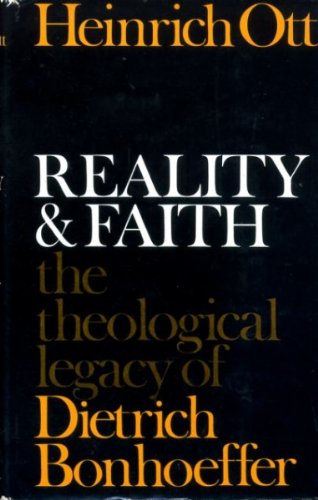
Heinrich Ott’s Reality and Faith: The Theological Legacy of Dietrich Bonhoeffer is a book I picked up because of how oft-cited (favorably or not) I found it in the literature. I have just begun reading it and already found it to be insightful. Early on, Ott writes about Bonhoeffer’s confrontation with his own life and the era in which he lived with the rise of the Third Reich in Germany and awaiting its overthrow, expecting God to act:
“The reality of our life, the reality of our experiences, is inescapable. We cannot flee from it, we cannot flee from the era in which we are placed, from the convictions of this era or from its historical entanglements. On one thing Bonhoeffer was quite clear, that he must stand firm through a demonic age, but he found his place in this very age and did not hanker after living in any other…
“But if God lives and if Jesus Christ is his final word, then this might be as inescapable as life itself…. If God lives everywhere, Bonhoeffer deduced, he lives here” (19-20).
God lives with us even in our inescapable moments. Even as we know we are entangled with our own history and caught up in the convictions and shifting whims of our times. Even if we believe our own era has its great evils and may even be “demonic” in whatever way we believe. There God is and remains.
May we, too, find ourselves living such that we realize that even in our own time, in our inescapable reality, God is here.
All Links to Amazon are Affiliates links
Links
Dietrich Bonhoeffer– read all my posts related to Bonhoeffer and his theology.
Be sure to check out the page for this site on Facebook and Twitter for discussion of posts, links to other pages of interest, random talk about theology/philosophy/apologetics/movies and more!
SDG.
——
The preceding post is the property of J.W. Wartick (apart from quotations, which are the property of their respective owners, and works of art as credited; images are often freely available to the public and J.W. Wartick makes no claims of owning rights to the images unless he makes that explicit) and should not be reproduced in part or in whole without the expressed consent of the author. All content on this site is the property of J.W. Wartick and is made available for individual and personal usage. If you cite from these documents, whether for personal or professional purposes, please give appropriate citation with both the name of the author (J.W. Wartick) and a link to the original URL. If you’d like to repost a post, you may do so, provided you show less than half of the original post on your own site and link to the original post for the rest. You must also appropriately cite the post as noted above. This blog is protected by Creative Commons licensing. By viewing any part of this site, you are agreeing to this usage policy.
Book Review: “Faithful Politics: Ten Approaches to Christian Citizenship and Why it Matters” by Miranda Zapor Cruz

Faithful Politics: Ten Approaches to Christian Citizenship and Why it Matters by Miranda Zapor Cruz provides an introduction to several different ways Christians have engaged in the political arena.
A few introductory chapters outline Cruz’s approach. Instead of taking a direct partisan line, she seeks to provide overviews of the ten approaches she covers and then give some analysis for each broad approach to Christian life in politics. One early insight is contrasting Christian and broadly American concepts of freedom: “American freedom conceptualizes freedom as for self; the Kingdom conceptualizes freedom for others” (15). This latter insight is backed by theologians such as Bonhoeffer, who wrote about explicitly being free for the sake of the other in Christianity (ibid).
After several broad comments on general guidelines for analyzing political approaches from within Christian perspectives, Cruz turns to the 10 approaches she covers. These are sometimes grouped together, and I’ll list them as grouped: three separationist approaches based on “Keeping the Kingdom out of the Country” (essentially approaches that advocate for Christians separating from public life in various ways in order to demark a clear separation between “the world” and church); two separationist approaches based on “Keeping the Country out of the Kingdom” (these are approaches like early Baptist separationism based upon keeping church and state separate, less than actually splintering from society itself); social gospel approaches (using one’s faith to guide society, ethics, and even spending programs); two Calvinist approaches (contrasting direct Christian influence on society a la Geneva and John Calvin and a more nuanced approach from Abraham Kuyper); dominionist approaches (the teaching that Christians must gain dominion over society and how this applies to political spheres); and Christian Nationalism (a view which puts faith in Christ essentially subordinate to allegiance to the nation-state).
Summarizing all of these is beyond the scope of what I want to do. Highlights include the look at Two Kingdoms separationist approaches and how Lutheranism was co-opted through that view for Fascism, but how Dietrich Bonhoeffer, a Lutheran pastor, went back to nuance of the Two Kingdom approach to fight back (101). I thought the insight into social gospel approaches and the several Anabaptist approaches was fascinating. Cruz’s evaluation of the different approaches constantly offered fruitful ground for thought and comment. For example, in her analysis of Christian nationalism, she writes, “physical and rhetorical violence are endemic to Christian nationalism, which is part of what makes it incompatible with Christian faithfulness…” (189). The constant rhetoric of modern nationalists that challenges people opposed to them to define Christian nationalism and show how it is bad would run into a wall when confronted with the basic quotes from Christian nationalists and analysis by Cruz here. Cruz’s analysis isn’t always negative, of course. For example, despite clearly not advocating for a separationist approach, Cruz writes that: “Anabaptist and evangelical approaches to separationism have their strongest appeals in their ability to clearly differentiate between the church and the world, and their commitment to Christian formation as an essential function of the church. We are all being discipled by something…” (81). These kinds of insightful comments from Cruz make the book incredibly valuable.
The book would absolutely serve well for a reading group of Christians who wanted to discuss how to interact with Christianity and politics, or even just looking at one single approach and diving more deeply from there.
Faithful Politics is an insightful, timely book. It provides readers with enough background on numerous options in Christian living to at least get a grasp on key concepts. It also provides ways forward for continued thought and research. Recommended.
All Links to Amazon are Affiliates
Links
Be sure to check out the page for this site on Facebook and Twitter for discussion of posts, links to other pages of interest, random talk about theology/philosophy/apologetics/movies and more!
Book Reviews– There are plenty more book reviews to read! Read like crazy! (Scroll down for more, and click at bottom for even more!)
SDG.
——
The preceding post is the property of J.W. Wartick (apart from quotations, which are the property of their respective owners, and works of art as credited; images are often freely available to the public and J.W. Wartick makes no claims of owning rights to the images unless he makes that explicit) and should not be reproduced in part or in whole without the expressed consent of the author. All content on this site is the property of J.W. Wartick and is made available for individual and personal usage. If you cite from these documents, whether for personal or professional purposes, please give appropriate citation with both the name of the author (J.W. Wartick) and a link to the original URL. If you’d like to repost a post, you may do so, provided you show less than half of the original post on your own site and link to the original post for the rest. You must also appropriately cite the post as noted above. This blog is protected by Creative Commons licensing. By viewing any part of this site, you are agreeing to this usage policy.
“The Foolishness of God” by Siegbert W. Becker- An engaging struggle
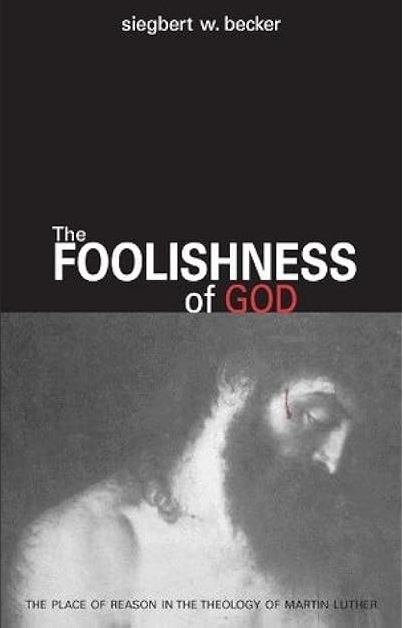
Many years ago, when I was deep into apologetics and trying to figure out my place in the world and in my faith, my dad gifted me with a copy of The Foolishness of God: The Place of Reason in the Theology of Martin Luther by Siegbert W. Becker. Well, a lot has changed since then, and I am still trying to figure out my place in the world and in my faith, but I am much more skeptical of apologetics than I was then… to say the least. I re-read The Foolishness of God now, probably more than a decade after my original reading. It was fascinating to see my scrawling notes labeling things as ridiculous or wrong when I now basically think a lot of it is right. On the flip side, I still have quite a bit to critique. I’ll offer some of my thoughts here, from a viewpoint of a progressive Lutheran.
Becker starts by quoting several things Luther says about reason, from naming it “the devil’s bride” to being “God’s greatest and most important gift” to humankind (1). How is it possible that reason can be a great evil, vilest deceiver of humanity while also being one of the most enlightening parts of human existence? One small part of Luther’s–as Becker interprets him–answer is that it depends on what reason is being used for. That’s a simplistic answer, though, suggesting one could categorize things like nature and science (reason is good!) and judging biblical truth (reason is bad!) into neat boxes for Luther. In some ways, this can be done; but in others, when one digs more deeply, it becomes clear that such an application would be an okay rule of thumb for reading Luther but would not be accurate all the way through. For example, where Luther sees the Bible teaching directly on nature or science, using reason to judge that teaching would be rejected. This, of course, opens up my first and probably greatest point of disagreement with Luther’s theses about reason. And yet, it also is confusing, because in some ways I’m not sure I wholly disagree.
What I mean by this is that I, too, am skeptical of the use of human reason for any number of… reasons. This is especially true when it comes to thinking about God. Supposing it is true that there is a God and that God is an infinite being in any way–whether it is infinitely good, infinitely powerful, etc. In that case, it seems that to suggest that we can use reason to grasp things about God is a fool’s errand. We are not infinite and can certainly not grasp the infinite; how can we expect our brains that cannot contain the multitudes to reason around God? On the other hand, in many ways reason is all we have. Even supposing God exists, we ultimately act or believe in ways and things we think are reasonable. And I’m deeply skeptical of a denial of this. What I mean by the latter is that I simply do not believe that people can believe things they think are inherently anti- or irrational. Becker outright makes the claim that Luther–and presumably Becker himself–do believe such things. Time and again, Becker flatly states that some claims of Christianity are inherently contradictory–be it the Trinity, the Incarnation, or [for Lutherans] Christ’s presence in the Lord’s Supper. So Becker is claiming that Luther truly did believe in things he thought were inherently anti-reason and irrational. But when push comes to shove, I strongly suspect that Luther and people like him who make these claims think that it imminently reasonable to believe in the irrational. Even while claiming that they believe in things they claim they think are contradictory, they are doing so because it makes sense to them. And this is precisely because of the limitations of human reason and thinking. We cannot go beyond our own head, we have to go with what we think is right, perhaps even while claiming we think it is irrational to do so.
Setting aside that question, Luther’s solution to the gap between the finite and the infinite is that of revelation. Because God became incarnate and came to humanity, we, too, can know God. God revealed God to us. Becker rushes to use this to attempt to counter what he calls Neo-orthodox interpretations that stack the Bible against Christ. He writes, “Neo-orthodoxy’s distinction between faith in Christ and faith in statements, or ‘faith in a book,’ is artificial and contrary to reason. By rejecting ‘propositional revelation’ and making the Bible only a ‘record of’ and ‘witness to’ revelation, the neo-orthodox theologians drain faith of its intellectual content” (11). I find this deeply ironic wording in a book that later has Becker outright claiming that Luther–and by extension Becker himself–believed things that are contrary to reason and affirming that this is a perfectly correct (we dare not say “reasonable”) thing to do. In my opinion, at least, it is quite right to make the distinction between faith in Christ and faith in statements. That doesn’t mean the Bible is devoid of revelation or can have no revelation; rather, it means that, as Luther put it [paraphrasing here], the Bible is the cradle of Christ. But to put the Bible then on par with Christ as a similarly perfect revelation is to make a massive mistake, as people, including Lutherans like Dietrich Bonhoeffer, have argued.
All of this might make it seem I have a largely negative outlook on Becker’s work. Far from it. I found it quite stimulating and generally convincing on a number of points. Most of it, of course, is exegesis of Luther’s own views of reason. And I think that Luther, while he could stand to be far more systematic and clear, makes quite a few excellent points about reason. When it comes to trying to draw near to God, reason does not do well. Why? Our own era has so many arguments in philosophy of religion about the existence of God. Anyone who has read or engaged with the minutiae of analytic theology or analytic philosophy getting applied to God has experienced what I think, in part, Luther was warning against. Philosophers, apologists, and theologians continue to attempt to plumb the very nature of God and gird it up with scaffolds of reason, providing any number of supposed arguments for God’s existence, proofs of Christological points, and the like. Bonhoeffer, a favorite theologian of mine, put many of these attempts to shame in a succinct quote: “A God who could be proved by us would be an idol.”
I think a similar sentiment applies to so much about God and even just the universe. I mean, we’re on a planet that is less than a speck in a cosmos that is so unimaginably huge and ancient that thinking we can comprehend it is honestly shocking. Sure, we can slap numbers on it, using our human reason to try to slice the universe into chewable bites, but when we find out things like how it takes more than 1 million Earth’s to fill the Sun, and that our Sun isn’t even remotely the largest star, nor the largest solar system, etc… how absurd is it to think we really comprehend any of it? And so, for me, from a very different angle, Luther’s words about reason make sense. Sure, we can use it to try to understand little slices of nature. But when we start to line it up with things of the infinite, it may be better to just let God be God.
The Foolishness of God is a fascinating, engaging, and sometimes frustrating work. In a lot of ways, it’s like engaging with Luther’s own works. It’s not systematic; it doesn’t cohere; it’s intentionally provocative. I will likely give it another read one day, and who knows where I–and it–shall stand?
All Links to Amazon are Affiliates links
Links
Dietrich Bonhoeffer– read all my posts related to Bonhoeffer and his theology.
Be sure to check out the page for this site on Facebook and Twitter for discussion of posts, links to other pages of interest, random talk about theology/philosophy/apologetics/movies and more!
SDG.
——
The preceding post is the property of J.W. Wartick (apart from quotations, which are the property of their respective owners, and works of art as credited; images are often freely available to the public and J.W. Wartick makes no claims of owning rights to the images unless he makes that explicit) and should not be reproduced in part or in whole without the expressed consent of the author. All content on this site is the property of J.W. Wartick and is made available for individual and personal usage. If you cite from these documents, whether for personal or professional purposes, please give appropriate citation with both the name of the author (J.W. Wartick) and a link to the original URL. If you’d like to repost a post, you may do so, provided you show less than half of the original post on your own site and link to the original post for the rest. You must also appropriately cite the post as noted above. This blog is protected by Creative Commons licensing. By viewing any part of this site, you are agreeing to this usage policy.
Reconstructing the Past: Florrisant Fossil Beds National Monument and Young Earth Creationism

Florissant Fossil Beds National Monument preserves an incredible piece of geological and paleontological time in Colorado. The uniqueness of its geologic history helped preserve incredible details of tiny animals, all the way down to insects, including one of the most famous fossils in the world: a butterfly’s imprint preserved in ash. What struck me most as I wandered this beautiful National Monument and learned more about it was how intricately we can construct the past in this region. Geologists and paleontologists are able to use the clues spread across the landscape to see what happened in great detail. Those details, however, either directly contradict or at least present major difficulties for the narrative told by some Christians known as young earth creationists. Here, we will examine the two narratives alongside the region itself and ask which presents a better picture of the past.
The Narrative told by Conventional Geology and Paleontology
The National Park Service actually has a wonderful video that tells about how Florissant was formed, along with how it was discovered, used, and preserved by humans. My own narrative of conventional science is largely based on that video as well as on placards and other things I read and observed around the site itself.
About 37 million years ago, a volcano’s crater exploded, covering the region with ash. Volcanic activity continued for millions of years, forming layers of ash across the region. Eventually, heavy rainfall dislodged a massive amount of this ash, creating a kind of avalanche of volcanic material known as a lahar. This fast-moving mudflow was enormous, stretching for miles as it spread and eventually covering about 15 feet of the area we now know as the area within Florissant. This mud covered the bottoms of a number of enormous trees, which eventually died and decomposed. Life recovered and the region began to grow again, but another lahar blocked a stream and that stream formed a shallow lake across the area. The water that covered the area had deposited minerals into the ash-covered stumps of these trees, eventually preserving them as petrified wood. Meanwhile, diatoms–tiny algae observable on a microscopic level that persist into today–bloomed in massive quantities in the lake. Along with occasional volcanic eruptions that layered ash in the lake, the diatom blooms dying off also formed layers at the bottom of the lake. These layers alternated (not in a specific pattern), eventually forming paper-thin shale.
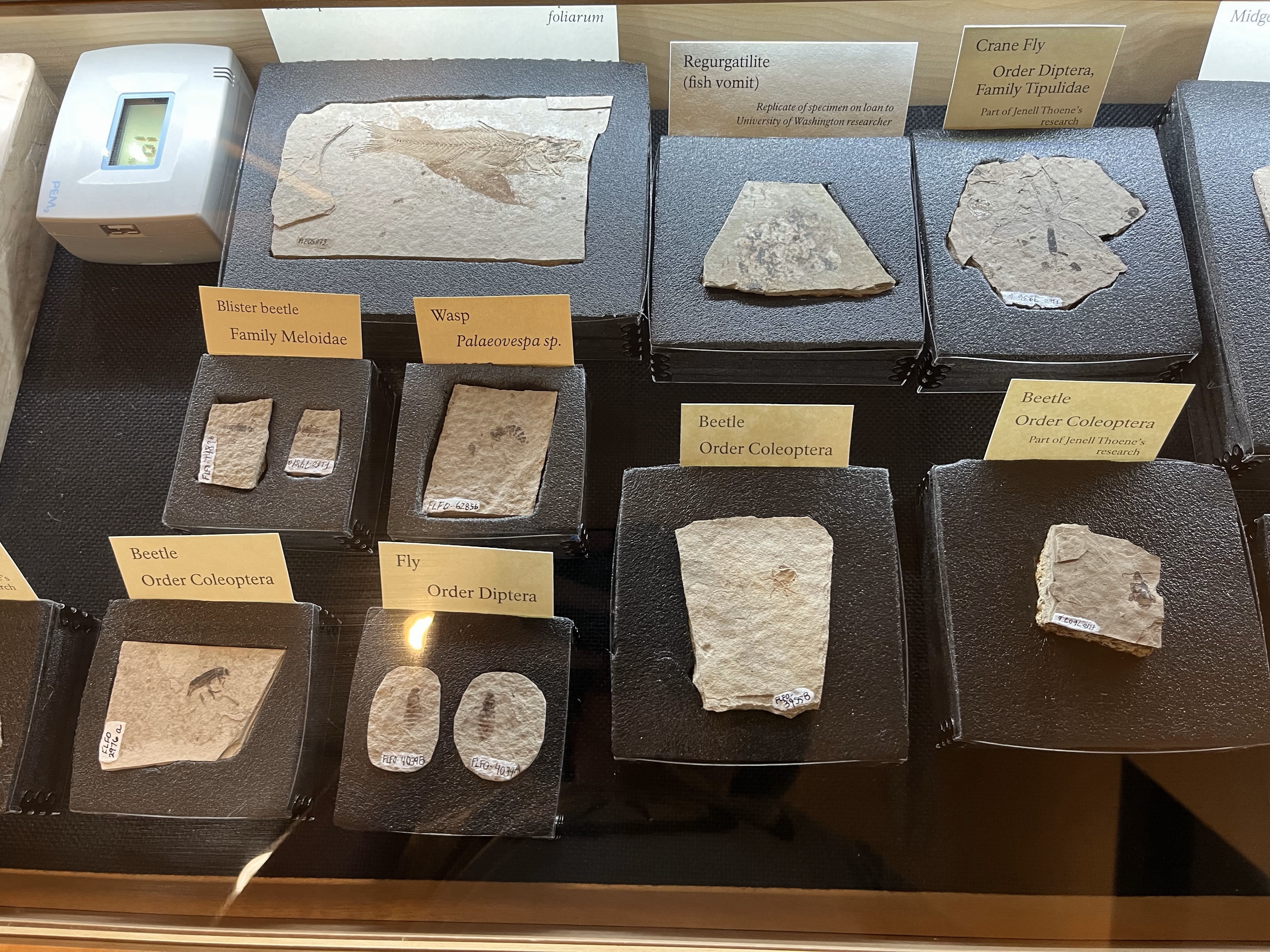
As creatures like fish, birds and even insects died and settled to the bottom of the lake, they were covered with these layers of diatoms and ash. Their bodies were mineralized, and to this day paleontologists can chip apart these incredibly thin layers of shale and find one of the richest deposits of well-preserved insect and plant life in the entire world. Large mammals also roamed the region, including brontotheres, an extinct rhinocerous-like mammal whose bones can be found across the area and into the Badlands. Their bones can also be found. Volcanic activity can be mapped across the region by observing directly the path of lava flows that have hardened into rock. Additionally, distant mountains can be seen to have blown off their tops in volcanic activity of that same time period, demonstrating the violent geologic past of the area.
The uniqueness of this site is due to the many factors involved in its formation: the volcanic activity that led to a lahar covering and preserving enormous ancient trees (including the largest petrified trees by diameter in the entire world); another lahar blocking a stream; additional volcanic activity that mostly spewed ash instead of lava in the area, allowing for preservation of fossils as the ash was cooled and settled in the water; intense periods of diatom activity due to whatever nutrients were provided by rich volcanic soil and plant deposits. For all of these, geologists can quite literally trace lines across the region and map where lava flows hit, where ash fell, whence came some of the volcanic activity (I had a park ranger literally point to the distance at a group of mountains; when looking more closely at the mountains later in the trip, you could see how they were partially collapsed from their volcanic past, blowing parts of themselves almost 100 miles across the landscape), and more. These were observable evidences of a past that linked all of these facets together to create the world-famous fossil site. It was incredible to see how well geologists could use the tools at their disposal to tell the story of the ancient past.
One last broad point in this section: the paleontological record here shows a dramatically different world than what we see in the same region today. The brontotheres are obviously extinct as we don’t see them anymore, but another facet of the discussion is that while the insects look incredibly similar to those of today, there are many with key differences that have changed over the 30+ million years since they were preserved. Some of them aren’t extinct and live into today, but in entirely different parts of the world. One prominently displayed fossil was of a tsetse fly, which once inhabited the land we now know as Colorado, but today lives in tropical Africa. The climate, in other words, has changed so dramatically that this kind of fly can no longer live in the snowy peaks of Colorado, but we have a record of its having done so in a past that was much warmer, and the other fossils in the area confirm the same observations. Conventional timelines don’t have difficulty explaining this, as the long timespan involved allowed for plate tectonics, glacier movement, ice age(s), and more to impact the climate.
Young Earth Creationism’s Two (or more) Narratives
Before diving too far into the narrative told by young earth creationism, we must realize that that movement itself is not monolithic. For a believe system that claims to be the plain reading of the Bible and that can be understood quite simply, it actually ends up teaching incredibly complex and continually edited narratives about the past. Its practitioners disagree on timelines and on how Earth’s geological history formed. So to tell a narrative of Florissant from that perspective, I have to do so knowing that there could be any number of “well, actually” type statements. That said, I believe that death by a thousand caveats is an issue that plagues young earth creationism generally. As YECs have to continually edit their narratives to try to force evidence to fit into a specific favored timeline, the constant ad hoc amendments serve to show just how mistaken YEC is generally. There are at least two broad narratives YECs could offer for Florissant.
The Noah’s Flood Narrative[s]
The Noahic Deluge truly did cover the entire surface of the Earth. In doing so, it churned up enormous amounts of dirt and sediment, remaking it and setting down virtually all sediment layers that we see across the entire Globe. An alternate version of this has a more tranquil Flood, which settled over the surface of the Earth but didn’t greatly impact the geologically observed history. This latter theory is largely abandoned in the literature as it has no explanation for the many aspects of geologic history we see to this day. The former is beset with difficulties, but the one I want to highlight here is that if we assume this is what happened, places like Florissant are almost entirely nonsensical. How would a churning Flood lay down deposits that happen to align in such ways that they can be traced across a region and layered, such that we can see a lahar covered the region, then another blocked a stream, forming a lake, volcanic lava flowed across nearby, and more, and more? It seems to be a non-starter. Why would random bits of sediment get deposited in ways that suggest a geologic past?
The Post-Flood Deposits Narrative
Increasingly, thoughtful YECs are being forced to draw lines to designate pre- and post-Flood deposits in the geologic record. There are a number of reasons for this, but one of the most obvious is that we can see geologic deposits being made today, so the obvious question is asked about how far into the past these records extend before one hits layers that were set down by a supposed global Flood. Many of the difficulties with the YEC narrative in which the Flood explains Florissant are assuaged by claiming that those deposits really were set down in the manner described, but that they were done so in a much more condensed timeline than mainstream geology teaches.
Going along with this, some YECs have suggested the Flood itself is responsible for almost none of the geologic record or, perhaps, only a tiny portion of it. The rest was formed largely as mainstream geologists suggest, but at a pace accelerated by hundreds or even thousands (millions?) of times the speed suggested by mainstream geology. This latter notion has its own massive difficulties, among them being the now well-known (among those involved in debating creationism) heat problem, but also that it doesn’t really provide an explanation for the geologic record other than “it moves fast.” So we’re going to set that one aside and focus on the more mainstream YEC view that Noah’s Flood formed the majority of the geologic column, but that some of it is post-Flood (and pre-, but we’re setting that aside, too). On this view, Florissant is post-Flood and so the way it formed geologically is essentially exactly as the geologists stated with lahars, lava flows, and more leading to what we observe today. The timeline, of course, is off (only a few thousand years instead of 37 million), but this YEC view at least has some kind of attempt to allow for us to learn about such features.
There are many problems with this view, too, however. One is that when we observe layering of sediment in the ways suggested at Florissant, it takes much longer than YECs could allow. While they often point to places like Mount Saint Helens to suggest that such formation could be much faster, this is problematic for a couple reasons. The first is that no mainstream geologist suggests catastrophes like Mount Saint Helens don’t happen in the past; rather, their timelines and observations align with such catastrophic events happening. The second is that Mount Saint Helens has been greatly exaggerated in YEC literature, taking features and labeling them with geologic terms that do not correspond with reality. Thus, an alleged canyon at Mount Saint Helens formed with the eruption is really just ash deposited and then cut through with runoff, which will continue to erode it rapidly in ways expected by mainstream geology. It’s not analogous to something like the Grand Canyon. Finally, a major problem with this “it just went fast” scenario is that it does nothing to explain the observation of different climate zones found in Colorado than what exist today. Are we to believe that alongside layering of ash and diatoms turning to rock and an immensely accelerated rate, the region also went from tropical to Mountainous and snow-covered during the winter in just a thousand or so years?
The answer from YECs of course is, yes, we are supposed to believe that. But what mechanisms do they suggest for this actually occurring? One is the notion that the Flood led to an ice age which, as the Flood waters receded, then changed the climate of the Earth. Another mechanism is the acceleration of nuclear decay (which again runs into the heat problem). Here we find YECs must continue to invent extrabiblical scenarios to explain extrabiblical observations, thus undermining their claim to be simply observing what the Bible says as their scientific starting point.

A final problem (not the final problem, simply the last one I’m touching on here) with the YEC scenarios is the sheer amount of deposition at even a relatively tiny site like Florissant. The photograph above shows just one hill composed of shale. This entire hill could be dug into and one could pull out paper-thin pieces of shale layering the entire hill (one should not do this as it is a National Park site and is very illegal; I’m saying this for the sake of observation!). This hill stands far taller than I do, and taller than surrounding trees, and is just one of many hills composed of the same material. All of this managed to get layered, ash-diatom-ash-ash-diatom-diatom-ash, etc. in such minute, miniscule layers that you literally can push them apart with a wedge and see the rock crumble in your hand because each layer is so thin. And for YECs, all of this is supposed to have happened in just a few thousand years, with the ash and diatoms getting compressed into those thin layers of rock, but in such an immense volume that it can cover hills, and in such precision that one can see where the trees were covered with mud from a lahar, and in such a careful way that it settled softly enough to cover but not destroy butterfly wings. Such a belief stretches the imagination beyond the breaking point. And this is but one site.
Conclusion
The first thing I want to conclude is that if you get the chance to visit Florissant Fossil Beds National Monument, you should do so. The hikes are fairly short- it isn’t a massive site. But for a day of exploring and learning about Earth’s past, it is nearly unrivaled.
Florissant provides an incredibly rich look at Earth’s geologic past. In just this one small region, one can literally see where volcanoes once spewed ash and covered parts of the area with lava, one can walk up to rock layers showing deposition of lava that flowed from nearly 100 miles away, one can see the world’s largest (by diameter) petrified trees, one can see the depositions of shale that led to some of the best insect fossils in the entire world, and more. It is an immensely wonderful experience to be able to see firsthand how geologists really can see the landscape and form conclusions about our past. And for all of that, it also provides a set of major problems for young earth creationism, a theory that is continually forced to evolve and add explanations simply to try to wave away the many, many difficulties with it.
Finally, Christians should know that young earth creationism is not even remotely a necessary doctrine for believing the Bible or remaining Christian. It is a theory with almost no connection to church history, and one which is a modern invention to try to counter modern science. The eternal truths of God do not rely upon human innovation of doctrine.
Links
Be sure to check out the page for this site on Facebook and Twitter for discussion of posts, links to other pages of interest, random talk about theology/philosophy/apologetics/movies and more!
Young Earth Creationism– This link will take you to the all my posts on YEC (scroll down for more).
Gregg Davidson vs. Andrew Snelling on the Age of the Earth– I attended a debate between an old earth and young earth creationist (the latter from Answers in Genesis like Ken Ham). Check out my overview of the debate as well as my analysis.
Ken Ham vs. Bill Nye- An analysis of a lose-lose debate– In-depth coverage and analysis of the famous debate between young earth creationist Ken Ham and Bill Nye the science guy.
SDG.
——
The preceding post is the property of J.W. Wartick (apart from quotations, which are the property of their respective owners, and works of art as credited; images are often freely available to the public and J.W. Wartick makes no claims of owning rights to the images unless he makes that explicit) and should not be reproduced in part or in whole without the expressed consent of the author. All content on this site is the property of J.W. Wartick and is made available for individual and personal usage. If you cite from these documents, whether for personal or professional purposes, please give appropriate citation with both the name of the author (J.W. Wartick) and a link to the original URL. If you’d like to repost a post, you may do so, provided you show less than half of the original post on your own site and link to the original post for the rest. You must also appropriately cite the post as noted above. This blog is protected by Creative Commons licensing. By viewing any part of this site, you are agreeing to this usage policy.
Book Review: “When God Became White” by Grace Ji-Sun Kim
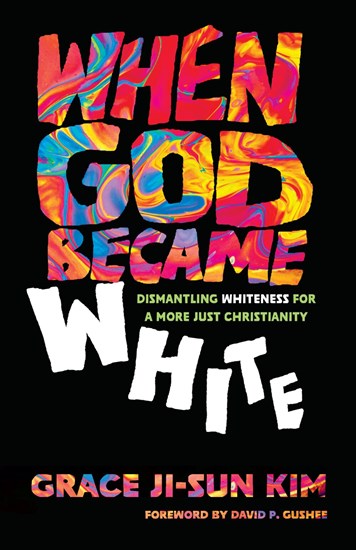
When God Became White by Grace Ji-Sun Kim shows the development of how Western Christianity shaped the narrative of God along lines that became more patriarchal and, ultimately, racist, than it had been.
I find it a little difficult to review this book. On the one hand, it provides quite a bit of stories and short, pithy points that will help readers looking for an introduction to these topics to come to a better understanding of how we got to where we are, particularly in the United States, with a white male patriarchal Christianity. On the other hand, as I read the book, I longed for deeper exploration of some of the topics.
For example, the book makes great points about mission work and how the whiteness of missionaries impacted perception of Christianity and race worldwide (61ff, see in particular 68 and following). Similarly, the author touches upon the fact that race is a humanly invented concept that relies upon social distinctions and contrast and that has historically been defined and redefined (27ff). But, while the latter points are utterly essential to the central thesis of the book–that whiteness has negatively thwarted Christianity in a number of ways–these historical impacts aren’t tied into the greater point, leaving the reader at times with the assumption that with the spread of Christianity came the spread of the concept of whiteness. But this goes against the very brief historical outline presented in the book and also against deeper studies like The History of White People. For me, it seems the thesis would be greatly strengthened with deeper exploration of the developing definition of whiteness and its moving goal posts alongside the differing depictions of Jesus and God and how these two interrelate. As it stands, the interrelationship is assumed, not argued for, and from that assumption comes many of the other theses of the book. And while I’m deeply sympathetic to these theses and the central concepts of the book, it felt like it needed a stronger backbone to link the concept of whiteness to Christianity, especially in light of the acknowledged historical development of that concept.
Much of the argument in the book relies, in fact, upon anecdotes. These are great for illustrative purposes (such as the famous portraits of white Jesus found ubiquitously in churches and grandparents’ foyers) to show the impact of white Jesus on our faith lives, but it doesn’t do as much to show how we can dismantle this or what historically happened to get from the Ancient Near Eastern God/Jesus to what we have today. Is it possible I was hoping for a different book than the one I got? Yes, that’s probably at least part of it. I wanted more depth. As it stands, though, this book does introduce readers to a number of important topics and difficulties with Christianity and the way it has changed into a white gendered God.
When God Became White is a pithy read that makes a number of great points. It doesn’t go deeply into some of the points contained, and relies maybe a bit too much on anecdote, but it remains a read well worth the time to struggle with the points it makes.
All Links to Amazon are Affiliates
Links
Be sure to check out the page for this site on Facebook and Twitter for discussion of posts, links to other pages of interest, random talk about theology/philosophy/apologetics/movies and more!
Book Reviews– There are plenty more book reviews to read! Read like crazy! (Scroll down for more, and click at bottom for even more!)
SDG.
——
The preceding post is the property of J.W. Wartick (apart from quotations, which are the property of their respective owners, and works of art as credited; images are often freely available to the public and J.W. Wartick makes no claims of owning rights to the images unless he makes that explicit) and should not be reproduced in part or in whole without the expressed consent of the author. All content on this site is the property of J.W. Wartick and is made available for individual and personal usage. If you cite from these documents, whether for personal or professional purposes, please give appropriate citation with both the name of the author (J.W. Wartick) and a link to the original URL. If you’d like to repost a post, you may do so, provided you show less than half of the original post on your own site and link to the original post for the rest. You must also appropriately cite the post as noted above. This blog is protected by Creative Commons licensing. By viewing any part of this site, you are agreeing to this usage policy.

 J.W. Wartick - Reconstructing Faith