christian
Really Recommended Posts 3/11/16- Aquinas, Syria, church and state, and more!
 I hope you’ll enjoy the latest round-up of really recommended posts for you, dear readers! This week, we have Aquinas on faith, a response to a claim about Jesus’ view of women, church and state, and Syrian refugees as topics. Let me know what you think, and be sure to let the authors know as well!
Response to Kevin DeYoung’s “Our Pro-Woman, Complementarian Jesus”– Philip Payne is a fantastic biblical scholar, and here he dismantles an article from complementarian Kevin DeYoung in which the latter argued that Jesus would agree to the subordination of roles for women. Also check out Part 2 of the response.
Aquinas on Faith and Reason– Thomas Aquinas had some intriguing things to say about the relationship of faith and reason. So often, people dismiss faith as patently absurd or against reason. Is that the case? Check out this post to see Aquinas’ insight.
The Church is Not the State– Some timely words regarding interpreting Scripture in light of our own nation.
The Syrian Refugee Crisis Moved Into My Neighborhood– Sometimes the best way to discuss controversial topics is to look at case studies. Here is a specific story from someone who had Syrians move into her neighborhood.
Book Review: “How to Be an Atheist” by Mitch Stokes
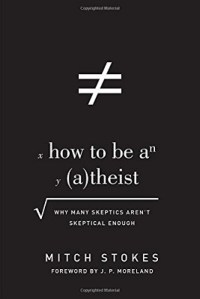 I’ll admit it: going into Mitch Stokes’ How to Be an Atheist: Why Many Skeptics Aren’t Skeptical Enough, I was skeptical [har, har]. Any book that claims to discuss “how to be x” where “x” is some worldview to which the author does not describe has an uphill battle. After finishing, I have to say that my fears were premature. In this astonishing book, Stokes does well what few even attempt: relational, witty engagement with those with whom one disagrees. The book is a calling for self-described skeptics to examine their own skepticism and see whether they are being skeptical enough. Throughout the book, key tenets of “belief” that most people share are challenged by means of classical and modern skeptical argument. Few aspects of life are left unexamined. Whether it is the belief in other minds, morality, or the origin of the universe, Stokes encourages consistent skepticism on all counts.
The book is organized around three parts: Sense and Reason, Science, and Morality. Stokes avoids the potential pitfalls of getting bogged down in complex attempts to defend an alternative view and focuses instead upon skeptical inquiry. He takes a microscope to these topics and asks, effectively, “How should we treat this topic if we were really going to be skeptics?” It’s a refreshing perspective, and one that makes the book highly readable. It reads like an inquiry in the best, technical sense of the term.
‘How do the topics of this inquiry fare?’ you might wonder. Under skeptical scrutiny, very little is left for us. This is not an extended apologetic for the Christian faith. No, this book is specifically aimed at seeing where skepticism takes us if we are actually consistent about it. Free will, objective morality, sense perception, and even realism about scientific inquiry are each cast into doubt. None of this is done in a condescending way or through trickery. Instead, Stokes continually utilizes the works of atheists as sources for his points. True skepticism leaves very little to be affirmed in the world, and what is left behind looks rather pale in comparison to what we experience.
How to Be an Atheist is one of those rare apologetics books that could, I think, reasonably be handed to a skeptical, atheistic friend as a book they might be willing to read–and engage with. Stokes’ humorous style is never offputting. Instead, he encourages a consistent, skeptical look at the world. He shows just how bleak such a vision of the world ought to be. Moreover, he does so by using the words and works of atheists themselves. The New Atheists (Sam Harris, Christopher Hitchens, Richard Dawkins, and Daniel Dennett) are featured throughout, but Stokes doesn’t limit the scope of the work to them. He delves deeper, citing some of the great skeptical minds of all time–people like J.L. Mackie and David Hume. The continued engagement with the best and brightest atheists demonstrates a willingness to engage with the “other side” on the part of Stokes that is admirable and fascinating.
If there is anything to critique in this excellent work, it would be that Stokes, having demonstrated the bleak view of the world through skeptical eyes, doesn’t do enough to dig readers back out of the “hole” of doubt that has been descended into. There are a few moments where this happens, but the book is almost entirely a work of skeptical inquiry–showing what it would look like if people consistently applied their skepticism. It is an endeavor to show the absurdity of life without God.
How to Be an Atheist: Why Many Skeptics Aren’t Skeptical Enough is an enjoyable read that provides both a mental workout and a bit of fun. It will serve as a valued reference and resource for me for some time to come, I’m sure. I recommend it very highly.
The Good
+Humorous examples
+Encourages consistency
+Engages top skeptical minds
+Valuable resource all-around
The Bad
-Little direction about where to go next
Disclaimer: I received a copy of this book for review from the publisher. I was not required to provide any specific kind of feedback whatsoever.
Source
Mitch Stokes, How to Be an Atheist: Why Many Skeptics Aren’t Skeptical Enough (Wheaton, IL: Crossway, 2016).
Links
Be sure to check out the page for this site on Facebook and Twitter for discussion of posts, links to other pages of interest, random talk about theology/philosophy/apologetics/movies and more!
Book Reviews– There are plenty more book reviews to read! Read like crazy! (Scroll down for more, and click at bottom for even more!)
Eclectic Theist– Check out my other blog for my writings on science fiction, history, fantasy movies, and more!
SDG.
——
The preceding post is the property of J.W. Wartick (apart from quotations, which are the property of their respective owners, and works of art as credited; images are often freely available to the public and J.W. Wartick makes no claims of owning rights to the images unless he makes that explicit) and should not be reproduced in part or in whole without the expressed consent of the author. All content on this site is the property of J.W. Wartick and is made available for individual and personal usage. If you cite from these documents, whether for personal or professional purposes, please give appropriate citation with both the name of the author (J.W. Wartick) and a link to the original URL. If you’d like to repost a post, you may do so, provided you show less than half of the original post on your own site and link to the original post for the rest. You must also appropriately cite the post as noted above. This blog is protected by Creative Commons licensing. By viewing any part of this site, you are agreeing to this usage policy.
Book Review: “The Reality of God and Historical Method” by Samuel V. Adams
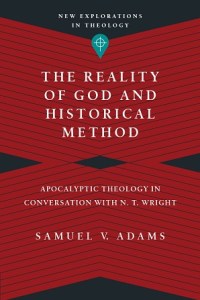
The Reality of God and Historical Method by Samuel V. Adams offers an in-depth look into how God’s existence impacts historical method. Adams specifically utilizes the work of N.T. Wright as a lens for apocalyptic theology and historical study.
The central thesis of the book is that the reality of God ought to have a significant impact on our historical method. Thus, a method like N.T. Wright’s which specifically sets out to treat the Bible like any other historical book takes away the power of God’s breaking into history. God’s activity in history causes an “irruption” in which history is reconstituted and centered around that event. Specifically, Jesus Christ’s death and resurrection entail that all of history is now oriented around those events, rather than being a kind of unified whole without any outside influence.
Adams pursues his argument by first outlining Wright’s historical method. Then, he introduces the notion of a theological view of history. For Adams, history ought to be informed by theology. The reason for this is because Christology demands that if Christianity is true, then God’s acting in history ought to determine how history is done, rather than having Christians attempt to do history in a way that puts God on the sideline. Thus, history is not a continuous chain, but rather the in-breaking of God into history brings discontinuity. Adams therefore argues that historiography cannot be theologically neutral. Believing God exists means that the way we do history must itself change. He uses the notion of apocalyptic to show how this method plays out, with theology informing historical study.
The book provides fascinating insight into and critique of N.T. Wright’s historical method, but it is much more than that. Adams presents a significant step forward into how theological history is to be understood.
The main criticism I have of the book is that it does little to present how, exactly, one is to do history going forward. Granting the notion of God’s in-breaking into history and the discontinuity that makes, what impact does this make for historical study beyond those things we tend to think of as theological. For example, how does Adams’ view of historical method impact how one does investigation into a specific event like McCarthyism or the Presidency of George Washington? Does it have no impact at all? That seems to be unlikely given the commitments Adams has drawn out. Does it mean that all history must be redefined by God’s in-breaking of the Word? If so, how?
The Reality of God and Historical Method is a fascinating, deep work that warrants careful reading. It is the kind of book that opens up new avenues to explore, and I think it should make an impact farther reaching than just one book. It will be interesting to see if Adams will continue the project and offer a way to interpret history more broadly than apocalyptically.
The Good
+In-depth look at N.T. Wright’s historical method
+Fascinating thesis with historical and theological import
+Well-documented with many insights
+New avenues to explore
The Bad
-Not enough specifics on a way forward
Disclaimer: I was provided with a copy of this book for review by the publisher. I was not required to write any specific kind of feedback whatsoever.
Source
Samuel V. Adams, The Reality of God and Historical Method (Downers Grove, IL: InterVarsity, 2015).
Links
Be sure to check out the page for this site on Facebook and Twitter for discussion of posts, links to other pages of interest, random talk about theology/philosophy/apologetics/movies and more!
Book Reviews– There are plenty more book reviews to read! Read like crazy! (Scroll down for more, and click at bottom for even more!)
Eclectic Theist– Check out my other blog for my writings on science fiction, history, fantasy movies, and more!
SDG.
——
The preceding post is the property of J.W. Wartick (apart from quotations, which are the property of their respective owners, and works of art as credited; images are often freely available to the public and J.W. Wartick makes no claims of owning rights to the images unless he makes that explicit) and should not be reproduced in part or in whole without the expressed consent of the author. All content on this site is the property of J.W. Wartick and is made available for individual and personal usage. If you cite from these documents, whether for personal or professional purposes, please give appropriate citation with both the name of the author (J.W. Wartick) and a link to the original URL. If you’d like to repost a post, you may do so, provided you show less than half of the original post on your own site and link to the original post for the rest. You must also appropriately cite the post as noted above. This blog is protected by Creative Commons licensing. By viewing any part of this site, you are agreeing to this usage policy.
Sunday Quote!- The Faith of Infants- Hermann Sasse
Every Sunday, I will share a quote from something I’ve been reading. The hope is for you, dear reader, to share your thoughts on the quote and related issues and perhaps pick up some reading material along the way!
The Faith of Infants – Hermann Sasse
One aspect of Lutheran theology that is often misunderstood is the notion of infant faith. It goes hand in hand with the Lutheran teaching of baptismal regeneration. Yet, time and again I have seen the accusation leveled at Lutherans that we somehow believe that faith is not required for salvation, because we believe infants are saved. Lutheran theology, however, teaches instead that infants do have faith. A brief quote from Hermann Sasse makes this more explicit:
[I]t is not merely avowed liturgical conservatism or even thoughtlessness when the Church for nearly two thousand years has thus baptized infantas as though they were adults, as though they could already confess with the outh and believe with the heart. This is not the ‘as though’ of mere fiction… God views us in Baptism as people who have already died and been raised… Thus he already views us as such who already believe, the poorest, weakest little child which we bring to Holy Baptism. (1197, cited below)
Sasse’s point here is that God views us eschatologically–as though we have faith, because that faith is the gift of God. Lutherans do not believe in salvation without faith; instead, a consistent application of the notion that faith is from God means God can impart that faith to whomever God chooses–whether one is elderly or newborn.
Source
Herman Sasse, quoted in Treasury of Daily Prayer (St. Louis, MO: Concordia Publishing House, 2008). Quoting from Herman Sasse, “Circular Letter 4 to Westphalian Pastors,” in The Lonely Way: Selected Essays and Letters, translated by Matthew C. Harrison et al., vol. 2 (CPH, 2002).
Links
Be sure to check out the page for this site on Facebook and Twitter for discussion of posts, links to other pages of interest, random talk about theology/philosophy/apologetics/movies and more!
Sunday Quote– If you want to read more Sunday Quotes and join the discussion, check them out! (Scroll down for more)
Eclectic Theist– Check out my other blog for discussions about all kinds of topics including science fiction, history, fantasy movies, and more!
SDG.
Really Recommended Posts 3/4/16- Lucado vs. Trump, Women at War, and more!
The Really Recommended Posts this week have a diverse array of topics. I hope you’ll enjoy them. Let the authors know what you thought, and let me know as well in the comments here!
Why Max Lucado Broke His Political Silence for Trump– More Christian leaders need to follow the example of Max Lucado and point out the absurdity of his election cycle and the claims of Donald Trump. One quote from Lucado regarding Trump saying he hasn’t asked for forgiveness: “I can’t imagine that. I’m just shaking my head going ‘How does that work?’ Does a swimmer say ‘I’ve never gotten wet?’ …How does a person claim to be a Christian and never need to ask for forgiveness?”
Women, War, and Evangelicals– A post noting the fact that despite the appeals to “natural law” and the like by complementarians, most Americans–and even plenty of evangelicals–favor allowing women into combat roles. See also my post on the topic.
Debased Coynage– Thomistic philosopher Edward Feser points out the total misunderstanding atheist Jerry Coyne demonstrated regarding some theistic arguments.
Armadillos and Ken Ham’s Hyperevolution Model– Young earth creationist groups like Ken Ham’s Answers in Genesis ironically put forward the most optimistic appraisals of evolutionary theory to be found. They just don’t like calling it that. Here’s another evaluation of Ken Ham’s model.
Planned Parenthood and Personhood Parables– A post featuring interesting thought experiments having to do with the rights (or lack thereof) of the unborn as well as discussion of some current events.
Book Review: “Modern Orthodox Thinkers” by Andrew Louth
 Modern Orthodox Thinkers presents a survey of recent Orthodox thinkers that goes beyond what a word like “survey” may imply. Andrew Louth manages to bring readers into an experiential awareness of Orthodoxy lived.
After an introductory chapter about the Philokalia, a collection of texts by Orthodox thinkers that emphasis a spiritual dimension to faith, twenty chapters present a number of Orthodox believers–from members of the church hierarchy to lay theologians–to readers. Each chapter provides a brief overview of the life of the thinker(s), a survey of their writings, and a focused look at selected aspects of their thought.
There is something here for almost any reader who is looking to glean from Orthodox thought. Whether it is Vladimir Solov’ev’s reflection on Sophia or Mother Thekla (Sharf)’s insight into Shakespeare, Keats, and others, Modern Orthodox Thinkers is a grab-bag of topics that will interest anyone. What’s more, the book presents these thinkers in such a way as to seemingly bring them into conversation with the reader. There is a sense of intimacy in the way that Louth presents the theology of each one that makes it go beyond a mere presentation of thought and towards an experiential awareness of the way theology is done.
Another strength of Louth’s work is that he brings women’s voices into the conversation as well. Too often, surveys of theological writers skip over the contributions women have made throughout history. Not so in this book, in which women thinkers are some of the most interesting people presented. For example, St Maria of Paris (Mother Maria Skobtsova)’s life was perhaps the most moving of all those presented. After the loss of a child, she pursued a life of helping others, taking the place of a Jew to go into a concentration camp, only to be executed in a gas chamber, again having taken the place of someone else (116). Her theology was that of lived theology, and it challenges readers to pursue the same lived faith for their own lives.
One difficulty with the book is that it will, at times, be completely impenetrable for the uninitiated (including the current reviewer). Although a brief introduction to the Philokalia is given, there is never a clear sense of exactly what it is supposed to be or how it is supposed to influence the thinkers presented. Other things are referenced in an offhand manner which gives little ground for readers to understand what is being discussed. For example, the “hesychast controversy” is presented with only the barest historical background of what it is supposed to be, despite the fact that it features prominently in several thinkers’ chapters. Although this was likely done due to space limitations and/or to keep the focus on the thinkers rather than on side issues, deeper discussion in the footnotes or even an extra paragraph would help those who are unfamiliar with Orthodoxy to understand more of the individual chapters.
Modern Orthodox Thinkers will challenge readers on a number of levels. First, it brings into focus the notion of a Christian life lived, whether by someone in the church or as someone who seeks to live as a Christian. Second, it will spur readers to a deeper understanding and exploration of Orthodox thought. Third, the breadth of topics will open readers to new avenues to explore. The book comes recommended.
The Good
+Impressive mix of topics and authors
+Includes women’s voices
+Experiential feeling to the writing
+Very broad scope
The Bad
-At times impenetrable for the uninitiated
Source
Andrew Louth, Modern Orthodox Thinkers (Downers Grove, IL: InterVarsity, 2015).
Disclaimer: I was provided with the book for review by the publisher. I was not required to provide any sort of feedback whatsoever.
Links
Be sure to check out the page for this site on Facebook and Twitter for discussion of posts, links to other pages of interest, random talk about theology/philosophy/apologetics/movies and more!
Book Reviews– There are plenty more book reviews to read! Read like crazy! (Scroll down for more, and click at bottom for even more!)
Eclectic Theist– Check out my other blog for my writings on science fiction, history, fantasy movies, and more!
SDG.
——
The preceding post is the property of J.W. Wartick (apart from quotations, which are the property of their respective owners, and works of art as credited; images are often freely available to the public and J.W. Wartick makes no claims of owning rights to the images unless he makes that explicit) and should not be reproduced in part or in whole without the expressed consent of the author. All content on this site is the property of J.W. Wartick and is made available for individual and personal usage. If you cite from these documents, whether for personal or professional purposes, please give appropriate citation with both the name of the author (J.W. Wartick) and a link to the original URL. If you’d like to repost a post, you may do so, provided you show less than half of the original post on your own site and link to the original post for the rest. You must also appropriately cite the post as noted above. This blog is protected by Creative Commons licensing. By viewing any part of this site, you are agreeing to this usage policy.
Brandon Sanderson’s “Calamity” – The Reckoning of Humanity
 Brandon Sanderson is one of the most gifted authors I know currently writing. Each book he writes, it seems, consistently has stunning twists, great action, and an interesting world. Here, we’ll take a look at the conclusion to his “The Reckoners” series, Calamity. We will be exploring it from a worldview perspective. There will be SPOILERS below for the whole series.
Face Your Fears
A theme that continues throughout the entire series is the notion of facing your fears. In Calamity, this is shown to be the way for Epics to gain control of their powers without going dark. Yet what does it mean to face our fears? For some epics, it is a literal sense, such as Firefight simply plunging an arm into fire–her weakness. For others, facing fear is facing failure, or a different kind of weakness.
As Calamity continues, however, we discover that these weaknesses are from Calamity himself–the things that Calamity is afraid of. Part of me wonders whether this cheapens the impact of this theme, for it makes the weaknesses of the Epics something that is imported to them rather than something intrinsic in themselves. Another part of me sees this as somewhat consistent–for as humans we are social, and we can all too easily take on the fears of others and turn them into something far greater than they are in fact.
The Nature of Humanity
In the climactic encounter between David and Calamity, Calamity is brought to a different, alternate reality in which he left the humans he’d gifted to their own devices. There, those with the powers are effectively superheroes, having had no darkness to face down, nothing from the outside to impinge upon their own reality. David challenges Calamity:
“Do you fear that?” I asked him softly. “That we aren’t what you’ve thought? Does it terrify you to know that deep down, men are not monsters? That we are, instead, inherently good?” (411)
Such a viewpoint is quite popular in our world. Humans are inherently good, right? Well, it seems that such a viewpoint is not the biblical one, which argues that humans are sinful from birth–even from conception (Psalm 51:5); that no one is good, not even one (Romans 3:10) and the like. There is some debate over this in Christian circles, but it seems quite difficult to square these (and other statements) with the notion that humans are inherently good.
Indeed, although this climactic challenge from David ultimately defeats Calamity, once Calamity is gone, not everyone suddenly turns good. Obliteration, for example, continues to seek the extermination of humanity (possibly?). The open-endedness of this makes it difficult to pin down where Sanderson was going with it, but it seems that even alleged “inherent goodness” does not guarantee goodness.
Conclusion
Calamity is one of those rare books that combines intense plot with serious discussion of worldview. Sanderson continues to weave these tales which force us to look at humanity and contemplate what it is that we are.
Links
Be sure to check out the page for this site on Facebook and Twitter for discussion of posts, links to other pages of interest, random talk about theology/philosophy/apologetics/movies and more!
The “Mistborn Trilogy” by Brandon Sanderson- Religion(s), Intrigue, and a Messiah– I look at another trilogy by Brandon Sanderson, the wildly creative “Mistborn Trilogy.”
Popular Books– Read through my other posts on popular books–science fiction, fantasy, and more! (Scroll down for more.)
Source
Brandon Sanderson, Calamity (New York: Delacorte Press, 2016).
SDG.
——
The preceding post is the property of J.W. Wartick (apart from quotations, which are the property of their respective owners, and works of art as credited; images are often freely available to the public and J.W. Wartick makes no claims of owning rights to the images unless he makes that explicit) and should not be reproduced in part or in whole without the expressed consent of the author. All content on this site is the property of J.W. Wartick and is made available for individual and personal usage. If you cite from these documents, whether for personal or professional purposes, please give appropriate citation with both the name of the author (J.W. Wartick) and a link to the original URL. If you’d like to repost a post, you may do so, provided you show less than half of the original post on your own site and link to the original post for the rest. You must also appropriately cite the post as noted above. This blog is protected by Creative Commons licensing. By viewing any part of this site, you are agreeing to this usage policy.
Sunday Quote: Dietrich Bonhoeffer on Anthropomorphism and God
 Every Sunday, I will share a quote from something I’ve been reading. The hope is for you, dear reader, to share your thoughts on the quote and related issues and perhaps pick up some reading material along the way!
Dietrich Bonhoeffer on Anthropomorphism and God
Dietrich Bonhoeffer was a Lutheran theologian who was murdered by the Nazis. Many people don’t delve too deeply into his theology, but I have found reading his broader works to be quite rewarding. Here’s a passage from his Creation and Fall:
God… receives a very specific proper name, Yahweh… One could suppose that such a proper name is evidence of a very primitive idea of God… yet just at this point one must reply that anthropomorphism in thinking of God… is no more irrelevant… than is the abstract use of the generic term ‘deity.’ On the contrary, clear anthropomorphism much more plainly expresses the fact that we cannot think of ‘God as such’ whether in one way or another. The abstract concept of God, precisely because it seeks not to be anthropomorphic, is in actual fact much more so than is childlike anthropomorphism. (74-75, sections 69-70, cited below)
Here, then, Bonhoeffer’s point is that merely abstracting the concept of God and speaking of God “as such” actually does just as much damage to our understanding of God as does “clear anthropomorphism.” That is, when we make God into a kind of philosophical construct, we are just as far away from the relational, radically personal God of the Bible as if we were to be anthropomorphic in a childlike way. For, as he points out in the last sentence above, we put God into our categories rather than the categories of Scripture.
I think Bonhoeffer has a good point here, one that warns people like me who are philosophically minded to remember that our God is an active God. Although it seems clear Bonhoeffer would not deny something like saying God is omnipotent, what he is denying is that we can use those categories to reach “God as such” and fit God into them alone. God–Yahweh–is much more than that, and we need to remember that.
What do you think? Can anthropomorphism be a helpful way to understand God? What dangers, if any, might come from making an abstract concept of deity?
Links
Be sure to check out the page for this site on Facebook and Twitter for discussion of posts, links to other pages of interest, random talk about theology/philosophy/apologetics/movies and more!
Sunday Quote– If you want to read more Sunday Quotes and join the discussion, check them out! (Scroll down for more)
Eclectic Theist– Check out my other blog for my writings on science fiction, history, fantasy movies, and more!
Source
Dietrich Bonhoeffer, Creation and Fall Douglas Stephen Bax, Translator (Minneapolis, MN: Fortress, 2004).
SDG.
Book Review: “Keeping Your Kids on God’s Side” by Natasha Crain
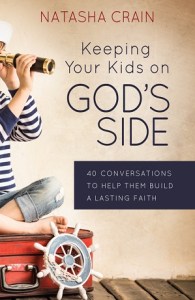 As a Christian parent, one of the things most important to me is bringing my son up in faith in Christ. As a man with an MA in Christian Apologetics, I know that my child will face many challenges going forward, and that the Christian faith has the answers. The problem, it seems, is figuring out how to unite these two–apologetics and child-rearing–in a way that can be understood by children, without being domineering or scary. Natasha Crain’s book, Keeping Your Kids on God’s Side, is an answer to prayers about this important topic.
The book features 40 “conversations” that can be had with children centered around topics from why we believe the Bible and textual criticism to the existence of God to questions about science and Christianity. Each of these chapters provides an introduction to the topic at hand. Crain utilizes stories of her own children quite well to demonstrate how these conversations might play out–or how they might get started.
The most helpful aspect of the book is that it provides a kind of all-in-one reference for common questions and apologetic topics that can be used to start children on the right path towards defending their faith and the calling of 1 Peter 3:15-16. Each of the 40 conversations is one that is worth having, and is often accompanied with quotes from prominent atheist thinkers to show the objections often raised to the faith.
Crain also does a good job of presenting multiple sides of controversial topics without specifying a side. For example, in the chapter on hell, she presents historical Christian positions (a literal view, a figurative view with eternal punishment, and the conditionalist view). The one place there is a bit of a slip on this regard is when it comes to the creation and evolution debate. She adequately presents both young and old earth creationism, but only gives a view like theistic evolution a passing mention, despite having seemingly increasing support among evangelicals.
A downside to the variety of topics that Crain presents is that she is only ever able to scratch the surface on each. The type of book it is basically makes this a necessity, and Crain does provide resources for further reading. Parents should note that they will need to utilize these resources for continuing conversations.
Keeping your Kids on God’s Side is a phenomenal work. It is the kind of book that parents will come back to time and time again. Not only that, but it has broad enough appeal that it serves as an excellent general apologetic work. It will energize parents to start these conversations with their children and give them the tools to keep them going. I highly recommend this work.
The Good
+Broad-minded approach that doesn’t tell readers what to think on controversial topics
+Clear tone and presentation
+Astounding number of topics introduced with valuable information
+Offers several key points to help discuss topics with children
The Bad
-Very brief on several points
-Doesn’t address full breadth of views on creation/evolution
Disclaimer: I received the book for review from the author. I was not obligated to provide any specific kind of feedback whatsoever.
Source
Natasha Crain, Keeping Your Kids on God’s Side (Eugene, OR: Bethany House Publishers, 2016).
Links
Be sure to check out the page for this site on Facebook and Twitter for discussion of posts, links to other pages of interest, random talk about theology/philosophy/apologetics/movies and more!
Book Reviews– There are plenty more book reviews to read! Read like crazy! (Scroll down for more, and click at bottom for even more!)
Eclectic Theist– Check out my other blog for my writings on science fiction, history, fantasy movies, and more!
SDG.
——
The preceding post is the property of J.W. Wartick (apart from quotations, which are the property of their respective owners, and works of art as credited; images are often freely available to the public and J.W. Wartick makes no claims of owning rights to the images unless he makes that explicit) and should not be reproduced in part or in whole without the expressed consent of the author. All content on this site is the property of J.W. Wartick and is made available for individual and personal usage. If you cite from these documents, whether for personal or professional purposes, please give appropriate citation with both the name of the author (J.W. Wartick) and a link to the original URL. If you’d like to repost a post, you may do so, provided you show less than half of the original post on your own site and link to the original post for the rest. You must also appropriately cite the post as noted above. This blog is protected by Creative Commons licensing. By viewing any part of this site, you are agreeing to this usage policy.
Sunday Quote!- The Failure of Eliminativism for Explaining Mind

Every Sunday, I will share a quote from something I’ve been reading. The hope is for you, dear reader, to share your thoughts on the quote and related issues and perhaps pick up some reading material along the way!
The Failure of Eliminativism for Explaining Mind
Philosophy of mind has long been an interest of mine that I have read extensively on. Stephen Parrish’s The Knower and the Known remains what I consider the most valuable single-volume resource for outlining and refuting various physicalist and materialist varieties of philosophy of mind. I have been re-reading the book and come across many excellent arguments once again.
One example is the section on eilminativist views of the mind. According to those who hold this theory, at the most basic level, things like beliefs and consciousness simply don’t exist and are instead relegated to “Folk Psychology.” Parrish’s critique is incisive. He writes:
One cannot, in the making of theories, coherently deny that there are theories and theory makers. One cannot, in trying to understand something, coherently deny that there is such a thing as understanding, and that there are conscious selves who understand. One cannot try to make reality intelligible by denying the very notion of intelligibility. Yet it is precisely these things that eliminativists attempt to do. Therefore, belief in eliminativism is self-refuting and cannot possibly be true. (139, cited below)
Of course, this argument is not one that is unanticipated by eliminative materialists like Patricia and Paul Churchland. Parrish deals with their counter-arguments at length, but the most pressing problem remains that their position effectively is impossible to maintain, for it denies that it can be believed itself.
I’d highly recommend The Knower and the Known to you, dear readers, if you’d enjoy a lengthy, deep treatment of this and many other related issues. Check out my 2 part review (part 1 and part 2) for more analysis.
Links
Be sure to check out the page for this site on Facebook and Twitter for discussion of posts, links to other pages of interest, random talk about theology/philosophy/apologetics/movies and more!
Sunday Quote– If you want to read more Sunday Quotes and join the discussion, check them out! (Scroll down for more)
Eclectic Theist– Check out my other blog for my writings on science fiction, history, fantasy movies, and more!
Source
Stephen Parrish, The Knower and the Known (South Bend, IN: St. Augustine’s Press, 2013).
SDG.

 J.W. Wartick - Reconstructing Faith