christian
Bible Note: Judges 15:1-3 and the right for vengeance
 As I’m working through the Bible writing a kind of running commentary on it as I go, I continually encounter depths of the material I hadn’t encountered before. One such place is the Samson narrative–one of my favorite stories in the entire Bible. The following is an extended version of one of the notes I put in my running commentary:
In Judges 15:3, having discovered his wife was given to someone else, Samson notes that “this time” he has the right to take vengeance. What does this mean? Is Samson saying that he has a right ‘this time’ as opposed to last (when he took vengeance because of the Philistines getting the answer to his riddle through his wife)? Or does he mean that he has a right ‘this time’ in addition to the last time?
Added dimension: In 14:19 when he strikes down 30 Philistines he does so in the power of the Spirit of the LORD. Further dimension: 14:4 speaks of how the LORD was seeking to confront the Philistines.
It seems to me this must imply that God, in sovereignty, is guiding the events towards an end God desires. Given this, we may be tempted to say Samson’s right is indeed a right to vengeance–a divinely given one. But it is possible God is also using this (clearly) sinful man in spite of the sinfulness of his behavior, including his desire for vengeance (which belongs to God alone).
Which interpretation do you think is correct? Why?
Book Review: “Interpreting the Prophets” by Aaron Chalmers
 Aaron Chalmers’ Interpreting the Prophets
The book is laid across 6 chapters, each with a focus on a central aspect of interpreting and applying biblical prophecy. These are: (1) What is a prophet and what is a prophetic book?; (2) The historical world of the prophets; (3) The theological world of the prophets; (4) The rhetorical world of the prophets; (5) From prophecy to apocalyptic; and (6) Guidelines for preaching from the prophets.
There are many insights which will be valuable for both those wishing to engage with the prophets as laity and those interested in drawing out deep exegetical insights from the text. Chalmers’ work serves as a guide for reading without telling readers exactly what various passages are supposed to mean. It is the kind of text that encourages readers to move to the Word and explore it for themselves, laying a solid foundation for interpretation beforehand.
One example of the insights Chalmers provides is his critique of those who would see the prophetic literature as speaking primarily to our time. He notes that this approach of trying to match up biblical prophecies one-to-one with newspaper headlines is mistaken for a number of reasons, including making the texts largely irrelevant to its contemporary hearers. Throughout the book, there are a number of insets that highlight various additional details, like the Ancient Near Eastern background of the text or specific views about things like the dating of a book.
Interpreting the Prophets
The Good
+Excellent insets provide background information into the world of the Bible
+Incisive critique of some popular approaches to reading the prophets
+Practical advice for readers of the Scripture, pastors, and professionals alike
The Bad
-Very brief on several important points
Disclaimer: I was provided with a review copy of the book by InterVarsity Press. I was not required to provide any specific kind of feedback whatsoever, nor was the publisher involved in this review in any way.
Links
Be sure to check out the page for this site on Facebook and Twitter for discussion of posts, links to other pages of interest, random talk about theology/philosophy/apologetics/movies and more!
Book Reviews– There are plenty more book reviews to read! Read like crazy! (Scroll down for more, and click at bottom for even more!)
Source
Aaron Chalmers, Interpreting the Prophets
SDG.
——
The preceding post is the property of J.W. Wartick (apart from quotations, which are the property of their respective owners, and works of art as credited; images are often freely available to the public and J.W. Wartick makes no claims of owning rights to the images unless he makes that explicit) and should not be reproduced in part or in whole without the expressed consent of the author. All content on this site is the property of J.W. Wartick and is made available for individual and personal usage. If you cite from these documents, whether for personal or professional purposes, please give appropriate citation with both the name of the author (J.W. Wartick) and a link to the original URL. If you’d like to repost a post, you may do so, provided you show less than half of the original post on your own site and link to the original post for the rest. You must also appropriately cite the post as noted above. This blog is protected by Creative Commons licensing. By viewing any part of this site, you are agreeing to this usage policy.
Sunday Quote!- Sanctification and Vocation
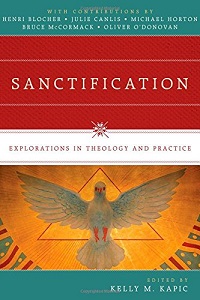 Every Sunday, I will share a quote from something I’ve been reading. The hope is for you, dear reader, to share your thoughts on the quote and related issues and perhaps pick up some reading material along the way!
Sanctification and Vocation
I’ll admit at the outset that I have read very little on the topic of sanctification. Thus, Sanctification: Explorations in Theology and Practice
Sanctification understood biographically has given encouragement to a belief in progressive and incremental moral improvement, to be attained with maturity and age… The map [of constant progression towards final sanctification over one’s life] was indeed wrong. It confused the work of God, who sanctifies old age as he sanctifies childhood, youth, and maturity, with the more attractive features that may decorate the progress of years through unaided nature… why, one wonders, has indulgence been accorded to the doctrine that the elect commit only venial sins after the age of fifty? (155)
I think this question is spot-on. The notion that we as Christians simply are automatically on a linear path to complete sanctification does not match reality and indeed can be extremely damaging to the life of faith. We are sinner-saints who struggle with sins throughout our lives and we must cast our cares on God, ever trusting in the blood of Christ and work of the Spirit to cleanses us from sin and unrighteousness.
What thoughts do you have on sanctification in the life of the believer? How might we be sanctified?
Whatever your views, Sanctification: Explorations in Theology and Practice
Links
Be sure to check out the page for this site on Facebook and Twitter for discussion of posts, links to other pages of interest, random talk about theology/philosophy/apologetics/movies and more!
Sunday Quote– If you want to read more Sunday Quotes and join the discussion, check them out! (Scroll down for more)
Source
“Sanctification and Ethics” by Oliver O’Donovan in Sanctification: Explorations in Theology and Practice
SDG.
Robert Sawyer’s “The Neanderthal Parallax” – Faith, Scientism, and Humanity
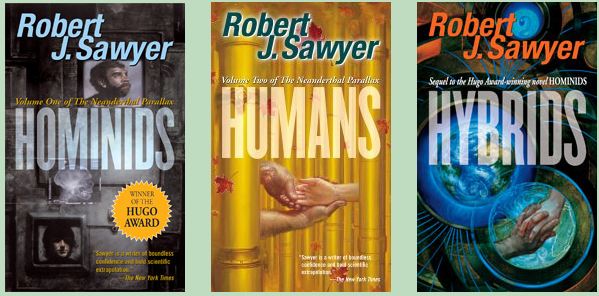 I recently finished reading Robert Sawyer’s trilogy “The Neanderthal Parallax.” I found the plot intriguing, but the worldview issues the books brought up had great difficulties in how they were conveyed and the kind of hidden premises smuggled in. Every story has a worldview, and the worldview of these books was surprisingly hostile and disingenuous particularly to Christians. I have enjoyed Robert Sawyer’s work in the past, but feel forced to interact with these books in a fairly critical fashion. There will be SPOILERS in what follows. I’ll not summarize the plot, but interested readers can see summaries on Wikipedia. I have written a review of the books here.
Faith
Perhaps the most unfortunate aspect of the books is that Sawyer seemingly did not put anything close to the amount of research and care into his portrayal of faith as he did his portrayal of biology, cosmology, and the like. On the latter topics, great detail is put into explaining aspects of various sciences and even invented science that Sawyer employs to support the plot. But people of faith are put up as frequently hypocritical but also lacking in erudition and thoughtfulness.
The central faith figure is Mary Vaughan, a specialist in ancient genetics. She consistently is put forth as the faithful counterweight to the faithlessness of the Neanderthals. However, she is a Roman Catholic who reveals objects to parts of her church’s official doctrines. She rejects the doctrine of original sin, for example. Having her put forward as the example of a religious person makes this even more difficult to swallow. I’m not suggesting that there are no people who have great cognitive dissonance in their beliefs–obviously many people do. The problem is that Sawyer uses Mary as the central image of Christianity throughout the novels, but she is woefully inept at even holding to the faith she claims for herself.
At one point in Humans, Ponter is talking to Mary at the Vietnam Memorial about life after death(188-207). He simply asserts that if you can’t see something it doesn’t exist. But of course this is as absurd as he claims “Gliskins'” (homo sapiens sapiens as opposed to the Neanderthals) belief in things like God is. I cannot see my own thoughts, yet they exist. Neither can I observe other people’s mental life, yet I am not irrational in believing that the people around me are also having thoughts.
In Hominids, Ponter speaks to Mary about the Gliskins’ viewing of a Mass taking place and again basically asserts that Christian belief in deity is absurd on its face. Mary struggles to articulate even the slightest defense of the Incarnation and other central Christian doctrines. Again, plenty of believers would struggle in this fashion, but Sawyer uses Mary as a kind of foil for all of Christianity. She’s got the best defenses Christians have to offer, and she can’t do anything but stutter when challenges to her faith are raised.
At several points, Big Bang Cosmology is challenged as something the Gliskins cling to because of their necessity of belief in a finite universe to support deity. Yet not only was Big Bang Cosmology initially rejected by the scientific community for this and other reasons (and only later accepted due to the mounting evidence for it), but even were the universe infinite, it would hardly follow that it is uncreated, as Ponter asserted without challenge. Sawyer seems to be unaware of–or at least makes his characters ignorant of–the entirety of Scholastic thought on the topic of continuous creation. Thomas Aquinas admitted this as a possibility. Thus, for Christians it is hardly an either/or of either eternal universe or finite universe. Either fits in with various strands of historic Christian theology. But again, Sawyer seems to have been either ignorant of this or willfully ignoring it to portray belief in deity in a more negative and indefensible light.
All of this wouldn’t be as unfortunate if Sawyer didn’t put discussions like this forward as if they were the best defenses Christians could come up with for their positions. Had they been simply believers who were also uninformed or insincere, it would not be as great an error. But Sawyer paints these interactions as though the defenses are the best Christians can come up with. As we have just surveyed very briefly, this is mistaken. I enjoyed the stories Sawyer put forward here, but his portrayal of people of faith is deeply flawed.
Religious Experience
Sawyer uses the books to explore the notion of a God part of the brain which, when triggered, can set off religious experiences. In Humans, it is discovered that Gliskins have a part in their brain which is able to have “religious experiences” triggered through electromagnetic interaction, while Neanderthals do not have a corresponding part of their brains.
A central scene in the entire series is near the end of Hybrids in Times Square, New York City. The Earth’s magnetic field is resetting and it triggers religious experiences, UFO sightings, and the like among the crowd gathered as this part of the Gliskin (homo sapien, remember) brain is triggered. People are crying out to their deities, fending off invading aliens, and the like all over Times Square. From this, Mary Vaughan’s faith is finally shattered:
The Pope had some ‘splainin’ to do.
All religious leaders did…
“It’s all a crock, isn’t it?” [Mary] said [to Ponter].
…”Look, I’ve changed my mind. About our child… Our daughter should not have the God organ…” (389)
Thus, we find that in Sawyer’s universe, the notion that we can induce religious experiences in the brain (and other types of experience like UFOs) means that these experiences are baseless in reality. Mary decides that her child should not have the capacity to have religious experience because it is all “a crock.” The Pope and others have some “‘splainin’ to do.” Presumably they are expected to take this as some kind of major challenge to their respective faiths.
The main problem with this is that we can conceivably trigger all sorts of things in the brain. It does not seem too outlandish to suppose that if we triggered a certain part of the brain, we might bring up a memory. If we extrapolate more, Sawyer’s vision of electromagnetically triggered religious experiences could be on par with memories as well, which could (in this scenario) be triggered in the same way. Should we start to distrust our perceptions or memories if we are able to trigger them with various impulses? Certainly not. This way lies (true) madness: distrust in our own memories and senses.
So what is left? What does the notion that religious experiences might be triggered by various brain activity demonstrate? Just that: religious experience may be triggered through manipulation. Full stop. This doesn’t in any way undercut evidence for theism or other beliefs from religious experience any more than our capacity to trigger scents, sounds, or memories would undercut our rational basis for believing this things to be real (or about real events).
Social Ills?
Sawyer uses the trilogy to attack all kinds of perceived and real social ills, from our treatment of the environment to gun control laws, and the like. But the question is how can he realistically put forward any kind of inter-cultural critique when the whole view he puts forward in the books is ultimately subjective. Mary Vaughan suffers a grotesque act of violence in a rape scene, but this is only used as an instrument in the plot (see my discussion here). Any moral critique Sawyer offers through his characters falls hollow because his only basis for it is some vague concept of pragmatism and self-preservation. Thus, it seems there is no ultimate basis for his criticisms of various ethical wrongs, and his use of several of these as mere instruments to advance the plot betrays this inability to provide an objective basis for right and wrong.
Conclusion
I’ve already written much on the difficulties with worldview in these novels. There are many more I could discuss. Again, I want to emphasize that it is very true that many Christians and believers would struggle to articulate their faith, be unable to defend various aspects of it, and not agree with at least some teachings of their church body. The problem is that Sawyer portrays this as the best Christianity can come up with. I was deeply disappointed to see that the overall thrust of the books was ultimately a kind of attack on my own faith, without any reasonable portrayal or interaction with stronger versions of it. Would that Sawyer had put the time into his depiction and study of faith as he had with the science behind this science fiction. For further reading, check out my reviews of the trilogy.
Links
Be sure to check out the page for this site on Facebook and Twitter for discussion of posts, links to other pages of interest, random talk about theology/philosophy/apologetics/movies and more!
Book Reviews: “The Neanderthal Parallax” – Hominids, Humans, and Hybrids by Robert Sawyer– I wrote a review of the trilogy on my other interests site. This review brings up some of the other worldview issues in the books, in addition to a brief summary of the plot outline and look at the science fiction elements.
Aliens that believe in God: The theological speculations in Robert Sawyer’s “Calculating God”– I write about a different Robert Sawyer book that I did enjoy quite a bit, Calculating God. I even wrote a second post discussing abortion, fundamentalism, and other issues the book raised.
Source
Robert Sawyer, Hominids (New York: Tor, 2002).
—, Humans (New York: Tor, 2003).
—, Hybrids (New York: Tor, 2003).
SDG.
——
The preceding post is the property of J.W. Wartick (apart from quotations, which are the property of their respective owners, and works of art as credited; images are often freely available to the public and J.W. Wartick makes no claims of owning rights to the images unless he makes that explicit) and should not be reproduced in part or in whole without the expressed consent of the author. All content on this site is the property of J.W. Wartick and is made available for individual and personal usage. If you cite from these documents, whether for personal or professional purposes, please give appropriate citation with both the name of the author (J.W. Wartick) and a link to the original URL. If you’d like to repost a post, you may do so, provided you show less than half of the original post on your own site and link to the original post for the rest. You must also appropriately cite the post as noted above. This blog is protected by Creative Commons licensing. By viewing any part of this site, you are agreeing to this usage policy.
Debate Analysis: Gregg Cunningham vs. T. Russell Hunter on “Pro-Life Incrementalism vs. Abolitionist Immediatism”
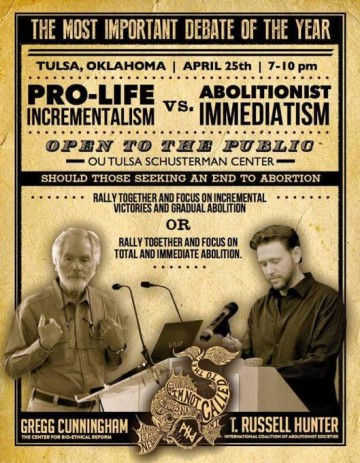
I do not take credit for this image and use it under fair use.
I recently took the time to watch through a debate on pro-life method between Gregg Cunningham and T. Russell Hunter. I summarized the debate here, along with a brief introduction of what was seen to be at issue. Essentially, Cunningham endorses the position that we should pass laws to limit abortion as much as possible now while working towards the ultimate goal of ending all abortion, whereas Hunter argues that we must work only for legislation that will “abolish” all abortions now.
Cutting Off Branches vs. Save Babies Now?
T. Russell Hunter continually made the same error: reducing everything down to an either-or when it could just as easily be both-and. His analogy of the tree was used throughout the talk. Abortion is the tree, he argued, and we must cut the tree down rather than hacking off the branches which will then grow back. The tree is thus the whole of abortion, while the branches are the individual methods used for it, ways to advocate for abortion, and the like. His argument is that if we stop abortion with one method, another will grow up in its place. It’s a powerful image, but one that is ultimately full of rhetorical flair with little basis in reality.
Jill Stanek pointed out a number of problems with this analogy in her own analysis of the debate. First, she notes that the analogy is faulty because trees can spring up even from their roots, so hacking a tree down doesn’t necessarily end it. This point might seem trivial at first, but Hunter’s whole goal was to argue we need to cut down the tree so it can’t grow back (unlike the branches) to kill the tree. But the analogy fails because trees can grow back. Moreover, Stanek notes that when we cut down trees, we saw off the branches first anyway.
Second, and most importantly, Hunter’s analogy fails because he assumes branches can cut back. But this begs the question. Suppose there was a law passed that made abortion illegal after 20 weeks. How could a “method” or “branch” grow back in that place? It would be a total ban on all abortions past a certain point in time. Thus, there is no such thing as growing back. The branch would be dead, and we could move on to the next one. Cunningham also showed data demonstrating that even ending methods lowers the amount of abortions. So when a branch is cut off, the tree is weakened.
Finally, Hunter’s view entails that the children whose lives are saved by incremental legislation should have been left to die. Again, he would oppose (and the “Abolish Human Abortion” group has opposed) legislation to limit abortions or stop certain methods from being used. But this means that the babies that are demonstrably saved by such laws, according to Hunter, should have been allowed to die. This is an awful turn of justice into injustice.
False Dichotomy
Hunter’s position seems to be entirely based on a false dichotomy, which Cunningham pressed pointedly throughout the debate. Namely, the notion that one has to be either someone who works through incremental legislation, or one is someone who supports the immediate ending of all abortions now. But this is just false. Cunningham put it better than I can: the issue is that we can be immediatists morally–that is, we absolutely want to end abortion now–while being incrementalists in practice. We can work to stop all the abortions we can now, even though we want all abortions to stop.
Cunningham also accurately noted that Hunter’s position depends on the notion that if everyone who was a pro-life incrementalist got together right now, we could bring an immediate end to all abortions. But this has not played out in legislation. Cunningham himself noted this–if we don’t have the votes, we do not have the votes. Thus, we can work with legislation that we can get passed to save those babies that legislation can rescue now.
If Hunter wins this debate, the implication is that all of these pro-life laws that do not end all abortions now should be voted down. But what about the lives that those laws demonstrably save? Should we allow them to be aborted just because we can’t pass a law to save all babies? Obviously not.
Hunter’s position fails, and it does so spectacularly. It fails the tests in the actual legislative procedures, as strict pro-life legislation continues to fail to get any votes. It fails the test of accuracy, because pro-life persons can oppose all abortions ethically while working incrementally within the system we have. Finally, it fails to save babies now that can be saved through legislation.
One Question and Answer
I didn’t type up a summary of the Q+A session but at 2:24:19 on this video of the debate, the question was asked as to whether Hunter would be for a bill that abolished all abortion except for one child. Hunter briefly described a scenario in which someone came to him and offered this legislation: all abortion would be abolished in his name except for one child, who would be aborted. He graphically described the abortion. His response was “Get behind me Satan.” He argued that if you take this deal, you are compromising and you might be able to say you saved lots of babies, but it never bears fruit.
Cunningham’s response was that no, he wouldn’t support the bill, and added that we don’t have the votes to pass legislation banning abortion. Cunningham agreed that this deal would be abhorrent because it would kill a child.
I think this is what many people don’t realize. Many pro-life advocates (I have no idea of the numbers so I’m hesitant to say most) would argue vehemently against consequentialism, the notion that the consequences of an action are the most important aspect of a moral decision (I am simplifying for brevity). Thus, there is no “ends justify the means” mentality, so the thought of killing one child to save others was found to be morally repugnant to both speakers.
Conclusion
T. Russell Hunter’s position against other pro-life views cannot be reasonably sustained. It collapses in on itself when it is challenged to present us with reasons as to why we should not try to save what lives we can now on the way to the total ending of abortion. The examples he used were shown to be false or misguided. I think that we need to realize that to end abortion, we should work together. The amount of energy the “Abolish Human Abortion” group has put into attacking others’ methods is better suited to work towards a goal we share: the ending of abortion.
I would like to end noting that I do appreciate the work the AHA/Abolish Human Abortion group does go out and pray, picket, and work at abortion clinics to try to save the babies they can there. But I wish they would join other pro-life persons like Cunningham in helping the other babies that are within our power to save now.
Links
Be sure to check out the page for this site on Facebook and Twitter for discussion of posts, links to other pages of interest, random talk about theology/philosophy/apologetics/movies and more!
Debate Between Gregg Cunningham and T. Russell Hunter– Scott Klusendorf, a major pro-life speaker and author, offers his reflections on this debate. He also has links to some other analyses.
Is it Wrong to pass incremental pro-life laws?– Here is a snip of the debate from the cross examination portion in which T. Russell Hunter is challenged on whether he would choose to save lives with incrementalism or let babies die for the sake of immediatism.
Debate: Pro-Life Incrementalism vs. Abolitionist Immediatism– a link to the debate.
The image used in this blog is not mine and I do not claim rights. I use it under fair use.
SDG.
——
The preceding post is the property of J.W. Wartick (apart from quotations, which are the property of their respective owners, and works of art as credited; images are often freely available to the public and J.W. Wartick makes no claims of owning rights to the images unless he makes that explicit) and should not be reproduced in part or in whole without the expressed consent of the author. All content on this site is the property of J.W. Wartick and is made available for individual and personal usage. If you cite from these documents, whether for personal or professional purposes, please give appropriate citation with both the name of the author (J.W. Wartick) and a link to the original URL. If you’d like to repost a post, you may do so, provided you show less than half of the original post on your own site and link to the original post for the rest. You must also appropriately cite the post as noted above. This blog is protected by Creative Commons licensing. By viewing any part of this site, you are agreeing to this usage policy.
Sunday Quote!- Adam and Eve had different names?
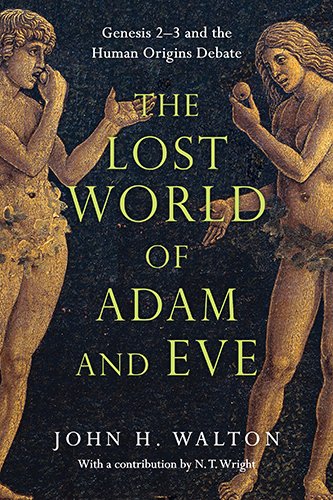 Every Sunday, I will share a quote from something I’ve been reading. The hope is for you, dear reader, to share your thoughts on the quote and related issues and perhaps pick up some reading material along the way!
Hidden Science in the Bible?
John Walton’s The Lost World of Adam and Eve
Although I believe that Adam and Eve are historical personages–real people in a real past–these cannot be their historical names. The names are Hebrew, and there is no Hebrew at the point in time when Adam and Eve lived.
If these are not historical names, then they must be assigned names, intended by the Hebrew-speaking users to convey a particular meaning… In English, if we read that someon’s name is “Human” and his partner’s name is “Life,” we quickly develop an impression of what is being communicated… These characters, by virtue of their assigned names, are larger than the historical characters to whom they refer. (58-59)
What do you think? Is Walton right to assert these were not the historical names of this couple because Hebrew didn’t exist at that time? What might we derive from this conclusion?
Check out my review of Walton’s book, and see what other insights are offered therein.
Links
Be sure to check out the page for this site on Facebook and Twitter for discussion of posts, links to other pages of interest, random talk about theology/philosophy/apologetics/movies and more!
Sunday Quote– If you want to read more Sunday Quotes and join the discussion, check them out! (Scroll down for more)
Source
John Walton, The Lost World of Adam and Eve
SDG.
Really Recommended Posts 5/29/15- Jesus or Muhammad, Kierkegaard, and more!
 Hello folks, it’s another week and that means another round of Really Recommended Posts! Here we have a pretty solid lineup which includes a discussion of whether Muhammad or Jesus was prophesied in the Bible, an accidental flight to North Korea as a sermon illustration, Kierkegaard, the Resurrection, and setting an example for your kids.
A Prophet like Moses: Jesus or Muhammad?– It has often been alleged by Muslim apologists that Deuteronomy 18:18 references a prophecy of Muhammad. How strong is this claim? What about Jesus?
Apologetic Sermon Illustration: Why doctrinal details matter and the case of Kenyan accidental flight to North Korea– Based on a real news story in which a Kenyan made a nightmarish mistake: he flew to Pyongyang, North Korea instead of Pyeongchang, South Korea. In his own words: “…who could tell the difference?” This post is worth reading for the news story alone, but the use of it as an apologetics illustration as well was a great idea. The author used it to discuss religious or doctrinal pluralism.
The Great Dane: Remembering Kierkegaard– A brief snippet on Kierkegaard’s impact and life.
If Jesus did not really rise from the dead (Comic)- Here’s a great illustration of why it is important to realize what relevance the sincere belief of the disciples had regarding evidence for the resurrection.
Why Setting a Good Example for your Kids is Overrated– We need to avoid making our instruction of our children law-oriented and on behavior rather than on the truth of Christianity and the grace of God. Here’s a discussion of how we might do that.
Book Review: “The Bible Story Handbook” by John Walton and Kim Walton

John Walton and Kim Walton’s The Bible Story Handbook
The book has a great introduction that argues that we need to be teaching the actual point of the Bible stories we use in lessons in Sunday School, sermons, and the like rather than abstracting the stories and chopping them apart to draw out specific illustrations we’d like to have. This is a very challenging introduction, not because it is technical, but because we so often do see this done in teaching the Bible and we so often do it ourselves. For example, we might see the story of Jonathan and David as about friendship rather than about what God was doing through the people acting in the story. A more extreme example is from the authors: one of their children came home and had been taught the story of Cain and Abel in Sunday School. But the point of the story–which was told sans violence because of the age of the children–they were told was that Cain and Abel had bodies. That’s it.
It is this level of abstraction that John Walton and Kim Walton work against in the book, consistently arguing story-by-story that the point of the Bible is to teach us about God and God’s action in human history. The stories are each outlined in the same fashion. There is a subheading listing the passage that has what the Bible story is (i.e. Samson and Delilah) followed by the verses that will be discussed (i.e. Judges 16). Then, there is a “Lesson Focus” that outlines key parts of the lesson in a sentence or two, then has main focal points of the lesson in bullet points. After that there is a Lesson Application which hones the Lesson Focus in to what we might take from the lesson. Then, the biblical context of the lesson is highlighted (this section often begins the same if there are multiple lessons in the same book). After that, Interpretational Issues are addressed (such as Samson’s hair and his strength). Background information related to the text is given (such as looms and their usage at the time of the story). Finally, “Mistakes to Avoid” puts forward the key meaning of the text and highlights some errors related to interpretation that people often make related to the specific text.
These sections each have vital information and are certainly of great value for those who want to preach, teach, or explore God’s Word.
There are a few downsides to the book. At times, it seems the “Mistakes to Avoid” might not fully explain why certain interpretations are “mistakes” or why the preferred interpretation ought to be put forward. The book has very broad application but does focus on teaching the Bible stories to children. It would perhaps have been nice to have similar notes about how to direct the lesson towards adults. These are both largely just nitpicks about what is an otherwise phenomenal book.
The Good
+Extremely challenging to many presupposed ideas about how to tell and teach Bible stories
+Great selection of Bible stories
+A constant stream of firm exegesis yielding sometimes surprising insights
+Applicable immediately to teaching settings
The Bad
-Would have been nice to have more focus on teaching Bible stories to adults as well
-Some of the “mistakes to avoid” do not seem like mistakes after all
Conclusion
John Walton and Kim Walton have done a great service with The Bible Story Handbook
Disclaimer: Crossway provided me with a copy of the book for review. I was not obligated to provide any specific kind of feedback whatsoever, nor did they request changes or edit this review in any way.
Links
Be sure to check out the page for this site on Facebook and Twitter for discussion of posts, links to other pages of interest, random talk about theology/philosophy/apologetics/movies and more!
Book Reviews– There are plenty more book reviews to read! Read like crazy! (Scroll down for more, and click at bottom for even more!)
Source
John Walton and Kim Walton, The Bible Story Handbook
SDG.
——
The preceding post is the property of J.W. Wartick (apart from quotations, which are the property of their respective owners, and works of art as credited; images are often freely available to the public and J.W. Wartick makes no claims of owning rights to the images unless he makes that explicit) and should not be reproduced in part or in whole without the expressed consent of the author. All content on this site is the property of J.W. Wartick and is made available for individual and personal usage. If you cite from these documents, whether for personal or professional purposes, please give appropriate citation with both the name of the author (J.W. Wartick) and a link to the original URL. If you’d like to repost a post, you may do so, provided you show less than half of the original post on your own site and link to the original post for the rest. You must also appropriately cite the post as noted above. This blog is protected by Creative Commons licensing. By viewing any part of this site, you are agreeing to this usage policy.
Is the Son “Equal To God”? – A reflection on an article from a Trinitarian Subordinationist
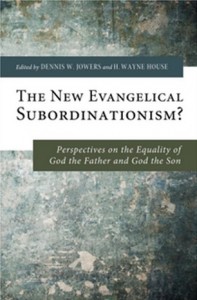
One of the debates going on within evangelicalism today is the concept of the eternal subordination of the Son. That is, is God the Son eternally–not just in the Incarnation or some other temporal state–subordinate to God the Father? Setting aside the complexities of the debate, one of the central questions is whether this eternal subordination entails ontological subordination. The pro-subordination side says it does not; others charge that it does. There are, of course, many other issues, but here we will examine an article from Denny Burk written about Philippians 2:6 in the book The New Evangelical Subordinationism?
Burk’s Thesis: The Son should not pursue “Equality with God”
Denny Burk argues that the Son “should” not pursue “equality with God” and the phrases “form of God” and “equality with God” are not synonymous. He surveys the use of the Greek article and concludes that the use in this instance is not anaphoric–basically the use of one expression carrying the meaning of another in context (I’m not linguist, so I hope I explained this adequately). Granting this distinction, I would suggest that Burk goes too far in concluding the Son is eternally subordinate and in fact arguing that the Son is inequal to the Father.
The Son , he argues, is in the form of God, but should not pursue “equality with God.” The final sentences of his article make this clear: “Therefore, in Paul’s Christology ‘form of God’ is something that Jesus possessed by virtue of his deity, while ‘equality with God’ is not. In fact, ‘equality with God’ is best understood as a role that Jesus refused to pursue so that he could pursue his redemptive work in the incarnation” (104, cited below).
Unequal Persons of the Godhead?
I found these statements astonishing, because I think they fundamentally do divide the Trinitarian persons on an ontological level. Consider the following premise:
P1- If two persons are “unequal,” those persons are not of the same essence.
I think this premise is eminently defensible, but simply asserting this premise begs the question against Burk’s position. Moreover, one would have to narrow down the definition and see what is meant by “unequal,” whether it applies to all forms of inequality, and the like. So rather than going down that route (one which I think would be ultimately successful but also highly complex), I’d simply suggest the following:
P2- If the Son is not “equal to God” to the same extent that the Father is “equal to God” then there is ontological division in the Trinity.
Unfortunately, we again run into the problem that without a demonstration of P2, it begs the question against Burk (and subordinationists who would use the same language). However, I think P2 is even more defensible than P1, so the establishing of P2 shall be the brief project to demonstrate Burk (and any who agree) have crossed the line with subordinationism into undermining the ontological unity of the Trinity.
Defense of P2 and Analysis of Burk’s position
There is no little danger in treating “God” as a kind of distinct entity from “Father,” “Son,” and “Spirit” because we may collapse into not just tritheism but rather quadri-theism where there is God, and then the the other three divine persons. Burk’s lack of defining what is meant by “equal to God” in his expressions seem to cross into this territory.
My defense of P2 will be quite simple. First, Christianity holds that Jesus is God. Period. Ergo, Jesus is equal to God. If Jesus is not just as “equal to God” as God the Father, then Jesus is not God but rather the Father is God and Jesus is some sort of quasi-divine entity having the “form of” but not “equality” with God.
Second, if we argue that two beings, x and y, do not equally share some aspect of nature, z, then it follows that x and y are not both essentially z. Converting that to our discussion of the Trinity, if we suppose that the Son and the Father do not equally have “equality to God,” then surely it must follow that the Son is not essentially God. The substance of the Godhead is not united in this view, but rather divided. If one wants to argue that I am mistaken here, I’d simply ask for a defense of the opposite position. How can there be two entities that are not both reflecting some attribute but who are then said to both be that attribute?
Again, we run into the great difficulty that Burk never does (in this article) adequately explain what he means by “equal to God.” It seems he is using this phrase as though “equal to God” is semantically equivalent to “equal to the Father” but then Burk’s position surely assumes quite a bit and reads subordinationism into the text rather deriving it from this text. After all, we know that Paul is perfectly capable of referencing God as “Father” so if he meant to say that the Son “should not” (using Burk’s terminology) pursue equality to the Father, he could have just said that.
Burk’s own discussion of how “form of God” and equality to God may be distinct is brief:
[A]lthough Jesus actually possessed an identical characteristic of His Father with respect to his deity (i.e. “he existed in the form of God”), he did not want to grasp after another role that was not his–namely, “equality with God.”
…[T]he contrast between “grasping for equality” and “emptying himself” suggests both are functiona categories… Paul argues here that in his pre-incarnate state, Christ’s [sic] existed as theos [I transliterated this word–it is Greek for ‘God’]. Yet in this pre-incarnate existence, Christ Jesus did not seek to be like theos [transliterated] in every respect. (103-104)
These statements lead us to a related difficulty–one related to the first I noted in this section: Burk’s position seems to either turn into equivocation between “God” and “God the Father” without any distinctions (as just noted) or it seems to treat “God” as a distinct entity from the Trinitarian persons. But either of these is extremely problematic.
Moreover, one is forced to wonder how one might say of God the Son that he is God but not like God in every respect. How might one conclude that the persons of the Trinity are of one being if one is “equal to God” in role, but another is not? Burk offers little reason to think this is possible, and simply avers to roles within the Trinity. I contend that this offers little comfort to those with concerns over the possible ontological division within the Trinity coming from subordinationism.
Conclusion
I believe that P1 (properly construed) and P2 are each correct and that Burk’s subordinationism–along with any others who would draw similar conclusions–does indeed ontologically split the Trinity. Moreover, I believe that Burk fails to adequately ground any reason for thinking his position does not break the essential nature of the unity and the one being of the Godhead. It is well and good to assert different roles within the Trinity, but when one “role” is “equality to God,” and that “role” is not shared by all the persons of the Trinity, the implications for Trinitarian theology seem deleterious.
It is certainly possible I am misunderstanding Burk on these points, but it seems the conclusions I’ve drawn follow from his position. I’m happy to be corrected on this. I must, for now, conclude with a rhetorical question: In what sense can we affirm that the Son is God if the Son is not “equal to” God?
Links
Be sure to check out the page for this site on Facebook and Twitter for discussion of posts, links to other pages of interest, random talk about theology/philosophy/apologetics/movies and more!
Women, Complementarianism, and the Trinity- How getting subordination wrong has undermined the Trinity– I note how some complementarians have distorted the doctrine of the Trinity in order to ground their theological position on women in the ministry
Source
Denny Burk, “Christ’s Functiona Subordination in Philippians 2:6: A Grammatical Note with Trinitarian Implications” in The New Evangelical Subordinationism?
SDG.
——
The preceding post is the property of J.W. Wartick (apart from quotations, which are the property of their respective owners, and works of art as credited; images are often freely available to the public and J.W. Wartick makes no claims of owning rights to the images unless he makes that explicit) and should not be reproduced in part or in whole without the expressed consent of the author. All content on this site is the property of J.W. Wartick and is made available for individual and personal usage. If you cite from these documents, whether for personal or professional purposes, please give appropriate citation with both the name of the author (J.W. Wartick) and a link to the original URL. If you’d like to repost a post, you may do so, provided you show less than half of the original post on your own site and link to the original post for the rest. You must also appropriately cite the post as noted above. This blog is protected by Creative Commons licensing. By viewing any part of this site, you are agreeing to this usage policy.
Sunday Quote!- Sanctification by Faith Alone?
Every Sunday, I will share a quote from something I’ve been reading. The hope is for you, dear reader, to share your thoughts on the quote and related issues and perhaps pick up some reading material along the way!
Sanctification by Faith Alone?
Sanctification: Explorations in Theology and Practice
One of the chapters, Richard Lints argues that sanctification is something that we receive by faith alone–in contrast to views which argue that it is some later co-operation between the Spirit and the believer to do good works. I hope I’m not misrepresenting his view, as I admit I have read very little on the topic. Thus, I’ll let him make his argument for himself:
The gospel is received rather than achieved by believers, and thus all the benefits given in the gospel are received by faith. The gift of the Holy Spirit is one of those “benefits” and no less than other gifts given in the gospel, so the Holy Spirit is received by faith… And therefore sanctifying faith is not different in its orientation than justifying faith. (44)
What do you think? Is this a good argument for the view that sanctification comes through faith alone? If so, how are works involved in sanctification? What is your view of sanctification overall?
Sanctification: Explorations in Theology and Practice
Links
Be sure to check out the page for this site on Facebook and Twitter for discussion of posts, links to other pages of interest, random talk about theology/philosophy/apologetics/movies and more!
Sunday Quote– If you want to read more Sunday Quotes and join the discussion, check them out! (Scroll down for more)
Source
“Living by Faith–Alone?: Reformed Responses to Antinomianism” by Richard Lints in Sanctification: Explorations in Theology and Practice

 J.W. Wartick - Reconstructing Faith