christian
Debate Overview: Pro-Life Incrementalism vs. “Abolitionist Immediatism” – Gregg Cunningham vs. T. Russell Hunter
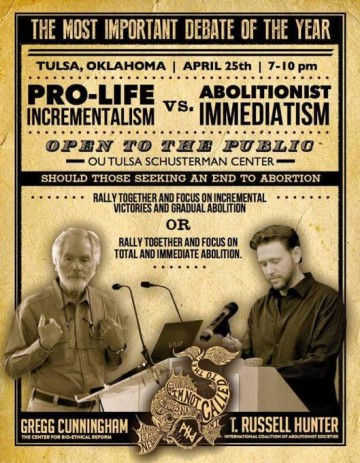
I do not take credit for this image and use it under fair use.
I’ve been looking forward to this one, folks. Here we have a debate between Gregg Cunningham and T. Russell Hunter on “Pro-Life Incrementalism vs. Abolitionist Immediatism.” T. Russell Hunter, a member of the group “Abolish Human Abortion,” argued for “Abolitionist Immediatism,” which is effectively the position that we must only work for the immediate ban of abortion. He issued a challenge to so-called “pro-life incrementalists”–those who would allow for “gradual” steps to legislate abortion (i.e. banning abortions for gender selection, etc.)–to debate the topic. Gregg Cunningham, Executive Director of the Center for Bioethical Reform, took up the challenge.
I took the time to watch and reflect on this lengthy debate. Here, I provide an overview of the debate with summaries of the statements made throughout [I do not summarize the Q+A session]. My next post on this debate will be a commentary on the debate itself and the arguments presented therein. Here, I will stick as closely as I can the arguments as they are presented. I will not offer analysis of the arguments in this post. In my next post on this debate, I will go over many of the arguments found herein and offer reflections on the debate.
I’d love to read your thoughts on the debate. You can watch the debate here.
Hunter Opening
The debate between incrementalism and immediatism is ancient. It is ultimately a debate between “God has said” and “Did God really say?” [He quotes this.] Immediatism is not suggesting that something happens overnight, but is rather the working towards immediate action. American abolitionists against slavery were immediatists–they believed that slaves ought to be instantly set free. These immediatist abolitionist saw any incremental solution to slavery as something that would prolong the institution of slavery and opposed it entirely. They saw slavery as a national sin and the nation needed to immediately repent of the institution of slavery.
After citing a few abolitionists, Hunter argues that Wilberforce was an immediatist, not a gradualist as many pro-life incrementalists have argued. Total abolition, according to Wilberforce, is the only acceptable solution to slavery. Any delay allowing slavery to continue for even an hour undermines the notion that slavery is sin. Martin Luther King Jr. was also an immediatist and argued for the immediate ending of segregation and racial injustice.
Ultimately, the call for the immediate repentance and the doctrine of immediatism is found in the biblical prophets (Isaiah 1:16-17 among others).
Cunningham Opening
We [at the Center for Bioethical Reform] are moral immediatists but strategic and tactical incrementalists. This is not because the desire is only for incremental legislation, but because strategically it works. Hunter’s position presupposes that the pro-life movement has the power to end abortion right now but chooses not to. Strategically, we should work to save every baby by passing every law that the courts and public will allow.
Hunter’s position includes a number of factually incorrect statements. The pro-life position is not losing the battle over abortion. The pro-life position is not eager to compromise, nor is it comfortable with the current status. Hunter’s approach suggests that he is the only one praying; but the pro-life movement prays, but also works to pass every law to save every baby possible in the here-and-now. Peer-reviewed study shows that legislation that restricts or regulates abortion are saving babies’ lives. Abortion rate is falling in states in which funding is cut off, parental or other requirements are in written law, and the like. We can save those babies these laws save en route to abolishing abortion.
Pro-life lawmakers have put their seats on the line to try to draft pro-life legislation, and they have lost their positions due to their own pro-life views. Yet they have been proven to be effective–these laws save lives. Again, Cunningham asserted that we may be absolutists morally, but strategically must be incrementalists because that saves lives now.
Sometimes we need to compromise on our laws in order to get them passed and save lives now. (He uses an example of the rape exception clause and his own use of the rape exception clause in order to prevent Planned Parenthood from defining the clause, thus saving lives by making it as narrow as possible.) Years later, the evidence showed that not one abortion had happened with a rape exception clause, and this saved babies lives immediately, despite Cunningham himself being against rape exceptions.
Hunter is mistaken on William Wilberforce, who was a moral absolutist, but a strategic incrementalist. Wilberforce started off fighting the slave trade rather than directly abolishing slavery, and this demonstrated that he was out to save lives and end as much slavery as he could. Legislation Wilberforce supported forced slave ships to be redesigned and worked to put laws through that restricted the ports slave ships could use, etc. He worked incrementally to restrict and slow down slavery through slave trade as much as possible.
Hunter Rebuttal
Wilberforce did not author the bills that attacked the slave trade. He only sometimes voted for them and “often ridiculed” them.
There is no talking about abortion without talking about it as a spiritual issue. “Secular people need to hear that abortion is sin also.” It is people’s hatred of God which leads them to abortion. To modify bills to get them passed by including compromises regarding restrictions is “writing an iniquitous decree to pervert justice.” Every child who is aborted is an image bearer of God and one of our neighbors.
Making an occasion for sin allows it to grow. Through incremental legislation, abortion is perpetuated. When bans are placed on things like partial birth abortion, it is an attack on method, not on abortion itself. Thus, inevitably abortion methods will change and the banned method will end, but abortions will continue. Whenever one method is ended, another method takes precedence and abortion continues. Partial birth abortions are morally equivalent to any earlier abortion, and when we work to make things like that illegal, abortion continues and people focus on things like partial birth abortion rather than abortion at large.
Cunningham Rebuttal
The inescapable conclusion of Hunter’s argument is that until we can outlaw abortion, we should be utterly indifferent to the slaughter of the babies that we can save now. Instead, we should be committed to saving every baby that we can now. While we move towards the goal of ending all abortion, we should not allow those babies we can save to die.
Wilberforce gave a speech to Parliament in which he advocated paying compensation to slave owners for their freed slaves weeks before his death. He did this because he didn’t have the votes to get abolition without compensation. This was a strategic move, not indicative of the moral absolute of ending slavery now.
Hunter’s argument that pro-life incrementalists imply that abortion is okay when they try to regulate abortion is absurd on its face. It is not as though by saving a baby because dismemberment laws were passed, someone is then advocating the position that abortion that is not dismemberment is suddenly okay. Incremental legislation saves and changes what it can when it can; it does not at all imply that the whole system is acceptable.
Hunter criticizes those who spend times fundraising, but the very images he uses that show abortions would have been impossible without fundraising and the professionals who take the photographs and obtain the images.
Cross Examination
[I do not type up every question and answer in these Cross-Exam portions.]
Cunningham: Hunter is critical of pro-life people working with secular people and the like in order to try to end abortion. If, hypothetically, your child falls into a swimming pool, would you quiz the paramedics about their worldview before letting them resuscitate your child?
Hunter: I would want them to resuscitate my child. That’s a straw man. When we fight evils, we do need to fight them on God’s terms. If we want the power of God on our side, we should not join hands with a “God-hating worldview” because secular worldviews are the very things that make abortions possible. Making strategies with people who adopt the worldview that allows for abortion perpetuates abortion.
Cunningham: I’m not the one who decides what the limits are on legal restraints for abortion. The public decides what the restraints are by what they will allow and vote for. Hunter’s position suggests that pro-life advocates have the power to end abortion now and choose not to do it. This is mistaken because attempts to end all abortion immediately continue to fail to be voted in.
Hunter: I would not put a bill forward to begin with.
Cunningham: Do you care about the lives of the babies?
Hunter: Yes.
Cunningham: Then why do you suggest we shouldn’t vote for legislation that saves these babies lives?
Hunter: Children are not increments.
Cunningham: We can do both.
Cunningham: Why can we not work to save babies through incremental legislation while working to end abortion entirely?
Hunter: You can do both as long as you don’t undermine the whole project. The rape exception is always brought up. People begin to believe that murdering children is okay if exceptions are in place.
Cunningham: Do you understand the difference between a moral immediatist (with strategic incrementalism) and pure incrementalism or compromise?
Hunter: Yes.
Cunningham: Why do you insist on conflating the two?
Hunter: Because if you undermine your own immediatism, you are what the word of God says someone who perverts justice.
Cunningham: Should we allow these babies to die rather than enact incremental legislation? [This is a key portion of the debate. See the transcript of this entire question and answer here.]
Hunter: Abortion is evil and it is one of the things that the powers and principalities of darkness endorse. If they can keep abortion going by deceiving people into becoming gradualists, then that will be allowed.
Cunningham: Let’s be both [incrementalists and immediatists]. Let’s be both.
Hunter: Is it that you don’t want to deal with immediatism, or do you just want to avoid the conversation about immediatism?
Cunningham: I’m determined to save that baby [through incremental legislation], and that’s an immediate kind of thing. We can be both immediatists and incrementalists. It is a false dilemma.
Hunter: Do you believe we have to fight abortion as abortion and sin?
Cunningham: We have to use clauses which the courts will allow because they strike down legislation that is complete ending of abortion.
Hunter: How do you do “both” [immediatism/incrementalism]?
Cunningham: The way people have continually done both. We can talk about abortion as sin and as a human rights violation, while working to end as much of it as we can. It does not have to be either/or. Hunter tends to be binary without justification.
Hunter: Do you think the church is doing enough to work against abortion and do you think that incremental bills encourage apathy?
Cunningham: The church is not doing enough and we are not educating our pastors enough to combat abortion.
Hunter: I see apathy tied into incremental legislation because when I ask pastors to help and go to abortion clinics and the like, I hear them cite their support of incremental legislation.
Cunningham: The reason for this is because the pastors are poorly trained.
Hunter: Do you think that people are more likely to oppose abortion if we convert them? Do you think it is a wise strategy to deal differently with secularists and Christians?
Cunningham: We don’t know who believes what. It is not either/or. We make sure both sets of people here both sets of argument, including getting the opportunity to share faith in Christ.
Hunter: I have e-mails from you saying you bring different displays to Christian schools and state schools. Do you think it is folly to try to call the nation to repent of abortion?
Cunningham: We should work to make every argument we can make to save the life of every baby whose life is imperiled, and this includes passing every law we can pass now to save every baby we can.
Hunter Closing
Isaiah 30 (reads). Pro-life incrementalists are like the Israelites running to Egypt instead of God. People, instead of trusting in the word of God and going into conflict with the people of the age, go and look at the laws to see what they can get within the current federal ruling. We must cut down the tree itself rather than the branches. Incrementalism is not in the Bible. It is not in the historical record. If you believe and trust in God, then you would be an immediatist.
Cunningham Closing
We don’t have to do either immediatism or incrementalism, we can do both. Hunter doesn’t find incrementalism in the Bible, but it is in the Bible: 1 Corinthians 3 shows that God reveals revelation incrementally. Mark 10 shows that the Law was incrementally revealed over time regarding divorce laws, which became much more restrictive over time, working with people over time. Regarding the temple tax, Jesus saw that he did not owe the temple tax, but he paid it anyway in order to compromise and pick the battles. It is possible to save babies incrementally and not do so to the exclusion of trying to save all the babies. Hunter’s position does not save babies now. The position does not allow for the love of Christ.
Conclusion
I will be offering analysis of this debate in a coming blog post. Please feel free to comment yourself on what you think of the debate and the arguments put forward therein here (and on the future post as well).
Links
Debate Between Gregg Cunningham and T. Russell Hunter– Scott Klusendorf, a major pro-life speaker and author, offers his reflections on this debate. He also has links to some other analyses.
Is it Wrong to pass incremental pro-life laws?– Here is a snip of the debate from the cross examination portion in which T. Russell Hunter is challenged on whether he would choose to save lives with incrementalism or let babies die for the sake of immediatism.
Debate: Pro-Life Incrementalism vs. Abolitionist Immediatism– a link to the debate.
The image used in this blog is not mine and I do not claim rights. I use it under fair use.
SDG.
——
The preceding post is the property of J.W. Wartick (apart from quotations, which are the property of their respective owners, and works of art as credited; images are often freely available to the public and J.W. Wartick makes no claims of owning rights to the images unless he makes that explicit) and should not be reproduced in part or in whole without the expressed consent of the author. All content on this site is the property of J.W. Wartick and is made available for individual and personal usage. If you cite from these documents, whether for personal or professional purposes, please give appropriate citation with both the name of the author (J.W. Wartick) and a link to the original URL. If you’d like to repost a post, you may do so, provided you show less than half of the original post on your own site and link to the original post for the rest. You must also appropriately cite the post as noted above. This blog is protected by Creative Commons licensing. By viewing any part of this site, you are agreeing to this usage policy.
Book Review: “Creative Church Handbook” by J. Scott McElroy
 How do we integrate the arts into our lives in the church?
As someone who is interested in the way we can more completely integrate our faith into our lives, this is a question that has interested me for some time. When Creative Church Handbook
The book is, well, a handbook for starting up, organizing, and thriving in arts ministries in your church. It is organized in a logical fashion, with an introduction providing reasons for supporting arts ministries and ways to get leadership on board, followed by numerous chapters on building said ministry, ideas for specific types of arts ministries, and moving the ministry beyond the church walls.
The chapters on setting up an arts ministry are wonderful because they provide a number of different concepts of what that ministry might look like, along with how to overcome potential challenges which may come up and advice on how to avoid burning people out or scaring them off. McElroy does a good job of envisioning the issues which may come up like funding, integration into worship, and the like.
The chapters on what an arts ministry may look like are where the rubber really hits the road as generalized suggestions about things like creating live artworks in worship are intertwined with concrete examples from successful arts ministries.
One downside to the book is that there is little if any mention of several art forms like music and technical arts. McElroy acknowledges this in the Preface and notes that, in part, it is because music has been integrated fairly well into worship and the technical arts are, well, technical and would require a different type of book. However, it seems to me that much of McElroy’s advice in this book could be modified slightly to apply to these other forms of the arts. The copy I received was a pre-release and so I was unable to evaluate the index as this was not included.
Overall, I would highly recommend Creative Church Handbook
I received a review copy of the book from InterVarsity Press. I was not obligated by the publisher to give any specific type of feedback whatsoever.
Links
Be sure to check out the page for this site on Facebook and Twitter for discussion of posts, links to other pages of interest, random talk about theology/philosophy/apologetics/movies and more!
Source
J. Scott McElroy Creative Church Handbook
SDG.
——
The preceding post is the property of J.W. Wartick (apart from quotations, which are the property of their respective owners, and works of art as credited; images are often freely available to the public and J.W. Wartick makes no claims of owning rights to the images unless he makes that explicit) and should not be reproduced in part or in whole without the expressed consent of the author. All content on this site is the property of J.W. Wartick and is made available for individual and personal usage. If you cite from these documents, whether for personal or professional purposes, please give appropriate citation with both the name of the author (J.W. Wartick) and a link to the original URL. If you’d like to repost a post, you may do so, provided you show less than half of the original post on your own site and link to the original post for the rest. You must also appropriately cite the post as noted above. This blog is protected by Creative Commons licensing. By viewing any part of this site, you are agreeing to this usage policy.
Sunday Quote!- The Creative Church Changes the World
Every Sunday, I will share a quote from something I’ve been reading. The hope is for you, dear reader, to share your thoughts on the quote and related issues and perhaps pick up some reading material along the way!
The Creative Church Changes the World
J. Scott McElroy’s Creative Church Handbook is a deeply insightful look into how we might integrate the visual arts into our churches in meaningful ways. But, one may ask, why should we bother to do so? McElroy’s words are worth considering:
When we choose to inspire, disciple and empower the artists in our churches, guiding them into a collaborative relationship with God, they will help the rest of the congregation on the path to unlocking our inherent creativity. The result–a creative church–can change the world. (60 [cited from a pre-release edition])
Put most simply, when we open our doors to creativity in the church, we engage the world on a completely different level than we do if we lack such creative insights. I think McElroy is completely correct here, and we know it is correct because we’ve seen how art like the Mona Lisa, The Last Supper, and other works have changed the world. If we, the church, can continue to engage on this level, how much more change for the Kingdom can we bring into the world?
I highly recommend the Creative Church Handbook. It is one of the best reads I’ve had all year.
Links
Be sure to check out the page for this site on Facebook and Twitter for discussion of posts, links to other pages of interest, random talk about theology/philosophy/apologetics/movies and more!
Sunday Quote– If you want to read more Sunday Quotes and join the discussion, check them out! (Scroll down for more)
Source
J. Scott McElroy Creative Church Handbook
SDG.
Book Review: “Mapping Apologetics” by Brian Morley
 Although there is widespread agreement over the need to have a defense of the faith (a biblical charge–1 Peter 3:15-16), there is much disagreement over exactly how that defense should proceed. Brian Morley’s Mapping Apologetics
There are few books that deal exclusively with apologetic methodology by outlining various approaches. Perhaps the most comprehensive is Faith Has Its Reasons
After a couple introductory chapters on apologetics in the Bible and history, the following chapters each highlight individuals who are major contemporary proponents of different apologetics methods. Included are such people as Cornelius Van Til, Alvin Plantinga, E.J. Carnell, Richard Swinburne, William Lane Craig, and John Warwick Montgomery, just to name a few.
Each of these chapters presents an extended overview of the apologist’s method of defending the faith along with several quotes and often detailed analysis of their primary arguments with examples. Thus, readers are given the resources to compare and contrast the various approaches on the level of the actual arguments and counter-arguments presented.
The people chosen are each major contributors to their specific variety of apologetics, so both those who are well-versed in apologetics and those who are just beginning will get insights from top defenders of the faith. I personally have an MA in Christian Apologetics, and I was familiar with each author, but the way that each was presented gave me a good refresher on their method and primary arguments–and sent me scampering to re-read some of my favorites!
The book includes some great follow-up questions after each chapter to help readers review the material in the chapter, along with useful further reading sections for those interested in learning more about specific defenders. Each chapter also includes criticisms of the specific type of apologetic the individual puts forward. These are often only about 1 1/2 to 2 pages, though, and it would have been nice to have a bit more space dedicated to the critiques and rebuttals to each approach. Morley also very quickly dismisses the fideistic approach as being “unbiblical” with only a brief argument. Although I am not at all a fideist, I do think that the approach has at least some merit and the aforementioned work by Boa and Bowman has some great insights into how it might also offer some insights into apologetics.
Mapping Apologetics
The Good
+Great summaries of top apologists from multiple methodological approaches
+Invaluable insight into different apologetics methodologies
+Helpful review questions and resource lists
The Bad
-Dismisses fideism too quickly
-Could stand to have more reflection on criticisms of each position
Disclaimer: InterVarsity Press provided me with a copy of the book for review. I was not obligated to provide any specific kind of feedback whatsoever, nor did they request changes or edit this review in any way.
Links
Be sure to check out the page for this site on Facebook and Twitter for discussion of posts, links to other pages of interest, random talk about theology/philosophy/apologetics/movies and more!
Book Reviews– There are plenty more book reviews to read! Read like crazy! (Scroll down for more, and click at bottom for even more!)
Source
Brian Morley, Mapping Apologetics
SDG.
——
The preceding post is the property of J.W. Wartick (apart from quotations, which are the property of their respective owners, and works of art as credited; images are often freely available to the public and J.W. Wartick makes no claims of owning rights to the images unless he makes that explicit) and should not be reproduced in part or in whole without the expressed consent of the author. All content on this site is the property of J.W. Wartick and is made available for individual and personal usage. If you cite from these documents, whether for personal or professional purposes, please give appropriate citation with both the name of the author (J.W. Wartick) and a link to the original URL. If you’d like to repost a post, you may do so, provided you show less than half of the original post on your own site and link to the original post for the rest. You must also appropriately cite the post as noted above. This blog is protected by Creative Commons licensing. By viewing any part of this site, you are agreeing to this usage policy.
“Dune” by Frank Herbert- Prophecy, Religion, and the Messiah
 Bless the Maker and His water. Bless the coming and the going of Him. May His passage cleanse the world. May He keep the world for his people.
Dune has been called “Science Fiction’s Supreme Masterpiece.” I say that this tagline is accurate. The depth of the saga is breathtaking, and its majesty is at times overpowering. Here, I’ll take a look at some key themes in the book from a Christian perspective. There will be SPOILERS in what follows.
Prophecy
Prophecy is found throughout the various factions in Dune. The Bene Gesserit is a school composed of women who are working to bring about a prophesied man–but to use him for their own ends. The Fremen, inhabitants of the desert, also have prophecies of one who would bring their world–Arrakis–to fertility and unite the Fremen against their enemies.
Prophecy has a function, which will be fulfilled one way or another. Often, this involves the conscious working of persons towards the fulfillment. This is unlike prophecy in the Bible, which is sometimes fulfilled in quite unexpected ways or even has double applications (such as the virgin birth).
Religion
Religion is a theme throughout the book, as there are many different philosophies of life on offer, but few which seem genuine. Herbert’s vision of religion is that it is essentially a function of humanity and one which is constructed through the interplay of power and belief. For example, in one biographical entry about Paul Atreides, the protagonist, the Princess Irulan writes:
You cannot avoid the interplay of politics within an orthodox religion. The power struggle permeates the training, educating and disciplining of the orthodox community… the leaders of such a community… must face that ultimate internal question: to succumb to complete opportunism as the price of maintaining their rule, or risk sacrificing themselves for the sake of the orthodox ethic. (401)
Hebert also channels much wariness about any engagement of politics and religion throughout the book. Representative is a saying allegedly from the Muad’Dib–the name given to Paul Atreides after he is seen as the fulfillment of various prophecies: “When law and duty are one, united by religion, you never become fully conscious, fully aware of yourself. You are always a little less than an individual” (408).
Yet this is not to say there is no genuine belief in the world of Dune. Debates over determinism and divinely decreed futures are placed throughout the book, and Paul Atreides himself struggles with his own role as an apparent Messiah.
The religious mixture of Buddhism, Islam, and Christianity found in the various factions provides much food for discussion and engagement for those who want to dialogue on these topics. How should we interact with those of other faiths? What lines of correlation may we see in other religions and how might we use these to engage believers in other faith traditions? These are questions which arise in Dune, and Herbert also offers challenges to believers to see what harm might be in their beliefs and to search out those aspects of their faith which lead astray from the truth.
Truth
There are many more philosophical, theological, and political questions which could be asked after reading a masterwork like Dune. A fundamental issue is that of truth. The issues of religion and prophecy listed above make one read the world of the work with a rather ambiguous eye: there seems to be some deception, but some truth, in various aspects of the different factions’ belief systems and what they present to the world as the truth.
From a Christian perspective, there is but one truth and that is found in Jesus Christ. Similarly, even on the world of Arrakis, we find that there is an objective standard of truth, it just isn’t always cut-and-dried as to how we might discern it. It is a reflection of the fallenness of the real world in which often the truth is intermingled with lies. We should work ever towards seeking the truth and working to bring it forward.
Conclusion
Weeks after reading Dune, I can still feel the hot sand under my feet, and still smell the Spice in the air. It is a simply incredible read which demands hours of reflection afterwards. I recommend it highly to you, dear readers. It will get your mind going, and it will also perhaps force some thought into one’s own faith and life–are we living a genuine life of faith, or have we turned it into a perversion?
Links
Be sure to check out the page for this site on Facebook and Twitter for discussion of posts, links to other pages of interest, random talk about theology/philosophy/apologetics/movies and more!
A Solar System and Cosmos Filled with Life?- A reflection on Ben Bova’s “Farside” and “New Earth”– I explore the notion that life should be expected all over the place in a post that looks at some of Bova’s most recent works.
“Fitzpatrick’s War”- Religion, truth, and forgiveness in Theodore Judson’s epic steampunk tale– I take a look at the book Fitzpatrick’s War, a novel of alternative history with steampunk. What could be better? Check out some of the worldview issues brought up in the book.
I have discussed the use of science fiction in showing how religious persons act. Check out Religious Dialogue: A case study in science fiction with Bova and Weber.
Source
Frank Herbert, Dune (New York: Ace, 1990). Originally printed 1965.
SDG.
——
The preceding post is the property of J.W. Wartick (apart from quotations, which are the property of their respective owners, and works of art as credited; images are often freely available to the public and J.W. Wartick makes no claims of owning rights to the images unless he makes that explicit) and should not be reproduced in part or in whole without the expressed consent of the author. All content on this site is the property of J.W. Wartick and is made available for individual and personal usage. If you cite from these documents, whether for personal or professional purposes, please give appropriate citation with both the name of the author (J.W. Wartick) and a link to the original URL. If you’d like to repost a post, you may do so, provided you show less than half of the original post on your own site and link to the original post for the rest. You must also appropriately cite the post as noted above. This blog is protected by Creative Commons licensing. By viewing any part of this site, you are agreeing to this usage policy.
Sunday Quote!- Darwin and Design
 Every Sunday, I will share a quote from something I’ve been reading. The hope is for you, dear reader, to share your thoughts on the quote and related issues and perhaps pick up some reading material along the way!
Darwin and Design
I’ve recently started reading God and Design
It should be possible to define a biological system such that, if it were to exist, its existence could not be explained in Darwinian fashion. If it is impossible to define such a biological system, then it will be impossible to formulate an empirical test that might disconfirm Darwin’s theory. Darwinism’s claim to be a genuine scientific theory would suffer a serious… blow. (11)
The reason Manson argues that the bare possibility of such a definition is required is because of the notion of “falsifiability” in science. While it is debated as to whether falsifiability is an actual criterion for “true” science (at least in the philosophy of science I have read), it has become largely assumed that, in some sense, a theory must be at least in principle falsifiable in order to avoid being question begging or too broadly defined.
Granting that, Manson’s point seems to be a valid one: in order for Darwinism to be viable, it must also be falsifiable. If we can’t even imagine a system that would falsify it, then that may have extremely broad implications. Whether we have imagined such systems–and whether we have discovered them–is a matter of no small amount of debate.
What do you think? Is falsifiability a required criterion for science? Are we able to such a defined biological system to challenge Darwinian evolution? Do such systems actually exist?
God and Design
Links
Be sure to check out the page for this site on Facebook and Twitter for discussion of posts, links to other pages of interest, random talk about theology/philosophy/apologetics/movies and more!
Sunday Quote– If you want to read more Sunday Quotes and join the discussion, check them out! (Scroll down for more)
Source
Neil Manson, “Introduction,” in God and Design ed. Neil Manson (New York: Routledge, 2003).
SDG.
Really Recommended Posts 5/8/15- Sola Scriptura, National Day of Prayer, and more!
 I’m pretty excited to offer you, dear readers, another round of Really Recommended Posts this week. These should give you some nice diverse topics to explore! As usual, be sure to let me know your thoughts on the links, and let the authors of the posts know themselves!
A Short Defense of Sola Scriptura– Here is some insight into the defense of the doctrine of sola scriptura against those who would allege that there needs to be some authenticating authority for the books that make up Scripture. What do you think of this argument?
“I can’t help you” – What Should Never Be Heard at Church– The way we invite (or don’t) others into the life of the church matters. What ways might we best provide an environment that welcomes others into our community? Here’s an example of how not to do it.
Beware of Prayer–New Apostles and Prophets on the National Day of Prayer– Some insight into the documents that are being passed around by leadership for the National Day of Prayer. I think this is pretty unfortunate. However, I don’t think this needs to interrupt your own participation in said day. For some insight into spiritual warfare (including the view of “warfare prayer” and the like), see my review of Understanding Spiritual Warfare: 4 Views (and the book itself, of course!).
5 Changes Elementary Sunday Schools Need to Make ASAP– How might we better equip our children to engage with the challenges they will face against Christianity? Here are 5 important points for changing Sunday School to set children up for success.
LOL Interwebz: Putin the Memes Away– Here’s a challenging post on the use of memes, what they do for us (and to us) and the relation of free speech and Christianity.
Bible Note: Judges 14:14- Samson, a Riddle, and Dramatic Irony?
 I’ve been reading through the Bible and making a kind of commentary on the whole thing as I go. Needless to say this has been a lengthy project!
A note from the NIV Study Bible on the Samson narrative–my current reading clued me in to something pretty interesting. I wonder how intentional this parallel might be. Here’s a note I put into my running Bible commentary:
“The NIV Study Bible (p. 380 note on 14:14) notes how this riddle could be foreshadowing Samson’s own fate- out of the eater (Samson), something to eat—Samson grinding grain after being blinded; out of the strong (Samson), something sweet—the joy of seeing their enemy cast down.”
What do you think? Is this parallel in the text? If so, is it intentional? What might we learn from its presences/lack thereof.
Microview: “Searching for an Adequate God” edited by John Cobb Jr. and Clark Pinnock
 Searching for an Adequate God
Given the major divergence between these positions, this book provides a fascinating dialogue and real insights into points of division between two radically different concepts of God. Intriguingly, the two positions also share many basic premises (as is emphasized by every author) such as an emphasis on human free will as a way to handle theodicy, the notion that God is temporal and impacted in some way by creation, and so on. The essays herein revolve, therefore, around these dual notions–the radical differences between the groups and the shared insights they argue they provide for theology.
The essays by David Ray Griffin (process) and William Hasker (open), along with their rebuttals to each other, frame the debate in an extremely interesting fashion, as their essays truly show the great differences between the positions. In between, essays by the other contributors (and their responses to each other) offer frequently autobiographical reflections on the two positions.
Perhaps most enlightening is the way that both positions show their distance on various points from classical theism and Christianity. Each of the Process contributors (and David Ray Griffin in particular) blithely dismissed or redefined the Trinity as a tertiary (as Griffin described it) doctrine for Christianity. This astounding claim demonstrates how vast the chasm is between the process view and Christianity. The open position, particularly as represented by Hasker, is highly critical of views of providence which entail God being even a secondary cause of evil.
The Good
+Fascinating interaction between two radically different yet frequently similar non-standard theistic positions
+Solid lineup of major representatives on both sides of the debate
+Good format
+Interesting insight into two positions which challenge classical theism
The Bad
-Too frequently autobiographical rather than topical in the middle essays
Conclusion
The value of Searching for an Adequate God
Links
Be sure to check out the page for this site on Facebook and Twitter for discussion of posts, links to other pages of interest, random talk about theology/philosophy/apologetics/movies and more!
Book Reviews– There are plenty more book reviews to read! Read like crazy! (Scroll down for more, and click at bottom for even more!)
Source
John B. Cobb, Jr. and Clark Pinnock, eds. Searching for an Adequate God (Grand Rapids, MI: Wm. B. Eerdmans, 2000).
Book Review: “Bulls, Bears, and Golden Calves” by John Stapleford
 John Stapleford’s Bulls, Bears and Golden Calves
Often, when I read about someone putting forward a “Christian” view of economics, I get worried because what happens all too frequently is that the “Christian” view is taken to be equivalent to some existing economic theory and then anyone who disagrees with that theory is seen as being sub-biblical. By contrast, Stapleford does a fantastic job of never giving into the temptation to endorse wholly any one system, noting the impact of human sin and the real injustices that are possible in any economic system. Thus, he successfully navigates a kind of balancing act between liberal and conservative economic views throughout the book.
That said, his often incisive criticism of various economic systems from different angles is sure to challenge almost any reader. In favor of pure free market economies? Stapleford notes that these are the best way to increase overall wealth in a system, but calls them out for often falling victim to greed or ignoring the poor. All in favor of socialist systems? Stapleford argues that these systems can trample the rights of the individual while also making it difficult to anticipate and plan for the needs of societies. No one is safe from the cogent analysis offered in this book.
After outlining numerous ethical theories and practices that Christians can apply to the public square and economics, the book proceeds with a number of practical chapters that apply these to specific situations, whether it is international economics, the environment, and more. The topics treated are extremely wide-ranging and the analysis offered continues to be challenging and insightful throughout. Just as an example, the chapter on gambling points out the failure of several arguments put forth to attempt to ethically justify the practice, while also pointing to numerous injustices in the system. This kind of detailed analysis is found throughout the book on every topic Stapleford touches.
That said, the main downside of the book just is its broadness. At times, readers may feel blown away by how much information is being fed to them. The sheer amount of data can feel a bit overwhelming. Also, because of the broadness of the book, some of the solutions offered feel over-simplified and may leave readers wishing for more analysis.
Overall, Bulls, Bears, and Golden Calves is a simply phenomenal read that will challenge all readers to live out a Christian life in the realm of economics.
The Good
+Eye-opening facts about numerous economic practices
+Excellent chapters on specific economic issues with applicable insights
+Bridges the seeming gap between liberal and conservative views in multiple places
+Consistently puts forth a Christian and holistic view of economics
The Bad
-Sheer amount of data can be overwhelming
-Some solutions offered seem over-simplified
Conclusion
I would highly recommend Bulls, Bears and Golden Calves
Disclaimer: I received a review copy of this book from InterVarsity Press. I was not obligated to provide any specific type of feedback or review nor was I required to give a positive review.
Source
John Stapleford, Bulls, Bears and Golden Calves
Links
Be sure to check out the page for this site on Facebook and Twitter for discussion of posts, links to other pages of interest, random talk about theology/philosophy/apologetics/movies and more!
Book Reviews– There are plenty more book reviews to read! Read like crazy! (Scroll down for more, and click at bottom for even more!)
SDG.
——
The preceding post is the property of J.W. Wartick (apart from quotations, which are the property of their respective owners, and works of art as credited; images are often freely available to the public and J.W. Wartick makes no claims of owning rights to the images unless he makes that explicit) and should not be reproduced in part or in whole without the expressed consent of the author. All content on this site is the property of J.W. Wartick and is made available for individual and personal usage. If you cite from these documents, whether for personal or professional purposes, please give appropriate citation with both the name of the author (J.W. Wartick) and a link to the original URL. If you’d like to repost a post, you may do so, provided you show less than half of the original post on your own site and link to the original post for the rest. You must also appropriately cite the post as noted above. This blog is protected by Creative Commons licensing. By viewing any part of this site, you are agreeing to this usage policy.

 J.W. Wartick - Reconstructing Faith