christian
Microview: “The Intellectual Origins of the European Reformation” by Alister McGrath
 It’s Reformation Month and I unfortunately haven’t been able to write as much as I’ve been able to in the past years on the Reformation, but I’d like to focus here on one of the several books on the topic I read this month. Check out the links for more of my writing on the Reformation.
Alister McGrath’s The Intellectual Origins of the European Reformation
Among the insights provided by McGrath, his analysis of humanism and its relationship with Reformation thought was particularly helpful. He showed that the Reformation did not rely as much upon humanism as is often alleged, while also describing the various ways in which humanist and Reformation thought interacted.
Overall, the book is a much-needed work on the background to the Reformation. Anyone who is interested in studying the development of thought in this period or in Reformation theology should read this excellent book.
Links
I discuss the origins of the European Reformations and how many of its debates carry on into our own day. The debates that took place during the Reformation continue on into today’s theological discussions.
The Church Universal: Reformation Review– What makes a church part of the Church Universal? What makes a church part of the true church? I write on these topics (and more!) and their origins in the Reformation.
Who Interprets Scripture? Sola Scriptura, the Reformation, and the modern era: Reformation Review– I investigate the notion of “sola scriptura” and its different applications in interpreting Scripture. I particularly emphasize the problem of doctrinal unity and the various ways church bodies have dealt with these difficulties from the Reformation into today.
The Continuing Influence of the Reformation: Our lives, our thoughts, our theology- Reformation review– I examine how the issues which came up during the Reformation continue to influence almost every aspect of our lives today. Theology matters.
Women in the Reformation: Hope, Silence, and Circumstance– I explore the role of women throughout the Reformation period from different angles.
Source
Alister E. McGrath b, The Intellectual Origins of the European Reformation
SDG.
——
The preceding post is the property of J.W. Wartick (apart from quotations, which are the property of their respective owners, and works of art as credited; images are often freely available to the public and J.W. Wartick makes no claims of owning rights to the images unless he makes that explicit) and should not be reproduced in part or in whole without the expressed consent of the author. All content on this site is the property of J.W. Wartick and is made available for individual and personal usage. If you cite from these documents, whether for personal or professional purposes, please give appropriate citation with both the name of the author (J.W. Wartick) and a link to the original URL. If you’d like to repost a post, you may do so, provided you show less than half of the original post on your own site and link to the original post for the rest. You must also appropriately cite the post as noted above. This blog is protected by Creative Commons licensing. By viewing any part of this site, you are agreeing to this usage policy.
Exegetical Fallacies- Who determines when it’s a fallacy?
 I recently read through Exegetical Fallacies by D.A. Carson. I think that he did an excellent job introducing a number of common errors regarding exegesis which may be avoided. However, I would have liked there to be more appeals for caution in the application of these fallacies. I worry about the possibility for someone to read through a book like this and then just willy-nilly apply the ‘exegetical fallacy’ hammer to all sorts of solid exegesis.
My concern is based upon two primary issues. First, the concept of “fallacy” within Carson’s usage. Second, the rather obscure nature of some of the specific “fallacies” he outlines.
The first concern is perhaps one that should be heavily qualified on its own. That is, I think that Carson’s choice of the term “fallacy” will imply, for many readers [the book is intended for an introductory level] a hard-and-fast rule for determining when something is blatantly false. Now, of course Carson cannot be faulted for using a technical term and having people misunderstand it. I simply wish that he had done more to clarify his usage of the term, because he clearly means it more broadly than “logical fallacy” but more narrowly than anything which appears to be wrong.
The second concern may help highlight the first. I am a bit worried about the application of these fallacies in practice. One can’t just say “Ha, [x fallacy] was committed, your interpretation fails!” I’m not at all suggesting that this is what Carson did (and I would be mistaken if I were to suggest that), but I am rather expressing a concern that some may attempt to use “exegetical fallacies” in this manner. For example, on page 37, Carson introduced the fallacy he termed “Appeal to unknown or unlikely meanings…” Now this, of course, is not a logical fallacy. And, in practice, it can be useful. But the question is: to what or whom are we referencing when we say “unknown” or “unlikely”? I fear that the application of this terminology could lead to people subjectively calling those things with which they disagree “unknown” or “unlikely” and then dismissing the other side as “fallacious.” Again, I’m not saying Carson does that himself, but I still think one must have a certain sense of caution in the application of this and other “fallacies.”
Another example may be found in the “root fallacy,” wherein one appeals to etymology to determine the meaning of a word. There are certainly fallacious usages of etymology in order to try to sort out the meaning of words, but as Carson himself noted, etymology can be quite useful for determining the meaning, and its usage is sometimes correct. Yet, tied into my first concern, calling this the “root fallacy” seems to denote a definitively fallacious sense to using roots to determine the meaning of words. But although Carson himself urges caution in this, he doesn’t really help to clarify when something would be fallacious as opposed to valid. Of course, that may just be the nature of the beast regarding some of these fallacies: they are highly difficult to pin down. But then I wonder what the usefulness is of making it seem as though there is some “rule” of “fallacy” regarding interpretation in this area.
I’d certainly like to be corrected and perhaps have my cautions dispelled, so feel free to drop a comment on your thoughts regarding this work.
On final analysis, I do think Carson’s book is useful in many ways. I just wish he had given more space to urging some caution and defining terms.
Links
Be sure to check out the page for this site on Facebook and Twitter for discussion of posts, links to other pages of interest, random talk about theology/philosophy/apologetics/movies and more!
Source
D.A. Carson, Exegetical Fallacies (Grand Rapids, MI: Baker Books, 1996).
SDG.
——
The preceding post is the property of J.W. Wartick (apart from quotations, which are the property of their respective owners, and works of art as credited; images are often freely available to the public and J.W. Wartick makes no claims of owning rights to the images unless he makes that explicit) and should not be reproduced in part or in whole without the expressed consent of the author. All content on this site is the property of J.W. Wartick and is made available for individual and personal usage. If you cite from these documents, whether for personal or professional purposes, please give appropriate citation with both the name of the author (J.W. Wartick) and a link to the original URL. If you’d like to repost a post, you may do so, provided you show less than half of the original post on your own site and link to the original post for the rest. You must also appropriately cite the post as noted above. This blog is protected by Creative Commons licensing. By viewing any part of this site, you are agreeing to this usage policy.
Sunday Quote!- Ancient Apologetics and the Disinterest of the Modern Age
 Every Sunday, I will share a quote from something I’ve been reading. The hope is for you, dear reader, to share your thoughts on the quote and related issues and perhaps pick up some reading material along the way!
Ancient Apologetics and the Disinterest of the Modern Age
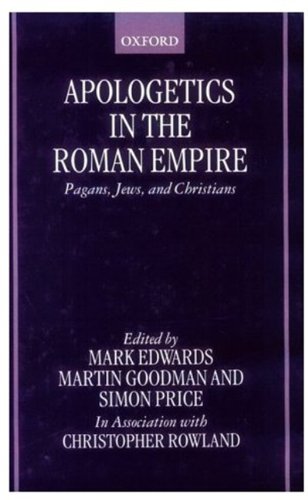
After getting a recommendation from… I don’t remember whom/which book, I picked up Apologetics in the Roman Empire
[T]he style of the ancient apologists has estranged them further from practical apologetic than their contents did in any previous century… The only modern scholars, therefore, to whom the [ancient] apologists [like Justin Martyr, Josephus, Tatian, and the like] mean anything are those who take a sympathetic interest in the culture and the interplay of religious traditions in the Roman Empire… (13, cited below)
Thus, according to the editors of this volume, the “only” reason that anyone would be interested in these works in the modern era is because they wish to explore the cultural understanding of the religious traditions in Ancient Rome.
That makes me quite sad, to be honest! As one who is deeply interested in the study of historical apologetics, it seems clear that much of what is discussed in this volume is actually of interest to modern apologists, those interested in church history, and many others. Of course the editors are perhaps merely speaking only of the interest which they have found for their subject, which speaks of the sorry state of how we modern apologists have abandoned our historic roots. Perhaps these words can serve as a rallying cry to raise us from our stupor of historical ignorance and realize the vast, untapped wealth of historical apologetics.
I have written to that end in a post in which I discuss the lost defenses of Christianity. Explore, take, and read!
The book itself has much appeal for those interested in historical apologetics. I’m about halfway through right now and have found it to be quite excellent.
Links
Be sure to check out the page for this site on Facebook and Twitter for discussion of posts, links to other pages of interest, random talk about theology/philosophy/apologetics/movies and more!
Sunday Quote– If you want to read more Sunday Quotes and join the discussion, check them out! (Scroll down for more)
On the Shoulders of Giants: Rediscovering the lost defenses of Christianity– I have written on how we may discover these enormous resources historical apologists have left behind for us. Take and read!
Source
Mark Edwards, Martin Goodman, and Simon Price, eds., Apologetics in the Roman Empire
SDG.
Really Recommended Posts 10/24/14- Reconciling in Christ, Walking Dead, and more!
 Hello friends! I have another set of links for you to peruse. As always, let me know what you think of the links and if you enjoyed them, leave a comment on those blogs! Thanks for stopping in and reading!
Ambassadors for Reconciliation– There has been much ire flying around over the director of the theistic evolutionist group Biologos’ invitation to creationists like Ken Ham to have dinner and talk over the issues. Here, Hugh Ross reflects upon the extreme reactions of some and the ways we can work towards reconciliation. One quote in particular is helpful:
Enough is enough. There are mission fields still to be reached. How can we ask nonbelievers to dialogue with us if we cannot graciously dialogue with one another, if we treat one another as enemies? Unless we make some progress in reconciling our differences, how can we expect to help reconcile a skeptical world to Christ? We are commissioned by God to be His ambassadors. It’s time for us to start behaving as ambassadors.
I think this is spot on. I have personally been accused by a number of those who disagree with me of being a vile compromiser, someone who is actively leading people away from Christ, etc. If this is how we treat fellow believers, why should those who do not yet believe think that we will be capable of honest dialogue with them? Let’s stop the insults and start genuine dialogue. Let us show one another charity.
When Humans Lose their Humanity: “No Sanctuary” and the real Horror of Terminus– What happens when humans are dehumanized? Here’s an interesting look at ‘The Walking Dead’ which explores this question in deeply insightful ways.
Do we really need to teach our kids apologetics when God is in control anyway?– Here’s an excellent post on the need to educate our children in the Christian faith. Unfortunately, some think that we shouldn’t bother because God is in control. How might we answer this?
Is the Shroud Evidence for God’s Existence?– I have a number of friends in apologetics who are convinced that the Shroud of Turin is genuinely the image of Christ. I am personally unconvinced, but I found this article on it interesting for analyzing what we should make of the Shroud, were it to prove genuine.
Intersections: Summit on Origins– I’m going to be at this conference hosted by Bethel University. It’s on the origins debate, a topic of great interest to me. If you’re able to make it, I’d love to see you there! Let me know!
Microview: “Ancient Near Eastern Thought and the Old Testament” by John Walton
 John Walton’s Ancient Near Eastern Thought and the Old Testament
The book is chock full of quotations from various documents from the ANE set alongside each other with comparative insight from Walton. It is organized in such a way that ANE thought is analyzed in regards to religion, cosmos, and people, with subdivisions of each. Throughout the text there are sidebars comparing what is being studied to the Old Testament, thus revealing many insights into the meaning of key OT texts. Walton’s approach is even-handed and fair.
I’d honestly say this might be the most interesting scholarly book I’ve read. I cannot recommend it highly enough.
Links
Be sure to check out the page for this site on Facebook and Twitter for discussion of posts, links to other pages of interest, random talk about theology/philosophy/apologetics/movies and more!
Source
John Walton, Ancient Near Eastern Thought and the Old Testament
SDG.
——
The preceding post is the property of J.W. Wartick (apart from quotations, which are the property of their respective owners, and works of art as credited; images are often freely available to the public and J.W. Wartick makes no claims of owning rights to the images unless he makes that explicit) and should not be reproduced in part or in whole without the expressed consent of the author. All content on this site is the property of J.W. Wartick and is made available for individual and personal usage. If you cite from these documents, whether for personal or professional purposes, please give appropriate citation with both the name of the author (J.W. Wartick) and a link to the original URL. If you’d like to repost a post, you may do so, provided you show less than half of the original post on your own site and link to the original post for the rest. You must also appropriately cite the post as noted above. This blog is protected by Creative Commons licensing. By viewing any part of this site, you are agreeing to this usage policy.
Do Young Earth Creationists Advocate Appearance of Age?
Young Earth Creationists (hereafter YEC or YECs) sometimes make the claim that the reason the universe is found to be so ancient by modern science is because it merely appears to be that old. I myself actually held to this view for a while when I was holding young earth creationism in tension with the evidence I observed.
I have been challenged in the past (for example, in the comments here) to provide evidence to show that this a claim made by anyone other than the “YEC in the street,” so to speak. That is, some YECs have told me that no serious YECs (that is, those who are publishing or working with the larger creationist think-tanks) make this argument.
Published Claim
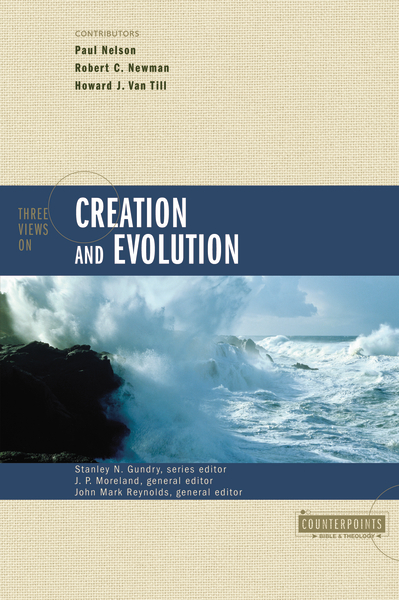
In the past I appealed to various online sources to show that, for example, the Institute for Creation Research makes this claim. I recently finished reading Three Views on Creation and Evolution
Some suggest God could have created starlight in transit to the earth. Perhaps most of cosmic history is apparent rather than actual. (52, cited below)
Initially this may not seem like a claim of “appearance of age,” but the authors go on to defend the plausibility of this “apparent” cosmic history and age of the universe:
…[Perhaps] God needed such a[n ancient appearing] creation to sustain life on earth. It might be necessary to have the universe the size and shape that it is in order for life on this planet to survive… God would have no real motive to ‘actualize’ most of cosmic history… ‘Apparent’ history in the mind of God could not be any different than ‘actual’ history… He would gain a fully functioning universe, but without the ‘waste of time’ needed to actualize the less interesting parts. (52-53)
From these quotes, it is obvious that Nelson and Reynolds are defending the notion of apparent age.
Problems for Young Earth Creationists
The notion of apparent age raises a number of issues for YECs. First is the common charge that this turns God into a deceiver. Nelson and Reynolds anticipated this objection and answered by using an analogy of someone’s mother refinishing an antique chair which would make it appear new. The only deception in this case, the authors argue, would occur if the mother failed to correct someone if they commented on the brand new chair. Similarly, God has provided a “label” to show the universe is not ancient: the Bible.
There are a number of problem with explanations like this one: first, in the case of the chair, further investigation would demonstrate it is not brand new. After all, antique dealers know the value of chairs which have not been tampered with by refinishing! We are able to discover whether additional layers of paint or finishing have been applied over the surface of a chair; similarly, we are able to discover whether things which initially appear young may indeed be quite old. The analogy itself breaks down. Second, the argument begs the question. After all, apart from YECs, those Christians who are asserting the universe is really billions of years old also claim that the Bible does not limit the age to only a few thousand years. This is the reason the challenge of “apparent age” comes up to begin with! So to turn around and say, no, it’s not deception because the Bible says it is young is to merely assert that which is being challenged.
Briefly, one might also wonder why Nelson and Reynolds think God “wasted time” in taking 7 days creating. Their dismissal of, say, star formation as something “less interesting” is frankly astonishing. Would that I could go back in time to see these “less interesting” events!
Another difficulty for the YEC comes in the form of a dilemma: Do you advocate a scientific understanding of young earth (and thus read science into the text) or argue for appearance of age (and thus grant that the Earth appears ancient)?
Think about that line for a moment. If YECs wish to affirm their position, they must either come up with a rival scientific understanding of the age of the universe and therefore read that scientific understanding back into the text (after all, where does Flood geology come from?–certainly not the text of the Bible!) or they must acknowledge the evidence that the universe is indeed quite ancient and merely assert that the evidence is trumped by their understanding of the Bible. The “appearance of age” argument grants that the universe indeed does provide evidence for being quite ancient.
Conclusion
Appearance of age is indeed part of the YEC quiver of arguments, as I have demonstrated. The question is, can this actually save YECs from an inconsistent view? I have argued that it does not. But even if YECs drop the “appearance of age” argument, they must still do that which they often attack others for doing: reading science back into the text of Genesis 1. If you’re a YEC, I hope you will think seriously before using the argument from “appearance of age.” But I also hope you’ll think seriously about whatever your alternative theory for the history of the universe might be. How much of it is actually derived from the pages of Scripture? How does your theory fit the Genesis account? Remember, there are other possibilities out there.
Links
Be sure to check out the page for this site on Facebook and Twitter for discussion of posts, links to other pages of interest, random talk about theology/philosophy/apologetics/movies and more!
Origins Debate– Check out all my posts on the discussion within Christianity over the duration and means of creation.
Source
Paul Nelson and John Mark Reynolds, “Young Earth Creationism” in Three Views on Creation and Evolution
SDG.
——
The preceding post is the property of J.W. Wartick (apart from quotations, which are the property of their respective owners, and works of art as credited; images are often freely available to the public and J.W. Wartick makes no claims of owning rights to the images unless he makes that explicit) and should not be reproduced in part or in whole without the expressed consent of the author. All content on this site is the property of J.W. Wartick and is made available for individual and personal usage. If you cite from these documents, whether for personal or professional purposes, please give appropriate citation with both the name of the author (J.W. Wartick) and a link to the original URL. If you’d like to repost a post, you may do so, provided you show less than half of the original post on your own site and link to the original post for the rest. You must also appropriately cite the post as noted above. This blog is protected by Creative Commons licensing. By viewing any part of this site, you are agreeing to this usage policy.
Question of the Week: Favorite Non-Bible Book on Jesus
Each Week on Saturday, I’ll be asking a “Question of the Week.” I’d love your input and discussion! Ask a good question in the comments and it may show up as the next week’s question! I may answer the questions in the comments myself.
Jesus the Christ
I try to make sure I’m reading one book on Jesus in my rotation of books all the time. That said, I’m starting to run low on books on Jesus. Thus, why not ask you, dear readers, for some more reading materials?
What’s your favorite non-biblical book on Jesus?
Is it an apologetics book? A work on Christology? What topic is your favorite? Let me know in the comments.
Links
Be sure to check out the page for this site on Facebook and Twitter for discussion of posts, links to other pages of interest, random talk about theology/philosophy/apologetics/movies and more.
Question of the Week– Check out other questions and give me some answers!
SDG.
Book Review: “Theology and Contemporary Critical Theory” by Graham Ward
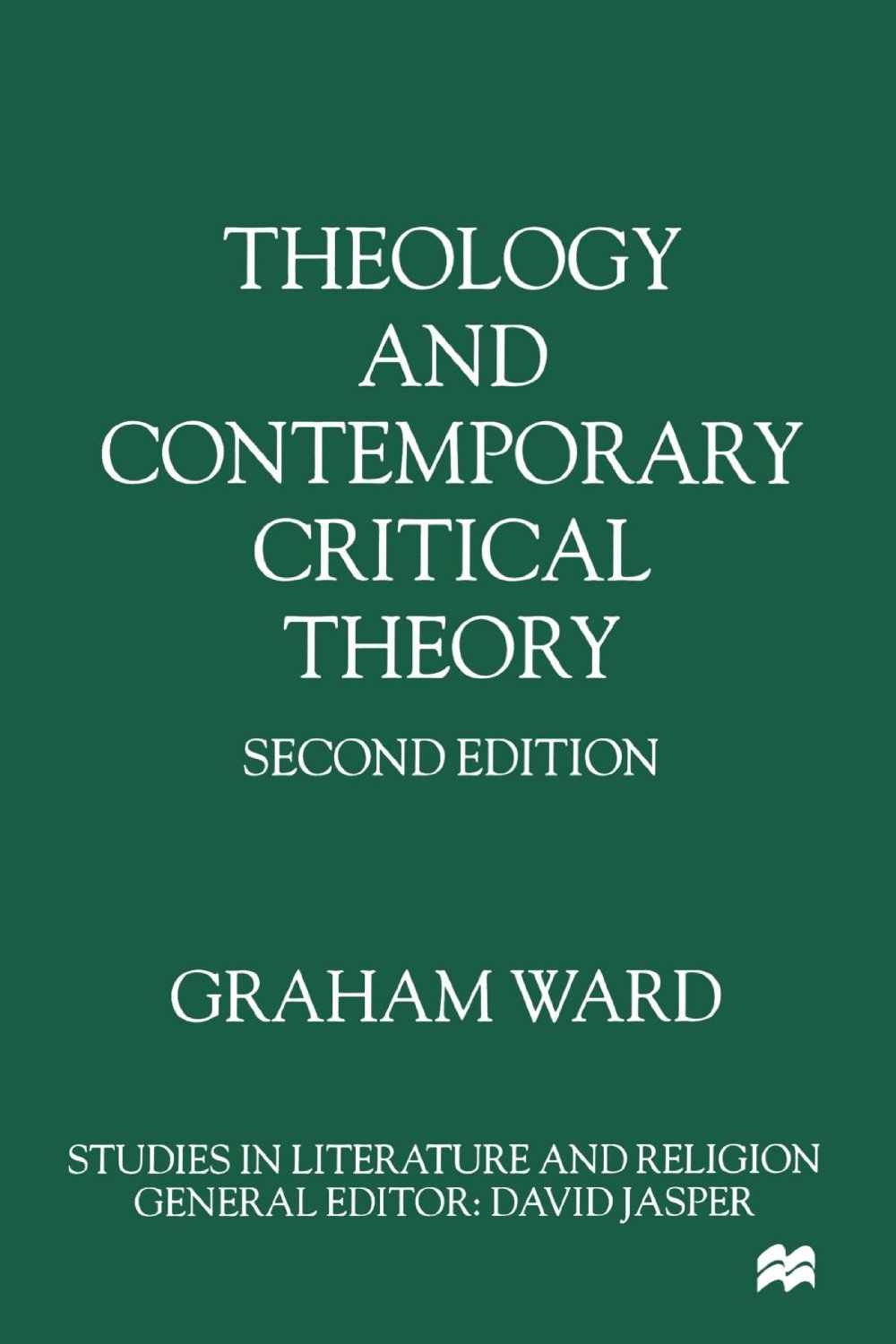
There is no conceivable limit to what critical theory cannot comment upon, nor what form that comment can take. Every discipline and cultural phenomenon is swept into its purview… (xviii)
Graham Ward, in Theology and Contemporary Critical Theory, seeks to bridge a gap between critical theorists and theologians. Critical theory is essentially various ways to look at how discourse is practiced through the means of socio-cultural factors. Yes, this is a simplified definition, but at its core critical theory engages with various practices of discourse in order to draw out the implications for how the conclusions may be reached. It calls into questions those conclusions by pointing out there may be more to the story.
In order to explore critical theory, Ward outlines the thinking of various contemporary theorists under representation, history, ethics, and aesthetics. These topics are each interesting in their own ways, and readers will be often surprised at the turns critical theorists take. Much of the thinking involved here is of interest, sometimes as much for how wrong it seems as for how enlightening it may be. There are some very weird findings from critical theorists, who are often involved in psychoanalysis and other projects to draw out the alleged sources of purported evidence.
Ward ends each chapter with insights into how the theories discussed may be applied to thinking about theology today. These conclusions are highly fruitful, as they demonstrate how even some approaches which seem at odds with Christianity in whole or in part may help shape theological thought. For example, issues of gender loom large and Ward suggests that critical theorists have jumped ahead of theologians in their thinking on the topic through explorations of how concepts of gender are formed. Whatever one’s thoughts regarding gender, it is true that theologians may do well to explore this topic further, whether from a critical (!) perspective or not.
One area readers may fault the work is that Ward, while engaging critical theory, is rarely critical himself. That is, he seems to adopt the findings (if psychoanalysis of entire fields of research may be called findings) of critical theorists without himself having a critical eye towards these same. However, that would be to try to make the book into something it is not. Ward’s project is to simply present critical theory and see how it might be applied to theology. That said, it would have been nice to have a chapter which engaged these theories. Those interested in the book should be aware that it really is the case that Ward essentially just reports on the theories and comments upon how theology might benefit from them.
Again, critical theory is far more complex than outlined above, but Ward has set for himself the monumental task of distilling it and applying it to theology, another field which he stresses touches upon all aspects of human life and experience. As such, readers should realize that although this book is engaging and compelling, there is far more work which can and should be done in this area.
Links
Be sure to check out the page for this site on Facebook and Twitter for discussion of posts, links to other pages of interest, random talk about theology/philosophy/apologetics/movies and more!
Source
Graham Ward, Theology and Contemporary Critical Theory (New York: St. Martin’s Press, 2000).
SDG.
——
The preceding post is the property of J.W. Wartick (apart from quotations, which are the property of their respective owners, and works of art as credited; images are often freely available to the public and J.W. Wartick makes no claims of owning rights to the images unless he makes that explicit) and should not be reproduced in part or in whole without the expressed consent of the author. All content on this site is the property of J.W. Wartick and is made available for individual and personal usage. If you cite from these documents, whether for personal or professional purposes, please give appropriate citation with both the name of the author (J.W. Wartick) and a link to the original URL. If you’d like to repost a post, you may do so, provided you show less than half of the original post on your own site and link to the original post for the rest. You must also appropriately cite the post as noted above. This blog is protected by Creative Commons licensing. By viewing any part of this site, you are agreeing to this usage policy.
Alvin Plantinga, the Compromiser?- A Call to Christian Charity in Disagreement
 The young earth creationist Ken Ham of Answers in Genesis recently wrote a blog post critiquing eminent Christian philosopher Alvin Plantinga on a number of levels. I’d like to offer a brief analysis of his comments.
Calvin College
Ken Ham doesn’t like Calvin College, where Plantinga once taught. About the school, he says:
Calvin College in Grand Rapids, Michigan, is one of the most ardently compromising Christian Colleges in the US that continues to lead so many young people astray in regards to the authority of Scripture beginning in Genesis.
Harsh words! Of course the reason that Calvin College is said to be a “compromising” college is because it doesn’t follow Ken Ham’s specific interpretation of Genesis as a necessity of Christian faith. By not holding to a position that the Earth is only about 6000 years old, Calvin College gets added to the blacklist of “compromisers.” This kind of name-calling is unbecoming Christians, but that unfortunately hasn’t stopped Ham and his followers.
Plantinga and Science
Ham takes issue with Plantinga’s words on whether science and Christianity may coexist. Following the link to read Plantinga’s own words, one reads:
[Those who believe in a conflict between science and faith] are thinking of evolution plus naturalism, which is the idea that there isn’t any such person as God or anything like God … evolution doesn’t say anything about whether there is such a person as God or not…It’s a metaphysical add-on they are importing into the scientific notion of evolution.
Ham believes that because of this, Plantinga is “equivocating” science and evolution. However, it can hardly be argued that evolution is not the reigning paradigm in biology. Thus, it is not so much equivocation as it is using terms as they are commonly understood. But that aside, the key point is that Plantinga surely seems to be correct. If one does not pair metaphysical naturalism with evolution, it poses no challenge to the existence of deity.
Charity
Now, the nuances of whether evolution may be reconciled with Genesis or not aside, the real question is the appropriateness of name-calling because other Christians believe in a different interpretation of Genesis. Ham wants to keep the focus on the alleged “utter contradiction” between evolution and Genesis, but he does so by elevating his specific interpretation of the Bible above any other view and even above Christian charity. For Ham, there is no need to engage with fellow Christians in a meaningful manner. Instead, he simply dismisses fellow Christians as compromisers and sees that as enough for his followers to ignore any complexities in the debate.
Of course, going back to the issue that Ham wants to frame: the alleged conflict between science and religion, I think that it is vitally important to allow charity in interpretations of Genesis. God’s word is infallible, but human interpreters are not infallible. Instead of lashing out at other Christians because they hold a different view than we do, perhaps we should work to reconcile with and learn from each other.
Ken Ham’s post is just a single example of the constant stream of vitriol spilled out by certain groups against those with whom they disagree. I myself have been called a compromiser, an unbeliever, a follower of Satan, someone who is working to undermine the faith, etc. by people who disagree with me. Why not start the discussion rather than pouring out insults? Why not seek to work together and, if necessary, debate the issues instead of using such nasty language about others?
Links
Be sure to check out the page for this site on Facebook and Twitter for discussion of posts, links to other pages of interest, random talk about theology/philosophy/apologetics/movies and more!
Christian Philosopher Says Science Doesn’t Oppose Faith– Read Ken Ham’s post for his own perspective and words on the topic.
I do not own rights to the image of Alvin Plantinga. I found it with an image search and could not find any original rights attribution. I am using it under fair use.
SDG.
——
The preceding post is the property of J.W. Wartick (apart from quotations, which are the property of their respective owners, and works of art as credited; images are often freely available to the public and J.W. Wartick makes no claims of owning rights to the images unless he makes that explicit) and should not be reproduced in part or in whole without the expressed consent of the author. All content on this site is the property of J.W. Wartick and is made available for individual and personal usage. If you cite from these documents, whether for personal or professional purposes, please give appropriate citation with both the name of the author (J.W. Wartick) and a link to the original URL. If you’d like to repost a post, you may do so, provided you show less than half of the original post on your own site and link to the original post for the rest. You must also appropriately cite the post as noted above. This blog is protected by Creative Commons licensing. By viewing any part of this site, you are agreeing to this usage policy
Sunday Quote!- Tourism, Borders, and the “Other”
 Every Sunday, I will share a quote from something I’ve been reading. The hope is for you, dear reader, to share your thoughts on the quote and related issues and perhaps pick up some reading material along the way!
Tourism, Borders, and the “Other”
William Cavanaugh is a favorite of mine due to his fantastic book, The Myth of Religious Violence. I had the chance to snag a more recent book of his, Migrations of the Holy
The artificial preservation of local identities is essential to tourism. In other words, the tourist represents both the attempt to transcend all borders and identities and the simultaneous attempt to fix the identities of non-Western subjects within its gaze. (79, cited below)
Cavanaugh’s point is in context of a broader discussion on migrant, tourist, pilgrim, and monk, and he acknowledges complexity to each of these categories. His point is that, in a sense, the very act of tourism both attempts to break down barriers (by going to the “other”) and also necessitates barriers (by upholding and even romanticizing or denigrating the concept of the “other”). It’s an interesting thought which makes one wonder about how we should live our lives in an increasingly “global” world.
How might we live our lives in the world in such a way as to avoid making the “other” into an object for our observation? How can we become “pilgrims” in a world which increasingly demands tourism? How can we sanctify a world which seeks to build barriers?
Links
Be sure to check out the page for this site on Facebook and Twitter for discussion of posts, links to other pages of interest, random talk about theology/philosophy/apologetics/movies and more!
Sunday Quote– If you want to read more Sunday Quotes and join the discussion, check them out! (Scroll down for more)
Book Review: “The Myth of Religious Violence” by William T. Cavanaugh– I review the book which has led me to discuss the ways the category of religion is used to stigmatize the other and also forced me to rethink a number of issues. I highly recommend this book.
Source
William Cavanaugh, Migrations of the Holy
SDG.

 J.W. Wartick - Reconstructing Faith