christian
Really Recommended Posts 10/10/14- Game of Thrones, Abortion, Joshua, and more!
 Another week, another look at some of the most interesting posts on the web. Here we have posts on the Game of Thrones and Philosophy, Joshua 10 and the meaning of the sun standing still, creationist Ken Ham, abortion, and ways your kid might be learning an oversimplified faith. As always, I’d love to read what you think of the posts! Be sure you leave a comment when you go visit to let the authors know your own insights. We have an owl post edition today because it’s cold.
6 Ways You May Be Raising Your Kids with an Oversimplified Faith– We are charged with raising our children in the faith. That doesn’t apply only to parents, but to the entire Christian community. How might we combat the simplistic image of faith that many children have? Check out this great post (and site) from Natasha Crain, and be sure to follow the site for some awesome posts on Christian teaching for children.
Biblical Credibility and Joshua 10: What does the text really claim?– Joshua 10–the passage about the sun ‘standing still’ in the sky has long drawn criticism from non-Christians for various reasons, primarily scientific inaccuracy. Here, eminent scholar John Walton (seriously one of my favorites) explains the text of Joshua 10 in light of other Ancient Near Eastern literature and the way it would have been understood in its time.
Scott Klusendorf Defends the Pro-Life View on the Unbelievable? Radio Show– Recently, Scott Klusendorf–a wonderful pro-life teacher and advocate–debated Mara Clarke on the subject of abortion. It was interesting to listen to this debate and see how the sides played out their arguments. Check out this post to get summary and commentary on the debate.
“You Win or You Die” (from Game of Thrones and Philosophy)– Whatever your view of the appropriateness of “Game of Thrones” (and we must note there is much objectionable content in it), there is no denying its current popularity. Check out this post from Anthony Weber which discusses some issues related to the philosophy of the series.
The Never-ending Debate: Ken Ham’s Obsession with Bill Nye– Some time ago, Ken Ham debated Bill Nye on evolution, the age of the earth, and more (see my summary and commentary on the debate here). Ken Ham has not let this public debate sit, and continues to utilize it to produce creationist material and muster the troops, so to speak. Is this a bad thing? Is it helpful? Let’s here your thoughts. Here is a post analyzing some recent trends in his organization regarding Bill Nye.
“The Monuments Men” – An Apologetic of Culture
 “The Monuments Men” is a film based on a true story of a group of soldiers sent to salvage cultural artifacts from destruction by the Nazis. Here, we’ll analyze the film from a worldview perspective. There will be SPOILERS in what follows.
Aesthetics
One question the film puts front and center is this: “Of what value is art?”
The question is put in a number of poignant ways, such as a moving scene in which Donald Jeffries is killed in an effort to protect Michelangelo’s Madonna and Child. The scene is powerful because Jeffries finds his value in his efforts to defend and preserve this beautiful art. He writes a letter to his father about the value of defense of such a work of art, which is overlaid with the imagery of him being killed by a Nazi officer.
Claire Simone works against the Nazis to try to protect and preserve the ownership of art. Her recognition of the importance of these pieces of history to those who collected them is a recognition of the power of the human mind to transcend the mundane.
The power of art to shape humanity, or even become a monument to humans–a way to transcend–is front and center throughout the film. The question that is then begged is this: if the natural world is all which exists, whence the transcendence? Where or to what might the transcendence point?
History and Life
History is important aspect of human life. Long have various cultures held notions that if one’s name were erased from historical record, it was as if one never had existed. The driving force to be remembered is a powerful one in human life, but perhaps it is also something which drives us towards art.
By collecting the art and stealing the works from their rightful owners, the Nazis were essentially attempting to rewrite history and capture the cultural past of those who owned or produced the art. There is a powerful message behind this of the need to be aware of how history is shaped by even those who are writing it.
Argument from Aesthetics?
How is it that humans recognize the value of art, or, more abstractly, of beauty? Some would allege that it is merely something we assign to things. The value is entirely a construct. In some ways that seems true, but there is something inherent in the notion that beauty–that art–is something which it is a great evil to destroy or take from someone else. Beauty is in the eye of the beholder, but it is also something which points beyond itself, to the transcendent.
The very possibility for recognizing that which is beautiful itself cries out for explanation. Whence the need for, dedication to, and recognition of beauty? A Christian would point beyond these towards God. Without the actual existence of the transcendent, there is little possibility for explaining the capacity for humans to reach out and grasp it.
Conclusion
“The Monuments Men” is a very solid flick to explore from worldview perspectives. It’s not as action-packed as most war movies, but it is more thoughtful and because of that it is in many ways more compelling. Perhaps most interestingly, it offers a view of the arts as something concrete, to be appreciated, and perhaps even transcendent.
Links
Be sure to check out the page for this site on Facebook and Twitter for discussion of posts, links to other pages of interest, random talk about theology/philosophy/apologetics/movies and more!
SDG.
——
The preceding post is the property of J.W. Wartick (apart from quotations, which are the property of their respective owners, and works of art as credited; images are often freely available to the public and J.W. Wartick makes no claims of owning rights to the images unless he makes that explicit) and should not be reproduced in part or in whole without the expressed consent of the author. All content on this site is the property of J.W. Wartick and is made available for individual and personal usage. If you cite from these documents, whether for personal or professional purposes, please give appropriate citation with both the name of the author (J.W. Wartick) and a link to the original URL. If you’d like to repost a post, you may do so, provided you show less than half of the original post on your own site and link to the original post for the rest. You must also appropriately cite the post as noted above. This blog is protected by Creative Commons licensing. By viewing any part of this site, you are agreeing to this usage policy.
Constantine’s Faith and the Myth of “Constantine’s Takeover”
 There is a narrative within some branches of Christianity (and some… “offshoots”) regarding church history. It is a narrative in which Constantine is seen as the great evil (whether intentionally or not) which corrupted Christianity. The narrative basically goes like this: Constantine rose to power, then everything went wrong in Christianity. He made Christianity the state religion, which introduced scores of nominal Christians into the church. He made service in the church a well-paying position, which corrupted the office of the ministry. He himself was probably not even a Christian!
So the story goes. Is it accurate?
From Narrative to History
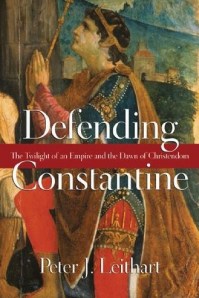
The question of Constantine is one of history. Too often, people have subjected Constantine to psychoanalysis, analyzing an ancient historical figure’s mental state to determine his motives. Historical study may indeed speculate about such things, but to suggest, as some do, that one may uncover some nefarious ancient plot to take over Christianity and lead it into heresy is to engage in writing historical fiction. So what may we actually learn from the historical accounts? Peter Leithart’s work, Defending Constantine: The Twilight of an Empire and the Dawn of Christendom 
Leithart notes that it seems clear that Constantine actually paid much deference to Christianity (Leithart, 93; 121ff; 128-129; 326-328, etc., cite below). He was keen to prevent major divisions within the Church which could have resulted, for example, from the Arian controversy. Hence, he called a council at Nicaea which would define Christian orthodoxy for centuries to come. Constantine himself likely favored the view of Arius, but when the Nicene Council ultimately came against Arianism, Constantine submitted to the defining of orthodoxy.
Constantine’s life appears to be one not of a plot to take Christianity over for political gain, but rather as a life lived struggling with newfound faith and attempting to integrate that faith into public policy. Alister McGrath notes that Constantine’s faith led him to legalize Christianity and sanction it, with some interesting and perhaps unforeseen side-effects:
The new imperial status of Christianity meant that its unity and polity were now matters of significance to the state. (McGrath, 139, cited below)
The much-discussed question of why, if Constatine’s faith were genuine, he would have waited until his deathbed to get baptized is easily answered by his belief that he should wait until the last possible moment to gain the purifying from sins which baptism would provide (Leithart, 299-300).
Frankly, the more one reads about Constantine, the more difficult it becomes to imagine him as someone whose faith was not genuine. Like any Christian, he had his faults–he was a sinner-saint–but he also worked through his position to try to spread and unite Christianity. Leithart notes that many of Constantine’s laws were “more often Christian in effect than in intent” (304). What he means by this is that many laws he made spring from a Christian worldview, though not being explicitly Christian themselves. For example, he outlawed gladiator shows–hardly something which can be said to be explicitly Christian–and this demonstrated Constantine’s genuine concern for human life and the “image of God” in humanity which was noted in yet another law he made (303-304).
In another work, a collection of essays on Apologetics in the Roman Empire
[The work] reveals an emperor who was able to give more substance to his faith than many clerics, and an apologist whose breadth of view and fertile innovations make it possible to mark him with the more eminent theologians of his age (275).
It’s time to set aside the notion that Constantine was somehow “faking it.”
 Constantine’s Takeover?
The “narrative” of Constantine has, unfortunately, often dipped into the notion that he was indeed a Pagan who overthrew traditional Christianity and condemned Christianity to political power-plays for centuries after his death. This notion simply does not line up with historical reality. Although Constantine’s enriching of the church’s coffers did lead to church positions becoming a political gain, it also provided a counter-balance to Imperial authority (Leithart, 304).
Moreover, Leithart argues that the notion that Constantine himself brought about so many wrongs to the church is historically fictitious: “[T]here was a brief, ambiguous ‘Constantinian moment’ in the early fourth century, and there have been many tragic ‘Constantinian moments’ since. There was no permanent, epochal ‘Constantinian shift'” (287). Indeed, the notion of church and state was something found seeded in Augustine’s writings (286) and although Constantine did bring about some monumental changes, the effects they had could only take place over vast amounts of time. It would be impossible to argue that the Catholic Church of the Medieval Period was directly the same or even the exact result of Constantine’s policy.
Finally, Constantine’s policies and actions “Baptized Rome” (Leithart, 301ff). He built churches, empowered bishops, called for unity, and deferred to church teaching. His laws, as noted above, were rooted in a genuinely Christian worldview and sprung from faith.
Conclusion: Defending Constantine
Was Constantine a perfect human? Obviously not. But was Constantine a Pagan who dramatically undermined Christianity; was he a usurper of the Church’s authority who did incalculable damage to Christianity? It does not seem so. Whatever your views on the matters, one must contend with strong historical evidence for the genuineness of Constantine’s faith. His policies indeed may have (and at points certainly did) damage the church, but was that his intent? Again, psychoanalysis of ancient figures is dubious, but the actions Constantine took were those of someone with genuine concern for the stability of Christianity. Most telling, perhaps, were his actions that were not explicitly stamped with Christianity but reflective of his background beliefs: by seeking to end violence, help alleviate poverty, and the like, he demonstrated his faith.
Links
Be sure to check out the page for this site on Facebook and Twitter for discussion of posts, links to other pages of interest, random talk about theology/philosophy/apologetics/movies and more!
Sources
Peter Leithart, Defending Constantine: The Twilight of an Empire and the Dawn of Christendom
Alister McGrath, Heresy: A History of Defending the Truth
Mark Edwards, Martin Goodman, and Simon Price, eds., Apologetics in the Roman Empire
SDG.
——
The preceding post is the property of J.W. Wartick (apart from quotations, which are the property of their respective owners, and works of art as credited; images are often freely available to the public and J.W. Wartick makes no claims of owning rights to the images unless he makes that explicit) and should not be reproduced in part or in whole without the expressed consent of the author. All content on this site is the property of J.W. Wartick and is made available for individual and personal usage. If you cite from these documents, whether for personal or professional purposes, please give appropriate citation with both the name of the author (J.W. Wartick) and a link to the original URL. If you’d like to repost a post, you may do so, provided you show less than half of the original post on your own site and link to the original post for the rest. You must also appropriately cite the post as noted above. This blog is protected by Creative Commons licensing. By viewing any part of this site, you are agreeing to this usage policy.
Sunday Quote!- Historical Criticism and What Prophets Would Have Done
 Every Sunday, I will share a quote from something I’ve been reading. The hope is for you, dear reader, to share your thoughts on the quote and related issues and perhaps pick up some reading material along the way!
Historical Criticism and What Prophets Would Have Done
Do Historical Matters Matter to Faith?
[R]edactional analysis is, of course, based on a number of presuppositions about Old Testament prophets and prophecy that cannot be proved, or disproved: (1) that a prophet/editor would not use the same concept or theme in more than one way… (2) that a prophet would not reuse, allude to, or elaborate upon his own (earlier) oracles… and (3) that a prophet would not proclaim anything that was not clearly relevant and perspicuous for his contemporaries ( Schultz 256, cited below)
There is great difficulty with each of these assumptions, as should be clear simply from reading through them. Although each is not necessarily without some merit–surely, for example, it is not an error to think that very often concepts are used in the same ways–the difficulty is when rather than becoming guides for interpretation, these points become areas around which to base limits on the possible meaning of various texts.
The book is full of insights like this throughout, and though I’m still reading through it, I would say I recommend it for the amount of information contained in it, along with the variety of its contents.
What do you think? Are these assumptions valid? How might historical critical methods impact how one reads the text? What presuppositions might be better suited to Christian scholarship regarding prophecy, if any?
Links
Be sure to check out the page for this site on Facebook and Twitter for discussion of posts, links to other pages of interest, random talk about theology/philosophy/apologetics/movies and more!
Sunday Quote– If you want to read more Sunday Quotes and join the discussion, check them out! (Scroll down for more)
Source
Richard Schultz, “Isaiah, Isaiahs, and Current Scholarship” in Do Historical Matters Matter to Faith?
SDG.
Really Recommended Posts 10/3/14- Profanity in the Bible, Earth’s Age, “Uglies” and more!
 Here we have another round of links for your perusal, dear readers. The topics include the age of the Earth (you really must read this), interpreting the Bible, YA Literature, apologetics, and profanity in the Bible. Oh yeah, you read that last one correctly. Check the posts out, and if you liked them be sure to let the authors know. Let me know what you think in the comments here!
Smoking Gun Evidence of an Ancient Earth: GPS Data Confirms Radiometric Dating– People who deny that the Earth really is billions of years old often do so by trying to undercut radiometric dating. But what if we were able to independently confirm radiometric dating? That’s actually what scientists have been able to do, thus confirming the ancient age of the Earth. Check out this post to see the evidence.
What the Bleep does the Bible say about Profanity?– I found this to be a very thought-provoking post on how Christians should think about profanity. I don’t agree with everything here, but it certainly got my brain working. What are your thoughts on this issue? Be sure to read the post, as it gives some great insights.
Uglies, Pretties, and Specials: Scott Westerfield’s Brave New YA World– Young Adult Literature is one way to get our fingers on the pulse of the culture. Here, Anthony Weber (whose awesome site you should follow!) looks at Scott Westerfield’s look into a future in which physical beauty is even more important than it is now.
Are We “Standing Over” Scripture When We Interpret It?– Sometimes, people express concern with the need to read the Bible in its context and work with interpreting a passage. Shouldn’t it all just be clear? Are we placing ourselves over Scripture? Check out this brief post on this concern.
Christian apologetics: Is there, besides current popular approaches, another way to “take every thought captive”?– I have often thought of the need for an integrative approach to apologetics, which looks at the various methods holistically instead of atomistically. Here, someone who seems to favor the presuppositional method looks for the possibility of reconciling various apologetic methods.
The Need for Psychological Apologetics– It is important to realize that psychological issues impact people from all backgrounds. Here, Pastor Matt Rawlings argues that we need to awaken to the need for psychological apologetics.
On Acquiring Books- How to get scholarly books to read
 A recent comment on my blog about how to get one’s hands on a pricey philosophy of religion book without having to fork over the near-100$ price tag got me thinking. I figured I would write this post to give some pointers for how to acquire books (not necessarily own, but get them in-hand) to further one’s study. I will be sharing specific insights for Christian scholarship, but overall this should be useful for anyone looking to read scholarly (or any!) books.
I will explore a number of ways, some of which may be familiar to you, to get these books in order to consume more awesome reading. Be aware: some of these which may seem obvious at first (library) will, I hope, have more insight beyond the obvious.
Please leave comments if you think of something that I’m missing here. As I live in the U.S., this list will have some things which may only be relevant for that. International readers, feel free to share some of your own insights in the comments.
Library
We’ll start with the obvious: use your local library. You’d be surprised what they might have access to. Inter-Library Loan is a great way to get books not immediately available. Often, your local library will have partnerships with university libraries across the nation and they’ll be able to get you that book to read. If you aren’t taking advantage of this, do so. Best of all this will be free! Well, apart from the taxes you pay. So you may as well use the library because you pay for it anyway!
Another thing to look out for is any local seminary libraries. Often, they’ll let you come in and at least sit down and read, and you may even be allowed a guest pass to check books out. It’s worth exploring and the seminary will have a robust collection of philosophy of religion and theology books. I very much recommend this route if at all possible.
E-Books
Look, I know your thoughts because they were mine: “I like the smell of books”; “I like to hold the book in my hand and page through it”; “I don’t want some newfangled device!”
I hear you.
But now, be silent, because I’m going to explain why you should go for e-books and probably spring some cash for an e-reader (or at least get a Kindle app on your smart phone or something!).
1) Shelf space- a constant struggle for we book-a-holics is shelf space. E-books provide a library at your fingertips without needing anything more than a single device.
2) Old books are freely available- Literally hundreds of thousands of books are now public domain, and many are available online for free through places like Open Library. You can access things like historical apologetics books by the “armful” and they’re all free. Beat that.
3) New books are often free- Many publishers cycle through books being free for a day on Amazon. It’s worth your time to check there frequently to see if a book you may want is free. Go off of your wish list and check on Kindle to see if a book might be free, and be aware that these do change fairly frequently. It may be worth signing up for some Facebook groups or e-mail lists about free books so that you don’t miss as many (and find some you didn’t even know about).
4) Major savings on books- Have you been eyeing that 200$ treatise on a topic of interest? Oh look, it’s 50$ on Kindle. Why not save the shelf space and 150$ and just get the Kindle version? This example is extreme, but you can usually save at least a few bucks by getting the e-book version.
5) Reading e-books isn’t as bad as it sounds- Again, I hear you, I resisted for a while. Now that I have my Kindle, though, we’re inseparable. I do miss the smell of books, but the screen looks like the page of a book, and I can highlight and even take notes and bookmark pages. Moreover, it’s lightweight and small so it is easy to carry. Also, imagine that vacation: instead of trying to lug a backpack full of 25 books, you could bring your e-reader and have access to an entire library (I have well over 200 books on mine).
Buy Books
Another obvious instruction, but there is an art to this. That is, pretty much everyone has a limited budget for buying books (if any–I know how that goes!), along with limited shelf space. So it’s not as simple as just saying: “Yeah, go spend that 150$ on that latest book from Brill” (very pricey publisher). Here are some things I’ve done to both discipline myself and acquire books in a more meaningful fashion.
1) Set a clear budget- obviously, without this you either have no way to buy books, or you will buy too many and not eat. Whether it’s 1$ a week and you save up for 50 weeks before you buy that one book or it’s 50$ a week and you’re drowning in books, set a budget.
2) Be aware of space requirements- once more this seems obvious, but try to keep in mind the space books take. If you have limited shelf space (and we probably all do), keep in mind that a 500 pager is going to take up a lot more space than a 150 page book. For that 500 page monstrosity, it might be better to look at E-Books above.
3) Make AND MAINTAIN a wish list- We all have wish lists, but have you thought of this as a way to limit or direct your buying? While browsing through Amazon and throwing things on your wish list, why not also try to think along the lines of expense and need? A good rule is this: leave a book on your wish list for at least 2 weeks before buying. If those two weeks are up and you still really want the book and have budged for it, then it’s more likely it wouldn’t just be an impulse purchase. Another thing to keep in mind is to prioritize your buying: some books we have an idle interest in reading; others are necessary for our research. The one’s in the latter category should almost always trump the former.
Look Into Review Programs
Many publishers are willing to give you free books in exchange for reviews. For example, Crossway has a blog program in which they make available some e-books to bloggers and you can review 2 a month or up to 12 a year. That’s 12 books you both don’t have to buy and also which don’t take up shelf space. Other publishers are often willing to send you books if you contact them. If there’s a new book out that you want to read, try contacting the publisher and offering to review it on your blog if they send you a copy. It’s a mutually beneficial system.
Links
Be sure to check out the page for this site on Facebook and Twitter for discussion of posts, links to other pages of interest, random talk about theology/philosophy/apologetics/movies and more!
SDG.
——
The preceding post is the property of J.W. Wartick (apart from quotations, which are the property of their respective owners, and works of art as credited; images are often freely available to the public and J.W. Wartick makes no claims of owning rights to the images unless he makes that explicit) and should not be reproduced in part or in whole without the expressed consent of the author. All content on this site is the property of J.W. Wartick and is made available for individual and personal usage. If you cite from these documents, whether for personal or professional purposes, please give appropriate citation with both the name of the author (J.W. Wartick) and a link to the original URL. If you’d like to repost a post, you may do so, provided you show less than half of the original post on your own site and link to the original post for the rest. You must also appropriately cite the post as noted above. This blog is protected by Creative Commons licensing. By viewing any part of this site, you are agreeing to this usage policy.
Honoring Giftedness- Women in David Weber’s science fiction
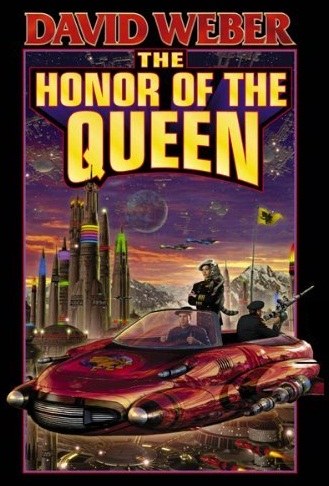 David Weber is the author of a few New York Times Bestselling science fiction series. One, the Honor Harrington series, follows a woman who starts off as a captain of a starship sent on routine (and initially boring) missions. The second book in the series, The Honor of the Queen
The two nations are complementarian in nature. Complementarianism is the theological belief that men and women are “complementary” in roles, which means that men should be in charge in the church and home. I have discussed it and the rival view that women should be ordained/treated as equals (egalitarianism) at length elsewhere [scroll down to see other posts].
What really struck me is that David Weber fairly presented firm theistic believers as a spectrum. In the future, the Christian Church has continued to reform and have splinter groups form because of this. Weber’s presentation of the issue showed that believers–even some who might be considered extreme–can be reasoned with and even persuaded to believe differently based upon evidence. Furthermore, he showed that even those who may line up on the side with which he disagrees are not all (or even mostly) blinded by faith or foolishness. Rather, although there are some truly evil and disillusioned people, Weber shows that many are capable of changing their position or at least acknowledging that rival views are worth consideration.
The most vivid portrayal of this theme is found in a conversation between Admiral Courvosier and Admiral Yakanov. Courvosier is from the same nation as Honor Harrington and wholly endorses his female officer in a position of command. They discuss Captain Honor Harrington:
[Yanakov responds to Courvosier’s question about his society’s reaction to Honor]: “If Captain Harrington is as outstanding an officer as you believe–as I believe–she invalidates all our concepts of womanhood. She means we’re wrong, that our religion is wrong. She means we’ve spent nine centuries being wrong… I think we can admit our error, in time. Not easily… but I believe we can do it.”
“Yet if we do[” Yanakov continues, “]what happens to Grayson [Yanakov’s world]? You’ve met two of my wives. I love all three of them dearly… but your Captain Harrington, just by existing, tells me I’ve made them less than they could have been… Less capable of her independence, her ability to accept responsibility and risk… How do I know where my doubts over their capability stop being genuine love and concern?” (96, cited below)
The exchange is characteristic of the way Grayson’s people are treated throughout the book. They are real people, capable of interacting with other views in honest ways. They feel challenged by a view contrary to their own. Some react poorly, and there are extremists who are blinded by hatred and anger. Yet all of them are treated as people with real concerns shaped by their upbringing and backgrounds.
Honor Harrington ends up saving Grayson, and at the end of the book, she is commended by the rulers of that planet. She talks to the “Protector” [read: king/president] of Grayson:
“You see,” [said the Protector] “we need you.”
“Need me, Sir?” [Responded Honor]
“Yes, Grayson faces tremendous changes… You’ll be the first woman in our history to hold land… and we need you as a model–and a challenge–as we bring our women fully into our society.” (419)
Weber thus allows for even ardent supporters of specific religious backgrounds to respond to reasoned argument and to change. They are capable of interacting on a human level and deserve every bit of respect as those who disagree with them. Again, there are those who are radicals and will not be reasoned with, but they are the minority and they do not win out.
The dialogue presented in this book provides some interesting insight into facets of the present dialogue between complementarians and egalitarians. David Weber’s fictional character presented a challenge to the Grayson’s notions of what it meant to be a woman by being an excellent officer and professional. There are, it seems, real “Honor Harringtons” out there, challenging preconceived notions of what it is to be a woman. When, for example, a woman takes on the role of leadership in the church and succeeds, that should not be dismissed as a fluke, but rather a challenge to a paradigm which may itself be undercutting women’s ability to succeed.
On a personal note, I have been challenged in exactly this way. When I was younger, I was a complementarian and was confronted by a woman who destroyed my presuppositions about what a woman “could do” spiritually. She showed that she could be a leader and present Christ to all without having to fit into role I defined for her. This real challenge caused me to realize that my notions of what a woman “should be” were themselves social constructs, not anything derived from the Bible. Like Yanakov, I had to rethink what my words and actions had done to perhaps limit the women around me. By God’s grace, this woman’s very existence forced me to rethink what I had assumed as truth and go back to God’s word to see where I had gone wrong.
David Weber’s own presentation of Honor Harrington as a paradigm-shattering woman is something that hits close to home for me. For you, dear reader, I think it is worth considering the same: who has challenged your view of what they are “supposed to be”? Is your view of someone’s giftedness directly drawn from the Bible or is it something that you’ve just always assumed? As for me, I think we need more Honor Harringtons in our lives.
Links
Be sure to check out the page for this site on Facebook and Twitter for discussion of posts, links to other pages of interest, random talk about theology/philosophy/apologetics/movies and more!
Check out my posts on egalitarianism (scroll down for more).
Source
David Weber, The Honor of the Queen
SDG.
——
The preceding post is the property of J.W. Wartick (apart from quotations, which are the property of their respective owners, and works of art as credited; images are often freely available to the public and J.W. Wartick makes no claims of owning rights to the images unless he makes that explicit) and should not be reproduced in part or in whole without the expressed consent of the author. All content on this site is the property of J.W. Wartick and is made available for individual and personal usage. If you cite from these documents, whether for personal or professional purposes, please give appropriate citation with both the name of the author (J.W. Wartick) and a link to the original URL. If you’d like to repost a post, you may do so, provided you show less than half of the original post on your own site and link to the original post for the rest. You must also appropriately cite the post as noted above. This blog is protected by Creative Commons licensing. By viewing any part of this site, you are agreeing to this usage policy.
Sunday Quote!- Pragmatic Use of Arguments for God
 Every Sunday, I will share a quote from something I’ve been reading. The hope is for you, dear reader, to share your thoughts on the quote and related issues and perhaps pick up some reading material along the way!
Pragmatic Use of Arguments for God
One of my favorite books on any argument for the existence of God is Caroline Franks Davis’ The Evidential Force of Religious Experience. I re-read it recently and came upon a number of awesome insights I hadn’t even marked the first time (how’s that as a case for re-reading books?)! One pertained to the notion that some theistic arguments might be successful, but not useful when it comes to trying to provide evidence to a skeptic:
Some arguments which have been proposed in favor of theism… suffer so many defects or are so controversial that they do not contribute a great deal to the theistic case. (242-243, cited below)
The point is not that all the arguments which may fall into this category are in fact irrational or mistaken (though some may be!), but rather that the usefulness of the arguments are hampered, in particular, by the controversy surrounding said arguments. The central thrust of her passage here is that some arguments may inspire so much objection (even if reasonable), that bringing them up may not contribute to a dialogue. I think this point is fascinating, though the philosophical side of me cries out saying “But if the argument is sound, why not use it!?” I wonder, however, whether this is the right approach.
Are there some theistic arguments which–apart from their soundness–are simply not useful in the case of presenting an apologetic? Should we base our use of these arguments on their utility in that case, or simply upon the logical soundness of the arguments? Which arguments might fall into this category?
Links
Be sure to check out the page for this site on Facebook and Twitter for discussion of posts, links to other pages of interest, random talk about theology/philosophy/apologetics/movies and more!
Sunday Quote– If you want to read more Sunday Quotes and join the discussion, check them out! (Scroll down for more)
Source
Caroline Franks Davis, The Evidential Force of Religious Experience
SDG.
Really Recommended Posts 9/26/14- Jesus Seminar, atheists and kids, and creationism!
First, I gotta brag: I have a son! He was born 9/17 and he’s just the cutest darling ever. Yay! I’ve been greatly blessed.
Now, I have still put together some awesome posts for your persual, dear readers! Here we have a nice variety of topics from the need to realize the dangers of a hardened heart to the Jesus seminar to talking about atheism with kids (I’m sure this last one won’t be controversial). Check them out and let me know what you thought!
Chemostratigraphy: silent objector to ‘Flood Geology’– Young Earth Creationists often argue that the Noachian Flood is to be seen as the explanation for the layers of sediment we find all over the planet. Can this claim stand up to scrutiny?
Who Were the Jesus Seminar? Should anyone have taken them seriously?– Christians have long faced challenges thrown at the historical faith by historical critics like those in the Jesus Seminar. But should the Jesus Seminar really be (or have been) taken seriously? Check out this post which addresses some issues related to this group.
14 Ways for Christian Parents to Teach Kids about Atheism– How might we as Christians approach the topic of atheism when speaking with children? Natasha Crain provides some much-needed insights into this area. I think this is a must-read even for those who are not parents so that we can think about how to interact in age-appropriate ways.
The Dangers of a Hardened Heart– The heardening of one’s heart presents a number of dangers for both a life of faith and a life without faith. Eric Chabot addresses these dangers in this thought-provoking post.
Is Your View Falsifiable?– Luke Nix points out a number of helpful ideas regarding whether one’s view is falsifiable. Does this matter? Read the post for many insights related to falsifiability and the Christian life.
A Brief Musing on the “Prosperity Gospel” – Psalm 4:6-7
 I have been reading back through the Psalms, because, you know, it’s what the cool kids do. Anyway, I came upon a passage which I thought may have some relevance for the “Prosperity Gospel” teaching (check out this brief summary and critique of this movement):
“Many, LORD, are asking, ‘Who will bring us prosperity?’
Let the light of your face shine on us.
Fill my heart with joy
When their grain and new wine abound.” Psalm 4:6-7 [7-8 in Hebrew Bible]
The text may not immediately seem to have anything to say about the notion that God will grant us ‘health, wealth, and prosperity.’ However, I think it actually does serve as a brief refutation of this alleged “gospel.” I’ll break it down.
Many, LORD, are asking “Who will bring us prosperity?”
There are those who call out to anyone, seeking prosperity rather than seeking after the LORD. Rather than asking the King of the Universe to let His will be done, they seek out prosperity from whatever place it may come. The modern teaching of the “prosperity gospel” is a form of this, but it smuggles in the notion that God is going to provide such wealth to those who ask.
Let the light of your face shine on us.
Rather than asking the LORD for prosperity, the Psalmist David seeks only to have God “shine” on him. Happiness comes from the presence of God.
Fill my heart with joy when their grain and new wine abound.
Here is what I would consider the dramatic turnaround: the first quoted section speaks of how there are others who are seeking after wealth from wherever it may come. Now, David asks from God, the only true provider, to give joy to him even when those who seek such prosperity actually get it.
Thus, we have a very real contrast: those who seek wealth as opposed to those who realize that the rain falls even upon the wicked and so they should rejoice in the light of God’s presence. The difficulty is not purely that the “others” are seeking from others; rather it is that they are seeking prosperity (more literally “happiness”) from God rather than simply rejoicing in God’s presence and Word.
Am I on Track?
I decided to take the time to look up these verses in a commentary after writing the above to see if I may be on the right track. There’s something to be said for the notion that we shouldn’t be doing theology in a vacuum. Samuel Terrien, in his commentary on Psalms from the Eerdman’s Critical Commentary series, argues that Psalm 4 should be seen as an evening prayer, likely even sung in the bedroom/prayed as one was getting into bed. His comments on the relevant passage note that “the poet is… saddened by the discovery of a certain skepticism around [him]… Happiness… which is lacking around him, may be due to a satiety of a materialist kind… For the pious, however, happiness arises from a grateful acceptance of God’s presence” (98-99, cited below).
Again, we see that the problem is that we should be finding our joy in the presence of God rather than material blessings from wherever they may come. Those who seek “health, wealth, and prosperity” are in fact pursuing the latter rather than the former. Psalm 4 should serve as a corrective to the prosperity “gospel.”
Links
Be sure to check out the page for this site on Facebook and Twitter for discussion of posts, links to other pages of interest, random talk about theology/philosophy/apologetics/movies and more!
Source
Samuel Terrien, The Psalms: Strophic Structure and Theological Commentary (Grand Rapids, MI: William B. Eerdmans, 2003).
SDG.
——
The preceding post is the property of J.W. Wartick (apart from quotations, which are the property of their respective owners, and works of art as credited; images are often freely available to the public and J.W. Wartick makes no claims of owning rights to the images unless he makes that explicit) and should not be reproduced in part or in whole without the expressed consent of the author. All content on this site is the property of J.W. Wartick and is made available for individual and personal usage. If you cite from these documents, whether for personal or professional purposes, please give appropriate citation with both the name of the author (J.W. Wartick) and a link to the original URL. If you’d like to repost a post, you may do so, provided you show less than half of the original post on your own site and link to the original post for the rest. You must also appropriately cite the post as noted above. This blog is protected by Creative Commons licensing. By viewing any part of this site, you are agreeing to this usage policy.

 J.W. Wartick - Reconstructing Faith