christian
A Solar System and Cosmos Filled With Life? – A reflection upon Ben Bova’s “Farside” and “New Earth”
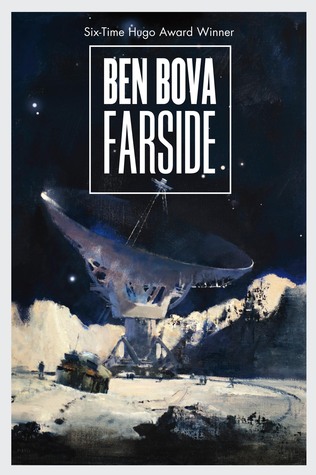
Ben Bova’s contributions to science fiction are monumental. A six-tme Hugo Award winner (!!), he is established as one of the most successful and entertaining authors of our time. I have quite enjoyed a number of his works, though I have at times been critical of his portrayal of religion. Bova’s major series, the “Grand Tour,” follows human exploration of the solar system (and at some points, beyond). The series is constructed in such a way as to not require readers to follow it chronologically. They are interlinked and interrelated, but not interdependent. Here, we’ll look at two recent books in this series which look at the discovery of an Earth-like planet. There will, of course, be major plot SPOILERS for both books in what follows.
Farside
After telescopes on Earth discover an Earth-sized planet relatively local to our own Solar System (ten light years away), the race is on to learn more about this planet. Farside portrays the struggles of a number of people in their efforts to build an observation base on the dark side of the moon. Jason Uhlrich seeks his Nobel Prize in his attempts to be the first to observe and chart the planet.
Life has already been found within the Solar System, and now two rivals rush to be the first to discover it in the great beyond of the stars. What is interesting is to note some of the assumptions that go into Bova’s characterization of life beyond Earth. First, one primary assumption seems to be that where there is water, there must be life. Second, life should be expected in all corners of the universe.
These assumptions are the subjects of much debate within the scientific community around the possibility of life on other planets and the origin of life. Regarding the former, there are those who do believe that life will be found in abundance throughout the universe. After all, given that we exist, life cannot be all that improbable, right? The other primary way of thinking is to argue that life is, in fact, quite rare in the universe and our own existence is a wonderfully improbable jackpot win.
 New Earth
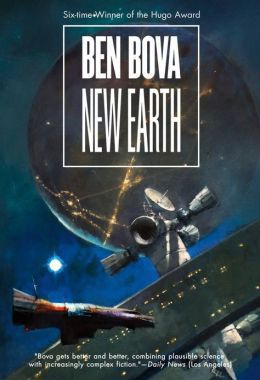
New Earth picks up some time after the events of Farside. Humanity has sent an expedition to “New Earth.” Upon arrival, there is a great mystery: “New Earth” is eerily like Earth itself. It turns out that a machine known as a “predecessor” has created the planet and grown these human-like aliens as a way to break it to humanity that there is, in fact, more intelligent life “out there.” Moreover, there is a catastrophic event coming towards the whole arm of the Milky Way which will wipe out these intelligent species, and humanity needs to help preserve themselves and the other species.
Though skeptical, ultimately all the members of the expedition are convinced, and the book ends with the message reaching Earth and the gearing up to proceed on this mission given by the Predecessor.
Reflection
There are, of course, any number of things that one could nitpick regarding the plausibility of the scenarios Bova envisions (one would be the rewiring of Uhlrich’s brain to “see” via hearing and touch… how does that work?), but here we’ll focus on two aspects of the work: the plausibility of life outside Earth and the mythos of the benevolent alien.
In Farside, readers who haven’t surveyed the body of Bova’s work discover that the Solar System itself teems with life: life once flourished on Mars, and its vestiges remain; on Jupiter, creatures soar in the skies; life is found elsewhere throughout the System. Bova’s vision of the origin of life seems to be that if there’s water, there may be life. Yet one has to wonder about the plausibility of life forming on a planet like Jupiter. How might biochemical interactions with delicate balances of material be maintained for long? What of the distance to the sun? The origin of life requires all kinds of factors to be “just right” and it simply is not enough to fudge the numbers by saying “It could have happened this way.” To develop a hypothesis around ad hoc assumptions is faulty.
Intelligent life, as explicated in New Earth, is even more problematic. It is easier to have single celled organisms than to have the complexity needed for intelligence. Even granting a naturalistic scenario, the conditions must be even more tuned for life and allow for the nurturing of that life for extremely long periods of time. The universe is indeed huge beyond belief but one has to wonder if even that immensity is enough to repeat the conditions which occur on Earth.
Of course, in the end, one must acknowledge that these are tales of science fiction, not proposals about how science fact might be. There is a certain sense of awe and wonder involved in considering whether life could exist all over the Solar System. It seems to me, however, that if that is the case, it probably got there by means of Earth–blown off the surface of our planet by an asteroid and traveled through space to Mars and possibly beyond.
Another major theme found in both books is what I dubbed the “Myth of the Benevolent Alien.” There is a kind of pervasive battle in science fiction between the notions that aliens want us dead or that aliens are going to be ultimately some kind of saviors of humankind. New Earth brings this benevolence front and center: some unknown life form created these “Predecessors” to find and aid intelligent life. It’s a scenario filled with wonder and hope. But it’s also a scenario which I’ve found time and again in materialistic literature.
The way this story goes: wherever possible, life is certain. It’s a kind of appeal to a fantasy of a godless universe wherein it may be possible to find hope and meaning in the stars. As one character (I believe it is Grant) said in Farside: Ad astra! (To the stars!). Second, the actual inherent implausibility of life both leads to this longing (we don’t want to be alone) and to a search for meaning (how did we get here?). My own answer is that theism provides a more plausible explanation of both the longing for meaning, meaning itself, and the way in which life arose. Interestingly, however, the atheistic accusation that theists are engaged in wishful thinking is perhaps mirrored through various declarations made by naturalists themselves (see the post linked above and in the links below).
Bova’s novels thus serve as a way forward in this discussion. By illustrating our longing and loneliness through the fulfillment of our desires (the discovery of life and the notion that we are not alone), Bova grants readers their wishes. However, we ultimately come to realize that these are indeed just wishes. Perhaps, one day, a “New Earth” will be discovered. But even if that happens, it will not be enough to satisfy our loneliness, nor will it answer our ultimate questions. Theism is the ultimate antidote to loneliness, the ultimate answer for our questions.
Links
Be sure to check out the page for this site on Facebook and Twitter for discussion of posts, links to other pages of interest, random talk about theology/philosophy/apologetics/movies and more!
Materialists: Where is hope? Look to the stars!– I analyze one aspect of materialism: the way that some look to hope in the “beyond” of the outer limits of the universe. Hope, for materialists, may come from the stars. Our salvation may lay beyond our solar system, in benevolent aliens who will bring great change and advances to us.
Our Spooky Universe: Fine-Tuning and God- The incredible circumstances which allow for life to exist and thrive on Earth are the cause for not merely fictional speculation, but actual reflection upon our place in the universe and how it might relate to the transcendent. Check out this post which surveys the evidence for the existence of God found in “fine-tuning.”
Sources
Ben Bova, Farside (New York: Tor, 2013).
Ben Bova, New Earth (New York: Tor, 2013).
SDG.
——
The preceding post is the property of J.W. Wartick (apart from quotations, which are the property of their respective owners, and works of art as credited; images are often freely available to the public and J.W. Wartick makes no claims of owning rights to the images unless he makes that explicit) and should not be reproduced in part or in whole without the expressed consent of the author. All content on this site is the property of J.W. Wartick and is made available for individual and personal usage. If you cite from these documents, whether for personal or professional purposes, please give appropriate citation with both the name of the author (J.W. Wartick) and a link to the original URL. If you’d like to repost a post, you may do so, provided you show less than half of the original post on your own site and link to the original post for the rest. You must also appropriately cite the post as noted above. This blog is protected by Creative Commons licensing. By viewing any part of this site, you are agreeing to this usage policy.
Sunday Quote: Do we need to agree with past thinkers?
 Every Sunday, I will share a quote from something I’ve been reading. The hope is for you, dear reader, to share your thoughts on the quote and related issues and perhaps pick up some reading material along the way!
Do we need to agree with past thinkers?
I recently read through Reading Genesis 1-2: An Evangelical Conversation, which has given me a lot to reflect upon. One quote that struck me was from Jud Davis:
A beloved teacher once said, “If you cannot find at least one ancient, one medieval, and one modern commentator who shares your view, it probably means you are wrong.” Over the years, I have thought long and hard about this statement, and I believe it is exactly right because if you could not find such examples, you would be forced to say, “Everyone before missed it until me.” (215)
I thought this was an interesting quote because it says much about how one approaches theological issues. First, there is some concern regarding this passage for me because it seems that some truths are indeed missed by everyone until someone discovers (or rediscovers) them. Second, there is a real concern for whether one innovates in doctrine and thus becomes a heretic. That is, innovation in theology is often divergence from established truths. These established truths are often established exactly because they follow from the text. Thus, an innovation which says, for example, that Jesus is not God is rightly denounced as heretical.
Based upon these conflicting concerns, I think it is permissible to say there is some tension within the practice of historical theology and exegesis. We must be careful to avoid the pitfalls of either ignoring the voices of the past or being too cautious to reconsider the evidence for certain positions. Going to either extreme would be dangerous. The most prominent danger, in my opinion, is the danger of using a passage like this to squelch debate or exploration. Ultimately, the text is the arbiter of truth, not established interpretations. If someone comes up with a “new” look at a text, it is important to consider it on its own terms rather than reject it because it is new. The weight of unanimity in the past should be seen to increase the standard of proof for those who disagree, but it should not be used to silence those who seek truth.
What are your thoughts on the balance between historical scholarship and new interpretations?
Links
Be sure to check out the page for this site on Facebook and Twitter for discussion of posts, links to other pages of interest, random talk about theology/philosophy/apologetics/movies and more!
Source
Jud Davis, “Unresolved Major Questions: Evangelicals and Genesis1-2” in Reading Genesis 1-2: An Evangelical Conversation
Really Recommended Posts 4/4/14- Views on “Noah” and “God’s Not Dead”
 I think it’s important to view a range of perspectives on two of the latest flicks to hit the big screens: “Noah” and “God’s Not Dead.” These films are going to draw religious viewers simply based on their content. How do we approach them? What conversations do we have? Here, I’ve offered a few posts about each film. I’d love to read your own thoughts on either or both of these flicks. Yes, this is an owl post edition because I have a winter storm blowing through right now. So that’s fun. (This is my attempt to keep smiling.)
God’s Not Dead
An Apologist Reviews “God’s Not Dead”– Here, a Christian apologist discusses his viewing of the movie. His overall thought is that though it is at times simplistic, it may help awaken the need for apologetics within the church.
David Baggett Guest Post: “God’s Not Dead”– Noted Christian philosopher David Baggett takes on the film. He’s concerned that the film oversimplifies and caricatures atheists and Christians, without paying enough attention to the thoughtfulness of either.
Personal Comments on God’s Not Dead– Astrophysicist Hugh Ross shared his personal thoughts on the film. He thinks it is worth seeing for Christians, but also has reservations regarding its portrayal of the people involved.
A Christian Philosopher’s Thoughts on “God’s Not Dead”– This is a Christian apologist from a different [presuppositional] perspective offering thoughts on the film. To be fair, he is actually looking at the trailer. Can his comments be valid still? Check out the post and judge for yourselves.
Noah
Darren Aronofsky’s “Noah”– Over at The Gospel Coalition, the flick “Noah” is presented as having numerous issues, but it may start conversations and it also helps show the reality of evil before the Flood. Moreover, the reality of the spiritual realm is something that not enough people think of, but in the film the spiritual reality is very real and powerful.
I’m a Christian and I think ‘Noah’ deserves a four star review– In stark contrast to the above, Matt Walsh rips the film apart and also questions why any Christian leaders would be endorsing it or thinking of it as worthy viewing.
Sympathy for the Devil– In this post, Brian Mattson argues that the film is actually an ingenious way of portraying Gnostic ideas and Kabbalah. Essentially, his view is that the film is very explicitly Gnostic and portrays God as evil and the devil as sympathetic.
No, Noah is not Gnostic– In response to the claims of Gnosticisim, Peter Chattaway argues that one cannot conflate Kabbalah with Gnostic thought. Furthermore, he argues that Mattson gets several plot points and points of comparison wrong.
Both, and Then Some!
Hollywood, Movies, and the Bible: Should We Rewind on How We View?– Darrell Bock shares some thoughts on several recent movies with faith themes in them, such as “Noah” and “God’s Not Dead.” He offers practical advice regarding how one might view films with a discerning eye as well.
Abortion Clinics, Pro-Life Activism, and “Abolish Human Abortion”
 Recently, the Facebook group for the activist group known as “Abolish Human Abortion” shared a note to fellow pro-life activists providing critique and advice. Here, we’ll analyze that post to see how accurately it represents their opponents and what we can take away from how to argue the abortion issue.
I’ll link to the entire post (see above; see it also reproduced in the comments below) so that you can read it for yourself and see if I unfairly represented anything. I’ve also kept a copy of it on file to reproduce it in the comments. I welcome comments so long as they follow my comment policy.
Tone
First, I want to say that I do appreciate some of what AHA has done and continued to do. Many of their posters are helpful (such as the one featured in this post or in my post on Bonhoeffer’s view of abortion), and they provide some solid analysis of the abortion issue from a worldview perspective. No one reading this post should think that everything I think about AHA is negative. I have had positive interactions with AHA in the past and hope, as they do, that one day we can end abortion. I also favor the immediate end of abortion to gradually ending it. My contention is that gradual legislation is actually effective (this claim will be borne out below).
Second, note that any response to me should operate under a fairly similar tone. I have actively worked to end abortion through protest, prayer, writing, and other avenues. I hope that one day we can end abortion. Attacks on me as a person because I disagree with the method of another pro-life group should be seen for what they are: obfuscation.
Third, I will not respond to anything not in the comments here. I simply don’t have time to go actively seeking responses to my posts, so if you have something to say, write it here and please be brief.
Analysis
The author of the note, T. Russell Hunter, begins with a claim: “When hospitals all across America start paying doctors to perform abortions within their walls, it will be the triumphs of pro-life legislation which drove them there.” This claim is that which Hunter contends to support. Let us analyze the rest of the note to see if this claim is borne out therein.
The first piece of allegedly supporting evidence is this: “Passing laws that temporarily shut down abortion clinics because they are not close enough to hospitals only strengthens the abortion industry…”
Think about that claim for a second. First, does it support the claim that hospitals “all across America” will start performing abortions? Second, does it provide any evidence whatsoever? Finally, let’s put this claim in perspective with some facts. Planned Parenthood has said, of the closure of several clinics in Texas [paraphrasing], “…the requirement could leave the state of 26 million people with as few as six abortion centers.” That same article notes how many abortion providers have failed to meet the new requirements put in place by laws in Texas. Think about that: if there are only 6 abortion centers in a state the size of Texas, do you think that the number of abortions will increase or decrease?
Another claim made by Hunter: “Abortion is not health care and we should not be fighting it by passing health-code rules and regulations.”
Given how much AHA likes to parallel ending abortion with the abolition movement, I think it is fitting to point to the way William Wilberforce–who effectively ended slavery in Great Britain–worked against slavery. For some time he tried to get votes passed to outright abolish slavery. Ultimately, however, abolition was assured when a bill was passed forbidding military aid to be provided to slave ships due to the war with France. The move was effectively a sleight of hand because several British ships operated under neutral flags, so the slave trade was crippled and slavery was abolished not long after that. You can see this story beautifully dramatized in the film Amazing Grace.
What does this bit of history tell us? It tells us that such means actually are effective. Thus, when a state like Texas passes new legislation to ensure the heath and safety of women who are at abortion clinics, and those new regulations cause a state with 26 million people to shut down abortion clinics, the pro-life cause does benefit.
Two claims of supporting evidence provided are: “4. Some ‘clinics’ will close, but those remaining will pick up the slack; 5. Shutting down clinics doesn’t halt abortion, it just makes people who choose to sacrifice their children drive further.”
I’d like to ask AHA to provide statistics to back up these claims. Rather than just throwing out speculation that women who choose abortion will just “drive further” (remember, Planned Parenthood is concerned a state like Texas [look at its size on the map!] will go down to just six clinics), back it up. Yet AHA expects us to believe through mere speculation that these women will “drive further.” I wonder what evidence they have to support that. Moreover, the evidence actually counters this claim. (From the article:) “Kansas is one state that is an example of how closing abortion clinics saves lives. Since 2001, every time an abortion clinic closed in Kansas, the number of abortions significantly dropped the following year.” That’s a fact. What has AHA provided to support their claim that closing clinics is not effective?
Unfortunately, the rest of the note essentially follows this same theme. There are a number of claims thrown out there with no evidence. Consider this tidbit: “Do you not see that the abortion industry only gets stronger as they build bigger and better clinics to meet your pro life standards. Do you not see that they (like you) just raise money from their so-called defeats? Have you not come to realized that no matter how many clinics you shut down, millions of babies are still being aborted every year. Do you not see that the devil himself would allow you to take a few pieces off the board so long as he constantly has you in check mate?”
Again, facts speak louder than empty leading questions. The number of clinics closed has not been offset by the number opened. The number is, in fact, down 74% since 1991. And, when clinics close, the number of abortions decreases.
Consequentialism or Pragmatism- Getting it Done?
The main problem with AHA’s reasoning is that they take an all-or-nothing mentality. You can observe that in the leading questions noted above. In particular, “Have you not come to realized [sic] that no matter how many clinics you shut down, millions of babies are still being aborted every year[?]” Yes, it is true that millions are being aborted. However, when pro-life legislation continues to reduce the number of those being aborted, that is cause to say that pro-life views are being furthered. I don’t know of any pro-life organization that’s saying “Hey, we got some clinics to close! Let’s stop working to end abortion!” That’s not how pro-life groups are approaching the issue. However, many of these groups are happy that when clinics close–as they are–the number of abortions decreases.
The fact that AHA is not happy about this says something, I think, about their own mentality when it comes to the issue. AHA demands only legislation which will immediately end abortion. They are seemingly unaware of how historically (as noted above with Wilberforce) working through other means can actually be more effective.
It is this seeming historical illiteracy (see also here) of AHA which worries me enough to make me want to respond to a note like the one I wrote on here. By failing to acknowledge the success of gradualism and, in fact, working against gradualist approaches, AHA is working against facts. Lives are being saved when abortion clinics closed. That’s something anyone who labels themselves “pro life” should celebrate.
Conclusion
AHA has not provided evidence to support the claims made in the note I analyzed. Moreover, several of the assertions made therein are actually contrary to observed facts. AHA seems to be either historically ignorant or willfully obfuscating the way in which abolition was brought about. Although I would also far prefer the immediate end of abortion, I think any who are pro-life should agree that when legislation closes abortion clinics–which lowers the number of abortions and therefore saves lives–it is cause for celebration rather than chastising those who worked to pass the legislation.
I reiterate that I know of no pro-life organization which is saying that the work is done once legislation which may close abortion clinics passes. The work will continue until we have brought an end to abortion. Groups like AHA should stop trying to muzzle those who have actively worked to save lives.
Finally, I admit I wrote this post with a heavy heart and only because I’m deeply concerned with the way that AHA has continued to aim criticism at pro-life individuals or groups which are actively saving lives. I was very excited when I learned about AHA over a year ago but have, unfortunately, felt burdened to caution others away from the group because of the way it continually fails to provide facts to support their attacks on other pro-life persons. We must learn from history and we should celebrate when lives are saved. I long to return to a point where I and AHA could stand together as we work side-by-side to end abortion. Unfortunately, as long as AHA fails to recognize that gradual steps actually do save lives, that day will not come.
Links
Be sure to check out the page for this site on Facebook and Twitter for discussion of posts, links to other pages of interest, random talk about theology/philosophy/apologetics/movies and more!
How Abolish Human Abortion Gets History Wrong– Here, a pro-life individual notes some of the historical errors in evaluating abolition and abortion AHA has put forth. It is worth seeing the response to some counter arguments made by AHA as well.
Abolish Human Abortion’s Revisionist History– Clinton Wilcox provides a more thorough analysis of the use of the term “abolition” and how abolitionists themselves actually worked incrementally to bring about the abolition of slavery.
SDG.
——
The preceding post is the property of J.W. Wartick (apart from quotations, which are the property of their respective owners, and works of art as credited; images are often freely available to the public and J.W. Wartick makes no claims of owning rights to the images unless he makes that explicit) and should not be reproduced in part or in whole without the expressed consent of the author. All content on this site is the property of J.W. Wartick and is made available for individual and personal usage. If you cite from these documents, whether for personal or professional purposes, please give appropriate citation with both the name of the author (J.W. Wartick) and a link to the original URL. If you’d like to repost a post, you may do so, provided you show less than half of the original post on your own site and link to the original post for the rest. You must also appropriately cite the post as noted above. This blog is protected by Creative Commons licensing. By viewing any part of this site, you are agreeing to this usage policy.
Peter Enns on Definitions and Inerrancy
 Not long ago, I finished reading Five Views on Biblical Inerrancy, a book in the Zondervan Counterpoints series which focused on the plausibility and meaning of inerrancy. Peter Enns was by far the most critical of the doctrine of inerrancy, and his essay largely put forward the position that we should not merely modify but simply get rid of the notion of biblical inerrancy. Here, I want to focus upon Enns’ methodology throughout the work.
We’ll look at Enns’ contributions to Five Views… a bit backwards, by focusing first upon his responses to the other authors. What I found was that time and time again, Enns demanded definitions for individual words from the authors he was responding to. Sometimes, these demands were warranted, but overall it seemed Enns would just call on the others to define their terms and say he didn’t know what they meant otherwise. Moreover, even where he did not demand definitions, he often put scare quotes around seemingly random words in his responses. This latter point is more a complaint about writing style than substance, but it was extremely distracting! On p. 61, for example, Enns put quotes around three words–“many,” “history,” and “accurate”–the latter two for seemingly no reason whatsoever.
However, what I want to focus on is Enns emphasis on the importance of definitions. Here are just some examples of Enns’ method in application:
“…’true,’ ‘error,’ ‘erroneously,’ and ‘falsehood’ are all left floating. I am not sure what Bird means by them–at least at this point” (Enns’ response to Bird, p. 182).
“For one thing, we have the perennial problem of what ‘affirm’ actually means, and Vanhoozer’s subsequent thoughts did not clear this up for me. Further, ‘eventually’ raises flags…” (Enns’ response to Vanhoozer, p. 245).
Now, as I noted, surely some of this is fair. It is true that it is important to wonder at the meaning of “truth,” as we know from the oft-quoted words of Pontius Pilate “What is truth?” (John 18:38). Thus, I am not saying that Enns has no point when he called for definitions throughout his critical engagement with his co-authors. Surely, definitions are extremely important. And it is because of the importance of definitions that I wonder why on earth Enns failed to even allow for different definitions of inerrancy in his own contribution to the book.
Think about this for a second: despite spending significant [what is meant by significant?] portions of his responses calling upon definitions from his co-authors, Enns himself titled his contribution: “Inerrancy, However Defined, Does Not Describe What the Bible Does.”
Yes, that’s right, the man who called for definitions of individual words like truth, falsehood, error, affirm, and more himself eschews the hassle of defining inerrancy, the central topic of not just his chapter but the subject of the book! I’m astonished by this. How can someone who has demonstrated such concern for details himself just lump all inerrantists together and say that “well, however they define it, it doesn’t work”? Well, what does Enns mean by “inerrancy”? Enns does interact with the Chicago Statement on Biblical Inerrancy (hereafter CSBI) and apparently takes this for his norm regarding the meaning of inerrancy, but without any explicit definition of inerrancy, readers are left wondering whether Enns really is so concerned with definitions after all.
Enns, of course, brings up a number of interesting points and several challenges to inerrancy with which those who hold to the doctrine must interact. However, without any distinction between inerrantists, Enns is left doing that which he accuses others of: making statements which are hard to understand because he hasn’t defined terms. One obvious difficulty with Enns’ approach comes to the forefront when he assumes that inerrancy is necessarily committed to a literalistic hermeneutic: “The implication [of the CSBI on historical matters] is self-evident: inerrancy means, first of all, that literalism is the default hermeneutic of the CSBI… Taken at face value, this means that any comparison of Genesis with other ancient Near Eastern origins stories… is ruled out of bounds” (88). Enns qualified the last statement by noting that only those comparisons outside of CSBI conclusions are ruled out.
But of course the CSBI itself does allow for the comparison of genre, cultural contexts, and more in regards to interpretation of the text. Moreover, the CSBI allows for not just young earth creationism, but for other approaches to the text as well.
Thus, it seems to me that Enns’ lack of concern for possible nuance to definitions of inerrancy–his rejection of defining terms despite his insistence that others must do so–leads to great difficulties with his own critique. I have not here engaged in the core of Enns’ argument. As I said, many of his points are thoughtful and engaging. However, I think that his method seems a bit disingenuous: he demands that others define terms, but when it comes to the central topic of the entire book, refuses to acknowledge that any distinctions within the doctrine of inerrancy can combat his conclusion that the Bible is not inerrant.
Links
Be sure to check out the page for this site on Facebook and Twitter for discussion of posts, links to other pages of interest, random talk about theology/philosophy/apologetics/movies and more!
“Theological Colonialism”? On theological issues which are ‘only popular in America’– Here, I evaluate the claims made by Michael Bird in his essay in Five Views on Biblical Inerrancy. More particularly, I consider the notion that doctrines which are allegedly only popular in one place of the world are somehow restricted in importance.
Source
Peter Enns, Responses and “Inerrancy, However Defined, Does not Describe What the Bible Does” in Five Views on Biblical Inerrancy (Grand Rapids, MI: Zondervan, 2013).
SDG.
——
The preceding post is the property of J.W. Wartick (apart from quotations, which are the property of their respective owners, and works of art as credited; images are often freely available to the public and J.W. Wartick makes no claims of owning rights to the images unless he makes that explicit) and should not be reproduced in part or in whole without the expressed consent of the author. All content on this site is the property of J.W. Wartick and is made available for individual and personal usage. If you cite from these documents, whether for personal or professional purposes, please give appropriate citation with both the name of the author (J.W. Wartick) and a link to the original URL. If you’d like to repost a post, you may do so, provided you show less than half of the original post on your own site and link to the original post for the rest. You must also appropriately cite the post as noted above. This blog is protected by Creative Commons licensing. By viewing any part of this site, you are agreeing to this usage policy.
Star Wars: Fate of the Jedi- a Christian reflection on the most recently completed Star Wars series
 Star Wars is not normally where I go to begin discussions about worldview. The most recently completed mini-series, however, “The Fate of the Jedi,” was full of material for discussing worldview perspectives. Here, I will only touch on a few of the many themes the series brought up. Some of these include world religions, objective morality, and theism. Of course, there will be HUGE SPOILERS for the Star Wars universe prior and up to this point. PLEASE REFRAIN FROM POSTING COMMENTS FROM OTHER STAR WARS STORYLINES.
I’ll not be summarizing the plot of the Fate of the Jedi series, which you may find by following the links for the individual books here.
World Religions and the Force
A huge part of the early stages of Fate of the Jedi involved Luke Skywalker and his son, Ben, traveling around the galaxy and visiting other various Force-using schools. These different Force-using schools paralleled, in many ways, various world religions. For example, the Baran Do Sages held onto a kind of gnostic way of knowing, where secret knowledge was preserved by a select group of masters to pass on from generation to generation. Another example is found in the Mind Walkers, who try to separate body from soul in order to walk in a completely different reality. Not only does this also seem gnostic in its bent, but it also reflects the notion of the extinction of the self found in some Eastern religions like Buddhism and Hinduism. There are a few other schools that the Skywalkers visit throughout their travels, and each has aspects of at least one world religion reflected therein.
Of interest is that the way the series approached the various parallels to world religions is that many of them appeared to be fairly obviously wrong. That is, they had a feel of wrongness to them, but they also seemed to get aspects of reality wrong. The Mind Walkers, for example, allowed their bodies to waste away while they experienced their own way of entering into the Force. One cannot help but sense a kind of aversion to this belief system, in which the body is so totally denigrated. Some of their comments also reflected a lack of concern for distinctions between good and evil. Yet again, this is a distinctive of some Eastern religions, and it is a way in which they are factually mistaken. Those who fail to make distinctions between good and evil, between reality and the mental life; they are operating under a mistaken view of reality.
The Fate of the Jedi, then, does not teach a kind of religious pluralism. Instead, it eschews pluralism for showing that some belief systems do not work. They simply do not line up with reality.
Redemption and Betrayal
The character of Vestara Khai is an extremely interesting figure. She may be the most complex character since Mara Jade. A Sith, she is captured by the Skywalkers, who initially do not trust her whatsoever (and for good reason). Yet, in a kind of typical story of conversion in the Star Wars universe, they begin to turn her to the Light Side of the Force. She realizes that her own life has not been based upon good, and she also acknowledges a distinction between good and evil. Her realization is centered around her relationship with her family and friends (such as they are). For a little while, it seems that Vestara is a true convert.
Yet the reader knows throughout that although Vestara has changed her whole way of viewing the universe, she is not entirely a convert. She still puts herself first. In fairness to her, she does so thinking that she is putting others first, and she often does seem to prioritize the needs of Ben–whom she’s come to love–over herself. But when push comes to shove, she betrays the trust of the Skywalkers in the most dire possible way, by giving away the secret identity of a loved one and dooming her to a life of dodging the Lost Tribe of the Sith. A commentary on the darker side of human nature, Khai’s life in the books also begs the question of where one goes from there: what redemption may be in store for someone who seems to have ruined all chances at salvation?
Prophecy and the Celestials
The notion of prophecy is found throughout the Star Wars universe. There was the prophecy of the “Chosen One”; later, prophecies revolved around the Sword of the Jedi and the Unification of the Force. Each of these prophecies were expected to be fulfilled. In the Star Wars universe, prophecy is the product of the Force. One wonders, however, how this plays out with what is an essentially impersonal force. It seems that in order to give revelation, there must be some kind of personal reality; for prophecy relates to the actions of persons.
Ultimately, readers encounter the Celestials–a group of beings (Father, Son, and Daughter… and later Mother) of extreme power. These beings are tied into the whole plot of the expanded universe books of Star Wars in some ingenious (and sometimes a bit questionable) ways. Although these beings may appear to parallel a kind of pantheon, it becomes clear that they are not. They may be seemingly eternal, but they are also contingent: it was entirely possible for them to be destroyed. Again, it is not these beings who drive reality; it is the Force. The Force is the power in the universe, the ‘all in all’ of the Star Wars universe. Yet, as I’ve argued above, it is hard to envision the force as entirely impersonal. It delivers prophecies and sometimes even answers the call of those in need. The “Trinity” created and driven by the Force ultimately drive the Force themselves in many ways.
Conclusion
The Fate of the Jedi series explores a huge number of issues related to worldview. I didn’t get to nearly all the major issues, let alone the minor ones, which come out throughout the series. Of interest is how the series clearly brought up world religions in such a way as to avoid pluralism, but rather provided ways to distinguish between truth and falsehood in religion. Prophecy begs for a personal being, yet the allegedly impersonal Force provides it. It was great to experience the Star Wars universe in such a way as to have it bring up so many issues of worldview in often thoughtful and, frankly, thought-provoking ways.
Links
Be sure to check out the page for this site on Facebook and Twitter for discussion of posts, links to other pages of interest, random talk about theology/philosophy/apologetics/movies and more!
“Fitzpatrick’s War”- Religion, truth, and forgiveness in Theodore Judson’s epic steampunk tale– I take a look at the book Fitzpatrick’s War, a novel of alternative history with steampunk. What could be better? Check out some of the worldview issues brought up in the book.
I have discussed the use of science fiction in showing how religious persons act. Check out Religious Dialogue: A case study in science fiction with Bova and Weber.
Source
Troy Denning, Star Wars: Fate of the Jedi- Apocalypse (New York: Del Rey, 2012).
Disclaimer: The images in this post are copyright of the Star Wars universe and I use them under fair use. I make no claims to ownership of the images.
SDG.
——
The preceding post is the property of J.W. Wartick (apart from quotations, which are the property of their respective owners, and works of art as credited; images are often freely available to the public and J.W. Wartick makes no claims of owning rights to the images unless he makes that explicit) and should not be reproduced in part or in whole without the expressed consent of the author. All content on this site is the property of J.W. Wartick and is made available for individual and personal usage. If you cite from these documents, whether for personal or professional purposes, please give appropriate citation with both the name of the author (J.W. Wartick) and a link to the original URL. If you’d like to repost a post, you may do so, provided you show less than half of the original post on your own site and link to the original post for the rest. You must also appropriately cite the post as noted above. This blog is protected by Creative Commons licensing. By viewing any part of this site, you are agreeing to this usage policy.
Sunday Quote! – Do Trilobites Yield a Greater Good?
 Every Sunday, I will share a quote from something I’ve been reading. The hope is for you, dear reader, to share your thoughts on the quote and related issues and perhaps pick up some reading material along the way!
Trilobites Yield a Greater Good
Recently, I finished reading Nature Red in Tooth and Claw
The purpose of that low organism [the trilobite] is by no means exhaustively explained when we have taken a measure of the sensational happiness he derived from his monotonous existence… But a far higher purpose is served in the adaptation of his complicated organism and of the position of his tomb in a sedimentary deposit to arrest the attention and direct the reasoning of a scientific observer. The pleasure of one lofty thought is worth more… than a whole heard of sensational pleasures. (142, cited below)
There is much to unpack in this quote, but for simplicity’s sake we’ll just examine one facet. Wright asserted that the final cause–the ultimate purpose–of a trilobite is not merely found in its own existence, but also in its existing to “arrest the attention and direct the reasoning” of a more highly developed organism. Indeed, Wright argued that the learning the life (and death) of the trilobite brought to the scientific observer was a far greater good than the life the trilobite lived of sensational pleasures.
A number of issues would need to be addressed before a fuller theodicy could be developed from this point. First, not every trilobite was able to convey its life to the good of a scientific observer. Second, is the good of scientific observation really better than sensational life of the trilobite?
Of course, I personally think the point by Wright is interesting and compelling to a point–but to develop that argument would take as much space as Murray dedicates to it. My final observation would be that Wright’s argument was not intended as the final word on the subject. It is but one among many facets of a greater good theodicy or a conjoined theodicy with other varieties of approaches to the problem of evil. Nature Red in Tooth and Claw
Links
Be sure to check out the page for this site on Facebook and Twitter for discussion of posts, links to other pages of interest, random talk about theology/philosophy/apologetics/movies and more!
Animal Pain Re-Visited– Over at Reasonable Faith, Michael Murray defends some theses of his book that I discussed above.
Source
Michael J. Murray, Nature Red in Tooth and Claw: Theism and the Problem of Animal Suffering
No Instruments in Church?
“Churches of Christ” have one primary distinctive belief: the NT does not authorize the use of musical instruments in worship services (thus they are committed to a capella worship). (Castelein, 130)

I was reading through the Zondevan Counterpoints series book, Understanding Four Views on Baptism recently and encountered the above quote. I admit that it caused me much confusion (I wrote on the margin: “Uh?”). First, I’ll admit I didn’t go looking through the New Testament to see if the claim was true. I’m just going to give John Castelein the benefit of the doubt and assume he’s right. Second, Castelein noted that “Churches of Christ” is not a denomination in the strictest sense and so there is diversity; but it seemed that his point was that they unified around this point. I also don’t know if this is true and will assume Castelein is correct (feel free to correct me if I’m wrong).
Okay, now to my point: even were I to grant that the NT does not authorize the use of musical instruments in worship, what does this mean? Think about it for a second. What else does the NT not authorize? I’m pretty sure there’s nothing in there about offering plates, displaying crosses in a sanctuary (or really anything at all about what a church may look like considering it was written during the time of house churches), playing Frisbee, or going on family vacations either. Does this mean all of these things may not be practiced? Certainly not. On the face of it, this appears to be an argument from silence: the NT doesn’t say we can, so we cannot. But of course that doesn’t follow.
Moreover, what of the multiple places in the Old Testament where the use of instruments in worship is clearly condoned and even encouraged? One may consider Psalm 33:2-3:
Praise the Lord with the harp;
make music to him on the ten-stringed lyre.
Sing to him a new song;
play skillfully, and shout for joy.
It seems to me that in order to argue that there may be no instruments in church, one must explicitly state that the Psalms may not apply to worship in Christian churches. For me, that’s a tough sell.
I’m curious to see whether there are positive arguments for this doctrinal distinctive. Let me know if you have encountered any and also let me know your own thoughts on the issue.
Links
Be sure to check out the page for this site on Facebook and Twitter for discussion of posts, links to other pages of interest, random talk about theology/philosophy/apologetics/movies and more!
Source
John D. Castelein, “Christian Churches/Churches of Christ View: Believers’ Baptism as the Biblical Occasion of Salvation” in Understanding Four Views on Baptism edited by Paul Engle and John Armstrong (Grand Rapids, MI: Zondervan, 2007).
SDG.
——
The preceding post is the property of J.W. Wartick (apart from quotations, which are the property of their respective owners, and works of art as credited; images are often freely available to the public and J.W. Wartick makes no claims of owning rights to the images unless he makes that explicit) and should not be reproduced in part or in whole without the expressed consent of the author. All content on this site is the property of J.W. Wartick and is made available for individual and personal usage. If you cite from these documents, whether for personal or professional purposes, please give appropriate citation with both the name of the author (J.W. Wartick) and a link to the original URL. If you’d like to repost a post, you may do so, provided you show less than half of the original post on your own site and link to the original post for the rest. You must also appropriately cite the post as noted above. This blog is protected by Creative Commons licensing. By viewing any part of this site, you are agreeing to this usage policy.
“Divergent” by Veronica Roth – A Christian review of the book
 Veronica Roth’s Divergent
Factions/Divergence
In the world of Divergent, Factions are the way of order. The people of the city of Chicago came together after a cataclysmic event (left largely unexplained in the book) to try to restore order. The thought was that they would split people into various Factions which each held to a certain primary guiding principle to combat evil and wrongdoing. For example, the Candor Faction felt that lies were the primary way in which evil entered the world. Deception was how anger and hatred could be brought into the world again, with dire consequences. Other factions-Abnegation, Erudite, Amity, and Dauntless-follow a similar structure of thought: each is constructed around the notion that a specific weakness led to the destruction of the world.
However, Tris, the main character of the book, is Divergent- she does not fit well into any one faction. Those who are divergent are considered dangerous because they are not as fully in line with the thinking of a faction, which makes it harder for them to be conditioned behaviorally to fit into any of the differing paradigms. Thus, they are not only dangerous to the system, but also dangerous to life: they might ruin the system which has protected those inside it.
The notion that humans would divide into different groups which each see a certain facet of human nature as dangerous for the thriving of the species is intriguing. It did seem a bit of a stretch for me to believe that people would willingly divide up into such factions and focus on nothing but those aspects of the human psyche, but it helped to drive the plot and it is perhaps more believable in light of Roth’s statement (through Tris, of course) that each faction began to mock even the good aspects of the others. For example, those who were in Dauntless like Tris would often mock the perceived need for Tris to take an extra step to care for others; or they would laugh at the difficulties with telling lies some people had (“You should have been from Candor!”).
Human nature in Divergent is shown to be more complex through those who are themselves divergent. They see beyond the narrow limits of each individual faction and are therefore immune to the conditioning others succumb to.
Family
Throughout the book, Tris repeats the mantra: Faction before Family. However, the mantra does not play out in reality. Instead, Tris find herself continually longing for her family and the familiarity of her former faction. Although she also finds herself becoming loyal to her new faction, the Dauntless, Tris is ultimately saved by the reunification (however brief) of her family.
The theme is rather poignant, for it suggests there is something to the notion that the family is the proper realm of interaction. It’s not that everyone has a perfect family in the “real world,” rather, the point is that in an ideal situation, everyone would have a support structure within a family. This support structure would be a place for ultimate refuge.
Choice
The book’s cover focuses on choice: it is one choice that defines who you are forever, it says. That choice, of course, is which faction to join. But when push comes to shove, so to speak, towards the end of the book, it turns out that a whole series of choices define you, not just which faction you want to belong to. It is not one choice that defines Tris and the others; it is the choices they make in times of crises, alongside those choices they’ve made throughout their lives, which ultimately determines who they are.
The concept of choice in the book resonates alongside the notion of divergence. After all, the Divergent are those who cannot be neatly categorized into any of the factions. Their choices, it seems, have a bit more freedom, or at least freedom from conditioning. I can’t help but think of the choice made in Eden that led to the Fall. Before that fateful choice, humans had a very wide range of choices available to them; afterwards, humans became bound to sin and much more narrow in their vision. In seeking freedom, we became bound; in trying to open more opportunities, we limited them.
Conclusion
Divergent is a very interesting book written by a woman who professes her Christian faith. The book is very dark at times and there are many more themes I could explore. The interest in “choice” and “divergence” related to human nature and sin is fascinating to me. I’m interested to hear your own thoughts on the issue, so be sure to leave a comment below!
Links
Divergent– Anthony Weber over at Empires and Mangers, one of my favorite sites (and one you should follow!), reviewed the YA Book Divergent. He examined it from a worldview perspective. The book is being made into a major motion picture and has been hailed by some as the “next Hunger Games.” That means we’re going to run into it everywhere. What questions can we bring to the table? There are SPOILERS in this linked post.
Be sure to check out my other looks into popular books (scroll down for more posts).
Source
Veronica Roth, Divergent
SDG.
——
The preceding post is the property of J.W. Wartick (apart from quotations, which are the property of their respective owners, and works of art as credited; images are often freely available to the public and J.W. Wartick makes no claims of owning rights to the images unless he makes that explicit) and should not be reproduced in part or in whole without the expressed consent of the author. All content on this site is the property of J.W. Wartick and is made available for individual and personal usage. If you cite from these documents, whether for personal or professional purposes, please give appropriate citation with both the name of the author (J.W. Wartick) and a link to the original URL. If you’d like to repost a post, you may do so, provided you show less than half of the original post on your own site and link to the original post for the rest. You must also appropriately cite the post as noted above. This blog is protected by Creative Commons licensing. By viewing any part of this site, you are agreeing to this usage policy.
Sunday Quote!- A Disconnect Between Parchment and Pew?
 Every Sunday, I will share a quote from something I’ve been reading. The hope is for you, dear reader, to share your thoughts on the quote and related issues and perhaps pick up some reading material along the way!
A Disconnect Between Parchment and Pew?
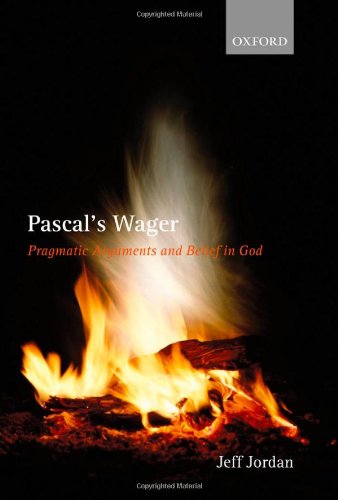
I just started reading Jeff Jordan’s Pascal’s Wager: Pragmatic Arguments and Belief in God, which I admit I have high hopes for. Right at the beginning I came upon a brief tidbit I thought was interesting to consider:
A disconnect exists between the arguments that philosophers find interesting and the arguments actually employed by Christians and other theists as reasons in support of their religious commitments. (vii, cited below)
I wonder sometimes about this very disconnect. The average person in the pew is unfamiliar with and unaffected by things like the Kalam Cosmological Argument or the subtle distinctions required to discuss the problem of evil. Rather, they are more concerned with the practical aspects of faith and the amount of work needed to explain these arguments is neither required nor desired. There does exist this disconnect between parchment–the philosophical theories–and the pew–the average Christian. What can we do to bridge this gap? What does this say about the epistemic validity of faith generally? Is this even an area for concern at all? I don’t think there are easy answers to these questions.
Interestingly, Jordan went on to suggest that one way to bridge the disconnect was with pragmatic arguments, such as Pascal’s Wager. It will be interesting to see how he develops that thesis, and how he defends such arguments. I eagerly look forward to continuing my read of the book.
Links
Be sure to check out the page for this site on Facebook and Twitter for discussion of posts, links to other pages of interest, random talk about theology/philosophy/apologetics/movies and more!
Jeff Jordan, Pascal’s Wager: Pragmatic Arguments and Belief in God

 J.W. Wartick - Reconstructing Faith