christian
Really Recommended Posts 8/23/13- Twain, Egypt, creationism, and more!
 I am excited to offer you, dear reader, a slew of fantastic posts for your perusal. The topics this go-round are diverse. We will look at Egypt and the media coverage there, Mark Twain and the Book of Mormon, Darwin’s Doubt, creationism, Stephen King’s Under the Dome, and Dietrich Bonhoeffer.
Mainstream media silent as Muslim Brotherhood targets Christians in Egypt– What is going on in Egypt? Violence against Christians has boiled over, but it seems we hear nothing about it here. Check out this article to read a refreshing perspective which will help inform you about what’s going on “over there.”
Mark Twain’s Review of the Book of Mormon– Mark Twain was a hilarious satirist and well deserves his place among the top American writers of his time. In this post, he turns his humorous pen to the Book of Mormon. It is worth noting a few errors with Twain’s account, however. I’m not sure if the Mormon account has changed, but Twain writes that the Book of Mormon was alleged to be translated from copper plates, when it is said to have been gold. More interestingly, Twain reveals his grounding in his own times when he writes “The Mormon Bible is rather stupid and tiresome to read, but there is nothing vicious in its teachings. Its code of morals is unobjectionable—it is ‘smouched’ from the New Testament and no credit given.” Take a gander at 2 Nephi 5:21ff (scroll down to verse 21 and following) and let me know if you see something which is similar to the New Testament’s statement in Galatians 3:28 and whether you object to the Book of Mormon’s writing in 2 Nephi.
Science, Reason, & Faith: Evaluation of Darwin’s Doubt by Stephen C. Meyer, part 1– With shouts of “pseudo-science” clamoring to drown out those who are even attempting to do research in the area of intelligent design, it is refreshing to sit back and look through some analyses which interact with the works rather than just spewing vitriol. I found this series of posts quite interesting and worth the read as I have been reading through the book myself.
Upset Creationist– Jay Wile is a young earth creationist whom I respect. His integrity is admirable. I disagree with his position strongly, but I admire him as person of character. This post is no different. He interacts with some comments the well-known creationist Ken Ham directed his way. Perhaps most thought-provoking was Wile’s comment that “Whether we are talking about the materials from Answers in Genesis or that particular exhibit in the museum, the message is crystal clear: the concept of millions of years has destroyed the church. I strongly disagree with that message.” Wile’s acknowledgement that we can be brothers and sisters in Christ despite disagreeing on this issue is refreshing.
Stephen King’s “Under the Dome”: A Mid-Season Perspective– one of my favorite blogs, Empires and Mangers, takes a look at the TV series based on the horror author’s work, “Under the Dome.”
Bonhoeffer, the Church, and the Consequence of Ideas– I’m a huge fan of Dietrich Bonhoeffer’s work. For those who don’t know, Bonhoeffer was a Lutheran who was executed by the Nazis during World War 2. In this article, his view of the Church and how that influenced his activism is briefly explored.
“The Knower and the Known” by Stephen Parrish, Part 2
 Stephen Parrish’s The Knower and the Known
Thought and Consciousness
What does it mean to have a thought? Parrish notes several aspects which go into the very act of knowing. There must be an object of knowledge; there must be a subject to consider the object; there must be consciousness in order to apprehend concepts and aboutness; there must be a relationship between subject and object and consciousness; there must be understanding of that relationship; and finally there must be a view of the world in which all of this can occur.
Consciousness itself is an extremely complex notion which involves phenomenality: the actual experience of thought; intentionality: the turning of one’s thoughts to consider an object; subjectivity: an agent which is itself the subject of the thought; and rationality: the capacity to order thoughts in such a way as to make sense of them. (206-213).
Consciousness has certain phenomenal properties. That is, when we consider our own thoughts, there is a distinct feeling to them which allows us to differentiate them from simple sense perceptions. There is an aspect of inentionality or attending-to our thoughts which is itself irreducible. Moreover, we are able to comprehend things which are themselves non-physical, such as the nature of a logical argument like modus ponens (226-228).
Consciousness must somehow interact with the physical world. If one is a physicalist, it becomes a matter of reducing consciousness to purely physical explanations, eliminating consciousness, or offering a brute relationship between consciousness and the physical world.
Qualia are also extremely important when considering consciousness. How is it that we are able to see objects as objects with certain properties? What process allows for individual particles/rays of light to manifest themselves in phenomenal consciousness in such a way as to provide a coherent picture of an object? Moreover, “there is more to recognizing qualia than just having color in one’s sensory field; there is also our attention to said qualia, the judgments we make about them, the objects that they represent, and also our memory of them–and these factors can make all of the difference” (257).
Subjectivity is also extremely important to forming a theory of consciousness. It seems that subjects are, in fact, irreducible. For the physicalist, the concept of a subject is extremely difficult. After all, a subject at t1 is going to be different from that subject at t2 in a number of highly relevant physical ways. Their neurons are firing differently from t1 to t2. How is it that subjectivity is maintained. The substance dualist holds that subjectivity is maintained through unity of consciousness which may not be reduced to the physical (291). The unity is preserved through intentionality but more thoroughly through rationality. The use of reason is one of the primary ways to offer continuity of the self. For the subject, S, at t3 is considering both thoughts at t1 and t2 in order to come to a conclusion at t4. Reason itself has aspects of intentionality which cannot be accounted for on a physicalist view of reality, for a physical object is capable of performing mathematical computations but not understanding the aboutness inherent in those computations (266-267).
Our Minds in the World
Parrish grounds his understanding of consciousness in a theistic worldview. There are numerous difficulties with an account of substance dualism which seem to only be soluble on a theistic interpretation. One of these is the problem of the interaction between body and mind. If God exists, then it seems inherently possible that a deity would be capable of forming the world in such a way that mind could interact with body. Parrish addresses several objections to the notion that an immaterial being could interact with a physical universe while also making an argument for non-physical selfs apart from God interacting in the universe (324ff).
The match of our minds with the world is something which must be accounted for. Parrish notes that if we ground ideal objects in an immaterial being like God, the difficulties with such objects existence and subsistence may be solved. Moreover, the glorious match of our mental life with reality is also explained, for a rational being is the source of all which we observe. If that is the case, then we no longer must appeal to simple brute fact to attempt to explain the phenomena of consciousness; instead, we may note that it is exactly as one might expect given theism (337ff).
And Then There was More…
Parrish concludes the work with a brief comparison of physicalism and substance dualism across multiple questions related to consciousness and the physical world. Finally, there are two appendices which address free will/agency and the theory of panpsychism, respectively.
Conclusion
In Part 1 of this review I outlined Parrish’s discussion of physicalism. Here, we have seen the structure of his substance dualism. It seems to me that Parrish’s deconstruction of physicalism is quite powerful. In particular, I noted that he makes a strong argument that physicalist theories ultimately boil down into either epiphenomenalism or mysterianism, neither of which is plausible. Moreover, his use of numerous examples and thought experiments throughout makes the work easier to comprehend while also providing a solid basis for grounding further discussions in philosophy of mind. Finally, the vast amount of research and documentation Parrish provides makes the work invaluable as a reference for physicalist writings alongside its clear value as a thorough critique of those same works.
The second major section, in which Parrish outlines his view of a theistic dualist ontology, is equally important. He provides a large amount of background for understanding how to put together various aspects of consciousness while also noting that, on theism, these observed phenomena cohere within an ontology, while on physicalism they are generally either discredited or ignored. The one thing the work may lack is a bit of cohesion in the section on substance dualism. Parrish has given a broad vision for how to hold a dualist ontology, but sometimes leaves it up to the reader to put the pieces together. The pieces are there, but not always assembled. I should note, however, that even here Parrish has provided an invaluable resource for those who wish to argue for a dualist vision of philosophy of mind.
I have already noted that Parrish’s The Knower and the Known is a tour de force in the realm of analyzing physicalist theories. However, the work is much more than a simple refutation of physicalism. Alongside that critique, Parrish has laid out the groundwork for substance dualism as a cogent alternative. Simply put, it is a must read for anyone with any interest in philosophy of mind. Comprehensive in scope, exhaustively documented, and interesting to read, The Knower and the Known is a must-have.
Source
Stephen Parrish, The Knower and the Known
SDG.
——
The preceding post is the property of J.W. Wartick (apart from citations, which are the property of their respective owners, and works of art as credited) and should not be reproduced in part or in whole without the expressed consent of the author. All content on this site is the property of J.W. Wartick and is made available for individual and personal usage. If you cite from these documents, whether for personal or professional purposes, please give appropriate citation with both the name of the author (J.W. Wartick) and a link to the original URL. If you’d like to repost a post, you may do so, provided you show less than half of the original post on your own site and link to the original post for the rest. You must also appropriately cite the post as noted above. This blog is protected by Creative Commons licensing. By viewing any part of this site, you are agreeing to this usage policy.
Book Review: “The Knower and the Known” by Stephen Parrish – Part 1
What is the mind? Are humans purely physical beings? What are we to make of physicalist/materialist philosophies of the mind? Do these debates have any relevance for the existence of God?
Stephen Parrish seeks to answer these questions (and more) in his work, The Knower and the Known
The work is split into two major sections. The first is an exploration of physicalist/materialist theories of mind; the second is an exploration of consciousness and how theism provides the best explanation for our phenomenal consciousness (among other things). We shall explore these in order. In this post, I shall focus upon Parrish’s critique of physicalism.
Physicalism
Parrish introduces the major physicalist theories related to the mind-body problem. These include reductionism, eliminativism, supervenience, and emergence. In order to make sense of the claim that the mind is a purely physical substance, it is important to come to an understanding of what it means to be “physical,” and Parrish cites numerous philosophers in order to come to a fairly simple working definition: “to be a material object (to be composed of matter) is ultimately to have certain kinds of causal power over certain areas” (69). The definition must, necessarily, be more complex. Thus, various aspects of dimension, space, and the like are explored. Then, KK provides an explanation of the standard materialist/physicalist view of reality, which is essentially that “everything that exists… can be located within space and time…” (85, Parrish’s definition cites that of C. Koons, and is also lengthier, but for the purpose of this review I have left it at this).
The nature of physicalism must also be understood in order to analyze the claims of physicalists. How is it, exactly, that the physical is to account for the mental? Parrish explores numerous ways proposed to explain physically the connection. These are centered around various proposed psycophysical laws, which hold that there are certain ways in which conscious states relate relation to other physical states. There have been many different proposals about how these laws might work.
According to the nomological theory, there is a lawlike correlation between conscious and other physical states. A nomological theorist would note the correlation between neurons firing in the brain and various mental states. The proposal would then lead to a law of correlation (and perhaps causation) for brain states b1, b2, and b3 with conscious states c1, c2, and c3. Parrish notes a number of problems with this theory, however. Most notably is the fact that there are sometimes different patterns of neurons firing for the same thought. Of course, a physicalist could counter that there are different laws for these different patterns as well. In that case, notes Parrish, “there would have to be laws to regulate the relation of every brain state with the relevant phenomenological aspect of thought to which it is correlated” (89-90). Of course, this becomes even more problematic when one considers that there is an infinite set of phenomenological aspects of our consciousness. That is, we can focus our minds around thinking of numbers and continue counting from one to a billion and beyond. For nomological theory to be correct, there must be a specific brain state for each of these thoughts (along with whatever different brain states would need to exist for the variations which can produce the same number). So there would then need to be an infinite set of laws to account for our mental life.
Yet there is another difficulty, for “since it seems possible for different types of brains to have the same conscious phenomenal thought, and every brain is constructed somewhat differently from every other brain, there would have to be even more laws that accounted for conscious items to accommodate all of the brain states of all the different brains” (90). To say that such a theory of mind begins to make a bloated metaphysics seems something of an understatement. And this is not to even begin to consider the possibility of other intelligent life in the universe, which would also need these lawlike relations for governing their conscious states.
And all of this is not to take into account the problems with explaining how and why there could be different patterns for the same thoughts not only across species but also across brains of the same species and also across individuals. A number of other possibilities are examined, including accidental correlation theory, realizability, and identity. Each of these comes with their own set of problems which Parrish elucidates (92-97).
Parrish throws the gauntlet at physicalist theories of mind in the chapter aptly titled “Judging Physicalist Theories of the Mind.” In this chapter, KK provides a thorough critique of all the major physicalist theories of mind. For the purpose of this review, I will only provide the briefest of summaries for each of these critiques. Mysterianism is essentially the notion that we cannot know how consciousness and the brain relate, but we do know that physicalism is true. The problem with this position is that such a position basically pushes the burden of proof unto other physicalist theories of mind as opposed to providing its own explanation, and the theory in fact seems to be just another form of epiphenomenalism.
Eliminativism is a simpler theory in which it is simply asserted that consciousness does not exist (133ff). Such a theory seems patently absurd on its face, yet some physicalist philosophers continue to maintain that despite any appearance to the contrary, “there are no conscious aspects, objects, properties, or events at all” (136). The difficulty with such a position is that it is “self-referentially incoherent” (137). That is, it cannot be consistently believed (whatever it means to “believe” something) that there are on mental state when, in order to have such a belief, one must have some sort of mental state. Parrish further offers a scenario to describe our world in terms of an eliminativist worldview, which would yield a kind of “zombie” world in which our fictional mental states have no relation to the world around us (149-150).
Identity theory basically asserts that consciousness just is identical to the brain. Much work must be done to analyze this theory by noting which theory of identity one might hold to, along with how such a theory of identity might play out. KK provides just such an exploration and comes to conclude that any of these identity theories falls to a number of objections, including the arbitrariness of the connection between the physical and the [identical] consciousness (162-163). Supervenience theory, which holds that somehow the mental supervenes upon the physical, suffers from providing no actual explanation for how this should be the case and thus basically devolves into one of the other physicalist theories.
Functionalism is the theory that “the conscious mind is the brain functioning in a certain manner” (171). Again, the difficulty here is that this seems to boil down largely into a bare assertion and how closely related to (and probably reliant upon) eliminativism it is.
Higher order theories of mind posit that consciousness is something like the brain scanning itself. However, this provides no explanation for how consciousness could arise and thus is again parasitic upon other varieties of physicalism, most notably eliminativism.
Epiphenomenalism is at the core of Parrish’s critique, for throughout the work he shows in numerous ways how the other physicalist theories of mind are ultimately mysterian or epiphenomenal in nature. Epiphenomenalism is basically the view that consciousness is causally inefficacious. Thus, it is the brain which “does the work” while consciousness is some kind of byproduct of brain activity. However, such a theory does not adequately explain how consciousness may itself arise, nor does it provide any attachment for our thoughts to reality. It thus suffers again from self-referential incoherence, for our mental states have no causal attachment to our brain states or reality. They are, again, merely “epiphenomena” which somehow are generated by our brains. If our mental states happen to line up with reality, that becomes a merely happy accident, for our mental states do not control our brain states but are rather generated by them. This is not to imply that mental states must control brain states to give rise to coherency, but rather to note that unless our mental states are causal in some sense, the very process of rational thought is illusory, for our prior mental states have no connection to our past mental states other than to be generated in a certain temporal order.
Conclusion
We have outlined Parrish’s critique of physicalism. Next week, we shall explore his defense of dualism and his case for theism from the nature of intelligibility. However, by way of conclusions for this section, it is important to note the insights which Parrish has offered in KK. The arguments he presented seem devastating to physicalism. In particular, the fact that so physicalist theories of mind all seem to either ultimately appeal to mystery or reduce consciousness beyond causal powers undermine the physicalists’ ability to explain reality sufficiently. If a worldview cannot even account for something as basic as our thoughts, such a deficiency seems to bode ill for the rest of that view. As noted, we shall note a powerful alternative which Parrish argues for in the latter part of the book, theistic substance dualism.
Parrish, of course, offers much more thorough critiques of every position listed here (along with many that were not included in this outline). The work is extremely important in not only its comprehensiveness but also its thoroughness for exploring theories of mind.
Stephen Parrish’s The Knower and the Known
Source
Stephen Parrish, The Knower and the Known
SDG.
——
The preceding post is the property of J.W. Wartick (apart from citations, which are the property of their respective owners, and works of art as credited) and should not be reproduced in part or in whole without the expressed consent of the author. All content on this site is the property of J.W. Wartick and is made available for individual and personal usage. If you cite from these documents, whether for personal or professional purposes, please give appropriate citation with both the name of the author (J.W. Wartick) and a link to the original URL. If you’d like to repost a post, you may do so, provided you show less than half of the original post on your own site and link to the original post for the rest. You must also appropriately cite the post as noted above. This blog is protected by Creative Commons licensing. By viewing any part of this site, you are agreeing to this usage policy.
Really Recommended Posts 8/2/13
 After a brief hiatus, “Really Recommended Posts” are back. This go-round I have found for your reading/viewing pleasure a debate on sola scriptura, Buddhism, fear, the Shroud of Turin, and presuppositional apologetics. As always, let me know what you liked/didn’t like! Send me your own recommendations!
Is the Bible the only infallible rule of faith? Tim Staples vs. James White (Video)- A (lengthy) debate between a Roman Catholic and a Calvinist regarding the rule of faith. Should we hold to sola scriptura, or do we need the Magisterium in order to preserve teaching? The debate is really worth listening to.
A Comparison of the Ethical teachings and Impact of Jesus and Buddha– A brief insight into comparative religions between Buddhism and Christianity. What of truth in other religions? I found this a very interesting post.
Fiction and Fear– A really excellent post over at Hieropraxis which notes the importance of an element of fear in fiction. The post ties this back to the relevance of the Christian teaching of Christ’s redeeming work.
Shroud of Turin Blog– I am not convinced that the Shroud of Turin is authentic. However, I do find some of the work being done regarding its authenticity is very interesting. This blog has a constant string of posts related to various evidences in favor of the Shroud’s authenticity. I recommend it for those interested in reading on the topic, with the caveat of my own (hopeful) skepticism.
What is pre-suppositionalism? What is presuppositional apologetics?– Over at Wintery Knight, this interesting post turned up with a critique of presuppositionalism as an epistemology (largely based on this post at The Messianic Drew). I found it interesting, though I do not fully agree with all the critiques leveled therein. For balance, I would also direct readers to Janitorial Musings for a counter-argument to the first major contention against presuppositionalism- Presuppositionalism and Circularity. I think readers should read all the posts involved for a more complete picture. Judge for yourselves what to think of the presuppositional “worldview” (to use Drew’s term–I would lean towards saying “epistemology” instead).
The Epistemic Argument Against Abortion
 Epistemology is the study of knowing. That is, it is the study of how we know something is true. Here, I will offer an argument against abortion which concerns the question: what do we know about the unborn?
An Analogy*
Suppose you are a demolition expert. You’re sitting outside a building you are to blow and you are about to hit the button. The area has been declared clear and so you have flipped the cover of the button up and you’re about to blow the building. Suddenly, someone cries out–a little red tricycle has been discovered outside the building. Fortunately, however, the people who spotted the tricycle tell you there is only a 20% chance that the child made his or her way inside the building. The equipment being used is expensive and your company is paying more Shrugging while thinking “Time is money,” you go ahead and press the button, blowing up the building. After all, you’re 80% sure there is no one inside.
…Wait a second. That’s horrible! Shouldn’t you check and be sure that there is no one inside the building? After all, that person’s life is worth so much more than the extra money your company will have to spend as the child is searched for.
The question then must be asked: what percent is low enough for you to press the button? Suppose you were 90% sure the child was not inside the building, would you pull the button then, confident that you gave your best effort? How about 95%? 98%? It seems to me the only morally permissible situation would be certainty. The building has been swept entirely from top to bottom and cordoned off, you are positive no one is inside. Then, you may press the button without moral culpability: you are certain you are not killing anyone whether directly or indirectly.
*I should note this example is from Kevin A. Lewis. I modified the scenario slightly.
The Argument Stated and Defended
The argument is actually very simple:
1) If it is possible that the unborn is a human person, we should not kill the unborn.
2) It is possible that the unborn is a human person.
3) Therefore, we should not kill the unborn.
Premise one seems obviously true to me. In order to deny premise one, the advocate for abortion must claim that we may destroy “fetuses” even if it is possible that they are human persons. That is, the pro-choice position must hold that it is permissible to blow the building at 80%; or perhaps even at 98%. Given a similar situation: the doctor with the tools for abortion goes and destroys the fetus with the possibility that, like the red tricycle sitting outside the building, they may not know whether they are killing a child; instead, they go forward with the procedure, even though they may be murdering a baby.
Note that what I’m claiming here is a very small claim: it may be even a .5% chance that the fetus is a baby (of course, I am convinced that from conception, we have a human being, but for the sake of argument I will grant even .01% chance), but then the doctor, like the demolition expert, goes ahead and “blows the building” anyway.
Premise 2 also seems to be obviously true. In order to show me that it is wrong, the pro-choice party must make an argument towards the claim that the unborn is not a human person. Why must they try to prove a universal negative? Well, my claim is very broad: It is possible the unborn is a human person. I have argued towards this end multiple times, and would be willing to engage someone on those points. But the bottom line is, even if my arguments fail, I still think that it is possible the unborn is a human person. I just need reasonable doubt here, not epistemic certainty. Unfortunately for those who are pro-choice, their position must yield epistemic certainty, but it cannot.
The conclusion follows from the premises via modus ponens. Thus, the argument succeeds.
Objections
We can never be sure about anything
Perhaps the most thoughtful answer a pro-choice advocate might make for this argument is that we can never be sure of anything. After all, we cannot be certain that when we drive somewhere, a child might run in front of our car and get hit and killed. Indeed, in the case of a demolition expert, one could always have a helicopter drop a small child onto the building at the last second, or a child could tunnel underneath and get in, etc.
My response to this argument is fairly straightforward. In abortion, we are intentionally going in and killing the fetus (or dismantling it; however you want to put it). The analogy with driving simply doesn’t work. In order for it to be even close to accurate, the driver isn’t driving safely. Instead, it would be like driving drunk along a sidewalk in Chicago. You shouldn’t do it.
The problem with the ‘certainty’ objection is that while it is true we cannot be 100% of just about anything, it is also true that there are some steps we should take in order to give ourselves epistemic certainty. That is, there is a line between saying something is broadly logically possible and saying that it actually reduces one’s epistemic certainty of a proposition. Certainly, it is possible for a helicopter to parachute a child onto the building in the seconds before it explodes, but does that reduce one’s epistemic certainty pertaining to the situation? I do not think so.
You’re A Man
Unfortunately, I run into this argument far more often than one might think. It should be pretty obvious that this argument is completely fallacious. Whatever my gender happens to be, I am capable of reasoning.
Sometimes, the argument is put forth as “get out of my womb” or something similar. Well again, if the unborn is a human being, then I am attempting to protect a distinct human being. Thus, this objection not only begs the question, but it is also insulting. It is nothing more than a rhetorical device.
We can never be certain that the fetus is not a human being
A response like this basically grants my argument. As I have argued, if this is the case abortions should be impermissible. We shouldn’t just bank on uncertainty to gamble with lives. Of course, I am not going to merely appeal to uncertainty, I have positively argued that the unborn are human beings. Period.
Links
Like this page on Facebook: J.W. Wartick – “Always Have a Reason.”
Be sure to check out my other posts in which I argue for the pro-life position. Particularly relevant to the present discussion are “From conception, a human” and “The issue at the heart of the abortion debate.”
Image Credit: Wikimedia Commons Chixoy.
SDG.
——
The preceding post is the property of J.W. Wartick (apart from citations, which are the property of their respective owners, and works of art as credited) and should not be reproduced in part or in whole without the expressed consent of the author. All content on this site is the property of J.W. Wartick and is made available for individual and personal usage. If you cite from these documents, whether for personal or professional purposes, please give appropriate citation with both the name of the author (J.W. Wartick) and a link to the original URL. If you’d like to repost a post, you may do so, provided you show less than half of the original post on your own site and link to the original post for the rest. You must also appropriately cite the post as noted above. This blog is protected by Creative Commons licensing. By viewing any part of this site, you are agreeing to this usage policy.
“The Rocks Don’t Lie” by David Montgomery: Chapter 4
 Here, I continue my look at The Rocks Don’t Lie
Chapter 4: World in Ruins
Outline
Montgomery begins by outlining the state of beliefs before early geological investigations. These were formed from theological understandings and thus derived themselves either from creation or the Flood.
The early theories of how the Flood shaped the rocks lent themselves as hypotheses for investigating the natural world. Although many of these theories would be dismissed immediately now, for their time they were serious ideas about how the world may have been shaped. Yet even in the early days of geological investigation, many theologians and geologists realized some of the major difficulties attributing the whole geologic story to the Flood would raise. Isaac Vossius, for example, “argued for a local flood on the grounds that there simply was not enough water on earth to submerge the highest mountains” (55). The amount of water needed for a global flood remains a great difficulty into today.
Other early geologic difficulties were centered around fossils. Were they really vestiges of once-living creatures, or merely tricks of the stones (59)? Steno entered this debate and, apart from noting that fossils were similar to those bones of living creatures, he also developed principles of geology which are used to this day. These were the notion that the bottom of a pile of sediment is oldest and that sedimentary layers are deposited horizontally (60).
As geologic investigations continued, more radical theories were put forth to hold a global flood. These included the notion that, prior to the Flood, the earth was smooth, and so it would have been easy to cover the globe with the water we observe now (66). Yet theories like this, which hypothesize the Flood wreaking havoc upon the earth, yield great difficulties of their own. For example, how could Noah’s descendants have populated the ends of the earth so quickly? Thomas Burnet, who had proposed this theory, argued that Native Americans had also survived the Flood (68).
John Woodward became another champion for advocates of a global flood. He asserted that the Flood dissolved the Earth’s crust and then laid down the sediment observable now (70). His theory was in keeping with others who held that a “mighty flood burst forth from a subterranean abyss” (71). However, John Arbuthnot, a physician, published an essay which not only showed that Woodward had plagiarized Steno, but also blew holes through the Flood theory Woodward had proposed. These included the fact that fossils did not rearrange according to specific gravity and that the layering of sediment could not have occurred within such a mix (71, 73).
Edmund Halley (of Halley’s Comet fame) came up with a theory which involved a comet coming near the earth and disturbing it on its axis, which “heaved the seafloor up… carving the topography we know today.” He also came up with the idea of a “vapor canopy” over the Earth which yielded the great amount of water needed to flood the entire planet (74).
Montgomery notes that it is “ironic” that many of the arguments used by young earth creationists for their positions on geology have been derived from the seventeenth-century geologists, who themselves “did not blindly trust particular literal interpretations of scripture. They had faith reason would lead to enlightened interpretation of God’s creation, as read from the pages of the book of nature…” (76).
Analysis
Montgomery has done a commendable job documenting the long history of the interplay between geology and theology related to the Flood. Moreover, he has shown how many of the ideas found in modern creationism reflect the debates of this period–some of which were acknowledged as refuted back then.
The importance of this historical background should not be understated. When one investigates the way that theories of the Flood developed alongside geology, it provides a fascinating case study for the interplay between science and faith. More importantly, studying the arguments of the past shows how easy it is to resurrect the same ideas in new contexts. Modern young earth creationism owes a great debt to people like Halley and Woodward. Unfortunately, many of these ideas remain just as refuted as they were shortly after they were first proposed.
It is also important to observe cases like Burnet, who started out trying to fit geology into his interpretation of Genesis, but ended up being forced to hypothesize all kinds of things which are not actually found in the Genesis account in order to maintain his theory. Modern creationists should be wary of doing the same: in attempting to stay true to the meaning of the text, people too often introduce concepts which are entirely foreign to the passages themselves. Ironically, this is often done in the name of being “literal.” I hope that works like Montgomery’s (and Young’s, see below) will help inform the Church regarding this debate.
Conclusion
Again, Montgomery’s book shows its great similarities with The Biblical Flood by Davis Young, which itself focuses almost entirely upon the interplay between geology and theology. Both of these books come recommended from me. Montgomery’s work is a faster read with a bit more focus upon the arguments of modern young earth views, while Young’s work provides more of the much-needed background for the debate. [I skipped ahead a bit and saw that Montgomery acknowledges Young’s own contributions to this discussion. I am of the opinion that each of their works bring unique contributions and are worth having.]
The Rocks Don’t Lie has so far proven to be a fantastic work in which the author acknowledges the complexities of the issues as well as the debt geology owes to Christianity. Soon, we will look into chapter 5.
Links
Like this page on Facebook: J.W. Wartick – “Always Have a Reason”
Check out my review of a similar work by a Christian: The Biblical Flood. I think this book is vastly important and should be in every Christian’s library.
Be sure to browse my extensive writings on the “Origins Debate” over creationism, theistic evolutionism, and intelligent design (among other views) in Christianity.
Source: David Montgomery, The Rocks Don’t Lie
SDG.
——
The preceding post is the property of J.W. Wartick (apart from citations, which are the property of their respective owners, and works of art as credited) and should not be reproduced in part or in whole without the expressed consent of the author. All content on this site is the property of J.W. Wartick and is made available for individual and personal usage. If you cite from these documents, whether for personal or professional purposes, please give appropriate citation with both the name of the author (J.W. Wartick) and a link to the original URL. If you’d like to repost a post, you may do so, provided you show less than half of the original post on your own site and link to the original post for the rest. You must also appropriately cite the post as noted above. This blog is protected by Creative Commons licensing. By viewing any part of this site, you are agreeing to this usage policy.
“Pacific Rim” – A Brief Christian Reflection
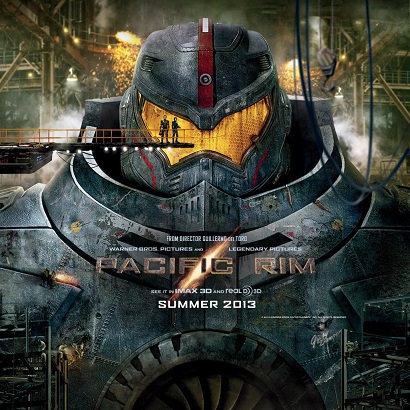 Thankfully, a slew of science fiction films are being released this year. “Pacific Rim” has generated quite a bit of buzz. I recently had the chance to view the film and will here offer some reflections from a Christian perspective. I feel obligated to put a disclaimer here: I realize this film is 99.9999% about blowing things up. I still think that a saying I often use is correct- there is no such thing as a film without a worldview. There will be SPOILERS in what follows. I do not offer a plot summary, as one can be found easily.
Master of the Storms?
Early in the film there is a scene in which Raleigh Becket, a Jaeger (think giant mech-tank) pilot, is marching out into a storm to fight a Kaiju (think Godzilla). As one watches this epic man-made titan march out to fight a monster, one is struck by the hugeness of it, the power of it. If humans can make this, what next? Raleigh discusses how once, humans were afraid of storms like hurricanes. Now, given the might of their creations, they need not fear a hurricane.
The quote seems impressive. After all, many today hope that humanity will reach heights like this. One day, we may be able to face down a hurricane and laugh. The powers of wind and rain may be overcome. But what then?
Interestingly, in the film the very next scene is that of a Kaiju absolutely beating down Raleigh’s Jaeger.
What? That’s not how the story is supposed to go. The story is supposed to show how we have finally transcended ourselves. But that is not the reality. The reality is that a giant Godzilla beast can still destroy even these hurricane-defying machines.
It is ironic, really. In the context of humanity’s defiance against the storms given their machines, another, greater challenge is thrown out there. One can almost imagine people railing against God once more. Why have we been left to fight this world on our own? But then one must remember what God has said:
[The LORD says:] “Can you pull in Leviathan with a fishhook
or tie down its tongue with a rope?…Will it keep begging you for mercy?
Will it speak to you with gentle words?
Will it make an agreement with you
for you to take it as your slave for life?Who has a claim against me that I must pay?
Everything under heaven belongs to me.” (Job 41:1, 3-4, 11)
Ultimately, God is in charge. Our attempts to control the seas, the storms, or the leviathan do not match up to God’s sovereign control over all creation.
The film does nothing to explore this avenue, but one can wonder: what of humankind’s efforts to try to best God? It seems that the answer is: it’s not going to happen. There is always a bigger Kaiju. There are always larger storms. Our fascination with these powerful aspects of creation may itself be a reflection of the Creator.
In the film, of course, humanity triumphs. As in all good action movies, the good guys win (no, I do not like sad endings for movies). But one can only wonder: if the Kaiju could come; what next? The God who rules the storms is the same God who can draw the leviathan with a hook.
Mind and Evolution
How much can our minds handle? In the film, the mental strain of piloting a Jaeger is too much for one person to handle. How do minds work in this context? Somehow they manage to create some linkage between two humans’ minds and create some kind of mental pathway such that the people are able to integrate and work together. What does that mean? I don’t know. It is techno-babble for an action flick. But suppose we were able to do this. What would it imply about minds? Well, no more than what we already know, it seems: our minds are connected to a physical reality. We as humans are grounded in embodiment.
The Kaiju turn out to be clones. I found that pretty surprising given the immense diversity of the creatures. Some had wings; others spit acid; still others had huge hammerheads to use as weapons. What kind of genetic diversity would have to be included in their DNA in order to allow for such radical diversity. I am absolutely not a geneticist–and this movie is absolutely not an attempt to portray anything scientifically accurate–but I wondered about this as I watched the movie.
Conclusion
Let’s be blunt. “Pacific Rim” is a movie for those who want to watch giant walking tanks fighting Godzilla clones. There is a plot to be found, and there are some themes involved–as in any movie–but at its heart, this movie is a pure action flick. That said, there were a few things to reflect upon, such as the notion of humanity trying to overpower God or the forces around us.
Links
Like this page on Facebook: J.W. Wartick – “Always Have a Reason.”
Did you like Pacific Rim? Check out John Carter.
Be sure to check out my other looks at movies here (scroll down for more).
SDG.
——
The preceding post is the property of J.W. Wartick (apart from citations, which are the property of their respective owners, and works of art as credited) and should not be reproduced in part or in whole without the expressed consent of the author. All content on this site is the property of J.W. Wartick and is made available for individual and personal usage. If you cite from these documents, whether for personal or professional purposes, please give appropriate citation with both the name of the author (J.W. Wartick) and a link to the original URL. If you’d like to repost a post, you may do so, provided you show less than half of the original post on your own site and link to the original post for the rest. You must also appropriately cite the post as noted above. This blog is protected by Creative Commons licensing. By viewing any part of this site, you are agreeing to this usage policy.
“The Rocks Don’t Lie” by David Montgomery: Chapters 2 and 3
Here, I continue my look at The Rocks Don’t Lie
Chapter 2: A Grand Canyon
Those who are familiar with Young Earth Creationism know that a major contention is that the Grand Canyon can serve as evidence for a global flood. For example, both Answers in Genesis and the Institute for Creation Research have several articles dedicated to the topic. (Just do a search on the sites–I have linked two examples. In the latter, the ICR author notes that the Grand Canyon is “Exhibit A for the flood model of geology.”)
Outline
David Montgomery notes this interest from young earth groups and so he dedicates a chapter to the topic. He uses his own exploration of the Canyon to lead into a discussion of the geological evidence. Some of the rock formations found there “require[d] both extreme heat and high pressure” to form (17). He turns to a brief explanation of radiometric dating: “…the age of a rock can be read like a geologic clock because radioactive isotopes decay at a fixed rate… If you know the half-life of an isotope–how long it takes for the remaining amount to decay–then the ratio of the parent-to-daughter isotope now in a rock tells you how long ago the rock crystallized” (17-18).
Next, Montgomery gives a fairly basic introduction to geology. He provides a brief overview of how one can note unconformities in the rock and how different formations cut across each other. These evidences, found in the Grand Canyon, show that it was formed by a series of events rather than one single event (20ff). Moreover, physical evidence of fossilized burrows from “wormlike animals” in the sandstone provides evidence against flood geology. “How could fragile worms have been crawling around on and burrowing into the seafloor during a flood powerful enough to remodel the planet? The biblical flood would have had to have dumped more than ten feet of sediment every day for a whole year in order to have deposited the thousands of feet of sediment exposed in the canyon walls” (22).
More evidence against flood geology is found in the way the sediments themselves were formed. First, the differing mass of types of silt, clay, sand etc. make it difficult to believe that they could have been mixed together in a flood and then been deposited with uniformity of layers. Second, layers like that of white sandstone are composed of “fine-scale features” which “would have been obliterated if they had formed underwater… These dunes were made by wind” (25).
Finally, the fossils found within the Canyon present another difficulty. “If all the creatures buried… had been put there by the biblical flood, then why aren’t modern animals entombed among them? That the vast majority of fossils are extinct species presents a fundamental problem for anyone trying to argue that fossils were deposited by a flood from which Noah saved [at least] a pair of every living thing” (27).
Analysis
Montgomery has presented a number of extremely difficult problems for young earth interpretations of the Grand Canyon. In particular, the difficulty with the species of animals found buried seems intractable. My reason for noting this in particular is because flood geologists must assert that all the animal life is either descended from or prior to the animals in existence at the flood. Of course, if the Grand Canyon was formed by the flood, we should observe some of these extinct animals now–or at least recently. Yet for many, we do not. Why is that? A young earth perspective cannot simply assert that they died in the flood, for these would have been preserved in the flood.
The other problems Montgomery noted may sometimes be dismissed by advocates of young earth theories. In particular, Montgomery does little to defend radiometric dating, which is itself a major target of young earth views. For those interested, Davis Young’s The Bible, Rocks and Time
Chapter 3: Bones in the Mountains
Montgomery surveys briefly and selectively a history of Christian interpretation of the Genesis account and argues that some found room for less literal interpretations. Moreover, he points out that those who insist upon a literal reading of the text for Genesis must present reasons for not taking other references to the sky as a dome, etc. as non-literal (44-46, 50). Yet he also notes that the perspective from which the Bible is written (on earth) alleviates these difficulties–but these difficulties can only be alleviated by “allowing for figurative or allegorical interpretations” in which we “acknowledge… the fact that we live on a planet” (50).
Another difficulty with young earth views is presented, because the discovery of the New World revealed a massive amount of new species which the Ark would have had to carry. How does one fit all of these species onto the Ark? More importantly, how did these species get to the Ark and back to their homes in North America without leaving their ancestors’ bones behind in places other than their native lands? (42-43)
I have to say this chapter really surprised me, because Montgomery showed an appreciation for and interaction with Christian theology that I was not expecting. For just one example, he refused to set up the oft-rehearsed science-vs-religion rants that often accompanied discussions of Galileo. Instead, he explored the historical context, and noted that the ideas the church held were not necessitated by the text but were rather incorporated from Ptolemic ideas (49).
Conclusion
The Rocks Don’t Lie continues to impress me. Montgomery is careful to avoid overstating his case. More importantly, he seems to genuinely respect the beliefs of those whose writings he surveys and he shows a true concern for accuracy regarding some of the controversies. Thus far, he has presented a number of significant scientific challenges to a young earth paradigm, as well as noting the change and variety of perspectives within theology. Be sure to follow the blog for the next chapter(s)!
Links
Like this page on Facebook: J.W. Wartick – “Always Have a Reason”
Check out my review of a similar work by a Christian: The Biblical Flood. I think this book is vastly important and should be in every Christian’s library.
Be sure to browse my extensive writings on the “Origins Debate” over creationism, theistic evolutionism, and intelligent design (among other views) in Christianity.
Source: David Montgomery, The Rocks Don’t Lie
SDG.
——
The preceding post is the property of J.W. Wartick (apart from citations, which are the property of their respective owners, and works of art as credited) and should not be reproduced in part or in whole without the expressed consent of the author. All content on this site is the property of J.W. Wartick and is made available for individual and personal usage. If you cite from these documents, whether for personal or professional purposes, please give appropriate citation with both the name of the author (J.W. Wartick) and a link to the original URL. If you’d like to repost a post, you may do so, provided you show less than half of the original post on your own site and link to the original post for the rest. You must also appropriately cite the post as noted above. This blog is protected by Creative Commons licensing. By viewing any part of this site, you are agreeing to this usage policy.
The Binding of Satan: An Eschatological Question
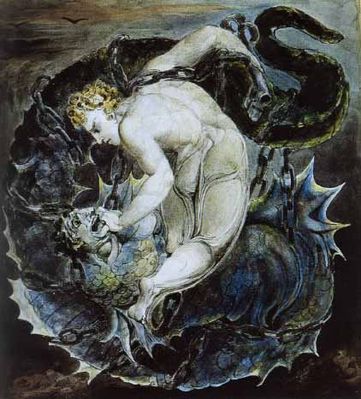 When does the binding of Satan occur? Is it something yet to come, or is it something which has already happened? Here, I will analyze the futurist position on these questions: the notion that Satan and his minions are yet to be bound.*
Futurism is, essentially, the position that the prophecies in Daniel and Revelation (and many elsewhere) are largely yet to be fulfilled. This is in contrast to historicism– the view that these prophecies have been fulfilled through the church age (with some yet future); preterism– the view that many of these prophecies have already been fulfilled in the past; and idealism– the view that these prophecies have spiritual meanings which may be fulfilled multiple times through history until the End.
The central passage for the question at hand is Revelation 20:1-3:
And I saw an angel coming down out of heaven, having the key to the Abyss and holding in his hand a great chain. He seized the dragon, that ancient serpent, who is the devil, or Satan, and bound him for a thousand years. He threw him into the Abyss, and locked and sealed it over him, to keep him from deceiving the nations anymore until the thousand years were ended. After that, he must be set free for a short time. (NIV)
The futurist interpretation of this passage would be fairly straightforward: at some point in the future, before the millennium, Satan will be bound. Many futurists hold that this also includes Satan’s minions. Representative is Paul Benware: “With the removal of Satan comes the removal of his demonic forces and his world system” (Benware, 334, cited below). It is on this point that the question I have turns. Consider Jude 6:
And the angels who did not keep their positions of authority but abandoned their proper dwelling–these he has kept in darkness, bound with everlasting chains for judgment on the great Day. (NIV)
Note the interesting parallels with the passage from Revelation 20. Both use the language of “chains” and reference a time when something will happen after this binding. Yet Jude 6 seems to imply the definite binding of these demonic forces from the time it was written or even before. Why? Jude 5 gives the temproal context, which is sandwiched in between discussion of the Exodus and Sodom and Gomorrah. Of course, Sodom and Gomorrah predate the Exodus, but the overall context of the passage is given by Jude as being around that time period (“I want to remind you…” v. 5).
Moreover, 2 Peter 2:4 states:
For if God did not spare angels when they sinned, but cast them into hell and committed them to chains of gloomy darkness to be kept until the judgment…
Again, in context Peter is discussing a number of past events. So it certainly seems that at least some demonic forces have already been bound. Benware writes of these passages: “The Scriptures reveal that Satan and his angelic followers will be judged for their sin and rebellion…” (329, emphasis mine). Now, Benware is clearly saying that there will be a judgment in the future, and that seems correct from both passages. However, he does not note anywhere in his major work the difficulty these verses present to his own view, for he insists elsewhere that amillenialists are incorrect when they view this binding as being a present reality (129ff). But he does grant that at least some demonic forces are bound now.
The question, then, is how is it that futurists can consistently insist upon the impossibility of Revelation 20:1-3 being a present reality while already granting that it is, at least in part, fulfilled? That is, if one grants that at least some demonic forces are bound, it seems that one cannot insist that certain spiritual forces cannot possibly be bound at present. Thus, it seems to me this particular aspect of futurism is not on as strong a ground as many insist.
Indeed, one may read Jude 6 and 2 Peter 2 and get the impression that these things have already occurred. There is no stipulation within the text to say that only some wicked angels have been bound. Indeed, they both seem to imply the total binding of all demonic forces. But this would not be compatible with the standard futurist interpretation of Revelation 20:1-3.
*Readers should note that I am not here intending to critique the overall futurist position. Instead, I am merely wondering about one specific aspect of some futurist interpretations.
Links
Check out my other posts on eschatology (scroll down for more).
Also, read my review of Benware’s massive work on premillenial dispensationalism, Understanding End Times Prophecy.
Sources
Paul Beware Understanding End Times Prophecy
SDG.
——
The preceding post is the property of J.W. Wartick (apart from citations, which are the property of their respective owners, and works of art as credited) and should not be reproduced in part or in whole without the expressed consent of the author. All content on this site is the property of J.W. Wartick and is made available for individual and personal usage. If you cite from these documents, whether for personal or professional purposes, please give appropriate citation with both the name of the author (J.W. Wartick) and a link to the original URL. If you’d like to repost a post, you may do so, provided you show less than half of the original post on your own site and link to the original post for the rest. You must also appropriately cite the post as noted above. This blog is protected by Creative Commons licensing. By viewing any part of this site, you are agreeing to this usage policy.
Against Christian Materialism
 Is it possible for Christians to be materialists? A number of Christians say that yes, it is. Here, I will argue that the conjunction of Christianity and materialism is indefensible.
The Biblical Witness
Having read a bit on this topic, I realize that many who are Christian materialists do not think that the Biblical data is conclusive. However, granting that this is their position, I would maintain that the Biblical evidence is very strong: we are more than a material body. Here, I will examine only a small collection of texts.**
Matthew 10:28- “Do not be afraid of those who kill the body but cannot kill the soul. Rather, be afraid of the One who can destroy both soul and body in hell.” (NIV)
What does this text mean if the soul and the body are not different things which compose the human being?
Ecclesiastes 12:7- “and the dust returns to the ground it came from, and the spirit returns to God who gave it.” (NIV)
When we die, our bodies–made of dust–return to the earth, but our spirit returns to God. What does this mean on materialism? Which part of our material selves go to God?
Revelation 6:9- “When he opened the fifth seal, I saw under the altar the souls of those who had been slain because of the word of God and the testimony they had maintained.” (NIV)
The souls of those killed for their faith cry out for justice from under the altar. The objection may be made that this is apocalyptic language. In answer, I would simply point out that even then it makes no sense on materialism even in that context. What are the souls that are crying out in this vision? What is the referent for the alleged metaphor?
In Matthew 17:1-8, Jesus speaks with Moses and Elijah, who have died. Did God raise them bodily, and did they then die again immediately afterwards and decompose when they are no longer visible?
1 Peter 3:18-19- “For Christ also suffered once for sins, the righteous for the unrighteous, to bring you to God.He was put to death in the body but made alive in the Spirit. After being made alive, he went and made proclamation to the imprisoned spirits…”
What was Jesus proclaiming the Gospel to? What is imprisoned? Where are the physical/material bodies in this passage? (Note that in context it is talking about those alive in Noah’s day–so again, where did their bodies go?)
Verses like these could be multiplied continually. Perhaps more telling is that the reasoning I’m using here regarding the texts and the distinction between body and soul is similar to the arguments put forth to justify the Trinity. That is, texts which discuss the Father and Son as different entities or even have all three persons of the Trinity in the same context are used to demonstrate that there really are three distinct persons in the Godhead. Yet this is exactly the type of argument I am here making for body and soul. They are used too many places together to be the same thing.
It seems to me utterly clear from the Biblical text that human beings are not purely material entities. Again and again texts can be shown to refer to the body on the one hand and the soul on the other. This is not to say that humans are necessarily one or the other; instead, it is to point out that humans are (at least) body and soul. (I say “at least” because there is a long tradition of trichotomy in Christianity wherein people hold that humans are body, soul, and spirit. I remain neutral in that debate and here only wish to show that humans are not merely material entities.)
The Philosophical Debate
Suppose that one maintains that the Biblical evidence is inconclusive. What then? Could we then say that Christianity and materialism are compatible, for materialism is not explicitly ruled out by the text? Here, I will offer two arguments against these conjoined propositions.
Identity Through Time
How do we maintain identity through time? Here, the problem must be answered by all materialists, not just Christian materialists.
The problem is, of course, that our bodies don’t maintain physical identity. We are continually replacing the physical parts of our body over time. Now, I am hesitant to make the oft-repeated claim that our entire bodies are replaced every so many years, as I have been unable to find any research confirming it. However, it simply is the case that large portions of our body are replaced. Given this fact, how do we maintain identity? What is it that keeps us the same person over time?
Another major problem is this: to which part of our body are we identical? Or, to put it another way, which parts of our body do we need to keep in order to be the same person? Here we can appeal to a thought experiment. A mad scientist has us captured and he wants to see how long we can maintain identity. Slowly, he replaces each part of our body with a new one with the exact same DNA, structure, etc. As he replaces these parts, he discards the old ones and destroys them. He starts with the legs. Then he moves to the midsection, replacing one organ at a time. Then the heart, the arms, the ears, the eyes. When he gets to the brain, he goes through and replaces only single neurons at a time.
The question is pretty obvious: When do we stop being the same person? The materialist simply has to admit that we are our bodies (for what else could we be?). But given that fact, to which part are we identical? The brain? If so, at one point in the experiment do we cease to exist? 51% of our brain is gone? 70%? All but one neuron? So is our identity grounded in that one neuron? If so, which one? Or is it just grounded in having any one neuron as the same? If so, how?
Frankly, I think this problem is devastating for materialists, but especially those who are Christians. Why would it be more acute for Christians? Well…
 Is There Hope in the Resurrection?
Central to the Christian hope is the hope for a future resurrection. The question which must be asked is this: Is this hope grounded in reality?
Suppose materialism were true. If that is the case, then humans are identical with their bodies in some fashion. I am intentionally vague here because I admit I’m not convinced as to how identity works within a Christian view of materialism (see above). If this were the case, then when we die and our material body decomposes, it may go on to become all sorts of different things, which themselves later pass away (plants may grow from the nutrients broken down from the body; then those plants may be harvested and eaten by other humans/animals/etc, which then die and are broken down, etc.). In the resurrection, then, God creates our body anew, complete–I assume–with our memories, experiences, etc. built in (perhaps they are simply functions of our brain, which God recreated perfectly, which thus contains our experiences).
Is there actual hope on this scenario?
Suppose the mad scientist were to come and kidnap you. He gleefully announces that he is going to use you for excruciatingly painful experiments which will take place over several years until you die. But, do not worry, because once you die, he is going to create a new body which is an exactly perfect copy of you, which will of course have all your experiences (minus this torturous one) and memories in place, and then he is going to give you billions of dollars.* Would you be comforted by this scenario? After all, you’re not going to remember the pain and you are going to come out the other end extremely rich!
Well there is a problem: the new body is not you. It is just a copy. For any materialist, this is problematic. We seem to know that identity transcends the body. But let us not delve into that difficulty right now. Instead, we will focus on Christian materialism. Now, it seems to me that this problem is almost the same for the Christian materialist with the Resurrection. After all, we are going to die. But we are told, don’t worry, we will be raised bodily by God! But whose body is going to be raised? How will God gather the material from our body (and at which time of our body–see above) in order to recreate us? And will not this body purely be a copy, rather than actually us?
There is a real disconnect here. Christian materialism cannot offer us the hope of the resurrection, without which our faith is worthless (1 Corinthians 15). Instead, it offers us the hope for our future copies, which will themselves have our memories and experiences, but will not be us. Our bodies will die and distribute throughout various portions of the world (even the universe–who knows if an asteroid might hit and distribute the molecules which made up our body elsewhere?). Then God will create us again in some fashion, and that body will live on in the Kingdom. But that body is not us. It will be a new body. This isn’t begging the question, it is merely stating a fact. The body that will be raised is not the body I have now. Thus, if I am my body, I am not raised.
Interestingly, Peter van Inwagen, a Christian philosopher who is himself a materialist, concedes the point I made in this section. In order to escape this extreme problem for Christian theology, he comes up with a rather unique solution: “Perhaps at the moment of each man’s death, God removes each man’s corpse and replaces it with a simulacrum which is what is burned or rots. Or perhaps God is not quite so wholesale as this: perhaps he removes for ‘safekeeping’ only the ‘core person’–the brain and the central nervous system–or even some special part of it… I take it that this story shows that the resurrection is a feat an almighty being could accomplish. I think it is the only way such a being could accomplish it…” (Van Inwagen, 121, cited below).
What response can we have to this? Well surely, it is possible for God to do this, but it raises all kinds of speculation. First, what Biblical evidence do we have to support that our bodies or our brains/nervous systems are transported by God somewhere in order to preserve them? Honestly, I think that someone who posits this kind of miraculous working holds a burden of proof to support it. Second, where is this storage yard of brains/nervous systems? This question is not intended to beg the question. Instead, my intent is to point out that they would have to be somewhere in the physical universe. Thus, we should be able to find a planet where all the brains/central nervous systems of everyone who ever died are being stored. Third, given this, could we potentially destroy this planet and thus destroy all possibility of the resurrection? Fourth, other than as a completely ad hoc measure to preserve the possibility of hope, what possible justification (philosophical, theological, and/or Biblical) do we have for this?
On the whole, it seems to me that Peter van Inwagen’s proposed solution fails. It fails because it is extremely ad hoc and because it may not even solve the problem it is intended to solve. Thus, it seems to me that Christian materialism fails as a worldview.
Conclusion
I have offered several arguments against the conjunction of Christianity and materialism. I think any one of these arguments is successful on its own (I should note that I also think the argument from the ego is successful–I have argued here against atheistic materialism, but this argument would be equally successful against Christian materialism). If any one is successful, the conjunction of Christianity and materialism must be false. Frankly, I think all the arguments are successful. I leave the Christian materialist to justify their position.
Links
Like this page on Facebook: J.W. Wartick – “Always Have a Reason.”
If Materialism, are there Subjects?– I contend that a materialist worldview cannot account for subjects. This post was written specifically to address atheistic materialism, but is perfectly relevant for theistic materialism as well.
Sources
*I am indebted to Alvin Plantinga and Stephen Parrish for this type of argument.
**I am indebted to Kevin A. Lewis for his list of texts provided in his “Essentials of Christian Doctrine II” syllabus.
Peter van Inwagen “The Possibility of Resurrection,” International Journal for Philosophy of Religion, 9:2 (1978), 114ff.
SDG.
——
The preceding post is the property of J.W. Wartick (apart from citations, which are the property of their respective owners, and works of art as credited) and should not be reproduced in part or in whole without the expressed consent of the author. All content on this site is the property of J.W. Wartick and is made available for individual and personal usage. If you cite from these documents, whether for personal or professional purposes, please give appropriate citation with both the name of the author (J.W. Wartick) and a link to the original URL. If you’d like to repost a post, you may do so, provided you show less than half of the original post on your own site and link to the original post for the rest. You must also appropriately cite the post as noted above. This blog is protected by Creative Commons licensing. By viewing any part of this site, you are agreeing to this usage policy.

 J.W. Wartick - Reconstructing Faith
