christian
Really Recommended Posts 10/15/11
 Mexico City Proposes Temporary Marriages– Yeah, it’s crazy.
On Symbiosis– Paul Adams points out a simple, but important point. Check it out.
Is Intuition an Unjustifiable Reason for Faith?– Great post by Erik Manning on the use of of intuition and issues of faith.
What is True Christianty?(tm)– at Josiah Concept Ministries, a great discussion of what makes someone a Christian (or not).
Humorless Humanist Humor– At “No Apologies Allowed”–a great comic showing the bankruptcy of humanism.
Is Mormonism a Cult?– A phenomenal side-by-side comparison of Christianity and Mormonism.
Richard Swinburne on “A skeptical age.”
Book Review: “My Christian Apology” by Martin Murphy
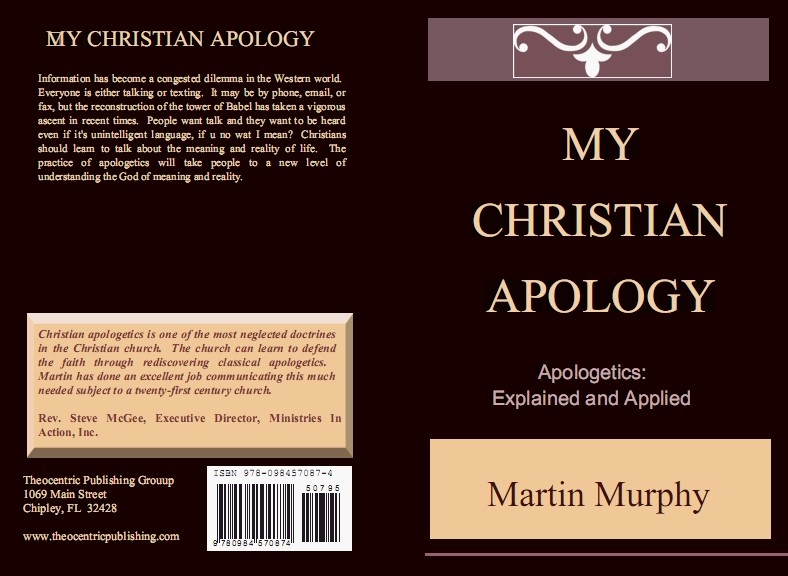 My Christian Apology by Martin Murphy provides some unique insight into apologetics. Rather than focusing upon arguments for the existence of God or methodology at the expense of historical understanding, Murphy grounds both arguments and method in history.
The book starts off with some introductory notes. What is apologetics? How do we communicate apologetics? These sections provide the groundwork of many apologetics texts. But Murphy quickly differentiates his work from most standard introductions to apologetics. His book focuses largely on epistemology and its relation to apologetics.
Murphy does a great job of making these concepts accessible to general readers. He defines epistemology (19) and then gradually eases the reader into its various applications to apologetics (19ff). A central theme throughout is that unbelievers and Christians have common grounds from which they can start discussions. One of these common grounds is Natural Law, which Murphy goes into at length (65ff). Natural Law has been repudiated by many modern thinkers, but it is grounded in Scripture and has a great theological base. I’ve reviewed a Lutheran book on the topic which I think helps show how useful Natural Law is. Murphy points out that Natural Law can provide a basis for knowledge of God. “If we know we are transgressors then we know we have violated the law of God” (73). This knowledge is not saving knowledge, but it provides a basis for judgment (84) and, I think, a possible common ground for apologetics.
Another strength of Murphy’s work is the focus upon historical apologetics. He cites Jonathan Edwards at length and in numerous places while exploring Edwards’ applications to apologetics (see 20-21, 29, 36, etc.). He also emphasizes the works of Southern Presbyterians in the area of apologetics. The historical background is a great quality of the work and one that I think Christian Apologists often fail to emphasize or utilize.
There is some emphasis on theology in My Christian Apology as well. Murphy’s discussion of natural law leads to a drawing out of the “noetic effects of sin.” Again, the points Murphy raises are clear and concise. Some readers will disagree, but all will be challenged. I find this account eminently plausible and I think that even those who disagree need to at least account for the Biblical case for original sin.
Martin Murphy’s My Christian Apology is a brief work that has a ton of great information packed into it. Questions that other basic apologetics books tend to avoid are treated with precision and lucidity. The emphasis on historical apologetics leads to many insights readers won’t find in other introductory works. I recommend that readers use this book along with other basic apologetics books in order to develop a more well-rounded apologetic method.
Source:
Martin Murphy, My Christian Apology (2010).
SDG.
——
The preceding post is the property of J.W. Wartick (apart from citations, which are the property of their respective owners) and should not be reproduced in part or in whole without the expressed consent of the author. All content on this site is the property of J.W. Wartick and is made available for individual and personal usage. If you cite from these documents, whether for personal or professional purposes, please give appropriate citation with both the name of the author (J.W. Wartick) and a link to the original URL. This blog is protected by Creative Commons licensing. By viewing any part of this site, you are agreeing to this usage policy.
Is God just lucky?: Possible Worlds and God’s Providence, a Defense of Molinism

Knowing all the possible circumstances, persons, and permutations of these, God decreed to create just those circumstances and just those people who would freely do what God willed to happen. (William Lane Craig, 86).
I’ve argued previously that molinism allows for human freedom and God’s perfect knowledge of the future. One objection which has been raised to my argument is that, granting all of it, it would seem that God is just really lucky that the world He wants to actualize is possible. Looking back, we can see that the argument flows from the logical priority of God’s knowledge. Central to my defense was the notion that the possible worlds are full of the free choices of creatures. The objection therefore argues that God must simply “get lucky.” There must be a possible world which God actually wants to actualize.
The argument would look something like this:
1) God can only create that which is possible
2) The set of possible worlds covers all possibilities.
3) Therefore, if there is a world which God wants to create, He would have had to be simply lucky–there would have had to be a possible world that contained the outcomes God desired.
The objection is quite thoughtful. It is not easy to resolve. Before rebutting this objection, it is important to note that the set of all possible worlds is the same whether one is a determinist, open theist, or molinist. Granted, open theists deny that this set would include future contingents, but for now that is irrelevant. All the positions agree the set of possible worlds includes no contradictions. Thus, any position must account for the “God got lucky” objection.
I believe that molinism offers a way around this difficulty, and it does so by again focusing upon logical priority. William Lane Craig’s quote above illustrates this. God’s will is at the forefront. I suggest that God’s will is logically prior to the set of possible worlds. Consider the following argument, which focuses upon the redemption (as one of the outcomes God would desire):
1) God only wills what is possible
2) God wills the redemption
3) Therefore, the redemption is possible (modus ponens, 1-2)
4) Whatever is possible exists in the set of possible worlds (tautology)
5) Therefore, the redemption exists in the set of possible worlds (3, 4)
From this argument, it wouldn’t be too difficult to draw the inference that God isn’t lucky in regards to the possibilities–God’s will would have some kind of determining power over the set of possible worlds, because anything God wills would have to exist in a possible world. In other words, God’s will is logically prior to the set of possible worlds. That which God’s will must be possible, so it is not the set of possible worlds that determines what God can will, it is rather God’s will which determines the set of possible worlds.
A potential objection I could see is that this argument just moves the debate up another level–does God will things because they are possible or are they possible because God wills them? My response would again point to logical priority, and I would say that God’s nature (will) is logically prior to the set of possible worlds.
An objection could then be raised: “Why doesn’t God will for a world without evil?” Answer: Free will defense would work here also. God could clearly will for a world to have the redemption without destroying free will for all persons, but to will a world without evil would (possibly) impinge on all persons’ free will.
Therefore, it seems that only molinism can adequately account for both human free will and God’s omniscience and providence. Whatever God wills will occur. God is not lucky, rather, God is sovereign.
SDG.
Sources
William Lane Craig, “God Directs All Things: On Behalf of a Molinist View of Providence” in Four Views on Divine Providence ed. Stanley Gundry and Dennis Jowers, 79-100 (Grand Rapids, MI: Zondervan, 2011).
Image Credit: I took this picture at Waldo Canyon near Manitou Springs, Colorado on my honeymoon. Use of this image is subject to the terms stated at the bottom of this post.
——
The preceding post is the property of J.W. Wartick (apart from citations, which are the property of their respective owners) and should not be reproduced in part or in whole without the expressed consent of the author. All content on this site is the property of J.W. Wartick and is made available for individual and personal usage. If you cite from these documents, whether for personal or professional purposes, please give appropriate citation with both the name of the author (J.W. Wartick) and a link to the original URL. This blog is protected by Creative Commons licensing. By viewing any part of this site, you are agreeing to this usage policy.
Movie Review: Courageous

I have a new post coming up on this movie in which I reflect on the movie again and point out many of the flaws I missed in writing this review. For now, I hope readers will be satisfied with this link (PDF) that shows some of the issues I have with the movie.
I loved this movie. That said, Courageous is a movie that many people will dislike. First of all, it has a strong Christian message. That alone will alienate many viewers. It also tugs at the heartstrings in very intentional ways. It’s a thriller with a heart. Again, some people will groan about this. There are no big name stars, no extensive CG, no 3D effects.
So why do I say I love this movie? Mostly because of those very things. The movie pulls no punches. People struggle with various sins, they struggle with reconciling their faith and lack of success. They struggle with sorrow. These are people in real lives, living real experiences, real trauma.
The film starts off with a bang, a man fills up his pickup’s tank at a gas station. He steps away for a moment and another man jumps in his truck and drives off. The man chases, leaps into the driver side window, and holds onto the wheel. They fly down the road, the owner of the vehicle clinging on for his life. Finally, he’s thrown from the side, they crash, and the thief runs away, leaving the man and his car. Why did he give chase, risking his life to save a car? Turns out his baby is in the back seat. After the police get the story–and it turns out the man is, himself, a police officer–they drive off. One officer, Adam Mitchell, asks the other, Shane Fuller, whether he would have held onto the wheel. Their answers set the stage for the rest of the movie.
What does it take to be a man? What makes a good father? Is being “good enough” good enough? These are the questions Courageous deals with, among others. The film has several different story paths. There are essentially 5 main characters, and each has a story to tell. None of their stories feel rushed or incomplete.
The acting is also phenomenal. The characters feel very believable, and there are several scenes which highlight each actors’ abilities. The movie is very, very serious. The themes explored are uncomfortable in many ways, and challenging. But the film does a great job breaking up the tension with humor. Several scenes are scattered throughout that ease off the gas pedal enough to let viewers relax and just enjoy the film. It’s action packed, but it won’t keep you from getting the message of the movie.
And ultimately, that is what Courageous is about: a message. Whether viewers respond to the message or not will largely impact their enjoyment of the film. But one thing that all viewers will be able to take a way is that it does take real courage to step up and be a man. Rather than hiding from challenges, we–and here I mean men and women–need to face them. And again, the film doesn’t leave us with just that plea. Rather, it frankly says there is no way to do this without God. Viewers are therefore challenged in numerous ways after viewing Courageous. They’re challenged to be better fathers, to be better Christians, to seek out those in need, to admit their faults, confess them, and turn to God.
I encourage anyone to see this movie, whether fathers, mothers, sons or daughters. It’s not only a movie with a message, it’s just plain good film. The action is fast, the characters are enjoyable, and viewers can’t helped but get sucked in. See this movie!
“…choose for yourselves this day whom you will serve… But as for me and my household, we will serve the LORD.” – Joshua 24:15a, c.
SDG.
——
The preceding post is the property of J.W. Wartick (apart from citations, which are the property of their respective owners) and should not be reproduced in part or in whole without the expressed consent of the author. All content on this site is the property of J.W. Wartick and is made available for individual and personal usage. If you cite from these documents, whether for personal or professional purposes, please give appropriate citation with both the name of the author (J.W. Wartick) and a link to the original URL. This blog is protected by Creative Commons licensing. By viewing any part of this site, you are agreeing to this usage policy.
Thermodynamics, the Past, and the Multiverse: Arguing about the Kalam Cosmological Argument

I wrote recently about several objections to the Kalam Cosmological Argument, but I wasn’t able to cover even the most common objections in one post. Here, I’ll examine a few more objections to the argument, as well as offer critiques and more links to read.
Matter can be neither created nor destroyed
A common objection to the Kalam Cosmological Argument (hereafter KCA or Kalam) is against its principles of causation. The atheist points out the principle of the conservation of energy: that energy can be neither created nor destroyed, but only change forms (it can equally be said that “matter can be neither created nor destroyed…”). Applying this to the Kalam, they argue that because the KCA asserts the universe began and was caused, it cannot be true–matter cannot come into existence.
There are several problems with this objection. First, it assumes a causal principle: that only material causes exist. For it is true that the conservation of energy applies to material causation, but it may not apply to immaterial causation. “Ah,” the atheist may counter, saying, “but why think that there is immaterial causation anyway?” Why? Because that’s exactly what the KCA is made to demonstrate: that the universe was caused by an immaterial entity. The first premise (Everything that begins has a cause) would indeed have to surrender to the conservation of energy… but only if it is assumed that the cause is material. The Kalam is presenting an immaterial cause, creating the universe ex nihilo–out of nothing. For more on this objection, see William Lane Craig’s answer to the question “Must everything have a material cause?”
Second, using the conservation of energy to argue against the beginning of the universe reveals confusion about cosmology to begin with. Scientists can extrapolate back to the beginning of the big bang–which is the moment when both space and time came into existence, along with all of the material world (Craig and Copan, cited below, 222ff). So we know scientifically that there was a moment when there was no matter at all. It was created, not out of other matter, but out of nothing. Here is the key to note: it is once the universe came into existence that the laws of nature came into effect–before the universe, there was nothing.
Third, if it is true that matter has never been created or destroyed, matter and energy would be eternal. But if that is the case, then due to another law of thermodynamics–entropy–the entire universe would have evened out all the energy by now. There would be no stars burning, no people breathing, etc. Thus, it is easy to see scientifically that the universe is not eternal.
Infinite Past is No Problem
The late atheistic philosopher J.L. Mackie objected to the Kalam from a different perspective. He felt that there was a problem with the way William Lane Craig tried to establish a finite past. He argues that “[The Kalam] assumes that, even if past time were infinite, there would still have been a starting-point of time, but one infinitely remote, so that an actual infinity would have had to be traversed to reach the present from there. But to take the hypothesis of infinity seriously would be to suppose that there was no starting-point…” (Mackie, 93, cited below).
William Lane Craig and Paul Copan point out that, “On the contrary, the beginningless character of the series of past events only serves to underscore the difficulty of its formation by successive addition. The fact that there is no beginning at all, not even an infinitely distant one, makes the problem worse, not better” (Craig and Copan, 214, cited below). It’s not that defenders of the Kalam argue that if the past is infinite, one could not count to the present–rather, it’s that if the past is literally infinite, there is no beginning, and one could never reach the present moment by successive addition.
If one finds this line of reasoning unconvincing, however, one must also deal with the empirical problem with an infinite past: entropy. If the universe has existed forever, then all the energy in the universe should have evened out by now. We would simply not observe the universe we do. Thus, both philosophically and scientifically, we can discount the idea of an infinite past.
The Multiverse, Redux
I addressed the multiverse in my previous post on the topic, but it should be noted how much of a difficulty there is for those wishing to use the multiverse to discredit the Kalam. Jeffrey Zweerink points out that according to Arvind Borde, Alexander Vilenkin, and Alan Guth, “any cosmos that expands on average (like an inflationary multiverse) must have a beginning in the finite past” (Zweerink, 32, cited below). The multiverse does not help those trying to avoid a beginning for the universe, it merely pushes the problem up one level.
Conclusion
Again, after subjecting the Kalam Cosmological Argument to multiple objections, it emerges unscathed. It establishes its conclusion: the universe has a cause. What does this mean? That’s a question we should all consider of utmost importance.
Links
An outline of the Kalam Cosmological Argument.
Dawkins and Oppy vs. Theism: Defending the Kalam Cosmological Argument– A survey of some philosophical and popular attacks on the KCA along with rebuttals.
Sources
William Lane Craig and Paul Copan,Creation out of Nothing
J.L. Mackie, The Miracle of Theism (New York, NY: Oxford, 1982).
Jeffrey Zweerink, Who’s Afraid of the Multiverse? (Reasons to Believe, 2008).
SDG.
——
The preceding post is the property of J.W. Wartick (apart from citations, which are the property of their respective owners) and should not be reproduced in part or in whole without the expressed consent of the author. All content on this site is the property of J.W. Wartick and is made available for individual and personal usage. If you cite from these documents, whether for personal or professional purposes, please give appropriate citation with both the name of the author (J.W. Wartick) and a link to the original URL. This blog is protected by Creative Commons licensing. By viewing any part of this site, you are agreeing to this usage policy.
The New Defenders of Molinism: Reconciling God’s Foreknowledge and Our Free Will
God has both complete foreknowledge concerning how… creatures will act and great control over their actions, in the sense that any act they perform is either intended or permitted by him. Yet because the knowledge which generates this foresight and sovereignty is not itself a product of free divine activity, our actions remain genuinely free, not the robotic effects of divine causal determinism. (Thomas Flint, 44, cited below)

Middle Knowledge–God’s knowledge of counterfactuals–is under attack from all sides. On one side, theological determinists argue that God’s foreknowledge necessitates all states of affairs. On the other side, open theists and process theists argue that foreknowledge limits the free will of creatures. That said, there are some extremely powerful philosophical defenses–and defenders–of the doctrine of middle knowledge.
Logical Priority and Creaturely Freedom
Essential to a correct understanding of molinism is an investigation of creation. Here, however, the discussion is not over the temporal nature of creation or the steps God took in creating. Rather, the focus is upon the logical priority within God’s creative act. By drawing out the logical priority involved, molinism solves the objections of both determinism and open theism.
The logical order of events is different from the chronological order in which they occur. Determinists focus only upon the chronological order: 1) Future contingents are true or false, God knows those which are true. 2) The events which are true occur (Craig, 128). From this, determinists (and open theists who deny God’s foreknowledge in order to preserve freedom of the will for this reason) conclude that everything is determined. The problem is they have ignored the contribution middle knowledge can make to reconciling free will and foreknowledge.
The logical priority of events occurring is quite different from its chronological order: 1) Events occur; 2) Statements about the events are true or false; 3) God knows the true statements.
By drawing out the logical priority of events’ occurring, one can then apply this to creation. William Lane Craig points out “The Three Logical Moments of God’s Knowledge”: 1) Natural Knowledge- God’s necessary knowledge of all possible worlds; 2) Middle Knowledge- God’s knowledge of creaturely counterfactuals. Here is the pivotal point: the third “logical moment” (again, note the distinction between chronological priority and logical priority) occurs only subsequent to God’s decision to create a world. God uses His natural knowledge to peruse the possible worlds, and His middle knowledge to determine how to best bring about His divine plans. Then, He chooses which possible world to create, and this brings about the third “moment” of God’s knowledge: 3) Free Knowledge–God’s contingent knowledge of the actual world (Craig, 131).
Note that God’s free knowledge is contingent–it is based upon actualizing a world from the set of possible worlds. Combining this with the facts of logical versus chronological priority, the resolution of the alleged difficulties from both determinists and open theists is revealed. Determinists ignored the fact that God, upon creating, is selecting from the set of possible worlds–included in each possible world is the set of free creaturely choices which will occur. God, therefore, does not determine which events will occur, but selects a world full of free choices. Open theists, on the other hand fail to recognize that the choices are free. The point must be emphasized: the choices themselves are logically prior to God’s knowledge of them. In other words, there is a set of possible worlds, each of which features various states of affairs. Middle knowledge reveals the free choices made by the individuals which can populate the possible worlds. God’s knowledge does not determine the choices–God simply chooses to actualize one of the worlds full of free choices. It is only the “free knowledge” of God which is determined by God (Flint, 42).
The Theological Superiority of Molinism
Reconciling God’s foreknowledge and creaturely free will is not the only reason to accept molinism. The doctrine has a number of theological advantages over both open theism and theological determinism. First, the doctrine undermines the extremely untoward idea within theological determinism that God causes evil. John Frame, for example, says quite simply “…[I]t is important to see that God does in fact bring about the sinful behavior of human beings, whatever problems that may create in our understanding” (Frame, 68). Molinists, on the other hand, acknowledge that God accounts for evil within His plan but they can rightly argue that evil is due to the free acts of creatures.
Molinism also provides a grounds for Biblical Inerrancy. Open theists have great difficulties providing any grounds for this doctrine (and often end up abandoning it). The reason for this is because open theists don’t believe God knows what free creatures will do. Thus, free creatures–the authors of the Bible–could be fallible. Middle knoweldge, on the other hand, shows that God knows what the creatures will do in whatever circumstances they are placed in. Thus, God would have known who, what, where, when, why, and how to bring about His infallible Word.
Most notably, prophecy perhaps only makes sense on a molinist account. While determinism allows for the truth of prophecy, it undermines the creature-creator relationship inherent in prophecy (and found in accounts like that of Jonah). God simply foreordains that His prophets come forward and prophecy, then He unilaterally brings about the truth of their prophetic utterances. Open theism, on the other hand, must force prophecy either into God’s luck or argue that it is one of the “unilateral” actions of God (which undermines the core of open theism–human freedom). Molinism, however, allows for human freedom and the truth of prophecy. Thomas Flint points out that prophecy on a molinist account could be brought about in two ways–either through God acting to bring about the truth of the prophetic utterance, or through God’s foreknowledge of the free actions of creatures (Flint 197ff).
Again, prayers and their answers may only make sense upon a molinist account. Determinists, in particular, have difficulty with prayer. God seems quite narcissistic–He foreordains that His creations worship Him, and then chooses to bring about their requests. Open theists, on the other hand, have left God hog-tied. I may pray for a friend to come to the faith, and God can only hope with me that that friend might change his/her mind. God doesn’t know what will happen, on open theism, so He, like me, can just try His best. Conversely, molinism allows for creaturely freedom to choose to pray, while also allowing God to bring about the states of affairs prayed for (Flint, 229ff–Flint specifically is discussing praying “for things to have happened”).
Conclusion
Molinism provides a wealth of theological insight. Not only that, but it also reconciles God’s foreknowledge with our free will. Molinism avoids the difficulties of both open theism and determinism, while making sense of theological and philosophical truths. The defenders of molinism have won their case.
Sources
William Lane Craig, The Only Wise God (Eugene, OR: Wipf and Stock, 1999).
Thomas P. Flint, Divine Providence: The Molinist Account (Ithaca, NY: Cornell, 1998).
John Frame, No Other God: A Response to Open Theism (Phillipsburg, NJ: P&R, 2001).
Image Credit: Bdpmax http://commons.wikimedia.org/wiki/File:Baitou_Mountain_Tianchi.jpg
SDG.
——
The preceding post is the property of J.W. Wartick (apart from citations, which are the property of their respective owners) and should not be reproduced in part or in whole without the expressed consent of the author. All content on this site is the property of J.W. Wartick and is made available for individual and personal usage. If you cite from these documents, whether for personal or professional purposes, please give appropriate citation with both the name of the author (J.W. Wartick) and a link to the original URL. This blog is protected by Creative Commons licensing. By viewing any part of this site, you are agreeing to this usage policy.
“The Multiverse Created Itself” and “Who made God after all?” -The Kalam Cosmological Argument

The most reasonable belief is that we came from nothing, by nothing, and for nothing. -Quentin Smith, Theism, Atheism, and Big Bang Cosmology, 135.
Is this so reasonable? Is it true that we came from nothing, by nothing, and for nothing? The Kalam Cosmological Argument is one of the most compelling arguments for theism. The broad opposition to the Kalam (or, more specifically, to its implications) from atheists has lead to some sophisticated arguments (like those of Graham Oppy or J.L Mackie), but it has also lead to some pretty poor arguments. Below, several objections to the Kalam Cosmological Argument have been outlined, along with rebuttals of varying lengths.
The Multiverse?
Some have objected to the Kalam by raising the possibility of a multiverse. They say that this counters the Kalam because it’s possible that our universe is one of nearly infinite past universes, generated as another “bubble” among untold trillions of other bubble universes. There should be one glaring difficulty with this objection that most can see immediately: “Whence the multiverse?” If the multiverse is proposed as eternal, then every objection about actual infinites applies to the multiverse. Not only that, but the multiverse itself would have to account for entropy. How is it that all the energy in this (nearly) infinite multiverse has not been used if it has existed for all eternity?
Ways around these difficulties have been proposed. For example, regarding entropy, some have argued that perhaps different laws of nature apply to the multiverse as a whole. Clearly, this is an extremely ad hoc theory that is really only invented to try to get around the argument. Once we’re allowed to modify reality to our every whim, we could indeed create anything we like–including (nearly) infinite universes.
Another problem with the multiverse objection is that we have startlingly little evidence for such a hypothesis. While there are many hypothetical scientists proposing bubble universes and the like, it’s shocking to read just how little evidence there really is for such a hypothesis.
Finally, even were there an infinite multiverse–as some have proposed due to string theory–this would not avoid an absolute beginning for the entirety of the multiverse. Bruce Gordon points out that the standard inflationary models still use inflation with a finite duration, which would entail that regardless of the number of universes which exist, there would still have to be an absolute beginning to the multiverse (Gordon, cited below, 86-87).
Perhaps, however, this multiverse (or the universe) is finite, but it created itself. There are a number of proposals suggesting just that.
The Universe Created Itself
I don’t think I can do much better than Edgar Andrews did over at his blog when he asks “Could a universe create itself?” He points out that the difficulty with each scenario proposed in which the universe creates itself is that it presupposes the existence of either matter, energy, or the laws of nature–the very things which this objection is supposed to answer. Andrews writes,
Stephen Hawking [who recently proposed the universe created itself] falls into this dilemma by claiming that the universe was created as a result of quantum mechanical fluctuations (in a vacuum) which became stabilized by gravitational forces [Hawking pp. 131-135; Hawking review]. He thus requires the laws of quantum mechanics and of gravity to have pre-existed the universe… But what is the law of gravity but a description of the way materialbodies interact — either with one another or with the space-time continuum? To claim that such a law existed in the absence of matter, energy, space or time stretches credulity and is incapable of demonstration. Only ‘mind of God’ and ‘non-material blueprint’ arguments remain and these are theological not scientific.
Similarly, suppose we took the claim of Smith (above) seriously–that the universe created itself from nothing. Does this even make sense? William Lane Craig writes, “…if prior to the existence of the universe, there was absolutely nothing–no God, no space, no time–how could the universe possibly have come to exist?” This is an extremely important question for the atheist to answer. Most often, however, atheists have instead changed the meaning of “nothing” to mean quantum vacuum or some other physical reality. This is hardly “nothing” that would have existed before the universe. Before the universe, there was no space, no time, no anything.
Edgar Andrews points out the confusion that some atheist philosophers and physicists perpetuate with this conflation of “nothing”:
[Victor Stenger] begins by utterly confusing the pre-creation ‘nothing’ that lies outside of space-time with the ‘nothing’ of a vacuum within space-time. Next, without making it clear which ‘nothing’ he is talking about, he claims that ‘the transition from nothing to something is a natural one, not requiring any agent.’ (Andrews, 97, cited below).
The problem isn’t solved when one lends it the idea of a multiverse, either. Oscillating universe models still imply a finite beginning (Gordon, 86ff). The idea that an infinite number of universes caused each other in a causal loop does no better–it leads only to a vicious regress. Ultimately, such proposals must be rejected for what they are–fiction.
Who Caused God?
Another trite response to the Kalam is the classic “Well fine, you say the universe is caused, well who caused God?” line. Here the atheist commits a number of classic blunders, to steal the phrase from “The Princess Bride.”
First, as in all scientific (and otherwise) inquiry, once one has reached the best possible explanation for an event, one has reached the end of the inquiry. An inference to the best explanation does not require an explanation of that explanation. There’s a reason that scientific inquiry can appeal to laws: they best explain how the world works.
Second, the first part of the Kalam is that “Everything which begins to exist has a cause” not “Everything is caused.” The atheist has merely misread or misinterpreted this principle. Should the atheist want to press the second point–that everything is caused, they have already conceded the weaker principle (that everything which begins has a cause), and they must further argue for a much stronger metaphysical claim. I leave it to the atheist to establish this claim.
“But,” the atheist may object, “you’re just denying the antecedent!” Not quite. I’m not saying that God didn’t begin, therefore God was uncaused–rather, I’m arguing that because God did not begin, this argument does not apply to God. There could be other arguments made to establish that God is caused, but to do so would require, as I pointed out, arguing for the metaphysical principle that “everything is caused.” Again, I leave the atheist to make this argument.
Conclusion
While many objections to the Kalam might be made in good faith, it is clear upon examination that they all fall far short of defeating the argument. The Kalam Cosmological Argument succeeds in its goal: to show that the universe is caused. What is this cause? That’s a question we must all consider with fear and trembling.
Links
Those interested in a broad outline of the Kalam Cosmological Argument can read my post on the topic.
For a discussion of one both Richard Dawkins’ and Graham Oppy’s objections to the Kalam, read Dawkins and Oppy vs. Theism: Defending the Kalam Cosmological Argument.
Sources:
Edgar Andrews, “Could a universe create itself?”
Edgar Andrews, Who Made God (Darlington, England: EP books, 2009). Reviewed here.
Bruce Gordon, “Inflationary Cosmology and the String Multiverse” in New Proofs for the Existence of God by Robert Spitzer (Grand Rapids, MI: William B. Eerdmans, 2010).
William Lane Craig and Paul Copan, Creation Out of Nothing (Grand Rapids, MI: Baker, 2004).
SDG.
——
The preceding post is the property of J.W. Wartick (apart from citations, which are the property of their respective owners) and should not be reproduced in part or in whole without the expressed consent of the author. All content on this site is the property of J.W. Wartick and is made available for individual and personal usage. If you cite from these documents, whether for personal or professional purposes, please give appropriate citation with both the name of the author (J.W. Wartick) and a link to the original URL. This blog is protected by Creative Commons licensing. By viewing any part of this site, you are agreeing to this usage policy.
Ehud the Judge/Assassin
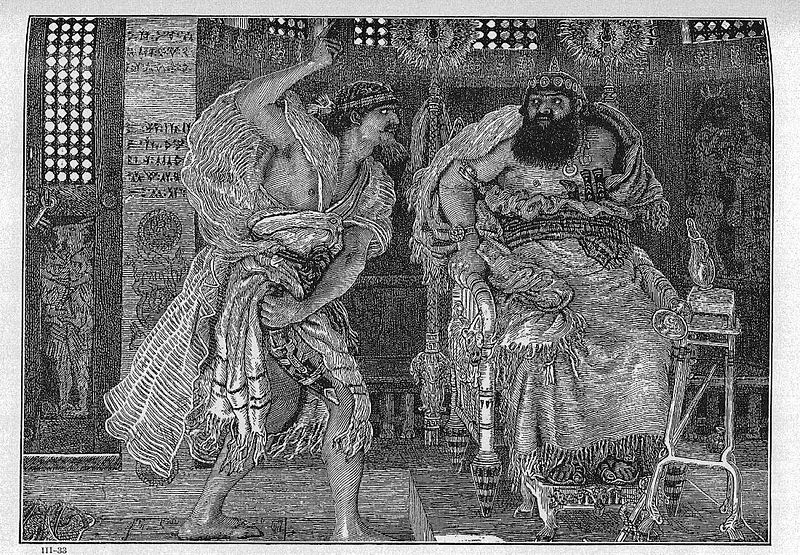 Ever notice that the Bible is like an action movie? There are some seriously amazing stories in the Bible. Judges is full of them. Some of these stories can really make people think, whether they believe the Bible is the Word of God or not.
Take Ehud. His story would make a really awesome action movie. It’s recounted in Judges 3:12ff. Here are the highlights:
The Israelites sin. The LORD punishes them by sending Eglon, King of Moab. Eglon gets some allies of his to come with him and they beat up Israel. The Israelites cry out for help, and the LORD sends help for them. Enter Ehud, the assassin. Ehud is left-handed, and the king’s body guards don’t discover his weapon (probably because they didn’t bother to search his right side–his sword would be on opposite hand to make it easier to draw). Ehud asks for a private audience and Eglon grants it. Ehud stabs Eglon so hard that it sinks all the way into the portly man’s flesh. Leaving his blade behind, Ehud escapes and rallies the troops, who unite around their new leader. He then strikes ten thousand Moabites down with his army, and none escape.
Yeah, it could make a pretty epic action movie. But what about a Bible story? How are we supposed to take this story in the context of Scripture? Note once more the beginning of the story: the Israelites did evil (Judges 3:12). Throughout Judges, we see the same pattern: the Israelites do evil, and God punishes them by oppressing them with one of the nations in the area. Then, the Israelites realize their evil, and they cry to God, repentant, and ask Him for help. He delivers them from their enemies, and there is peace in the land.
What can we take away from this story? Does it show another instance of evil in the Bible which Christians must hide? No, rather it shows the story that we can see woven throughout the Scriptures: a story of redemption and peace with God. Because of Jesus, we now live in an era in which we no longer have to wait for a deliverer, as Israel did. We’re told that all people have sinned and fall short (Romans 3:23), just as the Israelites did. And we all deserve punishment. But when we cry out to God, we know there is a redeemer close at hand. God forgives our sins because of Christ, and we can live in peace.
The cycle in Judges is repeated over and over. It reflects a time in which everyone did what they willed (Judges 21:25). God came to His people with the understanding they had. But in our time, we have Jesus who died once for all. The cycle is broken, and we may enjoy eternal peace.
See Judges 3 for more on Ehud.
This is part of a continuing series on “Awesome Person(s) of the Bible.” Other posts can be found here.
SDG.
——
The preceding post is the property of J.W. Wartick (apart from citations, which are the property of their respective owners) and should not be reproduced in part or in whole without the expressed consent of the author. All content on this site is the property of J.W. Wartick and is made available for individual and personal usage. If you cite from these documents, whether for personal or professional purposes, please give appropriate citation with both the name of the author (J.W. Wartick) and a link to the original URL. This blog is protected by Creative Commons licensing. By viewing any part of this site, you are agreeing to this usage policy.
Really Recommended Posts 9/16
 Yes the picture is another pun. I know, I know.
Infatuation with the “New” a Defense of the Old– Ever catch yourself latching onto something just because it’s the latest thing on the block? You’re not alone. But there’s something to be said for this infatuation of the “new.” Check out this excellent post on the topic.
The Dead Sea Scrolls- Biblical Archaeology– the 32nd in a series of posts at Theosophical Reuminations by Jason Dulle on… you guessed it, Biblical Archaeology. Really a phenomenal series. I can’t stress enough how much I think readers should check out the whole thing.
Imaginative Apologetics: A Reflective and Analytical Review– You won’t often see links to book reviews on my recommended posts, but I think this is a very interesting review. I have not read the book, but it seems the basic premise is that we must use our imaginations when it comes to a defense of the faith. Really interesting read.
Could a universe create itself?– There is some confusion among astronomers and physicists of late. Stephen Hawking proposed the universe could create itself. Lawrence Krauss argued in his debate with William Lane Craig that “nothing” has potential to create. Edgar Andrews, author of the book Who Made God? (my review here) addresses these arguments clearly and succinctly. Highly recommended.
The Essence of Every False Religion– No Apologies Allowed is one of my favorite apologetics websites. Most often, comics are featured–with a video here and there. They all give me food for thought. After checking out this link/comic, check out the rest of the site!
Christian Responses to 9/11– a list of Christian Apologetics Bloggers’ responses to 9/11.
Book Review: “Hidden Treasures in the Book of Job” by Hugh Ross
 Hidden Treasures in the Book of Job
Ross begins with an exhortation to Christian leaders to stop avoiding the issue of Creation and to come up with a reasonable “strategy of engagement. Christians who take the Bible as a trustworthy revelation from God need to study science and engage with scientists at the highest academic and research levels” (12). I pray Ross’s words will not fall on deaf ears.
Ross goes on to point out the historical backdrop of the book. The debaters present, Job, Eliphaz, Zophar, and Bildad were “likely the intellectual powerhouses of their day…” (28). Along with Elihu, who most likely recorded the book, they comprise the major characters. Interestingly, Eliphaz was named as a Temanite. Teman, Ross points out, “was famous in the ancient world for its exceptionally wise scholars” (28). Contrary to some who may accuse Ross of demeaning the historical value of Scripture, it is clear that he affirms the historical realism of the Book of Job.
Interestingly, HTBJ doesn’t start with the scientific questions; it dives in to “timeless questions” about God. Ross points out answers given throughout Job about the reason for death (39-40), the shorter lifespans of humans (40-41), blessings for the wicked (43ff), and more. Ross provides an argument about what is often called “natural evil.” He points out Job’s rejection of a “direct cause-and-effect relationship between destructive natural events and the people affected by them” and goes on to argue that scientifically, these “acts of God” are necessary for life (49). Hurricanes, for example, bring a number of benefits (51).
Ross quickly moves into scientific questions throughout the book of Job. He argues that God’s challenges to Job and friends reject naturalism, deism, evolutionism, and young-earth creationism (54). Job specifically points out that God continually interacts with creation. Perhaps most interestingly, Ross points out that in Job the Bible specifically points towards the Big Bang–with language of God “stretching out the heavens.” This, thousands of years before any scientific evidence existed (56-58). Not only that, but the book also alludes to dark matter. Rather than treating darkness as the “absence of light” as was the belief historically, Job points out the actual existence of darkness and its separation from light. Here again there is evidence that Job lines up powerfully with science (60-63).
Another fascinating aspect of the Book of Job, argues Ross, is its ability to speak to current situations like Global Warming (63ff).
Central to Ross’ argument in HTBJ is the thesis that the book of Job can be used as an interpretive backdrop for the Genesis creation account. Ross argues that Job 38-39 can be read in their entirety as a creation account (72). This opens the gate for interpreting other creation accounts through the lens of Job 38-39. He points out that there are areas of Moses’ creation account that Job makes explicit. Some of these points include a correct interpretation of “heavens and earth” (74); an outline of when plants were created (78-79); and perhaps most interestingly, one of the best explanations of the problem of light before the sun I’ve ever seen (80-84). Ross argues that, contrary to most interpretations, the Genesis account does not explicate that there was no sun before light, but rather that the light had been hidden by the atmosphere (82-83). Again, this would serve as powerful scientific confirmation of the Bible.
Ross is unafraid to pull his punches. He takes on the question of the extent of the flood (92ff) and argues convincingly that the flood was localized to all of humanity. Perhaps the most controversial point Ross makes is in regards to one of the best arguments for young-earth creationism–death and the Fall. Often, the young-earth argument is that the Bible excludes any possibility of death before the Fall. Ross argues that, given Job 38-39’s creation account, that interpretation can no longer be valid. He urges that Job 38:39-41 coincides with creation day five, and because these verses include death before the fall, this argument for a young-earth is unsuccessful. Ross’s argument here will really depend upon how convincing his assertion is that all of Job 38-39 lines up with the days of creation. Ultimately, I think, most young-earth creationists will remain unconvinced and argue that only the early part of Job 38 is a creation account. In Ross’s favor is the continuing tense (it appears as though the verbs throughout the section are in the Qal stem). But Ross doesn’t make this argument. Thus, it seems that this part of Ross’s argument will be convincing only to those willing to agree that Job 38-39 are, in their entirety, a creation account.
Later, Ross soundly demolishes the young-earth argument that Job provides evidence for dinosaurs living with humans. He convincingly argues that the behemoth is a hippopotamus (178-180) and the leviathan a crocodile (180-183).
Ross doesn’t leave the book of Job without discussing what seems like its primary question: suffering. He presents evidence that Job argues for both a greater good theodicy along with a free-will defense (190ff). Both of these sections are interesting, if brief.
There are many areas of interest within HTBJ I have left unexplored. Ross focuses extensively on soulish creatures and the differences between humans and animals. Most interestingly is Ross’s explication of the list of 10 “soulish” creatures named in Job and their import for humans (150-165). Suffice to say that there is much more content in the book worth reading.
There were times as I read Hidden Treasures in the Book of Job that I was filled with marvel at the magnificence of creation. At one point I stood up and surprised my wife, saying “Can you believe what God has made? And we know it from the Book of Job! Can you believe this!?” as I described some of the things Ross reveals in the book. There are some astounding ways that the Bible lines up with the evidence we have from cosmology, astronomy, biology, and other sciences. While some Christians may remain unconvinced by Ross’s argument for interpreting Genesis 1 through the lens of all of Job 7-39, the book deserves a reading and response by even those who disagree. Ultimately, readers of Hidden Treasures in the Book of Job will come away with some powerful evidence from science for the truths of Scripture–and vice versa.
Disclaimer: I was provided with a review copy of this book by Reasons to Believe. You can learn more about this science-faith think tank at reasons.org.
Source: Hugh Ross, Hidden Treasures in the Book of Job
SDG.
——
The preceding post is the property of J.W. Wartick (apart from citations, which are the property of their respective owners) and should not be reproduced in part or in whole without the expressed consent of the author. All content on this site is the property of J.W. Wartick and is made available for individual and personal usage. If you cite from these documents, whether for personal or professional purposes, please give appropriate citation with both the name of the author (J.W. Wartick) and a link to the original URL. This blog is protected by Creative Commons licensing. By viewing any part of this site, you are agreeing to this usage policy.

 J.W. Wartick - Reconstructing Faith
