Christianity
Can we evaluate worldviews? How to navigate the sea of ideas.
Think about it this way: worldviews are supposed to be reality. If a worldview does not match reality, how can it be reality?

I recently began a series on the truth claims of Mormonism. In that post, I asserted that there is positive evidence against the truth of the Book of Mormon. However, there is an important step to take before offering arguments against other religions. Namely, one must establish that evidence against the truth claims of a religion should rationally lead one to abandon that religion. (A related but similar point would be the positive evidence for religion leading to rational belief.)
Thus, before I continue to offer critiques of other religions, I offer some epistemic groundwork.
Truth Claims and Worldviews
First, it must be noted that worldviews are not mere matters of feeling, regardless of what the supporters of the varied views claim. For example, if one says “You can’t analyze what I believe, it’s just a matter of faith” they are making a claim about reality–that their faith cannot be analyzed. Similarly, if one claims “Israelites sailed to the Americas from the Middle East,” [Mormonism] or “There is no God” [atheism] they have made a claim about reality.
Such truth claims are capable of analysis, by definition. Statements are true or false. All worldviews make claims about reality, which are therefore true or false. Simply stating that one’s belief is “just faith” or “obvious” does not exclude it from making claims.
 How Do We Evaluate The Claims of Worldviews?
One’s beliefs should conform to reality, if one seeks to be rational. Certainly, one could say “To heck with the evidence, I’m going to believe x, y, and z! I don’t care if I can’t support the belief and that there is strong evidence against x, y, and z.” But if one were to say this, one would abandon their reason. Their heart could believe, but their mind could not. Ultimately, all truth claims can and should be put to the test.
Testing the claims of varied worldviews is no easy task. There must be objective criteria, otherwise one view will be favored over another. One cannot simply make their own view the default and argue that only by filtering truth claims through their position can truth be attained. Atheism, by no means, provides a neutral basis for evaluating religions, as I’ve argued elsewhere. In fact, atheism must past the standards for truth claims, just as any religion must. If one remains an atheist despite positive evidence to the contrary (or despite reasons to disbelieve the claims of varied atheistic worldviews like materialism), one abandons reason just as if one clung to a false faith.
Testing Worldviews as Hypotheses
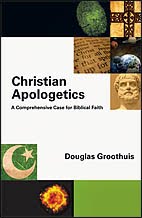
In his monumental work,Christian Apologetics, Douglas Groothuis argues that worldviews can be proposed as hypotheses. Worldviews present themselves as answers to explain the phenomena we experience (Groothuis, Christian Apologetics, 49). Groothuis therefore presents criteria for evaluating worldviews as though they were hypotheses about the world. Kenneth Samples similarly draws out nine tests which can be used to determine whether the claims of a worldview are true in his book A World of Difference (page numbers from that text, citation below). From these proposed methods, we can derive tests to evaluate competing worldviews:
1) Coherence– if a religion is contradictory, it simply cannot be true. For example, if a religion claimed that “Person Z is god, and person Z is not god,” that religion would be incoherent (Samples, 33). Furthermore, “If a worldview’s essential propositions are coherent… it is more likely to be true than if its essential propositions are not related in this way” (Groothuis, 55).
2) Balance– “A valid worldview will be ‘neither too simple nor too complex.’ All things being equal, the simplest worldview that does justice to all aspects of reality deserves preference (Samples, 33-34).
3) Explanatory Power and Scope– Does the worldview explain what we experience in enough detail? If a worldview does not explain our world, or it cannot account for certain phenomena, then it is lacks explanatory power (Samples, 34). Worldviews which make propositions which they cannot account for lose credibility (Groothuis, 53).
 4) Correspondence– Does the worldview match the facts we know about the world to our experience of the world? If we know that the worldview in question promotes claims we know are false, it does not match reality (Samples, 34-35). Think about it this way: worldviews are supposed to be reality. If a worldview does not match reality, how can it be reality? We are able to test factual claims through empirical and scientific methods, so if a worldview continually is able to establish its essential claims by means of these methods, it is more likely to be true (Groothuis, 55).
5) Verification– Can this worldview be falsified? Worldviews which cannot be found to be false cannot be found to be true either.
6) Pragmatic Test– Can we live by this worldview? This test is less important, but still has credibility–we must be able to live out the worldview in question (Samples, 35-36). But worldviews should also be fruitful in the development of greater intellectual and cultural discoveries (Groothuis, 57).
7) Existential Test– Like the pragmatic test, this one is not as important as whether the view is factual, but it is still helpful. If worldviews do not account for inherent human needs, it is possible the view is false (Samples, 36). Again, this is not necessary for a worldview, but it helps measure a view’s completeness.
8 ) Cumulative Test– Does the worldview gain support from all the previous criteria? If a worldview is able to satisfy all the criteria, it gains credibility (Samples, 36-37).
9) Competitive Competence Test– If the worldview satisfies the previous criteria with more evidential power than other worldviews, it gains credibility over and against them (Samples, 37).
10) Radical ad hoc readjustment– Groothuis presents this as a negative test for worldviews. “When a worldview is faced with potentially defeating counterevidence, an adherent may readjust its core claims to accommodate the evidence against it. Various theories and worldviews can legitimately refine their beliefs over time, but radical ad hoc readjustment reveals a deep problem…” (Groothuis, 57). There is, as Groothuis pointed out, a line between refining belief and simply readjusting belief in an ad hoc way. If, for example, it were discovered that Jesus did not rise from the dead, then Christianity would be false (more on that below). If, however, one simply adjusted Christianity to say “Jesus spiritually rose from the dead,” that would constitute a desperate, ad hoc measure to preserve the worldview and count as discrediting Christianity.
These tests present objective criteria for testing worldviews. If, for example, one wished to deny their worldview had to be coherent, they’d have to affirm that which they denied, for in denying that criterion, they were attempting to make their view more coherent. The testing of worldviews is a legitimate task, and indeed one in which people should engage. Some things, if falsely believed, are harmless (for example, if one believed it rained yesterday when it did not). Worldviews, however, if falsely believed, are damaging on any number of levels. If one believed God didn’t exist when, in fact, He did, then one would be doing a great evil by not acting upon the truth of God’s existence (and the contrary). Thus, the testing of worldviews is no task to be skimmed over, but one which should be approached with fear and trembling. The criteria outlined above allow people to engage in this task and evaluate the realm of ideas.
Christianity Encourages Exploration of Reality
What I find extremely interesting is that Christianity, unlike many world religions, doesn’t discourage the discovery of truth, nor does it evade evidence by claiming that it is merely a faith or feeling. Rather, the founders of Christianity explicitly stated that it is based upon certain truth claims, and that if those claims are false, then Christianity is worthless. Paul, for example, wrote “And if Christ has not been raised, your faith is futile; you are still in your sins” (1 Corinthians 15:17). The truth of Christianity rests exactly upon a testable claim: Jesus rose from the dead. If He did not, Christianity is false. Christianity’s scope and explanatory power are superior- it can account for the existence of contingent objects, persons, consciousness, life, and the like. Christianity corresponds to reality, satisfies existential and pragmatic needs, is simpler than many other explanations, its coherent, and it matches all the criteria. Christianity expects its adherents–and outsiders–to test the faith and discover whether it is true. I have found, personally, that it pasts these tests over and over.
Conclusion
Whether one agrees or not, it is simply the case that religions make claims about reality. These claims are, in turn, true or false. Not only that, but they must match with reality in several important ways. Christianity not only adheres to these tests, but it encourages them. It also passes these tests. Does your worldview?
Sources
Douglas Groothuis, Christian Apologetics (Downers Grove, IL: InterVarsity, 2011).
Kenneth Samples, A World of Difference (Grand Rapids, MI: Baker, 2007).
Image Credit
I took this picture at Waldo Canyon near Manitou Springs, Colorado on my honeymoon. Use of this image is subject to the terms stated at the bottom of this post. The other image is the book cover from Samples’ book.
SDG.
——
The preceding post is the property of J.W. Wartick (apart from citations, which are the property of their respective owners) and should not be reproduced in part or in whole without the expressed consent of the author. All content on this site is the property of J.W. Wartick and is made available for individual and personal usage. If you cite from these documents, whether for personal or professional purposes, please give appropriate citation with both the name of the author (J.W. Wartick) and a link to the original URL. This blog is protected by Creative Commons licensing. By viewing any part of this site, you are agreeing to this usage policy.
Really Recommended Posts 10/22
 Why Do Atheists Talk So Much About Religion?– A short, interesting post with a self-explanatory title. Check it out.
Ah, Richard Dawkins, when will he learn that attacking people doesn’t make their views wrong? His buddy PZ Myers has actually attacked me personally as well, but that’s beside the point. Check out Max Andrews’ thoughts on Dawkins refusing to debate Craig. Dawkins, of course, enlists the help of his yes man Myers.
Undesigned Coincidences and the Historicity of the New Testament– This is a great apologetics video making the rounds. The “undesigned coincidences” argument is one which is slowly seeing a revival–in part due to Dr. Tim McGrew, a friend of mine and a phenomenal philosopher. Check it out.
A Review of “The Magic of Reality”– Dawkins has been adamant that we should not indoctrinate our children. Yet his new book is intended to do just that: indoctrinate children with atheism. Check out this timely review over at Deeper Waters.
Sharing the Gospel – 10 Surprisingly Simple Tips for Talking with Cult Members (part 1)– it is what it says… some great hints for witnessing when the cults come a-knockin’.
The Book of Mormon, 1/18– part one of a series in which an apologist reads through the Book of Mormon. Great stuff.
William Lane Craig vs. Stephen Law- Thoughts and Links
Recently, William Lane Craig debated Stephen Law on the topic “Does God exist?” Remember the topic as I review the debate.
Craig 1
William Lane Craig presented a different set of arguments from his normal 5. This time, he argued the cosmological and moral arguments along with the argument from the resurrection. My guess is that the short time allowed was the reason for this change of strategy. Craig argued that actual infinites cannot exist in reality. He pointed out that transfinite math simply does not allow addition or subtraction of infinity, because it is absurd, but in the real world, if an infinite did exist, nothing could prevent it from having things added or taken away. Thus, Craig concluded, there cannot be an infinite past.
He then briefly outlined the empirical case for a finite past, citing Borde, Guth, and Vilenkin’s paper which shows that every model of the universe’s past must account for entropy, and therefore must be finite. I don’t want to get sidetracked from my review of the debate here, but so many people seem to either ignore or miss the point of this argument. It’s not that entropy only disallows an infinite universe that is one state, rather, entropy disallows an infinite past for oscillating universe models, bubble universes, and any other types of strategies people have tried to raise in order to rebut cosmological arguments. I recently got an e-mail in which someone said I’m being dishonest by only referencing the Big Bang as evidence for a finite universe, when there may have been previous universes. Well that’s simply wrong, even if there were previous universes, they would have to take entropy into account. If the past is infinite, all the energy available for the generation of universes would have been used up.
Anyway, Craig went on to argue the moral argument: If objective moral values exist, then God exists. They do, so God does. A great point Craig made is that any argument against the existence of objective moral values must rely upon premises which aren’t as plausible as the objective morals themselves. That’s an excellent point that many tend to ignore.
As far as the resurrection is concerned, Craig presented the “three facts” argument. He pointed out that three facts are agreed upon throughout scholarship on the topic: that the tomb was found empty, different individuals saw appearances of Jesus alive after his death, the disciples’ belief in Jesus resurrection despite having every predisposition to the contrary. These facts, argued Craig, are best explained by Jesus’ resurrection.
Law 1
Law began by arguing about animal suffering. He said that the extraordinary amount of suffering which is experienced by animals every day is such that it can weigh against the existence of God. He noted that some people dismiss this as “merely animals” but argued, “I wonder if they’d say the same thing if I took a red hot poker to their… cat.” Note how Law distorted his original argument, however. Certainly, I’d be extraordinarily angry with Stephen Law if he took a hot poker to my cat (I don’t have one any more but I used to). But the reason would be because Law is a moral agent. He is capable of knowing what he’s doing, and would clearly have to be sadistic in order to do such an action. If, however, an eagle came and carried my cat away, I would be extremely upset, but I would not accuse the eagle of having done a morally wrong action, because the eagle is not a moral agent. Yet Law used that very emotional image of himself–a moral agent–as an analogy for animal suffering. There’s clearly a major issue with such an argument.
Law went on to argue that there’s no reason to think that the God whose existence Craig is arguing for is not an evil god. Here I think Law had some decent points… for arguing against bare theism, but not against Christianity (see “Analysis” below). He argued that for certain theodicies, there can be parallel arguments constructed for an evil god. He also noted that Craig’s arguments could work just as well for an evil god (a notable exception would be the moral argument, more on that later… and it’s pretty hard to see how the resurrection would fit into his ‘evil god’ scenario). Law also argued that if the good in the world refutes an evil god, the evil in the world should refute a good God. Law didn’t do anything to rebut Craig’s arguments for the existence of God.
Craig 2
Craig quickly attacked Law’s appeal to emotion with animal suffering. He noted that it was very much anthropopathism to assume that animals had the same response to suffering as humans. In fact, he went on to note three hierarchies of suffering, and pointed out that animals do not have the capacity to be aware of the fact that they are suffering. So despite the suffering of animals, they are not even aware of that fact–something which Craig credited to God’s mercy. Animal suffering, he argued, is also necessary for a number of reasons, one of which is the stability of ecosystems. Without predation, all life on earth would be wiped out. Thus, it is fair to say that animal suffering fits into the divine plan.
Craig countered Law’s argument about the ‘evil god’ by noting that the moral argument specifically rebuts Law’s assertions. Not only that, but Law was arguing against a kind of theism which does not exist. Christians don’t survey the world and conclude God is good, rather, they believe God is good because that’s the type of being God is, necessarily.
Craig presented a number of reasons for thinking a good God would allow evil, which would therefore discount the rebutting evidence of evil. He also agreed with Law that looking at the world alone would lead to a draw, but that, as already noted, the moral argument and the type of being God is would defeat an ‘evil god’ scenario.
Law 2
Law argued that Craig had made a straw man of his position by saying that theism is not inductive. Then he went on to argue that the moral argument is the only one Craig can rely on to establish the goodness of God. He cited Swinburne as a Christian who did not believe objective morality relies on God. He ended his second segment by arguing that surely there is enough evil in the world to make the existence of God improbable.
Craig 3
Craig noted that Law has a strange kind of atheism which grants the existence of God but attacks the character. He pointed out that Law had still not rebutted any of his arguments, but focused merely on the character of God. He also pointed out that appealing to Swinburne was a mere appeal to authority and that he could cite a number of atheistic philosophers who agreed with his premises.
Law 3
Law argued that there are no objective moral values (curious, considering the citations Craig read in the debate). He then attempted to rebut the argument from the resurrection by citing an instance where a number of people believed they saw a UFO when it was really the planet Venus.
Craig Conclusion
Craig once more noted that Law had yet to rebut any of his arguments and that Law persisted in maintaining a strange atheism in which God exists, but may or may not be good. He noted that Law’s attempt to rebut the resurrection did not take into account the religio-historical context of that event and that all claims of experience must be measured by objective criteria, which the resurrection passes. He concluded that because his arguments stood undefeated, God exists.
Law Conclusion
Law basically said “why not believe in an evil god?” and argued that Craig still did not justify objective morals.
Analysis
Law came in with a pretty interesting argument which was unfortunately not the topic of the debate. I think it would be really interesting to see Law vs. Craig on a topic like “Is God good?” His arguments had some weight, but I think Craig did an excellent job rebutting them while remaining on track. Law essentially ignored the cosmological argument and put the topic of the debate aside in favor of arguing about whether God is good. As far as the topic of the debate goes, it’s clear that Craig established the existence of God. In fact, Law was essentially granting that point (in the Q&A he argued that it is not the case that because he didn’t rebut the arguments, he agrees God exists… but it is important to note that he did not rebut the arguments so, on the face of it, it seems that the arguments stand unchallenged). As far as Law’s good points go, I think he had the best points I’ve seen an atheist raise in a debate with Craig so far, but Craig was able to adequately rebut them while sustaining his primary argument: that God exists.
Finally, on the “evil god” hypothesis: Law failed to realize that the concept of “greatest possible being” is central to Christian theism and did not take that into account. Craig perfectly illustrated this when he acknowledged that a “creator” on its own cannot be shown to be good or evil, but went on to point out that that doesn’t affect Christian theism, which holds that God is the greatest possible being. Law was, in a sense, arguing against “bare theism,” which is, as he points out, incoherent. Yet Craig was arguing to establish the Christian God–the greatest conceivable being. Law’s arguments therefore seem to only underscore the coherence of Christian theism, by demonstrating that only with a correct concept of God can theism be coherent.
[The following section in brackets added after the post was up and had several comments.]
[I’d like to point out more explicitly why Law’s argument doesn’t work. The reason is because his concept of ‘god’ is incoherent. Theism claims that God is the greatest possible being. But Law is arguing that this being could be evil. Each of his arguments about the evil god were designed to argue that God ‘could be’ evil. But then Law would have to assert that evil is a property such that it makes beings great. I don’t see how he could argue this. He’d have to first argue the ontological reality of evil–which would establish the existence of objective morality and thus back up Craig’s moral argument. Then he’d have to argue that evil is, in fact, a property. Finally, he’d have to establish that evil is a great-making property. I don’t see any way he could possibly do this, and the burden of proof is definitely upon him to show these concepts are coherent. Unless and until he does that, his arguments are simply incoherent.]
Links
Stephen Law, his evil god, and radical skepticism– I analyze Stephen Law’s evil god challenge further and conclude that it entails radical skepticism.
http://www.premier.org.uk/unbelievable– follow the rest of Craig’s tour through England.
Download the debate at Apologetics 315.
Check out more analysis of the debate at Thinking Matters.
Was Stephen Law Guilty of a Bait and Switch?
An analysis of Law’s argument for an “evil god.”
Doug Geivett writes about “The Missing Ontological Argument” and Law’s misunderstanding of theism.
SDG.
——
The preceding post is the property of J.W. Wartick (apart from citations, which are the property of their respective owners) and should not be reproduced in part or in whole without the expressed consent of the author. All content on this site is the property of J.W. Wartick and is made available for individual and personal usage. If you cite from these documents, whether for personal or professional purposes, please give appropriate citation with both the name of the author (J.W. Wartick) and a link to the original URL. This blog is protected by Creative Commons licensing. By viewing any part of this site, you are agreeing to this usage policy.
The Book of Mormon: Introduction and Importance
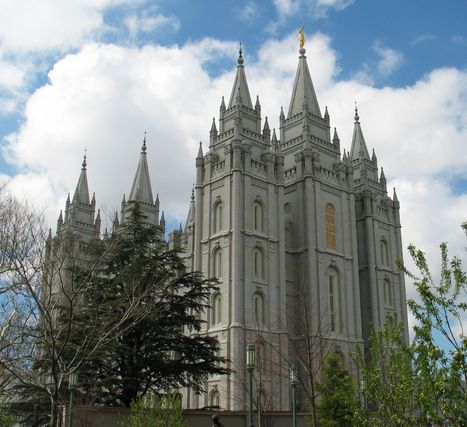 Mormonism is growing with great speed. There are few, however, who understand the limits of Mormonism’s truth claims. Mormon apologists have frequently made assertions which are either false or ungrounded. I have therefore decided to write a series of posts on the Book of Mormon, followed by a critique of Mormonism’s philosophical stances. This post will introduce the book of Mormon.
A man was born on December 23, 1805 in Vermont. He was known for digging for imagined buried treasure with his father and others.[1] He was also known for being a mystic,[2] for his conviction for disorderly conduct in a scam in which he tried to convince locals he had found treasure underground,[3] and for being the translator of golden plates: The Book of Mormon.[4] The man was Joseph Smith, Jr., the founder of the Mormon faith, “The Prophet.”[5] The Book of Mormon, according to the Church of Jesus Christ of Latter Day Saints (the official name of the Mormon Church), is “another witness that Jesus Christ… was and is God’s Son… It supports and verifies the Bible.”[6] If this is true, then the Book of Mormon is as much the Word of God as the Bible. However, the Book of Mormon’s validity as the Word of God is strongly undercut by scientific and historical evidence which contradicts its claims.
The Mormon Articles of Faith describe the Book of Mormon as “a volume of sacred scripture which, like the Bible, embodies the word of God.”[7] The Book of Mormon is supposed to record other prophecies about Jesus.[8] Perhaps the most striking enunciation of the contents of the Book of Mormon is found later in the Articles:
The Book of Mormon is a divinely inspired record, made by the prophets of the ancient peoples who inhabited the American continent for centuries before and after the time of Christ, which record has been translated in the present generation through the gift of God and by His special appointment. The authorized and inspired translator of these sacred scriptures… is Joseph Smith.[9]
Furthermore, the arguments for the authenticity of the Book of Mormon often parallel those arguments used to justify the Bible: it is said to be “internally consistent,”[10] prophetically fulfilled,[11] and supported by archaeology.[12] Yet there are also arguments unique to the Book: it was certified as genuine by three men who signed a statement confirming they witnessed the translation of the Book,[13] eight other witnesses claimed to have seen the gold plates from which the Book was purportedly translated,[14] and the ethnic background of Native Americans is said to be Israelite, which would demonstrate the Book’s truth.[15] It is clear that the Book of Mormon is the absolute bedrock of Mormon faith. If the evidences for the Book do not hold the evidential weight required to confirm its truth, then Mormon faith is undone.
The Book of Mormon’s veracity hinges on the claim that the lost tribes of Israel came to America, settled there, and wrote their history on gold plates which Joseph Smith later translated. Such claims at the time of Joseph Smith seemed irrefutable; they simply couldn’t conceive of technology which could test such ideas. Today, however, such technology is available. Unfortunately for Joseph Smith and the Mormon Church, the evidence runs contrary to what the Book of Mormon claims.
Over the coming weeks, I’ll investigate each of these claims in turn, while finding them wanting. The next post will demonstrate that the Book of Mormon cannot be true based upon a genetic analysis of Native Americans. Future posts will argue that the Book of Mormon does not reflect ancient near eastern writing and that the Mormon concept of God is philosophically untenable.
[1] Walter Martin. The Kingdom of the Cults (Bloomington, MN: Bethany, 2003), 197; Jerald and Sandra Tanner, Mormonism: Shadow or Reality? (Salt Lake City, UT: Modern Microfilm Company, 1972), 32.
[2] Martin, Kingdom, 197
[3] Wayne L. Cowdrey, Howard A. Davis, and Arthur Vanick, Who Really Wrote the Book of Mormon: The Spalding Enigma (St. Louis: Concordia, 2005), 395f.
[4] Martin, Kingdom, 201.
[5] Ibid., 197f.
[6] The Mormon Church, “Frequently Asked Questions,” The Church of Jesus Christ of Latter Day Saints, http://www.mormon.org/faq/#Book+of+Mormon|question=/faq/what-is-book-of-mormon/ (accessed October 14, 2010).
[7] James Talmage. A Study of the Articles of Faith (Salt Lake City, UT: The Church of Jesus Christ of Latter-day Saints, 1976), 251.
[8] Talmage, Articles of Faith, 252.
[9] Talmage, Articles of Faith, 255.
[10] Ibid, 278-279.
[11] Ibid, 274-275.
[12] Ibid, 283-293.
[13] Ibid, 270.
[14] Ibid, 271.
[15] Ibid, 283.
Image Credit: http://commons.wikimedia.org/wiki/File:Slc_mormon_tempel.jpg
SDG.
——
The preceding post is the property of J.W. Wartick (apart from citations, which are the property of their respective owners) and should not be reproduced in part or in whole without the expressed consent of the author. All content on this site is the property of J.W. Wartick and is made available for individual and personal usage. If you cite from these documents, whether for personal or professional purposes, please give appropriate citation with both the name of the author (J.W. Wartick) and a link to the original URL. This blog is protected by Creative Commons licensing. By viewing any part of this site, you are agreeing to this usage policy.
Really Recommended Posts 10/15/11
 Mexico City Proposes Temporary Marriages– Yeah, it’s crazy.
On Symbiosis– Paul Adams points out a simple, but important point. Check it out.
Is Intuition an Unjustifiable Reason for Faith?– Great post by Erik Manning on the use of of intuition and issues of faith.
What is True Christianty?(tm)– at Josiah Concept Ministries, a great discussion of what makes someone a Christian (or not).
Humorless Humanist Humor– At “No Apologies Allowed”–a great comic showing the bankruptcy of humanism.
Is Mormonism a Cult?– A phenomenal side-by-side comparison of Christianity and Mormonism.
Richard Swinburne on “A skeptical age.”
Book Review: “My Christian Apology” by Martin Murphy
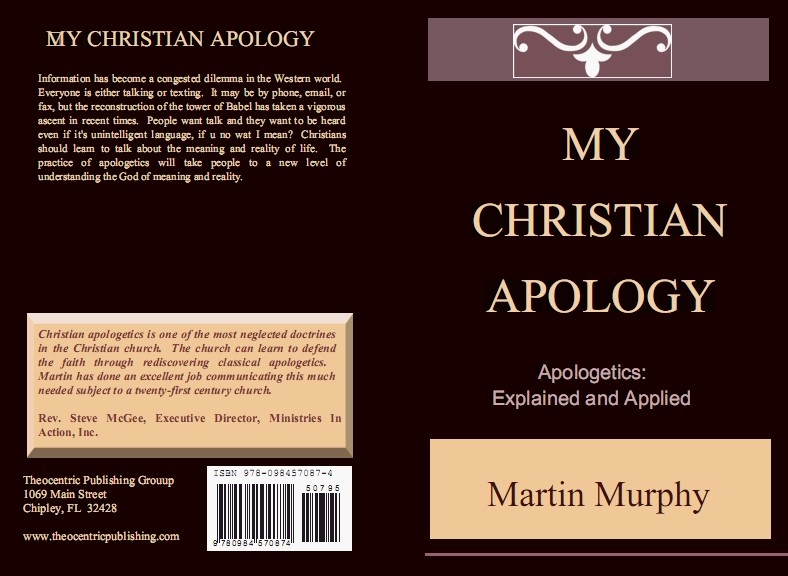 My Christian Apology by Martin Murphy provides some unique insight into apologetics. Rather than focusing upon arguments for the existence of God or methodology at the expense of historical understanding, Murphy grounds both arguments and method in history.
The book starts off with some introductory notes. What is apologetics? How do we communicate apologetics? These sections provide the groundwork of many apologetics texts. But Murphy quickly differentiates his work from most standard introductions to apologetics. His book focuses largely on epistemology and its relation to apologetics.
Murphy does a great job of making these concepts accessible to general readers. He defines epistemology (19) and then gradually eases the reader into its various applications to apologetics (19ff). A central theme throughout is that unbelievers and Christians have common grounds from which they can start discussions. One of these common grounds is Natural Law, which Murphy goes into at length (65ff). Natural Law has been repudiated by many modern thinkers, but it is grounded in Scripture and has a great theological base. I’ve reviewed a Lutheran book on the topic which I think helps show how useful Natural Law is. Murphy points out that Natural Law can provide a basis for knowledge of God. “If we know we are transgressors then we know we have violated the law of God” (73). This knowledge is not saving knowledge, but it provides a basis for judgment (84) and, I think, a possible common ground for apologetics.
Another strength of Murphy’s work is the focus upon historical apologetics. He cites Jonathan Edwards at length and in numerous places while exploring Edwards’ applications to apologetics (see 20-21, 29, 36, etc.). He also emphasizes the works of Southern Presbyterians in the area of apologetics. The historical background is a great quality of the work and one that I think Christian Apologists often fail to emphasize or utilize.
There is some emphasis on theology in My Christian Apology as well. Murphy’s discussion of natural law leads to a drawing out of the “noetic effects of sin.” Again, the points Murphy raises are clear and concise. Some readers will disagree, but all will be challenged. I find this account eminently plausible and I think that even those who disagree need to at least account for the Biblical case for original sin.
Martin Murphy’s My Christian Apology is a brief work that has a ton of great information packed into it. Questions that other basic apologetics books tend to avoid are treated with precision and lucidity. The emphasis on historical apologetics leads to many insights readers won’t find in other introductory works. I recommend that readers use this book along with other basic apologetics books in order to develop a more well-rounded apologetic method.
Source:
Martin Murphy, My Christian Apology (2010).
SDG.
——
The preceding post is the property of J.W. Wartick (apart from citations, which are the property of their respective owners) and should not be reproduced in part or in whole without the expressed consent of the author. All content on this site is the property of J.W. Wartick and is made available for individual and personal usage. If you cite from these documents, whether for personal or professional purposes, please give appropriate citation with both the name of the author (J.W. Wartick) and a link to the original URL. This blog is protected by Creative Commons licensing. By viewing any part of this site, you are agreeing to this usage policy.
Is God just lucky?: Possible Worlds and God’s Providence, a Defense of Molinism

Knowing all the possible circumstances, persons, and permutations of these, God decreed to create just those circumstances and just those people who would freely do what God willed to happen. (William Lane Craig, 86).
I’ve argued previously that molinism allows for human freedom and God’s perfect knowledge of the future. One objection which has been raised to my argument is that, granting all of it, it would seem that God is just really lucky that the world He wants to actualize is possible. Looking back, we can see that the argument flows from the logical priority of God’s knowledge. Central to my defense was the notion that the possible worlds are full of the free choices of creatures. The objection therefore argues that God must simply “get lucky.” There must be a possible world which God actually wants to actualize.
The argument would look something like this:
1) God can only create that which is possible
2) The set of possible worlds covers all possibilities.
3) Therefore, if there is a world which God wants to create, He would have had to be simply lucky–there would have had to be a possible world that contained the outcomes God desired.
The objection is quite thoughtful. It is not easy to resolve. Before rebutting this objection, it is important to note that the set of all possible worlds is the same whether one is a determinist, open theist, or molinist. Granted, open theists deny that this set would include future contingents, but for now that is irrelevant. All the positions agree the set of possible worlds includes no contradictions. Thus, any position must account for the “God got lucky” objection.
I believe that molinism offers a way around this difficulty, and it does so by again focusing upon logical priority. William Lane Craig’s quote above illustrates this. God’s will is at the forefront. I suggest that God’s will is logically prior to the set of possible worlds. Consider the following argument, which focuses upon the redemption (as one of the outcomes God would desire):
1) God only wills what is possible
2) God wills the redemption
3) Therefore, the redemption is possible (modus ponens, 1-2)
4) Whatever is possible exists in the set of possible worlds (tautology)
5) Therefore, the redemption exists in the set of possible worlds (3, 4)
From this argument, it wouldn’t be too difficult to draw the inference that God isn’t lucky in regards to the possibilities–God’s will would have some kind of determining power over the set of possible worlds, because anything God wills would have to exist in a possible world. In other words, God’s will is logically prior to the set of possible worlds. That which God’s will must be possible, so it is not the set of possible worlds that determines what God can will, it is rather God’s will which determines the set of possible worlds.
A potential objection I could see is that this argument just moves the debate up another level–does God will things because they are possible or are they possible because God wills them? My response would again point to logical priority, and I would say that God’s nature (will) is logically prior to the set of possible worlds.
An objection could then be raised: “Why doesn’t God will for a world without evil?” Answer: Free will defense would work here also. God could clearly will for a world to have the redemption without destroying free will for all persons, but to will a world without evil would (possibly) impinge on all persons’ free will.
Therefore, it seems that only molinism can adequately account for both human free will and God’s omniscience and providence. Whatever God wills will occur. God is not lucky, rather, God is sovereign.
SDG.
Sources
William Lane Craig, “God Directs All Things: On Behalf of a Molinist View of Providence” in Four Views on Divine Providence ed. Stanley Gundry and Dennis Jowers, 79-100 (Grand Rapids, MI: Zondervan, 2011).
Image Credit: I took this picture at Waldo Canyon near Manitou Springs, Colorado on my honeymoon. Use of this image is subject to the terms stated at the bottom of this post.
——
The preceding post is the property of J.W. Wartick (apart from citations, which are the property of their respective owners) and should not be reproduced in part or in whole without the expressed consent of the author. All content on this site is the property of J.W. Wartick and is made available for individual and personal usage. If you cite from these documents, whether for personal or professional purposes, please give appropriate citation with both the name of the author (J.W. Wartick) and a link to the original URL. This blog is protected by Creative Commons licensing. By viewing any part of this site, you are agreeing to this usage policy.
Movie Review: Courageous

I have a new post coming up on this movie in which I reflect on the movie again and point out many of the flaws I missed in writing this review. For now, I hope readers will be satisfied with this link (PDF) that shows some of the issues I have with the movie.
I loved this movie. That said, Courageous is a movie that many people will dislike. First of all, it has a strong Christian message. That alone will alienate many viewers. It also tugs at the heartstrings in very intentional ways. It’s a thriller with a heart. Again, some people will groan about this. There are no big name stars, no extensive CG, no 3D effects.
So why do I say I love this movie? Mostly because of those very things. The movie pulls no punches. People struggle with various sins, they struggle with reconciling their faith and lack of success. They struggle with sorrow. These are people in real lives, living real experiences, real trauma.
The film starts off with a bang, a man fills up his pickup’s tank at a gas station. He steps away for a moment and another man jumps in his truck and drives off. The man chases, leaps into the driver side window, and holds onto the wheel. They fly down the road, the owner of the vehicle clinging on for his life. Finally, he’s thrown from the side, they crash, and the thief runs away, leaving the man and his car. Why did he give chase, risking his life to save a car? Turns out his baby is in the back seat. After the police get the story–and it turns out the man is, himself, a police officer–they drive off. One officer, Adam Mitchell, asks the other, Shane Fuller, whether he would have held onto the wheel. Their answers set the stage for the rest of the movie.
What does it take to be a man? What makes a good father? Is being “good enough” good enough? These are the questions Courageous deals with, among others. The film has several different story paths. There are essentially 5 main characters, and each has a story to tell. None of their stories feel rushed or incomplete.
The acting is also phenomenal. The characters feel very believable, and there are several scenes which highlight each actors’ abilities. The movie is very, very serious. The themes explored are uncomfortable in many ways, and challenging. But the film does a great job breaking up the tension with humor. Several scenes are scattered throughout that ease off the gas pedal enough to let viewers relax and just enjoy the film. It’s action packed, but it won’t keep you from getting the message of the movie.
And ultimately, that is what Courageous is about: a message. Whether viewers respond to the message or not will largely impact their enjoyment of the film. But one thing that all viewers will be able to take a way is that it does take real courage to step up and be a man. Rather than hiding from challenges, we–and here I mean men and women–need to face them. And again, the film doesn’t leave us with just that plea. Rather, it frankly says there is no way to do this without God. Viewers are therefore challenged in numerous ways after viewing Courageous. They’re challenged to be better fathers, to be better Christians, to seek out those in need, to admit their faults, confess them, and turn to God.
I encourage anyone to see this movie, whether fathers, mothers, sons or daughters. It’s not only a movie with a message, it’s just plain good film. The action is fast, the characters are enjoyable, and viewers can’t helped but get sucked in. See this movie!
“…choose for yourselves this day whom you will serve… But as for me and my household, we will serve the LORD.” – Joshua 24:15a, c.
SDG.
——
The preceding post is the property of J.W. Wartick (apart from citations, which are the property of their respective owners) and should not be reproduced in part or in whole without the expressed consent of the author. All content on this site is the property of J.W. Wartick and is made available for individual and personal usage. If you cite from these documents, whether for personal or professional purposes, please give appropriate citation with both the name of the author (J.W. Wartick) and a link to the original URL. This blog is protected by Creative Commons licensing. By viewing any part of this site, you are agreeing to this usage policy.
Thermodynamics, the Past, and the Multiverse: Arguing about the Kalam Cosmological Argument

I wrote recently about several objections to the Kalam Cosmological Argument, but I wasn’t able to cover even the most common objections in one post. Here, I’ll examine a few more objections to the argument, as well as offer critiques and more links to read.
Matter can be neither created nor destroyed
A common objection to the Kalam Cosmological Argument (hereafter KCA or Kalam) is against its principles of causation. The atheist points out the principle of the conservation of energy: that energy can be neither created nor destroyed, but only change forms (it can equally be said that “matter can be neither created nor destroyed…”). Applying this to the Kalam, they argue that because the KCA asserts the universe began and was caused, it cannot be true–matter cannot come into existence.
There are several problems with this objection. First, it assumes a causal principle: that only material causes exist. For it is true that the conservation of energy applies to material causation, but it may not apply to immaterial causation. “Ah,” the atheist may counter, saying, “but why think that there is immaterial causation anyway?” Why? Because that’s exactly what the KCA is made to demonstrate: that the universe was caused by an immaterial entity. The first premise (Everything that begins has a cause) would indeed have to surrender to the conservation of energy… but only if it is assumed that the cause is material. The Kalam is presenting an immaterial cause, creating the universe ex nihilo–out of nothing. For more on this objection, see William Lane Craig’s answer to the question “Must everything have a material cause?”
Second, using the conservation of energy to argue against the beginning of the universe reveals confusion about cosmology to begin with. Scientists can extrapolate back to the beginning of the big bang–which is the moment when both space and time came into existence, along with all of the material world (Craig and Copan, cited below, 222ff). So we know scientifically that there was a moment when there was no matter at all. It was created, not out of other matter, but out of nothing. Here is the key to note: it is once the universe came into existence that the laws of nature came into effect–before the universe, there was nothing.
Third, if it is true that matter has never been created or destroyed, matter and energy would be eternal. But if that is the case, then due to another law of thermodynamics–entropy–the entire universe would have evened out all the energy by now. There would be no stars burning, no people breathing, etc. Thus, it is easy to see scientifically that the universe is not eternal.
Infinite Past is No Problem
The late atheistic philosopher J.L. Mackie objected to the Kalam from a different perspective. He felt that there was a problem with the way William Lane Craig tried to establish a finite past. He argues that “[The Kalam] assumes that, even if past time were infinite, there would still have been a starting-point of time, but one infinitely remote, so that an actual infinity would have had to be traversed to reach the present from there. But to take the hypothesis of infinity seriously would be to suppose that there was no starting-point…” (Mackie, 93, cited below).
William Lane Craig and Paul Copan point out that, “On the contrary, the beginningless character of the series of past events only serves to underscore the difficulty of its formation by successive addition. The fact that there is no beginning at all, not even an infinitely distant one, makes the problem worse, not better” (Craig and Copan, 214, cited below). It’s not that defenders of the Kalam argue that if the past is infinite, one could not count to the present–rather, it’s that if the past is literally infinite, there is no beginning, and one could never reach the present moment by successive addition.
If one finds this line of reasoning unconvincing, however, one must also deal with the empirical problem with an infinite past: entropy. If the universe has existed forever, then all the energy in the universe should have evened out by now. We would simply not observe the universe we do. Thus, both philosophically and scientifically, we can discount the idea of an infinite past.
The Multiverse, Redux
I addressed the multiverse in my previous post on the topic, but it should be noted how much of a difficulty there is for those wishing to use the multiverse to discredit the Kalam. Jeffrey Zweerink points out that according to Arvind Borde, Alexander Vilenkin, and Alan Guth, “any cosmos that expands on average (like an inflationary multiverse) must have a beginning in the finite past” (Zweerink, 32, cited below). The multiverse does not help those trying to avoid a beginning for the universe, it merely pushes the problem up one level.
Conclusion
Again, after subjecting the Kalam Cosmological Argument to multiple objections, it emerges unscathed. It establishes its conclusion: the universe has a cause. What does this mean? That’s a question we should all consider of utmost importance.
Links
An outline of the Kalam Cosmological Argument.
Dawkins and Oppy vs. Theism: Defending the Kalam Cosmological Argument– A survey of some philosophical and popular attacks on the KCA along with rebuttals.
Sources
William Lane Craig and Paul Copan,Creation out of Nothing
J.L. Mackie, The Miracle of Theism (New York, NY: Oxford, 1982).
Jeffrey Zweerink, Who’s Afraid of the Multiverse? (Reasons to Believe, 2008).
SDG.
——
The preceding post is the property of J.W. Wartick (apart from citations, which are the property of their respective owners) and should not be reproduced in part or in whole without the expressed consent of the author. All content on this site is the property of J.W. Wartick and is made available for individual and personal usage. If you cite from these documents, whether for personal or professional purposes, please give appropriate citation with both the name of the author (J.W. Wartick) and a link to the original URL. This blog is protected by Creative Commons licensing. By viewing any part of this site, you are agreeing to this usage policy.
The New Defenders of Molinism: Reconciling God’s Foreknowledge and Our Free Will
God has both complete foreknowledge concerning how… creatures will act and great control over their actions, in the sense that any act they perform is either intended or permitted by him. Yet because the knowledge which generates this foresight and sovereignty is not itself a product of free divine activity, our actions remain genuinely free, not the robotic effects of divine causal determinism. (Thomas Flint, 44, cited below)

Middle Knowledge–God’s knowledge of counterfactuals–is under attack from all sides. On one side, theological determinists argue that God’s foreknowledge necessitates all states of affairs. On the other side, open theists and process theists argue that foreknowledge limits the free will of creatures. That said, there are some extremely powerful philosophical defenses–and defenders–of the doctrine of middle knowledge.
Logical Priority and Creaturely Freedom
Essential to a correct understanding of molinism is an investigation of creation. Here, however, the discussion is not over the temporal nature of creation or the steps God took in creating. Rather, the focus is upon the logical priority within God’s creative act. By drawing out the logical priority involved, molinism solves the objections of both determinism and open theism.
The logical order of events is different from the chronological order in which they occur. Determinists focus only upon the chronological order: 1) Future contingents are true or false, God knows those which are true. 2) The events which are true occur (Craig, 128). From this, determinists (and open theists who deny God’s foreknowledge in order to preserve freedom of the will for this reason) conclude that everything is determined. The problem is they have ignored the contribution middle knowledge can make to reconciling free will and foreknowledge.
The logical priority of events occurring is quite different from its chronological order: 1) Events occur; 2) Statements about the events are true or false; 3) God knows the true statements.
By drawing out the logical priority of events’ occurring, one can then apply this to creation. William Lane Craig points out “The Three Logical Moments of God’s Knowledge”: 1) Natural Knowledge- God’s necessary knowledge of all possible worlds; 2) Middle Knowledge- God’s knowledge of creaturely counterfactuals. Here is the pivotal point: the third “logical moment” (again, note the distinction between chronological priority and logical priority) occurs only subsequent to God’s decision to create a world. God uses His natural knowledge to peruse the possible worlds, and His middle knowledge to determine how to best bring about His divine plans. Then, He chooses which possible world to create, and this brings about the third “moment” of God’s knowledge: 3) Free Knowledge–God’s contingent knowledge of the actual world (Craig, 131).
Note that God’s free knowledge is contingent–it is based upon actualizing a world from the set of possible worlds. Combining this with the facts of logical versus chronological priority, the resolution of the alleged difficulties from both determinists and open theists is revealed. Determinists ignored the fact that God, upon creating, is selecting from the set of possible worlds–included in each possible world is the set of free creaturely choices which will occur. God, therefore, does not determine which events will occur, but selects a world full of free choices. Open theists, on the other hand fail to recognize that the choices are free. The point must be emphasized: the choices themselves are logically prior to God’s knowledge of them. In other words, there is a set of possible worlds, each of which features various states of affairs. Middle knowledge reveals the free choices made by the individuals which can populate the possible worlds. God’s knowledge does not determine the choices–God simply chooses to actualize one of the worlds full of free choices. It is only the “free knowledge” of God which is determined by God (Flint, 42).
The Theological Superiority of Molinism
Reconciling God’s foreknowledge and creaturely free will is not the only reason to accept molinism. The doctrine has a number of theological advantages over both open theism and theological determinism. First, the doctrine undermines the extremely untoward idea within theological determinism that God causes evil. John Frame, for example, says quite simply “…[I]t is important to see that God does in fact bring about the sinful behavior of human beings, whatever problems that may create in our understanding” (Frame, 68). Molinists, on the other hand, acknowledge that God accounts for evil within His plan but they can rightly argue that evil is due to the free acts of creatures.
Molinism also provides a grounds for Biblical Inerrancy. Open theists have great difficulties providing any grounds for this doctrine (and often end up abandoning it). The reason for this is because open theists don’t believe God knows what free creatures will do. Thus, free creatures–the authors of the Bible–could be fallible. Middle knoweldge, on the other hand, shows that God knows what the creatures will do in whatever circumstances they are placed in. Thus, God would have known who, what, where, when, why, and how to bring about His infallible Word.
Most notably, prophecy perhaps only makes sense on a molinist account. While determinism allows for the truth of prophecy, it undermines the creature-creator relationship inherent in prophecy (and found in accounts like that of Jonah). God simply foreordains that His prophets come forward and prophecy, then He unilaterally brings about the truth of their prophetic utterances. Open theism, on the other hand, must force prophecy either into God’s luck or argue that it is one of the “unilateral” actions of God (which undermines the core of open theism–human freedom). Molinism, however, allows for human freedom and the truth of prophecy. Thomas Flint points out that prophecy on a molinist account could be brought about in two ways–either through God acting to bring about the truth of the prophetic utterance, or through God’s foreknowledge of the free actions of creatures (Flint 197ff).
Again, prayers and their answers may only make sense upon a molinist account. Determinists, in particular, have difficulty with prayer. God seems quite narcissistic–He foreordains that His creations worship Him, and then chooses to bring about their requests. Open theists, on the other hand, have left God hog-tied. I may pray for a friend to come to the faith, and God can only hope with me that that friend might change his/her mind. God doesn’t know what will happen, on open theism, so He, like me, can just try His best. Conversely, molinism allows for creaturely freedom to choose to pray, while also allowing God to bring about the states of affairs prayed for (Flint, 229ff–Flint specifically is discussing praying “for things to have happened”).
Conclusion
Molinism provides a wealth of theological insight. Not only that, but it also reconciles God’s foreknowledge with our free will. Molinism avoids the difficulties of both open theism and determinism, while making sense of theological and philosophical truths. The defenders of molinism have won their case.
Sources
William Lane Craig, The Only Wise God (Eugene, OR: Wipf and Stock, 1999).
Thomas P. Flint, Divine Providence: The Molinist Account (Ithaca, NY: Cornell, 1998).
John Frame, No Other God: A Response to Open Theism (Phillipsburg, NJ: P&R, 2001).
Image Credit: Bdpmax http://commons.wikimedia.org/wiki/File:Baitou_Mountain_Tianchi.jpg
SDG.
——
The preceding post is the property of J.W. Wartick (apart from citations, which are the property of their respective owners) and should not be reproduced in part or in whole without the expressed consent of the author. All content on this site is the property of J.W. Wartick and is made available for individual and personal usage. If you cite from these documents, whether for personal or professional purposes, please give appropriate citation with both the name of the author (J.W. Wartick) and a link to the original URL. This blog is protected by Creative Commons licensing. By viewing any part of this site, you are agreeing to this usage policy.

 J.W. Wartick - Reconstructing Faith

