Christianity
Book Review: “Diamonds in the Dust” by Shirley Mowat Tucker
 Recently widowed–her husband murdered–and living in fear, Ida Morgan feels utterly alone. Suddenly, a young girl, whom she calls Moses, floats into her life and sets off a series of events that awakens Ida to even more of the horrors of South Africa–horrors often hidden behind the scenes.
Ida’s interactions with Moses (and Moses’ siblings) lead her to a fork in the road: she can either confront her fear and help these children, or she can return to her safe, easier life.
But Ida is not the only character Shirley Mowat Tucker follows in Diamonds in the Dust, there are her neighbors, whose silver-lined lives may just be a facade; a man with a dark past, trapped by his circumstances; and others. Each character feels real. They each have their flaws, but the reader cannot help but be sucked in by their stories.
One tremendous strength of the book is how the reader is shown two worlds. On the one side is the world of Ida and her neighbors, on the other is the world of the children and others. One world needs no hope–it is “normal”; the other world must create hope from the horrible circumstances in which its people seem trapped.
Perhaps most interesting is the way it deals with God. It’s not the kind of Christian Fiction which throws God in the reader’s face every page. God, rather, works behind the scenes. He works through people. It’s a very realistic take on how God works in even the worst circumstances. “He has ears.”
Diamonds in the Dust comes out on December 1, 2011. You can check out the author’s web site: http://diamondsinthedust.net/
Christians looking for a quick, engaging read should pick up Diamonds in the Dust. It will open eyes to the issues of disparity that still exist in South Africa (and elsewhere), and it’s just a plain good read.
Disclaimer: I was provided with a review copy of Diamonds in the Dust by the publisher. My thanks to Athanatos Publishing Group for the copy of this book.
SDG.
——
The preceding post is the property of J.W. Wartick (apart from citations, which are the property of their respective owners) and should not be reproduced in part or in whole without the expressed consent of the author. All content on this site is the property of J.W. Wartick and is made available for individual and personal usage. If you cite from these documents, whether for personal or professional purposes, please give appropriate citation with both the name of the author (J.W. Wartick) and a link to the original URL. This blog is protected by Creative Commons licensing. By viewing any part of this site, you are agreeing to this usage policy.
“The Multiverse Created Itself” and “Who made God after all?” -The Kalam Cosmological Argument

The most reasonable belief is that we came from nothing, by nothing, and for nothing. -Quentin Smith, Theism, Atheism, and Big Bang Cosmology, 135.
Is this so reasonable? Is it true that we came from nothing, by nothing, and for nothing? The Kalam Cosmological Argument is one of the most compelling arguments for theism. The broad opposition to the Kalam (or, more specifically, to its implications) from atheists has lead to some sophisticated arguments (like those of Graham Oppy or J.L Mackie), but it has also lead to some pretty poor arguments. Below, several objections to the Kalam Cosmological Argument have been outlined, along with rebuttals of varying lengths.
The Multiverse?
Some have objected to the Kalam by raising the possibility of a multiverse. They say that this counters the Kalam because it’s possible that our universe is one of nearly infinite past universes, generated as another “bubble” among untold trillions of other bubble universes. There should be one glaring difficulty with this objection that most can see immediately: “Whence the multiverse?” If the multiverse is proposed as eternal, then every objection about actual infinites applies to the multiverse. Not only that, but the multiverse itself would have to account for entropy. How is it that all the energy in this (nearly) infinite multiverse has not been used if it has existed for all eternity?
Ways around these difficulties have been proposed. For example, regarding entropy, some have argued that perhaps different laws of nature apply to the multiverse as a whole. Clearly, this is an extremely ad hoc theory that is really only invented to try to get around the argument. Once we’re allowed to modify reality to our every whim, we could indeed create anything we like–including (nearly) infinite universes.
Another problem with the multiverse objection is that we have startlingly little evidence for such a hypothesis. While there are many hypothetical scientists proposing bubble universes and the like, it’s shocking to read just how little evidence there really is for such a hypothesis.
Finally, even were there an infinite multiverse–as some have proposed due to string theory–this would not avoid an absolute beginning for the entirety of the multiverse. Bruce Gordon points out that the standard inflationary models still use inflation with a finite duration, which would entail that regardless of the number of universes which exist, there would still have to be an absolute beginning to the multiverse (Gordon, cited below, 86-87).
Perhaps, however, this multiverse (or the universe) is finite, but it created itself. There are a number of proposals suggesting just that.
The Universe Created Itself
I don’t think I can do much better than Edgar Andrews did over at his blog when he asks “Could a universe create itself?” He points out that the difficulty with each scenario proposed in which the universe creates itself is that it presupposes the existence of either matter, energy, or the laws of nature–the very things which this objection is supposed to answer. Andrews writes,
Stephen Hawking [who recently proposed the universe created itself] falls into this dilemma by claiming that the universe was created as a result of quantum mechanical fluctuations (in a vacuum) which became stabilized by gravitational forces [Hawking pp. 131-135; Hawking review]. He thus requires the laws of quantum mechanics and of gravity to have pre-existed the universe… But what is the law of gravity but a description of the way materialbodies interact — either with one another or with the space-time continuum? To claim that such a law existed in the absence of matter, energy, space or time stretches credulity and is incapable of demonstration. Only ‘mind of God’ and ‘non-material blueprint’ arguments remain and these are theological not scientific.
Similarly, suppose we took the claim of Smith (above) seriously–that the universe created itself from nothing. Does this even make sense? William Lane Craig writes, “…if prior to the existence of the universe, there was absolutely nothing–no God, no space, no time–how could the universe possibly have come to exist?” This is an extremely important question for the atheist to answer. Most often, however, atheists have instead changed the meaning of “nothing” to mean quantum vacuum or some other physical reality. This is hardly “nothing” that would have existed before the universe. Before the universe, there was no space, no time, no anything.
Edgar Andrews points out the confusion that some atheist philosophers and physicists perpetuate with this conflation of “nothing”:
[Victor Stenger] begins by utterly confusing the pre-creation ‘nothing’ that lies outside of space-time with the ‘nothing’ of a vacuum within space-time. Next, without making it clear which ‘nothing’ he is talking about, he claims that ‘the transition from nothing to something is a natural one, not requiring any agent.’ (Andrews, 97, cited below).
The problem isn’t solved when one lends it the idea of a multiverse, either. Oscillating universe models still imply a finite beginning (Gordon, 86ff). The idea that an infinite number of universes caused each other in a causal loop does no better–it leads only to a vicious regress. Ultimately, such proposals must be rejected for what they are–fiction.
Who Caused God?
Another trite response to the Kalam is the classic “Well fine, you say the universe is caused, well who caused God?” line. Here the atheist commits a number of classic blunders, to steal the phrase from “The Princess Bride.”
First, as in all scientific (and otherwise) inquiry, once one has reached the best possible explanation for an event, one has reached the end of the inquiry. An inference to the best explanation does not require an explanation of that explanation. There’s a reason that scientific inquiry can appeal to laws: they best explain how the world works.
Second, the first part of the Kalam is that “Everything which begins to exist has a cause” not “Everything is caused.” The atheist has merely misread or misinterpreted this principle. Should the atheist want to press the second point–that everything is caused, they have already conceded the weaker principle (that everything which begins has a cause), and they must further argue for a much stronger metaphysical claim. I leave it to the atheist to establish this claim.
“But,” the atheist may object, “you’re just denying the antecedent!” Not quite. I’m not saying that God didn’t begin, therefore God was uncaused–rather, I’m arguing that because God did not begin, this argument does not apply to God. There could be other arguments made to establish that God is caused, but to do so would require, as I pointed out, arguing for the metaphysical principle that “everything is caused.” Again, I leave the atheist to make this argument.
Conclusion
While many objections to the Kalam might be made in good faith, it is clear upon examination that they all fall far short of defeating the argument. The Kalam Cosmological Argument succeeds in its goal: to show that the universe is caused. What is this cause? That’s a question we must all consider with fear and trembling.
Links
Those interested in a broad outline of the Kalam Cosmological Argument can read my post on the topic.
For a discussion of one both Richard Dawkins’ and Graham Oppy’s objections to the Kalam, read Dawkins and Oppy vs. Theism: Defending the Kalam Cosmological Argument.
Sources:
Edgar Andrews, “Could a universe create itself?”
Edgar Andrews, Who Made God (Darlington, England: EP books, 2009). Reviewed here.
Bruce Gordon, “Inflationary Cosmology and the String Multiverse” in New Proofs for the Existence of God by Robert Spitzer (Grand Rapids, MI: William B. Eerdmans, 2010).
William Lane Craig and Paul Copan, Creation Out of Nothing (Grand Rapids, MI: Baker, 2004).
SDG.
——
The preceding post is the property of J.W. Wartick (apart from citations, which are the property of their respective owners) and should not be reproduced in part or in whole without the expressed consent of the author. All content on this site is the property of J.W. Wartick and is made available for individual and personal usage. If you cite from these documents, whether for personal or professional purposes, please give appropriate citation with both the name of the author (J.W. Wartick) and a link to the original URL. This blog is protected by Creative Commons licensing. By viewing any part of this site, you are agreeing to this usage policy.
Ehud the Judge/Assassin
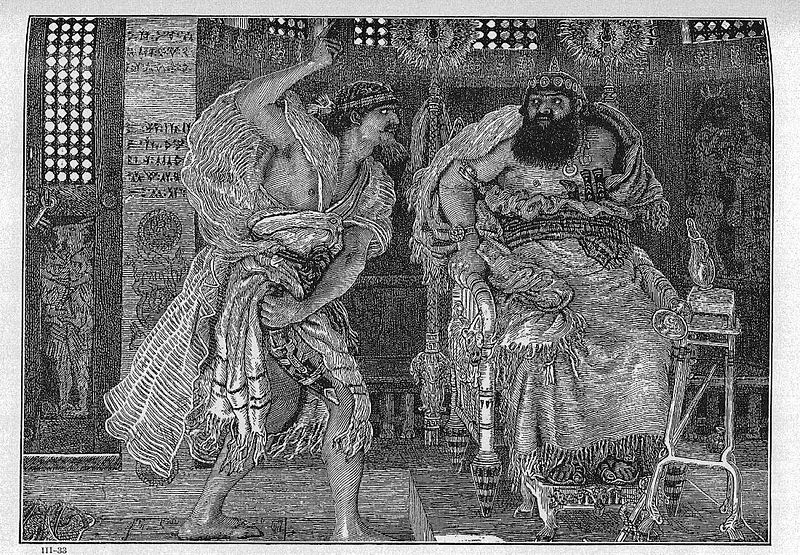 Ever notice that the Bible is like an action movie? There are some seriously amazing stories in the Bible. Judges is full of them. Some of these stories can really make people think, whether they believe the Bible is the Word of God or not.
Take Ehud. His story would make a really awesome action movie. It’s recounted in Judges 3:12ff. Here are the highlights:
The Israelites sin. The LORD punishes them by sending Eglon, King of Moab. Eglon gets some allies of his to come with him and they beat up Israel. The Israelites cry out for help, and the LORD sends help for them. Enter Ehud, the assassin. Ehud is left-handed, and the king’s body guards don’t discover his weapon (probably because they didn’t bother to search his right side–his sword would be on opposite hand to make it easier to draw). Ehud asks for a private audience and Eglon grants it. Ehud stabs Eglon so hard that it sinks all the way into the portly man’s flesh. Leaving his blade behind, Ehud escapes and rallies the troops, who unite around their new leader. He then strikes ten thousand Moabites down with his army, and none escape.
Yeah, it could make a pretty epic action movie. But what about a Bible story? How are we supposed to take this story in the context of Scripture? Note once more the beginning of the story: the Israelites did evil (Judges 3:12). Throughout Judges, we see the same pattern: the Israelites do evil, and God punishes them by oppressing them with one of the nations in the area. Then, the Israelites realize their evil, and they cry to God, repentant, and ask Him for help. He delivers them from their enemies, and there is peace in the land.
What can we take away from this story? Does it show another instance of evil in the Bible which Christians must hide? No, rather it shows the story that we can see woven throughout the Scriptures: a story of redemption and peace with God. Because of Jesus, we now live in an era in which we no longer have to wait for a deliverer, as Israel did. We’re told that all people have sinned and fall short (Romans 3:23), just as the Israelites did. And we all deserve punishment. But when we cry out to God, we know there is a redeemer close at hand. God forgives our sins because of Christ, and we can live in peace.
The cycle in Judges is repeated over and over. It reflects a time in which everyone did what they willed (Judges 21:25). God came to His people with the understanding they had. But in our time, we have Jesus who died once for all. The cycle is broken, and we may enjoy eternal peace.
See Judges 3 for more on Ehud.
This is part of a continuing series on “Awesome Person(s) of the Bible.” Other posts can be found here.
SDG.
——
The preceding post is the property of J.W. Wartick (apart from citations, which are the property of their respective owners) and should not be reproduced in part or in whole without the expressed consent of the author. All content on this site is the property of J.W. Wartick and is made available for individual and personal usage. If you cite from these documents, whether for personal or professional purposes, please give appropriate citation with both the name of the author (J.W. Wartick) and a link to the original URL. This blog is protected by Creative Commons licensing. By viewing any part of this site, you are agreeing to this usage policy.
Really Recommended Posts 9/16
 Yes the picture is another pun. I know, I know.
Infatuation with the “New” a Defense of the Old– Ever catch yourself latching onto something just because it’s the latest thing on the block? You’re not alone. But there’s something to be said for this infatuation of the “new.” Check out this excellent post on the topic.
The Dead Sea Scrolls- Biblical Archaeology– the 32nd in a series of posts at Theosophical Reuminations by Jason Dulle on… you guessed it, Biblical Archaeology. Really a phenomenal series. I can’t stress enough how much I think readers should check out the whole thing.
Imaginative Apologetics: A Reflective and Analytical Review– You won’t often see links to book reviews on my recommended posts, but I think this is a very interesting review. I have not read the book, but it seems the basic premise is that we must use our imaginations when it comes to a defense of the faith. Really interesting read.
Could a universe create itself?– There is some confusion among astronomers and physicists of late. Stephen Hawking proposed the universe could create itself. Lawrence Krauss argued in his debate with William Lane Craig that “nothing” has potential to create. Edgar Andrews, author of the book Who Made God? (my review here) addresses these arguments clearly and succinctly. Highly recommended.
The Essence of Every False Religion– No Apologies Allowed is one of my favorite apologetics websites. Most often, comics are featured–with a video here and there. They all give me food for thought. After checking out this link/comic, check out the rest of the site!
Christian Responses to 9/11– a list of Christian Apologetics Bloggers’ responses to 9/11.
Book Review: “Hidden Treasures in the Book of Job” by Hugh Ross
 Hidden Treasures in the Book of Job
Ross begins with an exhortation to Christian leaders to stop avoiding the issue of Creation and to come up with a reasonable “strategy of engagement. Christians who take the Bible as a trustworthy revelation from God need to study science and engage with scientists at the highest academic and research levels” (12). I pray Ross’s words will not fall on deaf ears.
Ross goes on to point out the historical backdrop of the book. The debaters present, Job, Eliphaz, Zophar, and Bildad were “likely the intellectual powerhouses of their day…” (28). Along with Elihu, who most likely recorded the book, they comprise the major characters. Interestingly, Eliphaz was named as a Temanite. Teman, Ross points out, “was famous in the ancient world for its exceptionally wise scholars” (28). Contrary to some who may accuse Ross of demeaning the historical value of Scripture, it is clear that he affirms the historical realism of the Book of Job.
Interestingly, HTBJ doesn’t start with the scientific questions; it dives in to “timeless questions” about God. Ross points out answers given throughout Job about the reason for death (39-40), the shorter lifespans of humans (40-41), blessings for the wicked (43ff), and more. Ross provides an argument about what is often called “natural evil.” He points out Job’s rejection of a “direct cause-and-effect relationship between destructive natural events and the people affected by them” and goes on to argue that scientifically, these “acts of God” are necessary for life (49). Hurricanes, for example, bring a number of benefits (51).
Ross quickly moves into scientific questions throughout the book of Job. He argues that God’s challenges to Job and friends reject naturalism, deism, evolutionism, and young-earth creationism (54). Job specifically points out that God continually interacts with creation. Perhaps most interestingly, Ross points out that in Job the Bible specifically points towards the Big Bang–with language of God “stretching out the heavens.” This, thousands of years before any scientific evidence existed (56-58). Not only that, but the book also alludes to dark matter. Rather than treating darkness as the “absence of light” as was the belief historically, Job points out the actual existence of darkness and its separation from light. Here again there is evidence that Job lines up powerfully with science (60-63).
Another fascinating aspect of the Book of Job, argues Ross, is its ability to speak to current situations like Global Warming (63ff).
Central to Ross’ argument in HTBJ is the thesis that the book of Job can be used as an interpretive backdrop for the Genesis creation account. Ross argues that Job 38-39 can be read in their entirety as a creation account (72). This opens the gate for interpreting other creation accounts through the lens of Job 38-39. He points out that there are areas of Moses’ creation account that Job makes explicit. Some of these points include a correct interpretation of “heavens and earth” (74); an outline of when plants were created (78-79); and perhaps most interestingly, one of the best explanations of the problem of light before the sun I’ve ever seen (80-84). Ross argues that, contrary to most interpretations, the Genesis account does not explicate that there was no sun before light, but rather that the light had been hidden by the atmosphere (82-83). Again, this would serve as powerful scientific confirmation of the Bible.
Ross is unafraid to pull his punches. He takes on the question of the extent of the flood (92ff) and argues convincingly that the flood was localized to all of humanity. Perhaps the most controversial point Ross makes is in regards to one of the best arguments for young-earth creationism–death and the Fall. Often, the young-earth argument is that the Bible excludes any possibility of death before the Fall. Ross argues that, given Job 38-39’s creation account, that interpretation can no longer be valid. He urges that Job 38:39-41 coincides with creation day five, and because these verses include death before the fall, this argument for a young-earth is unsuccessful. Ross’s argument here will really depend upon how convincing his assertion is that all of Job 38-39 lines up with the days of creation. Ultimately, I think, most young-earth creationists will remain unconvinced and argue that only the early part of Job 38 is a creation account. In Ross’s favor is the continuing tense (it appears as though the verbs throughout the section are in the Qal stem). But Ross doesn’t make this argument. Thus, it seems that this part of Ross’s argument will be convincing only to those willing to agree that Job 38-39 are, in their entirety, a creation account.
Later, Ross soundly demolishes the young-earth argument that Job provides evidence for dinosaurs living with humans. He convincingly argues that the behemoth is a hippopotamus (178-180) and the leviathan a crocodile (180-183).
Ross doesn’t leave the book of Job without discussing what seems like its primary question: suffering. He presents evidence that Job argues for both a greater good theodicy along with a free-will defense (190ff). Both of these sections are interesting, if brief.
There are many areas of interest within HTBJ I have left unexplored. Ross focuses extensively on soulish creatures and the differences between humans and animals. Most interestingly is Ross’s explication of the list of 10 “soulish” creatures named in Job and their import for humans (150-165). Suffice to say that there is much more content in the book worth reading.
There were times as I read Hidden Treasures in the Book of Job that I was filled with marvel at the magnificence of creation. At one point I stood up and surprised my wife, saying “Can you believe what God has made? And we know it from the Book of Job! Can you believe this!?” as I described some of the things Ross reveals in the book. There are some astounding ways that the Bible lines up with the evidence we have from cosmology, astronomy, biology, and other sciences. While some Christians may remain unconvinced by Ross’s argument for interpreting Genesis 1 through the lens of all of Job 7-39, the book deserves a reading and response by even those who disagree. Ultimately, readers of Hidden Treasures in the Book of Job will come away with some powerful evidence from science for the truths of Scripture–and vice versa.
Disclaimer: I was provided with a review copy of this book by Reasons to Believe. You can learn more about this science-faith think tank at reasons.org.
Source: Hugh Ross, Hidden Treasures in the Book of Job
SDG.
——
The preceding post is the property of J.W. Wartick (apart from citations, which are the property of their respective owners) and should not be reproduced in part or in whole without the expressed consent of the author. All content on this site is the property of J.W. Wartick and is made available for individual and personal usage. If you cite from these documents, whether for personal or professional purposes, please give appropriate citation with both the name of the author (J.W. Wartick) and a link to the original URL. This blog is protected by Creative Commons licensing. By viewing any part of this site, you are agreeing to this usage policy.
Book Review: “Who Made God?” by Edgar Andrews
 Who Made God?
Interestingly, Andrews gets the title of the book out of the way quickly. Andrews argues against the common atheistic retort, “Well if God made everything, who made God?” He writes, “Because cause and effect is only proven for the physical world, we can no longer insist that cause and effect are relevant when it comes to the origin of a spiritual entity like God.” I am not sure about the strength of this response. It seems to potentially put God outside the rules of logic, something of which most theists are very wary. A more convincing response, in my opinion, is to simply point out that the concept of God includes necessity. Theistic arguments are designed to show just this–that God is the uncaused ground of being.
Who Made God, however, quickly jumps into stride and doesn’t look back. Andrews lucidly argues that while science can describe events and put them to the test, it cannot explain things in the sense of a comprehensive explanation. Science, for example, “doesn’t tell us why there is [a force of gravity]” (30).
Without slowing down Andrews jumps into a clear explanation of String Theory and its attempts to be a “theory of everything.” Even were science to unify into a theory of everything, however, Andrews point would still stand. The theory would offer descriptions of how things happen, but it wouldn’t explain why the theory itself worked. He also offers a few critiques of string theory, such as the counter-intuitive nature of the theory (48).
Andrews continues on, offering God as a “hypothesis.” He argues that “the methodology of science” can be applied to God (58-59). He argues that Victor Stenger’s God: the failed hypothesis fails on a number of levels. Stenger claims that God “should be detectable: (1) by scientific ‘models’; (2) by scientific measurements… (3) by scientific ‘methods'” (67). Against this, Andrews points out that Stenger is trying to exclude God from existence by “having it both ways.” Stenger argues that God should be detectable, but cannot be because the measurements of science are restricted to the physical. Obviously, this begs the question against theism.
Andrews also addresses nothing, by which I mean the redefinition of “nothing” into “something” often done by atheists (see the debate between Lawrence Krauss and William Lane Craig). He points out that they often use “nothing” to reference vacuum and/or empty space or dark matter. But this is either deliberately misleading or just incomprehensible (97ff). As the atheists who say this often admit themselves, this “empty” space is hardly “nothing.” It is full of energy. But beyond space, beyond the existence of our universe, outside of space and time–that is what is meant by “nothing” (105).
The God hypothesis is vindicated when it comes to the evidence from astronomy and physics. The low entropy state of our universe (117-118), along with its origin (98ff) both point to a creator. Andrews moves on to argue that the origin of the laws of nature must also point to the God hypothesis (138-153). He then goes on to argue that our biological origins, the information found in cells, and the diversity of life have their best explanation with God. To cover these arguments fully would double the size of this review, but I found these arguments just as exciting as the rest of Who Made God. A sampling: proteins and DNA must have information in order to function correctly (181ff); origin of life theories can only be explained with the God hypothesis (196ff); evolution is nonfalsifiable (214-216); natural selection is a tautology (219-220); junk DNA isn’t junk (234ff); mutations really only help within dynamic populations and cannot lead to new species (230ff [through 240]). Andrews isn’t finished there, however, he tackles arguments for and against mind/body dualism (250ff).
Another strength of Who Made God is the format. There is a summary of each chapter prior to its contents, along with definitions of important terms. Humor is found throughout the work as the author tells funny stories or makes witty comments about the arguments. These aspects increase the readability of the book to a great degree.
This is not to say the book is without faults. Andrews’ treatment of the Ontological Argument was a bit abrupt. I’ve written on the argument before (see my posts here and here). Andrews’ critiques don’t apply to the most current versions of the argument. The most commonly used ontological argument is the modal version developed by Alvin Plantinga and others. This version of the argument doesn’t appeal to human ideas, but to modal necessity and possibility. To his credit, Andrews does point out that some philosophers find the argument compelling.
Another issue with Who Made God is the sometimes unconventional use of philosophical terms. For example, Andrews defines “phenomenology” as “The way phenomena… manifest themselves” (27). Phenomenology, however, is most commonly used (in philosophy) as the study of consciousness. Outside of philosophy, it generally refers to conscious experience or sense experience, not so much about the phenomena themselves. While the definition is not wrong, it caused some confuse, and may confuse other readers familiar with the other, more conventional uses. Another uncommon definition was given for “Monism.” Most often, the term refers to the idea that all of reality is one [i.e. it is all material, or all immaterial]. Andrews definition makes sense in context (he defines it as “The idea that mind is nothing more than the brain at work” [257] but that definition in philosophy of mind is more often used for “reductionism” which Andrews defines differently as well).
However, neither of these negatives outweigh the significant positives found throughout Who Made God. You know that I’m nitpicking when my main critique focuses on a couple unconventional definitions, particularly when Andrews uses valid definitions that simplify the terminology for the reader.
Edgar Andrews’ Who Made God is unique among the slew of apologetics books written at a popular level in that it offers a nearly comprehensive argument for Christianity based upon various scientific theories. Despite a few small flaws, I unreservedly recommend this book to all Christians looking to increase their knowledge of biology, physics, and astronomy. Andrews clearly and succinctly explains several scientific theories in terms which are easy to understand, while also showing the relevance for the “God hypothesis.” Readers will come away convinced that when it comes to science, their faith stands on firm ground. Books with scopes this broad most often shine their lights upon lots of topics and illumine none. Readers will find that Who Made God illumines nearly every topic it touches, bringing new insight and clarity into often confusing issues.
Source: Edgar Andrews, Who Made God?
Disclaimer: I was provided with a review copy free of charge by EP books. My thanks to both Edgar Andrews and EP books.
SDG.
——
The preceding post is the property of J.W. Wartick (apart from citations, which are the property of their respective owners) and should not be reproduced in part or in whole without the expressed consent of the author. All content on this site is the property of J.W. Wartick and is made available for individual and personal usage. If you cite from these documents, whether for personal or professional purposes, please give appropriate citation with both the name of the author (J.W. Wartick) and a link to the original URL. This blog is protected by Creative Commons licensing. By viewing any part of this site, you are agreeing to this usage policy.
On September 11th, 2001, harmless things became fearful
 There is a day that is burned into the memory of a generation–a day in which so many things we thought were harmless were turned against us. On September 11th, 2001, the United States was attacked by terrorists who flew planes into our buildings. The World Trade Center collapsed as we watched. We listened with pride about the men and women on United Airlines Flight 93 who died in order to prevent another attack.
We found out later box cutters were used to take over the airplanes. It was airplanes–a mere form of transportation–which were used to cause so much destruction. Harmless things became weapons.
But what does it all mean? How are we to come away from such an event unscathed? Something as simple as a box cutter was used against us. Can we trust anything? Is the person who invented the box cutter to blame? What about the manufacturer? What of the airplanes? Should we never fly again?
I can’t help but think about the ultimate when I am faced with the immediate. And the ultimate leads me to think of God. God created our universe, and as He created, He called each new creation “good” (see Genesis 1:4ff). But bad things started happening fairly quickly. Sin entered the world, and it wasn’t long before we had genocides, racism, hatred, terrorism, hunger, and you name it. The evils perpetuated by man would take too long to enumerate, and we can easily think of more.
Ultimately, God created the world as “good.” It was we who turned these good things against each other, it is we who actively seek to hurt, harm, and destroy each other. It is our free will that has turned things which are good into things used for evil.
On this 10th anniversary of 9/11… I sit back and ponder such things. It’s easy to throw blame around when we think about evil. It would be easiest to blame God. “Why don’t you prevent these evils, God?” But then we forget about the kinds of things God made, and how He only made them good.
The question is not: “Why did God create these things [free will, among others]?” The question is “Why have we used these things for evil?”
Links
“Are We All Moral Monsters?” Clay Jones looks at how 9/11 has awakened us to mortality in new ways.
Simply Incoherent– Christopher Hitchens argues that 9/11 is evil. But on his ontology, evil makes no sense.
9/11 ‘Full cognitive meltdown’ and its fallout
From Ground Zero to 10 Years Later–September 11, 2011– a reflection on 9/11
Did God Allow the Attacks on 9/11 for a “Greater Good”?– A post writing against ‘greater good’ theodicies. Not sure I agree entirely, but I think there are some great difficulties with the ‘greater good’ theodicy which Erik Manning draw out.
Where was God on 9/11?– A reflection on 9/11 along with a point-by-point critique of Rabbi Kushner’s response to 9/11.
Do all roads (and flights) lead to God?– A critique of religious pluralism.
Two Ground Zeros– From the horrors of 9/11 to the hope of Christ.
Suffering and the Cross of Christ– Christ helps us explain suffering.
America After 9/11, Is Religion Evil?– Is it?
Atheism, Evil, and Ultimate Justice– God will provide ultimate justice.
Ground Zero: Why truth matters more than preventing another 9/11 style attack
SDG.
——
The preceding post is the property of J.W. Wartick (apart from citations, which are the property of their respective owners) and should not be reproduced in part or in whole without the expressed consent of the author. All content on this site is the property of J.W. Wartick and is made available for individual and personal usage. If you cite from these documents, whether for personal or professional purposes, please give appropriate citation with both the name of the author (J.W. Wartick) and a link to the original URL. This blog is protected by Creative Commons licensing. By viewing any part of this site, you are agreeing to this usage policy.
Really Recommended Posts 9/8
 I’ve decided to change up my format a bit for these posts. Rather than just offering links with brief explanations, I will offer a bit of commentary and/or critique as I see fit. Also, rather than having links at the end, you can click on the link titles to go directly to the pages. Finally, yes that picture is supposed to be a pun.
Mathematicians and Philosophers: René Decartes: a really awesome discussion from Marvin Bittinger which explains briefly Descartes’ contributions to math and faith.
If you liked that one, check out Marvin’s other posts, including one on Blaise Pascal here.
Jason Dulle has been writing a series of posts on Biblical Archaeology. They each focus on a discovery which shows the truth of specific Bible passages. These posts are eminently readable and Jason helpfully sums up the Biblical significance. I highly recommend both his main site and the series. You can a sample of his posts here: Belshazzar; Nehemiah 2. Check out his site.
Joy of Dead Babies? Steve Bedard looks at one of the hard verses of the Bible: “Blessed shall he be who takes your little ones and dashes them against the rock!” (Psalms 137:9 ESV). I think Steve has some really excellent points here about interpretation. We must remember the genre and intent of the verses we read.
Living in the Multiverse: Is it Science?– a great blog about the multiverse from Max Andrews. He outlines some philosophy of science, then delves into multiverse theories, and finally adds a comment (I hesitate to call it an argument) that the multiverse would show the artistry of the Creator. I’m not sure I buy into the multiverse, but Max makes a compelling case. You can also check out his post on the theological implications of the multiverse.
Letter to a Christian Nation: Entry 1, Pages 1-7– Justin Effler is reading through Sam Harris’ Letter to a Christian Nation and doing a great job pointing out some fallacies and errors in thinking. First up: Harris’ redefinition of “atheist.”
Rejecting Christian Theism Because It’s Just Too Much Work– Wintery Knight outlines a dialogue in which Jim Wallace and an atheist were speaking. The atheist rejects theism because they don’t feel like taking the time to investigate.
http://whomadegod.org/ -Edgar Andrews’ site for his blog and book, “Who Made God.” It’s a phenomenal read that I just finished today. I highly, highly recommend it. Find it on amazon.
Dawkins and Oppy vs. Theism: Defending the Kalam Cosmological Argument
 “[Arguments for God’s existence from an infinite regress] make the entirely unwarranted assumption that God himself is immune to the regress.” -Richard Dawkins, The God Delusion, 101.
Dawkins vs. the Kalam
Just over a year ago at Richard Dawkins’ site, someone asked Dawkins to respond to the Kalam Cosmological Argument (see an exposition of the argument here). The reader outlined the argument:
- Whatever begins to exist has a cause
- The universe began to exist
- Therefore, the universe has a cause
Dawkins is frequently witty, but often wrong. The argument is for broad theism. The Kalam is intended to show that the universe is caused, it is not an argument for Christianity specifically. I pointed out in another post that just because an argument is for broad theism (or just the brute existence of God), that doesn’t mean the argument is useless evidentially for Christianity. If we know the universe is caused, then we also know whatever caused the universe must be capable of causation (obviously), choice (it must select a moment to bring about the universe), powerful enough to bring the universe into existence out of nothing, etc. This would be powerful evidence and part of a cumulative case towards Christianity.
Then there’s Dawkins’ quote in The God Delusion which I have seen utilized to challenge the Kalam. First, I should note that Dawkins’ quote is in response to Aquinas’ Five Ways/Proofs. Further, it seems to be intentionally pointed towards a Leibnizian version of the Cosmological Argument (for a fuller defense of that argument, see here). But, a simple answer to Dawkins objection, which he seems to think is devastating, would be to point out that the universe and God are different types of entities. The universe is contingent, and God is necessary. That’s not arbitrary, that’s just the kind of things those entities are.
A Philosophical Attack On the Kalam
Not all atheists are as capable of blind, willful ignorance as Dawkins. Graham Oppy’s recent book Arguing About Gods has a thoughtful, challenging section dedicated to William Lane Craig’s exposition of the Kalam.
Oppy challenges Craig on every step of the Kalam, but I’m going to focus upon one. Oppy writes, “[I]t is quite unclear why one should suppose that the allegedly counter-intuitive behavior of the transfinite [numbers]… casts doubt on the idea that the very smallest transfinite cardinals do find application to ‘the real world'”(Arguing About Gods, 140).
This proposal is meant to challenge Craig’s contention that the infinite cannot actually exist. For, if there can be no actual infinites, then the objects we see around us–indeed, the universe itself–must have begun. Yet Oppy’s contention really only reflects mathematical truths. But surely this is a rather untenable claim. Oppy would have to provide evidence that the infinite actually exists and is not just an abstract mathematical concept. Craig’s contention is that the infinite can only be used in things like Cantor’s theory for mathematical equations. Why does Craig make this restriction? He cites David Hilbert, the famous German Mathematician, who points out that:
the infinite is nowhere found in reality. It neither exists in nature nor provides a legitmate basis for rational thought… the role for infinite to play is solely that of an idea… (David Hilbert Quoted in Craig, 87, cited below)
Yet Oppy provides no reason to think that there are actually infinite things found in reality. Rather, he resorts to claiming that Craig misinterpreted Hilbert’s paradoxes and that “If the Cantorian theory of the transfinite numbers is intelligible, then we can suppose that some parts of it find application ‘in the real world…'” (Oppy, 140). But is that true? Aren’t there plenty of things that are intelligible but for which we have no application ‘in the real world’? I abstract a bit when I point this out, but it is perfectly intelligible that there could be flying pigs, yet we don’t find an application of that in “the real world” other than as a false statement. There are nearly limitless examples of intelligible things we can think of, or intelligible theories, which have no application in the real world.
But perhaps Oppy isn’t making a claim quite as strong as saying actual infinites exist. Perhaps he is just referring to the possibility that they do. The problem then, however, is that, as Craig writes in a critique of Oppy’s position, “Oppy’s attempt to defend the possibility of the existence of an actual infinite is vitiated by his conflation of narrowly and broadly logical possibility.” The problem is that Oppy has confused broad logical possibility (that it is possible to construct a consistent set with an actual infinite) with modal (the notion that an infinite actually does exist in a possible world) or actual possibility in the real world. Again, Craig writes, ” Oppy… seems to take a proposition’s freedom from inconsistency in first-order logic to be indicative of that proposition’s being true in some possible world” (Craig b, cited below). So Oppy has not done anything to defeat the Kalam. Even were Craig to grant that Cantorian theory allows for broad logical possibility of actual infinites, it would not show that they are actually possible in our world. And again, even were they possible in the real world, an actual infinite would have to exist in order to discredit the Kalam. Thus, Oppy’s counter to the Kalam is quite weak–it’s based upon a conflation of broadly logical and actual possibility, and even were he to show that infinites are actually possible, the problem would remain that we have observed none.
Yet, and this is very important to note, even if actual infinites did exist, that wouldn’t undermine the idea that everything which began has a cause. It would only allow atheists to claim the universe did not begin. But how would they go about claiming that? They’d have to show that a model of the origins of the universe which allowed for an infinite past was plausible–more plausible than the alternative. Yet the only hope for showing this would be to make a theory as parsimonious as the Big Bang theory, which postulates an absolute beginning to the universe. So, even were there actually infinite things in the universe, which I very much doubt, that would not undermine the Kalam. It would make the argument more difficult to defend, but it would not falsify it. All it would show is that there are objects which are not caused.
Thus, I take it that the Kalam Cosmological Argument does not suffer defeat, either from vocal, misguided atheists like Dawkins, or thoughtful philosophers like Graham Oppy.
Links:
Again, see an outline and defense of the Kalam Cosmological Arugment here.
William Lane Craig discusses another objection: whether a beginningless past is actually infinite: here. He offers a number of critiques of Oppy’s position here. You can also access a review by Craig of Oppy’s book here (you will need to sign up for a free account on http://www.reasonablefaith.org/).
Check out my review of a recent debate between Craig and Lawrence Krauss, in which the Kalam was discussed here. (Includes a link to the actual debate.)
Wintery Knight writes about how to defend the Kalam at his site: http://winteryknight.wordpress.com/2009/04/08/how-to-defend-the-kalam-cosmological-argument-just-like-william-lane-craig/
Sources:
Graham Oppy, Arguing About Gods (New York, NY: Cambridge, 2006).
Richard Dawkins, The God Delusion (New York, NY: Houghton Mifflin, 2008).
William Lane Craig, The Kalam Cosmological Argument (Eugene, OR: Wipf and Stock, 1979).
William Lane Craig b, “Graham Oppy on the Kalam Cosmological Argument” (Leadership U, November 8, 2005), http://www.leaderu.com/offices/billcraig/docs/oppy.html, accessed 9/1/2011. Also found at http://www.reasonablefaith.org/site/News2?page=NewsArticle&id=5162.
Image credit: ESA/Hubble and NASA: http://spacetelescope.org/images/potw1021a/, found at http://commons.wikimedia.org/wiki/File:PGC_39058.jpg.
SDG.
——
The preceding post is the property of J.W. Wartick (apart from citations, which are the property of their respective owners) and should not be reproduced in part or in whole without the expressed consent of the author. All content on this site is the property of J.W. Wartick and is made available for individual and personal usage. If you cite from these documents, whether for personal or professional purposes, please give appropriate citation with both the name of the author (J.W. Wartick) and a link to the original URL. This blog is protected by Creative Commons licensing. By viewing any part of this site, you are agreeing to this usage policy.
Materialists: Where is hope? Look to the stars!
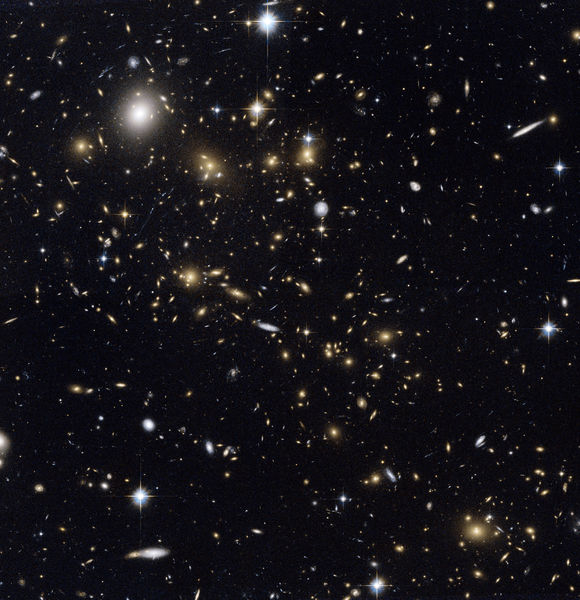 “[T]he Universe may harbor civilizations more intelligent than our own. Perhaps one day, through interstellar communication, some advanced civilization will help us resolve such age-old problems as war, famine, disease, overpopulation, misuse of natural resources, and human aging.”- John Oró, “Historical Understanding of Life’s Beginnings” (40, cited below).
Such is the hope of materialism. I’ve argued elsewhere that if all we are is matter, then there is no meaning. The pervasive response was that “we make our own meaning.” Leaving questions over the tenability of such a view aside, I have turned to a different, and interesting phenomenon: Where is there room for hope, within materialism?
It didn’t take long to dig up some quotes. One of the classes I’m taking this semester is on the Origins of Life. A few books we were assigned for this class were from a materialist perspective. The quote above is from one of those books. It resonated deeply with me. Consider this: If all we are is matter, having arrived here by unguided, biochemical processes, living on a dying planet in a dying universe–where is our hope? One cannot turn to transcendence with such a worldview, but one can attempt to emulate it.
Such is the case found in materialistic literature. Such is the grand materialist hope:
We can look hopefully for our saviors from the stars. There must be more intelligent life out there, and they will usher in a new era, a near utopia wherein disease, death, war, and hunger are all eliminated. Our alien saviors will rush to our aide once they’ve found us on this dying rock, and we will worship them as we used to worship the mythic gods of old.
But it is not just hope for the future which must guide us. Our realization that we are but one among many (and many who are probably smarter than us) must lead us to a new set of ethics. Oró writes of new ethical principles we must embrace: “Humility: The life of all cells descends from simple molecules… Hope: Someday we may communicate with more advanced civilizations… Universality: We come from stardust and to stardust we shall return… Peace: We should change our culture of war into a culture of peace” (Oró, 40-41 cited below). Humility, hope, peace, universality–these are all things Christians embrace also, but the materialist has redefined them. Our hope is not int the transcendent but in the here-and-now. Our hope, again, reaches for the stars.
But is this really a hope? We know the universe is dying. We know that, even were we to escape death, eventually the cosmic heat death of the universe would occur, and our ultimate doom is sealed. Should we hope that our alien saviors are also inter-dimensional travelers? Should we hope that they transcend space and time? I leave these questions open.
But the most interesting phenomenon in all of this is that the materialist has abandoned their presupposition. Rather than hoping for what is they hope for what we know not. They look to the stars, grasping at things unseen. Iris Fry, a professor at both Tel Aviv University and Technion-Israel Institute of Technology in Haifa and author of The Emergence of Life on Earth writes honestly and lucidly of the philosophical commitments of the materialist in this sphere:
[T]he realization that many non-empirical factors are involved in determining scientific positions and in the adoption of scientific theories leads to the notion of theoretical and philosophical decision, or commitment. Research into the origin of life and the search for extraterrestrial life are a clear case in point, because here the weight of the philosophical commitment is much greater than in more conventional scientific fields. As long as no empirical evidence of life beyond Earth has been found, and as long as no scientific theory has succeeded in providing a fully convincing account of the emergence of life on Earth, the adoption of an evolutionary point of view toward the question of life’s origin and the rejection of the idea of purposeful design involve a very strong philosophical commitment. -Iris Fry (283, Cited Below)
Ultimately, I think she is quite right. There is a philosophical commitment being espoused here, not a scientific commitment. Too often, materialists forget that, but kudos to Fry for honestly admitting it while also espousing the very commitment.
Where is our hope?
The materialist answers: The stars.
Is this really rational?
Sources:
John Oró “Historical Understanding of Life’s Beginnings” in Life’s Origin ed. J. William Schopf (Berkeley, CA: University of California, 2002).
Iris Fry The Emergence of Life on Earth (New Brunswick, NJ: Rutgers, 2000.
SDG.
——
The preceding post is the property of J.W. Wartick (apart from citations, which are the property of their respective owners) and should not be reproduced in part or in whole without the expressed consent of the author. All content on this site is the property of J.W. Wartick and is made available for individual and personal usage. If you cite from these documents, whether for personal or professional purposes, please give appropriate citation with both the name of the author (J.W. Wartick) and a link to the original URL. This blog is protected by Creative Commons licensing. By viewing any part of this site, you are agreeing to this usage policy.

 J.W. Wartick - Reconstructing Faith
