Christianity
Book Review: “Faithful Witness: The Confidential Diaries of Alan Don, Chaplain to the King, the Archbishop, and the Speaker, 1931-1946”

The years 1931-1946 were world-shattering and life-altering. Alan Don was the chaplain to the King, the Archbishop, and the Speaker of Commons in England during this period. In Faithful Witness: The Confidential Diaries of Alan Don, we are treated to an open look at his reflections on this time.
The introduction to the diaries provides significant context, background material about Alan Don, and insight into how Don lived and his importance. These diaries were confidential, but Don himself gave them to be read later in his life. It’s difficult to say how remarkable this is, because it gives a firsthand account of many major events in the United Kingdom for those wanting to learn more about this time period. The editor opted not to leave out any material that could be considered especially personal, again because Don provided them intact. Thus, these diaries offer a surprising mix of personal reflections, insights, and revelations into life during this period.
The diary entries themselves range from mundane reporting of moving from place to place to theological reflections, questions of church minutiae, and everyday life. Reading the diaries straight through is revealing over time, as everyday life changes in regard to some of the events happening around the world. Readers could also choose to pick individual topics. A robust index makes this fairly simple to do. For example, if one wants to see what Don says about Germany, one can go to the index, pick Germany (or a sub-topic related thereto), and find numerous entries throughout these years that ultimately yield an evolving understanding of the situation. This is especially interesting due to Don’s interaction with so many major figures of the time, as he gives personal insight and reflection on some of these meetings.
But this isn’t to leave aside those everyday moments or the minutiae of the church, either. It’s refreshing to see that Alan Don worries about such things as whether an ornate Bible is too heavy for someone to carry, what kind of meal he will have at a private gathering, or any other number of personal insights. It reveals a truly human person on the pages, even while giving so many major insights.
Don also writes on the end of each year a brief aside. Comparing the end of 1941 to the end of 1942 is of interest, for example. At the end of 1941, Don writes “Thus ends a year of dramatic events during which the tide of war seems to have turned definitely in our favour – thanks mainly to the Russian army and the British Navy” (384, he goes on to report more specifically). At the end of 1942, though, Don writes, “1942 started badly and we have surmounted many disappointments and disasters in our struggle with the aggressors. But the tide is on the turn and 1943 may see us nearing our immediate goal” (404). He goes on, “Anti Christ is abroad and compromise is unthinkable” (ibid). The evolution of his understanding of events is a truly fantastic thing to read, and to have it intermixed with theological insights makes it a wonderful read.
Faithful Witness is a rare look at the private life and thoughts of a figure with connections to nearly every major player in the United Kingdom during World War 2. It’s a valuable read for that reason, but Don’s tone and constant reflection make it a fascinating study in everyday life and theological reflection during this period as well. Readers interested in this period of history should see it as a must-read. It’s even moreso a required reading for those interested in the intersection of World War 2 and how people viewed it theologically. It’s a tremendous resource and a wonderful read.
Disclaimer: I was provided with a copy of the book for review by the publisher. I was not required to give any specific kind of feedback whatsoever.
Links
Be sure to check out the page for this site on Facebook and Twitter for discussion of posts, links to other pages of interest, random talk about theology/philosophy/apologetics/movies and more!
Book Reviews– There are plenty more book reviews to read! Read like crazy! (Scroll down for more, and click at bottom for even more!)
SDG.
——
The preceding post is the property of J.W. Wartick (apart from quotations, which are the property of their respective owners, and works of art as credited; images are often freely available to the public and J.W. Wartick makes no claims of owning rights to the images unless he makes that explicit) and should not be reproduced in part or in whole without the expressed consent of the author. All content on this site is the property of J.W. Wartick and is made available for individual and personal usage. If you cite from these documents, whether for personal or professional purposes, please give appropriate citation with both the name of the author (J.W. Wartick) and a link to the original URL. If you’d like to repost a post, you may do so, provided you show less than half of the original post on your own site and link to the original post for the rest. You must also appropriately cite the post as noted above. This blog is protected by Creative Commons licensing. By viewing any part of this site, you are agreeing to this usage policy.
Book Review: “Thinking About Evolution: 25 Questions Christians Want Answered” by Anjeanette Roberts, Fazale Rana, Sue Dykes, and Mark Perez
Reasons to Believe is a science-faith thinktank that operates from the perspective of Old Earth Creationism. Essentially, they hold that the earth and universe are billions of years old, but that God created progressively. Individual species or families were created by God ex nihilo at different points in time. Recently the organization published a book, Thinking About Evolution: 25 Questions Christians Want Answered that explores the evidence for evolution.
The book is written around 25 chapters corresponding to the eponymous questions. These questions are: “Does Evolution Explain Life on Earth?; Is Religious Belief the Only Reason to Question Evolution?; What’s Philosophy Got to Do With Evolution?; How Can We Keep Our Thinking Free from Fallacy?; Is Evolution Really a Problem for the Christian Faith?; What is Chemical Evolution?; Is Microevolution a Fact?; Does Microbial Evolution Prove Evolution is True>’ Is Natural Selection the Blind Force Driving Evolution?; Is There a Novelty Problem for Evolution?; What to Do with Teleology in Evolution? Can Evolutionary Processes Generate New Information?; Does Evolution Explain the Fossil Record?; What about the Genetic Similarity between Humans and Chimps?; Are the Hominin Fossils Evidence for Human Evolution?; Did Humans and Neanderthals Interbreed?; Did Neanderthals Create Art?; Can Evolutionary Processes Explain the Origin of Eukaryotic Cells?; Can Evolution Repeat Outcomes?; Can Evolutionary Co-option Explain the Irreducible Complexity of Biochemical Systems?; Has Evolution Refuted the Watchmaker Argument?; Is the Watchmaker Really Blind?; Is Junk DNA Evidence for Evolution?; Why Are We Progressive Creationists?; What if Big-E Evolution is True?
I wrote all these chapter titles out because it’s worth seeing that this is the content of the book. At a glance, readers interested in science-faith intersections probably have a number of assumptions about the answers to these questions, given the creationist background of Reasons to Believe. These assumptions may line up, but there are also sure to be some surprises mixed in there. For example, microevolution is most definitely affirmed as factual, but a significant amount of ink is spilled about trying to guarantee Neanderthals aren’t in any way associated with humans.
One thing that’s evident throughout the book is that there are numerous assumptions guiding the way evidence is interpreted by the authors. This is, of course, totally impossible to avoid. We all have assumptions that go into how we interpret anything. But some of these assumptions are put forward as almost obvious statements as though all Christians can or should agree. For example, in the chapter on “Is Evolution Really a Problem for the Christian Faith?” by Fazale Rana, he writes “Science should have no problem detecting a Creator’s handiwork–and even determining a Creator’s attributes,” (72). Prior to this remarkable statement, SETI is cited as an example of scientists attempting to find intelligence based on scientific assumptions. But of course, SETI and similar endeavors are predicated on the notion that intelligence wants to be discovered or that it is, in principle, discoverable. Yet many Christians may oppose this. For example, there is a lengthy tradition and numerous writings related to the hiddenness of God. Paul K. Moser, a philosopher, has written a few books on the topic of evidence for God only being available purposively (for example, The Elusive God). If, as Christian theology affirms, God is personal, then it seems quite possible that a person would have reasons to perhaps hide from or not be available for evidence in conventional means, especially given that person’s goals may be relational to humans rather than purely evidentiary. All of this is to say that certain assumptions made by the authors in this book are worth challenging. The very model that Reasons to Believe operates upon–a kind of strong concordism in which science will ultimately reveal God (or, minimally, unveil that the Bible is unchallenged by science, properly interpreted)–relies upon such assumptions. If they’re mistaken, significant questions about the inputs and outputs of the model would be raised.
The evidence for evolution is extremely strong. I don’t think the authors would seriously dispute that statement, given that they frankly acknowledge microevolution and microbial evolution. However, when confronted by this evidence, and the rather reasonable inference that one can move from small changes over large time to bigger changes, the authors shut down. For example, in the chapter on microbial evolution, Anjeanette Roberts writes, “But does microbial evolution involve production of totally novel protein products, cellular structures, cellular functions, metabolic pathways, or stepping stones to major transitions between kinds of organisms? …That’s highly debatable” (106). One might want to debate this, but the mere fact that just a sentence before, it had been acknowledged that microbial evolution does occur means that such “stepping stones” are in place. If we can observe microbial evolution in such small time spans, then given hundreds of millions of years, it seems to be little more than a lack of imagination to insist that such larger changes could not possibly occur. Of course, that’s not how strongly worded the objection is here. Throughout the book, the authors dance along this fine line of implying the evidence for evolution is highly contentious or questionable while also having to acknowledge that evolution just does occur.
For example, Sue Dykes makes it clear that she questions the existence of transitional forms, but then has to explain away the transitional forms that have been discovered in the fossil record (161ff). The reason to dismiss transitional forms appears to be that Dykes prefers to define transitional forms in the now-archaic way Darwin did as finding exacting step-by-step A-to-B lineages that we know for certain show the transition from A-Z. But this is not how evidence works. If we had the evidence to plays someone at the scene of a crime at the time in which it occurred with the weapon and intent to commit murder, someone coming along and saying “Ah ha! You cannot tell me the exact sequence in which the victim was stabbed!” wouldn’t be a compelling reason to question the suspect’s guilt. The sequence is there, though the order may be hotly contested. Examples Dykes investigates include whale evolution, which is quite frankly a compelling series of transitional fossils. Why are they questioned, then? Because there is the occasional discovery that may perhaps have a fossil dated differently or one form showing up earlier than expected! But that doesn’t really undermine the sequence any more than having one’s ancestor (grandparent, say) still alive today would mean one could not have been born yet. On a total-species level, it would be surprising to see entire species that were successful and ubiquitous enough for there to have actually been preserved fossils of them just dying off the exact moment a somewhat more adapted creature came along. Moreover, it is difficult for me to take seriously the questioning of transitional fossils when so many striking examples have been found. Not just the ones that exist in the public’s memory writ large, but also numerous amazing examples, like turtles, having “halfway” point type fossils. I wrote about some of these elsewhere. Again, do we have every one of the presumably hundreds of species preserved to get from point A-to-Z? No. But missing C, D, F, G, H, and I hardly precludes calling B, E, J, and M transitional forms.
The authors occasionally fall into the unfortunate position of implying that because scientists have updated predictions and models due to changing evidence, we can question the core idea. Sue Dykes writes about Hominin fossils, “It seems that the more we dsicover and the more we test, the more frustrated paleontologists become. New discoveries regularly undermine the ideal of a clear, single evolving lineage leading to modern humankind” (177). Well yes, because I doubt there are any paleontologists who actually that that “ideal” is attainable in actuality. Evolution is messy. It doesn’t produce simple chains. There are offshoots, branches that break off, never to come back, divergence, convergence, and more. Simply having a ton of fossils that fit to show evolution is occurring and not being able to find an “ideal” lineage doesn’t undermine the evidence for evolution. The stunning number of fossils and traits that can be found amongst them instead shows the compelling notion of evolution over time.
I was also surprised to see Fazale Rana seem to argue that evolutionary biologists would think that if we turned back the clock, evolution would just repeat results (225). I believe it was in Dawkins’s work that I read (reading it as a skeptic of evolution, more than a decade ago) that evolution would do the exact opposite. The metaphor was a videotape: if we rolled back the tape, the movie evolution would play would be completely different, because the forces acting upon nature that drive evolution couldn’t possibly be replicated. This seems to undermine the whole chapter in which Rana makes this statement about replicating results. Convergent evolution doesn’t really seem to be evidence against evolution, either, which is the somewhat confusing point that may be alluded to in this chapter (“Can Evolution Repeat Outcomes?”). Instead, Rana argues convergence points to progressive creationism due to shared features. But this was not established in the text, and the point Rana made about rewinding the clock seems to me to be mistaken.
A few chapters hint at more difficult problems for evolution. The question of irreducible complexity was compelling to me for quite a while, but though the authors here make the case, it still seems that co-option is but one of the several possible ways evolution could account for seemingly irreducible complexity. As has been pointed out by others much more in the know than I, irreducible complexity itself is something of a construct. For example, it may be the case that taking out a part of the eye that allows us to focus upon something would make the eye unable to function as an eye, but it would hardly make it useless. The mere ability to sense light/dark would be extremely advantageous on a number of levels. Another problem that is raised in the book is the question of generating information. I myself have become pretty skeptical of this argument, though, because it seems something of a category error. Yes, there is a strong metaphorical connection between human written language and the “language” of DNA, but to equate them to the point that is required for introducing intelligent design into the process is a stretch at best. Rana makes his case by pointing to the stunning improbability of randomly producing a functional cytochrome (153), but the very nature of evolution makes this nonsensical. Evolution isn’t randomly generating series of DNA strands in order to, hopefully, come up with a functional and beneficial protein. Instead, it is operating upon existing, functional (and even deleterious or non-functional) features. Simply stating blind probabilities is to massively overstate the range of actual possibility.
The concluding chapter is perhaps the best chapter of its kind I’ve read in any creationist literature anywhere. Anjeanette Roberts writes, “there are many faithful Christians today who confess Christ as Lord, hold the Bible as the authoritative Word of God, and believe in real miraculous events… while also holding that God used the initial conditions he established at the creation along with evolutionary processes to accomplish his purposes for life’s biological history on Earth” (282).
Later, she writes, “After all, it is not one’s view of origins that determines a person’s Christian status” (ibid). Then, she writes this great counterfactual: “If at some point in the future, the scientific evidence shows that evolutionary mechanisms are the mechanisms of god’s creation, then interpretive models… will fill a needed space in biblical Christian thought,” (283). Though not fully stating it, it is clear the implications here are that Roberts, and presumably other RTB scholars, are acknowledging that if evidence existed to convince them evolution were true, they would utilize some of the models for reconciling that with biblical truth that they already see as viable. This is an extraordinarily honest position, particularly for a creationist organization. Too often, people accuse creationists of being liars and/or deceivers, obfuscating truth. I have noted numerous points of disagreement with the book in my own review here. But let it be said that I think that RTB has done extremely valuable work, and that they’ll continue to do so. I can’t help but admire the integrity and honesty of their scholars, and am honored to work alongside them for God’s Kingdom.
Thinking About Evolution will give readers a solid base for understanding the most prominent old earth creationist perspective. While I think that the case it builds against evolution is lacking, I appreciate the candor, the integrity, and the genuine searching for truth the authors are pursuing. Readers interested in the intersection of Christianity and science will appreciate this book.
Disclaimer: I was provided with a copy of the book for review by the publisher. I was not required to give any specific kind of feedback whatsoever.
Links
Be sure to check out the page for this site on Facebook and Twitter for discussion of posts, links to other pages of interest, random talk about theology/philosophy/apologetics/movies and more!
Book Reviews– There are plenty more book reviews to read! Read like crazy! (Scroll down for more, and click at bottom for even more!)
SDG.
——
The preceding post is the property of J.W. Wartick (apart from quotations, which are the property of their respective owners, and works of art as credited; images are often freely available to the public and J.W. Wartick makes no claims of owning rights to the images unless he makes that explicit) and should not be reproduced in part or in whole without the expressed consent of the author. All content on this site is the property of J.W. Wartick and is made available for individual and personal usage. If you cite from these documents, whether for personal or professional purposes, please give appropriate citation with both the name of the author (J.W. Wartick) and a link to the original URL. If you’d like to repost a post, you may do so, provided you show less than half of the original post on your own site and link to the original post for the rest. You must also appropriately cite the post as noted above. This blog is protected by Creative Commons licensing. By viewing any part of this site, you are agreeing to this usage policy.
Book Review: “Splendour in the Dark: C. S. Lewis’s Dymer in His Life and Work” by Jerry Root

C. S. Lewis’s writings loom large in the church today, whether because of the massive influence of The Chronicles of Narnia or his spiritual works like Mere Christianity. Jerry Root brings attention to one of his lesser-known works Dymer, a narrative poem that was written before Lewis converted to Christianity. In Splendour in the Dark, Root argues that Dymer shows Lewis’s development of spiritual growth, intellectual prowess, and writing skill in ways that reverberate through his later works.
The book begins with an annotated edition of the narrative poem, Dymer, itself (annotations from David C. Downing). This narrative poem encompasses over 100 pages of the book and is a valuable resource. The annotations from Downing consistently provide insights and points of interest for readers. The text itself is an interesting narrative though, as Downing and Root each note, it has its faults. What it does show, however, is a remarkable elasticity of thought and willingness to explore deep issues at work in Lewis’s earlier life.
Root’s chapters are composed of 3 lectures with responses about Dymer. Root highlights the importance of the narrative poem in Lewis’s life, as he had it come upon him all at once, but waited for some time before publishing it 11 years later (133). Lewis’s fascination with writing and classics included the belief that one should use “literary form to match what it was he [Lewis] wanted to say” (138). One can see this throughout his works. Lewis saw the importance of form to function and message.
The concept of mutability and change is present in Dymer as well, and Root argues that this theme is in Lewis’s notion that “reality is iconoclastic” (143ff, see also 230). The necessity of change means that indoctrination will ultimately fail (145), and that those structures humans attempt to make to endure will fall. Lewis’s fascination with myth looms large throughout the poem, and certainly in his later works (173ff). Root continues to draw from Dymer to show Lewis’s influences on his later works, though he doesn’t explicitly make those connections at times. Readers will need some familiarity and appreciation for Lewis’s works to get the most out of this book.
Each chapter has a response from another scholar in a related field. These responses are largely affirmations of what was in the lecture they append.
Fans of C. S. Lewis should consider Splendour in the Dark a must-read. It brings attention to one of his lesser-known works while also providing thoughtful analysis and application to everyday life for Christians. Recommended.
Disclaimer: I was provided with a copy of the book for review by the publisher. I was not required to give any specific kind of feedback whatsoever.
Links
Be sure to check out the page for this site on Facebook and Twitter for discussion of posts, links to other pages of interest, random talk about theology/philosophy/apologetics/movies and more!
Book Reviews– There are plenty more book reviews to read! Read like crazy! (Scroll down for more, and click at bottom for even more!)
SDG.
——
The preceding post is the property of J.W. Wartick (apart from quotations, which are the property of their respective owners, and works of art as credited; images are often freely available to the public and J.W. Wartick makes no claims of owning rights to the images unless he makes that explicit) and should not be reproduced in part or in whole without the expressed consent of the author. All content on this site is the property of J.W. Wartick and is made available for individual and personal usage. If you cite from these documents, whether for personal or professional purposes, please give appropriate citation with both the name of the author (J.W. Wartick) and a link to the original URL. If you’d like to repost a post, you may do so, provided you show less than half of the original post on your own site and link to the original post for the rest. You must also appropriately cite the post as noted above. This blog is protected by Creative Commons licensing. By viewing any part of this site, you are agreeing to this usage policy.
Pacific Rim: The Black – Hope for the hopeless- a Christian perspective

“Pacific Rim” was a delightfully campy, action-packed sci-fi movie that has since spawned a sequel, some comics and novels, and now an anime from Netflix, “Pacific Rim: The Black.” The series has a tone that’s far more bleak than the movies, embracing the human cost of an invasion and long war against kaiju (giant monsters). Its story follows two teenagers, Taylor and Hayley Travis, as they make their way across a largely abandoned Australia. I’ll draw out some of the themes I found in the show from a Christian perspective. There will be some major SPOILERS in this post.
Hope
Taylor and Hayley have little reason to hope. Their parents left to fight the kaiju, leaving the kids behind in a secure, hidden community. They’ve not returned. Kaiju have effectively taken over Australia, the greater world seems to have abandoned Australia for lost, and they’re stuck somewhere in the middle of it with few resources.
Then, Hayley falls through into a jaeger storage facility–the jaegers are the giant mechs humans built to fight the kaiju–and the story starts rolling. The accidental revealing of a jaeger attracts a kaiju, and the monster destroys their home, along with everyone they’ve been living with. It’s a huge loss. They’re forced to move on due to the urgency of the kaiju attack, and continue to find hope in unlikely places… and people.
The siblings ought to be hopeless. They’ve lost everything. They even lose their jaeger. But they cling to each other, hoping for a future in which they escape to fight the kaiju, find their parents, and move on. Their tenuous lives continue in such hope, and it brings a refreshing feel to the show. It could have been all darkness and edginess, but it shows people persisting even in the darkest of circumstances.
Human Sinfulness
People will continue to sin, choosing themselves, their ambition, and power even when apocalyptic monsters roam the very land in which they live. This theme shows up abundantly in Shane, whose broken life leads to him seeking self-interest above all else. He’s a fascinating character. He’s evil, and though we see hints of what drives him, we never get it fully explained. Leaving him behind feels like a major moment in the show, setting up a later, final confrontation that can be anticipated in a later season. His character also shows how sinfulness can permeate whatever it touches, corrupting organizations, bringing others into its snare. It’s a nefarious thing, and at times makes you wonder whether the humans or kaiju are a greater threat to the survival of humanity.
Messiah… or not.
The very end of the series finally gives us a look at the “Sisters” who were barely alluded to earlier in the series. One of them sees the Boy/kaiju and says “The Kaiju Messiah…” It’s a striking plot point, certainly a twist in a final episode that was chock-full of them. Certainly the word “Messiah” is immediately something that gets theological antennae raised. What do they mean by “messiah” and why would that be in any way associated with the kaiju?
I wonder, though, if there may be a somewhat nefarious turn here. Given the implications of the term messiah and the questions of theological propriety of that title here, one can wonder about hope again–hope placed in the wrong things. Are the sisters putting their hope in the kaiju and mistaking muscles and mass for what constitutes true power and glory? Misplaced hope in the power of our world–or that of the world of giant monsters (!!!) is a theme in our history, surely. Perhaps the Sisters are another iteration of this same misplaced hope.
I’m probably going a bit deeper than may be warranted here, but “The Black” invites such speculation in a way I didn’t anticipate.
Links
“Pacific Rim”- A Brief Christian Reflection– I draw out a few themes from the original film, focusing on a Christian perspective.
Be sure to check out the page for this site on Facebook and Twitter for discussion of posts, links to other pages of interest, random talk about theology/philosophy/apologetics/movies and more!
Also see my other looks into television (scroll down for more).
SDG.
——
The preceding post is the property of J.W. Wartick (apart from quotations, which are the property of their respective owners, and works of art as credited; images are often freely available to the public and J.W. Wartick makes no claims of owning rights to the images unless he makes that explicit) and should not be reproduced in part or in whole without the expressed consent of the author. All content on this site is the property of J.W. Wartick and is made available for individual and personal usage. If you cite from these documents, whether for personal or professional purposes, please give appropriate citation with both the name of the author (J.W. Wartick) and a link to the original URL. If you’d like to repost a post, you may do so, provided you show less than half of the original post on your own site and link to the original post for the rest. You must also appropriately cite the post as noted above. This blog is protected by Creative Commons licensing. By viewing any part of this site, you are agreeing to this usage policy.
Book Review: “Free at Last? The Gospel in the African American Experience” by Carl F Ellis, Jr.

Free at Last? The Gospel in the African American Experience by Carl F. Ellis, Jr. is an exploration of African Americans’ interactions with Christianity in the united states with an emphasis on evaluating it by means of the Gospel. The hugeness of the project Ellis, Jr. puts forward and my own unfamiliarity with anything but the broadest strokes of the same means that my evaluation will largely be based upon its content rather than my own confirmation of its analysis.
Ellis, Jr. interweaves the book with historical narrative and analysis of how racism and other negative outcomes occur in our society. African American experience in the United States started almost entirely with being enslaved. Ellis Jr. notes how this Christianity of the land of the United States became rejected by black thinkers like Frederick Douglass. Douglass wrote of a distinction between the Christianity of Christ and that of the land (of the US) in that the latter was based upon enslavement and cruelty while the former is “pure, peaceable, and impartial” (20). Ellis Jr. notes how perspective is incredibly important in understanding the experience of others.
The question of the truth of Christianity and the Gospel are central to Free at Last? Ellis, Jr. notes that “Scripture describes at least two types of unrighteousness: ungodliness and oppression…” The distinction is important because one can lead into another, even unconsciously: “For example, if a person has a racist attitude, he or she is guilty of ungodliness. If, however, that person imposes his racism on others, forcing he to live in substandard conditions, then he is guilty of oppression” (28). Grace can serve as a solution to these sinful attitudes, actions, and dispositions.
A majority of the rest of the book traces African American experience from the earliest times of the United States into the 1990s, with a particular focus on Martin Luther King, Jr. and Malcom X. However, these are also interspersed with broader historical insights, analysis of streams of thought, and more. A fascinating section has Ellis, Jr. arguing that the movement towards Islam in African American experience cannot provide the same universality that Christianity does. In part, this is because orthodox Muslim teaching is that the Qur’an “is in Arabic only” (152). More importantly, the attempted de-Christianization of black culture through Islam can only either turn black culture into Muslim/Arabic culture or result in unorthodox Islam (121ff). Christianity, argues Ellis, Jr., provides a way forward for black Americans to experience universal hope (158ff).
This does not mean that Christianity has no pitfalls, however, for African Americans and indeed for people generally. Ellis, Jr. notes several “Anti-God Christianity-isms” that corrupt Christianity’s message but are all too common. These include Christianity that is anti-intellectual, Christianity that attempts to make God obligated to humans, Christianity that makes God into a kind of religious tyrant, and Christianity that puts God in a box (167-168). The last chapter of the book offers Ellis, Jr.’s vision for a renewal of Christianity and black experience.
Free at Last? is a compelling account of African American experience in regards to Christianity. Originally published in the late 1990s, this updated version offers a strong challenge to the modern cries out against allegedly anti-Christian ideas and philosophies from within the church while also arguing strongly for a robust Christian vision going forward. It’s a fascinating read, and I recommend it.
Disclaimer: I was provided with a copy of the book for review by the publisher. I was not required to give any specific kind of feedback whatsoever.
Links
Be sure to check out the page for this site on Facebook and Twitter for discussion of posts, links to other pages of interest, random talk about theology/philosophy/apologetics/movies and more!
Book Reviews– There are plenty more book reviews to read! Read like crazy! (Scroll down for more, and click at bottom for even more!)
SDG.
——
The preceding post is the property of J.W. Wartick (apart from quotations, which are the property of their respective owners, and works of art as credited; images are often freely available to the public and J.W. Wartick makes no claims of owning rights to the images unless he makes that explicit) and should not be reproduced in part or in whole without the expressed consent of the author. All content on this site is the property of J.W. Wartick and is made available for individual and personal usage. If you cite from these documents, whether for personal or professional purposes, please give appropriate citation with both the name of the author (J.W. Wartick) and a link to the original URL. If you’d like to repost a post, you may do so, provided you show less than half of the original post on your own site and link to the original post for the rest. You must also appropriately cite the post as noted above. This blog is protected by Creative Commons licensing. By viewing any part of this site, you are agreeing to this usage policy.
Book Review: “Talking Back to Purity Culture” by Rachel Joy Welcher

Purity culture is a movement that grew up within American Christianity with an intense emphasis on a specific definition of sexual purity. Rachel Joy Welcher’s Talking Back to Purity Culture: Rediscovering Faithful Christian Sexuality approaches that culture from a perspective that agrees with some of the basic motivations while disagreeing with the baggage that comes along with it.
Welcher surveys the landscape of purity culture with a look at history behind the movement. She summarizes a number of major works, highlighting the general view of this movement. Essentially, it focuses on hardened gender roles and extreme emphasis on importance of “purity,” by which is meant not just virginity but a kind of resistance to and avoidance of sexuality in almost any instance. Thus, for example, moves to “kiss dating goodbye” in favor of courtship regulated, approved, and observed by parents.
The movement towards purity does not come without additional baggage, however. Welcher notes several of these points through chapters about “The Idolization of Virginity” and “Female Responsibilities.” In the latter, she observes that the weight of purity largely falls upon women who, according to proponents of this movement, must do things like “dress modestly” and “select… attract… [and] satisfy her spouse” (42ff). This means that women are often left in fear that something as simple as an exposed bra strap will be enough to tempt others into sin, a responsibility that women ought not have to bear. Boys and men are taught similar ideas, and this has its own weight. For example, men are taught that they are almost insatiably sexual, seeing the simplest thing (an out of place bra strap, for example) as arousing and causing intense desire. When men don’t feel that way, they can then feel inadequate. The Purity Culture movement paints with a broad brush that basically forces all men and women individually into these specific behaviors, desires, and obligations, thus alienating those who do not feel they fit neatly into the buckets presented. Welcher also notes the problems that arise with purity culture and those who have been sexually abused or don’t fit all the norms presented.
The final few chapters focus on Welcher’s corrections to purity culture. While still maintaining a fairly conservative view of sexuality, Welcher notes that purity culture simply doesn’t correspond adequately to reality. However, she also pushes back against some of the stronger objectors to it. Nadia Bolz-Weber, for example, comes into scope as Welcher states that Bolz-Weber’s more permissive sexual ethic that included opening herself to her boyfriend erotically post-divorce is a “gospel of self” and exhorts readers to “not be deceived” (134). “Holiness is not premarital sex without shame,” writes Welcher (135). These notes might strike some readers as a reinforcement of some of the sexual ethic behind purity culture, and I’m not sure that’s entirely mistaken.
The last section of the book, in a chapter about purity culture “moving forward,” features Welcher using similar language to many of the writings of purity culture: “Loneliness is real, but lust does not love you. Its only desire is to tear you apart, limb from limb” (184). Those who have been especially harmed by purity culture’s expectations and adherents may find the pushback against purity culture is not as strong here as they’d like. Fairness demands acknowledging that this is beyond Welcher’s intent, but one wonders about the use of words like “lust” in the sentence quoted above. There is a remarkable amount of wiggle-room in definitions of lust, and a lot of baggage that comes with it. While Welcher pushes back on purity culture, this reader wonders whether she may not have taken it far enough. Though critical of more progressive thinkers like Bolz-Weber, Welcher may have moved too quickly to dismiss their whole sale attack on purity culture due to the broad damage it has done.
The book has discussion questions and activities throughout, allowing it to be readily used for a group study.
Talking Back to Purity Culture is a fascinating read. It not only provided insight and directions into the movement, but directed ways forward. As I read the book, I found myself reflecting upon it and how purity culture came into my own life at times and how it shaped who I am as a person. The book will surely provide groundwork for much future discussion, and hopefully allow more to “talk back” to purity culture with more informed voices.
Disclaimer: I was provided with a copy of the book for review by the publisher. I was not required to give any specific kind of feedback whatsoever.
Links
Be sure to check out the page for this site on Facebook and Twitter for discussion of posts, links to other pages of interest, random talk about theology/philosophy/apologetics/movies and more!
Book Reviews– There are plenty more book reviews to read! Read like crazy! (Scroll down for more, and click at bottom for even more!)
SDG.
——
The preceding post is the property of J.W. Wartick (apart from quotations, which are the property of their respective owners, and works of art as credited; images are often freely available to the public and J.W. Wartick makes no claims of owning rights to the images unless he makes that explicit) and should not be reproduced in part or in whole without the expressed consent of the author. All content on this site is the property of J.W. Wartick and is made available for individual and personal usage. If you cite from these documents, whether for personal or professional purposes, please give appropriate citation with both the name of the author (J.W. Wartick) and a link to the original URL. If you’d like to repost a post, you may do so, provided you show less than half of the original post on your own site and link to the original post for the rest. You must also appropriately cite the post as noted above. This blog is protected by Creative Commons licensing. By viewing any part of this site, you are agreeing to this usage policy.
Book Review: “Reimagining Apologetics: The Beauty of Faith in a Secular Age” by Justin Ariel Bailey

Reimagining Apologetics: The Beauty of Faith in a Secular Age is not the book I expected it to be. When I saw the title, I expected the book to be a kind of ground rules work for reinventing the wheel with apologetics and seeing arguments and the like in new ways. Instead, Justin Ariel Bailey seeks with the book to re-imagine apologetics. That is, he’s seeking to re-enchant apologetics with the human imagination and capture minds for Christ.
The first part of the book discusses apologetics and the imagination. Bailey notes the alleged crisis of doubt in an increasingly secular England alongside the “authenticity” demanded by Schleiermacher’s vision of Christianity. These chapters are very strong and provide enormous insight into the problems contemporary apologetics has in reaching people. Primarily, Bailey notes that this is due to a problem with enchantment, failing the imagination, and not providing a robust way to engage people beyond mere argumentation.
The second part of the book outlines models for reimagining apologetics through George MacDonald and Marilynne Robinson. These two thinkers have been hugely influential, and Bailey argues that they offer a different way of doing apologetics by capturing the imagination instead of having specific argumentation.
I do wish that Bailey had included some more examples in the models for re-imagining apologetics. Or, failing that, perhaps examples that haven’t been used as frequently in the literature. George MacDonald and Marilynne Robinson serve as fine examples for using the imagination in apologetics, but they’ve also received quite a bit of attention. It would be interesting to see a book like this explore, for example, the strands of faith found in the wildly imaginative worlds of someone like Gene Wolfe. I’m not saying that specifically we need Wolfe or anyone else, but it would be helpful to have explorations of figures whom we may not have seen as frequently in apologetics literature. That said, Bailey’s examination of the two he chose as emblematic for his project is insightful and robust.
Reimagining Apologetics seeks to encourage readers to think of apologetics in ways that may win people for Christ in ways that don’t conform to what is usually thought of as “apologetics” today. Part of that means a return to the way apologetics was done in the past. Another part means reimagining the future of apologetics–a future in which we use both heart and mind to conform others and ourselves to Christ. Recommended.
(All Amazon links are associates.)
Disclaimer: I was provided with a copy of the book for review by the publisher. I was not required to give any specific kind of feedback whatsoever.
Links
Be sure to check out the page for this site on Facebook and Twitter for discussion of posts, links to other pages of interest, random talk about theology/philosophy/apologetics/movies and more!
Book Reviews– There are plenty more book reviews to read! Read like crazy! (Scroll down for more, and click at bottom for even more!)
SDG.
——
The preceding post is the property of J.W. Wartick (apart from quotations, which are the property of their respective owners, and works of art as credited; images are often freely available to the public and J.W. Wartick makes no claims of owning rights to the images unless he makes that explicit) and should not be reproduced in part or in whole without the expressed consent of the author. All content on this site is the property of J.W. Wartick and is made available for individual and personal usage. If you cite from these documents, whether for personal or professional purposes, please give appropriate citation with both the name of the author (J.W. Wartick) and a link to the original URL. If you’d like to repost a post, you may do so, provided you show less than half of the original post on your own site and link to the original post for the rest. You must also appropriately cite the post as noted above. This blog is protected by Creative Commons licensing. By viewing any part of this site, you are agreeing to this usage policy.
“Winter’s Heart” by Robert Jordan- A Christian (re)reads The Wheel of Time
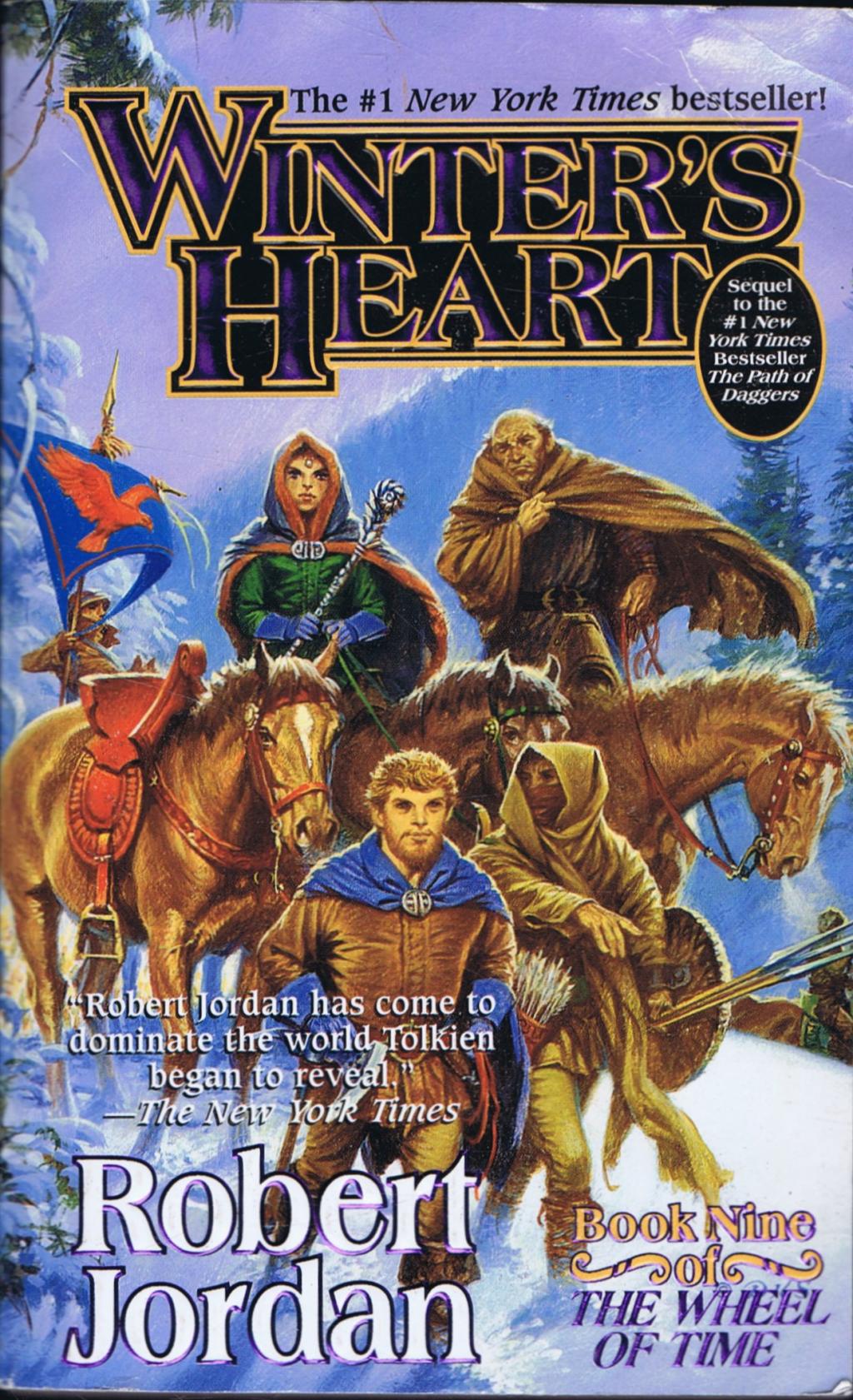
“The Wheel of Time” is a massive fantasy series by Robert Jordan (and, later, Brandon Sanderson) that is being developed into a television show for Amazon Prime. It’s cultural impact is huge, the series having sold more than 44 million copies. Here, I continue my series exploring the books from a Christian worldview perspective. There will be SPOILERS in this post for the series.
I’m reading this novel for the third time, and this time I listened to it. It’s amazing to me to see how differently I approach different issues it raises 5 years after I first wrote about it on this blog, and nearly 15 years since I first read the book. For one thing, I remember friends at the time I first read it saying it was a rather tedious read. But I have quite enjoyed the novel the three times I read it. But this third time did highlight some of the problems with Jordan’s later books in the series. There’s so much fluff in this novel. It could have been edited down to be about half the length and still gotten all the major points across. I don’t know if this is a result of me reading much more speculative fiction since even 5 years ago or what, but I just noticed some of the problems more than I did the first and second go-rounds.
Another difference is in myself, and that is explored more thoroughly below, in the section titled “Peace and Security?” It is fascinating to me that my own growth as a person can be measured against my reaction over time to this fantasy series. The intense strength of the imagination on formation should not be underplayed.
Self-Image
The concept of self looms large throughout the whole series, but perhaps especially so in Winter’s Heart. Whether it’s Rand still making sense of his own powers and authority as the Dragon Reborn or the women who are in love with him trying to navigate their own feelings about him and each other–the notion of self is critical throughout the novel. But self-image is part of this, too. Characters throughout the book are obsessed with how others view them. did their demeanor give something away? Did they dress properly? Or, “No, I won’t be dressing that way.”
Is this obsession with self-image a product of Jordan’s fluffing the novel and including so many additional details? I’m not sure, but it was something that stuck with me.
Peace and Security?
When I wrote about Winter’s Heart on this blog last time, I centered in on the situation in Far Madding, where weapons were highly restricted from being carried around openly. I noted the following passage:
“No need for any man to defend himself in Far Madding… The Street Guards take care of that. Let any man as wants start carrying a sword, and soon we’d be as bad as everyplace else…” (538)
I focused, as Jordan seemed to, on the fact that violence still continued wherever the guards were not. The implication, though I didn’t spell it out, is that Far Madding is foolish to prevent people from bringing weapons of all sorts into their city. It didn’t prevent violence, after all!
But now, looking back on what I wrote, and thinking about Christian responses to violence, I think that I, like Jordan and the naysayers of Far Madding and controls on weapons, confused Peace with Security. Dietrich Bonhoeffer, a German Lutheran pastor who was killed by the Nazis, wrote about the fact that “Peace must be Dared.” He wrote:
There is no way to peace along the way of safety. For peace must be dared. It is the great venture. It can never be made safe. Peace is the opposite of security. To demand guarantees is to mistrust, and this mistrust in turn brings forth war.
(DBWE 13, 308-309)
Placing trust in weapons and feeling secure means that we have essentially traded security for peace. Instead of peace, we have sought safety. Peace means daring to thwart war by daring the great venture–calling peace down on our neighbors.
Conclusion
Winter’s Heart is maybe the “fluffiest” entry in the series so far, with plenty of length conversations and descriptions of clothes and locales to make it feel bloated. That said, readers who enjoy verbose descriptions of a fantasy setting we’ve grown to love–and if you’ve come this far, I hope you love The Wheel of Time–will glean quite a bit to love from this novel. Those most interested in worldview and the main plot will have to wade through quite a bit to get there, but Jordan’s series remains thoughtful and compelling.
(All Amazon Links are Amazon Affiliates Links.)
Links
The Wheel of Time– Read all my posts on The Wheel of Time (scroll for more).
Be sure to check out the page for this site on Facebook and Twitter for discussion of posts, links to other pages of interest, random talk about theology/philosophy/apologetics/movies and more!
Book Reviews– There are plenty more book reviews to read! Read like crazy! (Scroll down for more, and click at bottom for even more!)
SDG.
——
The preceding post is the property of J.W. Wartick (apart from quotations, which are the property of their respective owners, and works of art as credited; images are often freely available to the public and J.W. Wartick makes no claims of owning rights to the images unless he makes that explicit) and should not be reproduced in part or in whole without the expressed consent of the author. All content on this site is the property of J.W. Wartick and is made available for individual and personal usage. If you cite from these documents, whether for personal or professional purposes, please give appropriate citation with both the name of the author (J.W. Wartick) and a link to the original URL. If you’d like to repost a post, you may do so, provided you show less than half of the original post on your own site and link to the original post for the rest. You must also appropriately cite the post as noted above. This blog is protected by Creative Commons licensing. By viewing any part of this site, you are agreeing to this usage policy.
Book Review: “The Other Side of the Wall” by Munther Isaac

The question of Israel and Palestine looms large in contemporary politics, but it also looms large theologically for many people around the globe. Munther Isaac’s The Other Side of the Wall gives a firsthand account of the land, along with a theological exploration of Israel, Palestine, and lament and hope.
Isaac starts the book with “An Invitation” in which he calls on readers to realize that the situation is probably far more complex than they’ve heard or been taught. So many factors–cultural, political, theological–are competing for attention in regards to the Israeli-Palestinian conflict that it makes it difficult to sort them all out. Additionally, a simplistic portrayal of the conflict in the United States, particularly among certain theological traditions, effectively erases Palestinian Christian voices from the narrative.
Next, Isaac leads readers on a journey of, as the subtitle says, lament and hope. There’s much to lose heart about when it comes to relationships in Israel and Palestine. But there’s also reason to hope. Too many global Christians ignore the plight of Palestinian Christians, whose rights are often trampled. Additionally, the voices of Palestinian Christians are ignored or even specifically excluded (see, for example, the story Isaac shares on 29ff about his letter to the editor). When people don’t fit neatly into the boxes that Christians have set up related to the conflict, it is easier to ignore them than to engage with them.
Christian Zionism is then analyzed by Isaac, and he notes that it has essentially become a kind of imperialism imposing the will of (largely American) Christians outside the land onto the people of the land. Simplistic readings of the biblical text yield results that exclude Palestinian Christians from the conversation and turn people into instruments. Isaac explores the promises of the land made in the Bible and notes the conditions given related to them in multiple places. He also highlights the problematic language and interpretations of the Bible put forward by many Christians related to Israel and the people living there. The notion that Jews need to rebuild the temple, only to be excluded from the Kingdom of God, is particularly nefarious. Yet this view is extremely common in American Evangelicalism, as people argue that prophecies demand the Temple return to Israel, while simultaneously arguing that Jews will be condemned for not believing in Christ. This turns people into instruments of theological systems in an alarming fashion.
Isaac argues this last point especially forcefully on 125ff, where he notes the teaching of a “prophecy expert” who argued that those Jews who did not believe in Jesus would be massacred, according to the Bible, and the remaining third would embrace Jesus as Messiah during a millennial reign. Isaac also noted that this has created tension in Jewish-Christian relations, as so many “prophecy experts” and evangelical Christians support the state of Israel abstractly while also holding views that treat Jews as objects in their eschatological narratives (126-127).
Isaac constantly challenges assumptions made about Israel and Palestine, noting how easy it is to move from “Arab” to “Muslim” and “not one of us” or an excluded voice (108). This also highlights the knee-jerk reaction of many American Christians to Muslims in general, which is far from reflecting the love of Christ for all our neighbors. He writes, “If You Hate Muslims, You Hate Jesus, Too. If We Love Jesus, We Will Love Hindus” (120, emphasis his).
Isaac wraps up the book with reasons for hope and ways to find love of neighbor and share in that hope going forward.
The Other Side of the Wall is an enlightening read. Isaac provides personal accounts while incisively critiquing (primarily American) Christianity for ignoring the plight of Palestinian Christians and mischaracterizing events in Israel in order to play games with Scripture. It’s a powerful critique, while also providing reasons for hope and a call to follow Christ by truly loving our neighbor. Highly recommended.
(All Amazon links are associates.)
Disclaimer: I was provided with a copy of the book for review by the publisher. I was not required to give any specific kind of feedback whatsoever.
Links
Be sure to check out the page for this site on Facebook and Twitter for discussion of posts, links to other pages of interest, random talk about theology/philosophy/apologetics/movies and more!
Book Reviews– There are plenty more book reviews to read! Read like crazy! (Scroll down for more, and click at bottom for even more!)
SDG.
——
The preceding post is the property of J.W. Wartick (apart from quotations, which are the property of their respective owners, and works of art as credited; images are often freely available to the public and J.W. Wartick makes no claims of owning rights to the images unless he makes that explicit) and should not be reproduced in part or in whole without the expressed consent of the author. All content on this site is the property of J.W. Wartick and is made available for individual and personal usage. If you cite from these documents, whether for personal or professional purposes, please give appropriate citation with both the name of the author (J.W. Wartick) and a link to the original URL. If you’d like to repost a post, you may do so, provided you show less than half of the original post on your own site and link to the original post for the rest. You must also appropriately cite the post as noted above. This blog is protected by Creative Commons licensing. By viewing any part of this site, you are agreeing to this usage policy.
Book Review: “Discerning Ethics: Diverse Christian Responses to Divisive Moral Issues” edited by Hak Joon Lee and Tim Dearborn
Discerning Ethics: Diverse Christian Responses to Divisive Moral Issues introduces numerous moral topics to Christians while providing insight into various approaches Christians have had to those same moral questions. Each chapter of the book introduces the moral topic at hand by providing a “real life” and “real world” example of how that moral question has arisen in the world and in real life. Then, different positions (in every chapter but one, three of them) are presented on that topic. Finally, each author gives a brief outline and defense of their own position on the question. The main text of the chapter is followed by discussion questions and recommendations for further reading.
The topics addressed in the book are broad and divided into four parts: ethics of the globe (climate change, poverty and income inequality, urban degradation, and immigration); of the body (access to health care, abortion, transgender, homosexuality and sexual identity); of violence (violence against women, war/nonviolence/just peacemaking, gun violence, and mass incarceration); and of formation (racism, disability, social and entertainment media, and public education).
The way the book is formatted allows for a surprising amount of depth despite the relatively short chapter length on each topic. For example, in the chapter on Access to Health Care by Brian White, the “real life” story reads, in part:
On April 8, 2016, the director of Uganda’s cancer institute at the Mulago Hospital announced that the country’s only radiotherapy machine, used for the treatment of a broad range of cancer patients, had finally broken down beyond repair. This machine typically treated around one hundred patients every day, and the hospital received nearly forty-four thousand new referrals each year, not only from Uganda but also from the neighboring countries of Rwanda, Burundi, and South Sudan… (91).
The story becomes my heartbreaking as Brian White notes that Victoria Akware, a woman who had cervical cancer, got the news just after having “sold her land to help pay for the long trip to the Uganda Cancer Institute to receive treatment…” (ibid). Clearly, this is a travesty on a major scale, as people’s lives are at risk due to inaccessible health care. The approaches to these topics White outlines are universal–everyone gets health care with a single-payer system; two tier, in which everyone gets a minimum level of care as a human right but can pay for higher levels of care; and private, in which health care is a commodity. As with the other chapters in the book, each of these positions has a specific thinker (or thinkers) the author draws from to expound their position. Ultimately, White argues for a position that he sees as a kind of middle way among these positions that provides for equality, need, and merit (see esp. 104-105).
Each chapter is outlined like this, and no matter what one’s own position is on the topic at hand, it will likely be challenged by having other positions presented fairly and own their own merits. Possibly the author’s perspective will provide its own challenge as well. Each chapter was excellent in its own ways, and several chapters provided surprising perspectives that I didn’t necessarily expect.
One example of the latter was the chapter on homosexuality and sexual identity by Matthew Jones. The author of this chapter is a gay man who is celibate because he believes that his conscience is bound to not act on his sexuality. His own “real life” story includes being removed from a pastoral internship for even admitting to his sexual identity (144-145). Jones’s analysis of the varied positions is insightful and should give a challenge to readers from any position. For example, he notes that the position that holds to a kind of sexual essentialism often fails to provide any context for people to live out their lives in a way that can comport to the expectations of their beliefs (154). On the far other end, Jones argues that Christians who hold to full biblical acceptance of differing sexual identities do not do justice to the texts involved (155). Again, wherever one falls on this spectrum, one will likely find their position challenged to do better by both real people involved and by their own work to live out Christ’s commands in the world.
The one caution this reader would give for the book is that readers should try to see it for what it is–an introduction to the topics it discusses. There is no way to fully engage with all of these topics in the length given, but the editors and authors set up a way to at least get an idea for why people, and Christians specifically, may think differently on these important issues. The book would serve as an excellent guide for one’s own exploration of contentious topics, a superb book to read in a study group, or as a textbook for a class on ethics.
Discerning Ethics is a fantastic introduction to numerous moral topics. It affords Christians access to diverse voices on important moral topics that are challenging in our own time. I recommend it highly.
(All Amazon links are affiliates links.)
Disclaimer: I was provided with a copy of the book for review by the publisher. I was not required to give any specific kind of feedback whatsoever.
Links
Be sure to check out the page for this site on Facebook and Twitter for discussion of posts, links to other pages of interest, random talk about theology/philosophy/apologetics/movies and more!
Book Reviews– There are plenty more book reviews to read! Read like crazy! (Scroll down for more, and click at bottom for even more!)
SDG.
——
The preceding post is the property of J.W. Wartick (apart from quotations, which are the property of their respective owners, and works of art as credited; images are often freely available to the public and J.W. Wartick makes no claims of owning rights to the images unless he makes that explicit) and should not be reproduced in part or in whole without the expressed consent of the author. All content on this site is the property of J.W. Wartick and is made available for individual and personal usage. If you cite from these documents, whether for personal or professional purposes, please give appropriate citation with both the name of the author (J.W. Wartick) and a link to the original URL. If you’d like to repost a post, you may do so, provided you show less than half of the original post on your own site and link to the original post for the rest. You must also appropriately cite the post as noted above. This blog is protected by Creative Commons licensing. By viewing any part of this site, you are agreeing to this usage policy.

 J.W. Wartick - Reconstructing Faith