Christianity
Book Review: “Weathering Climate Change” by Hugh Ross
 Hugh Ross is the founder of Reasons to Believe, a science-faith think-tank that approaches the topics from an Old Earth Creationist perspective. Ross’s latest book, Weathering Climate Change, presents a view of climate change from that same perspective. Ross, however, does not succumb to the pitfalls of denying climate change or trying to sugarcoat humanity’s impact on it. Instead, the book provides an in-depth look at the factors causing climate change, its potential impact, on ways that humanity might mitigate some of the impact, all set alongside a perspective that sees humanity as called by God to care for creation.
The majority of the book is occupied by presenting readers with the data. This is surely intentional, given the vast array of misinformation available a click away online. Ross presents chart after chart with data from reputable sources, showing the clear fact that what we’re experiencing now is irregular and not simply part of a broader pattern of Earth’s climate change. However, he also notes the historical data and how the Earth has undergone severe climate changes, and notes that our current period of relative stability is an exception.
That said, Ross doesn’t use that climate change to dismiss our current situation–time and again, he notes the severe nature of human impact on the climate and demonstrates that it is much more than another part of Earth’s natural cycle. This care for approaching the data, both modern and ancient, means that Ross is able to present readers with a fuller picture, hopefully leading them to grasp more accurately the state of the climate today.
Ross also analyzes several paths forward to combat climate change. What’s interesting is that he offers these while recognizing human’s sinful propensity to avoid long term problems and continue harmful behaviors that make them comfortable. Many of these solutions are outside of the box. For example, ending all consumption of red meat would make a huge impact, but it would also drive black markets for red meat and many likely would rebel against restrictions on such consumption. So an alternative solution, offers Ross, is to switch the kind of red meat consumed. In a surprising turn, he argues that ostriches could provide a middle way, allowing people to consume red meat (apparently similar to beef), while also mitigating much of the methane (and other) problem(s) related to wide consumption of beef.
Other, more enormous solutions, are also proposed. Re-planting parts of the Sahara, creating massive solar panels that can both block some sunlight while using it for energy, and more are analyzed both for the potential impact they could have and also for their practicality. It’s a quite refreshing turn, and certainly not what skeptics of creationism (honestly, including myself), might expect from someone who’s avowedly a creationist (of the Old Earth variety). The presentation of the data, analysis of solutions, and look at long-term trends are all, so far as this reviewer can tell (as someone who reads science texts but is by no means an expert), quite accurate and informative.
Ross also offers all of this alongside comments that the trends are part of God’s plan for humanity, allowing for humans to be–on his view–created at just the right moment for use of fossil fuels, for climate stability, and more. While some readers may balk at this, it is imperative to underscore the importance of a work like this, that introduces audiences who might otherwise not interact with the climate change data to hard science that backs up broader scientific consensus.
Weathering Climate Change is an unexpected delight. Ross offers a thorough look at the evidence for climate change, the recent history of Earth’s climate (in geologic terms), and potential solutions from the perspective of a creationist, without ever balking at the scientific challenges to his own perspective. He also offers it alongside his characteristic grace with competing views and his heart for speaking about God to those who will hear. I recommend it, even if you (like me), do not necessarily agree with all of his position. It will inform you and maybe even surprise you, as it did me.
Disclaimer: I was provided with a copy of the book for review by the publisher. I was not required to give any specific kind of feedback whatsoever.
Links
Be sure to check out the page for this site on Facebook and Twitter for discussion of posts, links to other pages of interest, random talk about theology/philosophy/apologetics/movies and more!
Book Reviews– There are plenty more book reviews to read! Read like crazy! (Scroll down for more, and click at bottom for even more!)
SDG.
——
The preceding post is the property of J.W. Wartick (apart from quotations, which are the property of their respective owners, and works of art as credited; images are often freely available to the public and J.W. Wartick makes no claims of owning rights to the images unless he makes that explicit) and should not be reproduced in part or in whole without the expressed consent of the author. All content on this site is the property of J.W. Wartick and is made available for individual and personal usage. If you cite from these documents, whether for personal or professional purposes, please give appropriate citation with both the name of the author (J.W. Wartick) and a link to the original URL. If you’d like to repost a post, you may do so, provided you show less than half of the original post on your own site and link to the original post for the rest. You must also appropriately cite the post as noted above. This blog is protected by Creative Commons licensing. By viewing any part of this site, you are agreeing to this usage policy.
Book Review: “Bearing God’s Name: Why Sinai Still Matters” by Carmen Joy Imes
The question of what to do with the Old Testament and what to do with the Law specifically is one that has loomed large throughout all Christian history, from questions about the Judaizers of Acts 15 all the way to the present. Carmen Joy Imes works to provide an answer to several questions about Christianity and its relation to the covenant at Sinai specifically in Bearing God’s Image.
Central to Imes’s argument is the notion that “taking the Lord’s name in vain” is a misunderstood commandment. Instead, we ought to see it in the context of being God’s name-bearers, those who carry God’s word throughout the world.
The first part of the book focuses on becoming the people who are God’s name-bearers. Perhaps the central feature of the book is found in this part as Imes notes several major points related to Christian living. First, the question of the Ten Commandments–Imes notes that people assume the Ten Commandments apply in every way to everyone to this day, but in reality they were part of the cultural mandate going along with the covenant with God at Sinai. Additionally, the second commandment about taking the Lord’s name in vain makes it seem as though God’s name is a swear word, which is almost the exact opposite of what it should be seen as. The commandment, according to Imes, truly is about bearing God’s name falsely–that is, it is a commandment not to claim to be of God while not acting as though one is of God. As she puts it, it ought to “change… everything about how we live” (51, emphasis hers).
Going along with this notion of being God’s name bearers, Imes draws on several sources to highlight the way they practiced religion in the Ancient Near East and how that would play out in context of the commandment. For example, the way covenantal priesthood dressed was itself one aspect of this (72-74).
Part two focuses on how we ought to live as God’s people who bear God’s name. This begins with asking what Moses and Joshua themselves made of this way of living. Next, Imes surveys more of the Old Testament to draw out living in God’s name throughout the Bible. Jesus is another way to live out God’s name, as Jesus is the name above all other names (151ff). She draws this same strand through some of the epistles as well.
Bearing God’s Image is written at an introductory level and could serve as a study group book fairly easily. It would help readers get exposed to many ideas related to the Christian use of the Hebrew Scriptures. It’s a solid introduction to a complex topic. Recommended.
Disclaimer: I was provided with a copy of the book for review by the publisher. I was not required to give any specific kind of feedback whatsoever.
Links
Be sure to check out the page for this site on Facebook and Twitter for discussion of posts, links to other pages of interest, random talk about theology/philosophy/apologetics/movies and more!
Book Reviews– There are plenty more book reviews to read! Read like crazy! (Scroll down for more, and click at bottom for even more!)
SDG.
——
The preceding post is the property of J.W. Wartick (apart from quotations, which are the property of their respective owners, and works of art as credited; images are often freely available to the public and J.W. Wartick makes no claims of owning rights to the images unless he makes that explicit) and should not be reproduced in part or in whole without the expressed consent of the author. All content on this site is the property of J.W. Wartick and is made available for individual and personal usage. If you cite from these documents, whether for personal or professional purposes, please give appropriate citation with both the name of the author (J.W. Wartick) and a link to the original URL. If you’d like to repost a post, you may do so, provided you show less than half of the original post on your own site and link to the original post for the rest. You must also appropriately cite the post as noted above. This blog is protected by Creative Commons licensing. By viewing any part of this site, you are agreeing to this usage policy.
Book Review: “Bonhoeffer’s Theology of the Cross” by J. I. de Keijzer
 Act and Being is perhaps Dietrich Bonhoeffer’s most opaque and difficult book. J. I. de Keijzer seeks, in Bonhoeffer’s Theology of the Cross, to show that Bonhoeffer’s book was, in fact, constructing a theology of the cross in conversation with Karl Barth, Martin Heidegger, and, most importantly, Martin Luther.
The introduction lays out de Keijzer’s project, including an emphasis on seeing Bonhoeffer in his context and, specifically, as a Lutheran theologian. This latter point is important, because de Keijzer goes on to emphasize the need to avoid starting with a defined theology of the cross in order to read that back onto Bonheoffer (and Barth–more on that soon) but instead to draw on the work of the individual to allow them to outline their theology of the cross (31). He then goes on to outline Barth’s theology of the cross and argue that Bonhoeffer is, himself, intentionally arguing for an alternative. Evidence for this is derived from Act and Being, Bonhoeffer’s second dissertation, and how it argues in a parallel structure to Karl Barth’s “Fate and Idea.”
After showing that Bonhoeffer’s Act and Being is intended as a parallel and contrasting project to Barth’s own theology of the cross, de Keizjer notes several points of divergence Bonhoeffer takes over and against Barth. One of these is the argument over whether the finite can contain the infinite (Bonhoeffer sides with Lutheran theology here, and de Keijzer shows that the Lutheran view does not stumble in the ways Reformed/Calvinist theologians often charge it with). (He expands on this both on 42-43 and 109-111, the latter of which shows how this is a major dividing line between the two Reformation branches of theology.) Another is a series of problems Bonhoeffer–explicitly or not–shows in Barth’s theology, such as how Barth’s theology is individualistic rather than comunal, that he (Barth) essentially made Christianity into a branch of idealism (47-49), and most famously, Bonhoeffer’s charge that Barth’s theology is a negativism of revelation. The latter receives quite a bit of space in de Keizjer’s work, as he argues that Bonhoeffer sees Barth’s work as failing to fully create a Christian theology. The negativism (or positivism) in Barth’s thought regarding theology receives an answer, according to de Keijzer, in Bonhoeffer’s use of the theology of the cross because Bonhoeffer’s own theology offers 3 things that Barth’s does not: 1. it offers helpful insight to the nonreligious person; 2. it does not undercut grace as a gift; 3. it provides guidance in nonreligious interpretations of theological concepts (52-54).
Martin Luther also looms large in de Keijzer’s discussion, as he notes that Luther cannot simply be reduced to one along a continuum of theologians who argued for a theology of the cross (55ff). Instead, Luther’s insights were essential for Bonhoeffer and, argues de Keijzer, for rightly understanding the theology of the cross in general. God’s real presence in and for the world is absolutely central to a right understanding of the incarnation and how God is present in Jesus’s flesh (57-58). Moving ahead, de Keijzer argues that Bonhoeffer’s theology of the cross provides a strong basis for just such a theology, giving several essential elements toward that end, such as the ambiguous relationship between revelation/faith and reason, the ability to use spacial metaphors fruitfully in theology, movement from the cross to the world, Christ on the cross as God acting in behalf of humanity, and a radically sacramental understanding of the body of Christ.
Luther’s influence continues as de Keijzer notes that while it may look as though Bonhoeffer and Luther diverged regarding epistemology and faith, that is far from the case. Luther’s epistemological project was to make room for grace in his own context, while Bonhoeffer’s project was to break the epistemological barrier created by idealism in order to retrieve grace (115ff). Luther continues to be central to Bonoheffer in the latter’s reading of Heidegger. Heidegger himself was heavily influenced by Luther, and Bonhoeffer utilized Heidegger’s philosophy in Act and Being to deconstruct rationalistic schemes (127ff, esp. 138-140). Ultimately, of course, Bonhoeffer’s project is heavily focused on ecclesiology and how through the church, Christ truly is present with God’s people (162ff).
Bonhoeffer’s Theology of the Cross is a fascinating look at a specific aspect of Bonhoeffer’s theology, and, more specifically, the points he was elucidating in his complex Act and Being. De Keizjer does a fantastic job of both explaining the finer points of Bonhoeffer’s view in contrast to his contemporaries and interlocutors while also showing how Bonhoeffer’s work may be applied to Christian life today. Highly recommended.
Disclaimer: I was provided with a copy of the book for review by the publisher. I was not required to give any specific kind of feedback whatsoever.
Links
Be sure to check out the page for this site on Facebook and Twitter for discussion of posts, links to other pages of interest, random talk about theology/philosophy/apologetics/movies and more!
Book Reviews– There are plenty more book reviews to read! Read like crazy! (Scroll down for more, and click at bottom for even more!)
SDG.
——
The preceding post is the property of J.W. Wartick (apart from quotations, which are the property of their respective owners, and works of art as credited; images are often freely available to the public and J.W. Wartick makes no claims of owning rights to the images unless he makes that explicit) and should not be reproduced in part or in whole without the expressed consent of the author. All content on this site is the property of J.W. Wartick and is made available for individual and personal usage. If you cite from these documents, whether for personal or professional purposes, please give appropriate citation with both the name of the author (J.W. Wartick) and a link to the original URL. If you’d like to repost a post, you may do so, provided you show less than half of the original post on your own site and link to the original post for the rest. You must also appropriately cite the post as noted above. This blog is protected by Creative Commons licensing. By viewing any part of this site, you are agreeing to this usage policy.
Jon Meacham's "The Hope of Glory" and Reconstructing Faith

Jon Meacham is best known as a biographer of Presidents, whether his excellent look at Thomas Jefferson’s life (my review here), or his Pulitzer-winning biography of Andrew Jackson. His recent work, The Hope of Glory, is a short reflection on Jesus’s words from the cross. I grabbed it after I got an email from Goodreads in which Meacham described his perspective and talked about his faith. I thought it might be interesting to see his perspective, but have to admit I was a little worried due not wanting to see some sort of patriotic deity paraded in front of me. I shouldn’t have been worried. What I found instead was a pithy, frank discussion of faith alongside some theological reflection. I found it helpful in my own reading as I’ve been reconstructing faith.
Meacham writes that, “For the thoughtful believer… there is nothing more certain than the reality of uncertainty, nothing more natural than doubt…” (12). He notes the difficulty with seeking certainty: “Fundamentalist believers and fundamentalist atheists would both do well… to acknowledge that literalism may be comforting but is ultimately dangerous, for an uncritical acceptance of one worldview or another (whether in religion or politics) ends more conversations than it begins” (13). Though I feel more certain now than I had before, a lot of that is due to my decision to “go public” with my own thoughts about faith. The common saying about the more you know, the more you know you don’t know seems so true to me in regards to Christianity and faith. While once, I felt so certain that I could demonstrate my beliefs were superior to those of others’, I no longer feel that way.
Fundamentalism is a frequent target of Meacham, and he even goes so far as to note that it can be sinful: “Literalism is for the weak; fundamentalism is for the insecure. Both are sins, too, against God, for to come to believe that we are in exclusive possession of the truth about things beyond time and space, and thus hold the power to shape lives about things within time and space, is to put ourselves in the place of God” (69-70). Over and over again, I see people who talk about the “clear teaching of Scripture” and how those who disagree with them are sinning due to their rejection of God’s word. But if that’s true, how is it possible that people do, seemingly in good conscience, disagree on so many of these “clear” issues? I think that we need to be very careful about what we say is so clear. What is clear for one of us may not be clear to all. We get in danger of reductionism when we push for the “yes or no” clarity of certainty.
Meacham notes that we as Christians “are called to use our minds as well as our hearts in reading the Bible…” and that we need not ignore possible difficulties in the Bible. He goes so far as to say that one can hold the Scriptures are “perhaps inspired but certainly fallible” (42). His wording is strong, to the point I’m not sure agree (I would affirm the Bible is inspired, for example), but part of his effort seems to be to force readers to think through their assumptions and certainties and see where there may be problems.
Meacham writes about hell, and he argues that one can find verses to contradict each other on the topic, such that a reader who wants to insist on literal interpretations will end up in a “guerrilla war that never ends” as they “fight… verse-to-verse” (90). One thing I’ve contemplated a lot as I reconstruct faith is the notion of the polyvalence of Scripture. I don’t remember where I first heard the term–it may have been Peter Enns–but I know I reacted poorly the first time I heard it. But more and more, I’ve thought about it as I’ve read and reflected on Scripture in my reading and devotion times. I think about how Kings and Chronicles portray the Kings of Israel and Judah in different, sometimes apparently competing ways. What does that mean for our own reading of Scripture? What does it mean as we try to take it seriously and read at as inspired?
Meacham’s book is a fascinating, challenging read that highlights his love of Jesus while also noting his own perspectives related to Scripture and believers. It’s worth reading and challenging yourself to look beyond individual quotes and think about what he says. Like me, you may find yourself nodding along at times, while at others you may sit back in contemplation and wonder about your own faith journey.
Links
Reconstructing Faith– Read other posts as I search for truth and navigate the messiness that is faith.
Be sure to check out the page for this site on Facebook and Twitter for discussion of posts, links to other pages of interest, random talk about theology/philosophy/apologetics/movies and more!
SDG.
——
The preceding post is the property of J.W. Wartick (apart from quotations, which are the property of their respective owners, and works of art as credited; images are often freely available to the public and J.W. Wartick makes no claims of owning rights to the images unless he makes that explicit) and should not be reproduced in part or in whole without the expressed consent of the author. All content on this site is the property of J.W. Wartick and is made available for individual and personal usage. If you cite from these documents, whether for personal or professional purposes, please give appropriate citation with both the name of the author (J.W. Wartick) and a link to the original URL. If you’d like to repost a post, you may do so, provided you show less than half of the original post on your own site and link to the original post for the rest. You must also appropriately cite the post as noted above. This blog is protected by Creative Commons licensing. By viewing any part of this site, you are agreeing to this usage policy.
Book Review: “The Genealogical Adam and Eve” by S. Joshua Swamidass
There is little doubt that an enormous amount of ink has been spilled over the question of the historicity of Adam and Eve given an evolutionary account. Often, the charge against theistic evolutionists is that they cannot or do not affirm what is thought to be required of biblical theology related to Adam and Eve. At other times, appeal to Adam and Eve is looked down upon as a quaint, outdated, and clearly mistaken view. Into that fray steps S. Joshua Swamidass with the book The Genealogical Adam & Eve: The Surprising Science of Universal Ancestry. Swamidass argues that there is a way past these seemingly endless debates.
The genealogical hypothesis is central to Swamidass’s argument. Swamidass’s thesis is genealogical, not genetic. Genetics can be used to provide a “tunnel vision” for ancestry (31), but genealogical ancestry is a broader, common language way of looking at ancestry. The hypothesis has 6 main components: 1. Adam and Eve lived recently in the Middle East; 2. they are the genealogical ancestors of everyone (specifically by AD 1); 3. They are specially, or de novo created; 4. interbreeding occurred between the lineage of Adam and Eve and others; 5. no additional miracles apart from special creation of Adam and Eve are allowed (for the purpose of the hypothesis); 6. assume two findings of evolutionary science: human descent common with the great apes and that the size of the human population never dipped to a single couple (p. 26-27).
Swamidass argues that rather than looking at trying to tie all humans together genetically, we may be able to do so genealogically. Once one traces ancestry back by a certain number of generations, one will effectively have so many ancestors that the number would exceed the number of humans who were alive at the time. That’s an absurd conclusion, of course, but it doesn’t account for the way that family trees intermingle and mesh together in many different ways. Nevertheless, due to the exponential way that tracing one’s family history back, Swamidass argues that it’s likely that we can argue that all humans have common ancestors as recently as several thousand years ago.
Swamidass takes this extrapolation and notes that because of this, one can affirm most of the major tenets of traditional Christian belief regarding Adam and Eve. Adam and Eve could have been specially created–science cannot test for this either way–a few thousand years ago, and still be the common ancestors of all living humans. What his thesis does have, of course, is humans outside the garden. But Swamidass notes that even traditional readings of the text have struggled with that due to questions of who Adam and Eve’s children married, or who Cain was afraid of, etc.
One could easily see how Swamidass’s hypothesis could be tweaked in different ways depending upon one’s own conclusions about the data or theological presuppositions. Some theistic evolutionists would likely dispute thesis 3, while creationists would dispute several theses. But what Swamidass has done is effectively offered a possible solution to the many, many science-faith controversies related to Adam and Eve. One can, on Swamidass’s thesis, affirm both the findings of evolutionary biology as well as virtually every aspect of the traditional view of Adam and Eve. The extraordinary import of this should not be understated: Swamidass has offered a defense of a hypothesis that virtually anyone who has written on the topic will need to contend with.
The Genealogical Adam & Eve is sure to be a controversial book. Yet hopefully, within that controversy, there can be a discussion of coming to agreement on specific doctrinal topics, and a broadening of areas where unity can be found. Swamidass has done serious, scholarly work here that anyone who wants to deal with the topic of Adam and Eve will need to address.
Disclaimer: I was provided with a copy of the book for review by the publisher. I was not required to give any specific kind of feedback whatsoever.
Links
Be sure to check out the page for this site on Facebook and Twitter for discussion of posts, links to other pages of interest, random talk about theology/philosophy/apologetics/movies and more!
Book Reviews– There are plenty more book reviews to read! Read like crazy! (Scroll down for more, and click at bottom for even more!)
SDG.
——
The preceding post is the property of J.W. Wartick (apart from quotations, which are the property of their respective owners, and works of art as credited; images are often freely available to the public and J.W. Wartick makes no claims of owning rights to the images unless he makes that explicit) and should not be reproduced in part or in whole without the expressed consent of the author. All content on this site is the property of J.W. Wartick and is made available for individual and personal usage. If you cite from these documents, whether for personal or professional purposes, please give appropriate citation with both the name of the author (J.W. Wartick) and a link to the original URL. If you’d like to repost a post, you may do so, provided you show less than half of the original post on your own site and link to the original post for the rest. You must also appropriately cite the post as noted above. This blog is protected by Creative Commons licensing. By viewing any part of this site, you are agreeing to this usage policy.
Book Review: “The Gospel According to Eve: A History of Women’s Interpretation” by Amanda W. Benckhuysen

The history of interpretation is an important subject for understanding Christian theology. One part of that history that is, thankfully, at last getting the attention that it deserves is the history of women’s interpretation. Amanda W. Benckhuysen’s The Gospel According to Eve is a fascinating look at this history that particularly focuses on questions related to women in Christian theology and practice.
Benckhuysen explores several topics from the perspective of women interpreters, drawing on women who wrote throughout Christian history on these fascinating topics. The main themes surveyed are Interpreting Eve–a chapter that focuses on how women interpreted the passages related to Eve; Defending Women’s Worth, in which women interpreters highlight the equality of women; promoting women’s education; Supporting Women as Wives and Mothers; Empowering Women to Preach and Teach; Forming the Character of Children; Advocating for Social Reform; and Influencing Gender Ideology.
There are many major points of interest found throughout the book. The chapter on women as wives and mothers sounds like it may be an affirmation of traditional gender roles, and some of the authors tended in that direction, but it also had fascinating early discussions from women about the beauty and wonder of breast-feeding and questions of class related to it. Here specifically Benckhuysen cites Elizabeth Clinton (c. 1574-c. 1630) and Hannah More (1745-1833) as two women who wrote on this topic. Clinton cited multiple biblical examples of women who nursed their children, but also broadened her argument beyond what was best for mother or child. She argued additionally that using wet nurses had a negative impact on lower classes due to taking away the autonomy of women, whose husbands often directly made deals over how much they’d be selling their services for (103-104).
The chapter on women preaching and teaching shows women both interacting directly with biblical texts often used to silence women’s voices, while also citing examples of pragmatic cases in which women needed to teach or preach. Benckhuysen also shows the array of women’s opinions on the topic, as some women agreed women should preach but still argued they ought to be under the authority of men. Time and again, in chapter after chapter, Benckhuysen shares portraits of women and their work that show the breadth of women’s voices throughout Christian history and the importance of hearing these diverse voices and opinions on a wide array of topics.
The Gospel According to Eve is a fantastic introduction to both the history of women’s interpretation and to investigating questions about the theological importance of women in Christian thought and practice. It is highly recommended.
Disclaimer: I was provided with a copy of the book for review by the publisher. I was not required to give any specific kind of feedback whatsoever.
Links
Be sure to check out the page for this site on Facebook and Twitter for discussion of posts, links to other pages of interest, random talk about theology/philosophy/apologetics/movies and more!
Book Reviews– There are plenty more book reviews to read! Read like crazy! (Scroll down for more, and click at bottom for even more!)
SDG.
——
The preceding post is the property of J.W. Wartick (apart from quotations, which are the property of their respective owners, and works of art as credited; images are often freely available to the public and J.W. Wartick makes no claims of owning rights to the images unless he makes that explicit) and should not be reproduced in part or in whole without the expressed consent of the author. All content on this site is the property of J.W. Wartick and is made available for individual and personal usage. If you cite from these documents, whether for personal or professional purposes, please give appropriate citation with both the name of the author (J.W. Wartick) and a link to the original URL. If you’d like to repost a post, you may do so, provided you show less than half of the original post on your own site and link to the original post for the rest. You must also appropriately cite the post as noted above. This blog is protected by Creative Commons licensing. By viewing any part of this site, you are agreeing to this usage policy.
Ancient Apologetics: Justin Martyr, Tatian, The Epistle to Diognetus, and More
Frances Young’s chapter, “Greek Apologists of the Second Century,” found in “Apologetics in the Roman Empire,” is a study of many of the earliest Christian apologists.
Justin Martyr (100-165) is the first to be treated, and his First and Second Aoplogy are among the earliest Christian apologetic treatises in existence. Writing from Rome, Justin addresses a number of charges made against Christians as though they were on trial (82-83). His first goal is to demand a fair hearing for Christianity, calling on those Romans who were pious to look upon Christian piety and those who were philosophers to love the truth and hear it from Justin. Then, he offers a challenge to the practice of condemning Christians for their beliefs while also trying to show the superiority of Christian ethics and beliefs (83).
Tatian (120-180) was a pupil of Justin Martyr and was from the East, though thoroughly Hellenized (85). Tatian follows his tutor in offering a plea in his Oration to the Greeks for fairness to Christians, but he includes in his own apology an attack on idolatry. He is among the first who argued that the good found in Greek philosophy, mythology, and the like were, in fact, derived from Moses, whom Tatian argued came before Moses. While Justin offered a kind of supersessionist view of Judaism, Young argues that Tatian did the same with regards to Hellenism.
The Epistle to Diognetus is difficult to place regarding time and authorship, having been spuriously assigned to Justin Martyr. After a survey of the possible origins of the work, Young notes that it is worth reviewing because it offers reasons for inquirers to understand “why Christians reject ‘the deities revered by the Greeks'” while also going so far as to “make light of death itself” (88). It is less a defense of these beliefs than it is a call to join in joyful acceptance of these beliefs as truths.
A major aspect of the defenses these early works offered was to argue that Christianity had robust ties with the ancient past, rather than being an entirely new faith. Thus, many Greek apologists argued the Hebrew Scriptures were more ancient and correct than the writings of Homer and other classics, even while dismissing Judaism as superstition or as something completely replaced by Christianity. This reflects the importance of tailoring the message of Christianity to one’s audience. At the time, any new belief was seen as deeply suspicious, while ancient beliefs were better established and more likely to be true. Regardless of whether or not these apologists were correct, they knew their context and offered an apologetic that suited it.
In our own time, it is easy to see some of these apologetics works as simplistic or useless–what has Rome to do with us? But it is worth seeing the major theme of exhortation tied into these early works. Justin Martyr called on philosophers of his time to truly act as though they were lovers of truth, which would mean they had to at least give a hearing to beliefs they might otherwise have rejected outright. In our own time, Christianity is sometimes dismissed for scientific or ethical reasons, but could we not take insight from Justin Martyr and others by offering a similar exhortation? We might say, “If you are lovers of knowledge, how can you reject even the chance of finding some new truth?”
Questions
- What insights might these early apologists have for us today?
- In what ways can the Christian apologist tailor their defense of Christianity to the needs of their time and place? How might we do so now, where we are at?
Links
Be sure to check out the page for this site on Facebook and Twitter for discussion of posts, links to other pages of interest, random talk about theology/philosophy/apologetics/movies and more!
Apologetics Read-Through: Historical Apologetics Read-Along– Here are links for the collected posts in this series and other read-throughs of apologetics books (forthcoming).
Dead Apologists Society– A page for Christians interested in the works of historical apologetics. There is also a Facebook group for it.
SDG.
——
The preceding post is the property of J.W. Wartick (apart from quotations, which are the property of their respective owners, and works of art as credited; images are often freely available to the public and J.W. Wartick makes no claims of owning rights to the images unless he makes that explicit) and should not be reproduced in part or in whole without the expressed consent of the author. All content on this site is the property of J.W. Wartick and is made available for individual and personal usage. If you cite from these documents, whether for personal or professional purposes, please give appropriate citation with both the name of the author (J.W. Wartick) and a link to the original URL. If you’d like to repost a post, you may do so, provided you show less than half of the original post on your own site and link to the original post for the rest. You must also appropriately cite the post as noted above. This blog is protected by Creative Commons licensing. By viewing any part of this site, you are agreeing to this usage policy.
Book Review: “For the Life of the World: Jesus Christ and the Church in the Theologies of Dietrich Bonhoeffer and Stanley Hauerwas” by Robert J. Dean
The question of what the church is supposed to do–what exactly is it supposed to be in the here and now of this world–is absolutely central to both Dietrich Bonhoeffer and Stanley Hauerwas. In For the Life of the World, Robert J. Dean analyzes these two major theologians’ views of the church and puts them into dialogue with each other.
First, Dean introduces both Bonhoeffer and Hauerwas and argues that each was deeply influenced by Barth and also saw the question of the nature of church in the world as of primary importance. Then, Dean moves into three primary topics that occupy the majority of the book. First, “This man is God”- the person of Jesus Christ in Bonhoeffer and Hauerwas. After noting the background for Bonhoeffer’s lectures in Christology–a background in which the Nazi Party was rising to total power–Dean notes that Bonhoeffer’s Christology was a challenge to any human attempt at sovereignty over the human person. Christ, according to Bonhoeffer, is radically “for me” and directs us towards being “for others.” Christ is truly present in the church now, not just as an abstract entity. Christ is concrete and this-worldly, such that theologies that try to abstract Christ or make him not present are deeply mistaken. For Hauerwas, Christ’s humanity is emphasized. Hauerwas’s central concern is very often ethics, and his Christology emphasizes that as well. Hauerwas also sees the importance of Christ as being uniquely present to and for us.
The second major topic in For the Life of the World is the church itself. Specifically, Dean introduces readers to the ecclesiology of Bonhoeffer and Hauerwas in turn. Bonhoeffer’s context is once more important, as he wrote about the church and its definition while he was involved in the struggle for the church’s soul as the Nazis took over Christianity with the German Christian movement. Bonhoeffer helped operate an illegal seminary, seeking to train pastors in a confessing church. As such, Bonhoeffer’s theology of church deeply emphasized community and the being there “for others” as Christ to them. Dean addresses some of the objections to Bonhoeffer’s theology of community, including from Bonhoeffer’s seminal work, Discipleship. Bonhoeffer himself saw some dangers in his own writings on discipleship, but stood by what he had written because of its use as a protest against comfortable, cultural Christianity (83). Bonhoeffer emphasized the church as central to the economy of salvation–he would not have been someone who would agree with sentiments like “I commune with God by mountain climbing” (assuming the sentiment, as it and similar ones often are, is suggesting one can/should do such things instead of being part of a church community). Instead, Christ comes to us in the church community and calls us to be part of that same community. Additionally, Bonhoeffer offered a critique of Barth in his ecclesiology, for Bonhoeffer’s notion of the true church being absolutely necessary for ourselves and for the other contrasts with Barth’s dictum that the world would not be necessarily lost with no church (92ff).
Hauerwas’s ecclesiology sees the church as a “colony of resident aliens” (108ff). The church, as such, is “an identifiable people in the world… formed in their faith and develop[ed]… as embodied, timeful human beings” (109). Hauerwas’s own ecclesiology has come under fire as being a kind of colonialism, due to his emphasis on the church as “a visible community distinguished from the world” (112ff). Some of this critique ought to be granted, such as the need to recognize the danger of defining church merely by opposition to some aspect of reality. Hauerwas’s ecclesiology also emphasizes sanctification and ethics. He, too, critique’s Barth’s ecclesiology, but Hauerwas does so because he sees Barth as being too over-determined by his attack on theological liberalism (123-126).
The third major theme Dean addresses is the question of the church and world in the theologies of Bonhoeffer and Hauerwas. Dean argues that this is a such a major theme in Bonhoeffer that “Bonhoeffer’s entire corpus could profitably be read as an indirect theological commentary on the relationship between church and state” (157). For Bonhoeffer, the Lutheran view of Two Kingdoms has become corrupted by those who suggest that Christians cannot offer a real critique of the state as well as the means to effectively absorb the church by the state. Thus, Bonhoeffer reacted against the Hegelian view of church and state and saw the talk of orders of creation for what it was–a way to fail to seriously interact with the fallen nature of the world and justify state violence and overreach (159). Bonhoeffer instead attacks any notion that the state can exist apart from the revelation of God in Christ (161) and thus Christians cannot simply flee behind an imagined barrier of church and state to avoid accountability for the other. Dean works this all through Bonhoeffer’s own nuanced use of “mandates” to understand church-state relationships.
Hauerwas’s view of church and state is intriguing because Dean argues Hauerwas’s theology of the state is omission by design. Additionally, Hauerwas remains agnostic about things like the ideal form of government (191, 193). Hauerwas does, however, see the dangers that states can devolve into and the threat they can be to humanity. He also sees that hope cannot be found in placing leaders in positions of power in a political system; rather, hope is found in “concrete communities which live out in their ordinary day-to-day lives a true politics” that helps the other and avoids politics of death (197).
After drawing out some conclusions about the nature of the church in the world, Dean has a brief appendix on Tyrannicide and Bonhoeffer’s own thought in relation to it. It provides a fairly balanced view that does justice to Bonhoeffer’s own nuance and struggle with questions of violence and the state.
The overview provided here doesn’t fully do justice to what Dean accomplishes in For the Life of the World. Though he often presents Bonhoeffer/Hauerwas’s views in parallel, he also draws out where they intersect, agree, and disagree. Additionally, he gives his own brief analysis of what insights Christians can draw from these two important theologians. I recommend the book highly for those interested in either one of the theologians discusses, but also for those interested in questions of church and state in the Christian life.
Disclaimer: I was provided with a copy of the book for review by the publisher. I was not required to give any specific kind of feedback whatsoever.
Links
Be sure to check out the page for this site on Facebook and Twitter for discussion of posts, links to other pages of interest, random talk about theology/philosophy/apologetics/movies and more!
Book Reviews– There are plenty more book reviews to read! Read like crazy! (Scroll down for more, and click at bottom for even more!)
SDG.
——
The preceding post is the property of J.W. Wartick (apart from quotations, which are the property of their respective owners, and works of art as credited; images are often freely available to the public and J.W. Wartick makes no claims of owning rights to the images unless he makes that explicit) and should not be reproduced in part or in whole without the expressed consent of the author. All content on this site is the property of J.W. Wartick and is made available for individual and personal usage. If you cite from these documents, whether for personal or professional purposes, please give appropriate citation with both the name of the author (J.W. Wartick) and a link to the original URL. If you’d like to repost a post, you may do so, provided you show less than half of the original post on your own site and link to the original post for the rest. You must also appropriately cite the post as noted above. This blog is protected by Creative Commons licensing. By viewing any part of this site, you are agreeing to this usage policy.
“Lord of Chaos” by Robert Jordan – A Christian (Re)Reads The Wheel of Time

“Humanity retreated, and the Shadow advanced.” – Robert Jordan, “Lord of Chaos,” p. 450.
“The Wheel of Time” is a massive fantasy series by Robert Jordan (and, later, Brandon Sanderson) that is being developed into a television show for Amazon Prime. It’s cultural impact is huge, the series having sold more than 44 million copies. Here, we continue the series with Book 6, Lord of Chaos. There will be SPOILERS in this post for the series.
The Shadow
One of the strongest themes throughout the book is the pending doom of the rise of evil. Evil advanced throughout the land, and had been making advances historically throughout the region with little opposition. In our world, it seems often that evil continues to exist unchecked. The parallels are palpable as one reads the book. One scene paints this reality starkly. Rand al’Thor is looking over a number of maps:
Borders and names were enough to rank the maps by age. On the oldest [nations were butted up against each other. Then…] Maredo was gone… Caralain vanished…. other nations… eventually [became] unclaimed land and wilderness. Those maps told a story of fading since Hawkwing’s empire crumbled, of humanity in slow retreat. A second Borderland map showed… the Blightborder fifty miles further north too. Humanity retreated , and the Shadow advanced. (440-450)
These names would be unfamiliar to those who haven’t read the series, but the implication should be clear: the maps showed the steady retreat of humanity in the face of the evil forces of the “Shadow.” The picture is breathtaking: one can easily imagine a series of maps showing encroaching darkness. But beyond the mere imaginary, it seems to be a fact that humanity–true humanity–is constantly retreating from evil. The evils of human trafficking, hunger, dishonesty, abortion, and the like continue to be perpetuated, and yet humanity is more interested–much like the people of The Wheel of Time–in the everyday mundane occurrences. Those things which “don’t harm me” are ignored. If we could see a map, we could see the Shadow encroaching as well.
It’s important not to completely focus on doom and gloom, however. In Lord of Chaos, the Dragon is Reborn, and the opportunity to defeat the Shadow is approaching. But those who know of prophecies know that this Dragon may also bring much destruction to the world. The Christian narrative presents a picture less bleak: evil is already defeated through our Lord. Final victory is inevitable.
Destruction of Life and other Injustice
The wanton destruction of life is found through much of Lord of Chaos. The forces of evil are not the only ones who are killing the innocent, however. Even those who call themselves the “Children of Light” bring about much evil through their actions. One scene which illustrates this is found in the way that a “Child of the Light” decided to deal with those who had sworn to the Dragon–the coming defender of the world:
He had managed to kill some of [the Dragonsworn], at least, though it was hard fighting foes who melted away more often than they stood, who could blend into the accursed streams of refugees… He had found a solution, however… The roads behind his legion were littered now, and the ravens fed to bursting. If it was not possible to tell the Prophet’s trash from refugee trash, well then, kill whoever clogged the way. The innocent should have remained in their homes where they belonged; the Creator would shelter them anyway. (611)
There is much injustice in this passage. First, the victims are blamed for their destruction: the reasoning is that they brought it upon themselves. Unfortunately, reasoning like this is frequently found today when people comment on various tragedies. We should not blame the victims, but rather go to their aid. Second, there is a kind of notion that “the Creator” (God?) would be pleased with this destruction, or at least could not be bothered to intervene. Again, this kind of reasoning is sometimes mentioned: God will sort them out, why bother with the possible consequences of bombing targets in civilian zones? Why deal with the plight of the refugee? Third, this plight of the refugee is found throughout the book. What of those who have been displaced by violence and war? In the book, it is actually Rand al’Thor who is the one who cares most about them. In our world, it should be the Christian who rushes to aid the defenseless.
Prophecy
The world of “The Wheel of Time” continues to be deeply steeped in fulfilled prophecy–whether coming fulfillment or already culminated. The emphasis on prophecy plays into the notion in Jordan’s world that there is a “Wheel of Time” which leads to a kind of cyclical universe model.
For our purposes, it is worth simply considering the notion that prophecies may have unexpected fulfillment. Rand does not always meet the prophecies of the Dragon in expected ways. Similarly, the way that some prophecies about the Messiah were fulfilled is not the way that many at the time (or now) expected.
Onward!
We have seen that Lord of Chaos brings up a number of interesting themes. From here, we shall move onward into more books in the series. What are your thoughts on these themes? Do you have any other major themes you can think of as being found within the series?
Links
Be sure to check out the page for this site on Facebook and Twitter for discussion of posts, links to other pages of interest, random talk about theology/philosophy/apologetics/movies and more!
SDG.
——
The preceding post is the property of J.W. Wartick (apart from quotations, which are the property of their respective owners, and works of art as credited; images are often freely available to the public and J.W. Wartick makes no claims of owning rights to the images unless he makes that explicit) and should not be reproduced in part or in whole without the expressed consent of the author. All content on this site is the property of J.W. Wartick and is made available for individual and personal usage. If you cite from these documents, whether for personal or professional purposes, please give appropriate citation with both the name of the author (J.W. Wartick) and a link to the original URL. If you’d like to repost a post, you may do so, provided you show less than half of the original post on your own site and link to the original post for the rest. You must also appropriately cite the post as noted above. This blog is protected by Creative Commons licensing. By viewing any part of this site, you are agreeing to this usage policy.
Sunday Quote!- Christ’s Name Obligates Justice
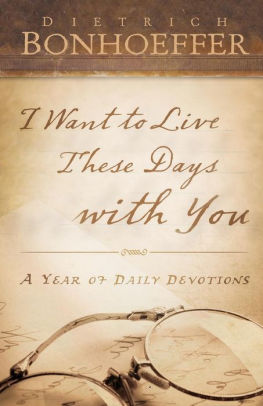
Occasionally, on Sunday, I will share a quote from something I’ve been reading. The hope is for you, dear reader, to share your thoughts on the quote and related issues and perhaps pick up some reading material along the way!
Christ’s Name Obligates Justice
I’ve been trying to ensure I do a daily devotion, which includes a brief liturgy, some Scripture reading, prayer, and a brief writing from a devotion. For this year, I chose I want to Live These Days with You, a collection of excerpts from Dietrich Bonhoeffer’s works for daily reading. I was struck by the reading from March 9, which features a quote from Ethics:
Wherever the name of Jesus Christ is named, he is there as protection and obligation. That is true of all people who in their battle for justice, truth, humanity, and freedom have again learned to name the name of Jesus Christ… It is not a ‘Christian Culture’ that must make the name of Jesus Christ acceptable to the world; rather, the crucified Christ has become the refuge, justification, protection, and obligation for those higher ideals that have begun to suffer and for their defenders. (DBWE 6:345, 347-348)
In our own time, we continue to see those who work not for justice, truth, humanity, and freedom, but instead for a “Christian culture,” itself allegedly based upon some broader worldview that, if only it would be embraced, would bring the former ideals along with it. But Bonhoeffer will have none of that. It is the very act of battling for those ideals that are obligated through the name of Jesus Christ himself. Moreover, those who do that battle are doing so in the name of Jesus, and as they do so, will find their refuge in the crucified Lord.
Links
Be sure to check out the page for this site on Facebook and Twitter for discussion of posts, links to other pages of interest, random talk about theology/philosophy/apologetics/movies and more!
On Christian Music– I wrote a post about the label “Christian music” and how that can lead to a number of difficulties with discernment.
Christian Discernment Regarding Music: A Reflection and Response– I reflect in depth on how we can use our discernment properly when it comes to music.
Sunday Quote– If you want to read more Sunday Quotes and join the discussion, check them out! (Scroll down for more)
Eclectic Theist– Check out my other blog for my writings on science fiction, history, fantasy movies, and more!
SDG.

 J.W. Wartick - Reconstructing Faith