Christianity
Really Recommended Posts 1/22/16- Neuroscience and boy/girl brains, consent, and more!
 I’ve been nose-deep in the latest Dean Koontz novel, but I still managed to pull together these posts for you, dear readers. We have neuroscience and the notion of a boy/girl brain, works of dead apologists, Consent and Planned Parenthood, oral tradition in the Bible, and Wittgenstein and Scholastic Metaphysics. Let me know what you think, and be sure to let the authors know as well.
Girl Brain? Boy Brain?: A Neuroscientist Examines the Evidence– We often hear about how boy and girl brains are hardwired to behave in different ways. What should we think about this claim? What does it mean?
Planned Parenthood’s Absurd Position on HIV Disclosure– “Consent” in sex entails informed consent, something that Planned Parenthood concedes. Why, then, do they turn around and argue you don’t need to give information to get consent?
Goodill on Scholastic Metaphysics and Wittgenstein– A philosophy-heavy post from Edward Feser on a challenge raised against Scholastic Metaphysics based on Wittgenstein’s philosophy. I enjoyed this read quite a bit.
Book Review: Understanding the Oral Tradition by Eric Eve– A substantive book review that will get you thinking about oral history and the transmission of the Bible.
Works of Dead Apologists– If you aren’t reading the works of dead apologists, you ought to be. Here’s a good place to get started.
Book Review: “The Open Minded Christian” by Richard Bushey
Richard Bushey’s book, The Open Minded Christian: How to Engage Charitably with Fellow Sinners presents a message that we often need to hear. That message is one of Christian love for neighbor.
Bushey outlines this necessary love of neighbor broadly in the first several chapters, noting that too often Christians tend to treat other Christians as though they were necessarily enemies of the faith. Moreover, this lack of charity extends to non-Christians as well. Repeated challenges are issued throughout the book for Christians to re-examine their own attitudes.
Several of the examples used to this regard are utilized very effectively. Bushey leads with a hot-button word like “evolution” or “homosexuality” and then turns around and presents analysis of how Christians tend to react to such topics. After that, he issues a call to Christians to act more Christlike in disagreement and to avoid jumping to conclusions about the “other” when it comes to issues like these. Thus, in the chapter on homosexuality, Bushey notes how quick many Christians are to disown or disavow people who are homosexual, thus leading to a continuing circle of anger and frustration. These and other examples are enlightening and help to bring to light how we ought to have a greater love of neighbor, even if we do not love everything about them.
A difficulty with the book is that there are many assertions about how certain groups shouldn’t split that ultimately seem unsubstantiated. For example: “[T]here is no ecclesiological reason that Calvinists and Arminians cannot congregate together” (7). First, what is meant by an “ecclesiological reason” as opposed to some other reason? A little ways down on the same page, Bushey seems to define what is meant by the term “ecclesiological reason”: “That is to say that if a church’s general practice is different from another, then creating different denominations make sense.” Second, why limit the scope of separation between denominations/churches to whatever is meant by “ecclesiological” reasons?
Given the definition Bushey apparently offers for “ecclesiological reason,” though, it seems that groups like Calvinists and Arminians do have reasons not to congregate together. For, if the umbrella is “general practice,” then many Calvinist churches have a general practice to speak of the sovereign decree of God in sermons and Bible studies; while many Arminian churches have a general practice to critique Calvinism from the pulpit (I have experienced both instances personally in different churches). Just a paragraph or so later, Bushey further clarifies, claiming that such ecclesiological differences are to be differentiated from “secondary” or “tertiary” differences, but again we have no definition of what is meant by those. I doubt that most convinced Arminians or Calvinists would feel their adherence to those sets of theological teachings are merely secondary or tertiary, given that it often comes back to the doctrine of God; but that is neither here nor there. The point is that some definitions offered at the outset would improve this work immensely.
Another problem is that Bushey at times mischaracterizes theological opponents when trying to demonstrate we ought not to do that very thing. For example, in section in which he is arguing that Christians ought to challenge their own beliefs in order to see if they match with reality, he writes, “The person who believes that water baptism washes away sins should dive into Romans 3-5 and try to prove that their view is wrong. They should read the text closely with the end in mind of proving that salvation comes by faith alone to the exclusion of baptism” (73). But this is a clear misunderstanding of what baptismal regeneration teaches. As one who affirms that (a Lutheran), I was shocked to see how my view was so clearly misrepresented here. It’s not as though by believing in baptismal regeneration, I deny salvation by faith alone. Far from it, and this shows how crucial a misunderstanding Bushey has here, for he seems to think that the view entails a kind of works-righteousness. Instead, Lutherans see baptism as a means of grace–an act of God; not a work of humanity. It was pretty jarring to have such a clear lack of understanding in a book that continually encourages understanding the other side.
Another example of this is the offhanded comment on the hypostatic union as allegedly entailing a kind of contradiction: “In the case of the hypostatic union, adherents deny that there are two persons within Christ, even though their view logically entails it” (88-89). Given that the hypostatic union has historically been affirmed as an orthodox understanding of Christology, and is used exactly to demonstrate that the two natures of Christ explicitly do not entail two persons, this is an astonishing statement. Indeed, one might ask how, exactly, two natures “logically entails” two persons. It doesn’t, and this basic, nonchalant dismissal of orthodox Trinitarian theology as being “inconsistent” is disappointing, to say the least.
The Open-Minded Christian is ultimately an uneven ride. The central message is one that needs to be heard, but it is surrounded by some serious misunderstandings and misrepresentations that make it difficult to take it as seriously as we ought to. It is worth a read for the good examples, but requires a critical eye.
The Good
+Some examples utilized quite effectively
The Bad
-Theologically suspect at times
-Some basic misunderstandings of opposing views
-Some grammatical errors
Disclaimer: I was provided with a copy of the book for review by the author. I was not obligated to provide any specific kind of feedback whatsoever.
Links
Be sure to check out the page for this site on Facebook and Twitter for discussion of posts, links to other pages of interest, random talk about theology/philosophy/apologetics/movies and more!
Book Reviews– There are plenty more book reviews to read! Read like crazy! (Scroll down for more, and click at bottom for even more!)
Eclectic Theist– Check out my other blog for my writings on science fiction, history, fantasy movies, and more!
SDG.
——
The preceding post is the property of J.W. Wartick (apart from quotations, which are the property of their respective owners, and works of art as credited; images are often freely available to the public and J.W. Wartick makes no claims of owning rights to the images unless he makes that explicit) and should not be reproduced in part or in whole without the expressed consent of the author. All content on this site is the property of J.W. Wartick and is made available for individual and personal usage. If you cite from these documents, whether for personal or professional purposes, please give appropriate citation with both the name of the author (J.W. Wartick) and a link to the original URL. If you’d like to repost a post, you may do so, provided you show less than half of the original post on your own site and link to the original post for the rest. You must also appropriately cite the post as noted above. This blog is protected by Creative Commons licensing. By viewing any part of this site, you are agreeing to this usage policy.
Book Review: “Partners in Christ: A Conservative Case for Egalitarianism” by John G. Stackhouse, Jr.
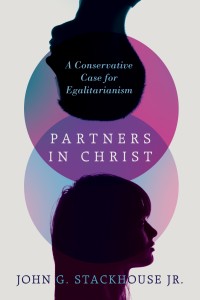 Partners in Christ: A Conservative Case for Egalitarianism is a challenging, extraordinary work. The first thought many readers might have when they see the title of this book is “A conservative case for egalitarianism? What!?” Yet that is exactly what this is. John G. Stackhouse, Jr. presents a case for egalitarianism that will challenge those on either side of the issue to rethink various aspects of their view.
The book is organized around a number of chapters, each of which is quite short. Each chapter’s title basically states what the goal of that chapter is. For example, a chapter entitled “Counterarguments from Church History” presents counterarguments to Stackhouse’s position from, well, church history. The organization is helpful, though it should not be mistaken for a license to jump around within the book. The case made herein is progressive and builds up over the course of the whole book.
Central to Stackhouse’s model is the notion that complementarians and egalitarians often talk past each other or fail to recognize the genuine concerns and possible insights from the “other side.” Thus, he challenges egalitarians to take more seriously the arguments for maintaining complementarity in gender, while he pushes complementarians to realize how often their case is based on presupposition rather than the biblical texts themselves. In other words, Stackhouse is going to make you uncomfortable, no matter what your position is. And, frankly, that’s a good thing. I’m a staunch egalitarian who used to be just as entrenched a complementarian, and it was good for me to have a book that challenged the assumptions I’m working under now. I think that effectively any reader could benefit from Stackhouse’s approach, even in disagreement.
The breadth of topics the book addresses makes it an excellent resource. Church history, theology, exegesis, modern social science, and more are each pieces of evidence that is brought forward to shed light on the issue. Particularly interesting was the chapter “Why, then, Do Women Not Lead?” which answered the question with a number of arguments from social science to theology. This kind of integrated approach is used beneficially throughout the book.
A disadvantage of the way the book is organized is that there is little space to dedicate to individual exegesis. Make no mistake, this is not the strongest egalitarian case from the Bible that can be made. It is an introduction to the full scope and depth of egalitarian arguments, yes, but it should not be mistaken for the most powerful argument possible.
Stackhouse’s ultimate conclusion is that women should be allowed the same roles in leadership in the church and home as men are allowed to fulfill. Again, this is not to say he will not challenge those who agree with this conclusion. I was taken aback by how fair and balanced this case was, and I know of no other book that presents as broad an introduction to such a complex topic as this one. I highly recommend Partners in Christ to you.
The Good
+Will challenge virtually every reader
+Excellent case, in brief, for egalitarianism
+Addresses wide variety of topics, arguments, and counter-arguments
+Balanced approach
The Bad
-Quite brief on several key points
-Concedes the notion of the “feminization of worship”
Disclaimer: I was provided with a copy of this book for review by the publisher. I was not required to write any specific kind of feedback whatsoever.
Source
John G. Stackhouse, Jr. Partners in Christ (Downers Grove, IL: InterVarsity, 2015).
Links
Be sure to check out the page for this site on Facebook and Twitter for discussion of posts, links to other pages of interest, random talk about theology/philosophy/apologetics/movies and more!
Book Reviews– There are plenty more book reviews to read! Read like crazy! (Scroll down for more, and click at bottom for even more!)
Eclectic Theist– Check out my other blog for my writings on science fiction, history, fantasy movies, and more!
SDG.
——
The preceding post is the property of J.W. Wartick (apart from quotations, which are the property of their respective owners, and works of art as credited; images are often freely available to the public and J.W. Wartick makes no claims of owning rights to the images unless he makes that explicit) and should not be reproduced in part or in whole without the expressed consent of the author. All content on this site is the property of J.W. Wartick and is made available for individual and personal usage. If you cite from these documents, whether for personal or professional purposes, please give appropriate citation with both the name of the author (J.W. Wartick) and a link to the original URL. If you’d like to repost a post, you may do so, provided you show less than half of the original post on your own site and link to the original post for the rest. You must also appropriately cite the post as noted above. This blog is protected by Creative Commons licensing. By viewing any part of this site, you are agreeing to this usage policy.
Sunday Quote!- History Has a History
 Every Sunday, I will share a quote from something I’ve been reading. The hope is for you, dear reader, to share your thoughts on the quote and related issues and perhaps pick up some reading material along the way!
History Has a History
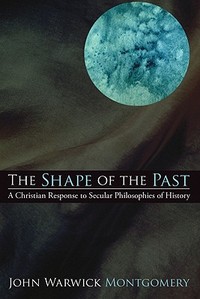
Historiography–the study of historical writing–is a fascinating topic, no matter how esoteric it sounds. There is so much more to history than a simple verbatim report of exactly what happened. The past is experienced by subjects and so has a kind of existential aspect of reality to it. John Warwick Montgomery’s work, The Shape of the Past: A Christian Response to Secular Philosophies of History is an attempt to view historiography through a Christian lens. One of Montgomery’s theses is a point fairly basic to historiography:
History itself has a history. [People] through the ages have written history in different ways as a consequence of the different philosophies of life that they have held. (34, cited below)
History is never fully objective. There can be objective facts of history, but our philosophies of life color how we organize those facts. Montgomery is careful to note that the process of writing history is selective in itself, and the way we organize it is another layer of interpretation.
The Shape of the Past is a fascinating work that I am enjoying immensely. I recommend those interested in the important topic of historiography check it out for a look at how Christianity can make a contribution to the topic.
Source
John Warwick Montgomery, The Shape of the Past (Eugene, OR: Wipf and Stock Publishers, 2008 edition [originally published 1975 by Bethany Fellowship]).
Links
Be sure to check out the page for this site on Facebook and Twitter for discussion of posts, links to other pages of interest, random talk about theology/philosophy/apologetics/movies and more!
Sunday Quote– If you want to read more Sunday Quotes and join the discussion, check them out! (Scroll down for more)
Eclectic Theist– Check out my other blog for discussions about all kinds of topics including science fiction, history, fantasy movies, and more!
SDG.
Downton Abbey’s Final Season: Episodes 1-2 – A Christian Perspective
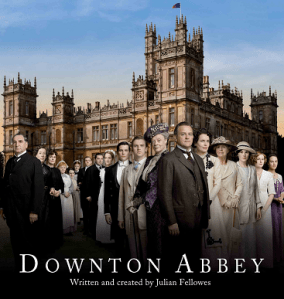 I will be analyzing each episode of the final season of Downton Abbey from a worldview perspective. I will be doing them two at a time to make space for my series on “The Expanse.” There will, of course be SPOILERS for each episode, and I will assume readers know about each previous season and episode’s content as well. It will be assumed that readers are familiar with the characters and circumstances. I will not be summarizing the plot of the episode; I will merely interact with the content from a perspective of worldview. BE COURTEOUS AND DO NOT BRING UP LATER EPISODES THAN THE ONE DISCUSSED HERE IN YOUR COMMENTS.
Episode 1
Lady Mary seemed to take some accountability in this episode. She was confronted by a woman who wanted to blackmail her for her affair, but she didn’t back down or agree to give her any money. She admitted her guilt, but did not want to tap into the family funds in order to pay off the woman. Ultimately, Lord Grantham interceded and got rid of the woman–for now. (As an aside, I’m not convinced we’ve seen the last of her. She seemed so angry! I could see her showing up again.)
However, taking accountability is not the full picture. Mary has shown little remorse for any of the acts she has done, whether it is sniping at her sister or something more serious. Moreover, her attitude of not giving into blackmail also reflected a rather nonchalant attitude towards how the news of her trist would impact others, whether the family of Tony Gillingham or her own. She seems to continue to think that her attitudes will only impact herself, completely unaware of how she impacts many others around her.
Episode 2
Thomas. Barrow. The name will almost certainly conjure up feelings in longtime watchers of Downton. This episode in particular showed how Barrow’s own attitude of bitterness and aggression towards most other people has led to his being ostracized by almost everyone else. Phyllis Baxter remains the only one who shows him any compassion and yet he continues to rebuff her attempts to be friendly towards him. There are many angles to be explored here, whether it is how our actions can bring upon ourselves the consequences thereof (without any need for things like Karma), but the angle I want to take is how Baxter’s action shows a kind of Christlike love towards Thomas.
Although this is never made explicit (or even implicit, really), the parallel is intriguing. It is one thing to love someone who is friendly to you. It is another to take compassion on someone who is hateful towards you. While we were still sinners, Christ died for us (Romans 5:8). Baxter’s kindness towards Thomas is a kind of sacrificial love that doesn’t require anything in return. It will be interesting to see how this plays out going forward.
More!
Be sure to let me know what you thought of the episodes, and what worldview-level issues you saw them raise, in the comments below.
Links
Be sure to check out the page for this site on Facebook and Twitter for discussion of posts, links to other pages of interest, random talk about theology/philosophy/apologetics/movies and more!
Eclectic Theist– Check out my other blog for my writings on science fiction, history, fantasy movies, and more!
SDG.
——
The preceding post is the property of J.W. Wartick (apart from quotations, which are the property of their respective owners, and works of art as credited; images are often freely available to the public and J.W. Wartick makes no claims of owning rights to the images unless he makes that explicit) and should not be reproduced in part or in whole without the expressed consent of the author. All content on this site is the property of J.W. Wartick and is made available for individual and personal usage. If you cite from these documents, whether for personal or professional purposes, please give appropriate citation with both the name of the author (J.W. Wartick) and a link to the original URL. If you’d like to repost a post, you may do so, provided you show less than half of the original post on your own site and link to the original post for the rest. You must also appropriately cite the post as noted above. This blog is protected by Creative Commons licensing. By viewing any part of this site, you are agreeing to this usage policy.
Really Recommended Posts 1/15/16- Graphic Novel Apologetics, Stay at home dads, and more!
Brr! It’s cold in Iowa… but not as cold as it was in Minnesota! I still walk around without a coat on in 30 degrees (F) due to my time spent in the frozen north. Anyway, the cold has given me time to read, and I present this latest round of really recommended posts to you, dear readers. There are posts about stay-at-home dads and egalitarianism, Batman and Christianity, Answers in Genesis’s position on “kinds,” the flying spaghetti monster and Santa, and censoring pro-life voices! Wow, I’m excited. Let me know what you think, and be sure to let the authors know you enjoyed their stuff, too!
Egalitarianism is for Men, Too– As a stay-at-home dad currently, I wrote this post for Christians for Biblical Equality to show some of the challenges faced in my life as well as how an egalitarian theology can benefit men. This one is from the heart, folks.
Review and Christian Reflections of My Favorite Works on Batman– Here’s a literary apologetics post on different Batman graphic novels. I decided to pick up one of these to start my own reading of Batman, since I’ve always enjoyed Batman. It is important to apply the Christian worldview to every aspect of our lives–including the fiction we read–and this is a good post showing how to do that.
Are Ruminants Derived from a Common Ancestor? Ruminating on the Meaning of Noahic “Kinds”– The Young Earth Creationist group, Answers in Genesis, is known for squeezing animals onto the Ark by reducing the number of species required, appealing to the notion of “kinds” in order to allow for common ancestors. Here is an analysis of just how difficult this assertion is to maintain.
God, Santa, and the Flying Spaghetti Monster– Often, atheists claim that God is on the same level, evidentially, as things like Santa Claus and the Flying Spaghetti Monster. Here is an analysis of that claim.
Six Ways I’ve seen Pro-Choice People Censor Pro-Lifers– Here are six common ways that pro-choice people have interfered with people who are trying to choose to listen to pro-lifers on college campuses and elsewhere.
Book Review: “Judges and Ruth: God in Chaos” by Barry Webb

Barry Webb’s commentary, Judges and Ruth: God in Chaos is part of the “preaching the word” series and presents the books in a pastoral, conversational fashion.
Webb continually brings up details of the text that are overlooked, bringing to light wonderful insights where people may tend to skip over. Minor judges (like Shamgar) are at times given as much detailed discussion as those we might consider more important. There is a clear method to this, as Webb seems uninterested in sharing those things readers learned and re-learned since Sunday School. This is a book that feels fresh and exciting–and I’ve read one of Webb’s other commentaries on Judges!
These insights are not limited to the minor judges, however. The sections on Gideon, Ehud, and Samson (one of my favorite Bible personages) are particularly excellent. Each will make readers look with more depth even at stories they think they knew. For example, regarding Eglon, the king Ehud kills, Webb points out that readers of the story should reflect on the interplay between Ehud’s bringing a harvest tribute and the corpulence of Eglon. The fatness of Eglon is, ironically, in part due to his gleaning food from Israel! It is just this kind of deep look at the text that can be found throughout the book, time and again, regarding the judges and Ruth.
The tone of the book is quite pastoral. There are no sections of Hebrew painstakingly pored over word-by-word. Admittedly, I love that kind of commentary. That’s not the kind of commentary this is. Instead, it is presented in a kind of conversational style that takes you directly to the story. A good word to describe the style is “immersive”: reading the commentary makes one feel as though they are inside the Bible story themselves, experiencing it, and seeing the world anew as the contemporaries might have. It is a pretty thrilling experience.
The section on Deborah as a “maverick” is unfortunate, because it undercuts the importance of the woman Deborah (though calling her a “maverick” seems on-point). Webb has written elsewhere (his commentary in the New International Commentary on the Old Testament Series on Judges) about how “there is no hint in the narrative or elsewhere in Scripture that her [Deborah’s] exercise of such a role [as leader/judge/prophetess] was contrary to God’s purposes, or a breach of his declared will in the way that the irregular worship practices of the period were” (Webb, The Book of Judges, (Eerdman’s, 2012) 188). Here, however, Webb qualifies this endorsement, carefully pointing to a pattern of male leadership throughout the Old Testament and arguing that Deborah is exceptional in her role here as prophetess/Judge. Yet in the same chapter, he also notes how the Old Testament is a patriarchal culture, which makes Deborah’s function as judge/prophetess even more exceptional! The exceptional nature, however, is not that it is improper–as Webb himself admits–but rather that her acting in this function, a prophetess called by God, challenges the very patriarchy that Webb has noted (and, at times, challenged himself) as the background for Old Testament practices. That is, Deborah functions as an attack on that paradigm, not a confirmation of it.
Though Webb notes that Deborah was praised in her function, he nowhere points out how this very act of praising Deborah for her role as leader and prophetess of Israel entails a theological truth of the gifting of God for women in such positions. I was disappointed to see this subtle shift in Webb’s affirmations about Deborah from his other commentary. This makes the section on Deborah less insightful than it could have been, however, particularly given her importance in the book of Judges.
Judges and Ruth: God in Chaos is a beautiful, pastoral book full of insights that will have you scrambling to grab your Bible and make notes. Although it isn’t perfect, it is a worthwhile read that will open the pages of the books covered in new ways. It is recommended.
The Good
+Full of intriguing details
+Immersive, engaging writing style
+Continually takes readers back to the text
+Plenty of background information
The Bad
-Inserts complementarian language into discussion of Deborah
Disclaimer: I received a copy of the book for review from the publisher. I was not required to provide any specific kind of feedback whatsoever.
Source
Barry Webb, Judges and Ruth: God in Chaos (Wheaton, IL: Crossway, 2015).
Links
Be sure to check out the page for this site on Facebook and Twitter for discussion of posts, links to other pages of interest, random talk about theology/philosophy/apologetics/movies and more!
Book Reviews– There are plenty more book reviews to read! Read like crazy! (Scroll down for more, and click at bottom for even more!)
Eclectic Theist– Check out my other blog for my writings on science fiction, history, fantasy movies, and more!
SDG.
——
The preceding post is the property of J.W. Wartick (apart from quotations, which are the property of their respective owners, and works of art as credited; images are often freely available to the public and J.W. Wartick makes no claims of owning rights to the images unless he makes that explicit) and should not be reproduced in part or in whole without the expressed consent of the author. All content on this site is the property of J.W. Wartick and is made available for individual and personal usage. If you cite from these documents, whether for personal or professional purposes, please give appropriate citation with both the name of the author (J.W. Wartick) and a link to the original URL. If you’d like to repost a post, you may do so, provided you show less than half of the original post on your own site and link to the original post for the rest. You must also appropriately cite the post as noted above. This blog is protected by Creative Commons licensing. By viewing any part of this site, you are agreeing to this usage policy.
“The Expanse” Episodes 1-5- A Christian Perspective
 I’ve been enjoying watching SyFy’s TV series, “The Expanse,” quite a bit. Part of that is because I’m a huge science fiction fan, but another part of it is because there is plenty of worldview discussion to go around. I’ll be posting a series on worldview in episodes from the expanse biweekly as they come out. There will be SPOILERS for the episodes discussed here. Please don’t post spoilers for later episodes on this post.
Fear and Safety
A theme that resonates all too readily with the current state of our society is that of fear of the “other.” People on Earth are afraid of anyone not from Earth, people of the outer planets/belters are afraid of people of Mars and Earth. Fear is a driving motivation for many of the characters so far. Chrisjen Avasarala is a clear example of this so far. She submits a captured suspected OPA terrorist to torture in order to try to get information from him that should protect others. The apparent callousness with which she does this act seems to be unquestioned by those around her.
It is all too easy to dehumanize those who are not like us. It is made easier when we fear “them.” Safety is the proverbial carrot that is held out to justify wrongful acts against the perceived evil “other.” We are assured that if such measures are not taken, our lives may be forfeit. Yet what price is too high to pay for safety?
Christians should be working against injustice wherever it occurs. Injustice includes cruel punishments and torture of others. Although we need not be completely without defense, there is no place for an ethic of the ends justifying the means in Christianity.
Home and Place
Episode 5 had an interesting conversation between an OPA man and Detective Miller. In it, the OPA man was pointing out how people on earth have a home, a place to call their own, but elsewhere, people do not. Throughout the series so far, there has been a sense of displacement among the characters. No one does seem entirely comfortable where they are. This notion of place is one that should not be too easily passed over.
Place is something that everyone needs–somewhere to call their own. In the Bible, this is evident in the narratives of Israel and the Promised Land, but it continues into our time with the promise of the New Creation. The hope for a home is something that is ultimately forward-looking, because we will never be truly home until we have been united with Christ. The longing evident in characters in “The Expanse” points us towards our own longings.
Conclusion
I’d love to know what you think of the series thus far and what worldview level issues you have seen therein. Leave a comment and be sure to follow the blog as I will be writing more as the series progresses.
Links
Be sure to check out the page for this site on Facebook and Twitter for discussion of posts, links to other pages of interest, random talk about theology/philosophy/apologetics/movies and more!
Eclectic Theist– Check out my other blog for my writings on science fiction, history, fantasy movies, and more!
SDG.
——
The preceding post is the property of J.W. Wartick (apart from quotations, which are the property of their respective owners, and works of art as credited; images are often freely available to the public and J.W. Wartick makes no claims of owning rights to the images unless he makes that explicit) and should not be reproduced in part or in whole without the expressed consent of the author. All content on this site is the property of J.W. Wartick and is made available for individual and personal usage. If you cite from these documents, whether for personal or professional purposes, please give appropriate citation with both the name of the author (J.W. Wartick) and a link to the original URL. If you’d like to repost a post, you may do so, provided you show less than half of the original post on your own site and link to the original post for the rest. You must also appropriately cite the post as noted above. This blog is protected by Creative Commons licensing. By viewing any part of this site, you are agreeing to this usage policy.
Book Review: “American Exceptionalism and Civil Religion” by John Wilsey
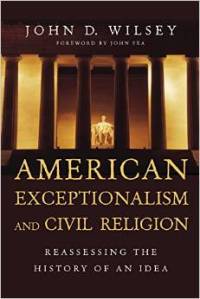
John D. Wilsey’s American Exceptionalism and Civil Religion sheds light on the ways that Americans through history have conceived of the United States as a blessed nation.
The book is organized around various historical periods, from the origins of exceptionalism in the earliest colonial periods to modern times. One aspect of American exceptionalism is “the idea that Americans are a people specially chosen by God and given a destiny to fulfill by him…” (16, cited below). Throughout the book, Wilsey shows how this idea has developed and how it has negatively impacted not only our theology but also the way the country developed politically and ethically.
Wilsey traces the sad history of slavery and expansion into North America, highlighting how the ideology of American Exceptionalism played into the whole endeavor. Because that which was deemed “American” was theologically tied to a concept of chosen nation and a skewed view of manifest destiny, people from the lowliest white farmer to the President of the United States were able to justify heinous acts upon fellow human beings. Furthermore, due to the concept of chosen nation that theologians lifted from the pages of the Bible and applied to the United States, many of these atrocities were dismissed as aspects of a new eschatological narrative pointing towards the concept of America’s growth and civil religion.
This notion is made particularly acute in the chapter entitled “The Innocent Nation” which shows how various American leaders portrayed the United States as innocent and without moral faults. Though this narrative was often challenged, it has been maintained over time and modified to keep up a notion of America as the moral light for all nations. The occasional mixing in of imagery is a powerful way Wilsey depicts narratives like this, such as the image of John Gust’s American Progress (featured on p. 78). Readers are exposed to a number of firsthand accounts and quotes from those involved in the process of theologizing and putting forth ideas about the United States.
Balance is an admirable feature of this book, which cautions against going to extremes in either direction related to the notion of the United States as a chosen nation. Moreover, even when critical of certain figures throughout history, Wilsey notes how many helped to bring about some good as well. For example, a few Presidents have perpetuated notions of America as an “Innocent Nation” while still working for justice and international peace–thus showing that exceptionalism can lead to a belief that those with the blessings ought to use them to help others.
What is all too often lacking in books like this is presentation of a way forward. That is, too often books like this focus solely on showing the problems with systematic corruption or evil, but then leave readers at a loss for how to combat it or try to move beyond it. Wilsey, however, laces commentary on “open exceptionalism” throughout the book as a way for Christians to remain appreciative of the blessings of their country without turning to an unbiblical view of deifying their nation. This open exceptionalism allows for Americans to see the United States as blessed with certain freedoms and prosperity, while still moderating notions that might lead to seeing America as above criticism or without fault. Thus, he provides a way to reevaluate our own views and move towards a position where we can remain patriotic while not falling into the traps of an exceptionalism that redefines Christianity.
American Exceptionalism and Civil Religion is an incisive critique of the notion of American Exceptionalism and Civil Religion. Moreover, it provides a way forward for those wanting to help bring about change.
The Good
+Excellent analysis of American exceptionalism
+Balanced view
+Presents a positive way forward
+Utilizes several threads of evidence
The Bad
-Requires readers to draw out definitions on some points
Disclaimer: I was provided with a review copy of the book by the publisher. I was not required to provide any specific kind of feedback whatsoever.
Source
John D. Wilsey, American Exceptionalism and Civil Religion (Downers Grove, IL: InterVarsity, 2015).
Links
Be sure to check out the page for this site on Facebook and Twitter for discussion of posts, links to other pages of interest, random talk about theology/philosophy/apologetics/movies and more!
Book Reviews– There are plenty more book reviews to read! Read like crazy! (Scroll down for more, and click at bottom for even more!)
Eclectic Theist– Check out my other blog for my writings on science fiction, history, fantasy movies, and more!
SDG.
——
The preceding post is the property of J.W. Wartick (apart from quotations, which are the property of their respective owners, and works of art as credited; images are often freely available to the public and J.W. Wartick makes no claims of owning rights to the images unless he makes that explicit) and should not be reproduced in part or in whole without the expressed consent of the author. All content on this site is the property of J.W. Wartick and is made available for individual and personal usage. If you cite from these documents, whether for personal or professional purposes, please give appropriate citation with both the name of the author (J.W. Wartick) and a link to the original URL. If you’d like to repost a post, you may do so, provided you show less than half of the original post on your own site and link to the original post for the rest. You must also appropriately cite the post as noted above. This blog is protected by Creative Commons licensing. By viewing any part of this site, you are agreeing to this usage policy.
“Faithful Elephants”- How a children’s story taught me war is terrible
 I vividly remember the day I first had read to me Faithful Elephants: A True Story of Animals, People, and War by Yukio Tsuchiya. [There are SPOILERS for this short children’s book in this post.] I was around 5 years old. My family was looking at a garage sale and I saw the book, which looked interesting to me. We brought it home and my mom read it to me. I remember we were both crying by the end. I was inconsolable for a while. “Why did the elephants have to die?” I remember asking.
The story of Faithful Elephants is a story about three elephants at a zoo in Japan during World War II. It was the late part of the war and Japan was being bombed. The army was worried the zoo would be hit and animals would escape and harm people. Thus, they poisoned the tigers, bears, and other dangerous animals. The elephants were considered in this category because they might stomp down houses and the like. But the elephants were too smart to poison through food; they just set the poisoned food aside and ate the good food. They couldn’t find a syringe strong enough to penetrate the elephants’ skin to inject the poison, so the elephants were to be starved.
They continued to starve, but the zookeepers had to keep passing by, knowing their beloved elephants needed them. Eventually, one elephant handler gave in and gave the elephants food, but the war kept going on and although no one found out, they couldn’t get food to the elephants again. The elephants died one day, their trunks sticking out of their cage because they were doing the trick that would always get them treats and food. The elephant handler and others hugged and cried over the bodies and the handler shook his fists at the sky while bombs fell, crying out against war.
There remains a monument for the elephants at the zoo to this day, and the story is read over the radio annually. I’ll admit it, I’m positive I couldn’t read this book aloud without crying, and I can’t get through it on my own without crying either. It’s an extremely sad story.
But my memory of the day involves more than just wondering why the elephants couldn’t have been spared. I also remember it as the first time I genuinely thought war is terrible. You see, before, war had always been something kind of cool. War was the realm of John Wayne movies: glory, some humor, and the good guys always win. But the Japanese in World War II were supposed to be the “bad guys”; suddenly I felt empathy for them. I realized that war had horrific side effects which were often unpredictable. It involved the innocent; not just animals but also people. I remember crying the whole day, pretty much without end. I just kept thinking: if that happened to elephants, what about the children? It’s not that I assumed the children starved to death, but I had realized that if something as bad as starving elephants had to happen, there were also probably way worse things. War wasn’t always a John Wayne flick.
The book taught me that war is terrible. I think that it is a lesson worth learning. It is easy to get caught up in the on screen glory of the good triumphing over bad. It is not easy to confront the actual horrors of war. From a Christian perspective, it seems quite clear we should work against these horrors wherever they might be found. We should work to keep peace; we should help those in need; where war is found, we should work towards a peaceful resolution. I’m not saying Christians must be pacifists. What I am saying is that we need to defend the defenseless and work towards peace.
The book is recommended for grades 3-8. I think that is probably a good age category, but parents should be aware it will be an extremely emotional work. I’d recommend reading it before sharing with children.
Recently, I found the book again while going through the attic at my parents’ house. Reading it still made me cry.
Appendix: An Alternate Reality?
There is some dispute over the historicity of the story. A little searching turned up this critical investigation into the story. Interestingly, it appears to be true that the elephants were starved, but the author of this historical report argues that the elephants could have been shot or poisoned and the starvation was cruel. He thus sees the story of the starving of the elephants (and a few other animals) as “Until it is understood that the story of Ueno Zoo’s slaughtered animals illuminates less the nature of war, but rather some human beings’ moral failure, this will remain an instance of not coming to terms with the past.” However, Tsuchiya provided a reason for starvation to be the preferred method: the possibility that the war would end and the animals could be saved. It seems to me this is not implausible.
Links
Be sure to check out the page for this site on Facebook and Twitter for discussion of posts, links to other pages of interest, random talk about theology/philosophy/apologetics/movies and more!
Source
Yukio Tsuchiya, Faithful Elephants: A True Story of Animals, People, and War illustrated by Ted Lewin, translated by Tomoko Tsuchiya Dykes (Trumpet, no date).
SDG.
——
The preceding post is the property of J.W. Wartick (apart from quotations, which are the property of their respective owners, and works of art as credited; images are often freely available to the public and J.W. Wartick makes no claims of owning rights to the images unless he makes that explicit) and should not be reproduced in part or in whole without the expressed consent of the author. All content on this site is the property of J.W. Wartick and is made available for individual and personal usage. If you cite from these documents, whether for personal or professional purposes, please give appropriate citation with both the name of the author (J.W. Wartick) and a link to the original URL. If you’d like to repost a post, you may do so, provided you show less than half of the original post on your own site and link to the original post for the rest. You must also appropriately cite the post as noted above. This blog is protected by Creative Commons licensing. By viewing any part of this site, you are agreeing to this usage policy.

 J.W. Wartick - Reconstructing Faith