Christianity
Sunday Quote!- Forgiveness in Islam and Christianity
 Every Sunday, I will share a quote from something I’ve been reading. The hope is for you, dear reader, to share your thoughts on the quote and related issues and perhaps pick up some reading material along the way!
Forgiveness in Islam and Christianity
James White’s book, What Every Christian Needs to Know About the Qur’an
Here Allah not only forgives the man of horrendous sin but also does so without the slightest reference to the fulfillment of the divine law against murder. The key issue is not God’s mercy or even God’s desire to forgive. The issue is how forgiveness can be obtained without violating His holiness and justice. From the perspective of this hadith, forgiveness flows not from God’s actions in providing a basis for salvation, but from His power alone. (158, cited below)
The distinction White discusses here is crucial. The basis for forgiveness in Christianity flows along with God’s holiness and justice: God provides for justice through the atonement provided by Christ. In Islam, however, Allah may choose to forgive whomever, whenever, merely because Allah is all-powerful–and this in the radical sense that Allah may do whatever Allah wishes, even violate divine law against murder and the like without any intercession and mediation.
It seems to me that this provides another reason to think of the reasonableness of Christianity: it provides a basis for God’s forgiveness apart from mere divine fiat.
What do you think? How important is this distinction? Does James White accurately portray this difference?
Links
Be sure to check out the page for this site on Facebook and Twitter for discussion of posts, links to other pages of interest, random talk about theology/philosophy/apologetics/movies and more!
Sunday Quote– If you want to read more Sunday Quotes and join the discussion, check them out! (Scroll down for more)
Source
James White, What Every Christian Needs to Know About the Qur’an
SDG.
Question of the Week: Favorite Non-Bible Book on Jesus
 Each Week on Saturday, I’ll be asking a “Question of the Week.” I’d love your input and discussion! Ask a good question in the comments and it may show up as the next week’s question! I may answer the questions in the comments myself.
Jesus the Christ
I try to make sure I’m reading one book on Jesus in my rotation of books all the time. That said, I’m starting to run low on books on Jesus. Thus, why not ask you, dear readers, for some more reading materials?
What’s your favorite non-biblical book on Jesus?
Is it an apologetics book? A work on Christology? What topic is your favorite? Let me know in the comments.
Links
Be sure to check out the page for this site on Facebook and Twitter for discussion of posts, links to other pages of interest, random talk about theology/philosophy/apologetics/movies and more.
Question of the Week– Check out other questions and give me some answers!
SDG.
Book Review: “Theology and Contemporary Critical Theory” by Graham Ward
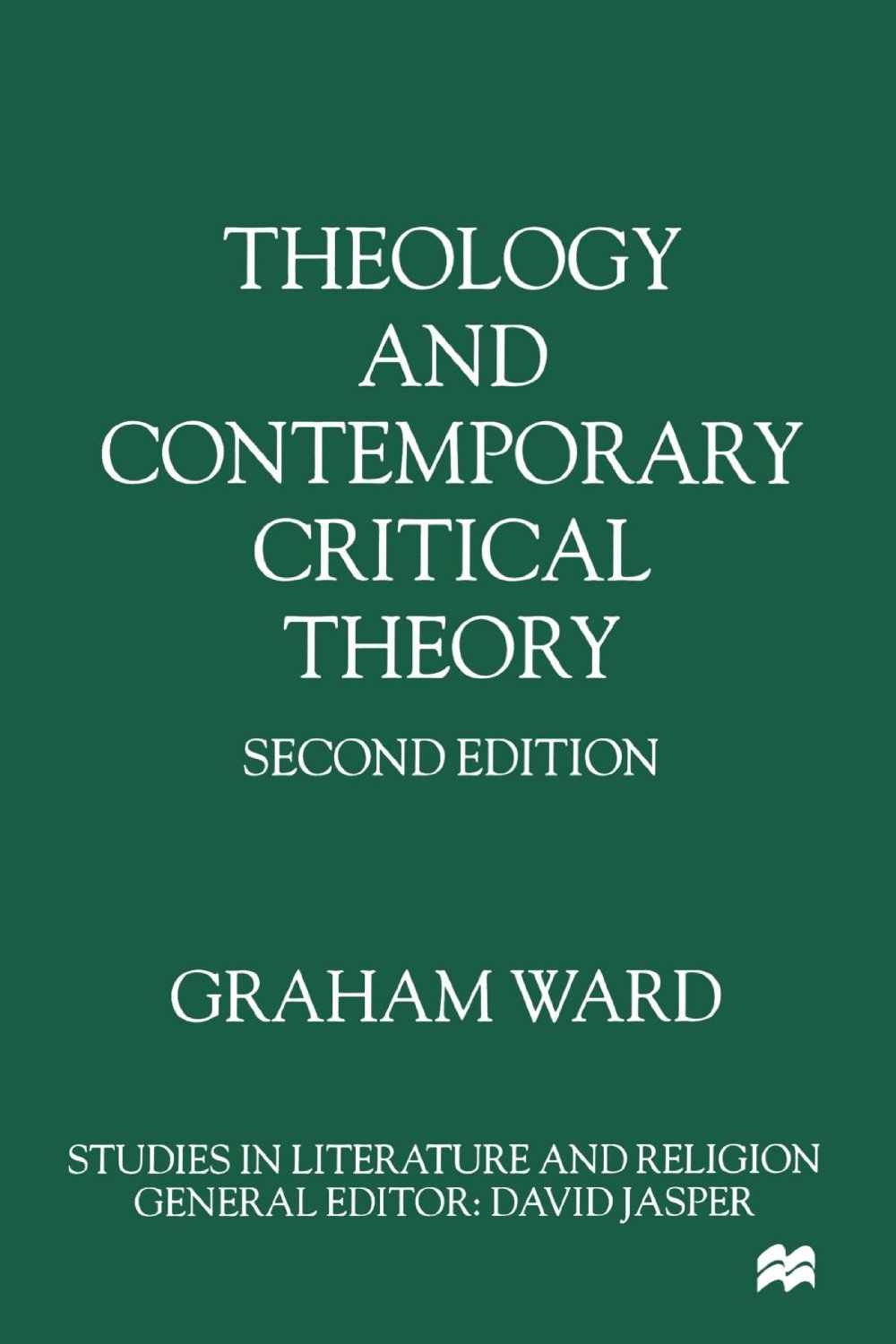
There is no conceivable limit to what critical theory cannot comment upon, nor what form that comment can take. Every discipline and cultural phenomenon is swept into its purview… (xviii)
Graham Ward, in Theology and Contemporary Critical Theory, seeks to bridge a gap between critical theorists and theologians. Critical theory is essentially various ways to look at how discourse is practiced through the means of socio-cultural factors. Yes, this is a simplified definition, but at its core critical theory engages with various practices of discourse in order to draw out the implications for how the conclusions may be reached. It calls into questions those conclusions by pointing out there may be more to the story.
In order to explore critical theory, Ward outlines the thinking of various contemporary theorists under representation, history, ethics, and aesthetics. These topics are each interesting in their own ways, and readers will be often surprised at the turns critical theorists take. Much of the thinking involved here is of interest, sometimes as much for how wrong it seems as for how enlightening it may be. There are some very weird findings from critical theorists, who are often involved in psychoanalysis and other projects to draw out the alleged sources of purported evidence.
Ward ends each chapter with insights into how the theories discussed may be applied to thinking about theology today. These conclusions are highly fruitful, as they demonstrate how even some approaches which seem at odds with Christianity in whole or in part may help shape theological thought. For example, issues of gender loom large and Ward suggests that critical theorists have jumped ahead of theologians in their thinking on the topic through explorations of how concepts of gender are formed. Whatever one’s thoughts regarding gender, it is true that theologians may do well to explore this topic further, whether from a critical (!) perspective or not.
One area readers may fault the work is that Ward, while engaging critical theory, is rarely critical himself. That is, he seems to adopt the findings (if psychoanalysis of entire fields of research may be called findings) of critical theorists without himself having a critical eye towards these same. However, that would be to try to make the book into something it is not. Ward’s project is to simply present critical theory and see how it might be applied to theology. That said, it would have been nice to have a chapter which engaged these theories. Those interested in the book should be aware that it really is the case that Ward essentially just reports on the theories and comments upon how theology might benefit from them.
Again, critical theory is far more complex than outlined above, but Ward has set for himself the monumental task of distilling it and applying it to theology, another field which he stresses touches upon all aspects of human life and experience. As such, readers should realize that although this book is engaging and compelling, there is far more work which can and should be done in this area.
Links
Be sure to check out the page for this site on Facebook and Twitter for discussion of posts, links to other pages of interest, random talk about theology/philosophy/apologetics/movies and more!
Source
Graham Ward, Theology and Contemporary Critical Theory (New York: St. Martin’s Press, 2000).
SDG.
——
The preceding post is the property of J.W. Wartick (apart from quotations, which are the property of their respective owners, and works of art as credited; images are often freely available to the public and J.W. Wartick makes no claims of owning rights to the images unless he makes that explicit) and should not be reproduced in part or in whole without the expressed consent of the author. All content on this site is the property of J.W. Wartick and is made available for individual and personal usage. If you cite from these documents, whether for personal or professional purposes, please give appropriate citation with both the name of the author (J.W. Wartick) and a link to the original URL. If you’d like to repost a post, you may do so, provided you show less than half of the original post on your own site and link to the original post for the rest. You must also appropriately cite the post as noted above. This blog is protected by Creative Commons licensing. By viewing any part of this site, you are agreeing to this usage policy.
Alvin Plantinga, the Compromiser?- A Call to Christian Charity in Disagreement
 The young earth creationist Ken Ham of Answers in Genesis recently wrote a blog post critiquing eminent Christian philosopher Alvin Plantinga on a number of levels. I’d like to offer a brief analysis of his comments.
Calvin College
Ken Ham doesn’t like Calvin College, where Plantinga once taught. About the school, he says:
Calvin College in Grand Rapids, Michigan, is one of the most ardently compromising Christian Colleges in the US that continues to lead so many young people astray in regards to the authority of Scripture beginning in Genesis.
Harsh words! Of course the reason that Calvin College is said to be a “compromising” college is because it doesn’t follow Ken Ham’s specific interpretation of Genesis as a necessity of Christian faith. By not holding to a position that the Earth is only about 6000 years old, Calvin College gets added to the blacklist of “compromisers.” This kind of name-calling is unbecoming Christians, but that unfortunately hasn’t stopped Ham and his followers.
Plantinga and Science
Ham takes issue with Plantinga’s words on whether science and Christianity may coexist. Following the link to read Plantinga’s own words, one reads:
[Those who believe in a conflict between science and faith] are thinking of evolution plus naturalism, which is the idea that there isn’t any such person as God or anything like God … evolution doesn’t say anything about whether there is such a person as God or not…It’s a metaphysical add-on they are importing into the scientific notion of evolution.
Ham believes that because of this, Plantinga is “equivocating” science and evolution. However, it can hardly be argued that evolution is not the reigning paradigm in biology. Thus, it is not so much equivocation as it is using terms as they are commonly understood. But that aside, the key point is that Plantinga surely seems to be correct. If one does not pair metaphysical naturalism with evolution, it poses no challenge to the existence of deity.
Charity
Now, the nuances of whether evolution may be reconciled with Genesis or not aside, the real question is the appropriateness of name-calling because other Christians believe in a different interpretation of Genesis. Ham wants to keep the focus on the alleged “utter contradiction” between evolution and Genesis, but he does so by elevating his specific interpretation of the Bible above any other view and even above Christian charity. For Ham, there is no need to engage with fellow Christians in a meaningful manner. Instead, he simply dismisses fellow Christians as compromisers and sees that as enough for his followers to ignore any complexities in the debate.
Of course, going back to the issue that Ham wants to frame: the alleged conflict between science and religion, I think that it is vitally important to allow charity in interpretations of Genesis. God’s word is infallible, but human interpreters are not infallible. Instead of lashing out at other Christians because they hold a different view than we do, perhaps we should work to reconcile with and learn from each other.
Ken Ham’s post is just a single example of the constant stream of vitriol spilled out by certain groups against those with whom they disagree. I myself have been called a compromiser, an unbeliever, a follower of Satan, someone who is working to undermine the faith, etc. by people who disagree with me. Why not start the discussion rather than pouring out insults? Why not seek to work together and, if necessary, debate the issues instead of using such nasty language about others?
Links
Be sure to check out the page for this site on Facebook and Twitter for discussion of posts, links to other pages of interest, random talk about theology/philosophy/apologetics/movies and more!
Christian Philosopher Says Science Doesn’t Oppose Faith– Read Ken Ham’s post for his own perspective and words on the topic.
I do not own rights to the image of Alvin Plantinga. I found it with an image search and could not find any original rights attribution. I am using it under fair use.
SDG.
——
The preceding post is the property of J.W. Wartick (apart from quotations, which are the property of their respective owners, and works of art as credited; images are often freely available to the public and J.W. Wartick makes no claims of owning rights to the images unless he makes that explicit) and should not be reproduced in part or in whole without the expressed consent of the author. All content on this site is the property of J.W. Wartick and is made available for individual and personal usage. If you cite from these documents, whether for personal or professional purposes, please give appropriate citation with both the name of the author (J.W. Wartick) and a link to the original URL. If you’d like to repost a post, you may do so, provided you show less than half of the original post on your own site and link to the original post for the rest. You must also appropriately cite the post as noted above. This blog is protected by Creative Commons licensing. By viewing any part of this site, you are agreeing to this usage policy
Sunday Quote!- Tourism, Borders, and the “Other”
 Every Sunday, I will share a quote from something I’ve been reading. The hope is for you, dear reader, to share your thoughts on the quote and related issues and perhaps pick up some reading material along the way!
Tourism, Borders, and the “Other”
William Cavanaugh is a favorite of mine due to his fantastic book, The Myth of Religious Violence. I had the chance to snag a more recent book of his, Migrations of the Holy
The artificial preservation of local identities is essential to tourism. In other words, the tourist represents both the attempt to transcend all borders and identities and the simultaneous attempt to fix the identities of non-Western subjects within its gaze. (79, cited below)
Cavanaugh’s point is in context of a broader discussion on migrant, tourist, pilgrim, and monk, and he acknowledges complexity to each of these categories. His point is that, in a sense, the very act of tourism both attempts to break down barriers (by going to the “other”) and also necessitates barriers (by upholding and even romanticizing or denigrating the concept of the “other”). It’s an interesting thought which makes one wonder about how we should live our lives in an increasingly “global” world.
How might we live our lives in the world in such a way as to avoid making the “other” into an object for our observation? How can we become “pilgrims” in a world which increasingly demands tourism? How can we sanctify a world which seeks to build barriers?
Links
Be sure to check out the page for this site on Facebook and Twitter for discussion of posts, links to other pages of interest, random talk about theology/philosophy/apologetics/movies and more!
Sunday Quote– If you want to read more Sunday Quotes and join the discussion, check them out! (Scroll down for more)
Book Review: “The Myth of Religious Violence” by William T. Cavanaugh– I review the book which has led me to discuss the ways the category of religion is used to stigmatize the other and also forced me to rethink a number of issues. I highly recommend this book.
Source
William Cavanaugh, Migrations of the Holy
SDG.
Really Recommended Posts 10/10/14- Game of Thrones, Abortion, Joshua, and more!
 Another week, another look at some of the most interesting posts on the web. Here we have posts on the Game of Thrones and Philosophy, Joshua 10 and the meaning of the sun standing still, creationist Ken Ham, abortion, and ways your kid might be learning an oversimplified faith. As always, I’d love to read what you think of the posts! Be sure you leave a comment when you go visit to let the authors know your own insights. We have an owl post edition today because it’s cold.
6 Ways You May Be Raising Your Kids with an Oversimplified Faith– We are charged with raising our children in the faith. That doesn’t apply only to parents, but to the entire Christian community. How might we combat the simplistic image of faith that many children have? Check out this great post (and site) from Natasha Crain, and be sure to follow the site for some awesome posts on Christian teaching for children.
Biblical Credibility and Joshua 10: What does the text really claim?– Joshua 10–the passage about the sun ‘standing still’ in the sky has long drawn criticism from non-Christians for various reasons, primarily scientific inaccuracy. Here, eminent scholar John Walton (seriously one of my favorites) explains the text of Joshua 10 in light of other Ancient Near Eastern literature and the way it would have been understood in its time.
Scott Klusendorf Defends the Pro-Life View on the Unbelievable? Radio Show– Recently, Scott Klusendorf–a wonderful pro-life teacher and advocate–debated Mara Clarke on the subject of abortion. It was interesting to listen to this debate and see how the sides played out their arguments. Check out this post to get summary and commentary on the debate.
“You Win or You Die” (from Game of Thrones and Philosophy)– Whatever your view of the appropriateness of “Game of Thrones” (and we must note there is much objectionable content in it), there is no denying its current popularity. Check out this post from Anthony Weber which discusses some issues related to the philosophy of the series.
The Never-ending Debate: Ken Ham’s Obsession with Bill Nye– Some time ago, Ken Ham debated Bill Nye on evolution, the age of the earth, and more (see my summary and commentary on the debate here). Ken Ham has not let this public debate sit, and continues to utilize it to produce creationist material and muster the troops, so to speak. Is this a bad thing? Is it helpful? Let’s here your thoughts. Here is a post analyzing some recent trends in his organization regarding Bill Nye.
“The Monuments Men” – An Apologetic of Culture
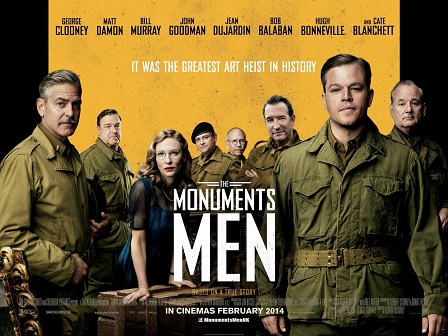 “The Monuments Men” is a film based on a true story of a group of soldiers sent to salvage cultural artifacts from destruction by the Nazis. Here, we’ll analyze the film from a worldview perspective. There will be SPOILERS in what follows.
Aesthetics
One question the film puts front and center is this: “Of what value is art?”
The question is put in a number of poignant ways, such as a moving scene in which Donald Jeffries is killed in an effort to protect Michelangelo’s Madonna and Child. The scene is powerful because Jeffries finds his value in his efforts to defend and preserve this beautiful art. He writes a letter to his father about the value of defense of such a work of art, which is overlaid with the imagery of him being killed by a Nazi officer.
Claire Simone works against the Nazis to try to protect and preserve the ownership of art. Her recognition of the importance of these pieces of history to those who collected them is a recognition of the power of the human mind to transcend the mundane.
The power of art to shape humanity, or even become a monument to humans–a way to transcend–is front and center throughout the film. The question that is then begged is this: if the natural world is all which exists, whence the transcendence? Where or to what might the transcendence point?
History and Life
History is important aspect of human life. Long have various cultures held notions that if one’s name were erased from historical record, it was as if one never had existed. The driving force to be remembered is a powerful one in human life, but perhaps it is also something which drives us towards art.
By collecting the art and stealing the works from their rightful owners, the Nazis were essentially attempting to rewrite history and capture the cultural past of those who owned or produced the art. There is a powerful message behind this of the need to be aware of how history is shaped by even those who are writing it.
Argument from Aesthetics?
How is it that humans recognize the value of art, or, more abstractly, of beauty? Some would allege that it is merely something we assign to things. The value is entirely a construct. In some ways that seems true, but there is something inherent in the notion that beauty–that art–is something which it is a great evil to destroy or take from someone else. Beauty is in the eye of the beholder, but it is also something which points beyond itself, to the transcendent.
The very possibility for recognizing that which is beautiful itself cries out for explanation. Whence the need for, dedication to, and recognition of beauty? A Christian would point beyond these towards God. Without the actual existence of the transcendent, there is little possibility for explaining the capacity for humans to reach out and grasp it.
Conclusion
“The Monuments Men” is a very solid flick to explore from worldview perspectives. It’s not as action-packed as most war movies, but it is more thoughtful and because of that it is in many ways more compelling. Perhaps most interestingly, it offers a view of the arts as something concrete, to be appreciated, and perhaps even transcendent.
Links
Be sure to check out the page for this site on Facebook and Twitter for discussion of posts, links to other pages of interest, random talk about theology/philosophy/apologetics/movies and more!
SDG.
——
The preceding post is the property of J.W. Wartick (apart from quotations, which are the property of their respective owners, and works of art as credited; images are often freely available to the public and J.W. Wartick makes no claims of owning rights to the images unless he makes that explicit) and should not be reproduced in part or in whole without the expressed consent of the author. All content on this site is the property of J.W. Wartick and is made available for individual and personal usage. If you cite from these documents, whether for personal or professional purposes, please give appropriate citation with both the name of the author (J.W. Wartick) and a link to the original URL. If you’d like to repost a post, you may do so, provided you show less than half of the original post on your own site and link to the original post for the rest. You must also appropriately cite the post as noted above. This blog is protected by Creative Commons licensing. By viewing any part of this site, you are agreeing to this usage policy.
Constantine’s Faith and the Myth of “Constantine’s Takeover”
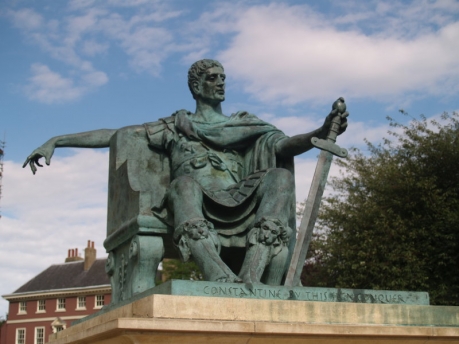 There is a narrative within some branches of Christianity (and some… “offshoots”) regarding church history. It is a narrative in which Constantine is seen as the great evil (whether intentionally or not) which corrupted Christianity. The narrative basically goes like this: Constantine rose to power, then everything went wrong in Christianity. He made Christianity the state religion, which introduced scores of nominal Christians into the church. He made service in the church a well-paying position, which corrupted the office of the ministry. He himself was probably not even a Christian!
So the story goes. Is it accurate?
From Narrative to History
The question of Constantine is one of history. Too often, people have subjected Constantine to psychoanalysis, analyzing an ancient historical figure’s mental state to determine his motives. Historical study may indeed speculate about such things, but to suggest, as some do, that one may uncover some nefarious ancient plot to take over Christianity and lead it into heresy is to engage in writing historical fiction. So what may we actually learn from the historical accounts? Peter Leithart’s work, Defending Constantine: The Twilight of an Empire and the Dawn of Christendom 
Leithart notes that it seems clear that Constantine actually paid much deference to Christianity (Leithart, 93; 121ff; 128-129; 326-328, etc., cite below). He was keen to prevent major divisions within the Church which could have resulted, for example, from the Arian controversy. Hence, he called a council at Nicaea which would define Christian orthodoxy for centuries to come. Constantine himself likely favored the view of Arius, but when the Nicene Council ultimately came against Arianism, Constantine submitted to the defining of orthodoxy.
Constantine’s life appears to be one not of a plot to take Christianity over for political gain, but rather as a life lived struggling with newfound faith and attempting to integrate that faith into public policy. Alister McGrath notes that Constantine’s faith led him to legalize Christianity and sanction it, with some interesting and perhaps unforeseen side-effects:
The new imperial status of Christianity meant that its unity and polity were now matters of significance to the state. (McGrath, 139, cited below)
The much-discussed question of why, if Constatine’s faith were genuine, he would have waited until his deathbed to get baptized is easily answered by his belief that he should wait until the last possible moment to gain the purifying from sins which baptism would provide (Leithart, 299-300).
Frankly, the more one reads about Constantine, the more difficult it becomes to imagine him as someone whose faith was not genuine. Like any Christian, he had his faults–he was a sinner-saint–but he also worked through his position to try to spread and unite Christianity. Leithart notes that many of Constantine’s laws were “more often Christian in effect than in intent” (304). What he means by this is that many laws he made spring from a Christian worldview, though not being explicitly Christian themselves. For example, he outlawed gladiator shows–hardly something which can be said to be explicitly Christian–and this demonstrated Constantine’s genuine concern for human life and the “image of God” in humanity which was noted in yet another law he made (303-304).
In another work, a collection of essays on Apologetics in the Roman Empire
[The work] reveals an emperor who was able to give more substance to his faith than many clerics, and an apologist whose breadth of view and fertile innovations make it possible to mark him with the more eminent theologians of his age (275).
It’s time to set aside the notion that Constantine was somehow “faking it.”
 Constantine’s Takeover?
The “narrative” of Constantine has, unfortunately, often dipped into the notion that he was indeed a Pagan who overthrew traditional Christianity and condemned Christianity to political power-plays for centuries after his death. This notion simply does not line up with historical reality. Although Constantine’s enriching of the church’s coffers did lead to church positions becoming a political gain, it also provided a counter-balance to Imperial authority (Leithart, 304).
Moreover, Leithart argues that the notion that Constantine himself brought about so many wrongs to the church is historically fictitious: “[T]here was a brief, ambiguous ‘Constantinian moment’ in the early fourth century, and there have been many tragic ‘Constantinian moments’ since. There was no permanent, epochal ‘Constantinian shift'” (287). Indeed, the notion of church and state was something found seeded in Augustine’s writings (286) and although Constantine did bring about some monumental changes, the effects they had could only take place over vast amounts of time. It would be impossible to argue that the Catholic Church of the Medieval Period was directly the same or even the exact result of Constantine’s policy.
Finally, Constantine’s policies and actions “Baptized Rome” (Leithart, 301ff). He built churches, empowered bishops, called for unity, and deferred to church teaching. His laws, as noted above, were rooted in a genuinely Christian worldview and sprung from faith.
Conclusion: Defending Constantine
Was Constantine a perfect human? Obviously not. But was Constantine a Pagan who dramatically undermined Christianity; was he a usurper of the Church’s authority who did incalculable damage to Christianity? It does not seem so. Whatever your views on the matters, one must contend with strong historical evidence for the genuineness of Constantine’s faith. His policies indeed may have (and at points certainly did) damage the church, but was that his intent? Again, psychoanalysis of ancient figures is dubious, but the actions Constantine took were those of someone with genuine concern for the stability of Christianity. Most telling, perhaps, were his actions that were not explicitly stamped with Christianity but reflective of his background beliefs: by seeking to end violence, help alleviate poverty, and the like, he demonstrated his faith.
Links
Be sure to check out the page for this site on Facebook and Twitter for discussion of posts, links to other pages of interest, random talk about theology/philosophy/apologetics/movies and more!
Sources
Peter Leithart, Defending Constantine: The Twilight of an Empire and the Dawn of Christendom
Alister McGrath, Heresy: A History of Defending the Truth
Mark Edwards, Martin Goodman, and Simon Price, eds., Apologetics in the Roman Empire
SDG.
——
The preceding post is the property of J.W. Wartick (apart from quotations, which are the property of their respective owners, and works of art as credited; images are often freely available to the public and J.W. Wartick makes no claims of owning rights to the images unless he makes that explicit) and should not be reproduced in part or in whole without the expressed consent of the author. All content on this site is the property of J.W. Wartick and is made available for individual and personal usage. If you cite from these documents, whether for personal or professional purposes, please give appropriate citation with both the name of the author (J.W. Wartick) and a link to the original URL. If you’d like to repost a post, you may do so, provided you show less than half of the original post on your own site and link to the original post for the rest. You must also appropriately cite the post as noted above. This blog is protected by Creative Commons licensing. By viewing any part of this site, you are agreeing to this usage policy.
Sunday Quote!- Historical Criticism and What Prophets Would Have Done
 Every Sunday, I will share a quote from something I’ve been reading. The hope is for you, dear reader, to share your thoughts on the quote and related issues and perhaps pick up some reading material along the way!
Historical Criticism and What Prophets Would Have Done
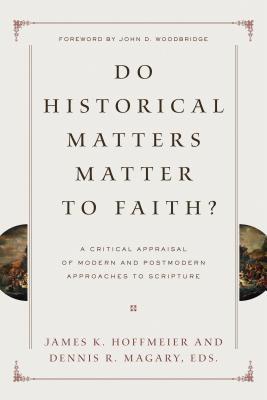
Do Historical Matters Matter to Faith?
[R]edactional analysis is, of course, based on a number of presuppositions about Old Testament prophets and prophecy that cannot be proved, or disproved: (1) that a prophet/editor would not use the same concept or theme in more than one way… (2) that a prophet would not reuse, allude to, or elaborate upon his own (earlier) oracles… and (3) that a prophet would not proclaim anything that was not clearly relevant and perspicuous for his contemporaries ( Schultz 256, cited below)
There is great difficulty with each of these assumptions, as should be clear simply from reading through them. Although each is not necessarily without some merit–surely, for example, it is not an error to think that very often concepts are used in the same ways–the difficulty is when rather than becoming guides for interpretation, these points become areas around which to base limits on the possible meaning of various texts.
The book is full of insights like this throughout, and though I’m still reading through it, I would say I recommend it for the amount of information contained in it, along with the variety of its contents.
What do you think? Are these assumptions valid? How might historical critical methods impact how one reads the text? What presuppositions might be better suited to Christian scholarship regarding prophecy, if any?
Links
Be sure to check out the page for this site on Facebook and Twitter for discussion of posts, links to other pages of interest, random talk about theology/philosophy/apologetics/movies and more!
Sunday Quote– If you want to read more Sunday Quotes and join the discussion, check them out! (Scroll down for more)
Source
Richard Schultz, “Isaiah, Isaiahs, and Current Scholarship” in Do Historical Matters Matter to Faith?
SDG.
Really Recommended Posts 10/3/14- Profanity in the Bible, Earth’s Age, “Uglies” and more!
 Here we have another round of links for your perusal, dear readers. The topics include the age of the Earth (you really must read this), interpreting the Bible, YA Literature, apologetics, and profanity in the Bible. Oh yeah, you read that last one correctly. Check the posts out, and if you liked them be sure to let the authors know. Let me know what you think in the comments here!
Smoking Gun Evidence of an Ancient Earth: GPS Data Confirms Radiometric Dating– People who deny that the Earth really is billions of years old often do so by trying to undercut radiometric dating. But what if we were able to independently confirm radiometric dating? That’s actually what scientists have been able to do, thus confirming the ancient age of the Earth. Check out this post to see the evidence.
What the Bleep does the Bible say about Profanity?– I found this to be a very thought-provoking post on how Christians should think about profanity. I don’t agree with everything here, but it certainly got my brain working. What are your thoughts on this issue? Be sure to read the post, as it gives some great insights.
Uglies, Pretties, and Specials: Scott Westerfield’s Brave New YA World– Young Adult Literature is one way to get our fingers on the pulse of the culture. Here, Anthony Weber (whose awesome site you should follow!) looks at Scott Westerfield’s look into a future in which physical beauty is even more important than it is now.
Are We “Standing Over” Scripture When We Interpret It?– Sometimes, people express concern with the need to read the Bible in its context and work with interpreting a passage. Shouldn’t it all just be clear? Are we placing ourselves over Scripture? Check out this brief post on this concern.
Christian apologetics: Is there, besides current popular approaches, another way to “take every thought captive”?– I have often thought of the need for an integrative approach to apologetics, which looks at the various methods holistically instead of atomistically. Here, someone who seems to favor the presuppositional method looks for the possibility of reconciling various apologetic methods.
The Need for Psychological Apologetics– It is important to realize that psychological issues impact people from all backgrounds. Here, Pastor Matt Rawlings argues that we need to awaken to the need for psychological apologetics.

 J.W. Wartick - Reconstructing Faith