Christianity
The Epistemic Argument Against Abortion
 Epistemology is the study of knowing. That is, it is the study of how we know something is true. Here, I will offer an argument against abortion which concerns the question: what do we know about the unborn?
An Analogy*
Suppose you are a demolition expert. You’re sitting outside a building you are to blow and you are about to hit the button. The area has been declared clear and so you have flipped the cover of the button up and you’re about to blow the building. Suddenly, someone cries out–a little red tricycle has been discovered outside the building. Fortunately, however, the people who spotted the tricycle tell you there is only a 20% chance that the child made his or her way inside the building. The equipment being used is expensive and your company is paying more Shrugging while thinking “Time is money,” you go ahead and press the button, blowing up the building. After all, you’re 80% sure there is no one inside.
…Wait a second. That’s horrible! Shouldn’t you check and be sure that there is no one inside the building? After all, that person’s life is worth so much more than the extra money your company will have to spend as the child is searched for.
The question then must be asked: what percent is low enough for you to press the button? Suppose you were 90% sure the child was not inside the building, would you pull the button then, confident that you gave your best effort? How about 95%? 98%? It seems to me the only morally permissible situation would be certainty. The building has been swept entirely from top to bottom and cordoned off, you are positive no one is inside. Then, you may press the button without moral culpability: you are certain you are not killing anyone whether directly or indirectly.
*I should note this example is from Kevin A. Lewis. I modified the scenario slightly.
The Argument Stated and Defended
The argument is actually very simple:
1) If it is possible that the unborn is a human person, we should not kill the unborn.
2) It is possible that the unborn is a human person.
3) Therefore, we should not kill the unborn.
Premise one seems obviously true to me. In order to deny premise one, the advocate for abortion must claim that we may destroy “fetuses” even if it is possible that they are human persons. That is, the pro-choice position must hold that it is permissible to blow the building at 80%; or perhaps even at 98%. Given a similar situation: the doctor with the tools for abortion goes and destroys the fetus with the possibility that, like the red tricycle sitting outside the building, they may not know whether they are killing a child; instead, they go forward with the procedure, even though they may be murdering a baby.
Note that what I’m claiming here is a very small claim: it may be even a .5% chance that the fetus is a baby (of course, I am convinced that from conception, we have a human being, but for the sake of argument I will grant even .01% chance), but then the doctor, like the demolition expert, goes ahead and “blows the building” anyway.
Premise 2 also seems to be obviously true. In order to show me that it is wrong, the pro-choice party must make an argument towards the claim that the unborn is not a human person. Why must they try to prove a universal negative? Well, my claim is very broad: It is possible the unborn is a human person. I have argued towards this end multiple times, and would be willing to engage someone on those points. But the bottom line is, even if my arguments fail, I still think that it is possible the unborn is a human person. I just need reasonable doubt here, not epistemic certainty. Unfortunately for those who are pro-choice, their position must yield epistemic certainty, but it cannot.
The conclusion follows from the premises via modus ponens. Thus, the argument succeeds.
Objections
We can never be sure about anything
Perhaps the most thoughtful answer a pro-choice advocate might make for this argument is that we can never be sure of anything. After all, we cannot be certain that when we drive somewhere, a child might run in front of our car and get hit and killed. Indeed, in the case of a demolition expert, one could always have a helicopter drop a small child onto the building at the last second, or a child could tunnel underneath and get in, etc.
My response to this argument is fairly straightforward. In abortion, we are intentionally going in and killing the fetus (or dismantling it; however you want to put it). The analogy with driving simply doesn’t work. In order for it to be even close to accurate, the driver isn’t driving safely. Instead, it would be like driving drunk along a sidewalk in Chicago. You shouldn’t do it.
The problem with the ‘certainty’ objection is that while it is true we cannot be 100% of just about anything, it is also true that there are some steps we should take in order to give ourselves epistemic certainty. That is, there is a line between saying something is broadly logically possible and saying that it actually reduces one’s epistemic certainty of a proposition. Certainly, it is possible for a helicopter to parachute a child onto the building in the seconds before it explodes, but does that reduce one’s epistemic certainty pertaining to the situation? I do not think so.
You’re A Man
Unfortunately, I run into this argument far more often than one might think. It should be pretty obvious that this argument is completely fallacious. Whatever my gender happens to be, I am capable of reasoning.
Sometimes, the argument is put forth as “get out of my womb” or something similar. Well again, if the unborn is a human being, then I am attempting to protect a distinct human being. Thus, this objection not only begs the question, but it is also insulting. It is nothing more than a rhetorical device.
We can never be certain that the fetus is not a human being
A response like this basically grants my argument. As I have argued, if this is the case abortions should be impermissible. We shouldn’t just bank on uncertainty to gamble with lives. Of course, I am not going to merely appeal to uncertainty, I have positively argued that the unborn are human beings. Period.
Links
Like this page on Facebook: J.W. Wartick – “Always Have a Reason.”
Be sure to check out my other posts in which I argue for the pro-life position. Particularly relevant to the present discussion are “From conception, a human” and “The issue at the heart of the abortion debate.”
Image Credit: Wikimedia Commons Chixoy.
SDG.
——
The preceding post is the property of J.W. Wartick (apart from citations, which are the property of their respective owners, and works of art as credited) and should not be reproduced in part or in whole without the expressed consent of the author. All content on this site is the property of J.W. Wartick and is made available for individual and personal usage. If you cite from these documents, whether for personal or professional purposes, please give appropriate citation with both the name of the author (J.W. Wartick) and a link to the original URL. If you’d like to repost a post, you may do so, provided you show less than half of the original post on your own site and link to the original post for the rest. You must also appropriately cite the post as noted above. This blog is protected by Creative Commons licensing. By viewing any part of this site, you are agreeing to this usage policy.
“The Rocks Don’t Lie” by David Montgomery: Chapter 4
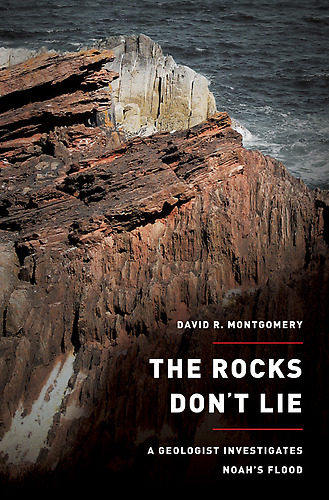 Here, I continue my look at The Rocks Don’t Lie
Chapter 4: World in Ruins
Outline
Montgomery begins by outlining the state of beliefs before early geological investigations. These were formed from theological understandings and thus derived themselves either from creation or the Flood.
The early theories of how the Flood shaped the rocks lent themselves as hypotheses for investigating the natural world. Although many of these theories would be dismissed immediately now, for their time they were serious ideas about how the world may have been shaped. Yet even in the early days of geological investigation, many theologians and geologists realized some of the major difficulties attributing the whole geologic story to the Flood would raise. Isaac Vossius, for example, “argued for a local flood on the grounds that there simply was not enough water on earth to submerge the highest mountains” (55). The amount of water needed for a global flood remains a great difficulty into today.
Other early geologic difficulties were centered around fossils. Were they really vestiges of once-living creatures, or merely tricks of the stones (59)? Steno entered this debate and, apart from noting that fossils were similar to those bones of living creatures, he also developed principles of geology which are used to this day. These were the notion that the bottom of a pile of sediment is oldest and that sedimentary layers are deposited horizontally (60).
As geologic investigations continued, more radical theories were put forth to hold a global flood. These included the notion that, prior to the Flood, the earth was smooth, and so it would have been easy to cover the globe with the water we observe now (66). Yet theories like this, which hypothesize the Flood wreaking havoc upon the earth, yield great difficulties of their own. For example, how could Noah’s descendants have populated the ends of the earth so quickly? Thomas Burnet, who had proposed this theory, argued that Native Americans had also survived the Flood (68).
John Woodward became another champion for advocates of a global flood. He asserted that the Flood dissolved the Earth’s crust and then laid down the sediment observable now (70). His theory was in keeping with others who held that a “mighty flood burst forth from a subterranean abyss” (71). However, John Arbuthnot, a physician, published an essay which not only showed that Woodward had plagiarized Steno, but also blew holes through the Flood theory Woodward had proposed. These included the fact that fossils did not rearrange according to specific gravity and that the layering of sediment could not have occurred within such a mix (71, 73).
Edmund Halley (of Halley’s Comet fame) came up with a theory which involved a comet coming near the earth and disturbing it on its axis, which “heaved the seafloor up… carving the topography we know today.” He also came up with the idea of a “vapor canopy” over the Earth which yielded the great amount of water needed to flood the entire planet (74).
Montgomery notes that it is “ironic” that many of the arguments used by young earth creationists for their positions on geology have been derived from the seventeenth-century geologists, who themselves “did not blindly trust particular literal interpretations of scripture. They had faith reason would lead to enlightened interpretation of God’s creation, as read from the pages of the book of nature…” (76).
Analysis
Montgomery has done a commendable job documenting the long history of the interplay between geology and theology related to the Flood. Moreover, he has shown how many of the ideas found in modern creationism reflect the debates of this period–some of which were acknowledged as refuted back then.
The importance of this historical background should not be understated. When one investigates the way that theories of the Flood developed alongside geology, it provides a fascinating case study for the interplay between science and faith. More importantly, studying the arguments of the past shows how easy it is to resurrect the same ideas in new contexts. Modern young earth creationism owes a great debt to people like Halley and Woodward. Unfortunately, many of these ideas remain just as refuted as they were shortly after they were first proposed.
It is also important to observe cases like Burnet, who started out trying to fit geology into his interpretation of Genesis, but ended up being forced to hypothesize all kinds of things which are not actually found in the Genesis account in order to maintain his theory. Modern creationists should be wary of doing the same: in attempting to stay true to the meaning of the text, people too often introduce concepts which are entirely foreign to the passages themselves. Ironically, this is often done in the name of being “literal.” I hope that works like Montgomery’s (and Young’s, see below) will help inform the Church regarding this debate.
Conclusion
Again, Montgomery’s book shows its great similarities with The Biblical Flood by Davis Young, which itself focuses almost entirely upon the interplay between geology and theology. Both of these books come recommended from me. Montgomery’s work is a faster read with a bit more focus upon the arguments of modern young earth views, while Young’s work provides more of the much-needed background for the debate. [I skipped ahead a bit and saw that Montgomery acknowledges Young’s own contributions to this discussion. I am of the opinion that each of their works bring unique contributions and are worth having.]
The Rocks Don’t Lie has so far proven to be a fantastic work in which the author acknowledges the complexities of the issues as well as the debt geology owes to Christianity. Soon, we will look into chapter 5.
Links
Like this page on Facebook: J.W. Wartick – “Always Have a Reason”
Check out my review of a similar work by a Christian: The Biblical Flood. I think this book is vastly important and should be in every Christian’s library.
Be sure to browse my extensive writings on the “Origins Debate” over creationism, theistic evolutionism, and intelligent design (among other views) in Christianity.
Source: David Montgomery, The Rocks Don’t Lie
SDG.
——
The preceding post is the property of J.W. Wartick (apart from citations, which are the property of their respective owners, and works of art as credited) and should not be reproduced in part or in whole without the expressed consent of the author. All content on this site is the property of J.W. Wartick and is made available for individual and personal usage. If you cite from these documents, whether for personal or professional purposes, please give appropriate citation with both the name of the author (J.W. Wartick) and a link to the original URL. If you’d like to repost a post, you may do so, provided you show less than half of the original post on your own site and link to the original post for the rest. You must also appropriately cite the post as noted above. This blog is protected by Creative Commons licensing. By viewing any part of this site, you are agreeing to this usage policy.
“Pacific Rim” – A Brief Christian Reflection
 Thankfully, a slew of science fiction films are being released this year. “Pacific Rim” has generated quite a bit of buzz. I recently had the chance to view the film and will here offer some reflections from a Christian perspective. I feel obligated to put a disclaimer here: I realize this film is 99.9999% about blowing things up. I still think that a saying I often use is correct- there is no such thing as a film without a worldview. There will be SPOILERS in what follows. I do not offer a plot summary, as one can be found easily.
Master of the Storms?
Early in the film there is a scene in which Raleigh Becket, a Jaeger (think giant mech-tank) pilot, is marching out into a storm to fight a Kaiju (think Godzilla). As one watches this epic man-made titan march out to fight a monster, one is struck by the hugeness of it, the power of it. If humans can make this, what next? Raleigh discusses how once, humans were afraid of storms like hurricanes. Now, given the might of their creations, they need not fear a hurricane.
The quote seems impressive. After all, many today hope that humanity will reach heights like this. One day, we may be able to face down a hurricane and laugh. The powers of wind and rain may be overcome. But what then?
Interestingly, in the film the very next scene is that of a Kaiju absolutely beating down Raleigh’s Jaeger.
What? That’s not how the story is supposed to go. The story is supposed to show how we have finally transcended ourselves. But that is not the reality. The reality is that a giant Godzilla beast can still destroy even these hurricane-defying machines.
It is ironic, really. In the context of humanity’s defiance against the storms given their machines, another, greater challenge is thrown out there. One can almost imagine people railing against God once more. Why have we been left to fight this world on our own? But then one must remember what God has said:
[The LORD says:] “Can you pull in Leviathan with a fishhook
or tie down its tongue with a rope?…Will it keep begging you for mercy?
Will it speak to you with gentle words?
Will it make an agreement with you
for you to take it as your slave for life?Who has a claim against me that I must pay?
Everything under heaven belongs to me.” (Job 41:1, 3-4, 11)
Ultimately, God is in charge. Our attempts to control the seas, the storms, or the leviathan do not match up to God’s sovereign control over all creation.
The film does nothing to explore this avenue, but one can wonder: what of humankind’s efforts to try to best God? It seems that the answer is: it’s not going to happen. There is always a bigger Kaiju. There are always larger storms. Our fascination with these powerful aspects of creation may itself be a reflection of the Creator.
In the film, of course, humanity triumphs. As in all good action movies, the good guys win (no, I do not like sad endings for movies). But one can only wonder: if the Kaiju could come; what next? The God who rules the storms is the same God who can draw the leviathan with a hook.
Mind and Evolution
How much can our minds handle? In the film, the mental strain of piloting a Jaeger is too much for one person to handle. How do minds work in this context? Somehow they manage to create some linkage between two humans’ minds and create some kind of mental pathway such that the people are able to integrate and work together. What does that mean? I don’t know. It is techno-babble for an action flick. But suppose we were able to do this. What would it imply about minds? Well, no more than what we already know, it seems: our minds are connected to a physical reality. We as humans are grounded in embodiment.
The Kaiju turn out to be clones. I found that pretty surprising given the immense diversity of the creatures. Some had wings; others spit acid; still others had huge hammerheads to use as weapons. What kind of genetic diversity would have to be included in their DNA in order to allow for such radical diversity. I am absolutely not a geneticist–and this movie is absolutely not an attempt to portray anything scientifically accurate–but I wondered about this as I watched the movie.
Conclusion
Let’s be blunt. “Pacific Rim” is a movie for those who want to watch giant walking tanks fighting Godzilla clones. There is a plot to be found, and there are some themes involved–as in any movie–but at its heart, this movie is a pure action flick. That said, there were a few things to reflect upon, such as the notion of humanity trying to overpower God or the forces around us.
Links
Like this page on Facebook: J.W. Wartick – “Always Have a Reason.”
Did you like Pacific Rim? Check out John Carter.
Be sure to check out my other looks at movies here (scroll down for more).
SDG.
——
The preceding post is the property of J.W. Wartick (apart from citations, which are the property of their respective owners, and works of art as credited) and should not be reproduced in part or in whole without the expressed consent of the author. All content on this site is the property of J.W. Wartick and is made available for individual and personal usage. If you cite from these documents, whether for personal or professional purposes, please give appropriate citation with both the name of the author (J.W. Wartick) and a link to the original URL. If you’d like to repost a post, you may do so, provided you show less than half of the original post on your own site and link to the original post for the rest. You must also appropriately cite the post as noted above. This blog is protected by Creative Commons licensing. By viewing any part of this site, you are agreeing to this usage policy.
“The Rocks Don’t Lie” by David Montgomery: Chapters 2 and 3
Here, I continue my look at The Rocks Don’t Lie
Chapter 2: A Grand Canyon
Those who are familiar with Young Earth Creationism know that a major contention is that the Grand Canyon can serve as evidence for a global flood. For example, both Answers in Genesis and the Institute for Creation Research have several articles dedicated to the topic. (Just do a search on the sites–I have linked two examples. In the latter, the ICR author notes that the Grand Canyon is “Exhibit A for the flood model of geology.”)
Outline
David Montgomery notes this interest from young earth groups and so he dedicates a chapter to the topic. He uses his own exploration of the Canyon to lead into a discussion of the geological evidence. Some of the rock formations found there “require[d] both extreme heat and high pressure” to form (17). He turns to a brief explanation of radiometric dating: “…the age of a rock can be read like a geologic clock because radioactive isotopes decay at a fixed rate… If you know the half-life of an isotope–how long it takes for the remaining amount to decay–then the ratio of the parent-to-daughter isotope now in a rock tells you how long ago the rock crystallized” (17-18).
Next, Montgomery gives a fairly basic introduction to geology. He provides a brief overview of how one can note unconformities in the rock and how different formations cut across each other. These evidences, found in the Grand Canyon, show that it was formed by a series of events rather than one single event (20ff). Moreover, physical evidence of fossilized burrows from “wormlike animals” in the sandstone provides evidence against flood geology. “How could fragile worms have been crawling around on and burrowing into the seafloor during a flood powerful enough to remodel the planet? The biblical flood would have had to have dumped more than ten feet of sediment every day for a whole year in order to have deposited the thousands of feet of sediment exposed in the canyon walls” (22).
More evidence against flood geology is found in the way the sediments themselves were formed. First, the differing mass of types of silt, clay, sand etc. make it difficult to believe that they could have been mixed together in a flood and then been deposited with uniformity of layers. Second, layers like that of white sandstone are composed of “fine-scale features” which “would have been obliterated if they had formed underwater… These dunes were made by wind” (25).
Finally, the fossils found within the Canyon present another difficulty. “If all the creatures buried… had been put there by the biblical flood, then why aren’t modern animals entombed among them? That the vast majority of fossils are extinct species presents a fundamental problem for anyone trying to argue that fossils were deposited by a flood from which Noah saved [at least] a pair of every living thing” (27).
Analysis
Montgomery has presented a number of extremely difficult problems for young earth interpretations of the Grand Canyon. In particular, the difficulty with the species of animals found buried seems intractable. My reason for noting this in particular is because flood geologists must assert that all the animal life is either descended from or prior to the animals in existence at the flood. Of course, if the Grand Canyon was formed by the flood, we should observe some of these extinct animals now–or at least recently. Yet for many, we do not. Why is that? A young earth perspective cannot simply assert that they died in the flood, for these would have been preserved in the flood.
The other problems Montgomery noted may sometimes be dismissed by advocates of young earth theories. In particular, Montgomery does little to defend radiometric dating, which is itself a major target of young earth views. For those interested, Davis Young’s The Bible, Rocks and Time
Chapter 3: Bones in the Mountains
Montgomery surveys briefly and selectively a history of Christian interpretation of the Genesis account and argues that some found room for less literal interpretations. Moreover, he points out that those who insist upon a literal reading of the text for Genesis must present reasons for not taking other references to the sky as a dome, etc. as non-literal (44-46, 50). Yet he also notes that the perspective from which the Bible is written (on earth) alleviates these difficulties–but these difficulties can only be alleviated by “allowing for figurative or allegorical interpretations” in which we “acknowledge… the fact that we live on a planet” (50).
Another difficulty with young earth views is presented, because the discovery of the New World revealed a massive amount of new species which the Ark would have had to carry. How does one fit all of these species onto the Ark? More importantly, how did these species get to the Ark and back to their homes in North America without leaving their ancestors’ bones behind in places other than their native lands? (42-43)
I have to say this chapter really surprised me, because Montgomery showed an appreciation for and interaction with Christian theology that I was not expecting. For just one example, he refused to set up the oft-rehearsed science-vs-religion rants that often accompanied discussions of Galileo. Instead, he explored the historical context, and noted that the ideas the church held were not necessitated by the text but were rather incorporated from Ptolemic ideas (49).
Conclusion
The Rocks Don’t Lie continues to impress me. Montgomery is careful to avoid overstating his case. More importantly, he seems to genuinely respect the beliefs of those whose writings he surveys and he shows a true concern for accuracy regarding some of the controversies. Thus far, he has presented a number of significant scientific challenges to a young earth paradigm, as well as noting the change and variety of perspectives within theology. Be sure to follow the blog for the next chapter(s)!
Links
Like this page on Facebook: J.W. Wartick – “Always Have a Reason”
Check out my review of a similar work by a Christian: The Biblical Flood. I think this book is vastly important and should be in every Christian’s library.
Be sure to browse my extensive writings on the “Origins Debate” over creationism, theistic evolutionism, and intelligent design (among other views) in Christianity.
Source: David Montgomery, The Rocks Don’t Lie
SDG.
——
The preceding post is the property of J.W. Wartick (apart from citations, which are the property of their respective owners, and works of art as credited) and should not be reproduced in part or in whole without the expressed consent of the author. All content on this site is the property of J.W. Wartick and is made available for individual and personal usage. If you cite from these documents, whether for personal or professional purposes, please give appropriate citation with both the name of the author (J.W. Wartick) and a link to the original URL. If you’d like to repost a post, you may do so, provided you show less than half of the original post on your own site and link to the original post for the rest. You must also appropriately cite the post as noted above. This blog is protected by Creative Commons licensing. By viewing any part of this site, you are agreeing to this usage policy.
The Binding of Satan: An Eschatological Question
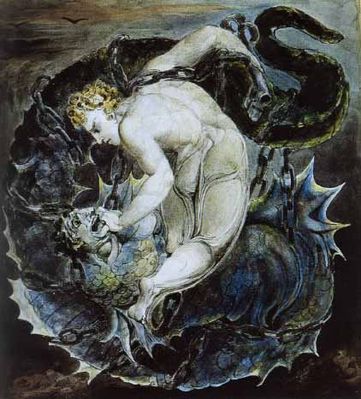 When does the binding of Satan occur? Is it something yet to come, or is it something which has already happened? Here, I will analyze the futurist position on these questions: the notion that Satan and his minions are yet to be bound.*
Futurism is, essentially, the position that the prophecies in Daniel and Revelation (and many elsewhere) are largely yet to be fulfilled. This is in contrast to historicism– the view that these prophecies have been fulfilled through the church age (with some yet future); preterism– the view that many of these prophecies have already been fulfilled in the past; and idealism– the view that these prophecies have spiritual meanings which may be fulfilled multiple times through history until the End.
The central passage for the question at hand is Revelation 20:1-3:
And I saw an angel coming down out of heaven, having the key to the Abyss and holding in his hand a great chain. He seized the dragon, that ancient serpent, who is the devil, or Satan, and bound him for a thousand years. He threw him into the Abyss, and locked and sealed it over him, to keep him from deceiving the nations anymore until the thousand years were ended. After that, he must be set free for a short time. (NIV)
The futurist interpretation of this passage would be fairly straightforward: at some point in the future, before the millennium, Satan will be bound. Many futurists hold that this also includes Satan’s minions. Representative is Paul Benware: “With the removal of Satan comes the removal of his demonic forces and his world system” (Benware, 334, cited below). It is on this point that the question I have turns. Consider Jude 6:
And the angels who did not keep their positions of authority but abandoned their proper dwelling–these he has kept in darkness, bound with everlasting chains for judgment on the great Day. (NIV)
Note the interesting parallels with the passage from Revelation 20. Both use the language of “chains” and reference a time when something will happen after this binding. Yet Jude 6 seems to imply the definite binding of these demonic forces from the time it was written or even before. Why? Jude 5 gives the temproal context, which is sandwiched in between discussion of the Exodus and Sodom and Gomorrah. Of course, Sodom and Gomorrah predate the Exodus, but the overall context of the passage is given by Jude as being around that time period (“I want to remind you…” v. 5).
Moreover, 2 Peter 2:4 states:
For if God did not spare angels when they sinned, but cast them into hell and committed them to chains of gloomy darkness to be kept until the judgment…
Again, in context Peter is discussing a number of past events. So it certainly seems that at least some demonic forces have already been bound. Benware writes of these passages: “The Scriptures reveal that Satan and his angelic followers will be judged for their sin and rebellion…” (329, emphasis mine). Now, Benware is clearly saying that there will be a judgment in the future, and that seems correct from both passages. However, he does not note anywhere in his major work the difficulty these verses present to his own view, for he insists elsewhere that amillenialists are incorrect when they view this binding as being a present reality (129ff). But he does grant that at least some demonic forces are bound now.
The question, then, is how is it that futurists can consistently insist upon the impossibility of Revelation 20:1-3 being a present reality while already granting that it is, at least in part, fulfilled? That is, if one grants that at least some demonic forces are bound, it seems that one cannot insist that certain spiritual forces cannot possibly be bound at present. Thus, it seems to me this particular aspect of futurism is not on as strong a ground as many insist.
Indeed, one may read Jude 6 and 2 Peter 2 and get the impression that these things have already occurred. There is no stipulation within the text to say that only some wicked angels have been bound. Indeed, they both seem to imply the total binding of all demonic forces. But this would not be compatible with the standard futurist interpretation of Revelation 20:1-3.
*Readers should note that I am not here intending to critique the overall futurist position. Instead, I am merely wondering about one specific aspect of some futurist interpretations.
Links
Check out my other posts on eschatology (scroll down for more).
Also, read my review of Benware’s massive work on premillenial dispensationalism, Understanding End Times Prophecy.
Sources
Paul Beware Understanding End Times Prophecy
SDG.
——
The preceding post is the property of J.W. Wartick (apart from citations, which are the property of their respective owners, and works of art as credited) and should not be reproduced in part or in whole without the expressed consent of the author. All content on this site is the property of J.W. Wartick and is made available for individual and personal usage. If you cite from these documents, whether for personal or professional purposes, please give appropriate citation with both the name of the author (J.W. Wartick) and a link to the original URL. If you’d like to repost a post, you may do so, provided you show less than half of the original post on your own site and link to the original post for the rest. You must also appropriately cite the post as noted above. This blog is protected by Creative Commons licensing. By viewing any part of this site, you are agreeing to this usage policy.
Against Christian Materialism
 Is it possible for Christians to be materialists? A number of Christians say that yes, it is. Here, I will argue that the conjunction of Christianity and materialism is indefensible.
The Biblical Witness
Having read a bit on this topic, I realize that many who are Christian materialists do not think that the Biblical data is conclusive. However, granting that this is their position, I would maintain that the Biblical evidence is very strong: we are more than a material body. Here, I will examine only a small collection of texts.**
Matthew 10:28- “Do not be afraid of those who kill the body but cannot kill the soul. Rather, be afraid of the One who can destroy both soul and body in hell.” (NIV)
What does this text mean if the soul and the body are not different things which compose the human being?
Ecclesiastes 12:7- “and the dust returns to the ground it came from, and the spirit returns to God who gave it.” (NIV)
When we die, our bodies–made of dust–return to the earth, but our spirit returns to God. What does this mean on materialism? Which part of our material selves go to God?
Revelation 6:9- “When he opened the fifth seal, I saw under the altar the souls of those who had been slain because of the word of God and the testimony they had maintained.” (NIV)
The souls of those killed for their faith cry out for justice from under the altar. The objection may be made that this is apocalyptic language. In answer, I would simply point out that even then it makes no sense on materialism even in that context. What are the souls that are crying out in this vision? What is the referent for the alleged metaphor?
In Matthew 17:1-8, Jesus speaks with Moses and Elijah, who have died. Did God raise them bodily, and did they then die again immediately afterwards and decompose when they are no longer visible?
1 Peter 3:18-19- “For Christ also suffered once for sins, the righteous for the unrighteous, to bring you to God.He was put to death in the body but made alive in the Spirit. After being made alive, he went and made proclamation to the imprisoned spirits…”
What was Jesus proclaiming the Gospel to? What is imprisoned? Where are the physical/material bodies in this passage? (Note that in context it is talking about those alive in Noah’s day–so again, where did their bodies go?)
Verses like these could be multiplied continually. Perhaps more telling is that the reasoning I’m using here regarding the texts and the distinction between body and soul is similar to the arguments put forth to justify the Trinity. That is, texts which discuss the Father and Son as different entities or even have all three persons of the Trinity in the same context are used to demonstrate that there really are three distinct persons in the Godhead. Yet this is exactly the type of argument I am here making for body and soul. They are used too many places together to be the same thing.
It seems to me utterly clear from the Biblical text that human beings are not purely material entities. Again and again texts can be shown to refer to the body on the one hand and the soul on the other. This is not to say that humans are necessarily one or the other; instead, it is to point out that humans are (at least) body and soul. (I say “at least” because there is a long tradition of trichotomy in Christianity wherein people hold that humans are body, soul, and spirit. I remain neutral in that debate and here only wish to show that humans are not merely material entities.)
The Philosophical Debate
Suppose that one maintains that the Biblical evidence is inconclusive. What then? Could we then say that Christianity and materialism are compatible, for materialism is not explicitly ruled out by the text? Here, I will offer two arguments against these conjoined propositions.
Identity Through Time
How do we maintain identity through time? Here, the problem must be answered by all materialists, not just Christian materialists.
The problem is, of course, that our bodies don’t maintain physical identity. We are continually replacing the physical parts of our body over time. Now, I am hesitant to make the oft-repeated claim that our entire bodies are replaced every so many years, as I have been unable to find any research confirming it. However, it simply is the case that large portions of our body are replaced. Given this fact, how do we maintain identity? What is it that keeps us the same person over time?
Another major problem is this: to which part of our body are we identical? Or, to put it another way, which parts of our body do we need to keep in order to be the same person? Here we can appeal to a thought experiment. A mad scientist has us captured and he wants to see how long we can maintain identity. Slowly, he replaces each part of our body with a new one with the exact same DNA, structure, etc. As he replaces these parts, he discards the old ones and destroys them. He starts with the legs. Then he moves to the midsection, replacing one organ at a time. Then the heart, the arms, the ears, the eyes. When he gets to the brain, he goes through and replaces only single neurons at a time.
The question is pretty obvious: When do we stop being the same person? The materialist simply has to admit that we are our bodies (for what else could we be?). But given that fact, to which part are we identical? The brain? If so, at one point in the experiment do we cease to exist? 51% of our brain is gone? 70%? All but one neuron? So is our identity grounded in that one neuron? If so, which one? Or is it just grounded in having any one neuron as the same? If so, how?
Frankly, I think this problem is devastating for materialists, but especially those who are Christians. Why would it be more acute for Christians? Well…
 Is There Hope in the Resurrection?
Central to the Christian hope is the hope for a future resurrection. The question which must be asked is this: Is this hope grounded in reality?
Suppose materialism were true. If that is the case, then humans are identical with their bodies in some fashion. I am intentionally vague here because I admit I’m not convinced as to how identity works within a Christian view of materialism (see above). If this were the case, then when we die and our material body decomposes, it may go on to become all sorts of different things, which themselves later pass away (plants may grow from the nutrients broken down from the body; then those plants may be harvested and eaten by other humans/animals/etc, which then die and are broken down, etc.). In the resurrection, then, God creates our body anew, complete–I assume–with our memories, experiences, etc. built in (perhaps they are simply functions of our brain, which God recreated perfectly, which thus contains our experiences).
Is there actual hope on this scenario?
Suppose the mad scientist were to come and kidnap you. He gleefully announces that he is going to use you for excruciatingly painful experiments which will take place over several years until you die. But, do not worry, because once you die, he is going to create a new body which is an exactly perfect copy of you, which will of course have all your experiences (minus this torturous one) and memories in place, and then he is going to give you billions of dollars.* Would you be comforted by this scenario? After all, you’re not going to remember the pain and you are going to come out the other end extremely rich!
Well there is a problem: the new body is not you. It is just a copy. For any materialist, this is problematic. We seem to know that identity transcends the body. But let us not delve into that difficulty right now. Instead, we will focus on Christian materialism. Now, it seems to me that this problem is almost the same for the Christian materialist with the Resurrection. After all, we are going to die. But we are told, don’t worry, we will be raised bodily by God! But whose body is going to be raised? How will God gather the material from our body (and at which time of our body–see above) in order to recreate us? And will not this body purely be a copy, rather than actually us?
There is a real disconnect here. Christian materialism cannot offer us the hope of the resurrection, without which our faith is worthless (1 Corinthians 15). Instead, it offers us the hope for our future copies, which will themselves have our memories and experiences, but will not be us. Our bodies will die and distribute throughout various portions of the world (even the universe–who knows if an asteroid might hit and distribute the molecules which made up our body elsewhere?). Then God will create us again in some fashion, and that body will live on in the Kingdom. But that body is not us. It will be a new body. This isn’t begging the question, it is merely stating a fact. The body that will be raised is not the body I have now. Thus, if I am my body, I am not raised.
Interestingly, Peter van Inwagen, a Christian philosopher who is himself a materialist, concedes the point I made in this section. In order to escape this extreme problem for Christian theology, he comes up with a rather unique solution: “Perhaps at the moment of each man’s death, God removes each man’s corpse and replaces it with a simulacrum which is what is burned or rots. Or perhaps God is not quite so wholesale as this: perhaps he removes for ‘safekeeping’ only the ‘core person’–the brain and the central nervous system–or even some special part of it… I take it that this story shows that the resurrection is a feat an almighty being could accomplish. I think it is the only way such a being could accomplish it…” (Van Inwagen, 121, cited below).
What response can we have to this? Well surely, it is possible for God to do this, but it raises all kinds of speculation. First, what Biblical evidence do we have to support that our bodies or our brains/nervous systems are transported by God somewhere in order to preserve them? Honestly, I think that someone who posits this kind of miraculous working holds a burden of proof to support it. Second, where is this storage yard of brains/nervous systems? This question is not intended to beg the question. Instead, my intent is to point out that they would have to be somewhere in the physical universe. Thus, we should be able to find a planet where all the brains/central nervous systems of everyone who ever died are being stored. Third, given this, could we potentially destroy this planet and thus destroy all possibility of the resurrection? Fourth, other than as a completely ad hoc measure to preserve the possibility of hope, what possible justification (philosophical, theological, and/or Biblical) do we have for this?
On the whole, it seems to me that Peter van Inwagen’s proposed solution fails. It fails because it is extremely ad hoc and because it may not even solve the problem it is intended to solve. Thus, it seems to me that Christian materialism fails as a worldview.
Conclusion
I have offered several arguments against the conjunction of Christianity and materialism. I think any one of these arguments is successful on its own (I should note that I also think the argument from the ego is successful–I have argued here against atheistic materialism, but this argument would be equally successful against Christian materialism). If any one is successful, the conjunction of Christianity and materialism must be false. Frankly, I think all the arguments are successful. I leave the Christian materialist to justify their position.
Links
Like this page on Facebook: J.W. Wartick – “Always Have a Reason.”
If Materialism, are there Subjects?– I contend that a materialist worldview cannot account for subjects. This post was written specifically to address atheistic materialism, but is perfectly relevant for theistic materialism as well.
Sources
*I am indebted to Alvin Plantinga and Stephen Parrish for this type of argument.
**I am indebted to Kevin A. Lewis for his list of texts provided in his “Essentials of Christian Doctrine II” syllabus.
Peter van Inwagen “The Possibility of Resurrection,” International Journal for Philosophy of Religion, 9:2 (1978), 114ff.
SDG.
——
The preceding post is the property of J.W. Wartick (apart from citations, which are the property of their respective owners, and works of art as credited) and should not be reproduced in part or in whole without the expressed consent of the author. All content on this site is the property of J.W. Wartick and is made available for individual and personal usage. If you cite from these documents, whether for personal or professional purposes, please give appropriate citation with both the name of the author (J.W. Wartick) and a link to the original URL. If you’d like to repost a post, you may do so, provided you show less than half of the original post on your own site and link to the original post for the rest. You must also appropriately cite the post as noted above. This blog is protected by Creative Commons licensing. By viewing any part of this site, you are agreeing to this usage policy.
“Monsters University” -A Brief Look from a Christian
 I recently had the chance to see “Monsters University,” the latest from Pixar. I thought it was, overall, a delightful film. Here, I will share my thoughts on the movie from a Christian perspective. There will be SPOILERS below.
University Life
Pixar did an excellent job capturing the true feeling of adventure at university; the first step on campus, orientation, the first class, friends, and more. I’ll never forget the feeling of anticipating meeting the roommate for the first time; sitting in the first class, and the like. The antics, the fun, and the learning that went on was joyous, and Monsters University does a great job recreating it in film… with monsters.
But there is a darker side to university. Roommates can fall out of favor with each other (I’m thankful my roomie and I remain great friends!), pranks can go wrong, bullies have made it into school as well, and classes can be failed. Monsters University dives into these themes headfirst. Mike Wazowski and James P.”Sulley” Sullivan are immediately at odds. Sulley is able to ride his family name and his size to largely succeed at the school; Mike continues to hit the books. Sulley gets credit for anything good that happens around him; Mike is left in the dust.
However, when Sulley and Mike are both kicked out of their program as “scarers,” they end up being thrust together on a team to try to make it back. In the time that follows, Sulley has to cope with his own inadequacies, Mike has to realize that he needs to work with a team, and the rest of the team learns about their own strengths.
There is a call in this movie: a call to realize there is more to people than meets the eye. Everyone has unique strengths and weaknesses. There is also a call to realize one’s own inadequacies and the need to work together with others.
At today’s university, we are also assaulted by a vast array of choices. One scene in the movie poignantly addressed this: Mike is walking through campus, where stands are set up all around calling for his attention: should he join the debate team, the art club, the scare contest, or others? Similarly, there are any number of things vying for our youth’s attention when they go to university. Have we equipped them to deal with the choices they will inevitably need to make?
Scaring
There is something to be said for the notion that scaring is a good thing among the monsters. This theme is treated with great lightness as a children’s film, but at points it seemed disturbing to me. These monsters need to harvest the screams of children (or others) in order to supply power for their society. Thus, they sneak into a child’s room and scare them in order to make them scream. Although these monsters are generally “nice” “people,” the fact that their job is to scare children as much as possible seems a little untoward.
The question for Christians here, I think, is how much we allow artistic license. Clearly, this film is a fantasy. The monsters are portrayed as “good guys” but this doesn’t necessitate that monsters are bad guys, it is simply a plot device. But, one may press, they are still monsters, and they are still scaring people for a living. How do we discuss such themes?
Garret Johnson has argued that “In all meaningful fiction, there exists an element of fear… The reason all humans respond to this kind of story, the reason the profound reality of fear preceding the most meaningful outcomes resonates with us, is because this is the story of our universe.”
He grounds this discussion in the fact that our own story–the Christian story–points to this reality. There is fear of death, but it is overcome; from tears, joy; from death, life.
Conclusion
“Monsters University” is comedy which will take adults back to days in school, with all the good and bad times that may offer. The themes of reconciliation and teamwork are refreshing, and the undertone of fear is an intriguing thing to speculate upon. How much does fear point us back to our reality; what hope is there in our lives? Will our tears be turned to joy?
Clearly, these questions go well beyond the scope of the film itself. But that does not mean one cannot use the film to dive into the deeper aspects of reality. For those looking to do so, “Monsters University” provides a compelling way forward. For those who aren’t, I would suggest that the themes found therein–particularly of reconciliation and the need to prepare our children for university–are worth the watch.
Links
Like this page on Facebook: J.W. Wartick – “Always Have a Reason.”
Fiction and Fear– Over at Hieropraxis, Garret Johnson writes about the interesting links between fiction and fear. Check out this post for some very interesting discussion.
Be sure to check out my other looks at movies here (scroll down for more).
SDG.
——
The preceding post is the property of J.W. Wartick (apart from citations, which are the property of their respective owners, and works of art as credited) and should not be reproduced in part or in whole without the expressed consent of the author. All content on this site is the property of J.W. Wartick and is made available for individual and personal usage. If you cite from these documents, whether for personal or professional purposes, please give appropriate citation with both the name of the author (J.W. Wartick) and a link to the original URL. If you’d like to repost a post, you may do so, provided you show less than half of the original post on your own site and link to the original post for the rest. You must also appropriately cite the post as noted above. This blog is protected by Creative Commons licensing. By viewing any part of this site, you are agreeing to this usage policy.
“Warm Bodies” – A Christian Reflection
 What is a Zombie? What if a zombie had some kind of thoughts in their head? What if… love could be involved? These are the types of questions raised–often in a very tongue-in-cheek fashion–in “Warm Bodies,” a zombie thriller with a twist. Here, I will analyze the movie from a Christian perspective. There will be SPOILERS in what follows.
What’s the Problem?
There are corpses. Walking ones. It’s kind of a problem, because in order to survive they need to eat humans.
Yet “Warm Bodies” goes beyond standard zombie fare. “R”, the main character–a zombie “corpse”–meets Julie and something is changed in him. His heart has a beat, and he is slowly starting to get better; he starts talking more normally a well. Eventually, this change manifests itself well enough for his personality to come out and for Julie to start to realize there is more to him than meets the eye.
Unfortunately… R also happened to kill Julie’s boyfriend. And, he’s been eating said boyfriend’s brain as well. He’s “not proud of it” but he also wants to find out from the brain what it is that makes Julie tick.
There is also the questions of the other “corpses”–will they too have some kind of heart-moving moment? And what about the skeletal zombies known as “bonies”?
What’s the Solution?
The solution seems to be love. But there is more to it than that. Julie’s love awakens R and their touching relationship begins to wake other “corpses” from their slumber. But R remains a corpse. There is something yet to be done for him. That comes in a climactic scene in which R and Julie are pursued by bonies. R grabs Julie and puts his body under her in order to save her as they jump from great height into a pool of water.
R emerges from the water cleansed and alive. Does this theme echo at all with Christianity? I couldn’t help but immediately think of baptism. The scene is stunning. R falls into the water and as he descends and rises out, his old self–his “corpse”-ness– is washed away. He emerges restored. He is human. I found this not very dissimilar at all to casting off the old Adam. R was a new creation. So are we (2 Corinthians 5:17). I personally found this scene as central to the entire film. It was the emergence of life from death. It was stirring.
As for the bonies? Well, they all get slaughtered because they are beyond hope. The cavalier attitude the film throws in this aside fits well with the rest of the tongue-in-cheek attitude of the movie, but on reflection it seems almost inappropriate. It is easy to celebrate the destruction of dehumanized flesh-eating monsters, but how did they get that way? Ultimately, it was because they were left alone in their “corpse” state long enough to devolve into mindless human-killing machines. It is a truly sobering thought to consider that this isn’t too terribly far from the “real world.”
In the End?
How is it that humanity got to be this way, with the split between humans and undead? It’s a question the film does not explore. But it is easy to see some potent imagery happening: people are vulnerable; other people are predatory. The theme is only barely developed in the film, and even then it is often played off as comedy. But the truth is that, unfortunately, this is how humanity often plays out. Many people are dead in sin (Romans 8:7) and continue to live out their lives apart from the saving work of Christ. We are to go out into the world and spread God’s love to them. We are to get to them before they harden their hearts; before there are any “bonies” out there.
As for us? We too were dead in sin. But the old has gone, the new has come. In Christ, we are a new creation. We are washed clean from our sins.
Links
Like this page on Facebook: J.W. Wartick – “Always Have a Reason.”
Warm Bodies: Exhuming Humanity– Anthony Weber compares the book and the movie to draw out even more themes and provide an extremely thorough evaluation of them both. If you don’t follow his blog, you really should do so.
Be sure to check out my other looks at movies here (scroll down for more).
SDG.
——
The preceding post is the property of J.W. Wartick (apart from citations, which are the property of their respective owners, and works of art as credited) and should not be reproduced in part or in whole without the expressed consent of the author. All content on this site is the property of J.W. Wartick and is made available for individual and personal usage. If you cite from these documents, whether for personal or professional purposes, please give appropriate citation with both the name of the author (J.W. Wartick) and a link to the original URL. If you’d like to repost a post, you may do so, provided you show less than half of the original post on your own site and link to the original post for the rest. You must also appropriately cite the post as noted above. This blog is protected by Creative Commons licensing. By viewing any part of this site, you are agreeing to this usage policy.
“The Rocks Don’t Lie” by David Montgomery: Preface and Chapter 1
I recently finished reading the Christian geologist Davis Young’s The Biblical Flood
It didn’t take long before I had decided that I would go through this one on an extended basis (sometimes lumping more than one chapter together) similar to how I reviewed Rob Bell’s work Love Wins. The reason is because I think the work has much to inform both Christian and atheist alike, while it also has some problems I would like to discuss as I go along.
I have not finished the book, but am rather writing these reviews as I read the chapters, so each one is fresh. Check out the end of the post for links to the other chapters as well as other related posts.
Outline
Preface
David Montgomery states that his purpose in writing the book was initially “to present a straightforward refutation of creationism, the belief that the world is a few thousand years old and that all the world’s topography… was formed by the biblical Flood.” However, he came to “a different story about the nature of faith” once he began researching the topic: “…I thought I’d find the standard conflict between reason and faith. Instead, I found a much richer story of people struggling to explain the world–and our place in it” (xii).
Essentially, he discovered that there was a complex interrelationship between science and theology which has played out in vastly different ways over time.
Chapter 1
Montgomery begins the book by telling a story of how he discovered evidence for a local flood in Tibet. He observed various geological features and came to believe that a lake had once covered the land. He suspected that such a feature in memorable history would yield an oral tradition and was rewarded with a story of a flood in the area (2-7). He asserts that “People around the world tell stories to explain distinctive landforms and geological phenomena” (7).
These stories are often dismissed as “relic[s] of another time,” but he believes that they may have an element of truth: “For most of our history as a species, oral traditions were the only way to preserve knowledge. So why wouldn’t the world’s flood stories record actual ancient disasters” (8-9). He notes that the story of Noah’s Flood may perhaps be among these stories, and hints that there could be truth to the biblical tale (9).
When science has come to interact with evidence which may hint at explanations for Noah’s Flood, certain forms of Christianity (here he uses “creationist” as he defined it in the preface) are “outraged” due to the preconceived notion that the Flood must have been global and account for all geologic history.
Yet the Flood has had a positive influence on geology by providing an early hypothesis to be tested once geology had progressed as a science (11-12). Theology and geology played off each other in a complex way which has spawned various factions of belief over the use of that evidence in theology (12-14).
Analysis
Preface
David Montgomery presents his case in a very winsome manner. I cannot help but be pleased by the way he has begun his interaction with science and faith issues. Rather than ranting over the alleged war between science and faith (something he admits he was expecting), he discovered a different story of a complex relationship which has often been mutually beneficial. Would that all atheists–and yes, it is worth saying, theists–interacted with other views in such a generous manner.
Chapter 1
Montgomery has provided a number of interesting insights already, particularly in regards to the fact that the relationship between science and faith is multifaceted and not as one-dimensional as many often portray it.
It is unfortunate, I think, that his own faith was seemingly built upon very poor theology. He writes, “In Sunday school I learned that Bible stories were parables to be read more for their moral message than their literal words. The story of Noah’s Flood taught mankind to be stewards of the environment… Growing up, I was satisfied that Jesus taught how to live a good life and that science revealed how the world worked” (9-10). Here we see how an anemic theology cannot be sustained. Christianity is picture that is much fuller than a mere “moral message” or “how to live a good life.” If only someone had taught that in Sunday school instead!
If the book continues in this fashion, I will have no qualms about recommending it. Tune in next week to continue the series!
Links
Like this page on Facebook: J.W. Wartick – “Always Have a Reason”
Check out my review of a similar work by a Christian: The Biblical Flood. I think this book is vastly important and should be in every Christian’s library.
Be sure to browse my extensive writings on the “Origins Debate” over creationism, theistic evolutionism, and intelligent design (among other views) in Christianity.
Source: David Montgomery, The Rocks Don’t Lie
SDG.
——
The preceding post is the property of J.W. Wartick (apart from citations, which are the property of their respective owners, and works of art as credited) and should not be reproduced in part or in whole without the expressed consent of the author. All content on this site is the property of J.W. Wartick and is made available for individual and personal usage. If you cite from these documents, whether for personal or professional purposes, please give appropriate citation with both the name of the author (J.W. Wartick) and a link to the original URL. If you’d like to repost a post, you may do so, provided you show less than half of the original post on your own site and link to the original post for the rest. You must also appropriately cite the post as noted above. This blog is protected by Creative Commons licensing. By viewing any part of this site, you are agreeing to this usage policy.
Inerrancy and Presuppositional Apologetics: A different approach to defending the Bible
Scripture is inerrant because the personal word of God cannot be anything other than true. -John Frame (The Doctrine of the Word of God
, 176 cited below)

One of the most difficult issues facing evangelical Christian apologists is the doctrine of inerrancy. I’m not trying to suggest the doctrine is itself problematic. Indeed, I have defended the doctrine in writing on more than one occasion. Instead, I am saying that defending this doctrine in an apologetics-related discussion is difficult. Here, I will explore one way that I think should be used more frequently when discussing the doctrine.
What is the problem?
There are any number of attacks on inerrancy and Biblical authority, generally speaking. Very often, when I discuss the Bible with others in a discussion over worldviews, I find that the challenge which is most frequently leveled against the notion of inerrancy is a series of alleged contradictions. The second most common objection is some sort of textual criticism which allegedly shows that the Bible could not be without error in its autographs. A third common argument against inerrancy is to quote specific verses and express utter incredulity at their contents.
Of course, it doesn’t help that the definition of inerrancy is often misunderstood. For simplicity’s sake, I will here operate under the definition that “The Bible, in all it teaches, is without error.” I have already written on some misconceptions about the definition of inerrancy, and readers looking for more clarification may wish to read that post.
How do we address the problem?
Most frequently, the way I have seen apologists engage with these challenges is through a series of arguments. First, they’ll argue for the general reliability of the Bible by pointing out the numerous places in which it lines up with archaeological or historical information we have. Second, they’ll argue that these historical reports given in the Bible cannot be divorced from the miraculous content contained therein. Given the accuracy with which these writers reported historical events, what basis is there to deny the miraculous events they also report?
Other apologists may establish inerrancy by rebutting arguments which are leveled against the doctrine. That is, if one puts forth an argument against inerrancy by pointing out alleged contradictions, these apologists seek to rebut those contradictions. Thus, once every single alleged error has been addressed, this approach concludes the Bible is inerrant.
Now, I’m not suggesting that either of these methods are wrong. Instead, I’m saying there is another way to approach the defense of the Bible.
A Presuppositional Defense of Inerrancy
Suppose God exists. Suppose further that this God which exists is indeed the God of classical Christian theism. Now, supposing that this is the case, what basis is there for arguing that the Bible is full of errors? For, given that the God of Christianity exists, it seems to be fairly obvious that such a God is not only capable of but would have the motivation to preserve His Word as reported in the Bible.
Or, consider the first step-by-step argument for inerrancy given in the section above, where one would present archaeological, philosophical, historical, etc. evidence point-by-point to make a case for miracles. Could it not be the case that the only reason for rejecting the miraculous reports as wholly inaccurate fictions while simultaneously acknowledging the careful historical accuracy of the authors is simply due to a worldview which cannot allow for the miraculous at the outset?
What’s the Point?
At this point one might be thinking, So what? Who cares?
Well, to answer this head on: my point is that one’s overall worldview is almost certainly going to determine how one views inerrancy. The point may seem obvious, but I think it is worth making very explicit. If we already hold to a Christian worldview broadly, then alleged contradictions in the Bible seem to be much less likely–after all, God, who cannot lie (Numbers 23:19), has given us this text as His Word. Here it is worth affirming again what John Frame said above: the Bible is inerrant because it is of God, who is true.
Thus, if one is to get just one takeaway from this entire post, my hope would be that it is this: ultimately the issue of Biblical inerrancy does not stand or fall on whether can rebut or explain individual alleged errors in the Bible–it stands or falls on one’s worldview.
One final objection may be noted: Some Christians do not believe in inerrancy, so it seems to go beyond an issue of worldview after all. Well yes, that is true. I’m not saying a defense of inerrancy is utterly reducible down to whether or not one is a Christian or not–as I said, I think evidential arguments are very powerful in their own right. I am saying that inerrancy is impossible given the prior probabilities assigned by non-Christian worldviews and altogether plausible (not certain) given Christian worldview assumptions.
A Positive Case for Inerrancy
Too often, defense of inerrancy take the via negativa–it proceeds simply by refuting objections to the doctrine. Here, my goal is to present, in brief, a positive argument for inerrancy. The argument I am proposing here looks something like this (and I admit readily that I have left out a number of steps):
1) Granting that a personal God exists, it seems likely that such a deity would want to interact with sentient beings
2) such a deity would be capable of communicating with creation
3) such a deity would be capable of preserving that communication without error
Therefore, given the desire and capability of giving a communication to people without error, it becomes vastly more plausible, if not altogether certain, that the Bible is inerrant. Of course, if God does not exist–if we deny that there is a person deity–then it seems altogether impossible that an inerrant text could be produced on anything, let alone a faith system.
I consider this a positive argument because it proceeds from principles which can be established (or denied) as opposed to a simple assertion. It is not a matter of just presupposing inerrancy and challenging anyone who would take it on; instead it is a matter of arguing that God exists, desires communication with His people, and has brought about this communication without error. Although each premise needs to be expanded and defended on its on right, I ultimately think that each is true or at least more plausible than its denial. Christians who deny inerrancy must, I think, interact with an argument similar to this one. Their denial of inerrancy seems to entail a denial of one of these premises. I would contend that such a denial would be inconsistent within the Christian worldview.
Note that this argument turns on the issue of whether or not God exists. That is, for this argument to be carried, one must first turn to the question of whether God exists. I would note this is intentional: I do think that inerrancy is ultimately an issue which will be dependent upon and perhaps even derivative of one’s view of God.
Other Books
One counter-argument which inevitably comes up in conversations about an argument like this is that of “other books.” That is, could not the Mormon and the Muslim (among others) also make a similar case.
The short answer: Yes, they could.
Here is where I would turn to the evidence for each individual book. Granting a common ground that these claimed revelations–the Bible, the Book of Mormon, the Qu’ran, etc.–are each purported to be inerrant and that their inerrancy is more probable on a theistic view, which best matches reality? In other words, I would turn here to investigate the claims found within each book in order to see if they match with what we can discern from the world.
The argument I am making here is not intended to be a one step argument for Christian theism. Instead, it is an argument about the possibility of an inerrant work.
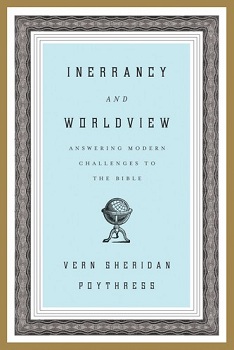 Appendix 1: Poythress and Inerrancy
Vern Poythress provides an example of how this approach works. In his work, Inerrancy and Worldview (my review of this work can be found here), he continually focuses on how worldviews color one’s approach to challenges presented against inerrancy such as historical criticism, certain sociological theories, and philosophy of language. One example can be found in his discussion of historical criticism:
The difference between the two interpretations of the principle [of criticism] goes back to a difference in worldview. Does God govern the universe, including its history, or do impersonal laws govern it? If we assume the latter, it should not be surprising that the resulting principle undermines the Bible… It undermines the Bible because it assumes at the beginning that the God of the Bible does not exist. (Poythress, Inerrancy and Worldview
, 53, cited below)
Yet it is important to see that my approach here is different from that of Poythress. His approach seems to be largely negative. That is, he utilizes presuppositionalism in order to counter various challenges to the Bible. When a challenge is brought up to inerrancy, he argues that it of course stems from an issue of worldview. Although this is similar to my approach, Poythress never makes a positive argument for inerrancy, which I consider to be a vital part of the overall defense of the doctrine.
Appendix 2: Standard Presuppositionalism and Inerrancy
I would like to note that I am not attempting to claim that my defense of inerrancy here is the standard presuppositional approach. The standard presuppositional approach is much simpler: the apologist simply assumes the absolute truth and authority of God’s word as the starting point for all knowledge.
It should not surprise readers that, given this approach, most (if not all) presuppositionalists embrace the via negativa for defense of inerrancy. That is, the standard presuppositional defense of the Bible usually is reducible to merely pointing out how the attacks on Scripture stem largely from one’s worldview, not from the facts.
Thus, one of the foremost presuppositional apologists to have lived, Greg Bahnsen, writes:
[I]f the believer and unbeliever have different starting points [that is, different presuppositions from which all authority comes for the realm of knowledge] how can apologetic debate ever be resolved? [In answer to this,] the Christian carries his argument beyond “the facts…” to the level of self-evidencing presuppositions–the ultimate assumptions which select and interpret the facts. (Bahnsen, Always Ready, 72 cited below).
It should be clear that this standard presuppositional defense is therefore very different from what I have offered here. The standard presuppositional defense simply reduces the debate to “starting points” and attempts to show contradictions in other “starting points” in method, exposition, or the like. My defense has noted the vast importance of worldviews in a denial of inerrancy, but has also offered a positive defense of inerrancy. Yes, this defense turns on whether God exists, but that can hardly be seen as a defect or circularity in the argument.
Links
Like this page on Facebook: J.W. Wartick – “Always Have a Reason.” I often ask questions for readers and give links related to interests on this site.
The Presuppositional Apologetic of Cornelius Van Til– I explore the presuppositional method of apologetics through a case study of the man who may fairly be called its founder, Cornelius Van Til.
Debate Review: Greg Bahnsen vs. Gordon Stein– I review a debate between a prominent presuppositional apologist, the late Greg Bahnsen, and a leading atheist, Gordon Stein. It is worth reading/listening to because the debate really brings out the distinctiveness of the presuppositional apologetic.
Sources
Greg Bahnsen, Always Ready
John Frame The Doctrine of the Word of God
Vern Sheridan Poythress, Inerrancy and Worldview
SDG.
——
The preceding post is the property of J.W. Wartick (apart from citations, which are the property of their respective owners, and works of art as credited) and should not be reproduced in part or in whole without the expressed consent of the author. All content on this site is the property of J.W. Wartick and is made available for individual and personal usage. If you cite from these documents, whether for personal or professional purposes, please give appropriate citation with both the name of the author (J.W. Wartick) and a link to the original URL. If you’d like to repost a post, you may do so, provided you show less than half of the original post on your own site and link to the original post for the rest. You must also appropriately cite the post as noted above. This blog is protected by Creative Commons licensing. By viewing any part of this site, you are agreeing to this usage policy.

 J.W. Wartick - Reconstructing Faith
