Dietrich Bonhoeffer
Sunday Quote!- Christ’s Name Obligates Justice
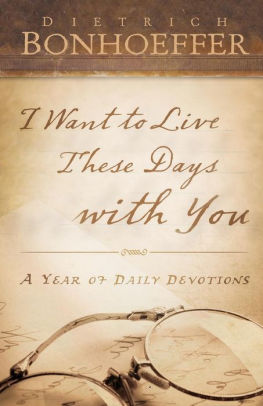
Occasionally, on Sunday, I will share a quote from something I’ve been reading. The hope is for you, dear reader, to share your thoughts on the quote and related issues and perhaps pick up some reading material along the way!
Christ’s Name Obligates Justice
I’ve been trying to ensure I do a daily devotion, which includes a brief liturgy, some Scripture reading, prayer, and a brief writing from a devotion. For this year, I chose I want to Live These Days with You, a collection of excerpts from Dietrich Bonhoeffer’s works for daily reading. I was struck by the reading from March 9, which features a quote from Ethics:
Wherever the name of Jesus Christ is named, he is there as protection and obligation. That is true of all people who in their battle for justice, truth, humanity, and freedom have again learned to name the name of Jesus Christ… It is not a ‘Christian Culture’ that must make the name of Jesus Christ acceptable to the world; rather, the crucified Christ has become the refuge, justification, protection, and obligation for those higher ideals that have begun to suffer and for their defenders. (DBWE 6:345, 347-348)
In our own time, we continue to see those who work not for justice, truth, humanity, and freedom, but instead for a “Christian culture,” itself allegedly based upon some broader worldview that, if only it would be embraced, would bring the former ideals along with it. But Bonhoeffer will have none of that. It is the very act of battling for those ideals that are obligated through the name of Jesus Christ himself. Moreover, those who do that battle are doing so in the name of Jesus, and as they do so, will find their refuge in the crucified Lord.
Links
Be sure to check out the page for this site on Facebook and Twitter for discussion of posts, links to other pages of interest, random talk about theology/philosophy/apologetics/movies and more!
On Christian Music– I wrote a post about the label “Christian music” and how that can lead to a number of difficulties with discernment.
Christian Discernment Regarding Music: A Reflection and Response– I reflect in depth on how we can use our discernment properly when it comes to music.
Sunday Quote– If you want to read more Sunday Quotes and join the discussion, check them out! (Scroll down for more)
Eclectic Theist– Check out my other blog for my writings on science fiction, history, fantasy movies, and more!
SDG.
Today in History: German Foreign Office Warns about Dietrich Bonhoeffer
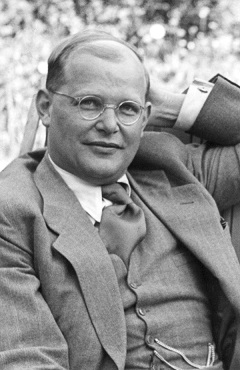
February 29, 1936: Dietrich Bonhoeffer, who would later be executed by the Nazis for his involvement in the resistance, had already made a name for himself, stirring up trouble with his actions alongside the Confessing Church. He had broken with the (much) larger German Christians and already declared that they represented a false Christ to the world, in part due to their allegiance to the Nazi state.
Bonhoeffer was heavily involved in ecumenical movements, and had informed the Foreign Office that he would be traveling as the director of the Preacher’s Seminary at Finkenwalde to support ecumenical work in Sweden. Today in history, the Foreign Office sent a letter to the German Legation in Stockholm warning them about Pastor Bonhoeffer’s actions:
The Reich and Prussian Ministry for Church Affairs as well as the Church Foreign Office would like to warn you about Pastor Bonhoeffer because his activities are not conducive to German interests. State and church officials have serious objections to his trip abroad, which has only now become known.
I respectfully ask that you report back concerning his public activities and concerning possible reactions in the Swedish press.(From Dietrich Bonhoeffer Works, Volume 14: Theological Education at Finkenwalde: 1935-1937 [DBWE 14:146])
This message’s import should not be understated. It shows that Bonhoeffer was already being monitored both at home and abroad. It also shows the close relations the Reich leadership had established with the German Christian church, for it was not just secular authorities who rejected Bonhoeffer’s resistance, it was also the church. May we, in our own time, never allow such evil to be united with the church. May we call out such evil wherever it stands. May we resist, even to death, the attempts of the world to thwart Christ’s church.
Book Review: “Bonhoeffer’s Christocentric Theology and Fundamental Debates in Environmental Ethics” by Steven C. Van Den Heuvel

Dietrich Bonhoeffer’s influence on modern theology continues to grow, as he has clearly become one of the most influential theologians from the 20th century. What is exciting for those who are interested in his theological legacy is the increasing interest in applying his thought to new approaches and modern questions in ways that go beyond mere interpretation and into a broader application. Steven van den Heuvel takes up one of the most pressing and interesting questions of our time by applying Bonhoeffer’s thought to questions of environmental ethics in his Bonhoeffer’s Christocentric Theology and Fundamental Debates in Environmental Ethics.
Van den Heuvel puts quite a bit of work into emphasizing Bonhoeffer’s Christology, laying the groundwork for later development through the book. His interpretation of Bonhoeffer is fascinating, and he ably navigates the difficulties of seeing Bonhoeffer as a true Lutheran while also seeing the innovations he made. Bonhoeffer’s concept of the Christ reality allowed him to both resist and oppose Nazi ideology while refusing to shunt responsibility and action (56-57).
By placing Bonhoeffer in his historical situation, moreover, van den Heuvel explains several difficult questions related to Bonhoeffer’s thought and use of terminology. For example, it might be baffling for many Christians today to see Bonhoeffer react so strongly against “orders of creation” when they are commonly used by many theological strands today. But van den Heuvel notes that Bonhoeffer was reacting against the Nazification of those theological categories as they attempted to use “orders of creation” to make racial hierarchy and integrate it into the church (92-95). Thus, Bonhoeffer insisted on use of “orders of preservation” and developed that terminology over and against the ideological developments that attempted to unite Nazis and Christianity.
After extensive discussion laying the groundwork for Bonhoeffer’s thought, van den Heuvel turns to specific questions of environmentalism. These included detailed look at several environmentalist threads and how Bonhoeffer’s thought can expand upon it and adapt it.
One specific insight is the question of technological advancement. This question is one that was of interest to both Bonhoeffer and Luther. Van den Heuvel shows that, as often was the case, Bonhoeffer followed Luther’s reasoning in seeing technology as a way for fallen humanity to maintain its mastery over nature in ways that are often deleterious (174-175). This question ties into the overall theological problem of the “mastery” of humanity over nature. Too often, Genesis 1:26-28 is used to see the world and nature as something that humanity can abuse and use to the fullest extent. But Bonhoeffer offers corrective here, seeing the fall of humanity as integral intertwined with how we interact with nature. Thus, because Bonhoeffer has a focus on this world, he notes that we live in a fallen world, in which the urge to dominate nature becomes, all too often, a destructive force. Indeed, van den Heuvel notes that Bonhoeffer apparently departs from Luther’s view regarding the Fall here. Where Luther held that the eschaton would bring about human dominance of the world once again, Bonhoeffer did not see that as part of the eschatological hope (175).
Bonhoeffer’s Christocentric Theology and Fundamental Debates in Environmental Ethics is incredibly important because it shows conclusively that Bonhoeffer’s thought is not something that remains in the past, but has real-world applications to today’s contemporary debates. Van den Heuvel has done Bonhoeffer scholarship a service by showing not only careful attention to Bonhoeffer’s thought and interpretation but also through showing how modern theologians can apply his thought to modern questions.
Disclaimer: I was provided with a copy of the book for review by the publisher. I was not required to give any specific kind of feedback whatsoever.
Links
Be sure to check out the page for this site on Facebook and Twitter for discussion of posts, links to other pages of interest, random talk about theology/philosophy/apologetics/movies and more!
Book Reviews– There are plenty more book reviews to read! Read like crazy! (Scroll down for more, and click at bottom for even more!)
SDG.
——
The preceding post is the property of J.W. Wartick (apart from quotations, which are the property of their respective owners, and works of art as credited; images are often freely available to the public and J.W. Wartick makes no claims of owning rights to the images unless he makes that explicit) and should not be reproduced in part or in whole without the expressed consent of the author. All content on this site is the property of J.W. Wartick and is made available for individual and personal usage. If you cite from these documents, whether for personal or professional purposes, please give appropriate citation with both the name of the author (J.W. Wartick) and a link to the original URL. If you’d like to repost a post, you may do so, provided you show less than half of the original post on your own site and link to the original post for the rest. You must also appropriately cite the post as noted above. This blog is protected by Creative Commons licensing. By viewing any part of this site, you are agreeing to this usage policy.
Another Spurious Dietrich Bonhoeffer Quote?
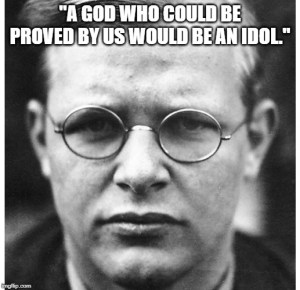 It is extremely important when quoting someone to find the reference for said quotation. I can’t emphasize that enough. It is very easy to attribute a quote to someone and have it spread, especially in these days of instantaneous communication. Slap a few words together, throw quote marks around it, and attribute it to someone famous and it may show up in a book later. One extreme example of this is from Dietrich Bonhoeffer, who’s quote about speaking and action is pretty much confirmed to be entirely made up. That quote has been proliferated all over the internet, in some publications, and even on the Senate floor of the United States. The alleged quote is:
Silence in the face of evil is itself evil: God will not hold us guiltless. Not to speak is to speak. Not to act is to act. -Probably not Bonhoeffer
That quote is really good! Kudos to whoever wrote it. But that person almost certainly was not Bonhoeffer. Some investigating by other people helped reveal the possible origins of this quote, but again, it wasn’t Bonhoeffer. Yet, when one looks for art of Bonhoeffer or pictures of him with quotes, this is perhaps the most frequently attributed quotation.
Another quote that I found alleging to be from Bonhoeffer is:
A God who let us prove his existence would be an idol.
I spent a few hours digging through my collected volumes of Dietrich Bonhoeffer Works in English after I searched for a few hours online in vain trying to find the attribution for this quote. What I did turn up in this search is interesting, because it makes this attribution much trickier. Turning to the Dietrich Bonhoeffer Works in English, one finds in volume 11 his discussion of a history of systematic theology a very similar quote.
Then, as I spent more time trying to find the source, I turned up someone else citing a collection of Bonhoeffer’s sayings that may have quoted it. So then, I searched for that work alongside the quote, which yielded that this quote is said to be from Bonhoeffer’s catechism with Hildebrandt. So, I got out my volume of Dietrich Bonhoeffer’s Works in English that had that catechism–ironically, still volume 11–and looked it up. There it was, black and white, but with a slightly different wording:
A god who could be proved by us would be an idol.
There it is. DBWE 11:260.
A massive fist pump and a lot of theology/academic nerd joy later, I am now able to reveal that this quote is not spurious and does indeed exist in Bonhoeffer’s corpus. To be fair, it should probably be cited as not just from Bonhoeffer but also Franz Hildebrandt, with whom he co-wrote the draft of the catechism.
But this exercise has taught me again something very important that everyone should take to heart. Cite your sources. It will save other people a lot of time and energy. More importantly, it’s a good exercise for you. Another thing I learned: keep digging.
Regarding anyone, don’t just trust a meme with their picture and name on it as being an actual quote. The spurious quote about “silence in the face of evil” has been spread far afield, even being quoted in the US Congress, despite it not actually being from Bonhoeffer. We need to exercise care in assuming quotes are genuine. Also, be sure when you share quotes to include the source–that way you help others and demonstrate you’ve done the work as well.
To celebrate finding the actual source, I made a meme of it for another of my Facebook pages, “Dank Lutheran Memes.” Check it out.
Links
Dietrich Bonhoeffer– Come read all of my posts about Dietrich Bonhoeffer.
Be sure to check out the page for this site on Facebook and Twitter for discussion of posts, links to other pages of interest, random talk about theology/philosophy/apologetics/movies and more!
SDG.
——
The preceding post is the property of J.W. Wartick (apart from quotations, which are the property of their respective owners, and works of art as credited; images are often freely available to the public and J.W. Wartick makes no claims of owning rights to the images unless he makes that explicit) and should not be reproduced in part or in whole without the expressed consent of the author. All content on this site is the property of J.W. Wartick and is made available for individual and personal usage. If you cite from these documents, whether for personal or professional purposes, please give appropriate citation with both the name of the author (J.W. Wartick) and a link to the original URL. If you’d like to repost a post, you may do so, provided you show less than half of the original post on your own site and link to the original post for the rest. You must also appropriately cite the post as noted above. This blog is protected by Creative Commons licensing. By viewing any part of this site, you are agreeing to this usage policy.
Book Review: “The Collected Sermons of Dietrich Bonhoeffer: Volume 2” edited by Victoria J. Barnett

Dietrich Bonhoeffer is one of the most influential theological voices of the 20th century, whose words resonate into the 21st century in wonderful and sometimes challenging and surprising way. Victoria J. Barnett, editor of Dietrich Bonhoeffer’s Works in English, has, with The Collected Sermons of Dietrich Bonhoeffer, Volume 2, put together a collection of his sermons that is both relevant and insightful into his life.
Barnett introduces each sermon so that readers have a context in which to place it. Often, this demonstrates the radical nature of his sermons as well as other biographical details about Bonhoeffer that shine through in his preaching. For example, when the German church experienced a takeover by the Nazis, Bonhoeffer preached sermons that went against the grain of going along with the state.
It is difficult to find a place to begin to understand a man like Dietrich Bonhoeffer. Each word he wrote seems so carefully considered, each quote needs to be placed within its broader context. It is easy to misquote him or to twist what he said. As such, a collection of sermons like this is almost an ideal entry point into his theology. Not only does a sermon contain whole theological points, but it also does so in a somewhat condensed form. One could argue–rightfully, I think–that drawing individual quotes from Discipleship may actually do damage to understanding the whole. But with sermons, one can listen, analyze, and parse wholly contained thoughts in a more condensed form.
Another thing that the collection does well is display the whole range of Bonhoeffer’s talent for sermons. Yes, his sermons tended on the scholarly side, but he tailored his sermon to the audience, and some of them are deeply personal. Others explore heavy theological concepts like the communication of attributes.
A few quotes from Bonhoeffer’s sermons seem in order to demonstrate the depth of this text:
We have become accustomed to seeing religion as something that corresponds to a need of the human soul and satisfies this need… But we forget the one most important question: whether religion is also something true, whether it is the truth.
Bonhoeffer, preaching from Finkenwalde after the Confessing Church refused to publicly come out condemning antisemitism:
“Babylon, which on its own power defies Christ, the crucified Lord… Babylon.. demands nothing of its subjects except blind love and intoxication… who would dare say that this Babylon is not eternal?–it will take a bad fall–woe to it!–how anxiously the Christian community… must… have yearned for its fall!”
Bonhoeffer makes a direct link between the hatred and action against a group of people (Jews) and defiance of Christ and acting as the apocalyptic Babylon.
Time and again stirring insights like these pour from the pages of Bonhoeffer’s sermons.
The Collected Sermons of Dietrich Bonhoeffer, Volume 2 is a valuable addition to any theological library. Even if one already owns his entire collected works, this collection puts together a number of impactful sermons with important contextual details that make it a necessary part of a Bonhoeffer collection.
Disclaimer: I was provided with a copy of the book for review by the publisher. I was not required to give any specific kind of feedback whatsoever.
Links
Be sure to check out the page for this site on Facebook and Twitter for discussion of posts, links to other pages of interest, random talk about theology/philosophy/apologetics/movies and more!
Book Reviews– There are plenty more book reviews to read! Read like crazy! (Scroll down for more, and click at bottom for even more!)
SDG.
——
The preceding post is the property of J.W. Wartick (apart from quotations, which are the property of their respective owners, and works of art as credited; images are often freely available to the public and J.W. Wartick makes no claims of owning rights to the images unless he makes that explicit) and should not be reproduced in part or in whole without the expressed consent of the author. All content on this site is the property of J.W. Wartick and is made available for individual and personal usage. If you cite from these documents, whether for personal or professional purposes, please give appropriate citation with both the name of the author (J.W. Wartick) and a link to the original URL. If you’d like to repost a post, you may do so, provided you show less than half of the original post on your own site and link to the original post for the rest. You must also appropriately cite the post as noted above. This blog is protected by Creative Commons licensing. By viewing any part of this site, you are agreeing to this usage policy.
Book Review: “Karl Barth and Dietrich Bonhoeffer: Theologians for a Post-Christian World” by Wolf Krötke
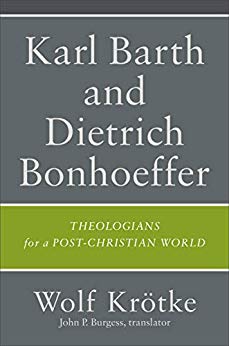
Karl Barth and Dietrich Bonhoeffer: Theologians for a Post-Christian World by Wolf Krötke is a formidable interpretation of both Karl Barth and Dietrich Bonhoeffer. Specifically, this collection focuses on how each of these theologians sought to relate to what they viewed as a post-Christian world.
Karl Barth is the subject of the first half of the book, and Krötke offers a range of topics engaging with Barth’s theology at multiple points. Krötke begins with an essay that highlights the challenges of engaging with Karl Barth to begin with. Then, he moves into Barth’s attack on “religion” itself as unbelief. Of course, what is meant by “religion” is key in this and many other essays, and the exact meaning of the term is notoriously difficult to pin down. Thus, much of the discussion here and elsewhere is spent drawing out what is being critiqued as “religion” vs. how Christianity can offer a better way forward.
Election, for Barth, is the “sum of the gospel,” and Krötke spends one essay discussing what is meant by Barth’s doctrine of election. In this doctrine, Barth sees that many major theological problems can be reconciled through Christ’s “Yes” to humanity (86).
Krötke’s interactions with Bonhoeffer are insightful and sometimes surprising, even to the point of being stunning (a word this reviewer used when taking notes on a few of the pages). In particular, the final essay on Bonhoeffer about Bonhoeffer’s “Nonreligious Interpretation of Biblical Concepts” alongside the “Missionary Challenge of the Church” was fascinating. Therein, Krötke notes that Bonhoeffer was extremely against any concept of God as a God available to us at our whim. God is not the kind of being who is available at the push of a button. Additionally, Krötke interprets Bonhoeffer’s religionless Christianity as putting forth the idea that God in Christ chooses to become powerless for us, such that in Christ, God leads us to the suffering of the cross (242-244). Rather than a God who could right all wrongs and does not, or one who cannot do so, the God of religionless Christianity, as Krötke reads it, is God in Christ who enters the world and, in doing so, intentionally gives up power in order to lead humanity to God. It’s a fascinating look at Bonhoeffer’s work, and a somewhat alarming interpretation in some ways, but also one that takes the notion of deity and makes it squarely within Christian theology.
Other essays on Bonhoeffer are equally fascinating, whether its when Krötke notes that Bonhoeffer’s life itself has become a theological resources for his interpreters or when he turns to the question of Bonhoeffer’s letters to his fiancee. On the latter point, Krötke reflects on his own attempts to look at Bonhoeffer’s letters to Maria von Wedermeyer. Ultimately, he found himself deciding that it was a kind of voyeurism–the theologian moving into an intensely personal scene in order to try to find any resource. It was a kind of question about biography and finding the past that this reader hadn’t considered before.
Karl Barth and Dietrich Bonhoeffer: Theologians for a Post-Christian World is a fascinating, engaging, and challenging read. I highly recommend it to those interested in the legacy of either one (or both) of these fascinating individuals. Krötke consistently presents startling insights and fascinating ways to move research forward. Highly recommended.
Disclaimer: I was provided with a copy of the book for review by the publisher. I was not required to give any specific kind of feedback whatsoever.
Links
Be sure to check out the page for this site on Facebook and Twitter for discussion of posts, links to other pages of interest, random talk about theology/philosophy/apologetics/movies and more!
Book Reviews– There are plenty more book reviews to read! Read like crazy! (Scroll down for more, and click at bottom for even more!)
SDG.
——
The preceding post is the property of J.W. Wartick (apart from quotations, which are the property of their respective owners, and works of art as credited; images are often freely available to the public and J.W. Wartick makes no claims of owning rights to the images unless he makes that explicit) and should not be reproduced in part or in whole without the expressed consent of the author. All content on this site is the property of J.W. Wartick and is made available for individual and personal usage. If you cite from these documents, whether for personal or professional purposes, please give appropriate citation with both the name of the author (J.W. Wartick) and a link to the original URL. If you’d like to repost a post, you may do so, provided you show less than half of the original post on your own site and link to the original post for the rest. You must also appropriately cite the post as noted above. This blog is protected by Creative Commons licensing. By viewing any part of this site, you are agreeing to this usage policy.
Book Review: “Seasoned Speech: Rhetoric in the Life of the Church” by James E. Beitler III
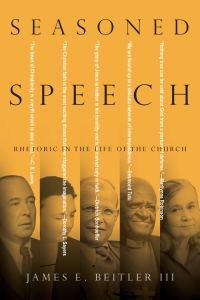 Rhetoric is a discipline that is rarely taught or even discussed anymore, even in scholarly circles. James E. Beitler III attempts to show the importance of rhetoric not just to Christian witness but to a full Christian life in Seasoned Speech: Rhetoric in the Life of the Church. He does this by outlining how five major Christian voices used rhetoric in their lives: C.S. Lewis, Dorothy L. Sayers, Dietrich Bonhoeffer, Desmond Tutu, and Marilynne Robinson.
C.S. Lewis is discussed in light of how he used rhetoric and worship to see the goodwill of Advent. His persuasive style and study of rhetoric helped him to become one of the most revered thinkers of the 20th century. C.S. Lewis addresses audiences on their own terms, adopted a humble stance, and cultivated communities. Again, this was centered around goodwill–the ultimate well-being of humanity through resurrection life with God (36-37). Dorothy Sayers used rhetoric and credal worship to emphasize the “energy of Christmastide” as Beitler puts it. Through vivid depictions and tranquil scenes, she made a rhetoric-filled argument for Christianity. Sayers’s He That Should come stirred up controversy in her own time, and Beitler quotes a remarkable defense Sayers offered of her portrayal of Christmas in which she talks about Christ being born “into this confused, coarse, and indifferent world… He was a real person, born in blood and pain like any other child, and dying in blood and pain, like the commonest thief…” The lifelike depictions of Sayers language comes through in the chapter dedicated to her, and shows how the persuasive rhetoric of her Christian witness played out.
Dietrich Bonhoeffer is used by Beitler to exemplify the use of preaching the Word and epiphanic identification–the hiddenness and reality of Christ the God-man. The “strange glory” of epiphany is that Christ comes to be identified with us–to be a human person. Even more radically, Bonhoeffer’s rhetoric led to the identification with Jewish Christians and taking a stand against those who would refuse to do so in Nazi Germany. Preaching, for Bonhoeffer, involved bringing the Word to the hearers ears, which would itself lead to identification with the Word. The word of God itself “is the exclamation point that we do not need to add,” said Bonhoeffer (115-116).
The chapter on Desmond Tutu was particularly fascinating, both in noting how Tutu’s wholly religious rhetoric led to calls for repentance and reconciliation and also how that same religious fervor led to accusations of divisiveness and triumphalism during the end of Apartheid in South Africa. Tutu’s prophetic rhetoric issued a stirring call for repentance from racial division and unity of the body of Christ. Marilynne Robinson has become a significant voice in Christianity through her fiction, which, through the Gilead Trilogy, uses rhetoric to make “faith’s unseen realities more believable and faith’s central questions more significant for unbelievers” and believers (162-163). Beitler notes the use of themes in the trilogy that help usher in a sense of ethos of Easter that makes sense of Christianity in real-world ways.
Throughout the book, Beitler does a good job of putting forward the ideas of those speakers/writers he wishes to highlight while allowing his own narrative and writing to take a back seat. Seasoned Speech is itself an execise in rhetoric, calling readers to a better appreciation of and for both the content of the writings and speeches of the people highlighted but also to go forth and learn more. I, for one, ended up putting holds on a number of works about and by several of the authors discussed, and I look forward to continuing to learn about their “seasoned speech” (a reference to Colossians 4:6).
Seasoned Speech: Rhetoric in the Life of the Church is a remarkable call to enjoy and learn from several fascinating thinkers in recent Christian history. It is the kind of book that calls for reading and re-reading and absorbing. I highly recommend it.
Disclaimer: I was provided with a copy of the book for review by the publisher. I was not required to give any specific kind of feedback whatsoever.
Links
Be sure to check out the page for this site on Facebook and Twitter for discussion of posts, links to other pages of interest, random talk about theology/philosophy/apologetics/movies and more!
Book Reviews– There are plenty more book reviews to read! Read like crazy! (Scroll down for more, and click at bottom for even more!)
SDG.
——
The preceding post is the property of J.W. Wartick (apart from quotations, which are the property of their respective owners, and works of art as credited; images are often freely available to the public and J.W. Wartick makes no claims of owning rights to the images unless he makes that explicit) and should not be reproduced in part or in whole without the expressed consent of the author. All content on this site is the property of J.W. Wartick and is made available for individual and personal usage. If you cite from these documents, whether for personal or professional purposes, please give appropriate citation with both the name of the author (J.W. Wartick) and a link to the original URL. If you’d like to repost a post, you may do so, provided you show less than half of the original post on your own site and link to the original post for the rest. You must also appropriately cite the post as noted above. This blog is protected by Creative Commons licensing. By viewing any part of this site, you are agreeing to this usage policy.
Book Review: “Sacred Rhetoric: Dietrich Bonhoeffer and the Participatory Tradition” by Justin Mandela Roberts
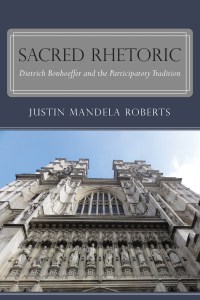 Dietrich Bonhoeffer’s influence stretches far and wide, and his concept of “worldly” or “religionless” Christianity is one of his most enduring traditions. That notion of the concreteness of his theology has led some to think that he rejected metaphysical aspects of the faith altogether. In Sacred Rhetoric: Dietrich Bonhoeffer and the Participatory Tradition, Justin Mandela Roberts pushes back against that thinking and argues that Bonhoeffer’s theology is, instead, one that stands alongside that of doxology, sacrament, and metaphysics.
The book is slim, but offers a wealth of detailed analysis of Bonhoeffer’s works from a number of angles that seem less common in Bonhoeffer scholarship. Bonhoeffer’s view of worship is analyzed, for example, as going beyond Barth while also integrating much of sacred tradition. Roberts’ analysis of Bonhoeffer’s thought on metanoia–the conversion or dark night of the soul–was a fascinating, personable read. The “Sacramental Interpretation” integrates Bonhoeffer’s sacramental theology with a view of the Word of God. Indeed, if there is a downside to reading the book, it may be found in the flurry of citations, musings, quotes, and ideas thrust at the reader in quick succession, making it difficult to absorb any one idea before moving swiftly onto the next. That said, Roberts’ analysis is helpful in many ways, both opening new interpretive lenses and new paths to explore for those interested in seeing how Bonhoeffer’s work may have opened up had he developed it further.
It was strange that Roberts opted to begin the book with a slight of Bonhoeffer. The second sentence of the introduction states “His academic pieces, including Sanctorum Communio, Act and Being, and Creation and Fall, offer nothing particularly remarkable as scholarly resources for the theological and philosophical traditions” (1). Given the fact that Creation and Fall is essentially the bulk of chapter 5’s focus is largely on Creation and Fall and each of the other works is cited as well, it seems Roberts would disagree with himself here, as he evidently finds these works quite remarkable indeed! Contextually, Roberts is opining on what it is that has made Bonhoeffer such an impactful figure on modern thought, possibly as an attempt to make him more real or down to earth for the average reader, but reading it was jarring in a book dedicated entirely to an interpretation of this apparently unremarkable figure.
Roberts’s work helps integrate Bonhoeffer’s thought into a broader Christian theology and practice. Sacred Rhetoric is an interesting, challenging read recommended for those looking to dig deeply into Bonhoeffer’s theological practices and metaphysics.
Disclaimer: I was provided with a copy of the book for review by the publisher. I was not required to give any specific kind of feedback whatsoever.
Links
Dietrich Bonhoeffer– many more posts, book reviews, and discussions of and about Dietrich Bonhoeffer and his life, theology, and thought (scroll down for more).
Be sure to check out the page for this site on Facebook and Twitter for discussion of posts, links to other pages of interest, random talk about theology/philosophy/apologetics/movies and more!
Book Reviews– There are plenty more book reviews to read! Read like crazy! (Scroll down for more, and click at bottom for even more!)
SDG.
——
The preceding post is the property of J.W. Wartick (apart from quotations, which are the property of their respective owners, and works of art as credited; images are often freely available to the public and J.W. Wartick makes no claims of owning rights to the images unless he makes that explicit) and should not be reproduced in part or in whole without the expressed consent of the author. All content on this site is the property of J.W. Wartick and is made available for individual and personal usage. If you cite from these documents, whether for personal or professional purposes, please give appropriate citation with both the name of the author (J.W. Wartick) and a link to the original URL. If you’d like to repost a post, you may do so, provided you show less than half of the original post on your own site and link to the original post for the rest. You must also appropriately cite the post as noted above. This blog is protected by Creative Commons licensing. By viewing any part of this site, you are agreeing to this usage policy.
Sunday Quote!- “Death is Hell… if not…” – Bonhoeffer
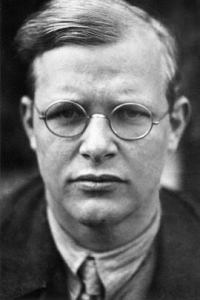 [Occasionally on] Sunday, I will share a quote from something I’ve been reading. The hope is for you, dear reader, to share your thoughts on the quote and related issues and perhaps pick up some reading material along the way!
Death is Hell… if not
I was really blown away by this passage from Bonhoeffer’s works as I was reading through today. Have had a lot of reason to reflect on death/dying recently, and this message was just so powerful to me:
Death is Hell and night and cold, if it is not transformed by our faith. But that is just what is so marvelous, that we can transform death. When the fierce apparition of the death’s head, which frightens us so, is touched by our faith in God, it becomes our friend, God’s messenger; death becomes Christ himself.- Dietrich Bonhoeffer, DBWE 13, 3/3 p. 335, “Sermon on Wisdom 3:3.”
Links
Be sure to check out the page for this site on Facebook and Twitter for discussion of posts, links to other pages of interest, random talk about theology/philosophy/apologetics/movies and more!
On Christian Music– I wrote a post about the label “Christian music” and how that can lead to a number of difficulties with discernment.
Christian Discernment Regarding Music: A Reflection and Response– I reflect in depth on how we can use our discernment properly when it comes to music.
Sunday Quote– If you want to read more Sunday Quotes and join the discussion, check them out! (Scroll down for more)
Eclectic Theist– Check out my other blog for my writings on science fiction, history, fantasy movies, and more!
SDG.
Book Review: “Christ and Revelatory Community in Bonhoeffer’s Reception of Hegel” by David S. Robinson
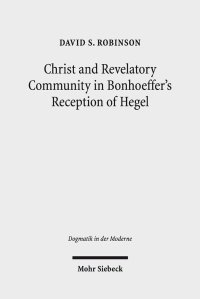 Robinson shows in Christ and Revelatory Community in Bonhoeffer’s Reception of Hegel that Bonhoeffer was influenced by, but also departed from GWF Hegel’s philosophy and theology on a number of key points. The book serves as a way to see Bonhoeffer through a Hegelian lens, and also note how Bonhoeffer developed Hegel’s thoughts in some key ways, particularly related to the community of the church.
Robinson begins with outlining some of Hegel’s thought related to the community and the somewhat elusive Geist (Spirit) in his thought. Then, he turns to Hegel’s incorporation of those ideas into the unfolding of Revelation in history and how Bonhoeffer specifically also incorporated revelation into history. The coming of Christ leads to a new community and the creator-human (Jesus Christ) opens new possibilities for the one and the many to come into conversation with each other. More explicitly, Robinson then turns to Christology in both Bonhoeffer and Hegel. Robinson argues Hegel’s Trinitarian theology–including the was not pantheistic but instead understood relationship as a central aspect of community. Bonhoeffer utilized similar themes in writing about Christ as existing in the community of the church.
One particularly fascinating chapter focused in on Bonhoeffer’s sacramental theology, contrasting it with how Hegel viewed the Eucharist. Bonhoeffer explicitly aligned himself against the Reformed objections to the Lutheran understanding of real presence of Christ in the bread and wine. Franz Hildebrandt, a friend of Bonhoeffer’s, utilized Hegelian thought to counter Karl Barth’s Reformed understanding of “this is my body” (132-134). Bonhoeffer himself incorporated Hegel’s concepts of seeing doctrine ad integral to the community to see Christ present in the Word preached as well as in the sacrament–the est of the sermon and sacrament (142). Hegel’s vision of the Eucharist sees union of objective and subjective into one through Christ, and he sees the Sacrament as the place where the Geist may become indwelling in the human person (146). Such a Lutheran understanding is reaffirmed and even made stronger in Bonhoeffer’s position, as he argues that one cannot distinguish idea from history/nature (though Robinson argues this was not necessarily Hegel’s position; see p. 147ff).
Community continues to be important as the concepts of freedom and revolution arise in Hegel and Bonhoeffer. These are questions of community that must be asked, and the thinkers diverge on this point. Hegel has been seen as an “apologist for Prussia” (169ff), though Robinson argues that he would better be understood as someone seeking Reform within existing institutions (172). Bonhoeffer addresses these questions through confessional space and seeing the church as the body of Christ–Christ existing as community in the church (177ff).
The concept of the Volk–folk–a kind of nationalist precursor to the Nazi ideology in Germany, is one that looms large in Hegel and Bonhoeffer in different ways. Robinson argues that Hegel’s Volkish tendencies were exacerbated and expanded by later Neo-Hegelian thinkers who sought exclusion based upon bloodlines and race, turning Hegel’s concepts of Geist into blood and “racialism” (197-198). Nevertheless, the dominant strand of Hegelian thought that arose in Bonhoeffer’s time was highly tied to Volk and bloodlines, an intensely racist theme that was used by the Nazis. Bonhoeffer, however, was exposed to thinkers apart from Hegel and one of those who helped shape his thought was W.E.B. Du Bois, whose The Souls of Black Folk, Robinson argues, was at least intrinsically influential for Bonhoeffer’s thinking. Both Hegel and Bonhoeffer criticized the state for its treatment of Jews and emphasized their humanity (204-206; 207-09). Hegel’s thought was Eurocentric, despite some aspects of criticizing the nationalism of his peers. Bonhoeffer’s thinking, Robinson argues, became transnational and ecumenical.
Robinson clearly carries the argument that Bonhoeffer was deeply influenced by Hegel’s thought. Whether it was by way of contrast or utilizing similar structure of arguments, Bonhoeffer’s training made him cognizant of Hegelian philosophy and interacted with it at many points.
Christ and Revelatory Community in Bonhoeffer’s Reception of Hegel is a fascinating look at Bonhoeffer’s reception of Hegelian thought. Robinson demonstrates that Bonhoeffer developed some ideas along Hegelian lines, while also sharply breaking from them in some respects. I highly recommend it for those looking to delve deeply into Bonhoeffer’s thought.
Disclaimer: I was provided with a copy of the book for review by the publisher. I was not required to give any specific kind of feedback whatsoever.
Links
Be sure to check out the page for this site on Facebook and Twitter for discussion of posts, links to other pages of interest, random talk about theology/philosophy/apologetics/movies and more!
Book Reviews– There are plenty more book reviews to read! Read like crazy! (Scroll down for more, and click at bottom for even more!)
SDG.
——
The preceding post is the property of J.W. Wartick (apart from quotations, which are the property of their respective owners, and works of art as credited; images are often freely available to the public and J.W. Wartick makes no claims of owning rights to the images unless he makes that explicit) and should not be reproduced in part or in whole without the expressed consent of the author. All content on this site is the property of J.W. Wartick and is made available for individual and personal usage. If you cite from these documents, whether for personal or professional purposes, please give appropriate citation with both the name of the author (J.W. Wartick) and a link to the original URL. If you’d like to repost a post, you may do so, provided you show less than half of the original post on your own site and link to the original post for the rest. You must also appropriately cite the post as noted above. This blog is protected by Creative Commons licensing. By viewing any part of this site, you are agreeing to this usage policy.

 J.W. Wartick - Reconstructing Faith