Eastern Orthodoxy
Book Review: “The Victory of the Cross: Salvation in Eastern Orthodoxy” by James R. Payton, Jr.
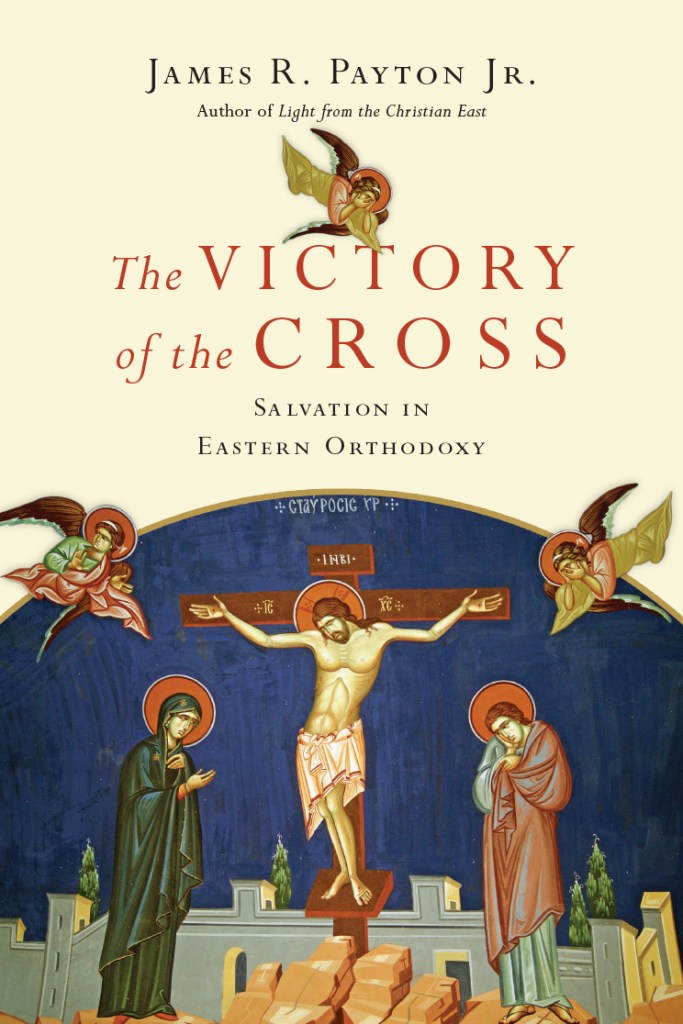
Eastern Othodoxy is often an almost impenetrable system of thought for Christians of different theological persuasions. James R. Payton, Jr.’s The Victory of the Cross: Salvation in Eastern Orthodoxy seeks to dispel some of that confusion by focusing closely on a specific theological question–salvation–and explaining it from an Eastern Orthodox perspective.
James R. Payton, Jr. comes at these controversial questions from the perspective of an evangelical with a deep understanding of the Orthodox faith. He explores some of the major themes in Eastern Orthodoxy related to salvation and brings light to them for those who might not have any real understanding of how Orthodoxy views certain topics. After a brief introduction, Payton sets the stage with a discussion of the cross, then walks readers through what might be a somewhat familiar path of going from a chapter on the need for salvation (also viewed in Orthodoxy as universal, though their view of original sin is less a culpable sin than a tendency towards sin) and moving into the focus on the savior, Christ. The way God saved humanity is one that is debated in non-Eastern circles as well, and here Payton focuses largely on the awe that the salvation brought with Christ inspires. One of the most controversial–perhaps only for its strangeness to non-Orthodox ears–aspects of Orthodox theology related to salvation is deification. An entire chapter is dedicated to that concept, along with a following chapter on “becoming like God” on the path to salvation.
Payton does an excellent job of grounding Eastern Orthodox beliefs in its practice and highlighting how much Orthodoxy draws from Church Fathers as well as orthopraxy. What is so often lost in many forms of Christianity today is the practice of lived faith. There’s a sense of “Yeah, I’m saved, and I read my Bible and go to church, and that’s it.” But Eastern Orthodoxy’s view of salvation does not allow such a surface level faith, at least not when done rightly. Instead, it demands a whole life committed to Christ and infused with the divine in contemplation and, indeed, in one’s own life. Payton’s work helps explain those aspects of Eastern Orthodoxy which may be strange to those who haven’t encountered it before while also ably highlighting the depth of the practice of faith and a life focused on the sign of the Cross.
The Victory of the Cross is a fascinating, adept introduction to the nature of salvation in Eastern Orthodoxy. It will serve readers not only as a way to springboard discussions into Eastern Orthodoxy, but also as a path to coming to a better understanding of the richness of the Christian tradition worldwide.
Disclaimer: I was provided with a copy of the book for review by the publisher. I was not required to give any specific kind of feedback whatsoever.
Links
Be sure to check out the page for this site on Facebook and Twitter for discussion of posts, links to other pages of interest, random talk about theology/philosophy/apologetics/movies and more!
Book Reviews– There are plenty more book reviews to read! Read like crazy! (Scroll down for more, and click at bottom for even more!)
SDG.
——
The preceding post is the property of J.W. Wartick (apart from quotations, which are the property of their respective owners, and works of art as credited; images are often freely available to the public and J.W. Wartick makes no claims of owning rights to the images unless he makes that explicit) and should not be reproduced in part or in whole without the expressed consent of the author. All content on this site is the property of J.W. Wartick and is made available for individual and personal usage. If you cite from these documents, whether for personal or professional purposes, please give appropriate citation with both the name of the author (J.W. Wartick) and a link to the original URL. If you’d like to repost a post, you may do so, provided you show less than half of the original post on your own site and link to the original post for the rest. You must also appropriately cite the post as noted above. This blog is protected by Creative Commons licensing. By viewing any part of this site, you are agreeing to this usage policy.
Book Review: “Modern Orthodox Thinkers” by Andrew Louth
 Modern Orthodox Thinkers presents a survey of recent Orthodox thinkers that goes beyond what a word like “survey” may imply. Andrew Louth manages to bring readers into an experiential awareness of Orthodoxy lived.
After an introductory chapter about the Philokalia, a collection of texts by Orthodox thinkers that emphasis a spiritual dimension to faith, twenty chapters present a number of Orthodox believers–from members of the church hierarchy to lay theologians–to readers. Each chapter provides a brief overview of the life of the thinker(s), a survey of their writings, and a focused look at selected aspects of their thought.
There is something here for almost any reader who is looking to glean from Orthodox thought. Whether it is Vladimir Solov’ev’s reflection on Sophia or Mother Thekla (Sharf)’s insight into Shakespeare, Keats, and others, Modern Orthodox Thinkers is a grab-bag of topics that will interest anyone. What’s more, the book presents these thinkers in such a way as to seemingly bring them into conversation with the reader. There is a sense of intimacy in the way that Louth presents the theology of each one that makes it go beyond a mere presentation of thought and towards an experiential awareness of the way theology is done.
Another strength of Louth’s work is that he brings women’s voices into the conversation as well. Too often, surveys of theological writers skip over the contributions women have made throughout history. Not so in this book, in which women thinkers are some of the most interesting people presented. For example, St Maria of Paris (Mother Maria Skobtsova)’s life was perhaps the most moving of all those presented. After the loss of a child, she pursued a life of helping others, taking the place of a Jew to go into a concentration camp, only to be executed in a gas chamber, again having taken the place of someone else (116). Her theology was that of lived theology, and it challenges readers to pursue the same lived faith for their own lives.
One difficulty with the book is that it will, at times, be completely impenetrable for the uninitiated (including the current reviewer). Although a brief introduction to the Philokalia is given, there is never a clear sense of exactly what it is supposed to be or how it is supposed to influence the thinkers presented. Other things are referenced in an offhand manner which gives little ground for readers to understand what is being discussed. For example, the “hesychast controversy” is presented with only the barest historical background of what it is supposed to be, despite the fact that it features prominently in several thinkers’ chapters. Although this was likely done due to space limitations and/or to keep the focus on the thinkers rather than on side issues, deeper discussion in the footnotes or even an extra paragraph would help those who are unfamiliar with Orthodoxy to understand more of the individual chapters.
Modern Orthodox Thinkers will challenge readers on a number of levels. First, it brings into focus the notion of a Christian life lived, whether by someone in the church or as someone who seeks to live as a Christian. Second, it will spur readers to a deeper understanding and exploration of Orthodox thought. Third, the breadth of topics will open readers to new avenues to explore. The book comes recommended.
The Good
+Impressive mix of topics and authors
+Includes women’s voices
+Experiential feeling to the writing
+Very broad scope
The Bad
-At times impenetrable for the uninitiated
Source
Andrew Louth, Modern Orthodox Thinkers (Downers Grove, IL: InterVarsity, 2015).
Disclaimer: I was provided with the book for review by the publisher. I was not required to provide any sort of feedback whatsoever.
Links
Be sure to check out the page for this site on Facebook and Twitter for discussion of posts, links to other pages of interest, random talk about theology/philosophy/apologetics/movies and more!
Book Reviews– There are plenty more book reviews to read! Read like crazy! (Scroll down for more, and click at bottom for even more!)
Eclectic Theist– Check out my other blog for my writings on science fiction, history, fantasy movies, and more!
SDG.
——
The preceding post is the property of J.W. Wartick (apart from quotations, which are the property of their respective owners, and works of art as credited; images are often freely available to the public and J.W. Wartick makes no claims of owning rights to the images unless he makes that explicit) and should not be reproduced in part or in whole without the expressed consent of the author. All content on this site is the property of J.W. Wartick and is made available for individual and personal usage. If you cite from these documents, whether for personal or professional purposes, please give appropriate citation with both the name of the author (J.W. Wartick) and a link to the original URL. If you’d like to repost a post, you may do so, provided you show less than half of the original post on your own site and link to the original post for the rest. You must also appropriately cite the post as noted above. This blog is protected by Creative Commons licensing. By viewing any part of this site, you are agreeing to this usage policy.

 J.W. Wartick - Reconstructing Faith