Eberhard Bethge
Biographies of Dietrich Bonhoeffer: An Ongoing Review and Guide
There is an ever-growing collection of biographies of Dietrich Bonhoeffer, the German pastor who was executed by the Nazis in 1945. This means that when people are looking to learn about Bonhoeffer, it can be difficult to know where to dive in. While I believe there’s no single strong answer to that question, I do think different biographies do different things well. This post will be a catch-all specifically for biographies about Bonhoeffer. I’ll highlight strengths and weaknesses of each one, in the hopes that this will let readers best choose from among the growing field of Bonhoeffer studies. This post will continue to be updated as I encounter additional biographies, and may be expanded to include related works.
Why am I qualified to do this post? I am not a Bonhoeffer scholar by any traditional means, and I think it is incredibly important to read those scholars. That said, I have read over 100 books by or about Bonhoeffer, his life, and his theology. By no means does this make me an expert, but I think I could at least offer some insights into questions about what biography to read.

Strange Glory: A Life of Dietrich Bonhoeffer by Charles Marsh
Marsh’s biography, published in 2014, presents Bonhoeffer’s life in a compelling fashion backed by scholarship. It is highly readable but doesn’t skip over details and controversies about Bonhoeffer’s life.
Advantages
-Written to effectively introduce readers to scholarship about Bonhoeffer while also telling his life’s story.
-Turns into a page-turner at times with Marsh’s effective writing style.
-Introduces readers to many topics related to Bonhoeffer’s life and theology in ways that can guide further reflection and study.
Disadvantage(s)
-Somewhat long for a reader attempting to get the basics of Bonhoeffer’s life, at more than 400 pages of text.
It’s For You If…
You want a one stop shop for Bonhoeffer’s biography. This is probably the single best biography in terms of combining scholarly insight, readability, and accuracy about Bonhoeffer’s life without being too dry.

The Faithful Spy: Dietrich Bonhoeffer and the Plot to Kill Hitler by John Hendrix
A graphic novel as a Bonhoeffer biography that caught me unawares in 2020. The art style is engaging, and the panels manage to tell the story without being too cluttered with text.
Advantages
-Extremely readable, with language that is easy to understand, even in sections on theology.
-It’s a graphic novel, I mean… come on. But really, this will appeal to adults who like graphic novels and can also be good reading for teens or tweens who want to engage with deeper topics.
-Probably the most unique biography in presentation.
Disadvantage(s)
-Doesn’t have a complete picture of Bonhoeffer’s life due to the focus on Bonhoeffer’s struggle with Nazism. While this is definitely a large part of his life, it doesn’t fully explain his theology or ethics. It’s a graphic novel, so expecting it to do so might be absurd, but it is worth noting that there is some hot debate in Bonhoeffer scholarship about just how involved he was in the plot to kill Hitler, or even whether he was involved at all. All nuance on this and related topics is basically lost with the format here.
-Relies a bit on Metaxas’s apocryphal work (see below).
It’s for you if…
You want a quick, easy read on Bonhoeffer that gives you at least a surface familiarity with his life and work. Or, you want something you could hand to someone who’s not interested in large tomes.

Bonhoeffer: Pastor, Martyr, Prophet, Spy by Eric Metaxas
This is by far the most popular biography of Bonhoeffer. There’s no doubt that Metaxas’s biography helped the burgeoning interest in Bonhoeffer along. That said, there are serious defects in this biography which lead me to strongly not recommend it as a work for anyone looking into Bonhoeffer’s life.
Advantages
-Popularity- popularity is not a bad thing. It’s great that Metaxas manage to shine a light on Bonhoeffer and encourage so many to read more about him.
-Great subtitle- Bonhoeffer’s life begs to be a major Hollywood blockbuster according to this subtitle.
Disadvantages
-Inaccuracy- I won’t nitpick various tiny facts that Metaxas got wrong. Any biographer can mess up geography or days. It happens. What is at issue is that Metaxas actually undermines much of Bonhoeffer’s own positions by substituting Bonhoeffer’s theology–that of a Lutheran theologian from Germany–with Metaxas’s preferred theology–that of right-leaning American Evangelicalism. For example, Metaxas doesn’t write anything about Bonhoeffer’s views on baptism or the Lord’s Supper, despite Bonhoeffer himself saying the Sacraments are necessary for the church. Why does Metaxas avoid it? Either he’s unaware of Bonhoeffer’s theology here–a major blunder given that Bonhoeffer is a Lutheran pastor–or he’s explicitly leaving it out to avoid offending the Evangelical-Baptist tendencies of his targeted audience, who would strongly disagree with Bonhoeffer’s sacramental theology. Bonhoeffer’s work in the resistance is not given the nuance the evidence requires. Bonhoeffer’s theology is devoid of challenging the reader in Metaxas’s reading. Bonhoeffer is made to be a biblical inerrantist, with Metaxas emphasizing his care for studying the Bible, despite Bonhoeffer’s own words noting that “the theory of verbal inspiration will not do” (DBWE 3:51). In short, Bonhoeffer’s life, theological views, and motivations are all slanted in Metaxas’s representation. Indeed, it shouldn’t escape most readers that Bonhoeffer’s viewpoints begin to seem eerily similar to those of Metaxas’s.
-Distorts the view of Bonhoeffer for many- due to the book’s popularity and its major inaccuracies, it has led to a distorted view of Bonhoeffer’s legacy. One example is the “silence” quote attributed to Bonhoeffer on the inside flap of the book. “Silence in the face of evil is itself evil. God will not hold us guiltless. Not to act is to act.” It’s a great quote, and sounds possibly like something Bonhoeffer would say. The problem is that he didn’t say it. The quote simply is not from Bonhoeffer. And yet it’s in the congressional record as something he said because of the popularity of this book. Now quote misattribution isn’t the end of the world, especially when the quote itself doesn’t necessarily run contrary to the person it’s attributed to. The problem is that Metaxas does things like this constantly. He presents Bonhoeffer as wholly alien to the context in which he operated.
-Somehow still too long for an introductory biography, weighing in at over 600 pages.
It’s for you if…
You’ve gotten a grounding in Bonhoeffer’s life and theology and want to see what the fuss is about. Or, you love writing critical reviews.
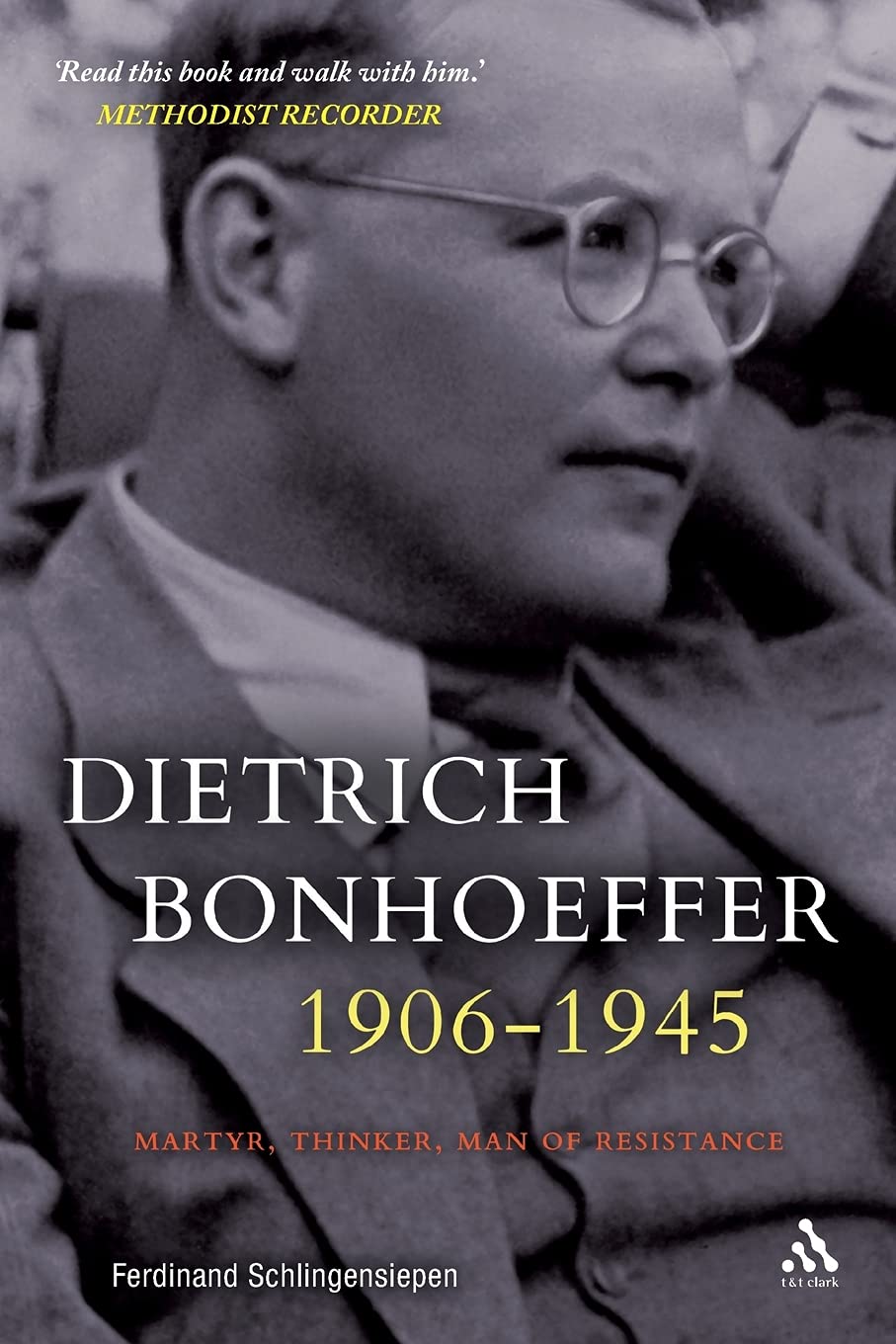
Dietrich Bonhoeffer 1906-1945: Martyr, Thinker, Man of Resistance by Ferdinand Schlingensiepen
Schlingensiepen’s biography is broad and intently focused upon Bonhoeffer’s intellectual development and production. It is an excellent work of Bonhoeffer scholarship but perhaps a bit less accessible for the lay reader.
Advantages
-Schlingensiepen’s academic experience and interpersonal connections make him imminently positioned to present an accurate accounting of Bonhoeffer’s life.
-The biography is not American-centric, as even the Marsh biography is in some ways. This biography is more historically based than it is theologically driven.
Disadvantage(s)
-The writing was originally German and the translation, while excellent, retains the dry tone and feel of the work.
-Schlingensiepen seems almost allergic to confronting modern concerns about theological questions that might arise from Bonhoeffer’s thought, making the biography more of a “just the facts, ma’am” approach than an attempt at relevance. This could also be seen as an advantage, depending on the reader.
It’s for you if…
You prefer a factual account of one’s biography to speculation about lesser grounded facts. Or, you would like to see a more modern German take on Bonhoeffer’s life. Or, you prefer to read one of the best scholarly treatments of Bonhoeffer’s life to anything more generalized.

The Doubled Life of Dietrich Bonhoeffer: Women, Sexuality, and Nazi Germany by Diane Reynolds
Bonhoeffer scholarship continues to broaden, and one great advantage of that is that scholars are driven to exploring corners of his life that would not otherwise have been explored. Reynolds here focuses specifically on Bonhoeffer’s life regarding the three subjects noted in the subtitle: women, sexuality, and Nazi Germany. (Full Review Here)
Advantages
-Insightful Commentary- Whether you agree or disagree with Reynolds’s conclusions, she makes a strong case in defense of her points. Truly, I think this biography deserves to be read by anyone who’s serious about engaging with Bonhoeffer’s life.
-Highlights lesser-discussed points- Women are constantly removed from history, but Reynolds puts women back into the narrative of Bonhoeffer’s life. She manages to show how influential many women were on Bonhoeffer’s life, leading to additional questions and avenues for exploration about Bonhoeffer. Additionally, the questions raised about Bonhoeffer’s sexuality elsewhere are highlighted here, with Reynolds deeply analyzing Bonhoeffer’s letters and life to make compelling, challenging arguments.
Disadvantages
-Primary focus is on the topics in the subtitle. Readers will get a fascinating look at Bonhoeffer’s interactions with women, interplay with Nazi Germany, and one of the deepest arguments about his sexuality found anywhere, but won’t have a full picture of his life.
-Highly controversial view of Bonhoeffer’s sexuality, which can be an advantage as it introduces readers to some of the best scholarly arguments on the topic.
It’s For You If…
You’ve read some about Bonhoeffer’s life and are interested in delving deeper into the background of some of his beliefs. You are curious about some of the hubbub surrounding Bonhoeffer’s sexuality in scholarly circles.
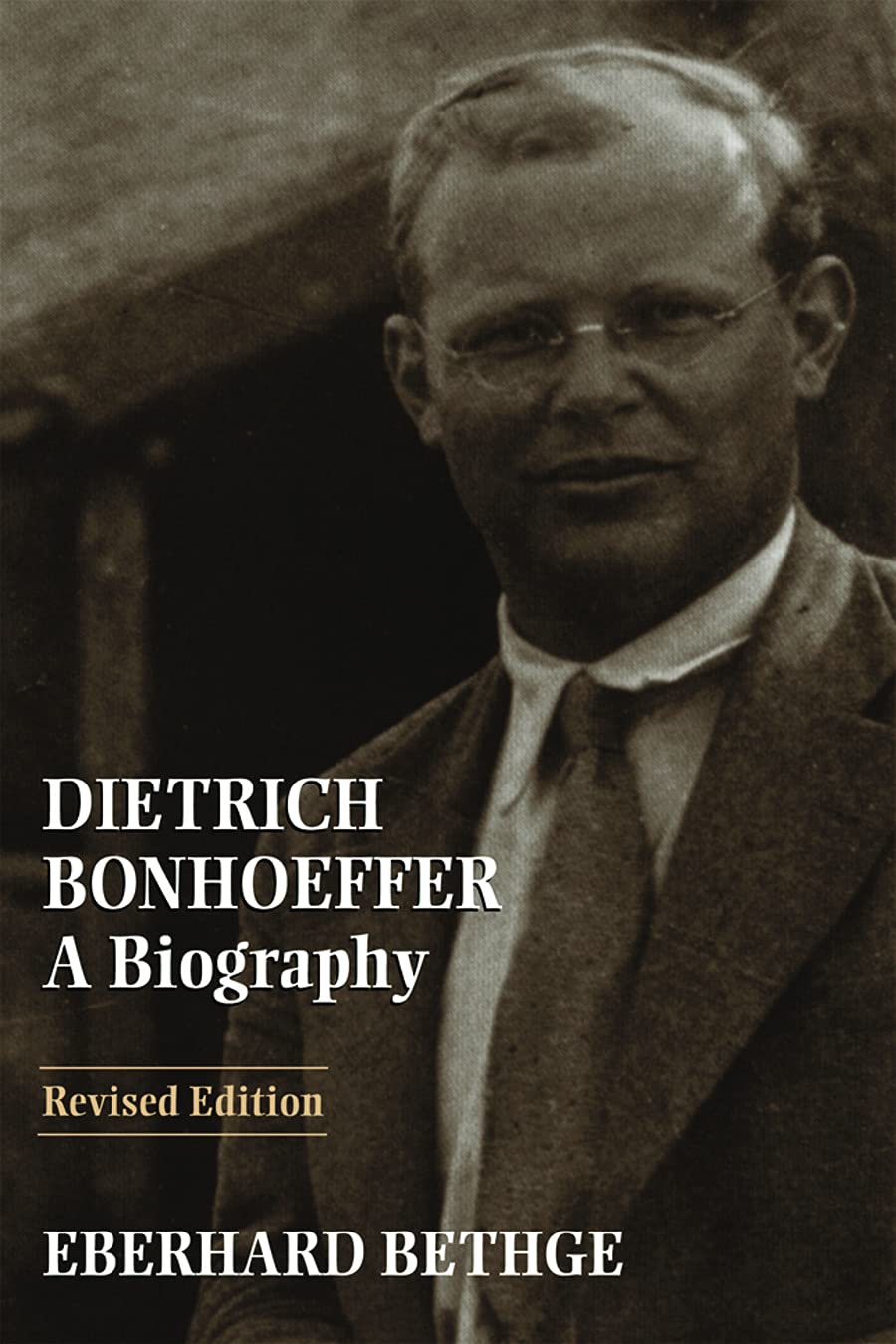
Dietrich Bonhoeffer: A Biography by Eberhard Bethge
Long seen as the definitive biography of Dietrich Bonhoeffer, this one is written by Bethge, Bonhoeffer’s great friend and confidant. It is voluminous in both content and commentary, providing key insights into Bonhoeffer’s thought from someone who knew him intimately.
Advantages
-The book feels absolutely comprehensive in its look at Bonhoeffer’s life.
-Bethge knew the subject well, personally, and this shows on basically every page.
-Bethge gives many insights into the “why” behind what Bonhoeffer was thinking, leading readers to deeper exploration and understanding of Bonhoeffer’s thought.
Disadvantage(s)
-It’s absolutely massive, weighting in at over 1000 pages (including notes/indices).
-There is some necessary bias from a friend of Bonhoeffer (Bethge) writing in a time in which Bonhoeffer wasn’t nearly as popular as he’s become now.
It’s for you if…
Want to feel like you know Bonhoeffer like a friend. Or, you’d like to see what serves as perhaps the baseline study for any student of Bonhoeffer’s life.
All Links to Amazon are Affiliates links
Links
Dietrich Bonhoeffer– read all my posts related to Bonhoeffer and his theology.
Be sure to check out the page for this site on Facebook and Twitter for discussion of posts, links to other pages of interest, random talk about theology/philosophy/apologetics/movies and more!
SDG.
——
The preceding post is the property of J.W. Wartick (apart from quotations, which are the property of their respective owners, and works of art as credited; images are often freely available to the public and J.W. Wartick makes no claims of owning rights to the images unless he makes that explicit) and should not be reproduced in part or in whole without the expressed consent of the author. All content on this site is the property of J.W. Wartick and is made available for individual and personal usage. If you cite from these documents, whether for personal or professional purposes, please give appropriate citation with both the name of the author (J.W. Wartick) and a link to the original URL. If you’d like to repost a post, you may do so, provided you show less than half of the original post on your own site and link to the original post for the rest. You must also appropriately cite the post as noted above. This blog is protected by Creative Commons licensing. By viewing any part of this site, you are agreeing to this usage policy.
Book Review: “Keys to Bonhoeffer’s Haus: Exploring the World and Wisdom of Dietrich Bonhoeffer” by Laura M. Fabrycky
 The intersection of the scholarly and the intimate is a rare gift. At first, some readers may think that scholarly works simply cannot be intimate. How can someone be so closely associated with a topic while also writing in a serious, academic way? Laura M. Fabrycky’s work, Keys to Bonhoeffer’s Haus: Exploring the World and Wisdom of Dietrich Bonhoeffer shows how that can be done related to Dietrich Bonhoeffer. By integrating her personal experiences of leading tours at the Bonhoeffer Haus and in Germany with insights into the background of Bonhoeffer’s life, Fabrycky manages to create a unique read in the field of Bonhoeffer scholarship.
Keys to Bonhoeffer’s Haus is a kind of memoir, exploring Fabrycky’s own interaction with Bonhoeffer through her time in Germany. Because of this, it offers a deeply personal look at many aspects of Bonhoeffer’s life. But alongside that, Fabrycky also offers scholarly details to go along with her reflections such that a compelling narrative-driven exploration of Bonhoeffer. But the book provides more than that–it is much more a kind of look at Bonhoeffer’s place and how that impacted his life and decisions. Seeing how locations in Germany were set up helped to understand certain points in Bonhoeffer’s life more thoroughly.
Fabrycky’s style is excellent. The chapter on learning to ride bikes and finding locations related to Bonhoeffer’s life while navigating the strange world (to Americans) of European rules regarding bikes was an absolutely fascinating read. Time and again, Fabrycky’s style drew this reader in to the extent that it truly felt like riding along the streets with her while exploring the interior of Bonhoeffer’s life through buildings and places. Another example of this was her note of the roadside crucifixions, which, contextually, were used by the Nazis to bolster anti-Semitism in portraying the Jews as those to fully blame for killing Christ.
But a strong sense of place and personal reflection are not all that is offered in this fascinating work. Fabrycky continually draws readers’ eyes and imaginations to reading alongside and experiencing alongside Bonhoeffer, examining concepts of friendship, how Bonhoeffer read Scripture, and concepts of loyalty and nationalism. Because these are integrated into a broader, personal narrative, it once again presents readers with a feeling of sitting next to Fabrycky and exploring and experiencing these things oneself. One example is related to Bonhoeffer’s use of Moravian watchwords, called Die Losungen (see Kindle locations 1718ff). Fabrycky writes, “These were, and are, daily Scripture meditations published every year by the Moravian Brethern, a Protestant group that traces its religious heritage to a pre-Reformation movement of pietists who were committed to Scripture, prayer, an evangelism… Bonhoeffer and many others used their so-called watchwords… as a daily devotional practice, and it was one he commended to others as well” (ibid). After reading this, this reviewer looked it up, and it turns out one can subscribe to these to this day via email, and it has been edifying practicing a religious discipline Bonhoeffer himself commended. After reading this from Fabrycky, moreover, this reviewer was reading in Dietrich Bonhoeffer’s works and noticed several times these very watchwords were mentioned in letters and elsewhere. It was a fascinating insight that let this reader focus more on aspects of Bonhoeffer’s works that had been missed before. These kind of insights are found in abundance throughout Keys… and make it an invaluable look at Bonhoeffer’s thought life.
One critique I have is of the portrayal of church and state in Lutheran theology. Fabrycky writes, for example, that Bonhoeffer’s pacifism challenged Lutheran ideals in German society. She also writes that “Being a good Lutheran and a good German meant inhabiting two worlds at the same time… the spiritual… and the secular…but these worlds were fully compartmentalized from one another” (Kindle Location 3922). Much debate has gone into Bonhoeffer scholarship regarding Two Kingdoms theology, and Fabrycky here aligns herself with those who read as Lutheran what others read as distortions of Luther. This may be semantics, but many (such as Trey Palmisano in Peace and Violence in the Ethics of Dietrich Bonhoeffer, review here) have argued that Bonhoeffer’s stance on church and state is the genuine Lutheran position. Further, several have argued that Bonhoeffer’s position is both consistent and draws directly from Luther to offer a corrective to the notion of Volk that turned the Two Kingdoms doctrine into a justification of essentially any state action (see Michael P. DeJonge’s Bonhoeffer’s Reception of Luther, review here). I also favor an approach that sees Bonhoeffer’s theology of church and state–the Two Kingdoms doctrine–both as genuinely Lutheran and consistent, such that his view of pacifism would have challenged those Lutherans who had effectively ceded the Two Kingdoms doctrine to a carte blanche for the state.
Keys to Bonhoeffer’s Haus is an enthralling, captivating read. It reads as though one is exploring Bonhoeffer’s world through the mind of one who has been deeply impacted by close connection with his physical world, even decades removed. It will give readers insights into Bonhoeffer that this reader, at least, hasn’t found elsewhere. It’s the kind of unique work that even the most thorough reader of Bonhoeffer’s life and related works will likely find fresh and insightful. Highly recommended.
Disclaimer: I was provided with a copy of the book for review by the publisher. I was not required to give any specific kind of feedback whatsoever.
Links
Be sure to check out the page for this site on Facebook and Twitter for discussion of posts, links to other pages of interest, random talk about theology/philosophy/apologetics/movies and more!
Book Reviews– There are plenty more book reviews to read! Read like crazy! (Scroll down for more, and click at bottom for even more!)
SDG.
——
The preceding post is the property of J.W. Wartick (apart from quotations, which are the property of their respective owners, and works of art as credited; images are often freely available to the public and J.W. Wartick makes no claims of owning rights to the images unless he makes that explicit) and should not be reproduced in part or in whole without the expressed consent of the author. All content on this site is the property of J.W. Wartick and is made available for individual and personal usage. If you cite from these documents, whether for personal or professional purposes, please give appropriate citation with both the name of the author (J.W. Wartick) and a link to the original URL. If you’d like to repost a post, you may do so, provided you show less than half of the original post on your own site and link to the original post for the rest. You must also appropriately cite the post as noted above. This blog is protected by Creative Commons licensing. By viewing any part of this site, you are agreeing to this usage policy.

 J.W. Wartick - Reconstructing Faith