Ecclesiastes
Book Review: “Reformation Commentary on Scripture: Old Testament IX- Proverbs, Ecclesiastes, Song of Songs”

The Reformation Commentary on Scripture series from InterVarsity Press is an impressive collection of commentaries that feature a wide range of voices from the Reformation period giving insight into biblical texts. The latest volume I got was Old Testament IX: Proverbs, Ecclesiastes, Song of Songs. I was particularly excited for this volume both because I quite enjoy the books of the Bible it is discussing and because commentary on these books often varies wildly depending upon one’s background beliefs and theological stances.
Proverbs- a book that is confusing for many commentators through history, especially given its sometimes contradictory advice (eg. whether to debate the fool in Proverbs 26:4-5). What are we supposed to do with the book? Reformation commentators varied in their thoughts on the book, too. For example, Peter Moffett, an English clergyman, states that the book is simply a collection of “certain general, short, and pithy sayings, used…. in every person’s mouth” (7). By contrast, Michael Cop, a Swiss Protestant pastor, argued that the book is indeed wisdom that teaches Christ (ibid). The “Proverbs 31 woman” is a popular trope taken by many Christians today to present the model woman. Reformation commentators varied on the meaning of Proverbs 31’s teachings about a woman, including praising women for being strong not just physically but also mentally (John Trapp, an Anglican exegete, 201), considering the passage as showing how rare it is to find a woman with such insight or properties as a kind of backhanded tribute (Michel Cop, 198-199) and, intriguingly, an admonishment against useless and foolish husbands (Cop again, 201). Still more insights include seeing the passage not as an ideal woman but an abstract praising of “womanly arts” that makes it more of an empowering passage than an ideal women must live up to (Lucrezia Marinella, a Venetian poet and writer). Indeed the whole section on this Proverbs 31 passage is worth close reading and consideration.
Ecclesiastes- I’ll not spend as much time reviewing this, but it is interesting to see what the various commentators say about individual passages. I don’t like rushing past this book, which is a favorite of mine, but with limited time for review, suffice to say that the insights are just as fascinating as those in Proverbs.
Song of Songs- one of the more uniquely interpreted books of the Bible both then and now. Reformation theologians saw the book in varied lights. Martin Luther, for example, saw the book as a celebration of the ideal political order (305-306). Others saw it as allegory for love of the Holy Spirit for the church (Francois Lambert, a French Reformed theologian, 304). Others saw it as even more figurative, such as Calvin’s reading of the book as “a figural representation of Christ’s reign” (207). Desiderius Erasmus, famous opponent of Luther and Catholic theologian, was keen to defend the Bible from any kind of sexual impropriety while also arguing the book is not an allegory of the Virgin Mary (304-305, 307). While the allegorical readings were very popular, some theologians still saw it simply as showing the “veiled intimacies of marriage” (eg. Hugo Grotius, a Dutch lawyer and humanist, 313-314). The rest of the discussion of the book is just as interesting, showing an intriguing line that the interpreters walked between attempting to find comfort from the blatant sexual language in allegory while also acknowledging it in their use of allegory. One interesting example is Henry Ainsworth (an English Puritan Hebraist) whose interpretation of Song of Songs 4:4-5 which explicitly praises the breasts of the woman writes that breasts are for “ornament and use” while immediately turning it to being about God and the Church–“So here the ‘breasts’ of Christ’s spouse are compared to ‘roes’ for pleasantness, to ‘fawns’… This signifies how the church is fruitful in good works and words of comfort…” (377). This kind of blunt speaking of the sexual language of the text and immediately re-interpreting it as allegory is common throughout the Reformation period, though there are a few exceptions.
Old Testament IX: Proverbs, Ecclesiastes, Song of Songs is an insightful, fascinating look at some of the books of the Bible with the most varied histories of interpretation. I recommend it for readers interested in Reformation theology but also for those who just want some insight into these fascinating, oft-contentious books of the Bible.
All Links to Amazon are Affiliates links
Links
Be sure to check out the page for this site on Facebook and Twitter for discussion of posts, links to other pages of interest, random talk about theology/philosophy/apologetics/movies and more!
Book Reviews– There are plenty more book reviews to read! Read like crazy! (Scroll down for more, and click at bottom for even more!)
SDG.
——
The preceding post is the property of J.W. Wartick (apart from quotations, which are the property of their respective owners, and works of art as credited; images are often freely available to the public and J.W. Wartick makes no claims of owning rights to the images unless he makes that explicit) and should not be reproduced in part or in whole without the expressed consent of the author. All content on this site is the property of J.W. Wartick and is made available for individual and personal usage. If you cite from these documents, whether for personal or professional purposes, please give appropriate citation with both the name of the author (J.W. Wartick) and a link to the original URL. If you’d like to repost a post, you may do so, provided you show less than half of the original post on your own site and link to the original post for the rest. You must also appropriately cite the post as noted above. This blog is protected by Creative Commons licensing. By viewing any part of this site, you are agreeing to this usage policy.
Devotion for an Apologist/Philosopher: Ecclesiastes
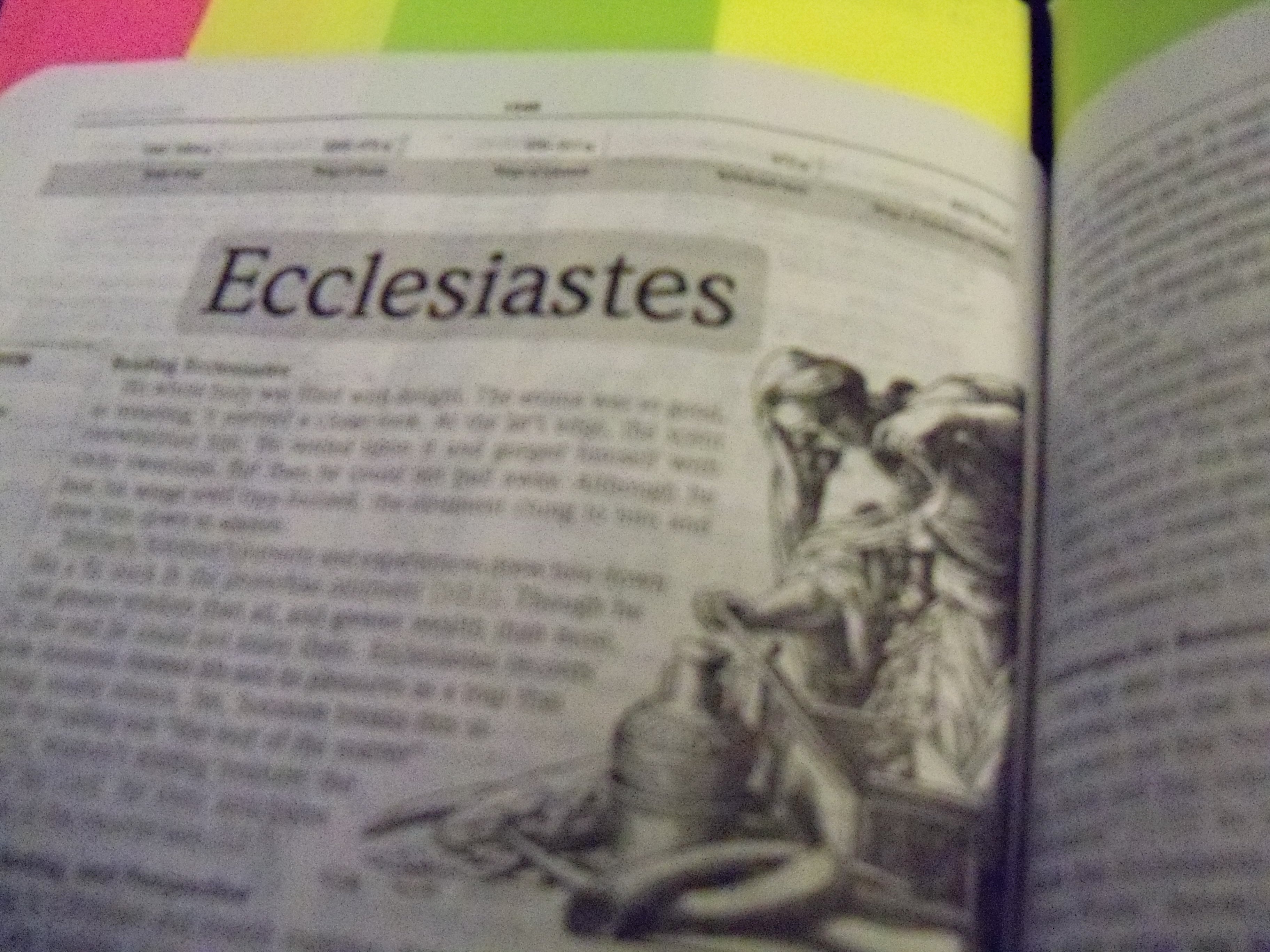 There are so many verses, chapters, and books in the Bible which resonate with me as a Christian philosopher/apologist. Ecclesiastes ranks near the top, however, due to its wonderfully philosophical message and style. The underlying theme of Ecclesiastes is that without God, everything is meaningless.
“‘Meaningless! Meaningless!’
says the Teacher.
‘Utterly meaningless!
Everything is meaningless.’… What has been is what will be, and what has been done is what will be done, and there is nothing new under the sun.” (1:2, 9).
The book starts with the idea that there is “nothing new under the sun.” The theme of “under the sun” is important to note. Consistently, “under the sun” is used to refer to “on earth.” It is in stark contrast to the “permanence of heaven” (TLSB). The theme contrasting life here on earth with heaven does not become apparent until very late in the book, so we too shall leave it until the end.
Solomon continues to explore the idea that that which we do “under the sun” is utterly meaningless. “For in much wisdom is much vexation, and he who increases knowledge increases sorrow” (1:18). The more we know, the more we sorrow. We can see themes like this in atheists like Albert Camus or Sartre, whose exploration of a world without God lead them to question whether suicide may be the only valid option.
“For what happens to the children of man and what happens to the beasts is the same; as one dies, so dies the other. They all have the same breath, and man has no advantage over the beasts, for all is vanity [also translated “meaningless”]. All go to one place. All are from the dust, and to dust all return” (3:19-20). The Teacher/Preacher goes on to contemplate our end: “Who knows whether the spirit of man goes upward and the spirit of the beast goes down into the earth? …Who can bring [man] to see what will be after him?” (3:21, 22b). It is death itself which makes life meaningless. Who knows what happens after death? Everything “appears utterly futile” (Waltke).
However, the Preacher/Teacher does not want us to collapse into despair. Without God, under the sun, all is meaningless. But with God, there is hope, joy, and meaning. This theme is sown in chapter 5 (verses 2-3; 7; and 19-20). Yet before fully developing this theme, Solomon returns to a life (and death) under the sun.
The existential life under the sun is absurd. “For the living know that they will die, but the dead know nothing, and they have no more reward, for the memory of them is forgotten. Their love and their hate and their envy have already perished, and forever they have no more share in all that is done under the sun” (9:5-6). Again the theme is “under the sun”. Without God, the life under the sun is meaning. We die, we pass away forever, we know not what comes after death, and even our actions pass away from under the sun. We no longer have a “share” in what is done under the sun.
The theme repeats throughout the book. “Under the sun”, all is meaningless, there is nothing new, and life itself passes away. Even a constant search for pleasure can only be meaningless.
Yet the conclusion to Ecclesiastes radically re-imagines the book. Solomon’s point so far has been that “you cannot make sense of life” (Waltke). Life under the sun is meaningless, futile, and vain. Existentially, the more we know, the more despair we can find. The more we explore life “under the sun,” the more we realize that it will be extinguished, and our actions will no longer impact that life.
The story does not end there, however. “The end of the matter; all has been heard. Fear God and keep his commandments, for this is the whole duty of man. For God will bring every deed into judgment, with every secret thing, whether good or evil” (12:13-14). The final verses of the book turn the meaning of the entire work about. The Preacher/Teacher comes to the conclusion: without God, all is meaningless; with God, there is good and evil, there is judgment, and there is duty. Rather than striving for nothing, we should strive for God. Rather than despair and futility; there is duty and good. Without God, life is meaningless; with God, there is meaning.
Sources:
Bruce Waltke, “Understanding the Old Testament.” Institute of Theological Studies. 2009.
The Lutheran Study Bible. (St. Louis, MO: Concordia Publishing House, 2009).
The picture is from The Lutheran Study Bible.
———
The preceding post is the property of J.W. Wartick (apart from citations, which are the property of their respective owners) and should not be reproduced in part or in whole without the expressed consent of the author. All content on this site is the property of J.W. Wartick and is made available for individual and personal usage. If you cite from these documents, whether for personal or professional purposes, please give appropriate citation and provide a link to the original URL. By viewing any part of this site, you are agreeing to this usage policy.

 J.W. Wartick - Reconstructing Faith