egalitarianism
Really Recommended Posts 8/28/15- The Socratic Method, Planned Parenthood, science, and more!
 I have put together another slew of reads with which you, dear readers, can engage. Here we have evidence for God, Planned Parenthood, Peter Boghossian’s “Street Epistemology,” evaluating scientific discoveries, and boys and girls. I hope you enjoy them! Let me know your thoughts, and be sure to let the authors know as well!
Can the Evidence for God Have Other Explanations?– Natasha Crain, a Christian apologist focused on putting together apologetics for parents and children, answers a question from a skeptic about the evidence purporting to show the existence of God having other explanations. Short answer: of course it might have other explanations; the problem is whether these explanations are better. Check out her post for elaboration.
A Response to “Planned Parenthood is Not Selling Baby Parts, You F*****g Idiots”– In the typical, well-reasoned manner of those who support abortion on demand, a”Skepchick” published a profanity-laden video and a shortened blog-version of the same response to those asking questions about Planned Parenthood. Here is a response to said video.
Boghossian’s Street Epistemology is Not the Socratic Method– Peter Boghossian attempts to reason believers out of their faith, largely by defining faith however he wants. Here is an analysis of his “Street Epistemology” and its attempts to use the Socratic Method against believers.
Girls’ Area– All the recent discussions about boys and girls and whether we need labels for boys’/girls’ toys and bedding has some farther reaching consequences. Here’s a post which highlights how perceived gender roles can impact children.
How to Evaluate Certainty in Scientific Discoveries– A good discussion of the use and importance of error bars in calculations, with the expansion of the universe as a case-study.
Egalitarian Music?
 I often find myself cringing at the lyrics that pass for contemporary Christian music as I listen to the radio (which, admittedly, I rarely do). From songs like “Courageous,” which makes it sound like only men can have courage… or at least that only they were “made to be” that way; to those like “Lead Me,” which encourages co-dependence in relationships, I find myself wondering if there are any egalitarian Christian musicians out there making music that shares that message. I know of none.
Anyone know of any?
The question, of course, is whether the concept of gender “roles” even needs to be an issue for egalitarian musicians. Moreover, how might an egalitarian theme be put forward meaningfully through music? I’m interested to know if anyone has thoughts on this.
Of course, all of this may just be another displayed symptom of the problem I’ve mentioned before with having a distinct genre of “Christian” music over and against other types of music.
Links
Be sure to check out the page for this site on Facebook and Twitter for discussion of posts, links to other pages of interest, random talk about theology/philosophy/apologetics/movies and more!
Christian Discernment Regarding Music: A reflection and response– Here I react to a post encouraging discernment when thinking about the category of Christian music.
On Christian Music– I reflect on the category of “Christian Music” and whether it is even a functionally helpful tool.
Engaging Culture: Demon Hunter’s “Extremist” and the Apologetic Task– I discuss the latest album from Demon Hunter and how music may act as an apologetic endeavor.
SDG.
Women, Emotions, and Apologetics: A Response to “Apologetically Blonde”
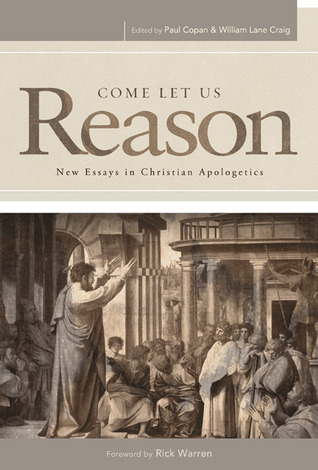 I recently came upon Come Let Us Reason: New Essays in Christian Apologetics, a book I’d been meaning to read for some time. I decided to take a break from the unpacking I was doing to do a little browsing as my son crawled around on my lap. I turned to the index to discover an article entitled: “Apologetically Blonde: The Struggle of Women to Defend Their Faith and What They Should Do about It” by Toni Allen (full citation below- all references to this text). As I browsed the article I knew I needed to write a response, because–with apologies to Toni Allen–I felt much of it was misguided.
Emotional Reasoning
The first critique I have of Allen’s article is the continued references to emotional reasoning and its apparent lack of justification for knowledge. Writes Allen:
…I find that women often depend on their experience and emotional connection with God as the primary justification for the beliefs they hold. In other words, women tend to perceive meaningful experiences and their corresponding emotions to be validation that what they believe is accurate. (40)
She goes on to say:
Yes, the gospel is for the whole person, and this includes existential reasons (including personal experience as well as our deepest emotions and longings)… However, a well-rounded defense of the gospel will include rational reasons and evidences. (40)
Throughout this section, Allen affirms the reality of personal experience and emotions as a basis for believing, but continually asserts that rational reasons are required in the public defense of Christianity. It is difficult to pin down exactly what Allen’s critique is in this section, because the wording is such that it could allow any number of exceptions. Words like “typically,” “often,” “includes,” and the like allow for broad interpretations of her meaning. But it does seem like the whole tone of the article as a whole is that emotions are somehow inadequate as a defense of the faith or that they are opposite or opposed to reason. This latter point is particularly problematic, and it seems like it is closest to the way Allen is leaning throughout the essay.
The reason I say this is because emotions are set up not alongside reasons and rationality, but rather as something separate from them. But this is itself mistaken. As any number of authors have pointed out, emotions themselves are part of the reasoning process and indeed can be integral or even essential to rationality. For example, Daniel Westberg argues in Renewing Moral Theology, a Thomistic approach to ethical theology, that emotions are a central part of the process of reasoning and judgment (see especially 40-43; see also my review of the book here). If Westberg is right, then for Thomists–a formidable bunch of philosophers indeed–emotions are a central aspect of reasoning; not something separate from and possibly antithetical to it. But even if he’s wrong, his case is fairly persuasive that emotions should not be dismissed from the reasoning process, and philosophers of several other flavors have agreed.
Thus, one of the major points of Allen’s assessment is itself mistaken because it operates from a false understanding of the relationship between emotions and reasoning.
As an aside, Allen’s assertion that “we must realize that appeals to religious experience typically do not function as a decisive apologetic” (41) is shifty in its wording (“typically”) while also being mistaken, as philosophers like Richard Swinburne, Caroline Franks Davis, Keith Yandell, and the like have made the argument from religious experience a powerful apologetic tool. Moreover, people like Alvin Plantinga have argued (persuasively, in my opinion), that we can have a rational basis for belief in God through properly basic belief and religious experience.
Can Women Do Apologetics?
Alongside Allen’s constant stream of arguing that women think more emotionally, there is the question of what exactly that is supposed to mean. Again and again we are treated to quotes like the one shared above and those below:
“[W]omen are naturally more cognizant of their emotions… depending on them as the primary validation for our beliefs directly affects our judgment.” (42)
“[I]n mentoring many women over the years, I have found it very common that rather than evaluate an idea on its merits, they are instead more reluctant to adopt an idea if it actuates negative feelings, or more eager to accept it because of positive ones.” (42)
“As women, we should welcome the challenge of defending our faith, even if this pushes us out of our comfort zone.” (45)
Lines like these are found throughout the essay with little supporting evidence other than personal experience–itself a great irony given the previous analysis. But apart from this, it fails to take into account that men and women operate on bell curves in regard to emotional–and other–reasoning skills and so making broad statements like these fails to reflect the reality of the spectrum of capacities for either gender.
Women, according to Allen, also are hamstrung in their attempts to do apologetics through “their natural inclination to avoid conflict” (37). But again, what does this say about men and women essentially (in the philosophical sense)? Do men who have an inclination to avoid conflict somehow become women or more feminine because of this? If so, in what fashion? And what biblical basis do we have for these kinds of assertions?
These and other issues betray a primary underlying presupposition of Allen’s article: gender essentialism. This is a deep topic that I cannot explore thoroughly here, but basically what Allen has–consciously or not–bought into is the notion that men and women operate in largely different spheres with clearly defined cognitive and other barriers between them. That’s why lines like “Women are naturally more cognizant of their emotions…” manage to sneak into the text. But these lines find little argumentative support and again fail to take into account the aforementioned reality that men and women do not operate in entirely different planes of existence–or even emotions. Although Allen generally included lines that allowed for some wiggle room, the overall message was clearly based on this presupposed and unfounded adherence to gender essentialism.
Apologetically Blonde?
A final issue I wanted to mention with the article is the title itself. Although “blonde jokes” have become part of our culture, I think that we as Christians are called to a higher standard. “Blonde” jokes select a specific portion of the population for the sake of ridicule. Though these are often “in good fun” the question is whether such jokes are taken that way and what kind of impact that might have on the people who are, well, blonde. I am not, but it’s easy to see how the use of “blonde” in the title as a synonym for “challenged” could be taken poorly and works against the gentleness and respect we need to display as Christian case-makers.
Links
Be sure to check out the page for this site on Facebook and Twitter for discussion of posts, links to other pages of interest, random talk about theology/philosophy/apologetics/movies and more!
Source
Toni Allen, “Apologetically Blonde: The Struggle of Women to Defend Their Faith and What They Should Do about It” in Come Let Us Reason: New Essays in Christian Apologetics eds. Paul Copan & William Lane Craig (Nashville, TN: B&H Publishing Group, 2012).
SDG.
——
The preceding post is the property of J.W. Wartick (apart from quotations, which are the property of their respective owners, and works of art as credited; images are often freely available to the public and J.W. Wartick makes no claims of owning rights to the images unless he makes that explicit) and should not be reproduced in part or in whole without the expressed consent of the author. All content on this site is the property of J.W. Wartick and is made available for individual and personal usage. If you cite from these documents, whether for personal or professional purposes, please give appropriate citation with both the name of the author (J.W. Wartick) and a link to the original URL. If you’d like to repost a post, you may do so, provided you show less than half of the original post on your own site and link to the original post for the rest. You must also appropriately cite the post as noted above. This blog is protected by Creative Commons licensing. By viewing any part of this site, you are agreeing to this usage policy.
A Sacramental/Lutheran Response to Women in Church Leadership
 The debate over women in the church–and particularly in church leadership–often has a different tenor when it is carried out in those church bodies which are sacramental in nature. A recent post over at The Junia Project entitled “Women & Leadership in Sacramental Churches” written by Tim Peck highlighted some of the different issues that come up in these church bodies. Here, I will present a few objections that often come up to women in leadership in sacramental churches, using Peck’s post for some insights. Then, I will note how from a Lutheran perspective, the notion that women cannot perform the sacraments is unfounded.
In the Place of Christ
One common objection to women serving in the office of the pastor has been that the pastor is to serve in the place of Christ when presiding over the sacraments. Thus, it is inferred that because Christ is a man, the pastor must also be a man. A similar objection is that Christ is the bridegroom of the church, and the pastor acts as Christ to the church. Thus, the pastor must be male, it is argued, because of the union of bride (church) and groom (Christ/pastor). As one complementarian I spoke with on this issue asserted, if the pastor were a woman, it would mean the church is in a homosexual relationship with the pastor (the inference being that the bride [church] would then be ‘married’ to the woman pastor).
The first part of the objection is answered fairly easily by pointing out, as Peck does, that:
Jesus was ethnically specific (Jewish), gender specific (male) and class specific (poor). To focus on just one and ignore the other two for the presider to function sacramentally seems arbitrary.
The second, similar objection can be answered by pointing out that the literal interpretation being used to exclude women from the pastoral office should also exclude any number of others from the office as well. After all, to turn the analogy the complementarian used above, if the pastor were married, then the pastor would be in a polygamous relationship with the church! But of course this is absurd. The reason it is absurd is because an analogy–the pastor being as Christ to the church–is being pressed into service literally. But this literalism is selective at best.
The Levitical Priesthood
Another argument I’ve heard a number of times is that pastors are analogous to the Levitical priesthood and, since no women were in the Levitical priesthood, women cannot serve as pastors. Peck again answers this argument:
[T]he New Testament itself insists that any priesthood existing among Christians would differ significantly from the old covenant priesthood. This should be obvious, since the old covenant priesthood was passed on by heredity. Moreover, men who suffered disabilities such as deformities, blindness, or mutilation were forbidden from serving as priests in the old covenant.
He offers other reasons to undermine this argument as well, but I think this one pretty much clinches it already: there is, again, a selectively literal reading happening. When it’s helpful for the complementarian argument, texts are taken literally, but even in the same contexts the literalism is not applied consistently.
A Lutheran Appeal
The Lutheran Confessions and the Administration of the Sacraments
From a confessional Lutheran perspective, the documents contained in the Book of Concord are binding. Yet, the types of arguments already analyzed above are often presented alongside the notion that a woman cannot perform the sacraments by virtue of being a woman. The reason this is true often varies from person to person, but the core of the reasoning is that women are excluded from the pastoral office and so by necessity cannot perform the sacraments. This reasoning reveals a presupposition: the sacraments, if performed by a woman, are made invalid.
The Augsburg Confession in Article VIII, states “Both the sacraments and the Word are efficacious because of the ordinance and command of Christ, even when offered by evil people.” In The Large Catechism, Fifth Part, “The Sacrament of the Altar,” Martin Luther states “Our conclusion is: Even though a scoundrel receives or administers the sacrament, it is the true sacrament… just as truly as when one uses it most worthily. For it is not founded on human holiness but on the Word of God.”
Thus, we find the unified teaching of the Book of Concord is that the efficacy of the sacraments is not based upon the person performing them. Indeed, if they were, then surely our confidence in the sacraments would be destroyed, for what pastor has no sin? The sacraments, then, cannot be made invalid because they are performed by a woman.
Responses to the Argument Above
The most likely response to this kind of reasoning would be to appeal to the biblical text to argue that women shouldn’t be pastors. However, this type of response would be a red herring. A discussion of the biblical texts is both necessary and valuable, but the argument that Lutheran complementarians have presented suggests that somehow the sacrament cannot be performed by a woman. Yet, as was demonstrated above, the Lutheran confessions themselves contradict this. The efficacy of the sacrament is not–thank God–dependent upon the one performing the sacrament. Thus, to argue that women would somehow invalidate the sacrament would be to deny the confessions of faith that we hold most dear and, indeed, undermine the very basis for our confidence in the validity of sacraments to begin with.
No human is without sin; none has no blemish. Our confidence in the sacraments is found not in the person performing them but in the unfailing word of God.
Another possible response is to appeal to, for example, the Apology of the Augsburg Confession, Article XIV, section 1 in which it states that “no one should be allowed to administer the Word and sacraments unless they are duly called…” The appeal would then go on to suggest that no woman, by virtue of being a woman, can be “duly called” into the administration of the Word and Sacrament. This counter-argument begs the question from the beginning. Rather than offering an argument as to why women cannot be duly called, the complementarian has here simply assumed that women cannot be called and then applied this backwards to exclude women from performing sacraments.
If the appeal is then, again, made to the biblical text, then that is where the debate must play out. But notice that if one moves in this direction, they have already conceded the invalidity of the reasoning the argument began with. Instead, they must continually retreat from the reasoning used above and try to argue from proof texts through specific–often unquestioned–exegetical methods.
Conclusion
There are many arguments put forward in sacramental churches against the possibility of women being in the role of the pastor. An analysis of two primary arguments have shown they are faulty in that they are selectively literal. From a Lutheran perspective, we find that the Lutheran Confessions themselves actually work against anyone suggesting that the sacraments are invalid when performed by any variety of people. It is God working, not some magical formula that the human must perform.
We must instead go back to the texts and approach them with a cautious eye towards the fact that we have selectively taken parts literally that cannot, when pressed, hold up. The conversation within Lutheran circles–and indeed, within sacramental circles generally–should continue, but the arguments analyzed herein have been shown to be wanting.
Sources
Tim Peck, “Women & Leadership in Sacramental Churches” 2015, online at http://juniaproject.com/women-leadership-in-sacramental-churches/.
All citations of the Lutheran Confessions are from:
The Book of Concord: The Confessions of the Evangelical Lutheran Church (Minneapolis: Fortress, 2008).
The Image in this post is from Wikimedia Commons and published under Creative Commons licensing. It was created by John Snyder and may be found here. Please appropriate cite if re-used.
SDG.
——
The preceding post is the property of J.W. Wartick (apart from citations, which are the property of their respective owners, and works of art as credited) and should not be reproduced in part or in whole without the expressed consent of the author. All content on this site is the property of J.W. Wartick and is made available for individual and personal usage. If you cite from these documents, whether for personal or professional purposes, please give appropriate citation with both the name of the author (J.W. Wartick) and a link to the original URL. If you’d like to repost a post, you may do so, provided you show less than half of the original post on your own site and link to the original post for the rest. You must also appropriately cite the post as noted above. This blog is protected by Creative Commons licensing. By viewing any part of this site, you are agreeing to this usage policy.
Really Recomended Posts 7/24/15- Pantheism, Parenting, Headship, and more!
Another week means another go-round of the web with some great reads for you, dear readers! This week we have a broad array of posts featuring pantheism, apologetics for kids, “male headship,” distractions and dedication to scholarship, and creationism. Let me know what you thought of the links and be sure to let the authors know as well!
Aristotle’s four causes versus pantheism– Can pantheism account for the world we actually observe? Here, prominent Scholastic Philosopher Edward Feser makes an argument that pantheism fails to account for the different kinds of causation we observe in the world.
How to Get Your Kids to Ask More Questions About Their Faith– Natasha Crain offers some thoughts on how to get kids invested in their faith through asking questions. I hope to one day implement some of these ideas into my own home, when my child is maybe a little older 🙂 (he’s 10 months old right now).
Headship Madness: The Headship Litmus Test– How does the notion that male headship is necessary and the biblical view lead to it being a kind of litmus test for theology generally and church practice explicitly? Here’s a post exploring how this view often does lead to headship becoming the test for sound theology.
Terry Mortenson concedes: “Stone Age” tools are a problem for Young Earth Creationism– Here’s an analysis of recent comments from an Answers in Genesis scholar on one argument that has been used against young earth creationism. This is a pretty major problem for trying to fit the timeline of YEC into the evidence we have.
Strive to be the Spiritual Bruce Lee (Comic)- We need to work to avoid the distractions that often get in the way of our spiritual practices and work towards building the kingdom instead of blowing time on such things. That said, we also need to balance some time for doing activities we enjoy and relaxing. Here’s a comic that speaks to the need to beat distractions.
Really Recommended Posts 7/17/15- Inside Out, women and sacraments, apologetics, and more!
I’m excited to present this week of “Really Recommended Posts” to you, dear readers, because it is a truly extraordinary lineup. I’ve worked ’round the clock (or at least for an hour) to read and bring to you some excellent posts from all over. Our diverse reads today include the latest Pixar movie, “Inside Out,” the necessity of not sharing (or apologizing for) fake news, women in sacramental churches, an exciting new book, and the criminal justice system. As always, let me know what you think! Be sure to let the authors know you appreciated their posts as well.
Inside Out– One of my favorite web sites, Empires and Mangers, takes a look at Pixar’s latest smash hit, “Inside Out.” Anthony Weber looks at the worldview issues raised in the movie, as well as how it might be used to start discussions about some good topics with children. Check out this great reflection.
An Embarassing Week for Christians Sharing Fake News– Here is some advice that we all need to take to heart. Ed Stetzer goes beyond just calling on Christians to check their sources to a real urgency to repenting and admitting wrong when we do share falsities. This is a phenomenal read that deserves to go viral.
Women Leadership in Sacramental Churches– The debate over women’s “role” in the church looks different in those church bodies which are sacramental in nature. I am Lutheran and have experienced the kind of reasoning outlined in this post to try to restrict women’s places in the church firsthand. This is a good read that will not only broaden perspectives about sacramental churches but also make headway in the debate over women in the church.
New Book by James Warner Wallace: “God’s Crime Scene: A Cold Case Detective Examines the Evidence for a Divinely Created Universe– Here is some background on an exciting upcoming release from the author of “Cold Case Christianity,” J. Warner Wallace. It looks like it will be examining arguments like the fine-tuning argument for the existence of God. I wrote a glowing review of Wallace’s previous book, and I look forward to reading this one as well.
Obama frees drug offenders whose terms ‘didn’t fit crimes’– I think that the criminal justice system has turned into a major issue of injustice that we need to address. I think the President’s calling attention to this is a great thing, regardless of what political stance I and others take. There is gross injustice in inequality of sentencing for drug-related crimes, and there is data to back up that much sentencing is racially-biased. We as Christians must speak up for those treated unjustly, and this is an issue worth talking about. What are your thoughts? I’d love to read them here.
Really Recommended Posts 7/10/15- Kangaroos, Cosmology, Fidelity, and more!
My apologies for missing the “Really Recommended Posts” last week, we just moved to Iowa and it was a very hectic week. We’re back in action now with a list of great reads for you. Be sure to let me know what you think, and let the authors know as well!
Dear Ken Ham: About Those Kangaroo Fossils…- Ken Ham’s response to why we don’t find kangaroo fossils from Ararat to Australia is another example of poor reasoning. Here, a response is offered to his argument.
So you think you understand the cosmological argument?– A lot of mistakes are made when evaluating the cosmological argument. Here’s a post by Edward Feser that explains several of these mistakes and answers some criticisms of the argument.
Think the “Billy Graham Rule” would have saved Tullian? Think again– There has been much commentary on the sexual infidelity of a fairly prominent church leader, Tullian Tchividjian. A lot of it has focused on how he should have stayed separate from women in general and avoided being along with women, as the “Billy Graham Rule” argues. But what does this say about women and men? Read on. My thanks to a friend on Facebook for sharing this.
Sci fi, free will, and the problem of evil– what might the resonating themes about free will in science fiction have to say about reality? Here, Clay Jones analyzes several aspects of science fiction with an eye for a greater metanarrative. My thanks to a friend on Facebook for sharing this.
Review: Unchristian: What a New Generation Really Thinks About Christianity… and Why it Mattes by David Kinnaman– This is a book I really enjoyed, though I share some of the concerns raised in this review. It’s worth reading the review to get an overview of the book’s content and some of the issues it raises. If I may be permitted a somewhat brief story here:
This was actually a pretty formative book for me when I read it some time ago (6+ years?). I remember finishing the book and feling supercharged to try to spread the truth of Christianity in a winsome manner. And quite seriously minutes after I finished and felt this supercharge of missional energy, a man showed up at the door of the house I was staying at at the time (a pastor’s house) and said he needed spiritual help. He entered the house right when I cracked open the door and kept saying he needed prayers.
I prayed with him and then thought he was going to leave, but he would not. He kept looking at the cat and saying he wouldn’t hurt a cat, and that he’d tried to kill himself a couple times that night by speeding and going through stop signs. I kept a short distance between he and I because he seemed clearly disturbed in some way.
Finally he did leave, answering the prayer I was saying over and over in my mind to God to protect me. I called the police but nothing ever came of it that I know of.
I’m still not sure how or why that happened, and I’m hoping I made an impact, but I don’t think I’ll know until the hereafter.
But I can’t help but think on it once in a while and wonder if what I did made a difference; if somehow that was God leading someone who needed help to where they needed to be.
Really Recommended Posts 6/26/15- Genetic engineering, parenting, evolution, and more!
I hope you will enjoy the latest round of the Really Recommended Posts, dear readers! I have taken some time out of a super busy schedule this week–preparing to move to a different state!–to scour the net for great reads to pass on to you. The topics we have include evolution, genetic engineering, parenting, historical apologetics, and racism. Let me know what you think, and, as always, be sure to let the authors know you enjoyed their posts as well!
Learning to Co-Parent– What does it mean to believe in the equality of the genders when it comes to parenting? How do we submit to each other out of love for the Lord through parenting? Here’s a great post on the topic with some practical insights.
Tears, Change, and Trust– A sermon on the Charleston shootings from a friend, Timothy Siburg. There are some good challenges against racism brought up in this post, and I urge you to check it out.
4 Key Points Christian Kids Need to Understand About Evolution– How should we be critical thinkers when it comes to evolution? Here’s a pretty even-keeled post on teaching kids about evolution. The post doesn’t fall into the pitfalls of assuming the absolute validity of any specific viewpoint or oversimplifying the topic. I enjoyed it.
Why You Should Genetically Engineer Your Children– Here’s an interesting argument from a Christian perspective for genetic engineering. I have reflected on the topic in the past and come down on a somewhat more negative perspective, though this post has challenged some of my positions. Check out my own post on genetic therapy and engineering, which I recently revised and updated.
Conrad Emil Lindberg on God and Revelation– Doug Geivett shares some insights on apologetics from the Lutheran theologian Conrad Emil Lindberg in his continuing series on historical apologetics. Be sure to read teh whole series, because it is excellent.
Really Recommended Posts 6/19/15- Creationism, memes, masculinity, and more!
Another week, another round of excellent reading from around the web for you, dear readers. We have analysis of creationist scholarship, a look at an exciting new book, historical apologetics, pro-life method, and analysis of a meme that attacks Christianity. As always let me know what you think, and let the authors know you enjoyed their posts as well!
The Dangers of Poor Scholarship: A Creationist’s Take on Feathered Dinosaurs– How do Young Earth Creationists often interact with science stories? Is there method consistent? Here, there is an analysis of creationist methodology when it comes not only to feathered dinosaurs but also to how the evaluate faulty arguments and lack consistency.
Malestrom: Swept up in the Currents of a Changing World (Review)– Color me delighted to see a book like this coming out. Our perceptions of what it means to be masculine are deeply embedded in our cultural norms. I have often engaged with complementarians who inform me of exactly what they think men ought to do or what men are “at their core.” But this they do without even acknowledging that even today there are cultures with differing understandings of what is masculine. How might we separate the good from the bad when it comes to talking about masculinity? This book seems to offer a way forward.
William Warburton’s 18th Century Defense of Christianity– It’s amazing how many historical defenses of Christianity are effectively lost in our time. The study of historical apologists is a continually fruitful one that yields great rewards for those who pursue it. Here, Doug Geivett highlights how even arguments that seem tied to their own time periods may provide us with new insights into controversies of our day.
John Reasnor Fails to Show that Incrementalism is Unbiblical– Clinton Wilcox engages in a debate over method when it comes to pro-life reasoning. Some have been arguing that we must do pro-life activism in such a way that only those laws or methods that ban all abortion may be supported. Is this reasonable? Wilcox analyzes the argument. I have provided a lengthy overview of and review of a debate on the same topic.
Will Your Murderer Be In Heaven?– Nick Peters offers an analysis of a meme floating around recently that attacks the goodness of Christianity because one’s own murderer might be in heaven. How does this attack hold up under scrutiny?
RRP 6/5/15
Another week, another round of Really Recommended Posts! Here we have posts on “celebrity books,” a pro-life debate, young earth creationism, what it means to be a man, and Zen Buddhism. Check ’em out, let me know what you think, and let the authors know as well!
When We Evaluate Zen Buddhism by Its Own Standards– What happens when you evaluate a religion like Zen Buddhism by its own standards of truth and the like? Check out this post to find out.
A Response to John Piper: What does it mean to be a man?– Frequently, Christians who have specific views of what gender “roles” are supposed to be package their cultural notions of what these roles ought to be in as well. Thus, it is claimed that men like cars, but women like shoes. Often, these claims are made straight-faced as if they apply to all women and men in all times and places. I have seen this time and again. Here is a response to John Piper on this very topic.
Celebrity Books– People don’t always read books unless they are “celebrity” authors. Do you often just buy books because of the author on the front? I know I do. To be fair–this often works out well. Here’s a post looking at some of the downside of this.
Is It Wrong to Pass Incremental Pro-Life Laws?– Here is a snippet of a debate on pro-life method with the question of whether we should pass incremental legislation. I summarized this debate here and analyzed the debate here.
My Response to a Young-Earth Critique of “Navigating Genesis”– Hugh Ross responds to a critique of his recent book on Genesis. The specific challenge raised is the location of Eden.

 J.W. Wartick - Reconstructing Faith
