Eric Metaxas
Biographies of Dietrich Bonhoeffer: An Ongoing Review and Guide
There is an ever-growing collection of biographies of Dietrich Bonhoeffer, the German pastor who was executed by the Nazis in 1945. This means that when people are looking to learn about Bonhoeffer, it can be difficult to know where to dive in. While I believe there’s no single strong answer to that question, I do think different biographies do different things well. This post will be a catch-all specifically for biographies about Bonhoeffer. I’ll highlight strengths and weaknesses of each one, in the hopes that this will let readers best choose from among the growing field of Bonhoeffer studies. This post will continue to be updated as I encounter additional biographies, and may be expanded to include related works.
Why am I qualified to do this post? I am not a Bonhoeffer scholar by any traditional means, and I think it is incredibly important to read those scholars. That said, I have read over 100 books by or about Bonhoeffer, his life, and his theology. By no means does this make me an expert, but I think I could at least offer some insights into questions about what biography to read.

Strange Glory: A Life of Dietrich Bonhoeffer by Charles Marsh
Marsh’s biography, published in 2014, presents Bonhoeffer’s life in a compelling fashion backed by scholarship. It is highly readable but doesn’t skip over details and controversies about Bonhoeffer’s life.
Advantages
-Written to effectively introduce readers to scholarship about Bonhoeffer while also telling his life’s story.
-Turns into a page-turner at times with Marsh’s effective writing style.
-Introduces readers to many topics related to Bonhoeffer’s life and theology in ways that can guide further reflection and study.
Disadvantage(s)
-Somewhat long for a reader attempting to get the basics of Bonhoeffer’s life, at more than 400 pages of text.
It’s For You If…
You want a one stop shop for Bonhoeffer’s biography. This is probably the single best biography in terms of combining scholarly insight, readability, and accuracy about Bonhoeffer’s life without being too dry.

The Faithful Spy: Dietrich Bonhoeffer and the Plot to Kill Hitler by John Hendrix
A graphic novel as a Bonhoeffer biography that caught me unawares in 2020. The art style is engaging, and the panels manage to tell the story without being too cluttered with text.
Advantages
-Extremely readable, with language that is easy to understand, even in sections on theology.
-It’s a graphic novel, I mean… come on. But really, this will appeal to adults who like graphic novels and can also be good reading for teens or tweens who want to engage with deeper topics.
-Probably the most unique biography in presentation.
Disadvantage(s)
-Doesn’t have a complete picture of Bonhoeffer’s life due to the focus on Bonhoeffer’s struggle with Nazism. While this is definitely a large part of his life, it doesn’t fully explain his theology or ethics. It’s a graphic novel, so expecting it to do so might be absurd, but it is worth noting that there is some hot debate in Bonhoeffer scholarship about just how involved he was in the plot to kill Hitler, or even whether he was involved at all. All nuance on this and related topics is basically lost with the format here.
-Relies a bit on Metaxas’s apocryphal work (see below).
It’s for you if…
You want a quick, easy read on Bonhoeffer that gives you at least a surface familiarity with his life and work. Or, you want something you could hand to someone who’s not interested in large tomes.

Bonhoeffer: Pastor, Martyr, Prophet, Spy by Eric Metaxas
This is by far the most popular biography of Bonhoeffer. There’s no doubt that Metaxas’s biography helped the burgeoning interest in Bonhoeffer along. That said, there are serious defects in this biography which lead me to strongly not recommend it as a work for anyone looking into Bonhoeffer’s life.
Advantages
-Popularity- popularity is not a bad thing. It’s great that Metaxas manage to shine a light on Bonhoeffer and encourage so many to read more about him.
-Great subtitle- Bonhoeffer’s life begs to be a major Hollywood blockbuster according to this subtitle.
Disadvantages
-Inaccuracy- I won’t nitpick various tiny facts that Metaxas got wrong. Any biographer can mess up geography or days. It happens. What is at issue is that Metaxas actually undermines much of Bonhoeffer’s own positions by substituting Bonhoeffer’s theology–that of a Lutheran theologian from Germany–with Metaxas’s preferred theology–that of right-leaning American Evangelicalism. For example, Metaxas doesn’t write anything about Bonhoeffer’s views on baptism or the Lord’s Supper, despite Bonhoeffer himself saying the Sacraments are necessary for the church. Why does Metaxas avoid it? Either he’s unaware of Bonhoeffer’s theology here–a major blunder given that Bonhoeffer is a Lutheran pastor–or he’s explicitly leaving it out to avoid offending the Evangelical-Baptist tendencies of his targeted audience, who would strongly disagree with Bonhoeffer’s sacramental theology. Bonhoeffer’s work in the resistance is not given the nuance the evidence requires. Bonhoeffer’s theology is devoid of challenging the reader in Metaxas’s reading. Bonhoeffer is made to be a biblical inerrantist, with Metaxas emphasizing his care for studying the Bible, despite Bonhoeffer’s own words noting that “the theory of verbal inspiration will not do” (DBWE 3:51). In short, Bonhoeffer’s life, theological views, and motivations are all slanted in Metaxas’s representation. Indeed, it shouldn’t escape most readers that Bonhoeffer’s viewpoints begin to seem eerily similar to those of Metaxas’s.
-Distorts the view of Bonhoeffer for many- due to the book’s popularity and its major inaccuracies, it has led to a distorted view of Bonhoeffer’s legacy. One example is the “silence” quote attributed to Bonhoeffer on the inside flap of the book. “Silence in the face of evil is itself evil. God will not hold us guiltless. Not to act is to act.” It’s a great quote, and sounds possibly like something Bonhoeffer would say. The problem is that he didn’t say it. The quote simply is not from Bonhoeffer. And yet it’s in the congressional record as something he said because of the popularity of this book. Now quote misattribution isn’t the end of the world, especially when the quote itself doesn’t necessarily run contrary to the person it’s attributed to. The problem is that Metaxas does things like this constantly. He presents Bonhoeffer as wholly alien to the context in which he operated.
-Somehow still too long for an introductory biography, weighing in at over 600 pages.
It’s for you if…
You’ve gotten a grounding in Bonhoeffer’s life and theology and want to see what the fuss is about. Or, you love writing critical reviews.
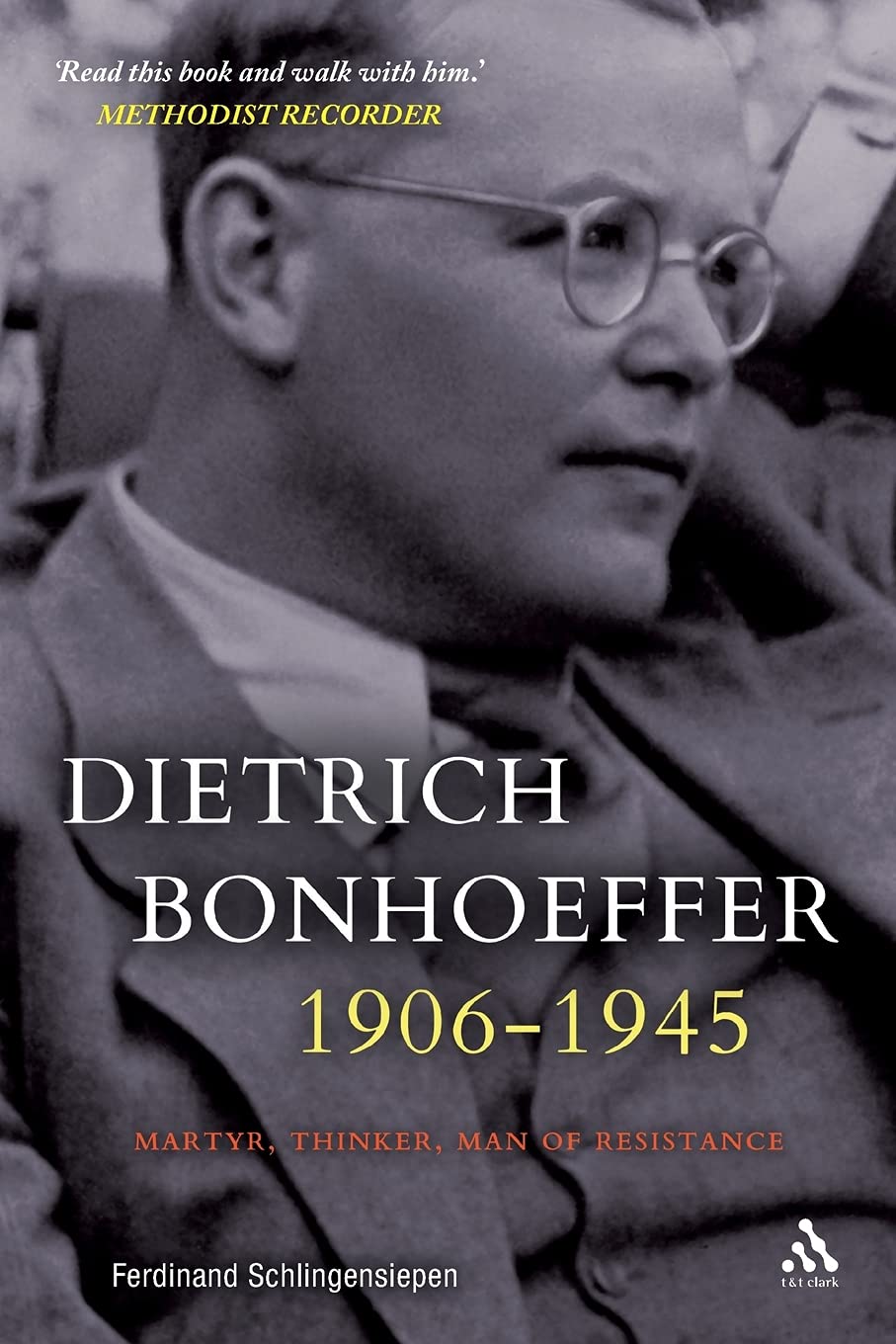
Dietrich Bonhoeffer 1906-1945: Martyr, Thinker, Man of Resistance by Ferdinand Schlingensiepen
Schlingensiepen’s biography is broad and intently focused upon Bonhoeffer’s intellectual development and production. It is an excellent work of Bonhoeffer scholarship but perhaps a bit less accessible for the lay reader.
Advantages
-Schlingensiepen’s academic experience and interpersonal connections make him imminently positioned to present an accurate accounting of Bonhoeffer’s life.
-The biography is not American-centric, as even the Marsh biography is in some ways. This biography is more historically based than it is theologically driven.
Disadvantage(s)
-The writing was originally German and the translation, while excellent, retains the dry tone and feel of the work.
-Schlingensiepen seems almost allergic to confronting modern concerns about theological questions that might arise from Bonhoeffer’s thought, making the biography more of a “just the facts, ma’am” approach than an attempt at relevance. This could also be seen as an advantage, depending on the reader.
It’s for you if…
You prefer a factual account of one’s biography to speculation about lesser grounded facts. Or, you would like to see a more modern German take on Bonhoeffer’s life. Or, you prefer to read one of the best scholarly treatments of Bonhoeffer’s life to anything more generalized.

The Doubled Life of Dietrich Bonhoeffer: Women, Sexuality, and Nazi Germany by Diane Reynolds
Bonhoeffer scholarship continues to broaden, and one great advantage of that is that scholars are driven to exploring corners of his life that would not otherwise have been explored. Reynolds here focuses specifically on Bonhoeffer’s life regarding the three subjects noted in the subtitle: women, sexuality, and Nazi Germany. (Full Review Here)
Advantages
-Insightful Commentary- Whether you agree or disagree with Reynolds’s conclusions, she makes a strong case in defense of her points. Truly, I think this biography deserves to be read by anyone who’s serious about engaging with Bonhoeffer’s life.
-Highlights lesser-discussed points- Women are constantly removed from history, but Reynolds puts women back into the narrative of Bonhoeffer’s life. She manages to show how influential many women were on Bonhoeffer’s life, leading to additional questions and avenues for exploration about Bonhoeffer. Additionally, the questions raised about Bonhoeffer’s sexuality elsewhere are highlighted here, with Reynolds deeply analyzing Bonhoeffer’s letters and life to make compelling, challenging arguments.
Disadvantages
-Primary focus is on the topics in the subtitle. Readers will get a fascinating look at Bonhoeffer’s interactions with women, interplay with Nazi Germany, and one of the deepest arguments about his sexuality found anywhere, but won’t have a full picture of his life.
-Highly controversial view of Bonhoeffer’s sexuality, which can be an advantage as it introduces readers to some of the best scholarly arguments on the topic.
It’s For You If…
You’ve read some about Bonhoeffer’s life and are interested in delving deeper into the background of some of his beliefs. You are curious about some of the hubbub surrounding Bonhoeffer’s sexuality in scholarly circles.
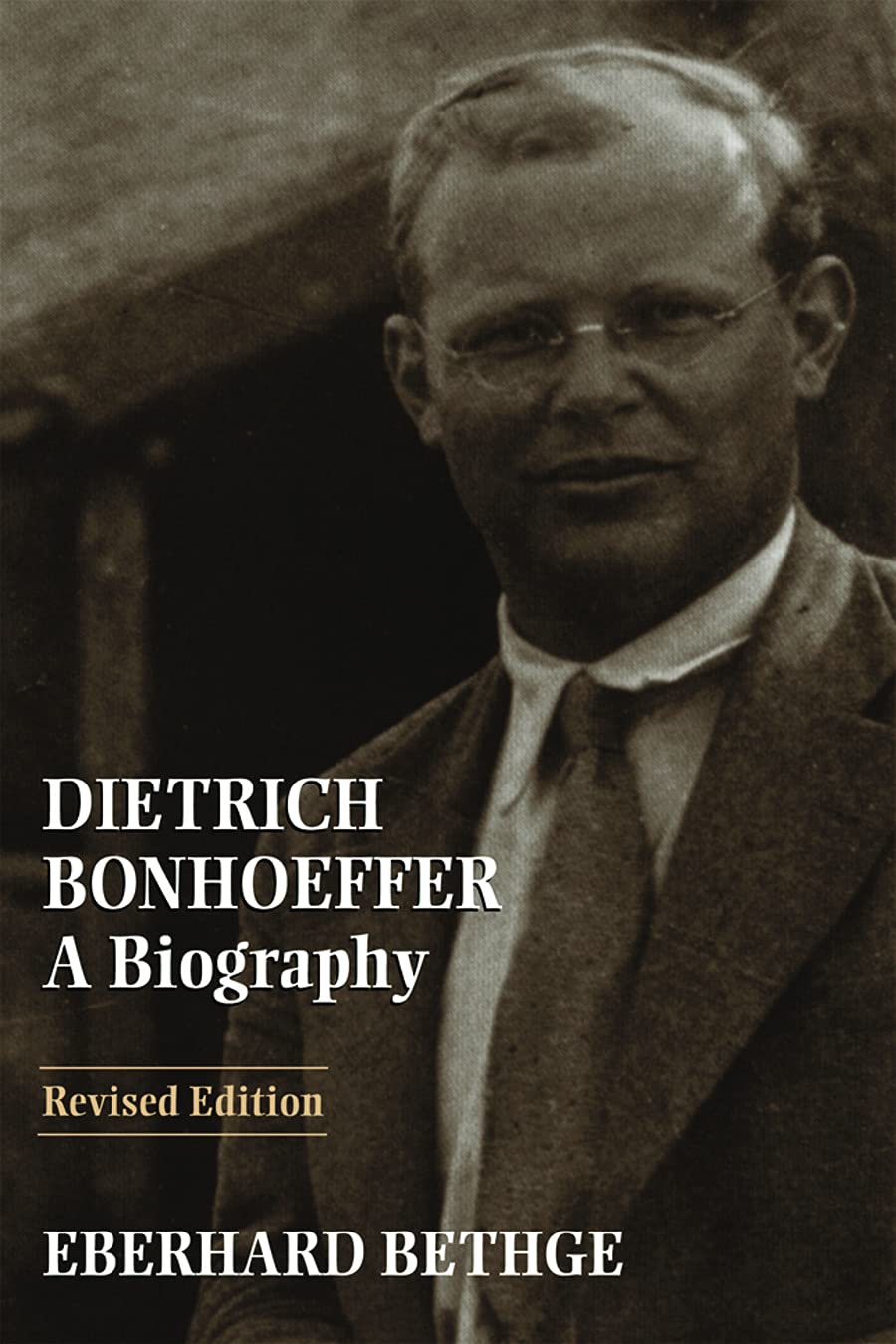
Dietrich Bonhoeffer: A Biography by Eberhard Bethge
Long seen as the definitive biography of Dietrich Bonhoeffer, this one is written by Bethge, Bonhoeffer’s great friend and confidant. It is voluminous in both content and commentary, providing key insights into Bonhoeffer’s thought from someone who knew him intimately.
Advantages
-The book feels absolutely comprehensive in its look at Bonhoeffer’s life.
-Bethge knew the subject well, personally, and this shows on basically every page.
-Bethge gives many insights into the “why” behind what Bonhoeffer was thinking, leading readers to deeper exploration and understanding of Bonhoeffer’s thought.
Disadvantage(s)
-It’s absolutely massive, weighting in at over 1000 pages (including notes/indices).
-There is some necessary bias from a friend of Bonhoeffer (Bethge) writing in a time in which Bonhoeffer wasn’t nearly as popular as he’s become now.
It’s for you if…
Want to feel like you know Bonhoeffer like a friend. Or, you’d like to see what serves as perhaps the baseline study for any student of Bonhoeffer’s life.
All Links to Amazon are Affiliates links
Links
Dietrich Bonhoeffer– read all my posts related to Bonhoeffer and his theology.
Be sure to check out the page for this site on Facebook and Twitter for discussion of posts, links to other pages of interest, random talk about theology/philosophy/apologetics/movies and more!
SDG.
——
The preceding post is the property of J.W. Wartick (apart from quotations, which are the property of their respective owners, and works of art as credited; images are often freely available to the public and J.W. Wartick makes no claims of owning rights to the images unless he makes that explicit) and should not be reproduced in part or in whole without the expressed consent of the author. All content on this site is the property of J.W. Wartick and is made available for individual and personal usage. If you cite from these documents, whether for personal or professional purposes, please give appropriate citation with both the name of the author (J.W. Wartick) and a link to the original URL. If you’d like to repost a post, you may do so, provided you show less than half of the original post on your own site and link to the original post for the rest. You must also appropriately cite the post as noted above. This blog is protected by Creative Commons licensing. By viewing any part of this site, you are agreeing to this usage policy.
Book Review: “The Battle for Bonhoeffer” by Stephen R. Haynes
 The Battle for Bonhoeffer by Stephen R. Haynes highlights the ways that people across theological, social, and political spectrums have played tug-of-war with Bonhoeffer’s thought, words, and legacy. As Charles Marsh puts it in his Foreword, “It is understandable… that readers with different theological and ideological perspectives would desire to claim Bonhoeffer as their own. ‘Excerpting Bonhoeffer’ has become a familiar exercise in each team’s effort to win…” (ix). Yet Bonhoeffer’s legacy is far more complex than a simple Google quote mine would allow. In my own reading of Bonhoeffer’s works, it is clear that it would be simple to find conflicting messages even within the same sermons at times. Like Martin Luther, for example, reading Bonhoeffer and interpreting him is like peeling away the layers of an onion, trying to get to the core. It takes care, precision, and thought. Unfortunately, as Haynes notes throughout this book, few people are concerned with doing so.
Though the subtitle is “Debating Discipleship in the Age of Trump,” there is far more to the book than dealing with the recent Trump phenomenon. Haynes notes how people on both the right and left have distorted or ignored aspects of Bonhoeffer’s legacy to turn in him into a supporter of their own positions. Marsh sets the table well, asking: “Have you heard progressive Christians cite the passage in Ethics calling abortion ‘nothing but murder’? Or recall Bonhoeffer’s preference for monarchy over democracy?” (xii). Haynes notes how Bonhoeffer was cited on one hand by Vietnam draft resisters, peace activists, liberation theologians, death-of-God thinkers on the left, and on the right by people who oppose abortion or same-sex marriage (and, regarding the latter, Haynes notes insights from both Charles Marsh’s Strange Glory and Diane Reynolds The Doubled Life of Dietrich Bonhoeffer [which I reviewed here] for reasons this may be quite inaccurate]). The baffling array of topics Bonhoeffer is alleged to have endorsed or condemned suggests that the quote mining being done through his legacy belies an inner complexity that is far deeper.
Haynes surveys the history of interpretation of Bonhoeffer, particularly in America, through the next several chapters. He places a special emphasis on seeing how evangelicals have viewed Dietrich Bonhoeffer. What is interesting in this latter topic is that, initially at least, Bonhoeffer was viewed positively but with some “warning flags” by American evangelicals who interacted with his works. Several appreciated his resistance to Nazi ideals, but were put off by his apparent lack of concern for things like “a high view of Scripture/inerrancy” and his being influenced by liberal German theologians. This portrait by the early evangelicals of Bonhoeffer is far more accurate than the one that has been passed into our own time, in part because it allowed for a multifaceted Bonhoeffer who was complex enough to resist being easily integrated into any one position.
Fairly early on, however, the complexities of Bonhoeffer’s thought and life began to be ignored in favor of seeing him as a figurehead for resistance to one’s own preferred ideas. Haynes demonstrates how Bonhoeffer was used to resist George W. Bush and the “war on terror,” and then ironically turned around to resist the “culture of death” under Barack Obama. The raising of the “Bonhoeffer flag” behind such opposed viewpoints should have served as a warning sign, but it unfortunately did not.
Enter Eric Metaxas. Metaxas’s biography, Bonhoeffer: Pastor, Martyr, Prophet, Spy was an extreme departure from Bonhoeffer scholarship generally. For one thing, Metaxas himself admitted to virtually ignoring or explicitly shunning the conclusions of 70 years of Bonhoeffer scholarship both at home and abroad. The cover flap for the book features a spurious quote from Bonhoeffer “Silence in the face of evil is evil itself…” that has since been passed all over the world and even “quoted” multiple times in Congress on record. To say that using an invented quote from Bonhoeffer on the cover of a biography of the man is a bad sign is an understatement. Haynes notes many, many problems with the biography, from a lack of engagement with Bonhoeffer’s actual works (and ignoring, for example, his Letters and Papers from Prison, which is one of the most important works for understanding his developed thought) to a recasting of Bonhoeffer into an American Evangelical. Yet it is Metaxas’s biography that has become the torch-bearer for the populist Bonhoeffer, making an image of the man that is incredibly distorted. For my own part, when I read Metaxas’s work, I was struck by how entirely de-Lutheranized Metaxas had made Bonhoeffer. Dietrich Bonhoeffer was a man who explicitly stated that, for example, without the Lord’s Supper there is no Christianity and who certainly supported infant baptism and regeneration, but Metaxas excised such details from his own dim look at Bonhoeffer’s theology, preferring to pull out those things which were more amenable to the typical American evangelical.
It was the populist view of Bonhoeffer which lead to notions of a “Bonhoeffer Moment” at various times before, during, and after the 2016 election cycle. Haynes spends some time noting how it was frequently said during the Obergefell v. Hodges Supreme Court case that American Christians were facing a “Bonhoeffer Moment” in which they would need to resist the government’s tyranny. Haynes notes how many evangelicals made comparisons to previous Supreme Court rulings, conveniently ignoring those unjust rulings they supported or the just ones they opposed. More decisively, Haynes notes that after Obergefell, evangelicals rallied around a woman who was part of an anti-Trinitarian sect to be their martyr for the cause. In the time since, though, very little has been done by evangelicals in their supposed “Bonhoeffer Moment.” This kind of co-option of the man’s legacy is a disservice to all involved.
Haynes doesn’t limit his analysis of the “battle for Bonhoeffer” to just the positives of Bonhoeffer’s life. Metaxas and others have argued Bonhoeffer is a “Righteous Gentile” (Metaxas even made “righteous gentile” part of his additional subtitle to his biography). But Bonhoeffer has explicitly been turned down for that technical categorization for a few reasons: 1) he wrote or supported some things that were seemingly anti-Semitic; and 2) though he did become a martyr, it wasn’t specifically due to his efforts to help the Jews during the Holocaust, which is a criterion for being deemed a “Righteous Gentile.” Bonhoeffer certainly opposed the Nazi treatment of the Jews and did help some Jews escape Germany (though at arm’s length for the most part–simply helping get proper papers from afar); but that was not his project or his main reason for opposing Nazi Germany. And that’s okay. It is important not to lionize Bonhoeffer for things he didn’t actually do, and Haynes is careful to help readers realize that.
The Battle for Bonhoeffer isn’t very long, but its length shouldn’t be taken for a lack of depth. It’s a thoughtful, critical, and sometimes convicting read. As one who is deeply indebted to Dietrich Bonhoeffer in my own theology and thought, I found ways in which I had been distorting him in this book as well. Haynes’ book provides an invaluable correction to distortions on the man’s life, times, and thought. I very highly recommend it.
Disclaimer: I was provided with a copy of the book for review by the publisher. I was not required to give any specific kind of feedback whatsoever.
Links
Be sure to check out the page for this site on Facebook and Twitter for discussion of posts, links to other pages of interest, random talk about theology/philosophy/apologetics/movies and more!
Book Reviews– There are plenty more book reviews to read! Read like crazy! (Scroll down for more, and click at bottom for even more!)
SDG.
——
The preceding post is the property of J.W. Wartick (apart from quotations, which are the property of their respective owners, and works of art as credited; images are often freely available to the public and J.W. Wartick makes no claims of owning rights to the images unless he makes that explicit) and should not be reproduced in part or in whole without the expressed consent of the author. All content on this site is the property of J.W. Wartick and is made available for individual and personal usage. If you cite from these documents, whether for personal or professional purposes, please give appropriate citation with both the name of the author (J.W. Wartick) and a link to the original URL. If you’d like to repost a post, you may do so, provided you show less than half of the original post on your own site and link to the original post for the rest. You must also appropriately cite the post as noted above. This blog is protected by Creative Commons licensing. By viewing any part of this site, you are agreeing to this usage policy.
Really Recommended Posts 12/13/13- Bonhoeffer, Creationism, Feminism, and more!
 The Really Recommended Posts this week are really wide-ranging. I hope you’ll enjoy this smorgasbord as much as I did. We feature Dietrich Bonhoeffer’s theology, creationism, feminism, intelligent design, the conquest narratives in the Bible, and more! Check them out, and, as always, let me know what you think!
Dietrich Bonhoeffer, a New Testament Pastoral Theologian– Bonhoeffer is, I admit, one of my favorite theologians. I only wish he had had more time upon the earth to develop more systematic works than he did write. I’m Lutheran too, which makes me gleeful at the broad appeal Bonhoeffer has demonstrated. In this post, Joel Willitts explores the way in which Bonhoeffer did theology. It’s a fascinating look at the development of his theology.
Multiple Lines of Evidence Support an Ancient Earth– The charge is often made from young earth creationists that dating methods don’t work. What about when those dating methods correspond across independent and multiple lines of evidence? It seems this presents a major challenge to the young-earth paradigm. Check out this post for a summary of several related points.
Was There an Exodus & Conquest– Two of the biggest challenges to the OT narrative are directly related to the historical accounts of the Exodus and the Conquest narratives. That is, did these even happen? Here, there is a post which briefly summarizes the issues and evidences related to these events.
“Darwin’s Doubt” with Stephen Meyer (and Eric Metaxas) [VIDEO]– A fairly lengthy video in which Eric Metaxas discusses intelligent design with Stephen Meyer. I found this video to be highly informative and also really entertaining. Metaxas is clearly a great speaker, and he keeps the discussion going and interesting throughout. Meyer, of course, is also a great speaker and it is worth hearing his discussion of these ideas.
thoughts on being a “Jesus Feminist”– What does it mean to be a Jesus Feminist? Can Christians be feminists and follow Christ? Check out this reflective post on what it means to be a Jesus Feminist.
Rescuing Songs of Christ’s Birth from Christmas– Should songs of Jesus’ birth be sung only during the Christmas season? Here, compelling reasons are offered as to why these songs are appropriate year-round.
The Advent Project– A pretty sweet deal: Biola University, one of the best schools out there (not biased at all ;)), has a series of Advent devotions going up daily available on their site. Each has a work of art, a music selection(s), and a brief reflection upon the coming of Christ, the incarnate God, into our lives. I’ve been following them as they go up and have enjoyed them all. Check them out for an excellent way to meditate on the meaning of Christmas.
Freedom of Religion and the HHS Mandate
I don’t often weigh in on the political sphere. However, I think there is a lot of misunderstanding over why many Christians are opposed to the HHS Mandate. It is important, first, to know what the HHS mandate is. It is just as important to know why people are opposing it. Even if you oppose its opposition, it is important to know the other side’s reasoning. I’ll keep this as brief as I can.
What is the HHS Mandate?
Simply put, the HHS mandate is a proposed regulation to force Roman Catholic and other organizations to provide services (like paying for abortions or contraceptives) for their employees. In other words, it forces them to pay for services to which they are religiously opposed.
What’s NOT the issue?
The issue here is not whether abortion is right or wrong. The issue is not whether contraception is right or wrong. The issue is not whether any individual ethical decision is right or wrong. One doesn’t need to agree with others on these issues to realize what the actual issue is.
What is the Issue?
The issue with the HHS mandate is that it destroys religious liberty by forcing organizations to pay for services to which they are ethically opposed. Think of it this way: You’re part of a religion which is opposed to doing various drugs. Should it be legal to force you to pay for marijuana for your employees if they desire it?
To explain it even more simply: I am not a Mormon, and I like caffeine well enough. Mormons are opposed to drinking caffeine. I would not try to force them to pay for coca-cola for their employees because this would be a violation of their conscience and religious liberty.
Here’s the key: even though I don’t necessarily agree with the ethical principle, I do agree with allowing for religious liberty and not forcing others to pay for services to which they are opposed religiously.
Analogy: one key battle was the fight over whether certain Native Americans would be allowed to utilize peyote (a drug from a cactus) as part of their religious ceremonies. Though I personally would be against using drugs, I would not oppose the use of such a substance in another’s religious ceremony. Why? Because it would violate their religious liberty.
So what’s the big deal?
Simply put: if the HHS mandate passes, it is the U.S. Government telling certain religious practitioners that although they are religiously opposed to certain services, they will be required to pay for them as a religious organization.
In other words, it is a gross violation of religious liberty. Whether you are Mormon, Catholic, Protestant, atheist, Muslim, or of any other persuasion, you should be against this mandate. One can’t help but think that if we allow such a violation of liberty in this area, it only sets up for violations of liberties in other arenas.
Further Reading
Will Obama force Catholics to buy insurance that covers abortions?
“This is the end of America”- Best Selling Author [Eric Metaxas] weighs in on HHS mandate.

 J.W. Wartick - Reconstructing Faith