eschatology
Review of “Love Wins” by Rob Bell: Preface and Chapter 1
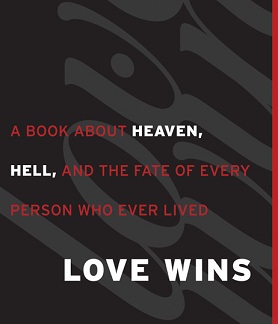 I know I am late to this party. It has taken me a while to get around to reading Love Wins
Rob Bell’s argument will be examined for historical accuracy and philosophical rigor. Furthermore, I will examine how Rob Bell makes his argument, because method is often one of the primary ways that people err in their theology. I begin with an analysis of the Preface and Chapter 1. I am hoping to release one post a week as I analyze this text. I will post each section with an outline of the arguments followed by my analysis.
Before I begin, one more note on this analysis: I have not read the book yet. My reason for this is I want to have it fresh in my mind as I do the analysis instead of coming to the text with a preconceived notion of what I remember it saying. Thus, these analyses will be based on a reading of the book chapter by chapter. I will end with an overall review once I wrap up the book. See the end of the post for links to other chapters.
Preface- “Millions of Us”
Outline
Rob Bell begins his book with a fairly simple statement “I believe that Jesus’s story is first and foremost about the love of God for every single one of us” (vii). Bell asserts that “Jesus’s story has been hijacked by a number of other stories… it’s time to reclaim it” (vii-viii). He points out that some teachings about Jesus have caused people to stumble, and that others do not discuss the issue of hell for various reasons.
Analysis
Bell is to be commended for taking on an issue that many are afraid to discuss. It is true that some people and even churches will not delve into the topic of hell. It is important to talk about this doctrine, as it has been part of Christian teaching from the beginning.
Unfortunately, it seems that Bell has already made a methodological mistake. He implored readers to “please understand that nothing in this book hasn’t been taught, suggested, or celebrated by many before me. I haven’t come up with a radical new teaching… That’s the beauty of the historic, orthodox Christian faith. It’s a deep, wide, diverse stream that’s been flowing for thousands of years…” (x-xi).
There are actually two errors here. First, simple diversity on a topic doesn’t somehow automatically validate all positions. Just because there was diversity about the doctrine of the Trinity doesn’t mean that the Arian position is somehow a valid theological perspective. Thus, it seems that Bell’s point here is moot. Diversity does not mean validity.
Second, historic, orthodox faith is not a diverse array of beliefs. The historic Christian faith has been define in universally acknowledged creeds which state what the universal church teaches on various essentials for the Christian faith. In fairness to Bell, he may be using “orthodox” to mean a denominational perspective, wherein the wider spectrum of beliefs is what may be considered “orthodox.”
Chapter 1: “What About the Flat Tire?”
Outline
Bell starts with a story about a quote from Gandhi, which prompted someone to write “Reality check: He’s in hell.” Bell reacts to this with a series of questions: “Really? Gandhi’s in hell? He is? We have confirmation of this? Somebody knows this? Without a doubt?” (1-2). Elsewhere, he focuses in on the individual again, asking whether it is true that the Christian message for someone who claimed to be an atheist during life has “no hope” (3).
He goes on to ask: “Has God created millions of people over tens of thousands of years who are going to spend eternity in anguish? Can God do this, or even allow this, and still claim to be a loving God? Does God punish people for thousands of years with infinite, eternal torment for things they did in their few finite years of life?” (2).
After focusing on the case of an individual’s salvation and whether there is an age of accountability, Bell focuses on the nature of salvation. “[W]hat exactly would have to happen… to change [an individual’s] future? Would he have had to perform a specific rite or ritual? Or take a class? Or be baptized? Or join a church? Or have something happen somewhere in his heart?” (5). Bell notes that some hold that one has to say a sinner’s prayer or pray in a specific way in order to get saved.
Bell continues to contemplate what it is to be saved, and points out that some believe that it is about a “personal relationship” but that that phrase is never used in the Bible. He asks why, if it is so central to salvation, would such a phrase not be in the Bible? (10-11). Bell asks whether “going to heaven is dependent on something I do” and then asks “How is any of that grace?” (11).
Then, Bell looks at various Biblical narratives, including the faith of the centurion, the discourse with Nicodemus, Paul’s conversion, and more, providing a constant stream of questions and noting apparently different things said about faith and salvation (12-18).
Analysis
Bell is right to focus on the notion of one’s personal fate. It is indeed impossible to declare with certainty that a specific person is in hell. It is always possible that God called them to faith in Christ before they died, even at the last moment. We should never say with 100% certainty that someone is in hell.
Bell is also correct to raise doubts about various things that people allegedly need to do in order to “get saved.” His critique of such theologies is again based around questions instead of head-on arguments, but even that is enough to poke holes into works-based theologies.
There seems to be a rather major methodological error in Bell’s analysis of a “personal relationship” with God.” His argument against using this notion to discuss salvation is to say that the phrase is not used in the Bible anywhere. As noted in the outline, he asks a number of very pointed questions regarding this and notes that the phrase isn’t in the Bible. But there are other phrases not used in the Bible which are central issues for Christianity, like “Trinity.” A phrase not appearing in the Bible does not automatically mean it isn’t taught by the Bible. Things can be derived from Biblical teaching without having the exact phrase we use to describe that teaching appear in the Bible. Just to hammer this home, let me point out that the phrase “Love Wins” nowhere appears in the Bible. One using Bell’s methodology here might come to the conclusion that his book is unbiblical.
Just as an aside, I found it a bit of a methodological problem that Bell begins the book with a chapter that is almost entirely questions. He promises answers later, but for now it seems like all the reader is left with is a bunch of–make no mistake about it–leading questions. I think that leading questions are appropriate for teaching, but not so much for defense of a position.
Conclusion
So far, we have seen that Bell makes a few methodological errors, each at a central part of his chapter. First, he made the assumption that diversity of views means validity of all. We have seen that such is not the case, diversity of views does not put them all on a level playing field. Second, he argued that because a phrase isn’t in the Bible, it doesn’t seem to be Biblical. We pointed out that this would collapse Bell’s own work because “love wins” is not found in the Bible. Even if it were, however, we noted that the mere absence of a phrase does not entail its falsehood or unbiblical nature.
However, we have also had several good things to say about Love Wins. In particular, his analysis of works-based systems of salvation was helpful. The fact that Bell is willing to discuss a controversial topic and ask the hard questions is also commendable.
Next week, we’ll analyze Chapter 2, which is about heaven. I look forward to your comments!
Links
Review of “Love Wins” by Rob Bell: Chapter 2– I review chapter 2.
Review of “Love Wins” by Rob Bell: Chapter 3– I look at Chapter 3: Hell.
Review of “Love Wins” by Rob Bell: Chapter 4– I look at Chapter 4: Does God Get what God Wants?
Review of “Love Wins” by Rob Bell: Chapter 5– I analyze chapter 5.
Love Wins Critique– I found this to be a very informative series critiquing the book. For all the posts in the series, check out this post.
Should we condemn Rob Bell?– a pretty excellent response to Bell’s book and whether we should condemn different doctrines. Also check out his video on “Is Love Wins Biblical?”
Source
Rob Bell, Love Wins
SDG.
——
The preceding post is the property of J.W. Wartick (apart from citations, which are the property of their respective owners, and works of art as credited) and should not be reproduced in part or in whole without the expressed consent of the author. All content on this site is the property of J.W. Wartick and is made available for individual and personal usage. If you cite from these documents, whether for personal or professional purposes, please give appropriate citation with both the name of the author (J.W. Wartick) and a link to the original URL. If you’d like to repost a post, you may do so, provided you show less than half of the original post on your own site and link to the original post for the rest. You must also appropriately cite the post as noted above. This blog is protected by Creative Commons licensing. By viewing any part of this site, you are agreeing to this usage policy.
Really Recommended Posts 2/1/13
 Thinking About ‘Future Things,’ Part 1– One area I will admit I have very little knowledge about in relation to Christian theology is eschatology. This series by Reasons to Believe provides an introductions to many aspects of eschatology and provides a fairly balanced view. I enjoyed it greatly and came away feeling much better informed. I recommend checking out the whole series.
Wukong’s Dilemma– An interesting look at Buddhist philosophy and the dilemma of a works-based religious system. I found this a very fascinating post.
Lance Armstrong, Thor and Ideal Heroism– A comparison of ‘real life heroes’ to the idealized heroes we construct. I found this post very insightful. I highly recommend it.
Christianity and High Beauty (With Pictures!)– A simply excellent post on the relation of the Christian worldview to beauty. There is much to be said about the importance of aesthetics in reality. This post hints at many of these themes.
Tim Keller, Women, and Ignoring your own rules– I found this post really excellent. It evaluates some of the Gospel Coalition’s stance on women in light of the rules that one of its adherents, Tim Keller, holds regarding discussion with other people. The problem is that they make many claims about egalitarians which simply are not true.
Critiquing Mormon Theology: An Innovative Approach– A presuppositional apologist examines various doctrines of Mormonism and offers a critique. It’s an interesting look into how the presuppositional approach can be integrated into a broad apologetic.
The Cross and the Stars– This is a fascinating look at some Roman Catholic science fiction authors. Readers of this site know I love science fiction and write about it frequently under popular books.
All will be made New: Mayans, end times, and eschatology, oh my!
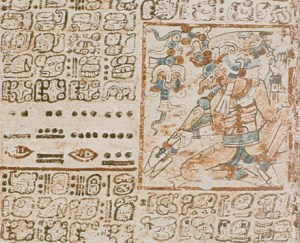 Is it the end? People are rushing to stores stocking up on bottled water and the necessities, preparing for the latest “end” which our world will endure. We’ve endured a few just this year. Some are now saying that the Mayan Calendar counts down to December 21, 2012 and that this was their prediction of the end of the world. The Mayans were extremely accurate in their calendar, so some people are thinking maybe they knew something we do not.
It just so happens that one of my random interests for quite some time has been ancient Mesoamerican history. I love reading about the Maya, Aztec, Inca, and Olmec cultures. Here, I’ll be drawing on those years of study (I am no expert–please don’t get me wrong here) along with my thoughts on Christian eschatology to provide a discussion of the latest “end of the world.”
The Mayans
Cultural Understanding
People often talk about the Mayan Calendar without placing it in its cultural context. The Ancient Maya were a very advanced people. It is easy to think that the people who inhabited ancient South America were a bunch of paganistic simpletons who knew little of the goings on in the world until a boat of enlightened Europeans showed up and taught them better. Such a view is, of course, extremely Eurocentric, and I would suggest it is also betrays a certain lack of knowledge over what it means to be an advanced civilization. The Maya certainly fill that role well, albeit with different types of advancement.
One could argue that the differences in advancements was due, in part, to the radically different worldviews operating in independent spheres of influence. The values of European cultures were shaped by the Christian worldview, and so their concepts of what was important were very divergent from that of the polytheistic Maya. Indeed, this could account for a number of the extreme differences in practical areas, such as the differences in military technology, and of course in the development of religious doctrine. The Maya were not, as some have argued in the past, necessarily a bunch of noble people. Their artwork portraying their religious ceremonies and conquests makes this explicit, with all kinds of atrocities being glorified through their art. An extended comparison of the development of Western and pre-Columbian societies would be fascinating but it is beyond the realm of my discussion here. My point is that the ancient Maya were a very different people and culture from our own.
Why emphasize this point? Well, for one, because the interpretations which have been given to the Mayan Calendar have largely been using a western view of meaning for calendars, dates, and events to interpret a distinctly non-western culture’s apparatus for interacting with reality. The Mayan Calendar is not some construct in a void to be interpreted by various persons from whatever presuppositional strata in which they operate. No, it must be placed within its cultural context in order to even begin to understand what it means that the calendar should have an end.
The Mayan Calendar
Robert Sharer and Loa Traxler discuss the Mayan Calendar extensively in their monumental work, The Ancient Maya
Sharer and Traxler note that:
We take for granted the need to have a fixed point from which to count chronological records, but the ancient Maya seem to have been the only pre-Columbian society to use this basic concept. Different societies select different events as a starting point for their calendars. Our Western chronology, the Gregorian calendar, begins with the traditional year for the birth of Christ. (110, cited below)
The Mayan calendar, on the other hand, uses the end of the last “great cycle” as their starting point for the calendar. They measure something called “The Long Count” which is an extended way to determine a great cycle of 13 “bak’tuns” which are each periods of about 5,128 solar years (110). The previous long count had ended in 3114 BC, and that was the date the Mayans held “established the time of the creation of the current world” (110). And yes, the current “Long Count” will be ending December 21, 2012. What does this mean?
The calendar was not just used for chronology, but rather served more uses, such as divination. Sharer and Traxler note that the calendar was “a source of great power” in the Maya society (102). The Long Count “functioned as an absolute chronology by tracking the number of days elapsed from a zero date to reach a given day recorded by these lesser cycles” (104). Thus, the Long Count served to place the entire calendar cycle into a context: it established a measurable starting point and ending point for their calendar, which was itself extremely accurate due to its use of various astronomical measurements.
The Mayan Calendar shares one distinctive with that of the other Mesoamerican societies, namely, the use of a 52 year cycle. This cycle was celebrated as the end of the world by the Aztecs. The close of one of these 52 year periods literally meant that “the world would come to an end” (107). Yet this end of the world, which happened every 52 years, was not something feared, but rather celebrated due to the dawn of a new Sacred Fire, “the gods had given the world another 52-year lease on life” (107).
We thus have two possible ways to interpret the end of the Mayan Calendar. First, we can see it as simply the terminus of 13 bak’tuns and the end of the unit of measurement of absolute time, which would simply inaugurate the beginning of another cycle of 13 bak’tuns. Second, we can extrapolate from the cultural context that perhaps each terminus of this cycle would be anticipated as the beginning of another “lease on life.” But this is of the utmost importance: neither interpretation suggests some kind of cataclysmic ending of the space-time universe. To call the Mayan Calendar a “prophecy” of endtimes is nothing more than sensationalism. What cause is there to fear this?
 The End of the World
Christians know that the end will come. However, this should not be surprising to anyone with knowledge of astronomy and physics. Indeed, our universe is ticking down to a cosmic heat death. Our universe itself will end. The energy will disperse, the stars will burn out, and all that will be left will be hulks of matter strewn about an ever-expanding galaxy. Or, perhaps there will be a “great crunch”–something I admit I am highly skeptical about–which will lead to an explosion of a new universe. But Christians have a unique perspective on the end of the world.
…[C]oncerning that day and hour no one knows, not even the angels of heaven, nor the Son, but the Father only. Matthew 24:36a.
First, no one will know when the end is come. The end is coming, but it will be like a thief in the night. Jesus tells us that it will be like in the days of Noah, where people continued to live their lives despite the impending doom.
Second, the Christian expects God to be the one to usher in this end. The end will be a new creation. Tears will be wiped away (Revelation 21:4) and creation will be restored. Unfortunately, some Christians have taken this to mean the utter annihilation of all things in the spatio-temporal universe. These Christians will sometimes have a dismissive attitude over the stewardship of the earth. After all, they argue, this universe will be utterly destroyed and we will have a perfect one made for us. Why bother conserving resources? This attitude is simply wrong, and as I have noted elsewhere, we are called to care for creation, something which evangelicals who disagree on certain topics unanimously affirm.
As Christians we are called to always be ready for Christ’s triumphant return. But that preparation does not mean being fearful of every end-time “prophecy.” Indeed, Jesus tells us that many will say the end has come but they are false prophets (Matthew 7:15; 24:4-5; 24:10-11; Luke 21:8; Mark 13:21-23). No, the preparation is the call to make disciples of all nations and to care for those in need.
We will endure another “end of the world” on the 21st of this year. Let’s take the time to reflect on what our Lord tells us in His Word. We do not know how or when, but God knows. We do not know the day or the hour, but God knows. God will take care of us. Let us thank Him.
Links
December 22nd, 2012– A poignant comic which speaks to the reality of what will happen on December 22, 2012.
Caring for Creation: A discussion among evangelicals– Creation care is an issue highly intertwined with eschatology. Here, I review an extremely thought-provoking panel discussion I attended at the Evangelical Theological Society conference in 2012. Climate change, endtimes, and Christianity and science are just a few related issues.
Cormac McCarthy’s Secular Apocalypse– An insightful post which reflects on Cormac McCarthy’s “The Road” and contrasts its vision of the apocalypse with the Christian worldview.
The End of it All…– I reflect on another failed end-time prophecy, this time from one who tried to use the Bible to make the prediction.
Source
Robert Sharer with Loa Traxler, The Ancient Maya
Image Credit
2012 Doomsday Myths Debunked– National Geographic.
SDG.
——
The preceding post is the property of J.W. Wartick (apart from citations, which are the property of their respective owners, and works of art as credited) and should not be reproduced in part or in whole without the expressed consent of the author. All content on this site is the property of J.W. Wartick and is made available for individual and personal usage. If you cite from these documents, whether for personal or professional purposes, please give appropriate citation with both the name of the author (J.W. Wartick) and a link to the original URL. If you’d like to repost a post, you may do so, provided you show less than half of the original post on your own site and link to the original post for the rest. You must also appropriately cite the post as noted above. This blog is protected by Creative Commons licensing. By viewing any part of this site, you are agreeing to this usage policy.
Who Interprets Scripture? Sola Scriptura, the Reformation, and the modern era: Reformation Review
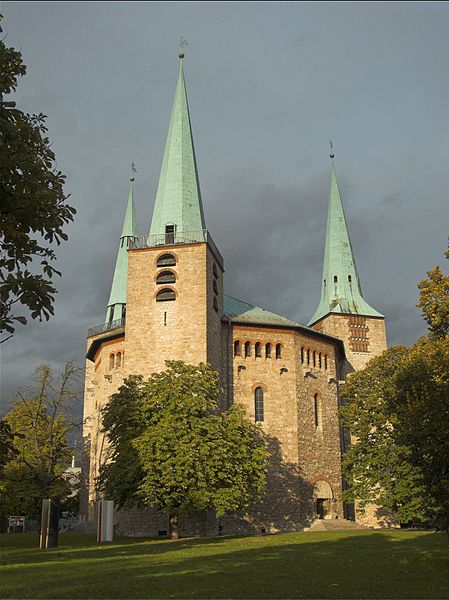 Theological debates raged throughout the period of the Reformation. These debates were about who had the right to interpret Scripture, what was the nature of salvation, who had authority in the church, and the like. Sound familiar? It should. Many of the debates that were central to the reformers are still in our purview today. Central to several of these debates focused upon the interpretation of Scripture.
Sola Scriptura: Two difficulties
The Reformers operated under the ideal of sola scriptura. The term literally means “scripture alone.” The notion seems simple enough: when it comes to doctrine, practice, and belief, the church universal is to be guided by Scripture alone. Yet it quickly became apparent during the Reformation era that things were not quite so simple.
First, sola scriptura was largely founded upon the notion that any Christian could read and understand Scripture. Yet, as became clear due to the fierce debates of the meaning of the Sacraments (i.e. the debate between Luther and Zwingli on the “real presence” in the Lord’s Supper), it seemed that on some things, Scripture wasn’t so simple (McGrath a, Reformation Thought: An Introduction
Second, Anabaptists and others argued that sola scriptura meant that every single individual Christian could read and understand the Bible for themselves. How was this problematic? Well, if every Christian could understand every part of the Bible, then there was no way to arbitrate between differing interpretations of soteriology (doctrine of salvation), eschatology (doctrine of the end times), and the like. Of course, not all of these interpretations could be correct, and if those who had argued for the individualism of Scriptural interpretation were correct, then they could all be right, in some sense. Furthermore, the issue was exacerbated in that because no one had the authority to proclaim what doctrines were correct, the church began to increasingly split to the point that “the radical Reformation was not a unified movement, but rather a chorus of protest against the clergy, secular authorities, and Reformers such as Luther and Zwingli. It was a reservoir for uncompromising protest that could well up in the most varied social circles… ‘Within the turmoiled flood of radical reform or restitution the fresh vitalities of the Reformation… were borne along swiftly to radical extremes'” (Carter Lindberg, The European Reformations
Limiting Perspicuity
The solution to the first problem was simply to concede that, on at least some issues, Scripture was not crystal clear. On at least certain points, the magisterial reformers “had conceded that Scripture is obscure” (McGrath a, 108). There was genuine disagreement over some issues. However, not all agreed with this conclusion, and some still pressed that all of Scripture was indeed clear. Such an argument tied into the second problem the Reformers had to confront in relation to sola scriptura: who has the right interpretation?
 Which Interpretation? Tradition’s Importance
Tradition played an important role in determining how the interpretation of Scripture was to be undertaken. During the Medieval period, a number of developments in hermeneutics laid the groundwork for the various interpretive methods utilized in the Reformation (McGrath b, 148ff). There were three primary views which emerged during the Reformation.
First, there was the position that “there is no place for tradition in the interpretation of the Bible. Every individual or community is free to interpret the Bible without reference to the Christian past” (McGrath a, 100). Such a position was part of the Radical Reformation and led to innumerable differing interpretations of Scripture. Of course, this was the group of reformers which applied sola scriptura most consistently. They took the principle literally and only allowed the Bible to be authoritative. However, with no way to arbitrate between differing doctrines, it seemed that such a position was incapable of standing up to scrutiny. All it could allow for was rampant individualism.
Second, there was the position that tradition was “an additional mode of divine revelation, in which information that was not committed to writing in the Bible was passed down…” (McGrath a, 100). The Roman Catholic church endorsed this position. However, it did not become popular with the reformers at all.
Instead, the Reformers developed a third position, one which stood as a middle way between the extremes of enshrining tradition and rejecting it outright. On this position, “Tradition designates a traditional way of interpreting a biblical text, which does not displace the text” (McGrath a, 100). Tradition therefore does not become an independent source of authority, but rather a way of interpreting the authority–Scripture–in an authoritative manner. By using tradition in this manner, the Reformers avoided the individualism of rejecting tradition, while also avoiding the error of raising tradition to the same level of importance as Scripture.
The third way was developed largely in the Reformed and Lutheran traditions, but it had its core in the historic Christian Creeds. Within the Lutheran tradition, the Apostles’; Nicene; and Athanasian Creeds were taken as theological foundations, and the Augsburg Confession and the later Book of Concord (which drew together several other confessions of the Lutheran faith) became the interpretive lens through which the Lutheran church would view Scripture and right doctrine.
Modern Theology, Reformation Problems
The discussions which occurred in the Reformation on the nature of sola scriptura, tradition, and the interpretation of Scripture had their origins in the past, and they continue into today. Some continue to insist that anyone can read the Bible and understand it in its entirety.
Against those who argue against their position, they insist that they themselves are just reading what the Bible says. This can be seen in a number of debates in Christian theology. It seems the best response to those who wield the ‘perspicuity of Scripture’ as a weapon against alternatives to their own doctrine have no alternative against those who disagree other than going back and forth claiming their own interpretation is correct and/or more clear.
The example I most often like to use is the book of Revelation and eschatology. Someone who claims the perspicuity of Scripture applies to the whole of Scriptural teaching must claim, in order to be consistent, that these doctrines are clear. Thus, such a person must maintain that every single verse in Revelation can simply be read by anyone and understood.
To be frank, I find this absurd. The extreme diversity of people’s interpretations of Revelation seem to undermine the notion that every passage in Scripture is clear. Furthermore–as has already been noted–those who hold to this radically individualistic position of Scripture have no way to decide between differing interpretations of Scripture. They are thus left with no way to determine any doctrine, whether it is radically opposed to Christianity or not, is heretical. Thus, one who holds this position cannot condemn modalism, as long as the person arguing for it is only using the Bible. After all, Scripture is clear! Everyone can read it. Therefore, it seems that this debate which continues to rage on from the Reformation must end. In order to avoid the mire of wanton individualism, we must have some principles for interpretation.
Another major issue of contemporary debate is that of Creeds and “paper popes.” Often, for example, the Lutheran Church is accused of utilizing the Book of Concord as a “paper pope”–a book which acts as an infallible interpreter of Scripture. Similarly, some argue that the historical Christian creeds are not Scripture and therefore must not be affirmed: again, sola scriptura.
It may be helpful to see this as a case study: in Lutheran circles, there is a debate over whether one must agree with the Book of Concord (the Lutheran Confessions) because it agrees with Scripture or insofar as it agrees with Scripture. Note the very important difference. If one says it is “because,” one is affirming that the Book of Concord is the correct intepretation of every relevant passage of Scripture. If one affirms that it is “insofar as,” one is admitting that there may be error in that interpretation. From a Lutheran perspective, this debate is hard to resolve. I tend to line up on the latter (insofar as) view.
However, it is clear that once one takes that position, one must lean more towards individualism. Again: how does one arbitrate doctrine if one does not adhere to any kind of authoritative statement on doctrine? It seems to me that one must at least hold that God has the power to transmit His teaching truthfully, and that’s why the historical Christian Creeds are vastly important. There must be a line drawn somewhere, but people may ever debate where to draw that line.
The key is perhaps found in Scripture itself, in which Christians are instructed not to continue arguments needlessly nor to focus upon topics which will create division (1 Corinthians 1:10ff; Ephesians 4:1ff). These teachings do not, however, preclude division nor do they allow for rampant individualism. It seems to me, therefore, that by adhering to the ecumenical council’s teaching–specifically, the creeds–as drawing out the right teachings of the church, we can avoid some of the great difficulties illustrated above. That’s why I would focus upon the Creeds which were drawn from those councils (like the Apostles’, and Nicene Creeds) as the sources of authoritatively governing Christian interpretations on those topics.
Conclusion
Many theological questions that are in play today have their origins in various aspects of Reformation thought, which themselves have their origins in earlier Christian thought. The issue of the perspicuity of Scripture, it seems to me, must be limited to that of soteriology and perhaps a few other core issues. On who has the authority to interpret Scripture, it seems that the Reformers offered a way forward: by agreeing to submit to the authority of ecumenical Creeds not as sources of their own authority but rather as authoritative interpretations of the Bible, Christians can proceed in their reading of Scripture and interpretations thereof through those lenses. Thus, the danger of individualism and endless division can be avoided.
Link(s)
I survey the origins of the Reformation.
Sources
Alister E. McGrath a, Reformation Thought: An Introduction
Alister E. McGrath b, The Intellectual Origins of the European Reformation
Carter Lindberg, The European Reformations
Thanks
Alister McGrath’s Reformation Thought: An Introduction was a gift from an anonymous donor. I was blown away when I saw it show up at my door and I have to say Thank you so much for being such a blessing! Whoever you are, you made my day. Well, more than just one day actually. This series of posts is a direct result of your donation. Thank you!
SDG.
——
The preceding post is the property of J.W. Wartick (apart from citations, which are the property of their respective owners, and works of art as credited) and should not be reproduced in part or in whole without the expressed consent of the author. All content on this site is the property of J.W. Wartick and is made available for individual and personal usage. If you cite from these documents, whether for personal or professional purposes, please give appropriate citation with both the name of the author (J.W. Wartick) and a link to the original URL. If you’d like to repost a post, you may do so, provided you show less than half of the original post on your own site and link to the original post for the rest. You must also appropriately cite the post as noted above. This blog is protected by Creative Commons licensing. By viewing any part of this site, you are agreeing to this usage policy.
The end of it all…
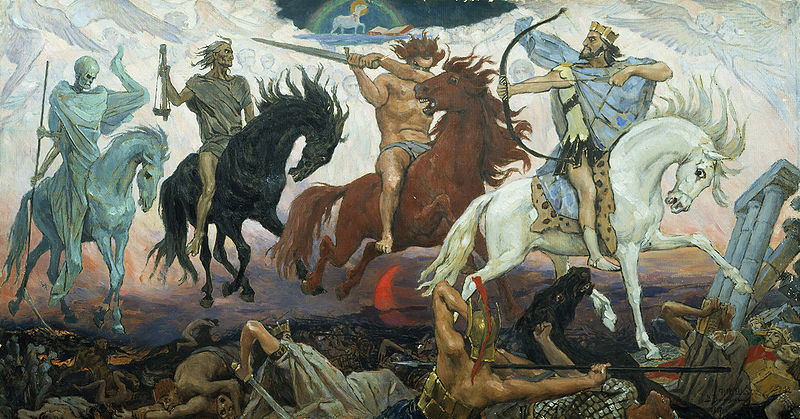 There’s a lot of confusion about endtimes in our world. It isn’t helped by the fact that there are false prophets springing up all around us, trying to tell us that which is to come. The recent controversy over Harold Camping’s prediction that the world would end on May 21st has me thinking about the study of end times (eschatology).
It’s an area I admit I haven’t studied much. The subject is confusing. There is a staggering array of views about what will happen in the end. The book of Revelation, from which we draw much of our knowledge over what will happen in the end times, can be greatly confusing to both the uninitiated and the scholar.
There are two major themes upon which I’d like to focus: knowledge of the end and our behavior at the end.
1) Knowledge of the end
Thinking about the apocalypse–the end of the world–is a tough issue. Like I said, there is a lot of diversity on the subject. As such, it is important for Christians to look to the Bible to see what we can know about the end. The key is to remember that must always go back to the Bible to see what it says about a subject before we believe what someone tells us it may say.
We are warned by Jesus in Matthew that there will arise false prophets (Matthew 24:24). Harold Camping is one such false prophet. He has distorted the truth of Scripture to gain followers.
Perhaps the most telling verse in the Bible which speaks against us being able to know when the end will come is Matthew 24:36, in which Jesus Himself says “But about that day or hour no one knows, not even the angels in heaven, nor the Son, but only the Father.” If that’s true, then how would any other human know? Not even Christ, in his state of humiliation, could tell us when the last day would come!
The bottom line is that we can’t know and we won’t know when the last days have arrived–not until Jesus Himself is here.
2) Behavior at the end
Suppose for a moment we are at the last days; what should our attitude be? The resounding chorus in Scripture is that we should be diligent and ready, but we should continue to spread God’s Kingdom. Looking back at the Matthew 24 passage, Jesus tells us, ““Therefore keep watch, because you do not know on what day your Lord will come… Who then is the faithful and wise servant, whom the master has put in charge of the servants in his household to give them their food at the proper time? It will be good for that servant whose master finds him doing so when he returns” (24:42, 45-46).
So our attitude should be one of the watchful servant: ready for Christ to come, but not letting that distract us from the work He has given us. Rather than put up billboards and go around telling everyone the end is nigh, our task is to continue what should be our “business as usual”–spreading the Word, taking care of the needy, and living our lives as Christians.
Conclusion
It is easy to get caught up in the “end times” controversies. I admit that often when I hear of such predictions, I am more diligent than usual in remembering to repent of my sins. But what does that tell me? It tells me that I need to be more diligent about that at all times. For we need to be ready when Christ does come. A life of readiness for Christ means a life of spreading the Good News about Him to all people. It means living a life of repentance and reconciliation to God. We may not know when the end will come, but it is coming–and we will experience it either in this life or the next.
SDG.
Links
Check out this blog post by Austin which discusses the Camping controversy: here.
News article discussing Camping’s befuddlement about his failure: here.
Image: “Four Horsemen of the Apocalypse” by Viktor Vasnetsov, 1887.
——
The preceding post is the property of J.W. Wartick (apart from citations, which are the property of their respective owners) and should not be reproduced in part or in whole without the expressed consent of the author. All content on this site is the property of J.W. Wartick and is made available for individual and personal usage. If you cite from these documents, whether for personal or professional purposes, please give appropriate citation with both the name of the author (J.W. Wartick) and a link to the original URL. This blog is protected by Creative Commons licensing. By viewing any part of this site, you are agreeing to this usage policy.

 J.W. Wartick - Reconstructing Faith