evidential apologetics
John Warwick Montgomery (1931-2024)
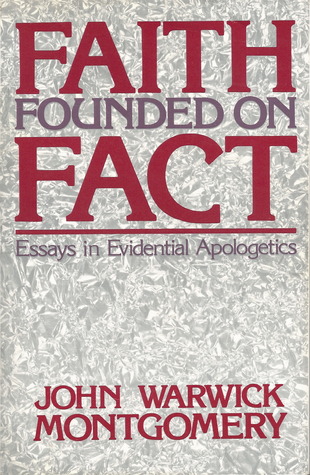
John Warwick Montgomery died on September 25, 2024. John Warwick Montgomery is the most well known apologist from Lutheran circles in decades. From within the Lutheran Church-Missouri Synod, he fought not just external threats to apologetics, but also internal ones. As a Lutheran, he was forced by turns to defend even the prospect of apologetics from those who would lean towards fideism or some form of Lutheran irrationalism.
Montgomery was highly prominent in discussions about apologetic method. When the presuppositional method arose within Reformed circles, Montgomery was perhaps its most vocal and engaging critic. His famous (or infamous, depending on one’s stance) essay “Once Upon an A Priori” used fables to engage with presuppositional method and showed that the method would likely collapse under its own arguments when faced with an equally staunch presuppositionalist from another faith tradition. He wrote quite a bit in defense of evidentialist apologetics, and generally believed and argued that the Resurrection was historical fact and can and should be investigated as such.
Inerrancy was another of Montgomery’s pillars of argument. He argued against positions which would qualify inerrancy more, and attempted to defend it within the Lutheran tradition. He argued against other Lutherans who left his own denomination, asserting that their changed stance on inerrancy was the “fuzzification” of inerrancy to the point at which it would become unrecognizable as such. Indeed, I find his arguments to that effect fairly convincing, and that is part of the reason I don’t hold to inerrancy; it simply does not work with how the Bible was written. Montgomery would vociferously disagree, but I’m thankful to him for clarifying quite adroitly how qualifying a position like inerrancy begins to make it difficult to pin down.
Montgomery was a lawyer as well. He wrote on a vast range of topics, from law to demonology, from apologetics to historiography. His texts show a man whose mind was capable of absorbing and expanding on countless theologically-inclined topics in ways that, if they didn’t reflect particular expertise, still would show a general grasp of the topic and drive engagement with it. I have read and re-read some of his books to the point where covers are beginning to fall off. It’s often popular to read only those with whom one agrees, or to read one with whom one disagrees only to challenge and condemn. Montgomery, for me, is a constant challenging duelist. Where I disagree, I continue to find reading his works fruitful and challenging. Where I agree, I find pleasure in seeing his defense ably lay out points of impact.

I had the pleasure of meeting him at a conference in 2012. He was friendly and vivacious. The lecture he gave on religious conversion was fascinating to me at the time. I wrote up the lecture notes for a blog post here, and he sent me an email about my post, apparently thinking I had simply re-posted his lecture. He wrote, “Can you inform me as to where you obtained it and whose permission you obtained for doing so? I am willing to have you retain it on your website–but I need to know your source for posting it.” I wrote him back, explaining I had based my post upon my own notes based upon his lecture. His response was gracious, and to the point, thanking me for my detailed response and exposition of his lecture. It was my last interaction with him–I wish I’d had the courage to e-mail him again later.
Montgomery’s voice will be missed. He was an able defender of his positions and his mind wriggled into the logical holes in others’ positions in ways that made it uncomfortable to disagree with him. I admire the man, and I hope to see him in the hereafter.
SDG.
Links
John Warwick Montgomery– See all my posts tagged about John Warwick Montgomery (scroll down for more).
——
The preceding post is the property of J.W. Wartick (apart from quotations, which are the property of their respective owners, and works of art as credited; images are often freely available to the public and J.W. Wartick makes no claims of owning rights to the images unless he makes that explicit) and should not be reproduced in part or in whole without the expressed consent of the author. All content on this site is the property of J.W. Wartick and is made available for individual and personal usage. If you cite from these documents, whether for personal or professional purposes, please give appropriate citation with both the name of the author (J.W. Wartick) and a link to the original URL. If you’d like to repost a post, you may do so, provided you show less than half of the original post on your own site and link to the original post for the rest. You must also appropriately cite the post as noted above. This blog is protected by Creative Commons licensing. By viewing any part of this site, you are agreeing to this usage policy.
Book Review: “Faith Founded on Fact” by John Warwick Montgomery
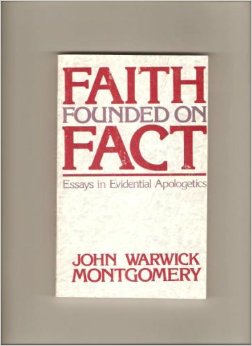 John Warwick Montgomery (hereafter JWM) is about as evidentialist as they come, and Faith Founded on Fact: Essays in Evidential Apologetics
Central to JWM’s apologetic methodology is the notion that one need not presuppose the truth of the Bible in order to defend it. For him, one may make the appeal to the skeptic by going to the skeptic and battling their reasoning on their own grounds. He states his thesis succinctly:
Few non-Christians will be impressed by arguments… in which the Christian stacks the deck by first defining ‘rationality’ and ‘internal consistency’ in terms of the content of his own revelational position and then judges all other positions by that self-serving criterion. (xix, cited below)
JWM surveys various attacks on the practice of evidential apologetics and argues that they fail (28ff). Although he deals with various liberal objections to apologetics, the core of his concern is for the objections raised by those who feel as though the evidentialist approach does injustice to faith. In response, he notes that any approach which removes Jesus from historical investigation–from hard evidence capable of being explored by all–reduces Him to a “historical phantasm” and does injustice to the reality of the incarnation (34-35).
The possibility of miracles and the argument of Hume engages in “circular reasoning” for Hume’s argument relies upon “unalterable experience” which is, of course his own experience and that of those who agree with him. Moreover, the definition of miracle has been slanted in such a way as to make it either irrelevant or beyond the realm of evidence by various parties (46ff). A case study of the miracle of the resurrection provides proof that miracles may be examined with an evidentialist mentality, for any who wish to deny the notion must relegate history to a place which may never be accessed through evidence (56ff).
JWM analyzes Muslim apologetics and concludes that it provides a number of lessons for Christian apologetists. Among these is the notion that merely showing the falsity of other religions is not enough for an evidential defense (93-94), the notion that “no religion is deducible from self-evident a prioris…” (97), and mere appeal to “try out” a religion is not enough to establish its credibility (98).
One of JWM’s most famous (or infamous, depending upon your view) essays is “Once Upon an A Priori,” in which he launched a broad-spectrum attack on presuppositional apologetics as a methodology. In this essay, JWM argues that when one suggests there is no neutral epistemic ground between two positions whatsoever–as presuppositional apologists do–“Neither viewpoint can prevail, since by definition all appeal to neutral evidencve is eliminated” (115). Because there are no neutral facts, there can be no appeal to facts to make one’s case; instead, all one is able to do is argue in circles against each other… “appeal to common facts is the only preservative against philosophical solipsism and religious anarchy…” (119). Instead, Christians must, like Paul, “become all things to all” people (122) in order to make the case for Christianity.
The practice of apologetics, for JWM, is intended to break down the barriers to belief. But the evidences are so strong that they obligate belief in Christian theism. However, the work of the Spirit is the work of conversion. The “evidential facts are God’s work, and the sinner’s personal acceptance of them… is entirely the product of the Holy Spirit” (150).
After an essay appealing to Christians to continue to use mass communication to spread the Word, JWM turns to “The Fuzzification of Biblical Inerrancy.” By “fuzzification,” he means (following James Boren), “the presentation of a matter in terms that permit adjustive interpretation” (217). In its application to inerrancy, it means the constant adjustment of inerrancy to make it invulnerable to attack in often ad hoc ways. What one is left with is “inerrancy devoid of meaningful content…” (223). In order to combat this, JWM suggests explicit definitions of terms such that one has a firm grasp upon what is meant by inerrancy, rather than a constant modification of the term and meaning.
There are a few areas of disagreement I would express with JWM’s theses. First, his apparent dismissal of the practice of taking the “falsity of one religion” as proof of another (93-94). He is correct in that the falsity of any given religion does not entail the truth of any other one. However, it seems to be the case that the falsity of any one religion does entail that any which have not been proven false are inherently more probable. Second, I think his reaction against presuppositionalism has led him to reject all of its tenets a bit too vehemently. For example, it seems to me that in his rejection of the notion there can be “no neutral ground” he also seems to jettison the notion that facts are interpreted no matter what the facts are. However, at times it is difficult to distinguish whether he is making a statement in a vaccuum or against a context. In relation to “facts,” he clearly holds the facts are determinative enough to demonstrate Christianity; but he also holds that people will not accept said facts other than through God’s action. Thus, perhaps the gulf between his position and that which he rejects is not so wide.
These disagreements aside, I also have enormous respect for and agreement with much of the content of Faith Founded on Fact. JWM effectively disposed of any apologetic method which inherently ignores the value of evidentialist reasoning, and he did so through not only apologetic but also theological reasons (i.e. it turns Christ into an “historical phantasm”). Moreover, his critique of presuppositional methodology–though at times off base (as noted above), does not entirely miss the mark. In particular, his critique that presuppositionalism voids any kind of objective method for determining facts is troubling for those who have presuppositional tendencies (readers should note that I myself think presuppositionalism has some merit–see my posts on the topic).
Faith Founded on Fact, put simply, is fantastic. In this review, I have only surveyed a small number of the areas I found to be of note throughout the work. JWM is witty and clever as usual, but he also raises an enormous number of points to reflect upon whether one agrees with his views or not. He offers a number of ways to approach apologetics from an evidentialist perspective, while also offering some devastating critiques of those who would allege that evidentialism fails. The book is a must read for anyone interested in apologetics.
Links
“How Much Evidence to Justify Religious Conversion?” – John Warwick Montgomery on Conversion– I summarize and analyze an incredible lecture given by John Warwick Montgomery which I had the pleasure of attending at 2012’s Evangelical Theological Society Conference. JWM argues for an evidential view of religious conversion.
Be sure to check out the page for this site on Facebook and Twitter for discussion of posts, links to other pages of interest, random talk about theology/philosophy/apologetics/movies and more!
Source
John Warwick Montgomery, Faith Founded on Fact: Essays in Evidential Apologetics
SDG.
——
The preceding post is the property of J.W. Wartick (apart from quotations, which are the property of their respective owners, and works of art as credited; images are often freely available to the public and J.W. Wartick makes no claims of owning rights to the images unless he makes that explicit) and should not be reproduced in part or in whole without the expressed consent of the author. All content on this site is the property of J.W. Wartick and is made available for individual and personal usage. If you cite from these documents, whether for personal or professional purposes, please give appropriate citation with both the name of the author (J.W. Wartick) and a link to the original URL. If you’d like to repost a post, you may do so, provided you show less than half of the original post on your own site and link to the original post for the rest. You must also appropriately cite the post as noted above. This blog is protected by Creative Commons licensing. By viewing any part of this site, you are agreeing to this usage policy.
“How Much Evidence to Justify Religious Conversion?” – John Warwick Montgomery on Conversion
 I had the opportunity to hear John Warwick Montgomery speak at the Evangelical Theological/Philosophical Conference in 2012. He was one of the most engaging speakers I have ever had the pleasure of listening to. Here, we’ll look at his presentation alongside the journal article that he discussed. The topic was “How Much Evidence to Justify Religious Conversion?”*
Conversion and Evidence
Montgomery began by discussing the possibility of a position which had so much evidence that it becomes difficult to not believe it. Despite this, people do not hold that position. The reason, he argued, is because reasons other than evidence play into one’s conversion. Moreover, we live in a pluralistic age, which means that there are a vast array of options available to people looking for a worldview. This pluralism necessitates a drop in conversion rates because there are more worldviews presenting their evidence to each individual. Thus, it is important to look into the issue of the burden of proof alongside the issue of the standard of proof.
Burden and Standard of Proof
Here, Montgomery turned to his experience in law to explore the notion. Simply put, the burden of proof can also be seen as the burden of persuasion . Montgomery noted that the prosecutor does not always carry the burden of proof because the defendant often provides a positive defense, and so has their own burden of proof. For example, if someone says “I could not have done x because I was doing y at the same time at location z” then they have made a positive claim which itself requires a burden of proof. Or, as Montgomery put it, “The person who wants to make a case has the burden of proof.”
But it is important to note that the burden of proof is not the same thing as a standard of proof. When people object to Christianity based upon a supposed lack of proof, they are not addressing the burden of proof but rather the standard. Montgomery acknowledged that Christianity must assume the burden of proof but makes several points related to the standard of proof.
First, proof “depends on probability–not on absolute certainty or on mere possibility” (Montgomery, 452, cited below). He appealed to the “Federal Rules of Evidence” to make this clear. The key is to note that probability ,not absolute certainty, is at stake. Why? Epistemologically speaking, absolute certainty can only be set out in formal logic or mathematics. It is unjustifiable to require absolute certainty for every fact. “Where matters of fact are concerned–as in legal disputes, but also in the religious assertions of historic Christianity–claims can be vindicated only by way of evidential probability” (Ibid).
Second, and more importantly for the current discussion, there are differing standards of proof. The legal system is again a model for this notion. In criminal trials, there is a higher standard of proof than for civil matters. The criminal standard is beyond reasonable doubt, while the civil standard is “preponderence of evidence.” Montgomery argued that religious conversion should be seen as bearing a standard of proof “beyond a reasonable doubt” (453).
Third, competing religious claims must each assume their own burden of proof. They cannot simply say “prove my religious claim false.” One must meet the standard of proof in order to have legitimate entry into the competition between worldviews.
Extraordinary Claims Need Extraordinary Evidence?
Often, the claim is made that religious claims, because they are extraordinary, need extraordinary evidence. I have written on this exact topic at length elsewhere, but here will focus on Montgomery’s argument. He argued “The notion that the ‘subject matter’ should be allowed to cause a relaxation or an augmentation of the standard of proof is a very dangerous idea…. No one would rationally agree to a sliding evidence scale dependent on the monetary sum involved [in a crime]–nor should such a scale be created… The application to religious arguments based on the factuality of historical events should be obvious. Of course, the resurrection of Christ is of immensely more significance than Caesar’s crossing of the Rubicon, but the standards required to show that the one occurred are no different from those employed in establishing the other” (Ibid, 455-456).
The notion that the import of a claim makes a sliding scale of evidence is made to be absurd because historical events have more importance across cultures and so would, on such a view, be radically different in their acceptable standards of proof.
The Existential Factor
Finally, Montgomery focused on the existential side of conversion. Here, he offered what he admitted as a somewhat crude argument which was derived from Pascal’s wager. Assuming that the standard of proof is met for a religious system, one still must deal with the existential factors of conversion. Thus, Montgomery argued, one’s commitment to a truth claim should be weighed by the benefits divided by the entrance requirements: C=B/E.
Because the entrance requirements for Christianity are extremely low, and its benefits infinite, one should, assuming the standard of proof has been met, be highly committed to Christianity. Montgomery noted that some may argue the entrance requirements are very high (i.e. setting aside adulterous relationships). Against this, Montgomery argued that the benefits vastly outweigh the finite bliss one feels by such sinful actions.
Applications
The subtlety of Montgomery’s argument should not be missed. It has application in a number of areas. First, Montgomery is as thoroughgoing an evidentialist as they come. His argument about the standard of proof being probabilistic is unlikely to gain much credence among those who favor a presuppositional approach to apologetics.
Yet it seems to me that Montgomery’s argument in this regard is correct. We must take into account the evidence when we are looking at various religious claims, and also acknowledge the existential factors which play into conversion.
Montgomery’s argument does much to clarify the issue for apologists in general. Our task is to clear barriers and present convincing evidence to those who argue that Christianity has not met the standard of proof. But our task does not end with that; we must also present the existential challenge of Christianity to those who believe the standard of proof has been met. This includes the preaching of the Gospel.
Montgomery was also careful not to discount the Holy Spirit in religious conversion. He made it clear that he was speaking to the notion of conversion in the abstract. People must be renewed by the Holy Spirit; yet that renewal may come through evidence and standard of proof.
It seems to me that Montgomery’s arguments were insightful and sound. He presented an excellent way to look at religious claims and evaluate them in light of evidence, while also taking existential factors into account.
Links
Like this page on Facebook: J.W. Wartick – “Always Have a Reason”
Montgomery’s use of evidence in law to look at religious truth claims reminds me very much of J. Warner Wallace’s Cold Case Christianity. Check out my review of that fantastic book.
Extraordinary Claims need… what, exactly?– I argue that the claim that religious claims need extraordinary evidence is mistaken.
I have written about numerous other talks at the EPS Conference on an array of topics. Check them out:
Gregg Davidson vs. Andrew Snelling on the Age of the Earth– I write about a debate I attended on the age of the earth.
Caring for Creation: A dialogue among evangelicals– I discuss a lecture and panel discussion on caring for the environment.
Genetics and Bioethics: Enhancement or Therapy?– Here, I outline a fascinating talk I attended about gene enhancement and gene therapy.
You can read my overview of every single talk I attended: My Trip to the Evangelical Philosophical/Theological Society Conference 2012.
Sources
*Unless otherwise noted, the information herein was discussed in John Warwick Montgomery’s EPS 2012 Conference talk entitled “How Much Evidence to Justify Religious Conversion? Some Thoughts on Burden and Standard of Proof vis-a-vis Christian Commitment”
John Warwick Montgomery, “How Much Evidence to Justify Religious Conversion?” in Philosophia Christi 13, #1 2011, 449-460.
SDG.
——
The preceding post is the property of J.W. Wartick (apart from citations, which are the property of their respective owners, and works of art as credited) and should not be reproduced in part or in whole without the expressed consent of the author. All content on this site is the property of J.W. Wartick and is made available for individual and personal usage. If you cite from these documents, whether for personal or professional purposes, please give appropriate citation with both the name of the author (J.W. Wartick) and a link to the original URL. If you’d like to repost a post, you may do so, provided you show less than half of the original post on your own site and link to the original post for the rest. You must also appropriately cite the post as noted above. This blog is protected by Creative Commons licensing. By viewing any part of this site, you are agreeing to this usage policy.

 J.W. Wartick - Reconstructing Faith