exegesis
Review of “Love Wins” by Rob Bell: Chapter 4
 I have been reviewing Rob Bell’s book, Love Wins, with a particular interest in his theological views and how he argues for those views. I have not read the book before, so each review is fresh: I am writing these having just completed the chapter the post is on. This week, I look at Chapter 4: “Does God Get what God Wants?”
Chapter 4
Outline
Bell starts the chapter by surveying a number of statements from church’s web sites regarding hell. These statements range from the unsaved being separated from God forever to eternal conscious torment. He seems to be pointing readers towards a kind of discontinuity between these statements and the statements about God’s power and love:
I point out these parallel claims: that God is mighty, powerful, and “in control” and that millions of people will spend forever apart from this God… even though it’s written in the Bible that “God wants all people to be saved and to come to a knowledge of the truth” [1 Timothy 2:4- seems to be NIV]
…How great is God? Great enough to achieve what God sets out to do… but in this, the fate of billions of people, not totally great. Sort of great. A little great. (97-98)
Bell asks a poignant question: “Will all people be saved, or will God not get what God wants?” (98). He then goes through a number of verses focused around God’s love. He notes the parables in Luke 15 about people pursuing their desires and concludes, “The God that Jesus teaches us about doesn’t give up until everything that was lost is found. This God simply doesn’t give up. Ever” (101).
Bell turns to the reason that many people think God may fail in his desire to save everyone. From the perspective of those who advocate the views he outlined at the beginning of the chapter, “love, by its very nature, is freedom… God has to respect our freedom to choose to the very end” (103). However, Bell argues that “We aren’t fixed, static beings–we change and morph as life unfolds.”
Tied into this notion of the unfixed nature of our lives, he seems to hold that it is possible that people can choose to come to Christ after they die. He asks, “why limit that chance [the chance to come to Christ] to a one-off immediately after death? And so they expand the possibilities… [The chance is given for] as long as it takes, in other words” (106-107).
Bell then traces this notion through Clement of Alexandria, Origen, Gregory of Nyssa, and Eusebius. He goes so far as to cite Augustine saying “‘very many’ believed in the ultimate reconciliation of all people to God” (108).
He argues that “central to their trust that all would be reconciled was the belief that untold masses of people suffering forever doesn’t bring God glory” (ibid). Moreover, he argues that “At the center of the Christian tradition since the first church have been a number who insist that history is not tragic, hell is not forever…” (109). He notes that “serious, orthodox followers of Jesus have answered these questions [about hell and salvation] in a number of ways” (ibid).
Next, Bell turns to an analysis of the book of Revelation. he notes that the book ends with notion that the gates of the city “never shut” and infers that “gates are for keeping people in and keeping people out. If the gates are never shut, then people are free to come and go” (114-115).
Bell ends the chapter with what seems like a poetic inference. He goes into prose and concludes that: “[Love] always leaves room for the other to decide. God says yes, we can have what we want, because love wins” (119).
Analysis
There is much to discuss in this chapter. First, it is important to note that Bell has done much to cause reflection upon the subject of hell. It is something that we as a group of believers need to be thinking on. Too often, the subject is cast aside. Bell has done admirably in bringing the topic to the table.
Moreover, Bell is correct to note that confusion can be caused by simply throwing statements on hell “out there” in a void. It is important to contextualize statements about heaven and hell and make clear what is meant by the phrases that are used in the discussion.
Bell seemingly just assumes that there will be more chances to “accept Christ” in the afterlife. His discussion of the possibility of people changing after death implies this perspective, but he has done nothing to establish it. Perhaps he will do so in a later chapter, at which point we will evaluate his argument for that perspective. Indeed, thus far his argument seems to be a kind of straw man: he asserts the notion that people are changeable beings even in the afterlife as a counterpoint to those who hold that people will continue to choose evil in the hereafter as though this choice is the reason people hold to the eternal hell view. Yet this is not the case; many who hold this position do argue that people will continue to choose evil, but the reason that people are condemned to hell is because they rejected the God, whose existence and power are obvious (Romans 1) in their lives. No one has an excuse (Romans 1:20).
Bell’s utilization of church fathers is problematic. I can’t help but think there is a subtle twisting of some of their views to fit his position. In particular, he cites Augustine as “acknowledging” that “very many” believed in “ultimate reconciliation of all people” (107-108). Yet Augustine himself categorically denies and denounces this position. In fact, almost the entirety of Book XXI of The City of God
I hate to beat a dead horse here, but let’s look what Augustine says (The City of God
Origen was even more indulgent; for he believed that even the devil himself and his angels, after suffering those more severe and prolonged pains which their sins deserved, should be delivered from their torments, and associated with the holy angels. But the Church, not without reason, condemned him for this and other errors…
So we see that Augustine, far from being anywhere near Origen’s view on the topic, endorses the Church’s condemnation of Origen as a heretic in this regard. Yet where does Bell reveal this? Where does Bell interact with historical theology? No, he seems perfectly content to throw out a bunch of names out of context together and let readers make their own assumptions. I realize this is a popular level book, but I can’t help but be very worried about Bell’s style here. It is very misleading. Maybe he does note later in the book that Origen was condemned as a heretic for this view, and that Augustine endorses this condemnation, but considering Bell seemingly endorses Origen’s view, I very much doubt that he will reveal that it was condemned by the Church.
More damning is the fact that Bell is able to, seemingly seriously, say that “At the center of the Christian tradition since the first church have been a number who insist that history is not tragic, hell is not forever…” (109). I admit that I agree in one sense–there have been many universalists throughout church history. However, that view was condemned as heretical. Augustine upholds that condemnation in The City of God
Here again we see one of Bell’s biggest methodological problems: he simply introduces a notion, argues that there are diverse views, and then assumes that they are all equally legitimate. but this is simply mistaken. Multiplication of viewpoints does not mean they are equally valid. Furthermore, Bell’s lack of interaction with historical theology on this point, when he himself is the one who introduces several of the church fathers, is questionable at best. Moreover, he says these teachers were “orthodox” when in fact Origen specifically was far from orthodox in his beliefs, as even a cursory study of Origen would reveal. Origen lived at a time before certain views were made explicit, yes, so he in a sense gets a pass in that his theology was intentionally exploratory. However, many of his views were later condemned, including the one Bell endorses. For Bell to turn around and use Origen to support his diversity of orthodox views on the topic is seemingly dishonest.
Moreover, one must wonder about Bell’s analysis of the meaning of the gates of heaven as open. Instead of looking at this passage in context, in which the notion of a city with open gates would imply a city unthreatened by outsiders because all enemies were defeated (which fits much better into the book of Revelation), Bell states explicitly “If gates are never shut, then people are free to come and go” (115). Think on this for a moment. What Bell has stated here undermines the notion of security of salvation. Now I do not hold to the doctrine of eternal security; however, I do affirm that once people are saved and in the New Creation in heaven, they are not about to change their status. They aren’t “going” anywhere. Bell’s view here undermines the assurance of salvation. His view of “love winning” also serves to illustrate this point, for if there is “always room for the other to decide” we must ask: is there always room to choose hell? Can “love win” by letting us walk away from the eternal salvation we are promised in Christ?*
Conclusion
I admit I have been highly critical in this chapter. I have tried throughout so far to find positive things to say about Bell’s work, and as I noted, Bell does well in this chapter to center discussion around the hard questions.
However, there are numerous problems with Bell’s work in this chapter. His use of the church fathers is highly problematic. I won’t rehearse the arguments again (see above). Oddly, his view also seems to imply that we have absolute autonomy and the ability to simply walk out of heaven whenever we wish. That in itself is another great difficulty, for it undermines the assurance of salvation we have in Christ: “I give them eternal life, and they shall never perish; no one will snatch them out of my hand” (John 10:28).
Bell continues to use the method of argumentation in which he simply notes diverse views on a topic and concludes that all are somehow equally at the table or equally valid.
Next week, we will look at Chapter 5: Dying to Live.
*My thanks to my wife for this point.
Links
The book: Rob Bell, Love Wins
Review of “Love Wins” by Rob Bell: Preface and Chapter 1– I discuss the preface and chapter 1 of Love Wins.
Review of “Love Wins” by Rob Bell: Chapter 2– I review chapter 2.
Review of “Love Wins” by Rob Bell: Chapter 3– I look at Chapter 3: Hell.
Review of “Love Wins” by Rob Bell: Chapter 5– I analyze chapter 5.
Love Wins Critique– I found this to be a very informative series critiquing the book. For all the posts in the series, check out this post.
Should we condemn Rob Bell?– a pretty excellent response to Bell’s book and whether we should condemn different doctrines. Also check out his video on “Is Love Wins Biblical?“
Source
Rob Bell, Love Wins
SDG.
——
The preceding post is the property of J.W. Wartick (apart from citations, which are the property of their respective owners, and works of art as credited) and should not be reproduced in part or in whole without the expressed consent of the author. All content on this site is the property of J.W. Wartick and is made available for individual and personal usage. If you cite from these documents, whether for personal or professional purposes, please give appropriate citation with both the name of the author (J.W. Wartick) and a link to the original URL. If you’d like to repost a post, you may do so, provided you show less than half of the original post on your own site and link to the original post for the rest. You must also appropriately cite the post as noted above. This blog is protected by Creative Commons licensing. By viewing any part of this site, you are agreeing to this usage policy.
Book Review: “Understanding End Times Prophecy” by Paul Benware
 Understanding End Times Prophecy
Wait, What?
Yes, I just used the words dispensational premillenialism together in a sentence as though it made sense. It does. That is one of the many views Benware surveys in the book. Before reading Understanding End Times Prophecy (hereafter UEP), I admit I could not have distinguished a dispensational premillenialist from an amillenialist. Nor could I have identified a pre-wrath view in contrast with a post-wrath view. Benware’s book touches all of these and more, explaining the various positions out there on the various eschatological themes while also providing a thorough critique of those with which he disagrees.
Outline of Contents
Benware starts by outlining some principles for interpreting Biblical prophecy. Primary among these is the notion that prophetic passages must be interpreted literally. Benware explains: “Literal interpretation assumes that… [God] based His revelatory communication on the normal rules of human communication. Literal interpretation understands that in normal communication and in the Scriptures figures of speech are valuable as communication devices…” and it is therefore “not… a rigid ‘letterism’ or ‘mechanical understanding of the language’ that ignores symbols and figures” (23-24).
UEP then outlines a broad understanding of Biblical covenants, noting that the covenant God made with Abraham was unconditional, and so must be fulfilled.Next, Benware turns to a number of passages which outline the Palestinian, Davidic, and New Covenants. These he discusses in the context of promises God makes to Israel which must be fulfilled.
The next major section outlines the major views on the millennium. Benware favors the dispensational premillenial view and so spends some time outlining it.The dispensational view focuses on the covenants found throughout the Bible. It holds that there are different “economies” of God’s working. These dispensations are not time periods, nor are they different ways of salvation. Instead, they are specific truths about how God chooses to work with His people (86ff). This view also holds that God will fulfill promises through Israel as a literal nation in the place that God promised them (88ff).
The premillenial view holds that Christ returns before the millennial kingdom. It holds that the millennium is a literal thousand-year reign of Jesus on earth. Thus, there are two resurrections: first, before the millennial kingdom; second, after the millennial kingdom. Israel factors prominently into this view; Israel will be part of the thousand year reign and will occupy the land that God promised unconditionally to Abraham (94ff). Benware argues against the notion that Israel has become displaced or fulfilled in the church (103-120).
Then Benware turns to the view of amillenialism. Essentially, this view holds that the “millennium” is non-literal and is being fulfilled now during the church age. There is one resurrection, and the judgment comes immediately upon Christ’s return. Thus, the current period is the millennial kingdom (121-137).
Postmillenialism is the subject next discussed in UEP. This view tends to be tied into the notion that we are now living in the kingdom of God and so will usher in a golden age through social justice or action. After this undefined point, Christ will return to judge (139ff). Benware is highly critical of this view, noting that it relies upon the notion that we will continue improving the world (yet the world seems to be falling farther rather than progressing); as well as its rejection of the notion of a literal reign of Israel (150ff).
Finally, Benware evaluates preterism. Essentially, this view holds that the events prophesied in Revelation and elsewhere have either all or mostly been fulfilled already. There is much diversity within this perspective, but largely it is tied in with the notion that the destruction of the temple ushered in the end times (154ff).
The next major area of evaluation in UEP is that of the rapture. Benware analyzes pre-tribulation; post-tribulation; and other rapture views. Pre-tribulation is the view that the rapture will happen before the tribulation period. Post-tribulation is the view that the rapture happens after the tribulation. These directly tie into how one views the coming of Christ and the millennial kingdom (207ff).
Finally, UEP ends with outlines of the seventieth week of the book of Daniel, the Kingdom of God, death and the intermediate state, and the final eternal state. An enormous amount of exposition and discussion is tucked into these final chapters. For example, Benware includes a critique of annihilationism.
I have here only touched on the surface of UEP. Benware is exceedingly thorough and has managed to write an amazing resource on the issues related to End Times Prophecy.
Analysis
As has been noted, UEP is a simply fantastic resource for those who want to look at the various views which are discussed in contemporary evangelicalism. Benware has also provided an extremely detailed exposition of the dispensational premillenialist position. If someone wants to critique that view, UEP will be a book which they must reference. It is that good and that comprehensive.
Furthermore, Benware provides a number of excellent insights through the use of charts. Throughout UEP, there are charts scattered which summarize the content of what Benware argues, show pictorially what various views teach, and more. These charts will become handy for readers to reference later when they want to discuss the issues Benware raises. They also help interested readers learn what various views and positions teach.
Benware rightly shatters false notions that Biblical prophecy is some kind of indiscernible mystery language which humans weren’t meant to think on. His care for making clear what the Bible teaches on a number of issues is noteworthy.
Unfortunately, there are several areas in the book which are cause for caution. Benware’s use of proof texts is sometimes questionable. There is great merit to utilizing a series of related texts after an assertion in order to support one’s argument, but upon looking up several texts that Benware cites to make his points, it seems that he often stretched texts far out of their context or even cited texts which had nothing to do with the argument he made in the context in which he cited them. For just one example, Benware writes “The second phase of his [the Antichrist’s] careerwill take place during the first half of the tribulation… During his rise to power he will make enemies who will assassinate him near the midpoint of the tribulation (cf. Rev. 13:3, 12, 14). But much to the astonishment of the world, he is restored to life and becomes the object of worship (along with Satan)” (300). Note that Benware specifically says that the Antichrist will be assassinated and resurrected. Now, turn to the passages that Benware cites. Revelation 13:3, 12, and 14 state:
3: One of the heads of the beast seemed to have had a fatal wound, but the fatal wound had been healed. The whole world was filled with wonder and followed the beast… 12: It exercised all the authority of the first beast on its behalf, and made the earth and its inhabitants worship the first beast, whose fatal wound had been healed… 14: Because of the signs it was given power to perform on behalf of the first beast, it deceived the inhabitants of the earth. It ordered them to set up an image in honor of the beast who was wounded by the sword and yet lived. (NIV)
Now, where in this section does it say the Antichrist will be assassinated? Where in this section does it talk about the Antichrist dying and being raised to life? Strangely, Benware seems to reject the literal hermeneutic he advocates, and begins to interpret texts in ways that bend them to the breaking point.
The issue of these proof texts opens a broader critique of UEP. Benware constantly insists upon a literal reading of Revelation and other prophetic texts, while also criticizing those who hold other views of using an inconsistent hermeneutic. Yet, as I believe I demonstrated above, Benware often goes well beyond the literal meaning of the texts and comes to conclusions which stretch them past literal readings. In fact, it seems that Benware balances an often literalistic reading of the text with a non-literal reading. Thus, Benware seems to fall victim to the very error he accuses all other positions of falling into.
An overall critique of the position Benware holds would take far too much space and time for this reader to dedicate in this review, but I would note that the conclusions Benware comes to are often the result of the combination of literalistic readings and/or taking texts beyond what they say that I noted above. Some of the worrisome issues include the notion that the sacrificial system will be reinstated (334ff); a view in which the notion that the church seems in no way fulfill the Biblical prophecies about Israel (103ff); hyper-anthropomorphism of spiritual beings (i.e. demons, which are spiritual beings, being physically restricted [130]); and the insistence on literalizing all numbers in the Bible (168), among issues. It’s not that Benware doesn’t argue for these points; instead, it was that it seems his method to get his conclusions was sometimes faulty, and the case not infrequently was overstated.
One minor issue is Benware’s use of citations. It’s not that he fails to cite sources; rather, the difficulty is that he inconsistently tells the reader where the source is from. Very often Benware block quotes another text (with proper end note citation) without letting the reader know who or what he is quoting. Although this may be better for readers only interested in the argument, it can be very frustrating for those interested in knowing where Benware is getting his information to have to flip to the back of the book all the time to trace down sources. The problem is compounded by the fact that sometimes he does tell the reader where the quote is from (for example, he’ll write “so-and-so argues [quote]”) while at other times he just dives directly into the quote. The inconsistent application here may be a minor problem, but it did cause major frustration through my reading of the text.
Conclusion
Understanding End Times Prophecy
Source
Paul Beware Understanding End Times Prophecy
Disclaimer: I was provided a review copy of this book by the publisher My thanks to Moody Books for the opportunity to review the book..
SDG.
——
The preceding post is the property of J.W. Wartick (apart from citations, which are the property of their respective owners, and works of art as credited) and should not be reproduced in part or in whole without the expressed consent of the author. All content on this site is the property of J.W. Wartick and is made available for individual and personal usage. If you cite from these documents, whether for personal or professional purposes, please give appropriate citation with both the name of the author (J.W. Wartick) and a link to the original URL. If you’d like to repost a post, you may do so, provided you show less than half of the original post on your own site and link to the original post for the rest. You must also appropriately cite the post as noted above. This blog is protected by Creative Commons licensing. By viewing any part of this site, you are agreeing to this usage policy.
Review of “Love Wins” by Rob Bell: Chapter 3
I have been reviewing Rob Bell’s book, Love Wins, with a particular eye towards evaluating not only his arguments, when they are made, but also the way he makes those arguments. I have not read the book before, so each review is fresh: I am writing these having just completed the chapter the post is on. Here, I’ll go over Chapter 3: Hell. First, I will outline the chapter, then I will analyze its content. Be sure to check the end of the posts to links for the other posts in this series, as well as a few other links.
Chapter 3: Hell
Outline
Rob Bell begins his discussion of hell by framing it around this issue: “God is loving and kind and full of grace and mercy–unless there isn’t confession and repentance and salvation in this lifetime, at which point God punishes forever. That’s the Christian story, right? Is that what Jesus taught?” (64). In order to answer this question, Bell says, he will show “every single verse in the Bible in which we find the actual word, ‘hell'” (ibid).
In order to do this, he first turns to the Hebrew Scriptures. As he explores these passages, Bell concludes that God has power over life and death and that God is present and involved in life after death. However, the words “life” and “death” have different meaning for the Hebrew Scriptures than we give them, argues Bell. Instead of some kind of fixed point of either being alive or dead, Bell notes that they view life and death as “two ways of being alive” (66). To conclude with his discussion of the Old Testament, Bell sums up: “simply put, the Hebrew commentary on what happens after a person dies isn’t very articulated or defined” (67).
Then, Bell turns to the New Testament. Here, he notes that the word for hell was often “Gehenna,” which in Jesus’ day was a fiery garbage dump (68). Bell skims through a few passages here, simply quoting individual sentences without context. Then he evaluates a few verses related to “Hades,” which Bell argues is “essentially the Greek version of… “Sheol” (69).
Then, Bell turns to a number of stories about using strong language to describe human suffering, with examples from Rwanda, as well as rape, divorce, adultery, etc. Next, he turns to an analysis of Luke 16:19-31, the story of Lazarus and the rich man. He makes much of the notion that the rich man is still alive in the fire, and that he still expects Lazarus to serve him (74ff). His analysis of this story ends with his conclusion: “He [the rich man] fails to love his neighbor… It’s a story about individual sin, but that individual sin leads directly to very real suffering at a societal level. If enough rich men treated enough Lazaruses outside their gates like that, that could conceivably lead to a widening gap between the rich and the poor” (78).
Because of this analysis, Bell argues that “What we see in Jesus’ story… is an affirmation that there are all kinds of hells… There are individual hells… There is hell now, and there is hell later, and Jesus teaches us to take both seriously” (79).
After an aside on Jesus’ eschatological warnings as very real and immediate, Bell turns to what seems to be the core of his argument for the chapter. Here I’ll quote at length:
Many people… have only ever heard hell talked about as the place reserved for those who… don’t believe… People who don’t believe the right things…
[I]n reading all of the passages in which Jesus uses the word ‘hell,’ what is so striking is that people believing the right or wrong things isn’t his point… he’s talking about… how [listeners] conduct themselves, how they interact with their neighbors. (82)
Analyzing texts which don’t explicitly discuss hell, but which are taken as teaching on the topic, is the next task Bell turns to. He notes Jesus’ discussion of Sodom and Gomorrah, when Jesus said “It will be more bearable for Sodom and Gomorrah on the day of judgment than for you.” Bell states, “More bearable for Sodom and Gomorrah? …There’s still hope? And if there’s still hope for Sodom and Gomorrah, what does that say about all of the other Sodoms and Gomorrahs?” (84-85). He then explores the theme of restoration throughout the Bible.
Then, he explores Matthew 25’s passage about the sheep and the goats. He makes much of the Greek word, kolazo. He argues that it could have the meaning of “pruning” rather than punishment, and so “the phrase can mean ‘a period of pruning'” in contrast to “eternal punishment” (91). He puts the possibility forward that this could be “an intense experience of correction” (ibid).
In the next chapter, Bell says he will turn to what happens after we die.
Analysis
Bell shows a great concern for the need to avoid views which ignore hell or desire to cut it out of the picture. There is a tendency towards avoiding a “literal” hell or even pretending the teaching isn’t part of Christianity at all. Bell rightly notes that this cannot be reconciled with Scriptural teaching, and that we need to think on the topic.
Bell’s discussion of “life” and “death” as having implications beyond merely physical death is correct. However, the place he draws it from (the Deuteronomic Code) is a bit strange. The blessings and curses, as well as the choice between “life” and “death” are based on the corporate promises given to the nation of Israel. That’s not to say it doesn’t have individual application, but the way Bell discussed it may cause some confusion.
Properly speaking, Bell’s statement that “there is hell now” seems simply mistaken. The reason is because he makes this as an application to our present lives being hell. No, he doesn’t make this as an analogy, as in our lives are hellish or like hell on earth. Instead, his point seems to be that people, when they are making life-destroying decisions, are currently experiencing the realities of hell. It seems that this may be an unfortunate tie-in to the apparent works righteousness explored in chapter 2.
However, Bell does seem correct at least in part when he asserts that Jesus’ teachings had much to say about the ills of society and how we must work to avoid bringing in even greater suffering through class warfare, independent choices, and the like.
Yet even in this, Bell’s primary points seems to be a kind of works-based righteousness yet again. In contrast to the notion that salvation is based around beliefs [faith?], Bell bases Jesus’ teaching in this area upon the love of neighbor. While this is clearly part of Jesus’ teachings, Bell’s position on this seems to be wrong again. Christ did explicitly teach that right belief [faith] is a criterion for salvation: “Whoever believes and is baptized will be saved. But whoever does not believe will be condemned” (Mark 16:16). No, this is not in the context of the verses on “hell,” which was the focus of Bell’s quote above, but the way Bell states his argument makes it sound as though what he has stated is the teaching of Christ on the topic.
This leads us to another overarching problem with Bell’s argument so far: namely, his tendency to atomize the texts he disagrees with in order to filter their teachings through specific texts he uses as control verses. He seems to create a canon-within-the-canon, utilizing certain proof texts as the filter through which he views all other texts. Even worse is the fact that he simply ignores texts which explicitly teach the opposite of what he states.
Bell demonstrates a truly confusing view of Jesus’ statement about Sodom and Gomorrah. Note that Jesus says that it will be better for Sodom and Gomorrah; Jesus does not say there is still hope. The text is pretty clear: Sodom and Gomorrah have already been condemned, but those who are rejecting Christ now will be under even worse judgment. I have very serious difficulties seeing any possible way that Bell could realistically conclude that this passage is teaching there is still hope for Sodom and Gomorrah. Instead, Jesus is using those cities as the paradigm example of evil. They are already condemned, and if those who are listening to Jesus at that point do not repent, their condemnation will be worse.
Finally, Bell’s interpretation of kolazo is also problematic. The reason is because he uses a translation from classical Greek as opposed to the Greek used in the New Testament (Koine Greek). He fails to acknowledge that although words can have meanings at one time, that doesn’t seal their possible range of meanings for all time. We can see this in some modern words, like “brave,” which used to mean “cowardly.” The point is that simply having a meaning at some point in time doesn’t make that meaning of a word useful at all other points in time. Furthermore, the meaning for kolazo as “punishment” is attested throughout early Christian literature as well as late classical literature. I tried to find the meaning Bell suggests for the word in a few New Testament lexicons I have sitting on the shelf and failed to find it. They unanimously give “punish” as the only or the primary meaning, and nothing related to pruning or horticulture, as Bell suggests, is even hinted at. I conclude that Bell is mistaken.
Conclusion
Bell gives some important points related to the need to reflect on Jesus’ teaching as well as a right emphasis on the reality of hell. Unfortunately, there are some pretty major exegetical errors found in chapter 3. My study of kolazo suggests that Bell is simply wrong on this topic. His interpretation of the passage related to “Sodom and Gomorrah” is odd, to say the least. Finally, although he doesn’t explicitly state his position, Bell seems to continue to imply that it is our actions, rather than faith, which determine the reality of heaven or hell for our life on earth and in the hereafter.
Next week, we’ll evaluate chapter 4, which is entitled “Does God get what God wants?”
Links
Review of “Love Wins” by Rob Bell: Preface and Chapter 1– I discuss the preface and chapter 1 of Love Wins.
Review of “Love Wins” by Rob Bell: Chapter 2– I review chapter 2.
Review of “Love Wins” by Rob Bell: Chapter 4– I look at Chapter 4: Does God Get what God Wants?
Review of “Love Wins” by Rob Bell: Chapter 5– I analyze chapter 5.
Love Wins Critique– I found this to be a very informative series critiquing the book. For all the posts in the series, check out this post.
Should we condemn Rob Bell?– a pretty excellent response to Bell’s book and whether we should condemn different doctrines. Also check out his video on “Is Love Wins Biblical?“
Source
Rob Bell, Love Wins
SDG.
——
The preceding post is the property of J.W. Wartick (apart from citations, which are the property of their respective owners, and works of art as credited) and should not be reproduced in part or in whole without the expressed consent of the author. All content on this site is the property of J.W. Wartick and is made available for individual and personal usage. If you cite from these documents, whether for personal or professional purposes, please give appropriate citation with both the name of the author (J.W. Wartick) and a link to the original URL. If you’d like to repost a post, you may do so, provided you show less than half of the original post on your own site and link to the original post for the rest. You must also appropriately cite the post as noted above. This blog is protected by Creative Commons licensing. By viewing any part of this site, you are agreeing to this usage policy.
Ken Ham, honesty, and AiG’s Reformation- A lesson in careful reading and hermeneutics
I recently responded (Ken Ham on “Compromise” and Stand to Reason) to a blog post–really a rant–by Ken Ham, young earth creationist. Well, Ken Ham apparently took issue with my own posts (and others’–see links at the end), and has offered another response. All block quotes are from Ken Ham’s post “To Help Bring Reformation” and all credit goes to him for the writing of said quotes. For a shorter response to Ham’s latest post, check out Unrecognized Agreement and Unity.
First, it is worth noting that Ham doesn’t cite any specific sources for the views he attacks, so it may be difficult to draw out all the points. To be fair, it seems that at least a few of his points respond directly to my own blog post. I will try my best to draw out Ham’s points while offering another critique.
In my initial post on the topic, I pondered the notion that AiG is seeking to start a reformation. I mean, Ken specifically stated such in his blog. To whit:
Thus, as part of the mission of AiG, we believe we have been called to challenge the church to return to taking God at His Word from the very first verse—we liken this to helping bring in a new Reformation. -Ken Ham
Leaving aside the hidden assumption that any view which is not exactly the same as AiG’s position is, by implication, not “taking God at His Word”… I wondered what exactly it was that Ken Ham and AiG is seeking to do with a reformation–is it a reformation simply pressing YEC or is it a comprehensive, whole-church reformation. Ham responded:
A few Christians reacted to my comments with blogs falsely accusing me (and AiG) of equating such “Reformation” as getting people to believe in young-earth creationism. That is not our motive—and never has been (despite the numerous times we have been accused of such). Really, believing in a young earth is a consequence of believing God at His Word in Genesis. In other words, our efforts are not directly to get people to believe in a young earth, but to get God’s people to take God at His Word in Genesis. -Ham
That’s fair. Ken Ham–and many other young earth creationists–tend to argue that if one takes the Bible at “its Word,” then one will end up as a YEC as well. But how is it that Ham and others assert their position is the position at which one will arrive if one takes the Bible as true? Well, clearly, it is through a specific hermeneutic. In fact, Ham cites it himself as part of the AiG mission statement:
We relate the relevance of a literal Genesis to the church and the world today with creativity. -AiG Mission statement as cited by Ken Ham
Right! Well then it is part of the mission of the group to endorse, legitimize, and put forward as the truth the hermeneutic of reading a “literal Genesis”–by which it is meant a Young Earth view. But of course others read a “literal Genesis” and have no problems with old earth positions and indeed see absolutely nothing in the account as contradicting an old earth position. So, it seems that if YEC is supposedly a consequences of the position AiG holds, then YEC is absolutely part of the “reformation of the church” that AiG is trying to bring about. It is a consequence of their hermeneutic.
But then there is the question of whether or not their are readings of Genesis which allow for or even call for an old earth position. Other inerrantists like C. John Collins or G.K. Beale argue that the passages do not necessitate a young earth position. Thus, it seems like, without argument, we once more have a YEC dismissing other positions as against “believing God at His Word.” This is the kind of subtle ad hominem attack that people who can sense logical fallacies will react against. Notice the dichotomy that is set up: if you “believe God at His Word” you will hold the same position as AiG; but if you don’t hold the young earth position, you therefore do not believe God at His Word. One can’t make a worse accusation against other evangelicals than this.
But hey, why stick with subtlety?
These bloggers and others who falsely accuse us of being focused on young earth creationism are themselves undermining the authority of the Word of God, for which they will be held accountable before the God of creation. -Ken ham
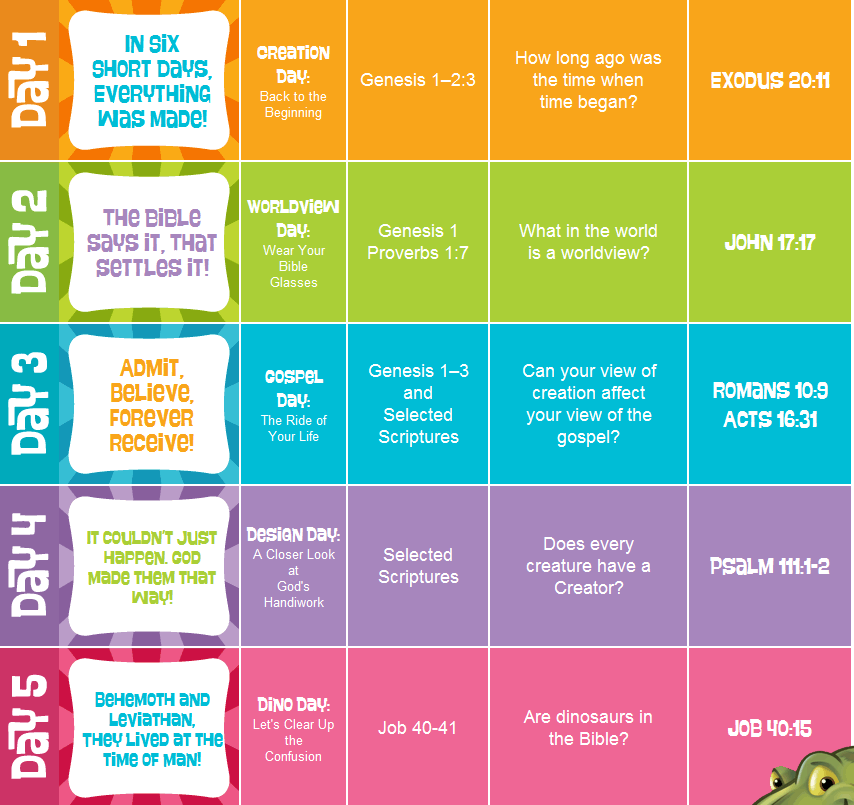 Yes, that’s right. Apparently I (and others) falsely accuse a group named “Answers in Genesis” which actively promotes young earth creationism through books (including children’s books), a magazine, a research journal, and even a VBS program [image on right all credit to answersvbs] (notice that the entire curriculum is focused on Young Earth Creationism: day 1 is in six short days, everything was made; day 2 is the bible says it, that settles it [and note that in Ham’s other post he argued we should teach our children how to think, not what to think–or at least in addition to ‘what to think’]; day 3’s main question is “Can your view of creation affect your view of the gospel?”; day 4 is on intelligent design [admittedly this doesn’t specifically mean young earth]; day 5 is going to teach children there are dinosaurs in the Bible) of focusing on a young earth.
Seriously, you did read that right. I and others are accused of falsely stating that Answers in Genesis is focused on young earth creationism.
Look, I’m not saying it’s a bad thing to have your ministry focused on a specific area. In fact, I think that Christians who are strong in science, the arts, philosophy, and other areas of knowledge need to step up and do what they’re best at for the glory of the Lord, whether that means making new discoveries in a lab or going and working at a retail job. Do it well! The problem is that Ken Ham is saying we’re falsely accusing Answers in Genesis of being focused on young earth creationism. Sorry, but they are.
Moving on:
Thus it is obvious that millions of years is incompatible with God’s Word. And one does not get millions of years from the Bible—it comes from fallible man’s interpretation of the past.- Ken Ham
Honestly, this has to be the favorite line YECs use: “man’s fallible __________” or some variant. Again, all it does is subtly poison the well. Isn’t it equally possible that man’s fallible interpretation could lead to a young earth view? Let me answer the question: YES. People are fallible, and they make hermeneutical mistakes, science mistakes, and other mistakes. Thus, one could equally say: “It is obvious that the young earth position is not necessitated by the text. To say that it is necessitated is to use man’s fallible interpretations of Scripture.”
Suddenly YEC looks like it is the evil “compromiser.” But I’m not going to take that route. Rather, I want to consider arguments, not attacks on character; I want to consider the text, and not bring eisegesis into it by assuming my position is the only possible interpretation.
Moving on:
I would also be prepared to say that those church leaders who condone “gay” marriage will have compromised Genesis! – Ken Ham
Another classic YEC scare tactics. I pointed it out in my last post responding to Ken Ham. Basically, you take the position you want to refute and then associate it with anything people who already agree with you will think is bad. For example, you could say “Hugh Ross believes in an old earth, just like evolutionists.” Suddenly, the people who read things like AiG’s website know that Hugh Ross is evil.
Here’s the problem: Hugh Ross isn’t evil. The statement is no argument. It’s guilt by association. It’s poisoning the well, and it’s unChristian.
Hey look, he does it again:
Those in the church who compromise Genesis with millions of years and evolutionary ideas are really saying that man’s word is infallible, and God’s Word is fallible! It is the other way round!- Ken Ham
Scare words abundant throughout. No argument, just assertions.
So no, the “Reformation” we are calling the church to is not (as some critics have been recently claiming) to get people to believe in a young earth— it’s having them accept the full reliability of the Bible. Believing in a young earth is a consequence of accepting God at His Word in Genesis.- Ken Ham
Honestly, this is the best piece of the entire blog post. It sums up Ham’s position well. Basically, he goes in with the assumption that the young earth is the only possible reading of Genesis. Thus, if anyone does not hold to a young earth position, they do not “accept God at His Word.” Now, what he’s saying is that it’s not that the reformation is young earth creationism; rather, the reformation is to re-evangelicalize the church: sola Scriptura! Amen!
Here’s the problem: a young earth is not the only possible reading of Genesis, and by putting it forth as such, and explicitly stating that it must be a consequences of “accepting God at His Word,” Ham and others who make similar claims have therefore put their views as God’s views. Their view is, in fact, a consequences of an ultra-literal hermeneutic which they espouse. The text itself does not warrant it. The fact that there is almost limitless reading from authors who argue that the Genesis account is Ancient Cosmology; or that it lines up with one week as part of creation; etc.; alone speaks to the fact that AiG’s position is not necessarily a consequences of the text, but of their hermeneutic: it’s a consequences of their method, not the source.
Bottom Line: Let’s focus on the issues involved in Genesis and the world that God has revealed to us, which is a reliable guide to truth (Psalm 19). The only reason I spend time responding to Ken Ham and others like this is because I do not want such statements to go unchallenged. When a Christian goes around accusing other Christians of being “compromisers” or other scare-words simply because they differ in their interpretation of a passage of Scripture, that Christian needs to carefully rethink the issues and realize “In essentials, unity, in non-essentials, liberty.” Stop throwing out the accusations. Focus on the issues.
Frankly, I pray this will happen, but I doubt that it will. As long as one holds one’s own methodology and hermeneutic is the only way to do it, there can’t really be thoughtful dialog. I hope I’m wrong, and I hope that maybe Ken Ham and AiG will be willing to work with others who have different views but still hold to inerrancy of Scripture in order to bring about a whole-church reformation towards inerrancy. But that would require AiG dropping the position that only they are right.
Links to Other Responses to Ken Ham’s “Compromise” Posting
Ken Ham on ‘Compromise’ and Stand to Reason– my response to Ham’s initial post.
Compromising the Kingdom– Faithful Thinkers offers a really in-depth critique of Ham’s use of emotional and ad hominem attacks.
A Brief Word on Ken Ham, Stand to Reason, and the OEC/YEC Debate– two really good points raised in this post. How do our attitudes drive people away?
SDG.
Book Review: “Man and Woman: One in Christ” by Philip Payne
 Philip Payne’s book Man and Woman, One in Christ
Summary of Contents
Paul’s Background
Payne notes that Paul was taught by Gamaliel, who was far more egalitarian than his contemporaries. Given this background, it is implausible that Paul had a low view of women (37).
Galatians 3:28
Those opposed to egalitarians (basically, egalitarians are people for women pastors, complementarians are those opposed to women pastors) often portray the position as having its only support in Galatians 3:28. Philip Payne does not base the egalitarian position on this verse alone, but he does argue that the passage provides a strong basis for the egalitarian position. Payne writes, “The natural implication of the equality of male and female in Paul’s teaching is that the gifts of women for ministry in the church should be recognized, welcomed and exercised in all areas of church life, including… church leadership” (104).
1 Corinthians 7- the equal rights of men and women in marriage
In 1 Corinthians 7, Paul explicitly parallels the obligations, rights, and conditions of men and women in marriage. Payne notes a large number of verses in which Paul uses the same language for both men and women (105-106). Not only that, but Paul specifically challenges the concept that men should be the spiritual leaders in the home in 1 Cor. 7:14 (107).
1 Corinthians 11
Payne’s book quickly turns to an extremely in-depth exegesis of the core verses related to the debate over women in church leadership. To put this into concrete terms, Payne’s analysis of 1 Timothy 2:8-15 covers eight chapters and 142 pages; 1 Corinthians 14 has nearly 50 pages dedicated to it, 1 Corinthians 11 is covered by over 100 pages. Payne does not set theology or exegesis to the side in favor of emotional appeals, as some complementarians tend to accuse egalitarians of doing. Rather, he centralizes the Bible as the inerrant Word of God and unswervingly demands that all sides conform to what the Bible teaches, no matter how difficult that teaching may be.
Regarding 1 Corinthians 11, Payne notes that the analogy regarding the “head” of woman does not imply authority, as complementarians must hold. Rather, “source” is a better exegetical and philological fit (113ff, see especially 131, 133). Payne further argues that the proper application of 1 Corinthians 11 would draw out the respect and honor men and women should have for each other as equals (214-215).
1 Corinthians 14:34-35
Rather than mincing words, I’ll jump right to the point: Payne argues that these verses are an interpolation. I’ll cover my own thoughts in the section below “Analysis/Critique,” but for now, I’ll focus on Payne’s argument.
Payne notes that there are a number of ways offered to interpret the passage, but he argues that the only plausible interpretation of the text is that women must be silent, no matter what, in every circumstance. The reasoning is lengthy, but the primary rationale behind this interpretation as most plausible is the it reiterates the prohibition three times, which, in the 1st Century, would have been seen as an absolute prohibition (218-219). Complementarians who allow women to sing in worship, therefore, are inconsistent in their interpretation of this passage, because they add a qualification which is not in the text (221).
Payne, however, argues the text is an interpolation. The evidence is both internal and external. First, the external evidence. The movement of the text itself hints that it was an interpolation which was placed in different parts of 1 Corinthians depending on the textual lineage (227ff). There is also a distigme which is used elsewhere to mark interpolations that is in the last line of 14:33, the correct place to mark 14:34-35 as an interpolation (232ff). Bishop Victor, between AD 541-544, corrected the text to omit 14:34-35 as an interpolation (246ff). Victor’s acumen for detecting interpolations is noteworthy, because he also omits the Trinitarian interpolation in 1 John 5:7-8 (246). MS88 omits the text, likely because it was copied from a manuscript which lacked the interpolation (249). Clement reflects a text without the verses (250-251). He notes other evidence as well (251ff). Payne also notes 9 lines of internal evidence for the text being an interpolation (253ff).
1 Timothy 2:8-15
These verses occupy the largest treatment in MWOC. The key to properly interpreting this passage, argues Payne, is the context and the church situation to which it is addressed. Context is always important in properly interpreting the Bible, but with letters it is even more important. Payne approvingly quotes Raymond Collins on this point, “…it is the epistolary genre that is most conditioned by the coordinates of time and space, historical and relational circumstances… They are ad hoc compositions whose essential import relates immediately and directly only to the situation that dictated their composition” (291).
Payne asserts that scholars know the situation in Ephesus–there was a preponderance of false teaching (296ff). Because of this, it is important to read the letter as a letter designed to put a stop to these teachings. Paul’s prohibition of women’s teachings is tied directly to the fact that false teachers had been praying upon women (299ff). The phrase Paul uses, “I am not permitting” “indicat[es] a new, case-specific injunction in response to a problem in Ephesus that does not carry the weight of church tradition” (321).
Payne also highlights the importance of the Greek word oude as conjoining the prohibitions Paul makes in this passage. The word is used throughout the Pauline corpus to “join together expressions that reinforce or make more specific a single idea” (338). Because of this, it is important to note that the word is used to conjoin the prohibitions in 1 Timothy 2:12. The prohibitions are “to teach” and “to assume authority.” Thus the prohibition is not Paul saying women cannot teach or assume authority over man… rather it is “Women should not teach in conjunction with assumed authority” (348-356).
But does authenteo mean “assume authority”? Complementarians generally must argue that it means simply “have authority.” Payne destroys such arguments, citing etymological (363-365) and document (365-373) evidence to demonstrate the word means “assume authority [to oneself-385ff].” Payne also deconstructs the complementarian argument to the contrary, showing that Paul used other words to refer to authority in a basic sense (373-380).
Importantly, Payne draws out the implications of Paul’s exhortations to women to learn quietly. This was the proper position of students. Paul is not telling women they have no place in the church, he’s calling them to learn in a proper fashion before teaching (see 316-317 for an example of this argument).
Thus, Payne concludes that Paul is not prohibiting women from teaching in the church. In the face of the counter-evidence of Paul’s affirmation of women teachers (61-68), the specific context of 1 Timothy, and the proper translation of the Greek words, the text should be read as a temporal restriction on teaching by women in a church struggling with false teachings being spread by women.
…And More
I have not even begun to draw out all of Payne’s arguments in MWOC. There are many more lines of reasoning including Paul’s affirmation of women in positions of ministry, Paul’s theological axioms which imply equality of man and woman, “salvation through childbirth,” Ephesians 5:21-33 and Colossians 3:18-19 with husband-wife relationships, Titus 1:5-9 and 1 Timothy 3:1-13 and the requirements for deacons and overseers, etc., etc. I cannot emphasize how broad Payne’s line of argument is, and how lucidly he explains his points. The book simply must be read by anyone interested in the topic.
Analysis/Critique
There are so many points Payne makes in MWOC that it would be impossible to cover them all. I found Payne’s arguments largely persuasive. That said, I have a few minor notes.
First, I am not convinced that 1 Corinthians 14:34-35 is an interpolation. I also think Payne dismisses the possible egalitarian readings of the passage too quickly (219ff). That said, Payne’s arguments are extremely powerful. I would have dismissed such arguments before reading this book, but now I’d say I’m very close to agreeing with Payne that these verses are an interpolation.
However, I wish that Payne had did a bit more work on the text to at least investigate the exegetical possibilities. I believe very few complementarians would be willing to accept that these verses are an interpolation, so if Payne had offered other possible interpretations, complementarians might find his case stronger. However, it is the case that complementarians who desire to use this passage to exclude women from the ministry now have the burden of proof upon them to demonstrate that it is not an interpolation, and they must do so with the same careful attention to the internal and external evidence which Payne utilized.
Initially I thought Payne might be overstating the case from Galatians 3:28, but he drew out enough parallel passages that it seems pretty convincing that egalitarians can interpret other passages in light of the Galatians verse (Payne does not use this method–he deals directly with the texts said to undermine egalitarianism… I’m merely suggesting that Payne’s work on Galatians 3:28 would allow egalitarians to be justified in utilizing it as a kind of “proof text” by which others must be judged).
Conclusion
Payne’s sustained positive argument for the equality of man and woman essentially convinced me of the egalitarian position over a year and a half ago. I have only recently finished the book, but when I first got it and skimmed through the arguments, I realized every argument I’d been using as a complementarian had an egalitarian answer. Not only that, but Payne’s critique of the complementarian position undermined the theological position which I’d held my entire life. I think it takes a great deal of intellectual integrity to read books which challenge one’s fundamental beliefs, and I have experienced it firsthand. I challenge readers on both sides of the issue to read this book.
Man and Woman, One in Christ provides an insurmountable challenge to the complementarian position. Any scholar working on the topic in the future must interact with this magnificent work. I simply must recommend it over and over again. I am thoroughly convinced that egalitarianism has a much stronger Scriptural and theological basis than the complementarian position, and MWOC is one of the works which lead me to that position. Payne’s thorough and thought-provoking analysis of the texts themselves demonstrates the Biblical accuracy of the egalitarian position. His work is one with which all must contend. The issue of women in the ministry is one we [the church] cannot get wrong. A thoughtful, open-minded approach to the Biblical issues is necessary. Let us make men and women one again.
Source
Philip B. Payne, Man and Woman, One in Christ
SDG.
——
The preceding post is the property of J.W. Wartick (apart from citations, which are the property of their respective owners) and should not be reproduced in part or in whole without the expressed consent of the author. All content on this site is the property of J.W. Wartick and is made available for individual and personal usage. If you cite from these documents, whether for personal or professional purposes, please give appropriate citation with both the name of the author (J.W. Wartick) and a link to the original URL. This blog is protected by Creative Commons licensing. By viewing any part of this site, you are agreeing to this usage policy.

 J.W. Wartick - Reconstructing Faith