Faithful Politics
Book Review: “Faithful Politics: Ten Approaches to Christian Citizenship and Why it Matters” by Miranda Zapor Cruz
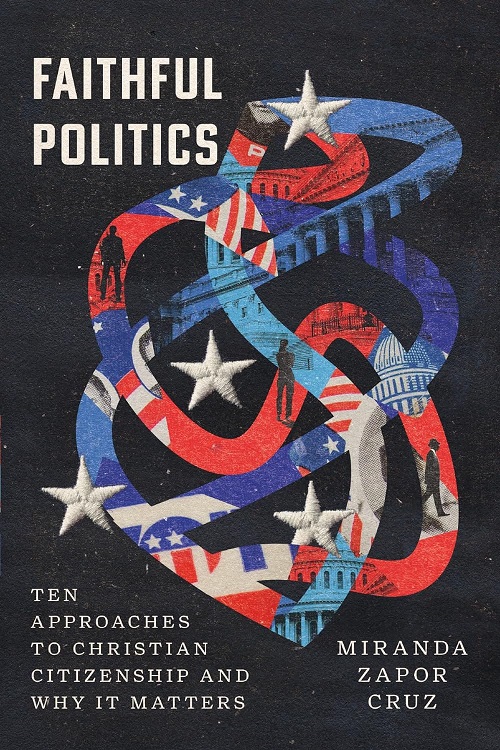
Faithful Politics: Ten Approaches to Christian Citizenship and Why it Matters by Miranda Zapor Cruz provides an introduction to several different ways Christians have engaged in the political arena.
A few introductory chapters outline Cruz’s approach. Instead of taking a direct partisan line, she seeks to provide overviews of the ten approaches she covers and then give some analysis for each broad approach to Christian life in politics. One early insight is contrasting Christian and broadly American concepts of freedom: “American freedom conceptualizes freedom as for self; the Kingdom conceptualizes freedom for others” (15). This latter insight is backed by theologians such as Bonhoeffer, who wrote about explicitly being free for the sake of the other in Christianity (ibid).
After several broad comments on general guidelines for analyzing political approaches from within Christian perspectives, Cruz turns to the 10 approaches she covers. These are sometimes grouped together, and I’ll list them as grouped: three separationist approaches based on “Keeping the Kingdom out of the Country” (essentially approaches that advocate for Christians separating from public life in various ways in order to demark a clear separation between “the world” and church); two separationist approaches based on “Keeping the Country out of the Kingdom” (these are approaches like early Baptist separationism based upon keeping church and state separate, less than actually splintering from society itself); social gospel approaches (using one’s faith to guide society, ethics, and even spending programs); two Calvinist approaches (contrasting direct Christian influence on society a la Geneva and John Calvin and a more nuanced approach from Abraham Kuyper); dominionist approaches (the teaching that Christians must gain dominion over society and how this applies to political spheres); and Christian Nationalism (a view which puts faith in Christ essentially subordinate to allegiance to the nation-state).
Summarizing all of these is beyond the scope of what I want to do. Highlights include the look at Two Kingdoms separationist approaches and how Lutheranism was co-opted through that view for Fascism, but how Dietrich Bonhoeffer, a Lutheran pastor, went back to nuance of the Two Kingdom approach to fight back (101). I thought the insight into social gospel approaches and the several Anabaptist approaches was fascinating. Cruz’s evaluation of the different approaches constantly offered fruitful ground for thought and comment. For example, in her analysis of Christian nationalism, she writes, “physical and rhetorical violence are endemic to Christian nationalism, which is part of what makes it incompatible with Christian faithfulness…” (189). The constant rhetoric of modern nationalists that challenges people opposed to them to define Christian nationalism and show how it is bad would run into a wall when confronted with the basic quotes from Christian nationalists and analysis by Cruz here. Cruz’s analysis isn’t always negative, of course. For example, despite clearly not advocating for a separationist approach, Cruz writes that: “Anabaptist and evangelical approaches to separationism have their strongest appeals in their ability to clearly differentiate between the church and the world, and their commitment to Christian formation as an essential function of the church. We are all being discipled by something…” (81). These kinds of insightful comments from Cruz make the book incredibly valuable.
The book would absolutely serve well for a reading group of Christians who wanted to discuss how to interact with Christianity and politics, or even just looking at one single approach and diving more deeply from there.
Faithful Politics is an insightful, timely book. It provides readers with enough background on numerous options in Christian living to at least get a grasp on key concepts. It also provides ways forward for continued thought and research. Recommended.
All Links to Amazon are Affiliates
Links
Be sure to check out the page for this site on Facebook and Twitter for discussion of posts, links to other pages of interest, random talk about theology/philosophy/apologetics/movies and more!
Book Reviews– There are plenty more book reviews to read! Read like crazy! (Scroll down for more, and click at bottom for even more!)
SDG.
——
The preceding post is the property of J.W. Wartick (apart from quotations, which are the property of their respective owners, and works of art as credited; images are often freely available to the public and J.W. Wartick makes no claims of owning rights to the images unless he makes that explicit) and should not be reproduced in part or in whole without the expressed consent of the author. All content on this site is the property of J.W. Wartick and is made available for individual and personal usage. If you cite from these documents, whether for personal or professional purposes, please give appropriate citation with both the name of the author (J.W. Wartick) and a link to the original URL. If you’d like to repost a post, you may do so, provided you show less than half of the original post on your own site and link to the original post for the rest. You must also appropriately cite the post as noted above. This blog is protected by Creative Commons licensing. By viewing any part of this site, you are agreeing to this usage policy.

 J.W. Wartick - Reconstructing Faith