fantasy
“A Crown of Swords” and “The Path of Daggers”- A Christian Reflection on the Wheel of Time
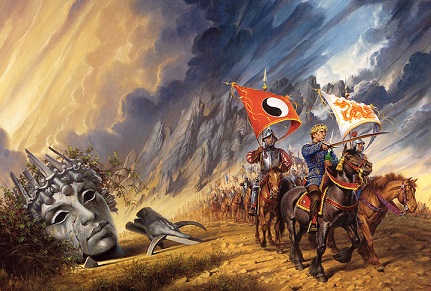 Robert Jordan’s epic fantasy series, “The Wheel of Time,” has much to reflect upon from a Christian perspective. Here, I’ll be examining books seven and eight, “A Crown of Swords” and “The Path of Daggers.” There are minor SPOILERS from both books here. Please do not share spoilers from later books for the sake of readers.
Men and Women
Throughout both books–and indeed the entire series–there is an undercurrent from many characters that “men always ____” or “women always ____.” What is interesting is that Jordan frequently flips these phrases around so that men are saying women are impossible to understand, but women then turn around and say the same about men. There is parallelism here which I believe was intentional.
The notion that there is a kind of “gender essentialism” is one which, unfortunately, is frequently pushed in Christian communities. I’m not saying at all there is no such thing as distinct genders; rather, my point is that what we conceive of as being gendered is often not the case at all. I actually found myself jarred at times when the women in the Wheel of Time novels would complain about the men being “impossible” or “gossipy”–after all, is that not what women are generally conceived as? But of course these patterns of behavior are not essential to male or female but rather aspects of personalities. Thus, it seems Jordan has a streak of feminist thought running through his works, though it is at times very subtle and even concealed. His writing speaks to the absurdity of labeling all people of one gender or the other as acting in specific, deterministic ways.
In the Service of…
Another concept which frequently occurs throughout these books is that there is complexity to relationships and loyalties particularly concerning evil or “The Dark One.” Many of the Forsaken follow after their own ends, to the point in which they frequently oppose each other, which itself seems to work against the will and ends of “The Dark One.”
Thus, it seems that for “The Wheel of Time” the service of evil is ultimately an irrational end which leads to chaos and disorder. It moves against the Pattern–the idea that there is a unity of time which continues to be woven together to make reality–and it also ultimately seeks to defeat itself just as much as it fights against the forces of the Light.
Belief, Evil, and Pragmatism
At one point in The Path of Daggers, Rand is surveying his arrayed forces and he considers their loyalty (and lack thereof). But in this considering, he notes:
they feared him [Rand] far more than they did the Aiel. Maybe more than they did the Dark One, in whom some did not really believe… (327-328)
The people, it seems, were more concerned with firmly holding their own wealth or gaining positions of authority and power than they were with the true evil which threatened the world. Unconvinced by the coming tribulation, they instead sought favor from the most powerful man in the world. The condition, it seems, is one which mirrors our own at points. Rather than being concerned with evil facing our world, or rather than fighting injustice, people are obsessed with gain that cannot be carried over across death and the grave. The true powers which threaten the world are left to expand and strengthen,while people seek their own gain.
It is a kind of pragmatism which infects us: injustice is “over there” and we are “right here,” so why be concerned with it? The notion that there is a spiritual realm with any sort of power is shrugged off, ignored, or even scorned as ancient superstition, unworthy of concern. Like the people who surround Rand in the book, we convince ourselves that evil has no power in the world and “[the Dark One”] could [not] and would [not] touch the world harder than he had already (328).
Conclusion
There is much to consider throughout the “Wheel of Time” series. Fantasy resonates with reality in sometimes tangible ways, as anyone who reads fiction frequently knows. How do you approach books from a worldview perspective? What do you think of the themes above, and what others have I not discussed from these two books?
I will be writing on later books in the series when able. Until then, I covet your thoughts!
Links
Be sure to check out the page for this site on Facebook and Twitter for discussion of posts, links to other pages of interest, random talk about theology/philosophy/apologetics/movies and more!
SDG.
——
The preceding post is the property of J.W. Wartick (apart from quotations, which are the property of their respective owners, and works of art as credited; images are often freely available to the public and J.W. Wartick makes no claims of owning rights to the images unless he makes that explicit) and should not be reproduced in part or in whole without the expressed consent of the author. All content on this site is the property of J.W. Wartick and is made available for individual and personal usage. If you cite from these documents, whether for personal or professional purposes, please give appropriate citation with both the name of the author (J.W. Wartick) and a link to the original URL. If you’d like to repost a post, you may do so, provided you show less than half of the original post on your own site and link to the original post for the rest. You must also appropriately cite the post as noted above. This blog is protected by Creative Commons licensing. By viewing any part of this site, you are agreeing to this usage policy.
“The Wheel of Time”: A Christian reflection on Books 1-5 of Robert Jordan’s epic saga
Note: I have many updated posts for all the books of The Wheel of Time, as well as looks at worldview questions in the TV series, here.
The Wheel of Time turns and Ages come and pass. What was, what will be, and what is, may yet fall under the Shadow… Let the Dragon ride again on the winds of time.

The Wheel of Time is nothing short of mammoth in size. The series spans 14 books, the shortest of which is about 680 pages. It is a fantasy series encompassing the fulfillment of a number of prophecies which foretold of an Age to come that would once more “break” the world: a man called the Dragon would simultaneously bring salvation and destruction. Here, we’ll explore many of the themes found in the first five books of the series–The Eye of the World, The Great Hunt, The Dragon Reborn, The Shadow Rising, and The Fires of Heaven. We’ll explore the series from a worldview perspective by seeking out the overarching themes found in the books related to the real world.
There will, of course be SPOILERS in what follows. If you’re leaving a comment, do try to limit your discussion to books 1-5. I will be posting on the following books in the series in the upcoming months, so if you want to comment on later parts of the series, please wait for the appropriate post.
Prophecy
It is clear that prophecy is a central theme throughout the books. Everyone, from beggar on the street to king or queen, is aware of the prophecies concerning the Dragon. Bards and entertainers recite the prophecies, using language to tell the stories in different forms. The fulfillment of prophecy is taken to be essentially guaranteed by everyone encountered.
Prophecy is not, however, always fulfilled in the ways expected by the main characters. Rand, for example, is often surprised by how the prophecies about the Dragon are fulfilled in him. Frankly, this makes me think about the way some prophecies of Christ were fulfilled. For example, the statement “Out of Egypt I called my son” is clearly a statement about the nation of Israel, but it is later applied to Christ. Moreover, many expected the Messiah to be a conqueror, but Jesus came to save through his own sacrifice.
The fact that the expectation existed, but the interpretation of the prophecies was diverse, is itself an interesting parallel to Christ as the fulfillment of prophecy. It will be interesting to see how the theme of fulfilled prophecy continues going forward.
Messiah and The Pattern
Interestingly, Rand may be understood as a kind of Messiah figure, but a bit of the inversion of Jesus Christ. Jesus came not to build an earthly kingdom; Rand’s kingdom must be ushered in through war and conquest. However, the destruction Rand is supposed to usher in in some ways seem to mirror prophecies about the end times in the book of Revelation. Moreover, one might wonder at this stage in the series where Rand is headed. Perhaps he will end up giving himself to save the world. But Rand is not himself incarnate Lord ushering in salvation through sacrifice; instead, he is driven by the Pattern–the force of the Wheel of Time which “weaves” strands–people’s lives, the activities of nations, and all things.
The Pattern is said to be woven around certain people who are part of its plan for continuing the revolution of ages. The system seems to imply an eternal universe with a repetition of time and places and reincarnation, but in these books, it seems that Rand may be breaking that pattern. It is unclear as to whether the series is developing in a direction which implies the repetition will continue, but it will be interesting to see where it leads.
Reincarnation is fairly explicit in the book, as Rand, the Dragon, is a reborn Lews Therin–one who was prophesied to return as the Dragon. He has to fight with the thoughts that are in his head from Lews Therin in order to control his own destiny. Again, it will be interesting to see how this plays out. Will Jordan continue to affirm reincarnation as an aspect of reality with a continually repeating “Wheel of Time” or will Rand manage to break the Pattern and turn time into a line rather than a Wheel?
It seems clear that the notions of reincarnation or a continually repeating pattern of time are no part of the Christian worldview. As interesting as these themes are in the books, it is clear they are fiction. The notion that time is constantly repeating is, in fact, false. The universe has a beginning and it is heading towards an end. As fiction, it is entertaining, but it should remain clear that it is fiction.
Rand as Messiah is an interesting way to view the series. The connections to the notion of prophesied salvation are interesting. But in Jordan’s world, the savior comes not only to save, but to ruin. It will be interesting to see where he takes it.
Men and Women
The characters each have their own ideas of how men and women should operate. Jordan seems to satirize the expectations as much as he flaunts them. Women are just as capable as men in the series, though of interest is the different cultural expectations and how men and women are expected to fulfill them in the different nations throughout the books. The Aiel, for example, a people group who live in a desert reason, have extremely different views of men and women than one encounters in other nations. They have societies of warriors, including ones for women, and both men and women are expected to comply with the unwritten laws of honor. Other nations operate with fairly patriarchal views which are reflective of the medieval setting of the work. The complexity of male-female interaction is continually interesting.
In the last of the books we’re exploring, The Fires of Heaven, some characters begin to interact sexually. As with the general views of the roles of men and women, the cultural expectations regarding marriage and sexual union are shown to be diverse across the differing cultures. The acts themselves are not explicit, but nudity is at times referenced and it is clear what has happened.
These sections demonstrate that the characters are not perfect but rather succumb to their various desires, not unlike real people. However, the fact that they are often interwoven with the different cultural expectations regarding marriage may spur discussion among Christians, who are often challenged to defend traditional views of marriage. It seems clear to me that the mere existence of culturally diverse ways of defining marriage does not undermine the notion that there is an ideal form of marriage which was established “in the beginning.”
Conclusion
“The Wheel of Time” starts off strong. It’s a powerful fantasy saga with quite a few themes which resonate with the Christian worldview. There are other themes which are contrary to truth as well. The series may spur discussion about various aspects of reality, from prophecy to views of men and women. So far, I have greatly enjoyed it. I look forward to reading the rest of the series and seeing how I might use it to interact with others regarding the Christian worldview.
Links
Be sure to check out the page for this site on Facebook and Twitter for discussion of posts, links to other pages of interest, random talk about theology/philosophy/apologetics/movies and more!
The art is the official galley art for the cover of The Fires of Heaven. I make no claims to ownership and give all credit to the artist, Darrell Sweet, and copyright holders.
SDG.
——
The preceding post is the property of J.W. Wartick (apart from quotations, which are the property of their respective owners, and works of art as credited; images are often freely available to the public and J.W. Wartick makes no claims of owning rights to the images unless he makes that explicit) and should not be reproduced in part or in whole without the expressed consent of the author. All content on this site is the property of J.W. Wartick and is made available for individual and personal usage. If you cite from these documents, whether for personal or professional purposes, please give appropriate citation with both the name of the author (J.W. Wartick) and a link to the original URL. If you’d like to repost a post, you may do so, provided you show less than half of the original post on your own site and link to the original post for the rest. You must also appropriately cite the post as noted above. This blog is protected by Creative Commons licensing. By viewing any part of this site, you are agreeing to this usage policy.
Announcing my new site: “Eclectic Theist”
I have many more interests than just philosophy of religion and Christian apologetics. I’ve been longing for an outlet for these interests for some time. Finally, I got down to business and made a new blog: “Eclectic Theist.”
On this new site, I’ll be writing about topics not normally discussed here on “Always Have a Reason.” For example, my first main entry is a reflection on science fiction. On this new site I’ll be discussing my other interests. Readers on here may be surprised at how random my reading is sometimes. In my undergraduate studies, I was a social studies major and I read extensively about Mesoamerican history. Did you know that!? Well now you do, and guess what? I’ll be writing about it again. I also love World War 2 history and have been reading more in that area in what exists of my free time. Of course, I’m also a huge fan of science fiction and fantasy, role-playing games, and more. All of these will be featured on this new site.
Will there be crossover? Probably. I’ve already thought of a few posts which can bring my outside interests on here and vice versa. For example, a series I’ve been contemplating for a while about science fiction and Christianity will see its launch on here in just a few short weeks. Other topics may crossover as well as they come up.
Does this mean I’ll write less here? Absolutely not. I have posts lined up for weeks now, and I continue to add to them. I’ll be maintaining my regular posts on here and using “Eclectic Theist” as an outlet for my other creative energy. Please, take the time to check out my introductory post to “Eclectic Theist” and browse the two new posts I have up. The site will be expanding quickly, so be sure to subscribe.
I’m looking forward to seeing many of you over there and talking about topics that interest us apart from philosophy of religion.
Finally, because I like pictures, I’ll share one that I just put up over on the new site: a picture of Orson Scott Card and myself.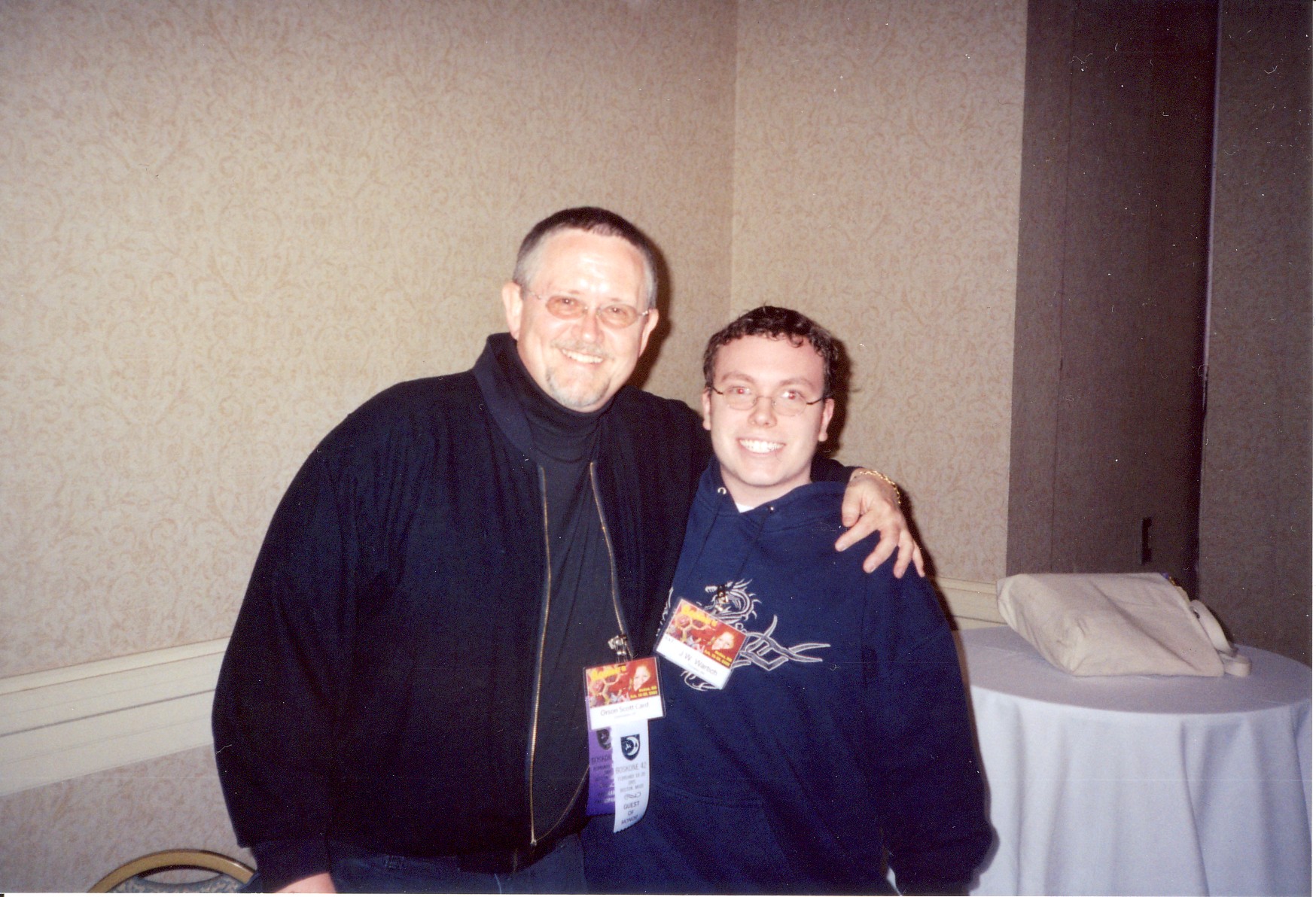

 J.W. Wartick - Reconstructing Faith