flood geology
Really Recommended Posts 9/26/14- Jesus Seminar, atheists and kids, and creationism!
 First, I gotta brag: I have a son! He was born 9/17 and he’s just the cutest darling ever. Yay! I’ve been greatly blessed.
Now, I have still put together some awesome posts for your persual, dear readers! Here we have a nice variety of topics from the need to realize the dangers of a hardened heart to the Jesus seminar to talking about atheism with kids (I’m sure this last one won’t be controversial). Check them out and let me know what you thought!
Chemostratigraphy: silent objector to ‘Flood Geology’– Young Earth Creationists often argue that the Noachian Flood is to be seen as the explanation for the layers of sediment we find all over the planet. Can this claim stand up to scrutiny?
Who Were the Jesus Seminar? Should anyone have taken them seriously?– Christians have long faced challenges thrown at the historical faith by historical critics like those in the Jesus Seminar. But should the Jesus Seminar really be (or have been) taken seriously? Check out this post which addresses some issues related to this group.
14 Ways for Christian Parents to Teach Kids about Atheism– How might we as Christians approach the topic of atheism when speaking with children? Natasha Crain provides some much-needed insights into this area. I think this is a must-read even for those who are not parents so that we can think about how to interact in age-appropriate ways.
The Dangers of a Hardened Heart– The heardening of one’s heart presents a number of dangers for both a life of faith and a life without faith. Eric Chabot addresses these dangers in this thought-provoking post.
Is Your View Falsifiable?– Luke Nix points out a number of helpful ideas regarding whether one’s view is falsifiable. Does this matter? Read the post for many insights related to falsifiability and the Christian life.
Really Recommended Posts 8/22/14- Osteen, apologetics, creationism, and more!
I have put together what I consider a very strong list of topics for you this go-round. Here, we have Acts, Osteen, Creationism, apologetics (x2), and C.S. Lewis. Check out the posts, and let me know what you think in the comments below!
Finally: A simple timeline of Acts– This tremendously helpful post provides a timeline of acts which shows when different people were traveling together and where they were at various points throughout the book. It is a great way to keep track of the goings-on in the book. Be sure to follow The Overview Bible, as they constantly have fantastic posts.
A Diluvialist Response to Buckland’s Kirkdale Cave Hyena Den– Flood geology has been around for a little while, and here, Joel Duff describes how early diluvialists-young earth flood geologists-initially reacted to some major important finds.
The Guide to Online Decorum for Christian Apologists– How, then, shall we live? This is a question to ask yourself, no matter your situation. Here, Pastor Matt Rawlings discusses how Christian apologists should interact in online settings.
C.S. Lewis’ (really) 10 Best Books– From Christian philosopher David Marshall, we have this list of C.S. Lewis’ 10 best books. Some might be obvious, some might surprise you. Regardless, it’s time to get some extra reading!
Osteen and Peter (Comic)– A poignant pictorial contrast between prosperity “gospel” and Christian life.
5 Things I Hate about Apologetics– Doing apologetics does present some pitfalls regarding faith and life. Check out this post related to these possible difficulties.
“The Rocks Don’t Lie” by David Montgomery: Chapters 2 and 3
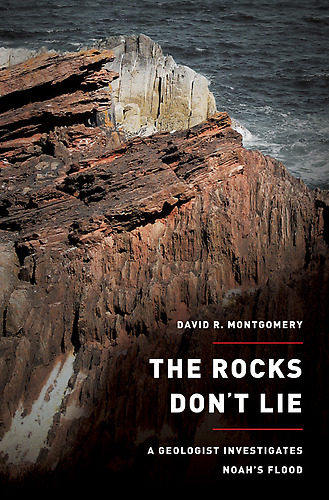
Here, I continue my look at The Rocks Don’t Lie
Chapter 2: A Grand Canyon
Those who are familiar with Young Earth Creationism know that a major contention is that the Grand Canyon can serve as evidence for a global flood. For example, both Answers in Genesis and the Institute for Creation Research have several articles dedicated to the topic. (Just do a search on the sites–I have linked two examples. In the latter, the ICR author notes that the Grand Canyon is “Exhibit A for the flood model of geology.”)
Outline
David Montgomery notes this interest from young earth groups and so he dedicates a chapter to the topic. He uses his own exploration of the Canyon to lead into a discussion of the geological evidence. Some of the rock formations found there “require[d] both extreme heat and high pressure” to form (17). He turns to a brief explanation of radiometric dating: “…the age of a rock can be read like a geologic clock because radioactive isotopes decay at a fixed rate… If you know the half-life of an isotope–how long it takes for the remaining amount to decay–then the ratio of the parent-to-daughter isotope now in a rock tells you how long ago the rock crystallized” (17-18).
Next, Montgomery gives a fairly basic introduction to geology. He provides a brief overview of how one can note unconformities in the rock and how different formations cut across each other. These evidences, found in the Grand Canyon, show that it was formed by a series of events rather than one single event (20ff). Moreover, physical evidence of fossilized burrows from “wormlike animals” in the sandstone provides evidence against flood geology. “How could fragile worms have been crawling around on and burrowing into the seafloor during a flood powerful enough to remodel the planet? The biblical flood would have had to have dumped more than ten feet of sediment every day for a whole year in order to have deposited the thousands of feet of sediment exposed in the canyon walls” (22).
More evidence against flood geology is found in the way the sediments themselves were formed. First, the differing mass of types of silt, clay, sand etc. make it difficult to believe that they could have been mixed together in a flood and then been deposited with uniformity of layers. Second, layers like that of white sandstone are composed of “fine-scale features” which “would have been obliterated if they had formed underwater… These dunes were made by wind” (25).
Finally, the fossils found within the Canyon present another difficulty. “If all the creatures buried… had been put there by the biblical flood, then why aren’t modern animals entombed among them? That the vast majority of fossils are extinct species presents a fundamental problem for anyone trying to argue that fossils were deposited by a flood from which Noah saved [at least] a pair of every living thing” (27).
Analysis
Montgomery has presented a number of extremely difficult problems for young earth interpretations of the Grand Canyon. In particular, the difficulty with the species of animals found buried seems intractable. My reason for noting this in particular is because flood geologists must assert that all the animal life is either descended from or prior to the animals in existence at the flood. Of course, if the Grand Canyon was formed by the flood, we should observe some of these extinct animals now–or at least recently. Yet for many, we do not. Why is that? A young earth perspective cannot simply assert that they died in the flood, for these would have been preserved in the flood.
The other problems Montgomery noted may sometimes be dismissed by advocates of young earth theories. In particular, Montgomery does little to defend radiometric dating, which is itself a major target of young earth views. For those interested, Davis Young’s The Bible, Rocks and Time
Chapter 3: Bones in the Mountains
Montgomery surveys briefly and selectively a history of Christian interpretation of the Genesis account and argues that some found room for less literal interpretations. Moreover, he points out that those who insist upon a literal reading of the text for Genesis must present reasons for not taking other references to the sky as a dome, etc. as non-literal (44-46, 50). Yet he also notes that the perspective from which the Bible is written (on earth) alleviates these difficulties–but these difficulties can only be alleviated by “allowing for figurative or allegorical interpretations” in which we “acknowledge… the fact that we live on a planet” (50).
Another difficulty with young earth views is presented, because the discovery of the New World revealed a massive amount of new species which the Ark would have had to carry. How does one fit all of these species onto the Ark? More importantly, how did these species get to the Ark and back to their homes in North America without leaving their ancestors’ bones behind in places other than their native lands? (42-43)
I have to say this chapter really surprised me, because Montgomery showed an appreciation for and interaction with Christian theology that I was not expecting. For just one example, he refused to set up the oft-rehearsed science-vs-religion rants that often accompanied discussions of Galileo. Instead, he explored the historical context, and noted that the ideas the church held were not necessitated by the text but were rather incorporated from Ptolemic ideas (49).
Conclusion
The Rocks Don’t Lie continues to impress me. Montgomery is careful to avoid overstating his case. More importantly, he seems to genuinely respect the beliefs of those whose writings he surveys and he shows a true concern for accuracy regarding some of the controversies. Thus far, he has presented a number of significant scientific challenges to a young earth paradigm, as well as noting the change and variety of perspectives within theology. Be sure to follow the blog for the next chapter(s)!
Links
Like this page on Facebook: J.W. Wartick – “Always Have a Reason”
Check out my review of a similar work by a Christian: The Biblical Flood. I think this book is vastly important and should be in every Christian’s library.
Be sure to browse my extensive writings on the “Origins Debate” over creationism, theistic evolutionism, and intelligent design (among other views) in Christianity.
Source: David Montgomery, The Rocks Don’t Lie
SDG.
——
The preceding post is the property of J.W. Wartick (apart from citations, which are the property of their respective owners, and works of art as credited) and should not be reproduced in part or in whole without the expressed consent of the author. All content on this site is the property of J.W. Wartick and is made available for individual and personal usage. If you cite from these documents, whether for personal or professional purposes, please give appropriate citation with both the name of the author (J.W. Wartick) and a link to the original URL. If you’d like to repost a post, you may do so, provided you show less than half of the original post on your own site and link to the original post for the rest. You must also appropriately cite the post as noted above. This blog is protected by Creative Commons licensing. By viewing any part of this site, you are agreeing to this usage policy.
Young Earth Creationism and Presuppositionalism: An Analysis
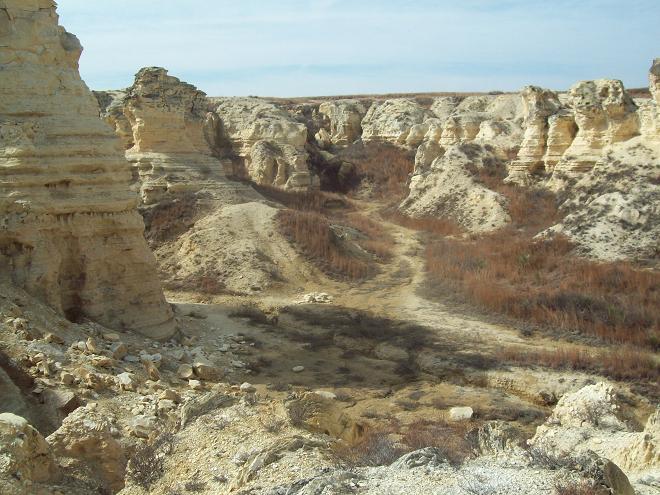 Young Earth Creationism stands or falls based upon the specific use of presuppositionalism as an epistemological groundwork. Here, I will challenge the very core of the young earth paradigm: I will charge that it is an invalid presuppositionalist approach to viewing science and theology.
Young Earth Creationism (YEC will be used hereafter for “young earth creationism,” “young earth creationist” and other forms of those words as needed), is, of course, the position that the Genesis account of the creation of the universe took place over the course of seven literal 24-hour days about 6-12,000 years ago. I have extensively explored various aspects of young earth creationism and other positions, and my posts can be found under the “Origins Debate” page.
Presuppositionalism is a type of apologetics (defense of the faith) which relies upon presupposing the truth of the Christian worldview in order to defend it. I have analyzed presuppositional apologetics a number of times. For an introduction into this position, check out “The Presuppositional Apologetic of Cornelius Van Til.”
Epistemology is the study of how we come to know things. Essentially, it asks questions like “How do we know that we know?”
Before proceeding, it is worth noting that many debates between YECs and people who believe in an ‘old earth’ perspective turn on the YEC use of presuppositionalism. A common theme for mocking YECs is to say they just refuse to hear evidence or shout over evidence, yet it seems that this is an unfair portrayal. As we evaluate the young earth position, it will become clear that the YEC perspective operates from within a presuppositional framework that explains much of the way YECs reason. It will also become clear, however, that the YEC use of this framework is invalid.
Thus, it is my contention that YEC is directly dependent upon a presuppositional approach to how we know things. For support of this contention, I note the fact that many YECs see this connection themselves. For example, Answers in Genesis has a number of posts on the topic, including a post outlining the meaning of and need for presuppositional apologetics. Or again, Nathaniel Jeanson of ICR presented a presuppositional case for YEC (analyzed by the Geochristian). However, this is not the only evidence. YECs tend to argue exclusively within a presuppositional framework.
Consider this argument:
The Bible clearly states that the earth was made in seven days. There is no room to interpret the text in any way other than as a literal week of creation.
Such an argument is extremely typical within the YEC community. However, it is also clearly a presuppositionalist approach to the question of the age of the earth. YECs will argue that science must be interpreted in such away as to line up with the creation account. A common theme is that “The data is the same, it is the interpretations of that data that differ,” another notion is that people are rejecting the “plain and obvious meaning of the text” when they offer an old earth interpretation. Such a position is often united with the notion that only by using “man’s fallible ideas” can one come up with a date of millions or billions of years.
The thought process goes in this order: we presuppose the truth of the Bible => the Bible teaches that the earth is 6-12,000 years old => all scientific evidence for the age of the earth must line up with the truth of the Bible. The Bible is the infallible word of God, and so it cannot be in error. Because, according to the YEC paradigm, the only possible interpretation for the Biblical account of creation is the young earth perspective, it therefore becomes clear that all science and truth must line up with YEC.
We are thus left with two possible ways to challenge YEC. Evidence simply is not the problem. Any evidence, if the YEC use of presuppositionalism is valid, simply must line up with YEC. Thus, to challenge YEC, one must confront directly its presuppositions. First, one can challenge the position by attacking the premise that the YEC paradigm is the only possible interpretation of the Genesis creation account. Second, one can challenge the position by directly attacking the presuppositional epistemological groundwork that the arguments are built upon. Rather than focus upon the first challenge, we will here explore whether or not the YECs have validly made use of the presuppositional approach.
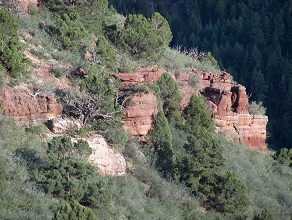 Assuming a Young Earth
It is important to note that the way the YEC argument works is to begin by simply assuming the truth of young earth creationism. I know this may sound radical, but it plays out time and again when discussing the various positions on the age of the earth. The young earth paradigm brokers no alternatives; only the young earth perspective is even possibly correct. How is it that YECs are so confident in their approach?
Simply put, the confidence is gained from the very way that they defend the young earth. YEC is not defended based upon evidence. It is not as though scientists are examining the earth and coming to the conclusion that the earth was formed only some thousands of years ago. Indeed, several prominent YECs assert that the very notion of finding the age of the earth from investigation of the geologic past is impossible or hampered by sin and fallible ideas. For just one example, Whitcomb and Morris, in their highly influential work, The Genesis Flood
[I]f He [God] did this [created a universe full-grown], there would be no way by which any of His creatures could deduce the age or manner of Creation by study of the laws of maintenance of His Creation. (238, emphasis theirs, cited below)
Such a notion persists throughout much YEC literature. In principle, the only way to conclude a young earth is to abandon supposed “uniformintarianism” (hold that the processes in place today continue at the same rate they did in the past–see an evaluation of one YEC’s use of this notion here) and view all of the history of the earth through the lens of God’s word. Now, whether or not it is valid to assume that the Genesis text is a scientific account, the argument here should be fairly clear. Namely, the young earth position is assumed. It is not something demonstrated by science, but rather a given before any scientific investigation takes place. Similarly, the position is assumed to be true before any exegesis has occurred. All scientific evidence and any exegetical hints at a different position are subsumed into the YEC position because it is assumed from the outset as correct. Because YEC is correct, all evidence must line up with it.
Some may object by arguing that frequently YECs offer evidence for their position. They may cite various catastrophic theories or flood geology as alternative explanations of Earth’s geologic past. However, even the authors of books like these (such as Whitcomb and Morris, or Walter Brown in his In the Beginning) admit that the key is to presuppose Scripture, which is of course, on their view, to presuppose a young earth.
The Validity of the Young Earth Assumption
It is clear that YEC turns upon presupposing its truth. YEC is assumed to be true, and all alternative views are simply wrong by default. Unfortunately, this is an abuse of presuppositional apologetics.
It is important to contrast the specifically YEC use of presuppositionalism with the wider use of presuppositional apologetics. Presuppositional apologetics in general is the method of engaging entire worldviews by granting their core assumptions and lining them up against reality in a competition of best explanation. The YEC use of presuppostionalism is to defend a single contention–a young earth–against all comers. There are very significant disanalogies here. What the YEC has done is use presuppositionalism not to enter into the square of debate over whole worldviews, but rather to insulate their interpretation against any possible counter-evidence.
There is a distinct difference between the use of presuppositional apologetics, and the use of YEC in presuppositionalism. The latter tends to simply reject outright any challenge as either against the “clear word of God” or as “assuming uniformitarianism.” By placing their own view beyond the realm of rational inquiry, they have undermined their own potential to know that it is true.
 The Faulty Grounds of the YEC Presuppositionalist
The foregoing evaluation leads us to the greatest difficulty facing the YEC approach: a faulty epistemology. Unfortunately, the way that the defense of YEC has been shown to work introduces a paradigm of knowledge which is impossible to sustain. Essentially, the YEC must assume what they think they know. Such an assumption seems to be viciously circular. The YEC must reason thus: “The Bible teaches a young earth=> The Bible is True=> the earth is young.” When presented with counter evidence, rather than engaging with the evidence, the YEC generally falls back to this same argument and reinterprets the evidence. That is where the whole system breaks down: the YEC has not made the right use of presuppositionalism, which allows for entire worldviews to be falsified. Instead, the YEC has misused presuppostionalism to put a young earth interpretation beyond falsification.
The objection will be made that everyone has core beliefs that must be assumed without evidence. Although such an assertion is itself hotly debated, I think it is possible to sidestep such a difficult discussion. Instead, one can note that even if one grants that core beliefs are necessarily assumed, the burden of proof is squarely placed upon the YEC to show how holding to a young earth is necessary for knowledge. Why is this the case? The simplest explanation is that if one assumes the epistemology needed for presuppositionalism is correct, then one has essentially a framework that involves the assumption of core beliefs that are necessary to allow for any knowledge. Thus, for example, the existence of God might be argued as necessary for knowledge (a la Alvin Plantinga, Cornelius Van Til, Greg Bahnsen, and the like) because without God to make us rational, there is no basis for thinking that our beliefs have any actual relationship to reality. Whether or not this is the case, it seems that a young earth is not one of these core beliefs.
Thus, we have finally come to the ultimate failing of the presuppositional defense of YEC: it abuses its epistemological framework to the point of breaking. The YEC has utilized an epistemological approach that allows for core beliefs to be assumed, but has done so in such a way that essentially any belief could be assumed with equal validity. An old earth creationist or theistic evoloutionist could equally argue that their position is based upon a core belief that must be assumed, in which case YEC is undermined. In turn, they could assume their reading of Scripture and make all others wrong by default.
Presuppositionalism must walk a fine line to determine which presuppositions are genuinely those which must be assumed for knowledge. When challenged, the presuppositionalist must make arguments to show that the presuppositions are indeed necessary for knowledge. Unless and until a YEC makes a case that by abandoning the notion of a young earth, one necessarily undermines all knowledge–a case which I must admit seems impossible–the YEC use of presuppositionalism is undermined. Rather than making a valid use of that apologetic approach, YECs have undermined its very principles, and have thus eliminated their own possibility of knowledge. They have relativized all truth by introducing as “first principles” things which are not necessary for knowledge.
A Final Defense
The YEC may object, saying that they have indeed established that YEC is necessary for knowledge. After all, if one denies YEC, which is the clear teaching of Scripture, one has denied God’s word, which is the basis for the entire presuppositional approach.
Setting aside a critique of presuppositionalism as the notion that one must assume the entirety of Scripture to have any knowledge, I would respond by simply noting that this argument does nothing to rebut my charge. I have argued that believing the notion that the earth is merely thousands of years old is not necessary for knowledge. The burden of proof rests squarely on the YEC to show how it is. By merely asserting that denying YEC undermines all of Scripture, one has begged the question. They have engaged in a presuppositional defense of something for which it has been charged that such an approach is epistemologically impossible. In order to defend it, one cannot simply assume that the other side is wrong, one must show how they are wrong.
Objective Knowledge
We have seen that YEC misuses presuppositionalism. A final point worth noting is that the YEC approach to apologetics actually undermines the possibility of objective knowledge. For, as we have noted, the YEC simply assumes their interpretation of the text without argument and then evaluates all science and theology through that lens. However, the YEC offers no reason for rejecting the notion that others could do exactly the same thing with their interpreatations of the text. The YEC has essentially made all truth relative. Anyone can simply assume their position is correct without argument, and then reinterpret all counter-evidence based on that approach. It therefore becomes clear that the YEC use of presuppositionalism must be rejected.
Unfortunately for YECs, the young earth position itself stands upon the bedrock of its faulty use of presuppositionalism. It remains to be seen whether it can adapt itself for a solid evidential base.
A Way Forward in the Age of the Earth Dialogue
It has become clear that YEC is based upon a faulty use of presuppositionalism and that its use of the presuppositional approach undermines the very possibility of objective knowledge.
How, then, can one proceed? It seems that the best way to proceed is to simply throw off the bindings of the misuse of presuppositionalism (taking note that presuppositionalism in general is not necessarily invalid if used properly–see discussion here) and engage in an honest debate over the evidence for either position. Rather than throwing out rote accusations at the other side (“You’re denying Scripture”; “That’s just because you’re assuming ‘uniformitarianism'”; etc, etc), let us engage in dialogue on the evidence at hand. Let’s look at the text in its cultural and linguistic context. Let’s examine the geological evidence of the earth and see where the evidence leads us. Let us not cut off the discussion before it has even begun by simply assuming we’re right and the others are wrong. We are called to always have a reason (1 Peter 3:15). By abandoning the necessity of reasoning when it comes to an issue such as young earth creationism, YECs have undermined the very possibility of a consistent apologetic.
Links
I examine a number of common young earth creationist arguments. Also check out my extensive writings on the origins debate.
Naturalis Historia is a phenomenal site which largely focuses upon investigating claims about a young earth. Some great starting places would be the series on the amount of salt in the oceans (Part 1 here) or some of the thoughts on baraminology.
Geocreationism is another site that examines evidence for the age of the earth with a theological approach. I highly recommend it.
Finally, the GeoChristian offers a number of critiques of the young earth theological and scientific perspectives.
Sources
John Whitcomb and Henry Morris, The Genesis Flood 50th Anniversary Edition
The last image is from NASA. The other images were personal photographs and protected by the copyright on this site.
SDG.
——
The preceding post is the property of J.W. Wartick (apart from citations, which are the property of their respective owners, and works of art as credited) and should not be reproduced in part or in whole without the expressed consent of the author. All content on this site is the property of J.W. Wartick and is made available for individual and personal usage. If you cite from these documents, whether for personal or professional purposes, please give appropriate citation with both the name of the author (J.W. Wartick) and a link to the original URL. If you’d like to repost a post, you may do so, provided you show less than half of the original post on your own site and link to the original post for the rest. You must also appropriately cite the post as noted above. This blog is protected by Creative Commons licensing. By viewing any part of this site, you are agreeing to this usage policy.
Gregg Davidson vs. Andrew Snelling on the Age of the Earth
 I was recently at the Evangelical Philosophical Society conference (see my thoughts on every talk I attended) and one of the sessions was a debate between Gregg Davidson of Solid Rock Lectures and Andrew Snelling of Answers in Genesis on “Scripture, Geology & the Age of the Earth.” A number of readers requested more information on this talk, and I found it very interesting myself. Here, I’ll touch on the highlights of this dialogue as well as my own thoughts.
Davidson- A Biblical Worldview and an Ancient Earth
Gregg Davidson, a geologist who authored When Faith and Science Collide
Another problem is that YECs fail to recognize that their position itself is an interpretation of Scripture. Their view is not Scripture itself. There is a tendency in debates about theology to view one’s own position as what the Bible teaches, but that fails to take into account the possibility of fallible human interpretation.
Davidson argued for an approach to Scripture that takes note of the fact that God often deigns to make use of “the knowledge of the day to communicate truths about the nature of God.” As an example, he referenced Jesus saying that the mustard seed is the smallest seed of all the plants on earth, despite the fact that it is not (Mark 4:30-32). The point was not the size of the seed, but rather the power of faith. Thus,we must be careful not to make Scripture teaching something it does not claim for itself. He pressed that to read into the Genesis text specific dates and time periods is to make the text teach something that it is not claiming.
Turning to the science, Davidson noted that there are any number of evidences for an ancient earth, but that he chose to focus upon just one area from a number of evidences in order to show how interdisciplinary and cross-confirmed the age of the earth is. He focused upon the Hawaiian Islands and their formation and age. There are multiple, independent ways to investigate the age of these islands. The islands were formed by a hot spot–a place where magma shoots up from underneath the crust and bubbles to the surface. This eventually would form islands when enough of the lava cooled and hardened. The islands are on a moving continental plate and so as they move away from the hot spot, the expectation is the islands get progressively older. Thus, in a series of 3 islands arranged thusly: 3-2-1-0 (0 being the hot spot), 3 would be the oldest island.
Davidson first noted the ages that were found by testing the age of the volcanic rock with radiometric dating. These ages yielded millions of years. Now of course most young earth creationists hold that radiometric dating methods are deeply flawed, but Davidson noted that this procedure can be tested for accuracy with independent methods. Before turning to that, he showed a picture of what the estimate for the movement per year of the plate over the hot spot would be based solely upon the radiometric dating. Basically, this works by just taking the distance of 3-2-1 and measuring how far each is from the hot spot, then dividing the radiometric date by that distance to see how far the islands move per year. The estimate yielded movement of 2.6-3.6 inches per year.
Recent technology has allowed us to utilize Global Positioning Systems (GPS) to actually measure the rate that the islands are moving. These measurements yield approximately 3.1 inches per year, which is exactly in the middle of the estimate given by the radiometric dating. Given the measured rate, scientists can extrapolate how many millions of years old the islands are based upon their distance from the hot spot. It’s kind of an inverse way to get the date. They simply divide the measured distance of the islands from the hot spot by the measured rate of movement per year. Of course, this way of measuring is not dependent in any way upon radiometric dating. Thus, there are two independent sources showing the date in millions of years for the Hawaiian Islands.
The coral growth around the Islands was a third confirmation of the ancient age of these formations. This argument was more complex than the first two. Basically, it seemed the argument was that because different corals form closer to the surface, we can look at the coral reefs formed around the islands as they are farther out and see how much the coral has moved up the island as it subducted (moved under the water with the continental plate). Thus, as the islands move farther away, and therefore sink into the water, the coral that can only survive at certain depths is submerged too far for it to get adequate sunlight, and it dies. One can then measure radiometrically the age of rings of corals. When one measures the coral on the islands, they can correlate that with the ages of the corals and the islands themselves. This measurement also lined up with the previous two.
Davidson concluded that the problem with the YEC paradigm is that they will often focus upon rebutting multiple, independent claims. While this may work for each claim individually, the problem is that all of these types of evidence add up to form one cohesive picture. When they are cross-referenced and they all hit on the same age or date range, they all show the same predictions of distance, and the like, it becomes extremely implausible to say that every single way to find the age of the earth is faulty. They form a full picture. Furthermore, Davidson critiqued YECs for often presenting a selective picture of the evidence–only showing the evidence which favors their position.
Snelling- A Biblical and Geological Defense of a Young Earth and the Global Flood
Andrew Snelling is a well-known proponent of YEC, the author of Earth’s Catastrophic Past
Snelling began by offering the common argument that Jesus taught the global flood and young earth creationism. He argued that the Hebrew word used in Genesis 7:17 is only used for this event, which hints at the incredible devastation.
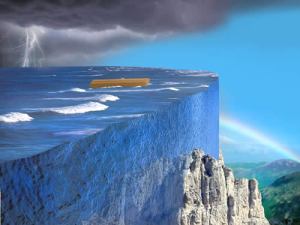 Furthermore, the language in Genesis states that the mountains were covered. Snelling’s slideshow had the image shown here on the right, which is becoming pervasive in discussions about the extent of the Flood. The argument is that if the Flood were local, it makes a mockery of the Biblical text. (See a different perspective on this issue with Hugh Ross’ “In the Days of Noah.”)
Snelling outlined several things we should look for if there was a global flood. Among these expectations are:
1) Marine fossils in strata for terrestrial creatures- Snelling named a number of places these could be found. This is an expectation because the Flood covered the whole earth, so the creatures should all be mixed together.
2) Rapid burial of creatures and plants- Snelling noted a number of places where fossils show rapid burial. This is expected because the Flood would have suddenly come upon these creatures.
3) Fossil graveyards- The Flood would have killed huge numbers of animals, so we should expect to find huge fossil graveyards, which we do.
4) Evidence that the ocean flooded the continents- if the Flood were global, we would expect to find its sedimentation upon the continents, and we do.
He argued that these are all evidenced in Earth’s catastrophic past, and he pointed to the Grand Canyon as evidence for a number of these evidences.
Snelling also looked at various geological features he said were evidences for a global flood and a young earth. Among these were several layers of sedimentary rock which are bent. He argued that this can only occur when the rock is liquefied like cement–otherwise it cracks–so this sedimentation had to happen during the Flood.
Discussion- Q+A
Next, there was a dialogue between Snelling and Davidson in the form of them asking each other questions. The highlights were a few specific questions:
Davidson asked Snelling about the Grand Canyon: specifically, he noted that the terrestrial fossils were found in similar strata, but never in the same layers, which instead suggests an ebbing and flowing of the water; not a global flood. Furthermore, he pointed out the lack of any pollinating plants in an entire mile of sediment. He asked how Snelling’s account lines up with this data. Snelling responded by arguing that the fossils are indeed mixed together and that we even find footprints in the wrong layers. He argued that due to “devastating tsunamis” which would have swept the earth, some of this could be undone and/or specific types of creatures/plants might have been swept out of the layers.
Snelling gave a brief outline of problems with radiometric dating giving divergent ages and asked Davidson to comment on the difficulties he pointed out with radiometric dating. He argued that often, old earth proponents and “secularists” simply assume an age for the rock and interpret the tests to get that age. Davidson responded noting that he worked with radiometric labs for quite some time and that there is mixing in the chemicals which can be accounted for. He showed a picture showing how some of this can work and how labs have to account for certain elements contaminating the rocks. However, he pointed out there is a margin of error to account for some of these difficulties.
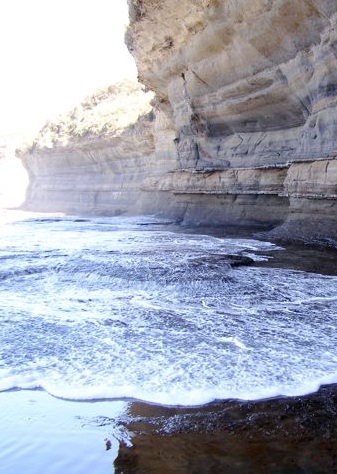 Davidson then brought up a slide with images of bent rocks. One was a “bench” at a graveyard in which the middle had sagged despite being made of stone. He argued that with enough pressure/time rock can sag under its own weight or (as the picture showed) even no weight at all. Given this evidence, he asked why bent rocks should count in favor of YEC. Snelling responded by saying that hard rock can be bent by pressure but that if the pressure is sufficient the rock will crack. He continued to emphasize that in the Grand Canyon one can observe rocks bending without fracture.
Evaluation
I have to say I was struck by how much this interaction turned on the scientific aspects of the debate. I had thought that Snelling would focus more upon an attack of Davidson’s interpretation of Scripture, and while he did some of that, the majority of his responses were related to scientific arguments. Davidson followed suit and kept hammering examples that showed how the YEC interpretations Snelling gave of various natural phenomena failed.
Davidson’s scientific presentation in his paper was extremely strong. It would be very hard to explain away the fact that three completely independent methods for dating the islands lined up so clearly to point towards an ancient earth. If I had been on the border between young earth or old earth going in, I would have come out as convinced of an old earth. I actually did go in as one who holds to an old earth, having been convinced by the evidence a few years ago, and I came away utterly convinced that YEC is false.
Snelling’s talk was a great defense of the YEC position, but it demonstrated the flaws that Davidson was quick to capitalize on. I was really impressed by the fact that Davidson had a number of slides ready to respond to both Snelling’s presentation and his questions. Davidson’s critique of the “bent rocks” was particularly devastating.
Davidson’s critique of YEC: that they focus upon independently repudiating various dating methods, came to fruition in this discussion. He really showed how the YEC paradigm is utterly dependent upon a selective presentation of data at the exclusion of pieces that do not fit.
One thing I would have liked to see was more debate over the Flood and the Bible passages in general. I was surprised by how much the talk focused on the science–though that was extremely interesting.
Let me know your thoughts on the topic. Have you any insights on any of these issues?
Links
I have written on other talks that I attended at the ETS/EPS Conference in 2012. Specifically, check out my post on Caring for Creation: A discussion among evangelicals. I have also written briefly on every talk I attended. See my post on the ETS/EPS Conference 2012.
There are a great many posts on creation issues on my site. You can access them by checking out my page on the Origins Debate.
Naturalis Historia is a site that focuses primarily on the scientific evidence for an old earth. I highly recommend it.
For the theological aspects of the debate (and also more of the scientific discussion), check out The GeoChristian as well as Geocreationism, two fantastic sites.
Finally, for a comprehensive Biblical and scientific old earth view, see Reasons to Believe.
SDG.
——
The preceding post is the property of J.W. Wartick (apart from citations, which are the property of their respective owners, and works of art as credited) and should not be reproduced in part or in whole without the expressed consent of the author. All content on this site is the property of J.W. Wartick and is made available for individual and personal usage. If you cite from these documents, whether for personal or professional purposes, please give appropriate citation with both the name of the author (J.W. Wartick) and a link to the original URL. If you’d like to repost a post, you may do so, provided you show less than half of the original post on your own site and link to the original post for the rest. You must also appropriately cite the post as noted above. This blog is protected by Creative Commons licensing. By viewing any part of this site, you are agreeing to this usage policy.

 J.W. Wartick - Reconstructing Faith