Genesis
Book Review: “The Biblical Flood” by Davis Young
 Davis Young seeks in his work, The Biblical Flood
Overview
Young, a Christian geologist, provides a detailed overview of the Church’s theological and scientific musings on the Flood. He develops this overview chronologically, beginning with early Jewish thought. The focus within the entirety of his book is directly centered upon how extrabiblical evidence was used to shape theology and vice versa. The relation should not be understood as binary. Throughout history, there was a spectrum of approaches to the extrabiblical evidence which included resistance (not infrequently forged by ignorance) as well as integration. Here, I will survey only the broadest outline of Young’s discussion.
Early Flood Views
Early Christians were aware of Pagan stories of floods but made little or no appeal to them as evidence for a universal flood, and in fact some argued that these other stories were clearly differentiated from the Biblical account because they were local as opposed to global. There was much speculation over the location of the Ark as well as the notion that fossils were the result of this universal deluge.
Middle Ages and Renaissance
Medieval thought regarding the Flood was steeped in the “ahistorical view of creation” found at the time. That is, the science of the time thought of creation as deductible from the character and nature of God. However, the discovery of the New World brought up many challenges to a universal deluge theory, which challenges began to get recognition. These included the vast number of species which would have had to fit onto the Ark and the discovery of people across the world. During this period, the discovery of flood stories in various cultures began to be viewed as evidence for a universal deluge (37).
New World
The New World continued to present challenges to the universal deluge theory. One of the foremost among these was animal migration. Entirely new and distinct species were discovered in the New World which did not exist in Europe. How did these animals get to these distant lands? More importantly, how did they get there without leaving any traces of themselves behind if they all only came from one location: the Ark? These challenges continue to vex those who hold to a universal deluge (60ff).
Geology’s Origins
The notion of a universal flood has contributed much to the development of geology as a science. The Christian worldview finally presented a picture of the universe which humans could explore in order to learn truths about reality. The Flood itself presented a theory about how to account for the geological features of the earth (65ff). Various features of the natural world were attributed to the flood, including the discovery of marine fossils on mountains and geological features like valleys. These early geologists were committed to an following the evidence where it led.
Diluvialism and Catastrophism
Various theories were put forward to explain the features of the earth. These included varied catastrophic notions, wherein the geological features were explained by a global, catastrophic flood. Such theories are repeated into today.
Geological Evidence Mounts into the Twentieth Century
Young establishes that the evidence against catastrophic diluvialism became weighty fairly early into the investigations of geologists (109ff). New discoveries related to mammoths and the way they died (over a period of time by a variety of causes rather than all at once) were greatly important, as the issue of these mammoths was found throughout the speculation about the flood. New dating methods were developed which were more accurate. Archaeological finds showed floods in areas of the Mesopotamia, but they were dated at different times. The discovery that humanity was widely spread over the earth and that there was no major extinction event throughout this spread raises a significant challenge for Flood Geologists (233). Other major challenges to Flood Geology include (but are by no means limited to): the dating of igneous formations, the cooling of the earth, metamorphism, and continental drift.
Theological Reflections
Throughout this period of discovery, theologians were not inert. Indeed, many theologians were at the front lines, actually participating in the discoveries themselves. Near Eastern Studies have revealed parallels with the Flood account which some have suggested show derivation. Others, however, argue these other flood stories merely show the perpetuity of such events and how ingrained they became on the human consciousness (236ff).
More recently, Flood Geologists have come into being once more. Their arguments parallel almost exactly those found spread in the early days of geology. Yet these arguments have been refuted by the evidence from the earth itself. Some continue to make false statements about the mammoths’ deaths, the formation of sedimentation, dating methods, and more. Young argues that this is largely due to the specialization of studies found within various fields like theology and geology. Theologians are rarely acquainted with the geological evidence, while geologists are rarely versed in theological language.
Theologians who were versed in geology began to see how interpretations of the text, rather than the text itself, had shaped the Christian response to geological evidence. People like Hugh Miller appealed to extrabiblical data in support of their intepretations of the Flood narrative (147ff).
Miller professed puzzlement that learned, respectable theologians would accept “any amount of unrecorded miracle” rather than admit a partial deluge. Could they not see that the controversy was not between Moses and the naturalists but between the readings of different theologians? (151)
More recently, many and varied theories of the flood as local have been developed and defended. The reaction from Flood Geologists has been vigorous, but theories of a global flood include a multitude of quotes from various scientists which would support competing theories of rock formation, sedimentation, and more. That is, Catastrophic Flood views present mutually exclusive theories for how the geological (and other) evidence came to be.
Appendix: Arkeology
The book is capped off with a discussion of “arkeology”: the search for Noah’s Ark. Young notes the array of locations which have been given as well as the mutually contradictory accounts of those who claim to have seen the Ark or evidence of the Ark. He warns Christians to remain cautious of any such claims.
Challenge
I believe that a good way to summarize the content of the book would be to view it as a challenge Young is issuing to those who allege that catastrophic theories are the only possible way to interpret the text and geological evidence. He himself writes, “If conservative and orthodox theology is to remain vital and relevant to a world in need of the Christian gospel… theologians will have to abandon their flirtation with flood geology and other forms of pseudo-science, reacquaint themselves with genuine scientific knowledge, and incorporate that knowledge into their thinking, secure in the realization that genuine insight into God’s creation… is still a gift of God to be treasured” (215).
Young’s book can be viewed through this lens. He shows how scientific knowledge challenged traditional readings of the text, but also how many theologians and Christian geologists alike interacted with this in order to gain “genuine insight” into God’s word and creation.
Conclusion
The Biblical Flood
I do not claim to have touched upon even all the major points found in Young’s work. The book is full of voluminous amounts of historical details which reveal interesting scientific and theological notions. The theory of a global flood was the one of the first major proposals for how the earth’s geological history was formed. As geological discoveries mounted, this theory was falsified. Moreover, theologians who interacted with the extrabiblical evidence had a wide array of responses, from downright rejection of the evidence or reinterpretation of it to attempt to fit a global flood to concordist views in which the extrabiblical evidence informed interpretation of the text. Which direction should we go? Young has presented a major challenge to those wishing to maintain a notion of the global flood. He presents mountains of evidence to challenge catastrophism, while also showing how, historically, thought on the Noahic Flood has comfortably incorporated the extrabiblical evidence without any necessary compromise of the text or faith. I commend the book to the reader without reservation.
Links
Like this page on Facebook: J.W. Wartick – “Always Have a Reason.” I often ask questions for readers and give links related to interests on this site.
Be sure to check out my posts on the “origins debate” which feature a wide range of posts on issues related to varying Christian views on evolution, creation, and more.
Davis Young, The Biblical Flood
SDG.
——
The preceding post is the property of J.W. Wartick (apart from citations, which are the property of their respective owners, and works of art as credited) and should not be reproduced in part or in whole without the expressed consent of the author. All content on this site is the property of J.W. Wartick and is made available for individual and personal usage. If you cite from these documents, whether for personal or professional purposes, please give appropriate citation with both the name of the author (J.W. Wartick) and a link to the original URL. If you’d like to repost a post, you may do so, provided you show less than half of the original post on your own site and link to the original post for the rest. You must also appropriately cite the post as noted above. This blog is protected by Creative Commons licensing. By viewing any part of this site, you are agreeing to this usage policy.
Answering Common Young Earth Creationist Arguments
 The debate over the age of the universe is a hot issue for some Christians, and this unfortunately leads to a number of faulty arguments and even some name-calling. This post is not going to argue against young earth creationism specifically. Rather, I hope that it can be a resource for both young earth and old earth proponents in order to avoid faulty reasoning. Each argument’s topic will be in bold with the problem outlined and a response. [Image at head of post credit here.]
Please see the end of the post for a response to an article linking back to this one.
Perspicuity of Scripture–
The Argument
Some young earth creationists (hereafter YEC or YECs) argue that old earth positions undermine the perspicuity of Scripture. Perspicuity of Scripture is the notion that the central teachings of Scripture can be understood by any who come to the Gospel. The charge YECs make is that because it seems, on a surface level reading of the text, that Genesis 1 implies creation over the period of 6 literal 24 hour days, those who deny this undermine the Perspicuity/Clarity of Scripture.
Response
The Perspicuity of Scripture does not apply to all areas of Biblical doctrine. Rather, it is the notion that anyone can understand the plan of salvation as laid out in Scripture and come to right knowledge for faith.
Think of it this way: read the book of Revelation. Do you understand everything in this book, or is the apocalyptic literature hard to discern? Throughout much of Christian history, there has been debate over the meaning of Revelation. There are a number of views, like preterism, idealism, dispensationalism, etc. But this doesn’t mean that what Scripture teaches in general is unclear. The clarity of Scripture in regards to salvific issues is absolute. Any reader can read and understand God’s plan for salvation.
Addendum
If the argument is pressed, again ask the YEC whether they are claiming they understand every single doctrine that the Bible teaches. Do you understand perfectly the Trinity, the atonement, the incarnation, the Lord’s Supper, the proper relation of Law and Gospel, etc.? If someone claims they do, they are essentially equating their understanding to God, rather than adhering to Scriptural teaching (1 Corinthians 13:12).
The Meaning of Day
The Argument
The Hebrew word used in Genesis one, yom, means day. It literally means a 24 hour period.
Often this argument is presented in a fairly demeaning and/or ad hominem way to the opponent: “Why do you insist on reading man’s fallible ideas into the text? It says day, it means day. I trust the Bible.”
Response
Actually, the Hebrew word yom has several different literal meanings. For example, according to Brown-Driver-Briggs’ Hebrew Lexicon, yom can mean “day, time, or year”; day as opposed to night; a 24 hour day; a time or period of time; a year; an age. Thus, if someone reads the text and argues that in Genesis 1 the days mean “ages”, they are still reading the text literally.
Evening and Morning
The Argument
When the Genesis 1 text refers to the days, it applies the terms “evening and morning” to each one of days 1-6, which means that each day is indeed a 24 hour period. That’s what evening and morning means.
Response
The delineation of time periods for days was not possible until the fourth day. As it is written, “Let there be lights in the vault of the sky to separate the day from the night, and let them serve as signs to mark sacred times, and days and years, and let them be lights in the vault of the sky to give light on the earth” (Genesis 1:14-15, I italicized “days”). Thus, the text itself tells us that the sun did not serve as a specific indicator of the length of days until the fourth “day.”
The repetition of evening and morning is an indication of the metaphor for the work week used throughout Genesis 1. Notice that evening and morning are reversed from the order in which they occur in a 24 hour day.
Day is not a long period of time
The Argument
Sure, there are other literal meanings of “yom” and in poetic literature it says that a day is like a thousand years for the LORD, but Genesis is a narrative and so the days mean literal 24 hour periods.
Response
Actually, in the very same account the word day is used in order to refer to the whole time of creation. As it is written, “These are the generations of the heavens and the earth when they were created, in the day that the Lord God made the earth and the heavens” (Genesis 2:4). I used the ESV translation here because the NIV translation translates yom as “when” here. In this text, the word “day” refers to the entirety of God’s creative work. Thus, the text itself utilizes the same word, yom, to mean a longer period of time than a 24 hour period in the same context of creation. And because this is “narrative” it can’t be dismissed as “mere poetry.” Speaking of which…
That’s Just Poetry
The Argument
Many of the verses that old earth proponents use are from places like the Psalms. For example, the verse about a day being like a thousand years is from Psalm 90:4. These verses are poetry and therefore not relevant to the actual age of the earth.
Response
Poetic literature still makes truth claims. Are you suggesting that nothing in the Psalms is true? To dismiss a text that is brought up in order to counter your position by saying “that’s just poetry” is tantamount to throwing God’s word out the window. One might wonder why it is that the YEC interpretation of Genesis 1 trumps every other passage in the Bible.
Appearance of Age
The Argument
Sure, some scientific evidence may make it seem as though the earth is old, but it is not actually old. Instead, God made it in such a way that it would support life, and in order to do so, it had to look old. He created light already on its way to earth and the Flood explains sedimentation.
Response
Nature tells us about reality, though we cannot infallibly search it (Psalm 19); God does not lie; therefore, God would not make something which by all appearances would look old, but is not in fact old.
Rebuttal
But Adam looked old. He was created about 30 years [or some adult age] old! Similarly, the plants in the garden, etc. would have looked old, but been new.
Response
The text doesn’t actually say how old Adam was when he was created. But that’s a side issue. More importantly, we would be able to tell how old Adam was by looking at evidences like his teeth, his bones, and the like. All of these would show signs of age.
Regarding the plants, this argument really just begs the question for YEC. As it is written, “And the LORD God planted a garden in Eden, in the east, and there he put the man whom he had formed. And out of the ground the LORD God made to spring up every tree that is pleasant to the sight and good for food…” (Genesis 2:8-9a).
The text clearly says that God planted a garden. While it says that God made plants spring up, it is prefaced by the notion of planting. The notion of planting implies growth over time.
And suppose this is wrong; suppose the plants were grown instantly: we’d still be able to test them and see how old they actually were by looking at things like cell division and tree rings.
Rebuttal
Your response assumes uniformitarianism.
Response
See section on uniformitarianism.
Presuppose Naturalism
The Argument
This one is extremely common when one listens to/watches debates between YEC and old earth proponents. Essentially, the argument goes like this: “You are presupposing naturalism in order to come up with an old earth. I presuppose the Bible is true instead. The difference is I [the YEC] am aware of my presupposition.”
Response
Strictly speaking this argument is actually completely false. Naturalism is the philosophical position that only the natural world exists. The debates in which this argument is often brought up are very often between Christians of opposing views. Therefore, because they are both Christians, neither one is operating under the presupposition of naturalism.
Rebuttal
The YEC may press this objection, however, and say what they mean is that one is presupposing a naturalistic methodology as opposed to the entire worldview.
Response
Define “naturalistic methodology.”
1) If you mean assuming “uniformitarianism”: see the argument and response below.
2) If by “naturalistic methodology” you mean something else, show how that is the case.
Uniformitarianism
The Argument
The only way to come up with an old earth is by assuming that everything has been uniform forever; in other words, the processes in place now are operating at the same speed they always have.
Response
Let’s apply this argument to one field: geology. Geology does come up with ages around 4.5 billion years old for the age of the earth. Now, the problem is that this is not due to uniformitarianism. Rather, geologists must take into account the fact that catastrophes do happen. For example, a huge meteor hitting the earth would change the geological landscape. Modern geology is neither catastrophist nor uniformitarian; rather, it must take both into account. And it still comes up with an “ancient” earth. The problem is that YECs go to the opposite extreme and actually assume that a catastrophe (or numerous catastrophes) can account for all geologic evidence. By citing specific examples of catastrophism, they then apply a catastrophic geology to the rest of the earth. It’s exactly the methodology YECs critique, but then they do it themselves. This is simply naive.
Furthermore, the burden of proof here is upon the YEC to show that the rates could increase at such a monumental rate on such a monumental scale that everything we observe that looks ancient is, in fact, ‘young.’ They must make the argument.
Rebuttal
You’re just starting with man’s fallible ideas. I just use the text for my guide.
Response
See “Look, it’s what the Bible says” and “Man’s Fallible Ideas” sections below.
Look, it’s what the Bible says
The Argument
I just read the Bible and agree with it. It says days, I say days; it gives genealogies, I add them together. All I do is take Genesis literally. You use man’s fallible ideas to distort the text.
Response
It has already been shown that the word “day” has several literal meanings. It has already been shown that “day” is used for a longer period than a “day” in the context of creation in Genesis. Thus, one could respond by saying “I just read the text literally too. On the first ‘age’, God created…. on the second age, God created…., etc.”
Furthermore, the genealogies are incomplete. It can be demonstrated that a number of genealogies in the Bible skip people or operate in an inexact fashion. By assuming the genealogies are linear, one has read anachronistically a 21st century notion of a genealogy back onto the text. That would be one of man’s fallible ideas.
Furthermore, the notion of an old earth proponent importing ‘man’s fallible ideas’ into the text can be equally applied to YEC. Who says that YECs are infallible? Would you claim you read the Bible perfectly and discern everything correctly?
You weren’t there!
The Argument
You weren’t there at creation. Neither were these “scientists” you cite in your “evidence.” How do you know what happened?
Response
You weren’t there either, my friend. However, when we look at the stars, we are looking at the past. Furthermore, we can measure things like cosmic background radiation, sedimentation rates, volcanic activity, and the like in order to discern how old the earth is. Again, God tells us that nature gives us a record (Psalm 19), so one wonders why we are being told to doubt that record.
 Very Good
The Argument
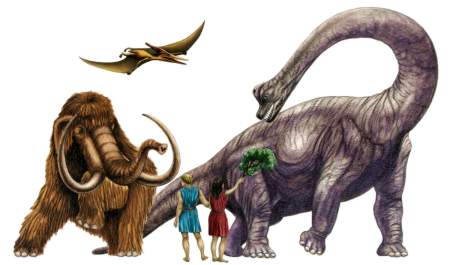
God says that his creation was “very good”; how could there then be animal death, thorns, cancer, and the like. The world would have been beautiful, without death, and without any kind of evils. Think about it, you’re saying that God was calling cancer eating away at dinosaurs and the like a “very good” thing! [Image credit here.]
Response
First, it seems very often that when YECs use the phrase “very good” what they mean is “perfect” in their own eyes. Why think that animal death is necessarily bad? If animals didn’t die, ecosystems would collapse: all the plant-eaters would starve, insects would take over and eat all plant life, and any number of other “bad” things would happen. Animal death is part of a beautiful system of maintaining order in the world.
Using the cancer example to try to argue that it couldn’t be “very good” is importing human emotions into creatures which are not moral agents. Simply put, an animal is not a moral agent. This doesn’t mean it is good to kill them, but it isn’t bad either. The harm comes when a moral agent intentionally brings unnecessary harm to an animal.
I would like to see an argument for what “very good” means to YECs. Why should it mean absolute perfection?
Finally, one must wonder about the fact that God planted the garden in Eden and it is that creation which is “very good”. God planted this Garden, and it was the localized area in which Adam and Eve were placed. That’s what the text says. Nowhere does it say the whole earth was like the Garden.
Compromise
The Argument
Unfortunately, this is one of the less subtle ad hominem types of arguments YECs employ. It basically goes like this: use a scare word like “evolution,” put in in context with an old earth proponent, and then call them compromisers. For example, “Wartick, who believes in a form of old earth creationism–really just a variety of theistic evolutionism–chooses to compromise the text to fit secular science.”
Response
Unfortunately, this very type of argument is used to discredit many fellow Christians. Rather than focusing on the issues at hand, it is indeed easier to just bash the opposition. For the record, I am not a theistic evolutionist. The point is that others who hold views similar to my own suffer from arguments like this against them. It’s dishonest.
The most unfortunate thing to take from this type of argument is that the average Christian on the street is very affected by it. Recently, I recommended an article from an extremely prominent Christian philosopher to another Christian. Their response was that if this other believer thought evolution might be true, they were too biased and they would not read the article.
That’s right, the effect of this type of argument is that it brings about a situation in which people won’t even read what other believers have to say about a topic. One must wonder, at least a little bit, about a position which discourages adherents to read the works of the opposition. Why not read and consider other viewpoints and take what is true?
Plain and Obvious Meaning- or “I don’t need to twist the text.”
The Argument
Basically, the way this one goes is as follows:
I just read the text for what it says. You have to do all kinds of things to interpret it. Why do you twist the text to fit your views?
Response
 Actually, YEC is also an interpretation of the Biblical text. It is an inference from the textual data. You are also interpreting the text, and need to justify your hermeneutic. Given the mounting evidence against it in books like The Lost World of Genesis One
You’re Using Science to Change the Meaning of Scripture
The Argument
Old earth proponents may have a viable exegetical position, but why on earth would they pick old earth over young earth? It seems the only reason is because they are caving in to science.
Response
Science can give us a record of reality. When the church lines itself up with views that do not accord with reality, it is discredited. Consider the controversy over heliocentrism vs. geocentrism. This controversy resulted because the church lined itself up with a philosophical position that it thought was taught by the text of the Bible. Similarly, the young earth position is an interpretation of Scripture and its advocates must contend with the scientific evidence.
Augustine issued a strong warning related to this objection [Literal Meaning of Genesis, Chapter 19, Volume 1]:
“If they find a Christian mistaken in a field which they themselves know well and hear him maintaining his foolish opinions about our books, how are they going to believe those books in matters concerning the resurrection of the dead, the hope of eternal life, and the kingdom of heaven, when they think their pages are full of falsehoods and on facts which they themselves have learnt from experience and the light of reason?”
The Bible says it, I believe it, that settles it
The Argument
This argument has a few varieties:
1) The Bible says the earth is not millions or billions of years. Why do you insist on changing God’s word for man’s fallible ideas?
2)The Biblical text entails a young earth. Why do you read it as a long period of time?
Response
1) Where in the Bible does it say “the earth is not millions or billions of years old”? Where in the Bible does it tell me the date of creation?
2) Please show me: where in the Bible does it tell me the date of creation? Where does in the Bible does it specifically say YEC is true? If you can’t, then you’re using an inference. See “Plain and Obvious Meaning” above.
Man’s Fallible Ideas
The Argument
Perhaps the most frequently used argument is of this variety. Too often, when threatened by exegetical or extra-biblical evidence that contradicts their position, YECs will fall back to this type of argument:
“That’s just using man’s fallible ideas to interpret the text.”
or
“That’s using man’s fallible [geology, astronomy, physics, insert discipline] to alter the meaning of God’s word.”
Response
The Young Earth position is an interpretation of the text as much as any other. Thus, the argument could just as easily be turned around:
“You’re just using man’s fallible interpretation to read a young earth onto the text.”
But, to be honest, this argument just amounts to a subtle ad hominem, even if the one using the argument doesn’t realize it. Why? Because it suggests that the other side is a) wrong; and b) not thinking Biblically.
A better response, therefore, would be to simply point out that the YEC position is also interpreting the text and that old earth proponents are looking at the whole body of evidence God has provided instead of just trusting what others tell them about the text.
Response to article against this one:
Over at “fortress maximus” the author offered a response to this article. I’ll not go point by point, but rather I listed a few areas of major contention. The most contentious point for me is that the author says I reject inerrancy, which is false. When I say “you” after this, I’m referencing his article. As of this point in time (January, 2013), he has not amended his article to remove the false claims made about me therein. Anyway, response:
Thanks for your thoughtful response. I have a few comments, but I won’t be too lengthy because I don’t have time.
1) You wrote “the author fails his own claims by only outing the YEC arguments as faulty and then offering the OEC arguments as an unchallenged substitute.”
The title of the post is “answering common YEC arguments.” I think that pretty much makes my intention clear. The stated purpose is that I’m not arguing specifically against the YEC position, which I don’t. I only answer many arguments. It’s a bit disingenuous to claim I’m doing otherwise.
2) You wrote, “Poetry in the Bible certainly is relevant, but only in revealing spiritual truths, not historic ones.”
No historic truths in the Psalms, eh? I guess the Psalms by David when he was fleeing from his enemies don’t tell us anything about his situation? I would like to see an argument for this claim.
3) Regarding appearance of age, you wrote “I’ve never heard any serious YECer use these arguments. Old appearance has nothing to do with God’s creation and how it may appear. This stance is also unsupported scripturally, hence it is blatantly flawed. So, if you are a YECer and you used this argument, stop it!”
I was once YEC and unfortunately used this argument myself, because almost every other YEC I knew used it as well. Thus, it’s an argument used by YECs, and I answered it. I agree, though: stop it!
4) You wrote “We’re finally getting to the greatest point of contention – this argument states that the Bible is inaccurate and as such flawed (“the genealogies are incomplete”). This goes against the premise that the Bible is the holy, inspired, infallible, written Word of God.”
Wrong, absolutely wrong. Unfortunately, YECs tend to do this to me all the time: put words in my mouth. Please show me in a quote where I said the Bible is inaccurate and flawed. Show me. You literally say it right there: “this argument states that the Bible is inaccurate and as such flawed”
But wait, the quote is actually: “the genealogies are incomplete” which we can demonstrate from the Bible. It’s not that they are inaccurate; it is that the modern notion of a genealogy stating one generation after another with no gaps is just that: a modern notion. I never stated the Bible is inaccurate, nor do I state it is flawed. I have been a staunch defender of inerrancy. Your statement here is extremely ad hominem; it is, in fact, so wrong and unsubstantiated by my blog that if I weren’t giving you the benefit of the doubt I’d think you’re just lying about me. I therefore ask you to retract it.
5) regarding dating methods: I hate to say it but anyone who reads non-YEC literature on this topic will not be convinced by these arguments. Yes, there are aberrations in the dating which are not covered up by secular or other scientists whatsoever: they state them in their works; no, they do not undermine the whole system.
Resources
Here is a list of resources for old earth perspectives. I will annotate it at some point. For now it’s just a list of amazon links.


SDG.
——
The preceding post is the property of J.W. Wartick (apart from citations, which are the property of their respective owners) and should not be reproduced in part or in whole without the expressed consent of the author. All content on this site is the property of J.W. Wartick and is made available for individual and personal usage. If you cite from these documents, whether for personal or professional purposes, please give appropriate citation with both the name of the author (J.W. Wartick) and a link to the original URL. If you’d like to repost a post, you may do so, provided you show less than half of the original post on your own site and link to the original post for the rest. You must also appropriately cite the post as noted above. This blog is protected by Creative Commons licensing. By viewing any part of this site, you are agreeing to this usage policy.
Adam, Animals, and the Fall: A response to ‘Defending Genesis’
 I recently argued that Young Earth Creationism makes a theological blunder in that its picture of God is morally impermissible. Please read the full post here, as well as my response to the Answers in Genesis critique here.
The post has generated a large amount of discussion and a number of critiques. I am thankful for numerous thoughtful responses and while I can’t respond to all of them I’d like to at least answer a few more criticisms.
First, let me restate the argument:
1. If animals did not die before the fall, then their death must be the result of sin.
2. Animals are incapable of sinning (they are not morally responsible agents)
3. Therefore, animal death must be the result of a morally culpable agent’s sin.
From this, I concluded that because God kills animals due to Adam’s sin, and not their own, this would make God unjust. As I noted in my response to Answers in Genesis, “The argument as it stands contains a few assumptions which I’ve found in YEC literature. 1) Animals did not die before the fall; 2) Death is inherently a bad thing; 3) all physical death is the result of sin. Now a denial of these assumptions can undermine my argument; I grant that. My point is that if one holds to these three assumptions, my argument shows that YEC is morally impermissible.”
Now, the post has received another lengthy critique from “Defending Genesis” over at http://siriusknotts.wordpress.com/. The post in question can be found here.
I’d like to thank Rev. Tony Breeden for his thoughtful criticism of my post, but still offer my response and hope that any dialog that continues can ensure that iron sharpens iron.
One criticism that has been repeated, and Rev. Breeden continues in this vein, is “At no point does his [my, J.W.’s] argument start with the Bible because he is supposing he can simply use Young earth Creationism’s presuppositions against us. So he’s not asking if Young Earth Creationism is Biblically correct but whether it will stand up to his rational critique. In this regard, his objection is more philosophical than theological.”
Others, like Elizabeth Mitchell at Answers in Genesis, have stated the objection more simply, “He cites no Scripture…”
Again, I must reiterate that in no way is exegesis the limit of theology. Those who wish to discredit my argument by this subtly veiled ad hominem seem to be unaware of the entire practice of analytic theology. I can’t help but think that these two examples are much less an attempt at getting to the issues as they are an attempt to discredit me personally because I did not use a passage from Scripture in my argument. Let me point out something: if someone’s theological background leads their position to paint a portrait of God that is unjust, that is very much a theological problem.
Moving on, the Rev. Breeden writes, “In any case, we can firmly establish that he’s not starting with the Bible as his ultimate authority.”
I’m very curious as to where this statement comes from. Clearly, God is my ultimate authority. The Bible, as I’ve argued elsewhere, is God’s inerrant word. I can’t help but think that this quotation is a not-so-subtle ad hominem. Perhaps it’s not, but one can’t help but wish that those criticizing my argument had stuck to the premises rather than going off on tangents and speculation.
Unfortunately, that is not the only tacit hint at my lack of Christian fortuity hinted at in the article. The Rev. proceeds to say, “In his rebuttal, Wartick admits that he remains oblivious [to Romans 8:20-22]…” Of course, in the post to which he is referring, I do not say anywhere that I remain oblivious. Rather, I pointed out that the verses do not establish that which Answers in Genesis (and apparently Rev. Breeden) want them to.
Thankfully, Rev. Breeden does turn to the arguments eventually. He agrees with my contention that animals are not moral agents (he says that it is “true enough”). Yet the Rev. does not believe that God’s character is called into question despite the notion that if YEC’s contentions are true then God would have apparently decided to start killing animals due to Adam’s sin. Rather, he turns to Romans 8:20-22 and a bit of exegesis in order to draw out this point.
Writes Breeden, “The passage referenced [Romans 8:20-22] notes that all of creation has come under the bondage of corruption. It also admits that the whole of creation was not made subject to this futility willingly, which admits the point that it suffers but not of any decision it made itself. So why was it made bondage to decay, so that the whole of creation groans and travails in pain until now?”
Again, as I read this, I note that there is nothing here which states that animals did not die before the fall. Rather, as will be seen shortly, it seems the YEC control belief that animals could not have died before the fall forces this interpretation of the passage. Note that Rev. Breeden’s own words say that creation is subject to bondage and decay. There is nothing which mentions the explicit death of animals suddenly starting to occur post-fall.
Moving on, he writes, “The answer is found in Genesis 1:28, where God gave dominion over all creation to Adam. This is the answer to Wartick’s objection and to the more common atheist objection that God is unjust for making the rest of us culpable for Adam’s sin: just as when a kingdom suffers for the actions of its king, all of creation [including animals and humanity itself] suffered for the sin of the one who had been given dominion over them.”
Now this is the exact response one astute reader of the original post gave, and I admitted that this does seem to have some plausibility (of course my admission to plausibility was translated by Rev. Breeden into “So it appears his argument is refuted by his own admission…” which is hardly the case–again it seems that I am refused a fair hearing. But what is the problem with this interpretation? Let’s look at the verse in question, Genesis 1:28:
God blessed them and said to them, “Be fruitful and increase in number; fill the earth and subdue it. Rule over the fish in the sea and the birds in the sky and over every living creature that moves on the ground.” (NIV)
Does this verse establish a link between Adam’s death and animal death? I do not see how it does, at all. In fact, one could just as plausibly read it in conjunction with Romans 8:20-22 to show that mankind’s fallen state has lead to a misuse of man’s dominion over the earth which has indeed subjected it to decay and ruin–as anyone who does research on our impact on the environment could attest to. Such a reading does no damage to the text. Adam’s fall led to the corruption and decay of the earth due to Adam’s subjugation and dominion over it.
As pointed out by GeoChristian, the passages YECs cite to support their contentions only lead to this support if one assumes YEC is correct to begin with. And here again we see that the reading of Genesis 1:28 in conjunction with Romans 8:20-22 is linked to animal only by the control belief that animal death is the consequence of the fall. The verses don’t say anything about animal death; that is simply read into the text.
Thus, it seems to me that despite my initial nod to the potential plausibility of this response, the texts that YECs use to support it do not offer anything near the robustness of the link between Adam’s dominion and animals’ death that is required for their position.
Moving on with the ad hominiems, we find that:
“For example, he [I, J.W. Wartick] suggests that a traditional orthodox reading of the text is incorrect and must be modified. This impugns the doctrine known as the perspicuity of Scripture, for he suggests that the traditional reading of Genesis is unclear; it also suggests a form of neo-Gnosticism, for it suggests that the Scriptures cannot be understood without an understanding of 21st century science. While he claims that his argument shows that the traditional Biblical interpretation of Genesis is morally impermissible, he admits that his argument is partly a reaction to [dare I say, rebellion against] the point that a compromise with extraBiblical millions of years requires pre-Fall animal death, and that, as he notes, ‘animal death before the fall makes God morally questionable.'”
I would like the Reverend Breeden to point out where I made these assertions. Nowhere have I suggested that a “traditional orthodox reading of the text is incorrect” (unless one assumes that the YEC reading is the traditional, orthodox reading, contrary to evidence that as far back as Augustine, this has not been the required reading). Further, I do not suggest that reading Genesis is unclear. I have nowhere done this. Nor do I endorse neo-Gnosticism.
I noted on his blog that there seemed to be at least one subtle ad hominem in his post (and one seemingly can’t deny the string of unestablished claims about my Christian character above) and the Rev Breeden responded, saying “This is not an attack on you personally, but on your presuppositions, which begin with man’s fallible ideas rather than the Bible…”
I must object and point out this is simply false. One can’t help but notice several points throughout the post where Rev Breeden poisons the well regarding my character. A quick survey: “If you’re reading that from an orthodox Christian worldview [contrasted with my worldview]…”; “we can firmly establish that he’s [meaning me, J.W.] not starting with the Bible as his ultimate authority”; “if he were to examine the consequences of his own worldview, he would come to some troubling conclusions” [again suggesting that I am not an orthodox Christian]; “your [my, J.W.’s] presuppositions, which begin with man’s fallible ideas rather than the Bible” [in other words, I am accused of not taking the Bible as authoritative (again)]; “I would expect an apologist to recognize the difference between an ad hominem and a critique of one’s starting points” [a not-so-subtle hint that I am an inadequate apologist].
I’ll let the reader decide here. Read through my site, and notice that I defend the inerrancy of the Bible; that I argue for the existence of God; affirm the deity of Christ; have defended the Trinity against errors; have continually attacked naturalism; etc. Contrast that with Rev Breeden’s comments, in which he implies repeatedly that I am not orthodox, that I am “oblivious” to the Bible, and that I do not use Scripture as a starting point for my theology.
Frankly, I’m insulted, but I’m here going to publicly offer my forgiveness to the Reverend Breeden for his hopefully unintentional poisoning of the well in regards to my character. If he wishes to continue this dialog, I’d be happy to do so… but only provided he abstains from insulting my character in the process.
Conclusion
To sum up my answer to this criticism. First, my argument clearly has not been answered by “Defending Genesis.” As I pointed out, the majority of the criticisms were in fact just thinly veiled (if at all) insults, for which I have offered forgiveness. The substantive part of the critique focused upon a few verses for which I’ve pointed out at least one alternative, and which I have noted do not, in fact, establish the point that “Defending Genesis” attempted to make. I pointed out that only with the assumed truth of the control belief that animal death is the result of the fall will those verses be read as YECs do. I noted that the case for linking animal death to Adam’s dominion is not nearly as robust as it would have to be in order to establish the link YECs hope to establish.
Thus, it seems my argument has not been refuted. It still seems that if we grant the YEC control belief that animal death is inherently bad and link it to the fact (granted by “Defending Genesis”) that animals are not moral agents then we find that according to the theological tenants of YEC, God unjustly punishes animals.
Finally, I have made an appeal to those in this debate to stay away from personal attacks. I have demonstrated that I have already weathered some of these, but have offered my forgiveness in the name of Jesus Christ for these personal attacks. Going forward, I hope these can be avoided.
Image credit: http://commons.wikimedia.org/wiki/File:R%C3%B8d_r%C3%A6v_(Vulpes_vulpes).jpg
The Life Dialogue: Geocreationism Guest Post 2
This is part 2 of a thought-provoking series of guest posts by Mike Trutt on Geocreationism. Check out other posts on the “Life Dialogue” within Christianity here. View Part 1 here.
Mike Trutt is an evangelical Christian with a Jewish background. He believes the Bible is inspired by God, recorded by man, and given its life by the Holy Spirit. You can read about and discuss his Old Earth views on scripture, science, history, and other topics at his blog,http://geocreationism.com.
Geocreationism – Evolution and God
As the reader proceeds, I request an open mind. With many of my theories on Creation, I often get the question of “why”? I cannot always answer. But consider how often God does not explain Himself to you. Quite often, He tells us what He did and what He will do, and we have only to believe Him. Abram was promised a son in His old age. He believed God and it was accounted to Him as righteousness; Zechariah on the other hand laughed, and God shut him up mute until his son John the Baptist was born. And so I take a risk with Creation, attempting to be righteous and not mute, and trusting God’s hand will be gentle if I am wrong. If in the end you still need an answer as to “why” then I offer you this: whatever God did, it was for His glory.
= = =
Evolution is not an easy topic for Christians. Whatever the version, Evolution does not appear to require God any more than God requires Evolution. It is enough to keep atheists and Christians apart, but do not be fooled into picking sides. Such thinking is a trap of the enemy, as either choice is the result of a common theological fallacy… that God would not create using natural or “random” means. But, what if scripture showed otherwise?
Consider this passage in 1 Chronicles 14:15-16…
15 And when you hear the sound of marching in the tops of the balsam trees, then go out to battle, for God has gone out before you to strike down the army of the Philistines.” 16 And David did as God commanded him, and they struck down the Philistine army from Gibeon to Gezer.
God went before David to strike down the philistines; David’s armies went and struck down the philistines. God and David took separate actions, yet accomplished the same defeat. To say then that Evolution is false because God created everything is like saying that David did not achieve victory over the Philistines, because God obviously did. This not only limits God, it contradicts the plain meaning of scripture. If Evolution is true, then Biblically speaking, it is as much God’s instrument as David’s armies above. But, just as a secular historian may study the defeat above and see only David’s army, a scientist studying the species will only see mutation, adaptation, and Natural Selection… but the blindness of man does not negate what he sees any more than it equates to an absence of God.
= = =
On Day 1, God hovered over the deep. As recorded in the size and age of the moon’s craters, meteor strikes devastated the earth’s early oceans, causing clouds and torrential rains throughout the world. From where God hovered in Genesis 1:2, the sun’s still-dim light could not be seen through the rain and clouds, and while the meteors continued it would be so. With His pronouncement to “Let there be light,” the meteors ceased and the light of the sun pierced the darkness. This was 3.9 billion years ago. The rains would not yet stop, but an atmosphere would begin to form. There would now be sunlight, though the sun itself remained unseen.
On Day 2, the torrential rains continued to fall so hard, there was no perceivable separation between the clouds above and the seas below. With God’s declaration to “Let the waters separate from the waters,” the rains started to let up. Was Moses aware of these conditions when he wrote of them? Given their parallels with Egypt’s creation myths, I would say not. However, their alignment with modern secular scientific theories should be enough to give one pause.
On Day 3, the skies were still hazy and the world was still covered in water. God said to “let the water gather together in one place, and let dry ground appear.” Plate tectonics began around 2.4 billion years ago, as the earth hardened beneath the water and earthquakes thrusted the earth’s crust above the seas. God then said to “Let the land produce vegetation: seed-bearing plants and trees on the land that bear fruit with seed in it, according to their various kinds.”
According to their various kinds? Most people take it to mean that the vegetation will be capable of reproduction. But examine the King James translation: “And God said, Let the earth bring forth grass, the herb yielding seed, and the fruit tree yielding fruit after his kind, whose seed is in itself, upon the earth: and it was so.” God specifically listed seeded plants. What of the non-seeded, specifically succulents and spores?
The Bible says the land produced seeded plants at God’s command. It reminds me of David’s victory above. God went before the land to produce seeded plants, and then the land went forth and produced seeded plants. And if the land’s production was as physical as David’s victory, then why be surprised that it left behind some trace? Why be surprised that production of seeded plants required spores and succulents to develop first, each giving way to the next? Why be surprised that God didn’t even wait for the seeded plants to appear before He moved into the sunset and starting His work on Day 4? That’s right. Seeded plants did not appear until 300 million years ago, long after Day 4, which we discuss below. But once again, God’s work for Day 3 was done. It was time for the land to do its work.
On Day 4, as algae and fungi made significant inroads on the land, God said “Let there be lights in the heavens to separate the day from the night.” Scientists believe the Oxygen of these primitive plants cleared up the sky around 1.9 billion years ago. The sun, moon, and stars could be seen clearly in the skies, when they had been completely obscured before.
Day 5’s pronouncement reads, “Let the water teem with living creatures, and let birds fly above the earth across the skies.” Day 6 reads, “Let the land produce living creatures according to their kinds,” and it goes on to list their groups. If interpreted as the initial appearance of sea life, birds, and land mammals, then Days 5 and 6 must overlap, because whales appeared after land mammals in the fossil record. Such overlap of Days is not Biblical, but through scientific discovery we can find a meaning that explains it.
65 million years ago, a giant meteor struck the earth. It is referred to as the KT impact, and it nearly decimated all life on the planet. It killed nearly every dinosaur, bird, sea creature, and mammal around the world. According to the fossil record, the first to recover was sea life. Placing Day 5 after the KT impact, a time when mere life was scant but there, God’s pronouncement becomes apropos, “Let the water teem with living creatures.” Next would be the birds. Why? It was the first time in their existence when they had no natural predators. And, just as Day 3 began a process leading to seeded plants, so Day 5 began a process eventually leading to whales. But wait. This required a recovery of mammals on the land, because they are what eventually led to mammals in the seas. What of the mammals of Day 6? The most comon theories have these days overlap.
According to the fossil record, the mammals that evolved on Day 5 were almost wiped out around 33.5 million years ago, after the whales appeared. The event is called the Grand Coupure. Then, almost as suddenly, the mammals that survived gave way to new varieties, the ones we see today, the ones listed in scripture: “Let the land produce living creatures according to their kinds: the livestock, the creatures that move along the ground, and the wild animals, each according to its kind.” Once again, the specificity of scripture, when compared with the discoveries of science, provides an answer.
= = =
It was hard to fit my treatise on Evolution into the word limitation of a blog, but I hope the point comes through, that secular science is useful and God is sovereign. The next installment will discuss the doctrine of Original Sin, and why death before Adam is compatible.
The Life Dialogue: Matt Moss Guest Post Part 3
This is part 3 of a series of guest posts by Matt Moss on the Genesis Creation account. Check out the first post here, and the second here.
Thesis 5– Genesis 1 – 2 describes the whole of creation as God’s (pre-fall) Temple.
When examining the seven days of creation we see several factors that indicate something cultic (meaning religious) taking shape. The first three days show a forming of the earth which (in v. 2) was “without form.” In the second set of three days you see a filling of the earth which (in v. 2) was “void.” Walton, in keeping with his functional model suggests a better translation of these words tohu and bohu (without form and void). Similar to bara’ he provides a survey of tohu’s use in the Bible (bohu occurs three times, always with tohu) and shows that the word “describes that which is non-functional, having no purpose and generally unproductive in human terms (48-9).” In light of this, the state of tohu and bohu means that the earth has a functional non-existence. Thus, when God begins His bara’ work, the functional bringing into existence of all that He does, Genesis 1 wants us to see what purpose everything serves.
Examining the functions in Genesis 1 we will find many parallels to the religious life of ancient Israel as studied in Exodus, Leviticus, and the rest of the OT. I’d like to turn now to days 4 – 7 of the Genesis 1 account (1:14 – 2:3) to examine the indicators that the Genesis 1 cosmology is a temple cosmology.
Genesis 1:14-19 (ESV) – “And God said, “Let there be lights in the expanse of the heavens to separate the day from the night. And let them be for signs and for seasons, and for days and years, 15 and let them be lights in the expanse of the heavens to give light upon the earth.” And it was so. 16 And God made the two great lights—the greater light to rule the day and the lesser light to rule the night—and the stars. 17 And God set them in the expanse of the heavens to give light on the earth, 18 to rule over the day and over the night, and to separate the light from the darkness. And God saw that it was good. 19 And there was evening and there was morning, the fourth day.”
So let’s look at what functions these lights in the sky are given:
1) to separate the day from the night
2) to be for signs and for seasons (moed) and years
3) to give light upon the earth
4) to rule the day & night
5) to separate the light from the darkness
Now you may be asking yourself, “I don’t see anything here that is particularly temple focused. First I would like to point out that in a society where watches & clocks are not present, the Sun, Moon, and stars are what tell you when it is time to worship (they did so much more often than once a week). Second, we can see throughout the OT that specific days of specific months are given festivals and holidays. These were mapped out by using these very lights, after all that is their given purpose in point two, “to be for signs and for moediym and years.”
The word moed occurs 223 times in the OT, so we have a large cross section of uses to help us nail down the possible meanings and the intended meaning within this context. The basic lexical entry is “appointed time.” However it is important to note that in Exodus 23:15, God says, “You shall keep the Feast of Unleavened Bread. As I commanded you, you shall eat unleavened bread for seven days at the moed in the month of Abib, for in it you came out of Egypt.” At the very beginning of the cultic/religious life of Israel upon exiting Egypt this word is tied to their religious festivals! Throughout Exodus, Leviticus, & Numbers moed is unanimously used in the phrase “tent of meeting (moed)” for the tent in the centre of the Tabernacle (the travelling version of the Temple before Solomon builds the first Temple). Now, beyond this there are countless uses of moed as “appointed time” in the worship life of Israel. I would thus maintain that Genesis 1 claims the functional purpose of the Sun, Moon, and stars is to indicate the daily, weekly, monthly, and yearly worship schedules of God’s people. In other words, when the ancient Israelite children asked their parents, “why is that moon shining in the sky?” the parents would answer in accord with Psalm 104:19 and say, “God made the moon to remind us when to observe the Feast of Passover and the other feasts/festivals.”
There is one more minor indicator that I would like to bring up when discussing the functional creation of Light. When we examine Genesis 1 as a Temple cosmology we realize just why something seemingly inconsequential like the Golden Lampstand (Ex. 25:31ff) is present in the Temple. Not only does it serve to light the room, but it is absolutely necessary to have this light in the Temple because this Temple reflects the Cosmic Temple corrupted in the Fall. If the Cosmic Temple has Light (Gen 1:3-5, 14-19) so must the Tabernacle/Temple have that Light (Ex. 25:31-40; 2 Chron 4:7).
Genesis 1:20-23- “And God said, “Let the waters swarm with swarms of living creatures, and let birds fly above the earth across the expanse of the heavens.” 21 So God created the great sea creatures and every living creature that moves, with which the waters swarm, according to their kinds, and every winged bird according to its kind. And God saw that it was good. 22 And God blessed them, saying, “Be fruitful and multiply and fill the waters in the seas, and let birds multiply on the earth.” 23 And there was evening and there was morning, the fifth day.”
Granted, there is not much here that we would directly relate to the Temple if we did not first see that days 4-6 are paralleling days 1-3. Now, when we look back to verses 6-8 and read it in the light of other ancient Near Eastern cosmologies we see that on days two and four more than any other we find the physical shape of a temple. The Lutheran Study Bible footnote on these verses is very helpful in pointing out the structural/functional aspect of how the “expanse” works and the image it evokes. “The point of the image is the function rather than the substance: the sky serves as a divider. The Israelites often used figurative terms to describe the cosmos as it appeared to them (cf. Is 40:22, where the sky is described as a “curtain” and a “tent”).”
[Further expansion of thesis 5 coming later this week]
The Life Dialogue: Matt Moss Guest Post Part 1
This post is the first guest post in my series on the “Life Dialogue” within Christianity. See other posts in the series here.
This post was written by my dear friend, Matt Moss, who has just returned from studies in England. Here we go:
JW has asked me to write this guest post for a long time now and I have delayed and delayed due to school and general business. So now I begin what he has asked me to do: present an explanation of creation as it is presented in Genesis 1. One reason this post was delayed was because I came across a book by John Walton entitled “The Lost World of Genesis 1,” which tackled Genesis 1 in a similar way in which I had hoped to. I decided to study it before attempting to write my own piece. While I do not agree with every direction he takes, the work is insightful and challenging. In the end it served to be a very formative work in helping me develop what others (professors) were beginning to form in my mind. Namely, that the cosmology of Genesis 1 is not intended to address 21st century scientific debates on the origin of species and to make it address such debates is shoddy exegesis and an abuse of Scripture.
Precisely speaking, the cosmology of Genesis 1 is a Temple cosmology, a religious document that tells us so much more than how the material of this world came into existence. As this post will hopefully show, Genesis 1 goes beyond the pithy question of how and when everything came into being. Genesis 1 answers who brought it about and why! The when and the how are not answered which tells us two things. 1) The ancients might have been smart enough to realize that the important questions are ones of metaphysical importance: why are we here? And/or 2) God did not tie salvation to having a 100% perfect scientific cosmology and therefore did not deem it necessary to provide the ancients (or us) with a fail-safe scientific model for how and when He did what He did.
Given our ever-present desire to know all things, this will hardly be greeted with joyful ears, but hopefully by the end of this post you will see that there are much better discoveries in the Genesis 1 than what the scientific harmonizers try to glean from the text.
PART 1
Thesis 1: The Bible does not tell us everything we want to know.
I hope this one is self-explanatory, thus I will not waste any more space on it.
Thesis 2: The Bible tells us what it does so that we might believe in Jesus Christ as God’s Son and have life in His name.
For the Christians who read this blog entry, I sincerely hope that this too is unanimously affirmed and needs no more addressing. (Jn 20:30-31)
Thesis 3: Therefore, nothing on which the Bible is silent will negatively or positively affect your salvation.
The implication being- if the Bible is silent on the mechanics of the material creation (as we will explore below) then modern debates over young earth, old earth, design, and all other scientific cosmologies fall into a level of importance far below what the text actually seeks to tell us. Now, I am fully willing to acknowledge that many in the scientific field will take evolution and other aspects of theoretical cosmologies and use them to offer proofs that deny God’s existence. Thus, apologetics serves a valiant purpose in refuting this and affirming the truth that God is creator. However, this post’s main focus is on Genesis 1, which is the chief text wrestled over by all who place themselves under the large umbrella of “creationists.” If Genesis 1 is truly silent on the how and when of creation by God, then Young Earth Creationists should not use Genesis 1 to brow beat Old Earthers into accepting their 21st century model (and vice versa, et al). Let science do its job with integrity, clarity, and truth and let the Bible say what it says. Unduly harmonizing them does injustice to both. 100 years from now science may have developed a cosmology that is 180 degrees different than anything we have today. Think then of how much time would have been wasted force-fitting Genesis 1 into a 21st century cosmology. We would have nothing to show for it but a need to start all over and try and force Genesis 1 into a 22nd century cosmology. I think the better option is to (1) adopt as best we can an ancient Israelite cosmology while we read the text, (2) take out (exegete) what it is truly saying, and (3) learn the lessons that God communicated to His first audience which is what He still desires to tell us.
Part 2- Coming later this week.

 J.W. Wartick - Reconstructing Faith
.jpg)