God
What kind of evidence?
It seems that it is often the case that when I read works from atheists or talk to atheists one primary objection to the existence of God is “There’s not enough evidence.” A question I ask in response is “What kind of evidence?”
For many atheists (generalizing here, and I realize this), the assumption is that the scientific method is the only way to yield truth. But, assuming for the sake of argument that God exists, how would the scientific method show God exists? It seems to me that the scientific method cannot do so. There could be ways to see traces of God’s influence on the natural world (such as Intelligent Design theorists have claimed), but the God of Classical Theism is Spirit–this God is not part of nature, but created nature. Thus, God is transcendent to nature. God can interact with nature, but is, Himself, not nature.
But then there is a quandary. If I take it that the scientific method (hereafter E for empiricism) is the only way to yield truth, then I have no means by which I can even investigate the truth claims of Theism (hereafter T). For E, at best, can only perhaps give traces of T, but these will not be sufficient for evidence of T on their own. Thus, if I take E to be the only way to investigate reality, I am, a priori, ruling out even the possibility of T, for I am ruling out any means by which I could discover T to be true.
So again the question is “What kind of evidence does one want to show God exists?” Sensory experience could be one reasonable demand, but this seems question begging, as Classical Theism generally doesn’t claim that God interacts on such a sensory (i.e. auditory, visual, etc.) level except in extremely special circumstances (as in the Call of Moses, the Call of Elijah, etc.). What kind of evidence would convince someone to believe in God? Perhaps we could grant that not just E, but also philosophy and logic (hereafter L) are means by which we can yield truth (I believe that this is not an unreasonable suggestion at all, given that science is governed by logic). This opens us up to the possibility of considering arguments for and against the existence of God.
But, at most, L could demonstrate T, but such claims could be ignored, denied, etc. It seems that L could not get one to an understanding of T that would lead to belief. Let’s be honest here, would a good argument really convince anyone that God exists? I sincerely doubt it–for reasons outlined below (and here).
It seems to me that the existence of God necessarily involves one’s will. For if T is true, then the entire world is completely different than it would be if ~T were true. If T is true, then there is a God who created, sustains, and is personally involved with the universe. This includes every person in that universe, every creature, and every object. All of these have their origins in God. But if such a proposal is true, then it seems as though one would have to think, act, and live very differently on T versus ~T. One would be obligated to think about God, to act according to God’s will, and to live daily as though God exists–interacting with God in prayer, praise, thanksgiving, exhortation, etc.
So it seems to me that if T is true, it is not just a matter of seeing enough evidence. I can believe all sorts of things and not have them mean anything to me in actuality. For example, I believe that turtles hatch from eggs. This doesn’t change my behavior. Rather, it is simply factual knowledge. But would that kind of knowledge about God be enough? Let’s say that I have some overwhelming evidence, call it x, that God exists. Is x going to be regarded by me on the same level of the proposition that turtles hatch from eggs? Obviously not, for if x exists, then T is true, and then my entire life should be different. Thus, when asking about evidence, one should realize that such evidence absolutely involves not just belief but also life. Because of this, it seems to me that God could and would make evidence of His existence “purposively available“.
So who is asking for the evidence for God’s existence? Is it someone willing to change his/her life based on the answers? Is it someone who is ruling out the possibility to begin with? Is it someone willing to submit to this God, if this God exists?
Therefore, I return to the question: “What kind of evidence?” and even this question seems to miss the point. Perhaps the answer to the assertion that “There’s not enough evidence to believe in God” or “What evidence is there for belief in God?” should be “Who’s asking?”
——
The preceding post is the property of J.W. Wartick (apart from citations, which are the property of their respective owners) and should not be reproduced in part or in whole without the expressed consent of the author.
The Devotional Life of a Christian Apologist/Philosopher
As a Christian Apologist and Philosopher (if I may be so bold as to refer to myself in such a way) it is important to maintain an intimate relationship with my God. Often, it is easy to get lost in all the “If… then…”s the “therefore”s, and the premises of arguments about God and forget that God is the Living God, who wants to interact on a real, personal level with all His people. It is a trap that awaits those who talk about God in such abstract terms: forgetting that that same God is there and should be praised and loved.
Thus, it is important to maintain a devotional life. I encourage readers to set their own routines for exploration of God’s Word, prayer life, etc. It is important to utilize those periods of downtime–be they periods of an hour, two hours, or even ten or fifteen minutes–in order to expand knowledge of Word and Truth. I’ve outlined my own routine below (though I sometimes stray from it) in order to provide a potential base for study and some recommendations.
Daily (or as often as possible)
1. Read at least 1 chapter from the Bible: This may be done all in order (as I’m doing right now) or by a variety of other methods (such as following a “read the Bible in a year” type of thing).
2. Devotion: I use and very highly recommend the Treasury of Daily Prayer, which has readings from Scripture, church fathers, etc. along with liturgies for personal devotion.
3. Pray: This can be done independently or by using various books of prayer (I utilize the Lutheran Book of Prayer).
4. Hone Greek/Hebrew Skills: This one takes some prior study and knowledge, but I definitely recommend learning Biblical Greek and Hebrew in order to study the Word (a wonderful Hebrew Text is here, while a great introduction to Greek is here). Once one can utilize these languages, they can be used in daily meditation by taking a reader (such as this one) to practice this wonderful gift.
5. Other readings: Normally, I’m working through at least one “hard” book and one “light reading” book at a time. An example of a “hard” book could be God and Necessity while a “light reading” can be C.S. Lewis. Daily, I would say try to read as much as possible in whatever downtime one has. A fifteen minute period can mean 10-20 pages of reading for a “light reading” book, while I usually save “hard” books for times I have an hour or more. Utilize a notebook to take notes on the readings you do. Also, sometimes it’s good to read both a “hard” and “light” book from the same author, as this will reinforce the ideas (for example N.T. Wright–one could read The New Testament and the People of God [hard] and The Challenge of Jesus [light]).
Weekly (at least)
1. Church: Attending worship with fellow believers is extremely important for spiritual nurturing.
2. Extra reading: Take at least one day a week to sit and have some serious reading time from Scripture and books you are reading.
3. Exercise: Don’t forget to utilize the body God gave you. Take a 1-3+ mile run 1-3 times a week. While running, reflect on the gifts God has given. Pray, think about topics you’ve read from Scripture or other readings, recite verses.
4. Memory work: Try to memorize at least one verse a day. You may not retain them all in your memory, but once you start to do this, you will find you’ll be opened to an even more intimate understanding of Scripture.
Hopefully these ideas will serve to encourage others who are looking for devotional life. Do not neglect prayer and reading the Word; these are vitally important to the spiritual life of the Christian.
——
The preceding post is the property of J.W. Wartick (apart from citations, which are the property of their respective owners) and should not be reproduced in part or in whole without the expressed consent of the author.
Bible Difficulties 3: Joshua 6:21-24
The Bible has been compared to an anvil–no matter how hard people beat on it, it remains firm, it stands strong. I love this comparison, and I have my own to offer. The Word of God is like a sword being forged. It is under attack by others, who beat on it with hammers, trying to destroy it, yet in all their attacks, the Word only gets sharper, and its blade more keen. The Word stands.
This post is the third in a series I’ve been working on which discusses Bible Difficulties–hard passages in Scripture. Other posts in the series can be accessed here.
Summary
One of the most commonly-cited difficulty with Scripture is the charge that God commands wicked actions. I’ve offered other defenses of such charges before (see here and here), but here I’d like to examine one specific case (and I will likely do so in the future as well). Today I’ll discuss the case of Jericho found in Joshua 6:21-24 (found in context here).
These verses say: “They devoted the city to the LORD and destroyed with the sword every living thing in it—men and women, young and old, cattle, sheep and donkeys… Then they burned the whole city and everything in it, but they put the silver and gold and the articles of bronze and iron into the treasury of the LORD’s house.” (Joshua 6:21, 24).
Why is this passage difficult?
Surely this is a hard truth! Men, women, children, and animals are destroyed due to God’s command.
Commentary
There are a number of ways commentators address these verses and others like them. I’m going to outline my own view, which is a synthesis of many others.
Most importantly is the idea that the entirety of Scripture witnesses of God’s relationship to man. This is made specific in the revealed incarnation of God into the person of Jesus. Thus, verses like these should be seen in light of the whole of Scripture. More on this in a bit.
The second most important point is that God is, necessarily, sovereign. Sovereignty implies that God is in absolute control of the universe. This point is so important because it is the case that God has created all living things and has sustained them by His grace. Thus, all things owe each second of their lives to Him. We don’t deserve anything, only God deserves anything–which is our adoration, thanksgiving, and praise.
Now, before getting into a Scripture-in-context argument, we can examine this individual case. The charge is (essentially) that God is unjust for allowing and endorsing the total destruction of Jericho, including women, children, and animals. Geisler and Howe make the fivefold argument, found in The Big Book of Bible Difficulties, that
1) The Canaanites were far from innocent. The Canaanites abhorrent immorality is described in Leviticus 18, which includes descriptions of such Canaanite practices as child sacrifice (see Leviticus 18:21, 24, 25, and 26). These people were not walking around minding their own business. They were a dangerous, defiled nation (Geisler, 137).
2) God had given Palestine more than 400 years to repent, starting with the promise to Abraham in Genesis 15:16. The people of the land, however, had not repented (137).
3) In regards to killing everyone, including women and children, the fact of the matter is that they were part of a people whose depravity was such that anyone who came in contact with it was polluted (see Leviticus 18 once more). Geisler and Howe further put forward the controversial view that children who die before the age of accountability go to heaven (they cite 2 Samuel 12:23 for this) and so God was being merciful by bringing them to Him rather than having them condemned for eternity (138–I am not endorsing the latter part of this argument, but I think it was worth repeating here).
4) God’s sovereignty means that He who has created life may also take it (138).
5) The threat of such a vile, violent, and corrupt people meant they must be eradicated so as not to lead astray God’s chosen people, who had already shown themselves susceptible to such apostasy (138).
I think that Geisler and Howe make a fairly credible defense here, though I think a high understanding of Christology can enhance the defense further. The Lutheran Study Bible commentary about “Divine Warfare” states that “Satan and man’s sin started warfare… Christ’s divine warfare [his death and resurrection] achieves victory and salvation… divine warfare [is] God’s just punishment [for] human sin… the Church’s warfare is spiritual… a Christian view of warfare must distinguish Law from Gospel” (376). These points combine to show a Christian understanding of such passages:
As I mentioned above, Christ can be seen as the key to understanding even these passages. Paul, in the book of Romans, writes that “all have sinned and fall short of the glory of God” (3:23). There is no one righteous, not even one (3:10). Thus, all deserve death and punishment similar to that of Jericho. However, God, in His mercy, sent His Son to die once for all sinners, thus opening salvation to all who believe. This is by faith, not by works (Ephesians 2:8-9). Therefore, when viewing a difficult passage such as this, as Christians, we can see a distinction between Law and Gospel. God’s Law is evident in His Just dealings with sinners–the wages of sin is death (Romans 6:23a)–while also remembering that God’s mercy is in all things, for “the gift of God is eternal life through Jesus Christ our Lord (Romans 6:23b).
Further, one very important point to make in all matters like this is that the Christian understanding includes the belief that all things have eternal relevance. Things that happen in this life have repercussions for the next. As such, any understanding of temporal suffering should take into account God’s plan of eternal salvation for all who believe.
Sources:
Geisler, Norman and Thomas Howe. The Big Book of Bible Difficulties. Baker Books. 1992.
The Lutheran Study Bible. Concordia Publishing House. 2009.
——
The preceding post is the property of J.W. Wartick (apart from citations, which are the property of their respective owners) and should not be reproduced in part or in whole without the expressed consent of the author.
An Authoritative Call: Remembering that God is God
“Who is God?”
“What does God mean to us?”
These are questions that are central to existence. If God does indeed exist (argued elsewhere, see here) then they are of supreme importance. There are no questions that can be more important.
God, being sovereign, could make demands on humans. Why should God choose to interact with humans who are in a state of rebellion against him? This is not legalism, rather it is an assertion about God. God is sovereign and could have plans for all humans. It seems that the God of Classical Theism does indeed have such plans for all people (perhaps citing verses like Jeremiah 29:11 “For I know the plans I have for you, declares the LORD, plans for welfare and not for evil, to give you a future and a hope”). But the God of Classical theism is inherently personal, and this is a point that is often missed.
A God who is personal is necessarily relational. Thus, when one is pondering questions of God’s existence or purpose, etc., a valid question to ask is “What is my relation with God?” Why should God choose to interact with those who are scornful, mocking, or blaspheming Him?
I think this is vitally important to the question that precedes the two I began this post with: “Does God exist?” Those who are asking this may do well to ponder what the implications of God’s existence would be while they are thinking about this question. If one is asking such a question, while knowingly being biased against a positive answer, acting against what one knows such a God may demand (i.e. some kind of obedience), or outright rebelling or blaspheming against God, it may indeed be the case that a God who is morally perfect and sovereign could freely choose to withhold evidence. And this withholding would not be in order to keep God’s existence from a person, but as a teaching exercise, a means with which to shape a person as they continue to wonder about God’s existence or purposes.
This, I propose that the questions “Who is God?” and “What does God mean to us [me]?” should actually precede, rather than follow, the question “Does God exist?” Walls against evidence can be built. People can freely choose to deny any evidence for the existence of God or put the question up to a test of validity that no arguments could meet. Such attitudes should–must–be avoided. I’m not trying to preach legalism here, nor am I arguing that it is our actions that can somehow get us right with God (rather, it is Christ’s atoning sacrifice for our sin that grants us entry into the Kingdom of God), but I am arguing that those who do not believe in God and honestly wish to pursue the question should think about one’s own attitude and purpose in such an investigation. If one approaches with a Russell-like attitude of “I’ll just tell God when I die that the evidence wasn’t good enough”, one should not expect any amount of evidence to sway them, simply because of such an attitude.
Again, God is personal and therefore relational. If this is the case, why should not evidence for the existence of God manifest itself in such ways? Why shouldn’t it be purposively available or such that it makes demands upon individuals? Why should evidence for God’s existence be sterile, lacking any kind of emotional interaction with the being that is its referent? If God exists, then this is exactly the kind of evidence we should expect: relational, interaction-based, purposively available evidence.
Now I think that we can get this interaction-based evidence in places like the Bible. I believe that the Bible is the book whose author is always present, a quote I’ve heard somewhere and can’t seem to find who it is from. If one were to read the Bible with a mindset open to God’s interaction rather than trying to find contradictions, inconsistencies, “evils”, and the like, one might find more there than meets the eye.
Thus, I argue, the question “Does God exist?” should be viewed in light of who that God may be. If the God of Classical Theism exists, if the God of Christianity exists, then one may do well to remember that this God can issue an authoritative call–a call to repentance, a call from the Holy Spirit to a right relationship with God in Christ. This God can and does make demands. This God can and does offer salvation. This God is relational. Whenever exploring the questions about God, we do well to remember that God is God.
This post came from the fact that I’ve still been contemplating Paul K. Moser’s book, The Elusive God and the questions he raises throughout the book. I think that I will probably rewrite my review at some point, because the more I think about it, the more important I think his points are.
——
The preceding post is the property of J.W. Wartick (apart from citations, which are the property of their respective owners) and should not be reproduced in part or in whole without the expressed consent of the author.
The Morality of God: Christ at the Center
Here we have a perfect example of the truth of God’s Word: “The mind of sinful man is death, but the mind controlled by the Spirit is life and peace; the sinful mind is hostile to God. It does not submit to God’s law, nor can it do so. Those controlled by the sinful nature cannot please God.” Romans 8:6-8. Indeed, when man is in sin, he is hostile to God. He doesn’t simply misunderstand or misinterpret God, but he is hostile to God.
This can be seen in the writings of the so-called New Atheists (who bring nothing new to the table). They accuse the God of the Old Testament (Hebrew Scriptures) of being an evil, sadistic being (to put it nicely). They defame God’s name and delight in calling Him unjust.
In all of this, however, they betray their complete lack of knowledge about Scripture, God, and the universe.
I believe that there are (among many others) two primary ways that the New Atheists are in error when they attack God in such a way. These two ways are:
1) They forget that if God does indeed exist, then they are in no position to judge God
2) They ignore Christology, which is of utmost importance in any discussion of God
But there is a third point that I have left unmentioned, as I’m still mulling over it. I learned of it upon reading God is Great, God is Good edited by William Lane Craig. I’ll likely write about it in the future.
In the first place, those who attack God’s morality seem to be forgetting a rather obvious point: if God exists, then we are certainly in no position whatsoever to judge whether God is moral or not.
Let us assume for a moment that the God of classical theism exists (i.e. omnipotent/omniscient/omnibenevolent/necessary/sovereign/etc.). If this God exists, then it seems blatantly obvious that it is God who judges what is right and wrong, not us. It’s honestly baffling that anyone could miss this point, but I’ll try to make it more clear.
1. If the God of classical theism exists, then He is sovereign (i.e. the ultimate authority in the universe)
2. Assume, for the sake of argument, that the God of classical theism exists
3. Therefore, God is the ultimate authority in the universe.
Now those who raise this objection somehow think that they are capable of judging the actions of the ultimate authority in the universe. This is not only irrational, but it is an ultimate show of egoism and haughtiness. There is no such thing as a good argument for humans being able to judge the Supreme Being, if such a Being exists.
The second explanation is even more readily ignored by the New Atheists. It’s easy to quote mine Scripture to pull things out of context in order to try to prove a point, but one must understand that Scripture stands or falls as a whole. As such, Christ is to be understood as the interpretive principle for all of Scripture. Every verse should be understood in light of Christ, who is to be at the center of all theology.
So what does Christ have to do with an argument about whether God’s Law as presented in the Hebrew Scriptures is evil? Everything. Christ is the accomplishment of the Torah (the Law). N.T. Wright argues in his work The Climax of the Covenant that the Law “is given for a specific period of time, and is then set aside–not because it was a bad thing now happily abolished, but because it was a good thing whose purpose had now been accomplished.” While some may object to Wright’s interpretation (as they may argue that this view of Torah is anti-nomian in nature, though I think anyone who reads Wright in context will realize this is not the point he makes at all), I believe he makes a wonderful point here. Christ came to save all people (the doctrine of objective justification). Thus, the question should not be whether or not the OT Laws are evil, but the question should rather be “What does this [the Law] mean?”
The answer can be seen in Christ. Romans 10:4- “Christ is the end of the law so that there may be righteousness for everyone who believes.” The Greek word for “end” in this passage is tellos, which means “end, goal, to set out for an ultimate goal” (Strong’s Bible Dictionary). Christ has now come. The Law is accomplished. It is to Him that we should turn when we are condemned by the Law. Further, Galatians 2:15-16 “We who are Jews by birth and not ‘Gentile sinners’ know that a man is not justified by observing the law, but by faith in Jesus Christ. So we, too, have put our faith in Christ Jesus that we may be justified by faith in Christ and not by observing the law, because by observing the law no one will be justified.”
Thus we know that it is through Christ that the Law must be interpreted, as the perfect atoning sacrifice for our sins. The Law can make no one righteous, it can only condemn (and that is evident in those who react with hatred to it [see C.F.W. Walther’s “Proper Distinction between Law and Gospel” to examine this point exhaustively). Those condemned by the law react with hatred, as can be seen by the works of Dawkins, Hitchens, Harris, et al. But what the New Atheists (and others) need most severely is most certainly the Gospel and the understanding thereof. All Scripture must be interpreted through the Cross of Christ.
This post is part of a series on Jesus: the Living God. View other posts in the series here.
——
The preceding post is the property of J.W. Wartick and should not be reproduced in part or in whole without the expressed consent of the author.
God, Human Freedom, and Necessity
Divine Omniscience and Human Freedom is a topic I have written on in the past. Initially, I wrote a post that was derived almost entirely from William Lane Craig’s The Only Wise God. Shortly thereafter, I wrote a second post that expanded slightly on the ideas. These garnered much discussion, though perhaps more on Facebook than on here.
In all of these discussions, I had a nagging feeling. I believe the viewpoint I hold is fairly well defended, but I felt as though I wasn’t defending it correctly. Questions kept arising that I was on the verge of having answers to, but was unsure of how exactly to explain. But as has often been the case in my life, I read more, learned more, and want to discuss more.
In my first post I outlined an argument that basically stated that while:
Argument A:
1. Necessarily, if God foreknows x, then x will happen.
2. If God is omniscient, God foreknows x.
3. Therefore, x will happen.
is true
Argument B:
“1. Necessarily, if God foreknows x, then x will happen.
2. If God is omniscient, God foreknows x.
3. Therefore, x will necessarily happen.”
is not.
The problem was in how to explain the fallacy in the second statement. After reading Plantinga’s The Nature of Necessity, (my review here... ever the shameless plug for my site!) however, I started to figure it out. It was only today that the idea kind of sprung on me (divine providence?).
The fallacy is in confusing de dicto and de re necessity. The first syllogism grants de dicto necessity, but not de re, while the second argument unjustifiably concludes de re necessity from de dicto.
Of course, a definition of terms is necessary (pun intended):
De dicto necessity is: “a matter of a proposition’s being necessarily true”
While de re necessity is: “an object’s having a property essentially or necessarily” (Plantinga, V)
Here’s an example:
I am sitting on a chair (a comfortable one, I might add) as I write this. Thus, it is necessarily true that I am sitting (for x=x necessarily, I am sitting, therefore I am sitting). But this kind of necessity is de dicto. It does not follow that I am necessarily sitting in the de re sense, for if that were true, I could simply not do otherwise. I could never get up.
But let us return to freedom and divine omniscience. The first syllogism states de dicto necessity: If God knows x will happen, x happens. But the second syllogism argues for de re necessity: if God knows x will happen, necessarily, x will happen. This is the fallacy. There is no de re necessity here. God’s knowledge of x does not assign x any essence or property. Rather, God’s knowledge that x will happen simply means x will happen. God’s knowledge of x does not assign any kind of necessity to x, but merely means that his own knowledge is true. God’s knowledge of x does not mean that x could not have been otherwise, only that it will not be.
Thus, we can reveal a few errors. The first is the error that God’s knowledge of some action x somehow makes x itself necessary. The second is the error of tying God’s knowledge of x in with his causation of x. Oftentimes, one can read works where people write believing that God’s knowledge of an event x somehow determines or even causes x to occur, and it could not be otherwise. While God may indeed choose to cause x, just because God knows x doesn’t mean it follows that x is necessarily true.
Perhaps another example might help:
Let’s consider the moon. God created the moon. He also knows exactly what interactions it has with other objects in the universe. But it seems quite obvious that God could have done otherwise concerning the moon. The moon could have been created with a smaller mass, a different color dust, an atmosphere. But to say that, as some would, Argument B is true would mean that the moon exists as it does, and because God knows this it could not have been otherwise. But this seems obviously false. There is nothing inherent in the moon itself that means it is necessarily true that it looks the way it does or has the mass it does. Rather, the only necessity, if any, that can be assigned to the moon is de dicto, not de re. (I realize there are some problems with this example, such as using an object rather than a proposition, but it is to illustrate a point.)
Thus, those who believe God’s foreknowledge of some action x determines x necessarily have committed the de dicto – de re fallacy. It is quite an easy error to commit, but on further examination it can be demonstrated fallacious.
——–
The preceding post is the property of J.W. Wartick and should not be reproduced in part or in whole without the expressed consent of the author.
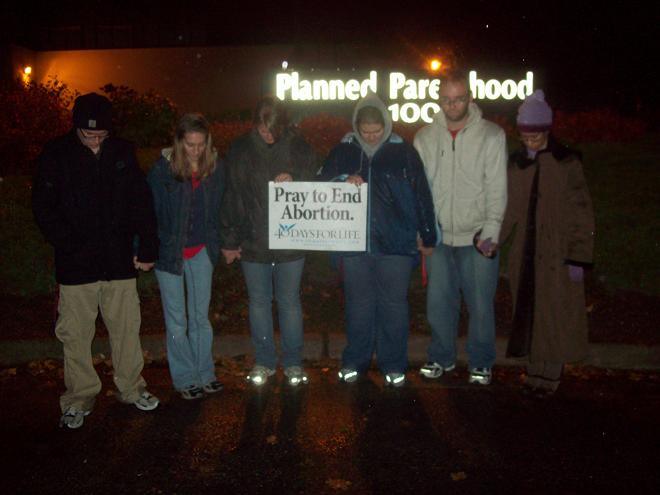
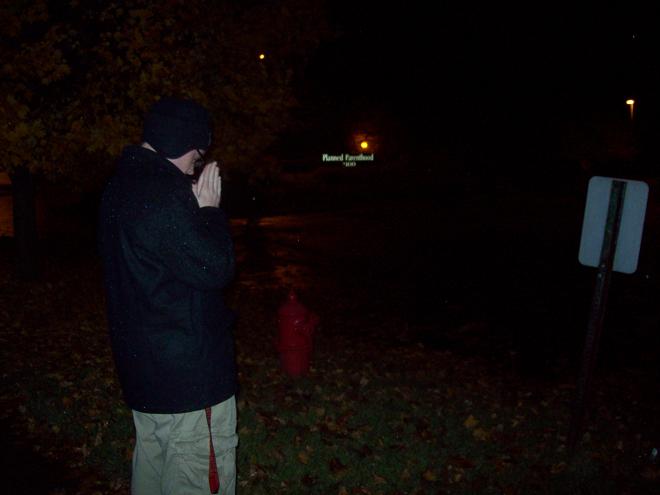
Abortion Clinic Prayer Vigil
As part of 40 Days for Life, a group I’m in on Campus (Concordia Students for Life) went to an abortion clinic that was shockingly close. I’ll be discussing the experience, and there are a few photos:
When we first arrived on site, there was a man there to talk to us about what we could/could not do, where we could go, etc. It was late evening, so it was closed, but two employees drove by us while we were talking to the man. One of them had her hand over her mouth as she drove past. Not sure what she might have been saying/thinking but I hope that it may have been sorrow or regret of some kind. The man who was there told us about just talking to people, a couple stories, etc. The most striking thing though was him talking about the “medical waste” trucks that would come and take the “waste.” It’s disgusting… discarded babies, hauled as “waste.”
Once the man left, we stood in a circle and prayed. Then we sang some songs, just pieces of hymns or praise songs that we could remember. Then we separated and prayed individually.
The setting was so perfect. It was raining, freezing cold, and dark as sin. It was so striking to think of my previous thoughts on the notion of suffering and how God understands human suffering. Thinking of the rain as God’s tears… and thinking about the fact that just days before we drew 3200 hearts in chalk on the pavement outside the chapel to show the number of hearts each day that are never allowed to love. Those hearts were being washed away at the end of the day, just as the hearts they’d represented had been extinguished that entire day (several of us had this same thought). But we were there to protest, we were there to pray, to ask for forgiveness, and to acknowledge the Redeemer.
It was a truly powerful experience. There is an air about the place, a spiritual kind of malevolence. The moment I stepped onto the general property, I could feel it. I immediately teared up. What could I say? What prayer could I offer? I simply repeated a version of the Kyrie (“Lord have mercy, Christ have mercy, Lord have mercy on us”) the entire time as I prayed with emotions and thoughts, not words, just feelings. What kind of atrocity have we allowed? Will my generation stand against this? I pray it shall be so.
Most striking to me is the difference between just talking about abortion from an impersonal perspective and being at a clinic where I could feel the effects. I’m not trying to say it’s not worth trying to debate abortion from an objective standpoint, but it is so much more real than that (see here for my own arguments against abortion). It’s not something that’s just an interesting topic, but it is a matter of life and death, and it’s a matter of life on death on a huge scale. Several thousand a day in U.S.A. alone. What kind of happiness are we pursuing when we murder the innocent? It speaks volumes about our values that a “choice” is valued above a life. We have become such pragmatists that we can turn a blind eye to the massacre next door. It’s disgusting.
We can’t claim to care about freedom or justice or liberty and deprive thousands of people of their lives each day. It’s horrible. And the only response I can muster, the only prayer I can utter is “Lord have mercy on us.”
There are a couple pictures below.
The Suffering God: Christianity, Evil, and God
Christianity is confronted with many questions in this era.
What is it that makes Christianity different?
Aren’t all religions the same?
Are not all the gods people worship really just the same god?
I (and many before me) suggest, however, that there is an answer to all of these questions. One of my professors, the Reverend Dr. Richard J. Shuta, told a story in our class. He was on the way back home, waiting for a cab. A man was waiting with him. Rev. Dr. Shuta is a theologian, and the man, who would be travelling in the cab with him, was a professor of philosophy. The man cut to the chaise and said, “I have just one question. If I stand on a street corner and I see a church, a mosque, a hindu temple, a buddhist temple, etc… why should I enter the church instead of any other?”
Dr. Shuta’s answer was simple, but profound. “Suffering.”
It is remarkable, in my opinion, that suffering, which is often used as a weapon against theism (see my post on this topic), can be such a remarkable explanatory tool for Christianity. For it is suffering itself which sets Christianity apart.
If a list of all the things that united all humanity were compiled, I am sure that suffering would be near the top of the list. Suffering is something each and every individual experiences on some level. It is how we make sense of this suffering that is different.
The God of Christianity understands this universal concept. The God Christianity worships is symbolized by a Cross, the image of suffering. Other religions demand that humanity approaches god. They demand that humanity make oneself better, purify oneself, become nothing, etc. Christianity has God do it for us. God came to us, God suffered, God took the burden on Himself so we may live in eternity.
The Suffering God is the God of Christianity. The Loving God is the God of Christianity. What is it that makes Christianity different? The God of Christianity knows pain, and understands it, and experienced it.
Again, it is the Cross that defines Christianity. What do Christians believe? Christ crucified for all.
Ravi Zacharias states, in Can Man Live Without God? “It is the cross that invites us to die to self that the life of Christ may live in us fully. Without the cross there is no glory in man. The difference between man-made utopias and a God-made heaven is the cross (178).” [Emphasis his]. It is the cross. It is this symbol of suffering Christ. The symbol of our Suffering God. Suffering unites humanity, and God knows this suffering intimately.
Modern theism, according to N.T. Wright, seems to tend towards Enlightenment Deism. I’d tend to agree. Even Christians tend to think of God as some far away being that “loves us” but doesn’t really interact with us. It’s a concept that must be abolished from Christianity, for our God is the God who is Here. Our God is Immanuel, literally “God with us.” This God of Christianity is the one which we have too often abandoned and modified with our philosophical meanderings, allowing worldly concepts to permeate a personal, truly loving God.
The Cross is suffering. The symbol with which we refer to Christ is a symbol of suffering. It is this idea that is vastly important when thinking of Christianity. Christianity acknowledges suffering. Its symbol is one of suffering. Christianity explains suffering in human terms, rather than reducing it to naturalistic accounts, trying to explain it away, and the like. Christianity realizes there is real suffering in the world, and worships the God who suffered Himself that we be reconciled to Him.
Dietrich Bonhoeffer, that great German pastor, martyred for his faith by Hitler, wrote in Ethics, “It is with the Christ who is persecuted and who suffers in His Church that justice, truth, humanity, and freedom now seek refuge; it is with the Christ who found no shelter in the world, the Christ who was cast out from the world, the Christ of the crib and of the cross, under whose protection they now seek sanctuary… (61).”
Christ’s suffering is our shelter.
I’d like to conclude that there is therefore a kind of argument because of evil, not a problem or argument of evil that can be presented in defense for Christianity, rather than as an offense against it. I haven’t fully developed this argument, so I don’t have a formal layout yet. Instead, I’ll present it in informal fashion:
There is a universal suffering which leads to a universal need for comfort. This universal need seems to imply that there is comfort to be had. There is, in fact, some comfort to be had. If there is comfort to be had, it further seems that this comfort must be, possibly, universal. Comfort can only be transferred on a personal, rather than an impersonal level. Thus, the universal comfort must interact on a personal level. A universal comforter that is personal tends to point towards theism rather than any other worldview.
This is only the bare-bones of an argument I’ve only recently started to develop, and I’d be happy to receive feedback, positive or negative.
Counter-Counter-Apologetics 1: Redeeming Pascal’s Wager
When I first started to get into apologetics, one of the first sites I stumbled upon was Iron Chariots, a counter-apologetics site.
This site’s mission statement is “Iron Chariots is intended to provide information on apologetics and counter-apologetics. We’ll be collecting common arguments and providing responses, information and resources to help counter the glut of misinformation and poor arguments which masquerade as “evidence” for religious claims. ”
Note especially the scare quotes they use around evidence. This is a tactic atheists are very prone to using. Anything they disagree with, they put quotes around to make it look less true. Atheists are “right.” See? Fun, isn’t it? Does it do anything of value? No.
Anyway, it was sort of disturbing to see that there are those who are trying any means necessary to get around theism. I left the site a little scared, wondering if Christian Apologetics was all it is said to be. Well it is. After much more studying and forgetting completely about this site, I stumbled back upon it the other day, and decided to see what the anti-theists are saying about apologetics. Not much of value, in my opinion. And because I feel like it, I’m going to start countering their counter apologetics in a series of posts that will happen randomly interspersed with my others. These posts won’t just include arguments from this site, but will also include things like my counter for the “Argument from Atheism” (AKA “One Step Further Argument”).
This article will focus on Pascal’s Wager. Before I proceed, I should note that I absolutely do not think Pascal’s Wager is a good tool for witnessing, nor is it all that great as an argument. But it is, I think valid, and while it should not be used as a reason to believe, it does provide what, in logic, is called a dilemma for the atheists.
Pascal’s Wager is essentially as follows: God exists or He does not exist. If He does exist, there is infinite reward for believing in Him, but infinite loss for not believing in Him. If He does not exist, there is nothing to lose. “Nothing to lose, everything to gain,” is often the summing-up of this dilemma.
Iron Chariots accurately, in my opinion, points out that there isn’t nothing to lose by disbelieving. If there is no God then,
“For one thing, if you go through life believing a lie, that is a bad thing in itself. Besides that, there is more to being a believer than just saying “Okay, I believe now” and getting on with your life. Serious believers spend a lot of their time in church, and contribute a lot of money as well. There’s a reason why some towns have very affluent looking buildings for churches, and why large and elaborate cathedrals are possible: they’re funded by folks who donate a tenth of their income throughout their lives to tithing. This is surely quite a waste if the object of worship isn’t real.”
The article then goes on a rant about property taxes, persecution, etc., things which will not be discussed here because, frankly, I find these arguments ineffably dull, though I may be forced to talk about them in the future.
So yes, I concede that there is a reward for not believing if there is no God. They also accurately show that there can be finite rewards for believing in God even if He doesn’t exist, because of psychological benefits, society, etc. Unfortunately, they plug these positives into a table of good life vs. bad life instead of actually in Pascal’s Wager. So I’ll just do the work for them.
Pascal’s Wager
God Exists | God Doesn’t Exist
Belief ∞ + | Finite +
Disbelief | ∞ – | Finite +
Okay so the table isn’t working so well. I think it can be figured out. Anyway, the main argument is that there is after all, a reward for not believing if there is no God. The problem is that even if that reward outweighs the finite reward of believing in a non-existant God, that still must be weighed against the infinite negative of not believing if there is a God. The argument that there is a reward for not believing, so it is logical to not believe breaks down when you weigh the infinite negative of disbelief if God exists verses the finite positive of disbelief if God does not.
There is one final point I’d like to make. That is, that the same site continues to argue that another problem is which god to believe in. I’d like to counter that by saying that isn’t the point of Pascal’s Wager. Belief in a god is better than belief in no god, because the probability for infinite reward still increases (in that it will be 1/however many gods to choose from) verses the probability for infinite negative (which would be certain if there is a God). So Pascal’s Wager still stands. I grant that the probability increase would be very low, so some may then argue that it’s not worth giving up the finite reward of not believing in a god. The response could then be that there is still a granted finite reward in believing in a god if god doesn’t exist, and any increase in probability for infinite gain verses infinite loss would outweigh the any loss of finite reward that could be gained from disbelief. In other words, the increased probability plus the finite reward of believing in a god would outweigh the definite probability of infinite negative if there is a God combined with the finite reward of not believing in a God.
Sorry for the drawn out post, but I wanted to respond thoroughly. There is more I’d like to say, but that’s where I’ll end for now.
Freedom of Will/Divine Omniscience continued
On other sites (well, facebook anyway), the previous post generated a lot of interest, so I decided to continue with a very brief discussion raising a couple extra points.
The two main problems I have with any view other than divine omniscience AND human freedom (specifically, molinism) is that those who reject divine omniscience seem to reject Biblical teaching on this doctrine. There are plenty of verses that talk about God knowing all things. He even challenges those who would be gods to tell the future.
The most convincing case, however, in my opinion, is the fact that there is prophecy throughout scripture, given by God. Not only that, but Jesus himself prophesies. Also, the writers of the gospels continue to say things about Jesus that are prophecies fulfilled. Finally, Jesus predicting Judas’s betrayal and Peter’s denial can only be explained by his foreknowledge of such events. While some may assert that Jesus intuited such events, this derives them of all theological significance. Thus, those who do not want to deprive the gospel message and Jesus’ divinity, I believe, must adhere to omniscience.
Similarly, there is a vital (I think) flaw in those who assert that our free will doesn’t exist or that it is just an illusion. This flaw is the fall into sin. If God knows all things, and our free will is only an illusion to us, then we fell into sin by his knowledge AND will.
Theologically, God foreknowing man’s fall into sin is not an issue (another vast subject), but it would be for those who do not believe we have free will.

 J.W. Wartick - Reconstructing Faith