God
Book Review: “Chance and the Sovereignty of God” by Vern Poythress
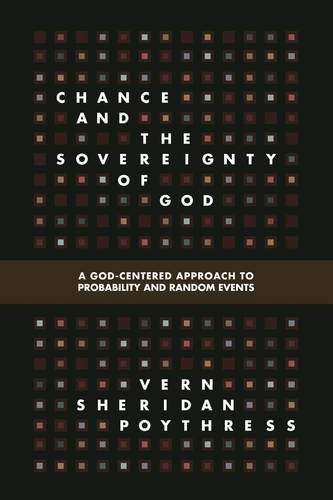 When I saw the title Chance and the Sovereignty of God: A God-Centered Approach to Probability and Random Events, I pounced on the opportunity to review it. This is a topic I’ve been considering for doctoral work so I was extremely excited to dive in.
The book starts off well, with discussions on the nature of chance and exploration of the biblical material for anything dealing with seemingly random events. Poythress ably shows that the Bible clearly presents God as in control of all these events. Numerous verses suggest that God is in control over “all” events, while verses which explicitly mention seemingly random or chance occurrences also attribute such events to divine knowledge and control. Poythress’ look into these topics is detailed and broad. He addresses the weather, random events like the toss of a die, human free choices, the life and death of the smallest creature or plant, and even gambling! These things are all argued to be ultimately, biblically under the sovereignty of God.
Another area the book excels in is the discussion of chance in rival worldviews. Any view which denies the centrality of God is one which suppresses the knowledge of God (Romans 1). Poythress notes that this means that “chance” may become a God-substitute. Chance is seen as being not only the explanation of events but their actual cause:
People are implying that [Chance] has the power to bring about events… The word chance first gets associated with events that we as humans cannot predict or explain… Then, in a second step… [Chance] becomes a label that we offer as the new explanation for the unpredictable event… We say “Chance brought it about”… (Kindle Location 1707)
Chance as an explanation, Poythress argues, is ultimately empty. For chance is substituted to become whatever we cannot predict or explain, and is then used itself as the explanation. I found Poythress’ comments here interesting and very insightful. His application of this concept to other worldviews later in the book makes it worth the read for these sections alone.
One difficulty with the book is the question of audience. At times, the discussion of probability theory becomes complex and very scholarly, but the earlier sections of the book speak broadly and with words that seem aimed more at a general readership. This mixture of technical and general writing makes it hard to pinpoint the audience. Who is supposed to read this book? What is it supposed to be used for?
Another problem I saw in the book is the lack of thorough argumentation for many points. No complaint of this nature may be lodged against the book’s discussion of probability theory, which is well fleshed-out. But on God’s relation to probability theory and how that relates back to sovereignty, there are often only a few sentences at a time to make a claim about the nature of the interrelationship. For example, throughout Section IV on “Probability and Mathematics,” there are lengthy discussions of probability theory with passages on how it relates back to God seemingly tacked on throughout. Near the beginning of this section, one sample is representative:
Both of these [mathematical] principles [discussed above] have their foundations in God… The separations within this world have their ultimate foundation in the distinction among the persons of the Trinity… The unity and diversity in outcomes rest… on the original pattern of unity and diversity in God. God has caused the creation to reflect his glory and wisdom. (Kindle Location 3346)
Poythress does make some earlier references to this argument, but it just never seems to be fully established and surely a statement about mathematical separations for probability in the world being a reflection of distinction among persons in the Trinity may cause some skepticism. It is a point which begs for more argumentation than was dedicated to it here. Where Poythress does address it (Chapter 11), we find more detail to the arguments, but even more questions left unanswered. For example, granting that God is revealed in all things which are made, why think that a sequence of flipping coins is explicitly a revelation of the Trinity instead of simply a revelation of God’s imbuing the universe with order and regularity so that seemingly random events are possible? But Poythress takes it as the former–a revelation of the Trinity–without so much as a comment on alternative possibilities.
Perhaps more problematic is that Poythress never seems to tackle the broader implications of his biblical argumentation. Yes, he put much work into showing God is sovereign over the weather, chance events, free will, and the like. But I kept thinking, “And now what?” What does it mean to say God is in control over natural disasters? What does it mean to say that the roll of dice I make in a game of Risk, for example, is controlled by God? What are the implications of the biblical data Poythress has set before me? Topics like these are taken up at points, only to be quickly set aside by a paragraph or even just a sentence or two.
Overall, Chance and the Sovereignty of God is an interesting look at an oft-neglected topic, but its scope is too broad and its argumentation at times too vague to be helpful. On biblical issues Poythress has offered much to consider. His outline of probability theory is helpful but technical. What I found after reading the book is that I continued to hope for a more detailed discussion on how sovereignty would interlink with chance. Yes, the book makes it plain that God has sovereignty over seemingly random events, but exactly how does that work? What does that mean for everyday life? At times these topics are taken up, only to be set down after but a few sentences. At times helpful and stunningly insightful, at other times frustratingly vague and broad, it’s a book that will leave you longing for more.
Links
Be sure to check out the page for this site on Facebook and Twitter for discussion of posts, links to other pages of interest, random talk about theology/philosophy/apologetics/movies and more!
Source
Vern Poythress, Chance and the Sovereignty of God: A God-Centered Approach to Probability and Random Events (Wheaton, IL: Crossway, 2014).

Disclaimer: I received a review copy of the book through Crossway. I was not obligated by the publisher to give any specific type of feedback whatsoever.
SDG.
——
The preceding post is the property of J.W. Wartick (apart from quotations, which are the property of their respective owners, and works of art as credited; images are often freely available to the public and J.W. Wartick makes no claims of owning rights to the images unless he makes that explicit) and should not be reproduced in part or in whole without the expressed consent of the author. All content on this site is the property of J.W. Wartick and is made available for individual and personal usage. If you cite from these documents, whether for personal or professional purposes, please give appropriate citation with both the name of the author (J.W. Wartick) and a link to the original URL. If you’d like to repost a post, you may do so, provided you show less than half of the original post on your own site and link to the original post for the rest. You must also appropriately cite the post as noted above. This blog is protected by Creative Commons licensing. By viewing any part of this site, you are agreeing to this usage policy.
Book Review: “In the Beginning God: A Fresh Look at the Case for Original Monotheism” by Winfried Corduan
 Rarely does a book come along which forces a reader to completely rethink how they’ve viewed a whole slew of interrelated topics. Winfried Corduan’s latest work on the origin of religion is just such a book. I’ve waited some time to finish writing the review simply because it’s taken a while to reflect upon its content and reread and absorb many of the arguments to support the conclusions Corduan provides. Here, I offer some thoughts which can only touch upon the wealth of information in this fantastic book.
The Thesis
Winfried Corduan’s central thesis is simply stated:
Regardless of how one explains the origin of human beings, one cannot get around the fact that the first religion of human beings was monotheism, the recognition and worship of one God.
The way Corduan defends this claim is initially through analysis of competing claims of major thinkers in the past and present on the origin of religion. He then provides a positive case for original monotheism.
Critical Examination of Competing Views
Corduan surveys a number of major thinkers in anthropology who have proposed various ways that religion may have arisen and developed. A central thought throughout many of these thinkers is the notion that cultures, like organisms, evolve. Thus, the thought was that the earliest stages of religion would be “primitive” while later stages of religion would be more complex and perhaps people would even move beyond religion.
The various theses Corduan examines are each interesting in their own light. Max Müller’s theory that mythology is corruption of human language is wonderfully imaginative, though ultimately bereft of real evidential backing. E.B. Tylor’s application of Darwinism to the development of religion remains highly influential but also provides insight into how a paradigm may corrupt and even create evidence. Andrew Lang set the stage for later thought about how religion may have developed, but unfortunately his theory suffered from assumptions that anyone not “developed” like the Europeans was clearly inferior or lower on the evolutionary scale. Thus, his theory suffered from its own brand of self-confirmation and key blind spots.
A telling critical insight Corduan provided which applies to many of the evolutionary perspectives on the origin of religion is that the field evidence gathered for these hypotheses operated under a critical assumption: “nineteenth-century anthropology proceeded on the premise that the ancient past has preserved itself. We can still see it in full bloom in the cultures of tribal people. Human beings who are now living on a stone-age level must have preserved stone-age culture, they argued.
But of course this doesn’t follow at all. It is perfectly possible for such “stone age” societies to in fact be extremely complex and advanced. In fact, Corduan provides much evidence to suggest that this is exactly the case. Highly complex rituals and traditions are often found in these allegedly primitive societies. Moreover, many of these societies show kinds of vestiges of original monotheism, which itself provides counter-evidence to the hypothesis that these societies support the notion of evolution of religion.
A Case for Original Monotheism
Corduan’s case for original monotheism incorporates many aspects of Wilhelm Schmidt’s work. Thus, he dedicates a few chapters to analysis and defense of Schmidt’s theories. Schmidt’s theories are based off of his analysis of how cultures shift. Corduan provided fascinating and practical examples to look at how cultural movement works. One application of this to the origin of religion is that societies shift and push competing cultures either to adapt and integrate or to be pushed more to the fringes. Early settlers are often supplanted by later explorers who stayed in one place and developed before moving on. Allegedly primitive societies are often found in the deserts or at the outskirts of society because they were the first to move on and thus developed only as they settled in ever-distant areas. However, this cannot be used to support the notion that a “stone age” level of a society today entails the preservation of cultural behaviors and practices from such a time period.
The shifting of cultures through “culture circles” thus is used to evaluate how religion may have developed and moved across the Earth. Most importantly, Schmidt worked with the anthropological data that other researchers used, but he approached it without the dogmatic stance that the development of religion must have been Darwinian. This assumption led many other researchers to reject or downplay aspects of the observational evidence because they did not fit the theory. Schmidt discovered, however, that a number of cultures had vestiges of monotheism from earlier times. This resulted in Schmidt hypothesizing that one possible explanation for the shared original monotheism of these cultures could have been an actual deity.
Corduan then provides analysis of a number of critical responses to Schmidt as well as more modern evolutionary or simply agnostic approaches to the origin and diversification of religion. Finally, he surveys a number of world religions to see if aspects of original monotheism may still be found therein.
 Interesting Avenues to Explore
Other avenues are opened as Corduan analyzes specific cultures, such as Egypt or China, and finds that Egypt’s brief affair with “monotheism” may not have been as significant as some take it or that China’s modern religious thought perhaps reflects an original monotheism beneath the surface.
The application of various aspects of anthropological research and the rejection of agnostic approaches to the origins of religion also open up new avenues for research and exploration. If we don’t assume that we can’t know something, how might we approach the project of discovering how religion may have originated and spread? Corduan, of course, provides Schmidt’s theories as one way, though he also integrates insight even from those scholars with whom he disagrees. Thus, he provides a rather integrative approach to the question.
The analysis of various anthropologists who have thought on issues of the origins of religion also open up new ideas to explore, books to read, and evidence to consider.
Avenues for exploration like this are found throughout the book in droves. I mean that: there is so much in this book that makes me want to know more, to learn more. That is coupled with the fact that it made me realize, again, how little I do know regarding entire fields of research and study. In the Beginning God is a call not only to re-evaluate one’s presuppositions, but also a vast treasury of topics to explore.
Of course another extremely interesting thought to examine is that if monotheism were the original religion of people of all sorts, might this have implications for apologetics? Ultimately, Corduan answers in the affirmative. He argues that at least some aspects of this study point to the existence of a monotheistic deity as a possible explanation for the data. He does not think that the anthropological study provides a comprehensive case for the Christian truth, but he does ultimately argue it can be one factor among many to show the truth of Christianity.
A Final Defense
The immediate reaction of some might be that Corduan’s bias yields his results. Similarly, in Schmidt’s time, some alleged that missionary influence led to the purported evidence for original monotheism. However, it should be clear that although everyone has a bias, the evidence presented by Corduan seems impossible to dismiss as simply the wishes of a theist. Rather, he has provided sound reasons for thinking that original monotheism is a relevant hypothesis which perhaps outstrips its opponents in terms of explanatory scope.
Conclusion
In the Beginning God: A Fresh Look at the Case for Original Monotheism
Links
Be sure to check out the page for this site on Facebook and Twitter for discussion of posts, links to other pages of interest, random talk about theology/philosophy/apologetics/movies and more!
Sigmund Freud, Totemism, and the origin of religion- Who cares about facts?– I analyze some of Corduan’s comments regarding Sigmund Freud’s theorizing about the origin of religion.
Sunday Quote!- Is Monotheism from Egypt?– I provide a brief quote from Corduan’s book and note how it may interface with some theories related to the source of monotheism.
Source
Winfried Corduan, In the Beginning God: A Fresh Look at the Case for Original Monotheism
SDG.
——
The preceding post is the property of J.W. Wartick (apart from quotations, which are the property of their respective owners, and works of art as credited; images are often freely available to the public and J.W. Wartick makes no claims of owning rights to the images unless he makes that explicit) and should not be reproduced in part or in whole without the expressed consent of the author. All content on this site is the property of J.W. Wartick and is made available for individual and personal usage. If you cite from these documents, whether for personal or professional purposes, please give appropriate citation with both the name of the author (J.W. Wartick) and a link to the original URL. If you’d like to repost a post, you may do so, provided you show less than half of the original post on your own site and link to the original post for the rest. You must also appropriately cite the post as noted above. This blog is protected by Creative Commons licensing. By viewing any part of this site, you are agreeing to this usage policy.
Molinism and Aseity- A knock-down argument against middle knowledge?
 One of the most recent “Straight Thinking” podcasts–a podcast put on by Reasons to Believe–featured Travis Campbell discussing Middle Knowledge (which is an aspect of the philosophical theological position known as molinism). Middle Knowledge is, essentially, God’s knowledge of counterfactuals–that is, the knowledge of things like “If someone talks about molinism, J.W. Wartick will be interested.” That is a counterfactual because it states something which may be contrary to fact–that is, it depends on some condition to be fulfilled in order to be true (in the example above, it is the occasion of someone to talk about molinism).
On the second part of the interview, Campbell discussed some objections to molinism which he felt made the position intractable. One of the first objections he presented was an objection from “aseity” that is, God’s self-existence. According to the doctrine of divine aseity, God does not rely upon anything else for God’s existence. Now, molinism classically holds that God surveys the realm of possible worlds prior to the creative act and so sees all possibilities related to free creaturely choices. Then, God creates the world God desires. Campbell argued that this undermines God’s aseity because it makes God dependent upon creatures for omniscience–one of God’s essential attributes.
The argument, if sound, has great force. After all, if molinism means one must deny an essential attribute of God, there is a pretty serious difficulty with the doctrine. But does it? Campbell cited William Lane Craig, a leading proponent of molinism, as admitting that molinism entails that God’s knowledge, at least, is in some sense dependent upon creaturely choices. From what I have read of WLC,* I have found it seems he frequently makes it appear as though molinism presents God as able to choose among any parts of possible worlds to construct whatever possible world God wants. Not correct… but possibly also not Craig’s actual view;* perhaps Craig is only making it seem thus when he discusses molinism in summary. What I’m getting at is that I’m not convinced Craig is as consistent a molinist as, well, Molina (or in modern times, Thomas P. Flint).
Now for the claim itself, I do not think it follows that God is actually dependent upon creaturely choices. And, if it follows from molinism that God is dependent in that way, then it must also be true of any view which holds to foreknowledge whatsoever. In fact, this is where I have a pretty serious bone to pick with any view which denies comprehensive foreknowledge. Unless I am much mistaken–which is quite possible–the realm of possible worlds is a set of necessary truths. That is, each possible world is a complete set of all true propositions for the entire history of that world.*** But if that is the case, then molinism is no different on God’s creative activity than any other view of creation, for God is simply selecting one from a set of possible worlds.
There is debate over how such a set of possible worlds might be populated–does the set of possible worlds come from God, or is it simply a set of necessary truths?** Whatever one’s answer for this, it remains clear to me that molinism is not defective in this area: the molinist simply holds that God selects a possible world from the set of possible worlds. The fact that the molinist emphasizes that these possible worlds include free choices is essentially a moot point so far as aseity is concerned. If there is such a set of possible worlds, then any view of God’s foreknowledge and creation has to acknowledge that God’s creative act is the bringing forth of one such possible world. If there is no such set, then it seems our universe is necessary, which would itself be problematic for the doctrine of creation.
So it seems to me that Campbell failed to make a compelling argument against molinism from aseity. In order for his argument to be successful, he would have to show that molinism’s view of possible worlds is somehow radically different from any other position and then also demonstrate that molinism’s view also necessarily makes God dependent upon creaturely freedom. But of course that would also involve him having to show that the set of possible worlds, on molinism, is itself independent of God. And it seems to me that although perhaps not all molinists hold that God does generate the set of possible worlds, it is entirely possible for a molinist to consistently hold that this is the case: the set of possible worlds is dependent upon God. And, if that is true, Campbell’s argument fails. I conclude that Campbell’s argument fails because it is both incomplete and unsound.
*I have his Divine Foreknowledge and Human Freedom but I am working through Molina’s work before I transition into it.
**Interestingly, Craig is working in this area for his next major academic work, according to his own discussion of related topics on his podcasts.
***One may hold that a possible world is merely the starting conditions of a world, but I do not see how that distinction could be made coherently. That is, I’m not convinced that a set of possible worlds would not include the entire history of the possible world. Moreover, any who would argue that God has comprehensive knowledge of the future would have to grant that God’s creative act would entail the history of the entire [possible] world.
Links
Be sure to check out the page for this site on Facebook and Twitter for discussion of posts, links to other pages of interest, random talk about theology/philosophy/apologetics/movies and more!
SDG.
——
The preceding post is the property of J.W. Wartick (apart from quotations, which are the property of their respective owners, and works of art as credited; images are often freely available to the public and J.W. Wartick makes no claims of owning rights to the images unless he makes that explicit) and should not be reproduced in part or in whole without the expressed consent of the author. All content on this site is the property of J.W. Wartick and is made available for individual and personal usage. If you cite from these documents, whether for personal or professional purposes, please give appropriate citation with both the name of the author (J.W. Wartick) and a link to the original URL. If you’d like to repost a post, you may do so, provided you show less than half of the original post on your own site and link to the original post for the rest. You must also appropriately cite the post as noted above. This blog is protected by Creative Commons licensing. By viewing any part of this site, you are agreeing to this usage policy.
“Evermore: Edgar Allan Poe and the Mystery of the Universe” by Harry Lee Poe
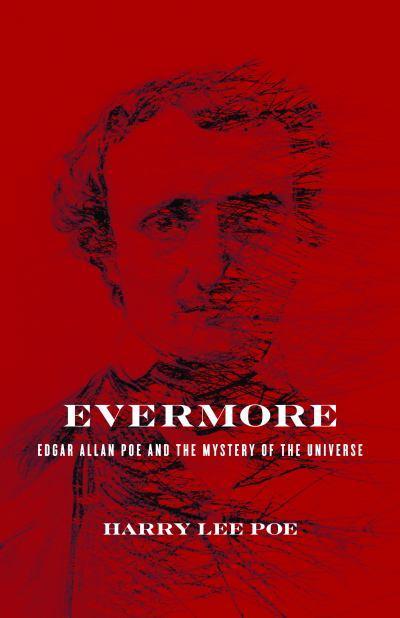 Edgar Allan Poe. His name immediately calls to mind images: a black raven haunting one’s thought, the beating of a heart driving one mad, gruesome, macabre deaths. It also brings to mind thoughts on the man himself: twisted, slightly mad, alcoholic, broken.
Are these images of the man’s work and life accurate? Harry Lee Poe (a cousin of Poe’s) argues that they are not. Instead, this kind of imagery is a result of both the popularization and the character assassination of one of the great American literary giants.
Harry Lee Poe’s work, Evermore: Edgar Allan Poe and the Mystery of the Universe
The Myth of Edgar Allan Poe
It is interesting to note that from the time he died, Edgar Allan Poe’s person was the target of a character assassination which would give rise to the popular portrayal of him as a dark, haunted drunkard. Rufus Griswold, a man who portrayed himself as a minister despite having never been ordained, published a work which has remained in the popular consciousness through the present day. In it, he falsified information about Poe and heavily edited a number of letters from the author in order to portray him as the dark, fearsome man he is often imagined even today. Harry Lee Poe exposes this mythos by noting the work of Arthur Hobson Quinn, who in 1942 published the letters Poe wrote alongside the altered letters Griswold used to make the image he created.
Thankfully, Edgar Allan Poe’s (hereafter EAP) image has been recovering in scholarship, but the damage at a popular level continues to be seemingly ubiquitous. The image of Poe as a brooding man matches what people wish to see when they read his works of horror and thrills. However, Harry Lee Poe (hereafter HLP) notes that there is much more to EAP’s body of work than is often known.
The Broader Poe
EAP’s body of work had its share of horror and mystery, but it also featured humor and satire, science fiction, and beauty. Remarkably, EAP contributed to the formation and even creation of entire genres which are extremely popular today. His science fiction was, at the time, known as “hoaxes” because no actual genre existed in order to encompass them. He also wrote the first detective mystery works to be known in literature. He was innovative and unique in his contributions to literature. He truly stands easily among the literary giants of all time.
The distribution of his works is also worth noting. EAP intentionally wrote in a number of different ways about a number of different things. HLP documents his major tales, numbering each under headings of genre. The results are surprising: EAP wrote more humor and satire than he did horror. Yet he is largely known today only for the latter (24-27). It is worth looking at Poe’s entire body of work in order to understand the man.
Mystery and Reality
One of the central parts of Poe’s work involves the writing of mystery stories. As has been noted, EAP was the first to write in the specific genre of detective mystery stories. EAP’s use of the mystery story shows that he assumed the problem of evil as a very real difficulty. However, the concept of a detective mystery story, in which the reader, through the characters, seeks to solve the mystery and find the one who committed the crime. In short, there is a broader concept of justice involved in a mystery story. Unless there is justice in the universe, the problem of evil cannot present a difficulty for one’s worldview, for evil could just be a given.
EAP, who had written horror stories already, moved the blood and gore from the climax of the story (horror) to the beginning (mystery). The rest of the story would not be about the blood and gore, but about righting a wrong: “injustice cannot be allowed to continue… the sense of justice assumes the basica rationality and order of the universe so that Truth may be discovered. The reader wants to know the truth” (115).
Beauty and Love
The concept of beauty was central to EAP’s work. He used the concept to evoke a particular feeling related to the injustice of crime, but he also saw beauty as a way to point beyond the mundane. “Beauty constituted to Poe evidence that human experience is not bound by time but belongs to eternity” (83).
The different varieties of love are exemplified throughout Poe’s works. Affection, friendship, and passion are developed by HLP to explain EAP’s concepts of how these related to the world at large. Each of these concepts could be forces for the positive or for ill. Affection, friendship, and passion could each become corrupted, and each would lead to devastating results if one allowed this to happen (86ff). Love provided a difficulty for EAP, for he saw that it may tell us about something beyond the world: it may inform us about God. But if it could be perverted, does that suggest an outside source from which love sprang, which we corrupted (107-108).
Eureka
Perhaps the most interesting portion of Evermore is the discussion of EAP’s own views as he expounded them in his work, Eureka. In this work, Poe examined the mystery of the universe. He held that the universe had a beginning and was actually expanding. He argued that light and electricity belonged “to the same continuum.” His view was close to the modern theory of the Big Bang. Yet EAP thought of this around a century before the latter came into vogue. Because the universe began, “Poe concluded that a God exists who created the universe for his pleasure. Love and Beauty provide a glimpse of God… Pain, suffering, evil, and death are the contingencies of physical existence that are left behind” (55). EAP saw the universe as a grand story, which was “the plot of God” (ibid).
The reasoning behind EAP’s amazingly prophetic vision of cosmology was found in his own observations. He noted the difficulties presented by the notion of an infinite universe, including the fact that the night sky had places where there were no stars to be seen (known as “Olber’s Paradox”).
In Eureka, EAP postulated a deity. It seemed intuitively obvious to him that if the universe began to exist, God must exist. Given that his own observational evidence led him to the conclusion that the universe began, he concluded that God exists. Moreover, he posited that this deity would have to design the universe and guide its expansion from a primordial particle (152). However, this deity was essentially pantheistic, which was his solution to the problem of evil. Each individual person would become Spirit individualized. God would become all-in-all, thus bringing holiness to all.
Edgar Allan Poe’s Beliefs?
HLP argues that EAP may indeed have become an orthodox believer late in life. Having already come to the conclusion that God exists and that the universe had a beginning (itself something EAP noted matched remarkably with the Biblical account), Poe would come forward at a Sons of Temperance meeting. HLP notes that such a move cannot be abstracted purely as coming out against alcoholism (something EAP struggled with himself). Instead, the group was explicitly evangelical in nature. Coming forward would be similar to someone today coming forward at a Billy Graham meeting (166). Those interested in Poe’s beliefs must therefore come to one of two conclusions: either he was “the charlatan and scoundrel that Griswold said he was” or “he had a conversion experience.” The Sons of Temperance taught explicitly evangelical Christianity, which would suggest that if EAP was genuine, he had come to accept a more evangelical, orthodox faith before he died.
Conclusion
Few works have intrigued me as much as Evermore has. Edgar Allan Poe has been a favorite of mine for some time, but I admit that I had bought into the stereotypical picture of the man as much as anyone else. Having only really read his horror and some poems, I have not had a complete vision of his actual body of work. Harry Lee Poe does an exemplary job of showing how EAP explicitly viewed his works as a growing body of interconnected themes, seeking to find the mysteries of the universe.
Edgar Allan Poe was a visionary. He was a great American author whose writings paved the way for hundreds of years to come. He was also well ahead of the science of his day, and similarly had already deduced the theological conclusions well before others had attempted to do so. Harry Lee Poe has presented a convincing, thorough look at EAP’s entire body of work. Having done so, he makes the man even more interesting than the myth. Edgar Allan Poe’s explorations of the mysteries of the universe leaves me profoundly interested in the man and his body of work. I highly recommend Evermore: Edgar Allan Poe and the Mystery of the Universe
Source
Harry Lee Poe, Evermore: Edgar Allan Poe and the Mystery of the Universe
SDG.
——
The preceding post is the property of J.W. Wartick (apart from citations, which are the property of their respective owners, and works of art as credited) and should not be reproduced in part or in whole without the expressed consent of the author. All content on this site is the property of J.W. Wartick and is made available for individual and personal usage. If you cite from these documents, whether for personal or professional purposes, please give appropriate citation with both the name of the author (J.W. Wartick) and a link to the original URL. If you’d like to repost a post, you may do so, provided you show less than half of the original post on your own site and link to the original post for the rest. You must also appropriately cite the post as noted above. This blog is protected by Creative Commons licensing. By viewing any part of this site, you are agreeing to this usage policy.
Ben Hur- The Great Christian Epic
 There was a time when Hollywood battled for which studio could churn out the best epic, the greatest film, the most splendor upon the big screen. “Ben Hur” was a film which towered above all the rest. It won 11 academy awards, a feat matched only by two other movies (“Titanic” and “The Return of the King”), but it was also the only one of those three to win for acting (Best Actor: Charlton Heston as Ben Hur and Hugh Griffith won Best Support Actor).
Although best remembered for its famous chariot race scene, the film’s themes continue to echo with our own times. At the heart of “Ben Hur” is a struggle between ways of viewing the world set alongside an epic story which relates that struggle to the cosmic struggle for redemption and salvation of the people of God. There will be SPOILERS for the film in what follows.
Background
It is important to note that “Ben Hur” is based upon the novel of the same name by Lew Wallace. Wallace, a general during the Civil War, was disturbed by a conversation he had with a prominent skeptic of the time, Robert Ingersoll. Ingersoll’s challenge against the historicity of Christianity gave Wallace a great desire to search the historical acconts around the time of Christ and compose Ben-Hur: A Tale of the Christ
A Battle of Worldviews
The question of worldview is explored throughout the film. What is it that makes hte people of the Roman colony of Judea so obstinate? They seek after Messiahs, after a different savior each day of the week. One conversation poignantly illustrates the heart of this conflict:
Sextus, a centurion in charge of the Roman garrison asks Messala, who has come to relieve him, “How do you fight an idea?”
Messala responds “You ask how to fight an idea? Well, I’ll tell you how: with another idea.”
Messala realizes that at the heart of the people’s will is their worldview. Their hope is in the destruction of Rome. They long for a Messiah who will lead them to a successful revolt to throw off the Romans. Yet Messala desires to fight this hope with his own worldview: that of the power of humankind. Rome is power, and for him, the Emperor is that power deified.
 Revenge
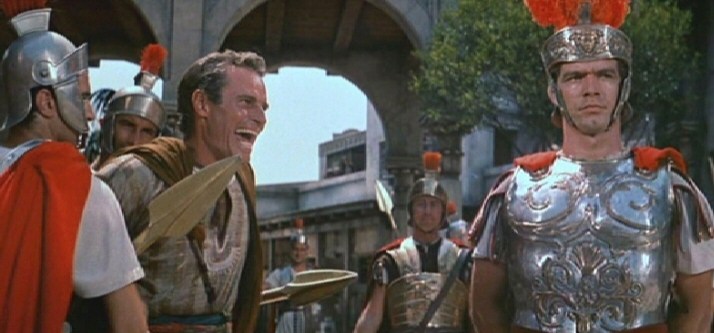
Vengeance. It’s a theme which seems initially to drive the movie. Messala betrays his friend, Judah Ben Hur, towards the beginning of the film. The Hur family is thrown into prison to languish there, and Judah is sent to the galleys to row as a slave. Judah swears to Messala that he will take revenge upon him upon his return. In a deeply ironic voice, Messala responds, “Return?” The life of a galley slave is not expected to be long.
But Judah does return. He rescues the Roman Quintus Arius who is in charge of his ship and is eventually adopted into the Arius family. He returns to Judea as the son of a consul, with all the power and privilege his rank implies. After learning of a way to take revenge upon Messala without the possible legal ramifications–by besting him in the circus maximus in a chariot race and leaving Messala destitute from debt–Judah succeeds in the arena.
The climax of the quest for vengeance can be found in the scene in which Judah Ben Hur confronts Messala for the first time since seeming to come back from the dead. He slams his seal–the seal of the Consul QUintus Arius–into a document and stares Messala down. Now, Judah is in the superior position. He is the one whose victory is inevitable. From this point on, his vengeance seems assured.
However, after Ben Hur’s epic defeat of Messala in the chariot race, which leaves Messala not only broke but also leaves his body broken, it turns out that revenge is not as sweet as it may seem. Messala informs Judah “the race goes on”–his family is still alive, but they are lepers, left to flounder on the edges of society as unclean, cursed wretches.
It is not revenge which pays. It may give some kind of satisfaction for the briefest moment, but Judah learns its satisfaction is only fleeting. His glory must be found elsewhere, and it is not a glory he can bring himself.
Redemption
Judah is devastated by his discovery that his mother and sister are lepers. He realizes there is nothing he can do to save them, and it seems Messala’s own plan has achieved victory after all. Judah, moved by compassion, takes up his mother and sister in his arms despite their protests, almost guaranteeing that he, too, will contract the terrible disease.
He and Esther, a servant of his former household, take his family through the streets of Jerusalem. The latest Messiah, Jesus, is set to be crucified, and a crowd gathers there to watch. As Jesus dies, his blood runs through the rainwater as it spreads out symbolically to the world. When it touches the Hur family, they are cleansed of their diseases, washed utterly by the blood of Christ. In a stunning twist, it is not the hero who brings about victory, but rather the Messiah who has only been seen briefly throughout the film at pivotal moments. It is Jesus to whom all glory is given, not to Judah Ben Hur.
We have seen that Messala hoped in a human who took upon deity for himself. But the film (and indeed Wallace’s earlier book) show that this hope is misplaced. The God-man that humans should look to is not the conqueror; he is not god because he has human power; instead, the God-man Jesus Christ took on flesh in order to save, to humble himself and become obedient to death on the cross. It is a subversive tale. It is a story of redemption and salvation. It is an idea against which the powers of humanity and the devil muster all their strength to attempt to overthrow, but the idea lives on. It is the idea which cannot be overcome, cannot be outshined.
Conclusion
“Ben Hur” is my favorite movie of all time. The epic clearly portrays the truth that is above all truths: we are powerless, but God is powerful. Judah Ben Hur is unable to save that which he loves and must ultimately rely upon another, who saves them through the washing of his blood. Ben Hur’s story is our own in many ways. We continually struggle against the powers of the world and we often have motivations which are, at best, questionable. But ultimately, we find that when we rely upon ourselves, we are unsuccessful. Only when we rely upon God do we find success.
Sources
Tim LaHaye, “Introduction” in Lew Wallace, Ben-Hur: A Tale of the Christ
Ben Hur.
SDG.
——
The preceding post is the property of J.W. Wartick (apart from citations, which are the property of their respective owners, and works of art as credited) and should not be reproduced in part or in whole without the expressed consent of the author. All content on this site is the property of J.W. Wartick and is made available for individual and personal usage. If you cite from these documents, whether for personal or professional purposes, please give appropriate citation with both the name of the author (J.W. Wartick) and a link to the original URL. If you’d like to repost a post, you may do so, provided you show less than half of the original post on your own site and link to the original post for the rest. You must also appropriately cite the post as noted above. This blog is protected by Creative Commons licensing. By viewing any part of this site, you are agreeing to this usage policy.
“The Knower and the Known” by Stephen Parrish, Part 2
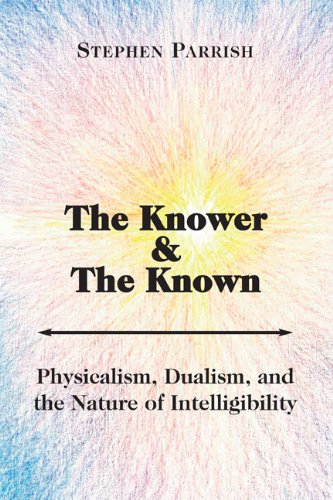 Stephen Parrish’s The Knower and the Known
Thought and Consciousness
What does it mean to have a thought? Parrish notes several aspects which go into the very act of knowing. There must be an object of knowledge; there must be a subject to consider the object; there must be consciousness in order to apprehend concepts and aboutness; there must be a relationship between subject and object and consciousness; there must be understanding of that relationship; and finally there must be a view of the world in which all of this can occur.
Consciousness itself is an extremely complex notion which involves phenomenality: the actual experience of thought; intentionality: the turning of one’s thoughts to consider an object; subjectivity: an agent which is itself the subject of the thought; and rationality: the capacity to order thoughts in such a way as to make sense of them. (206-213).
Consciousness has certain phenomenal properties. That is, when we consider our own thoughts, there is a distinct feeling to them which allows us to differentiate them from simple sense perceptions. There is an aspect of inentionality or attending-to our thoughts which is itself irreducible. Moreover, we are able to comprehend things which are themselves non-physical, such as the nature of a logical argument like modus ponens (226-228).
Consciousness must somehow interact with the physical world. If one is a physicalist, it becomes a matter of reducing consciousness to purely physical explanations, eliminating consciousness, or offering a brute relationship between consciousness and the physical world.
Qualia are also extremely important when considering consciousness. How is it that we are able to see objects as objects with certain properties? What process allows for individual particles/rays of light to manifest themselves in phenomenal consciousness in such a way as to provide a coherent picture of an object? Moreover, “there is more to recognizing qualia than just having color in one’s sensory field; there is also our attention to said qualia, the judgments we make about them, the objects that they represent, and also our memory of them–and these factors can make all of the difference” (257).
Subjectivity is also extremely important to forming a theory of consciousness. It seems that subjects are, in fact, irreducible. For the physicalist, the concept of a subject is extremely difficult. After all, a subject at t1 is going to be different from that subject at t2 in a number of highly relevant physical ways. Their neurons are firing differently from t1 to t2. How is it that subjectivity is maintained. The substance dualist holds that subjectivity is maintained through unity of consciousness which may not be reduced to the physical (291). The unity is preserved through intentionality but more thoroughly through rationality. The use of reason is one of the primary ways to offer continuity of the self. For the subject, S, at t3 is considering both thoughts at t1 and t2 in order to come to a conclusion at t4. Reason itself has aspects of intentionality which cannot be accounted for on a physicalist view of reality, for a physical object is capable of performing mathematical computations but not understanding the aboutness inherent in those computations (266-267).
Our Minds in the World
Parrish grounds his understanding of consciousness in a theistic worldview. There are numerous difficulties with an account of substance dualism which seem to only be soluble on a theistic interpretation. One of these is the problem of the interaction between body and mind. If God exists, then it seems inherently possible that a deity would be capable of forming the world in such a way that mind could interact with body. Parrish addresses several objections to the notion that an immaterial being could interact with a physical universe while also making an argument for non-physical selfs apart from God interacting in the universe (324ff).
The match of our minds with the world is something which must be accounted for. Parrish notes that if we ground ideal objects in an immaterial being like God, the difficulties with such objects existence and subsistence may be solved. Moreover, the glorious match of our mental life with reality is also explained, for a rational being is the source of all which we observe. If that is the case, then we no longer must appeal to simple brute fact to attempt to explain the phenomena of consciousness; instead, we may note that it is exactly as one might expect given theism (337ff).
And Then There was More…
Parrish concludes the work with a brief comparison of physicalism and substance dualism across multiple questions related to consciousness and the physical world. Finally, there are two appendices which address free will/agency and the theory of panpsychism, respectively.
Conclusion
In Part 1 of this review I outlined Parrish’s discussion of physicalism. Here, we have seen the structure of his substance dualism. It seems to me that Parrish’s deconstruction of physicalism is quite powerful. In particular, I noted that he makes a strong argument that physicalist theories ultimately boil down into either epiphenomenalism or mysterianism, neither of which is plausible. Moreover, his use of numerous examples and thought experiments throughout makes the work easier to comprehend while also providing a solid basis for grounding further discussions in philosophy of mind. Finally, the vast amount of research and documentation Parrish provides makes the work invaluable as a reference for physicalist writings alongside its clear value as a thorough critique of those same works.
The second major section, in which Parrish outlines his view of a theistic dualist ontology, is equally important. He provides a large amount of background for understanding how to put together various aspects of consciousness while also noting that, on theism, these observed phenomena cohere within an ontology, while on physicalism they are generally either discredited or ignored. The one thing the work may lack is a bit of cohesion in the section on substance dualism. Parrish has given a broad vision for how to hold a dualist ontology, but sometimes leaves it up to the reader to put the pieces together. The pieces are there, but not always assembled. I should note, however, that even here Parrish has provided an invaluable resource for those who wish to argue for a dualist vision of philosophy of mind.
I have already noted that Parrish’s The Knower and the Known is a tour de force in the realm of analyzing physicalist theories. However, the work is much more than a simple refutation of physicalism. Alongside that critique, Parrish has laid out the groundwork for substance dualism as a cogent alternative. Simply put, it is a must read for anyone with any interest in philosophy of mind. Comprehensive in scope, exhaustively documented, and interesting to read, The Knower and the Known is a must-have.
Source
Stephen Parrish, The Knower and the Known
SDG.
——
The preceding post is the property of J.W. Wartick (apart from citations, which are the property of their respective owners, and works of art as credited) and should not be reproduced in part or in whole without the expressed consent of the author. All content on this site is the property of J.W. Wartick and is made available for individual and personal usage. If you cite from these documents, whether for personal or professional purposes, please give appropriate citation with both the name of the author (J.W. Wartick) and a link to the original URL. If you’d like to repost a post, you may do so, provided you show less than half of the original post on your own site and link to the original post for the rest. You must also appropriately cite the post as noted above. This blog is protected by Creative Commons licensing. By viewing any part of this site, you are agreeing to this usage policy.
“Pacific Rim” – A Brief Christian Reflection
 Thankfully, a slew of science fiction films are being released this year. “Pacific Rim” has generated quite a bit of buzz. I recently had the chance to view the film and will here offer some reflections from a Christian perspective. I feel obligated to put a disclaimer here: I realize this film is 99.9999% about blowing things up. I still think that a saying I often use is correct- there is no such thing as a film without a worldview. There will be SPOILERS in what follows. I do not offer a plot summary, as one can be found easily.
Master of the Storms?
Early in the film there is a scene in which Raleigh Becket, a Jaeger (think giant mech-tank) pilot, is marching out into a storm to fight a Kaiju (think Godzilla). As one watches this epic man-made titan march out to fight a monster, one is struck by the hugeness of it, the power of it. If humans can make this, what next? Raleigh discusses how once, humans were afraid of storms like hurricanes. Now, given the might of their creations, they need not fear a hurricane.
The quote seems impressive. After all, many today hope that humanity will reach heights like this. One day, we may be able to face down a hurricane and laugh. The powers of wind and rain may be overcome. But what then?
Interestingly, in the film the very next scene is that of a Kaiju absolutely beating down Raleigh’s Jaeger.
What? That’s not how the story is supposed to go. The story is supposed to show how we have finally transcended ourselves. But that is not the reality. The reality is that a giant Godzilla beast can still destroy even these hurricane-defying machines.
It is ironic, really. In the context of humanity’s defiance against the storms given their machines, another, greater challenge is thrown out there. One can almost imagine people railing against God once more. Why have we been left to fight this world on our own? But then one must remember what God has said:
[The LORD says:] “Can you pull in Leviathan with a fishhook
or tie down its tongue with a rope?…Will it keep begging you for mercy?
Will it speak to you with gentle words?
Will it make an agreement with you
for you to take it as your slave for life?Who has a claim against me that I must pay?
Everything under heaven belongs to me.” (Job 41:1, 3-4, 11)
Ultimately, God is in charge. Our attempts to control the seas, the storms, or the leviathan do not match up to God’s sovereign control over all creation.
The film does nothing to explore this avenue, but one can wonder: what of humankind’s efforts to try to best God? It seems that the answer is: it’s not going to happen. There is always a bigger Kaiju. There are always larger storms. Our fascination with these powerful aspects of creation may itself be a reflection of the Creator.
In the film, of course, humanity triumphs. As in all good action movies, the good guys win (no, I do not like sad endings for movies). But one can only wonder: if the Kaiju could come; what next? The God who rules the storms is the same God who can draw the leviathan with a hook.
Mind and Evolution
How much can our minds handle? In the film, the mental strain of piloting a Jaeger is too much for one person to handle. How do minds work in this context? Somehow they manage to create some linkage between two humans’ minds and create some kind of mental pathway such that the people are able to integrate and work together. What does that mean? I don’t know. It is techno-babble for an action flick. But suppose we were able to do this. What would it imply about minds? Well, no more than what we already know, it seems: our minds are connected to a physical reality. We as humans are grounded in embodiment.
The Kaiju turn out to be clones. I found that pretty surprising given the immense diversity of the creatures. Some had wings; others spit acid; still others had huge hammerheads to use as weapons. What kind of genetic diversity would have to be included in their DNA in order to allow for such radical diversity. I am absolutely not a geneticist–and this movie is absolutely not an attempt to portray anything scientifically accurate–but I wondered about this as I watched the movie.
Conclusion
Let’s be blunt. “Pacific Rim” is a movie for those who want to watch giant walking tanks fighting Godzilla clones. There is a plot to be found, and there are some themes involved–as in any movie–but at its heart, this movie is a pure action flick. That said, there were a few things to reflect upon, such as the notion of humanity trying to overpower God or the forces around us.
Links
Like this page on Facebook: J.W. Wartick – “Always Have a Reason.”
Did you like Pacific Rim? Check out John Carter.
Be sure to check out my other looks at movies here (scroll down for more).
SDG.
——
The preceding post is the property of J.W. Wartick (apart from citations, which are the property of their respective owners, and works of art as credited) and should not be reproduced in part or in whole without the expressed consent of the author. All content on this site is the property of J.W. Wartick and is made available for individual and personal usage. If you cite from these documents, whether for personal or professional purposes, please give appropriate citation with both the name of the author (J.W. Wartick) and a link to the original URL. If you’d like to repost a post, you may do so, provided you show less than half of the original post on your own site and link to the original post for the rest. You must also appropriately cite the post as noted above. This blog is protected by Creative Commons licensing. By viewing any part of this site, you are agreeing to this usage policy.
Analogical Language, Doctrine of God, and the World
In God’s world, everything is, after all, comparable to everything else. Granted, we tend to wince a bit when something we love or admire is compared to what we consider an unworthy object… Everything is related to everything else. There is nothing that ‘has nothing to do with’ anything else… To criticize a metaphor as such is to engage in criticism at the word-level, rather than the sentence-level, which is an illegitimate practice. (John Frame, The Doctrine of the Knowledge of God, cited below, 231-232)

One of the most interesting discussions in theology is the use of language about God and the world. Much ink has been spilled in writing about this topic, because it is of critical importance. If human language is incapable of meaning anything in relation to God, then we can say literally nothing about God. There is also much discussion over the relation of different things in creation to other things. Are there bits of creation which are absolutely unique?
Creation
It does not seem to be the case that any part of the created world is sui generis in the sense that it is absolutely unique from anything else in creation. Consider anything you like which exists. It is easy to draw parallels. A flower and an automobile are both made of matter; a lake and a grove each contain water. The analogies may take a while to think up, but they are there.
God and Analogy
Conversely, we find great difficulty when we try to relate creation back to God. We think of analogies for the Trinity and discover they all fall into one variety of Trinitarian heresy or another. The problem is because although creation gives us evidence for a creator, creation is not the creator. Using analogies to try to compare the deepest mysteries of God to the natural world is theologically dangerous. However, using analogies to discuss God is not always impossible. Indeed, the Bible is filled with analogies regarding God: God is like a rock, a mother hen, a fortress, and the like. Thus, it is possible in principle to compare the created world with the creator. The problems come when we try to turn the relations of the Godhead into relations of the natural order. So it is necessary to remember that though we can speak analogically of God, we should be careful in choosing what we are speaking of. To speak analogically of the Trinity to things such as the states of water invites heretical understandings of the Trinity.
Another difficulty is when we read human relationships back onto the Trinity as well. One error which has unfortunately become quite common is to look at the terms “Father” and “Son” and assume that these names for the divine persons must mean that the relationship between these persons in the Godhead entails eternal subordination. Such thinking is extremely anthropomorphic. It reads human relationships back onto God. Again, creation is not the creator. Human relationships should not be our model for the doctrine of God. One should never govern the doctrine of God by human analogy, and to eternally subordinate one of the persons of the Trinity introduces hierarchy into the Godhead and invites multiple theological mistakes.
Doctrine of God, therefore, should always be the guide. Analogies should flow from God to creation rather than from creation to God. Thus, we should say “God is like x”; not “x is like God.” Semantically, these two sentences are fairly equivalent. My point is that prioritizing God in such language helps us to focus on the necessity of prioritizing God’s reality over our own. When we speak analogously of God, we must remember that we are not saying God is like creation in that an aspect of creation is Godlike or somehow an exact replica of an attribute of God. Instead, when we speak analogously of God, we must speak from God to us.
Talk About God
God is the being which is absolutely unique. There is no one like God (2 Samuel 7:22; 1 Chronicles 17:20; Jeremiah 10:7). But does this mean that we are incapable of talking about God? Indeed, some theologians have favored the notion that we can only speak analogically of God. For example, when we say God is loving, what is meant by that phrase is not that God is loving in the sense that we are loving, but rather that God is something like loving is for us. However, this notion seems to me to be just as mistaken as attempting to describe Trinitarian mysteries in naturalistic forms. For if God cannot be known other than analogically, then we have no true knowledge of God. The claims of those who argue we can only speak analogically of God leads to a state of affairs in which we know nothing of God. After all, when I make the claim that “God loves us” my claim, on this view, is reducible to: “God loves us, but this love is qualified in some unknown [and unknowable!] sense.” For if we were able to know what it means to say “God loves us” that is itself univocal and not analogical. Thus, those who claim that we can only speak analogically of God eliminate the possibility of knowing anything at all about God.
Think on this for a moment with me. Suppose the claim is correct. We can only know God analogically. Thus, God is “like” something loving, but not actually something loving in the sense we mean when we say loving. If we say that God is Just, we cannot mean it in any sense which we know to be true univocally. The difficulty rating only increases when we consider those properties exclusive to God. We claim that God is omnipotent–all powerful. But on the view that we can only speak analogically or metaphorically of God, God is all-powerful, but only “like” having power in the sense that we conceive of when we think of power. God doesn’t actually have the capacity to do anything which is logically possible, for that is merely conceiving of power within the realms of human language; no, God, on this view, has omnipotence*, which is omnipotence + something that we cannot know. Thus, such an assertion undermines all knowledge of God.
Therefore, we must admit that talk about God has some sense of univocity to it. When the Bible teaches that God is just, that concept of justice is univocal in some sense with our own. We can understand some truths about God.
Once we have established this point, it is again extremely important to realize that the flow of such truths is from God to us and not vice-versa. God’s justice is the perfect form of what we understand to be just. God’s love is perfect love, which our human love can only imitate. Yet in that imitation, we have some understanding of what it is like to be loving. Thus, we can know God without knowing everything about God.
To Sum Up
Religious language is one of the areas of philosophical theology which is often just assumed. I think it is to our own discredit that we avoid such discussions. I have shown how misunderstandings of religious language can lead to theological errors which can be fairly easily avoided. The way we can avoid such errors, I have charged, is to remember that language about God should always flow from God to us. God is perfect, and our language about God should never be used to limit that perfection. Thus, we cannot limit God to human relationships or human understandings of deity. On the other hand, we should not be so pessimistic of our possibility of knowing God that we undermine any possibility of speaking truthfully of our Lord.
Links
Like this page on Facebook: J.W. Wartick – “Always Have a Reason”
Source
John Frame, The Doctrine of the Knowledge of God
SDG.
——
The preceding post is the property of J.W. Wartick (apart from citations, which are the property of their respective owners, and works of art as credited) and should not be reproduced in part or in whole without the expressed consent of the author. All content on this site is the property of J.W. Wartick and is made available for individual and personal usage. If you cite from these documents, whether for personal or professional purposes, please give appropriate citation with both the name of the author (J.W. Wartick) and a link to the original URL. If you’d like to repost a post, you may do so, provided you show less than half of the original post on your own site and link to the original post for the rest. You must also appropriately cite the post as noted above. This blog is protected by Creative Commons licensing. By viewing any part of this site, you are agreeing to this usage policy.
Really Recommended Posts 4/19/13
 Here we have another excellent round of posts from across the net. Please, if you look at nothing else, look into the Gosnell case. The link I have here really puts the matter well. The other posts this week are just as important and interesting, however. We have posts on the divinity of Jesus, the “King James Only” debate [what’s that? check out the link!], Rob Bell and spiritual reality, the dominion of nature in Genesis, and Sam Harris on morality. As always, pass this post to your friends and let me know what you enjoyed!
The Gosnell Trial and Destroying the Image of God– Who is Gosnell? The horrific details of this trial confirm that the image of God is under assault. But that assault goes beyond the obviously criminal actions of this man. They extend to the fact that we have undermined the image of God in humanity by devaluing human life, period.
Did the divinity of Jesus emerge slowly after many years of embellishments?– Wintery Knight presents a fantastic summary of the evidence that the divinity of Christ was a belief tied to the earliest years of Christianity.
King James Only Debate (VIDEO)– It is depressing to admit that this is a debate, but there are in fact Christians who believe the King James Bible is the only Bible we should use because… well, watch this debate and find out. I think that James White did an excellent job refuting this position.
Rob Bell’s Recipe for Spiritual Disaster– Rob Bell has seemingly prided himself in asking the tough questions that no one is asking. But what about the answers? Are there answers? Check out this thoughtful post on Bell’s theological system. Be sure to also check out my study guide of his book, “Love Wins” which comes with links to a chapter-by-chapter review I did as well.
Does Genesis 1:27-28 authorize exploiting nature?– Dan Story has written a fantastic overview of the issues related to interpreting Genesis 1:27-28 (dominion over the earth) as a command to exploit nature. Be sure to also check out his further analysis. For more on that issue, check out my Caring for Creation: A discussion among evangelicals.
Sam Harris’ Equivocation on “The Good”– Max Andrews offers a brief yet poignant look at how Sam Harris has erred on his attempts to ground objective morality in a non-theistic system.
“Love Wins” by Rob Bell- A Brief Review and Study Guide
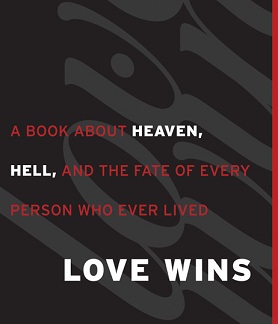 I have spent a great deal of time evaluating Rob Bell’s controversial work, Love Wins
General Review
Over the past several weeks, I have gone through Love Wins chapter by chapter. There have been several positive themes found throughout the book. Of these, the ones most important are the notion that we often trivialize the message of the Bible into “getting in” to heaven and the argument that we cannot turn Jesus into a slogan or the cross into a symbol for whatever we like.
Bell has rightly brought the focus onto eschatology, something which is often ignored or avoided in modern settings.
Yet throughout my reviews of the book (see links at the end), I have noted numerous errors found therein. First, Bell makes errors regarding historical theology. He makes claims about the history of the church which are falsified upon closer examination. Second, his interpretive method is very problematic, as he will often take merely a single part of a verse (sometimes two words completely torn from their context!) in order to make an entire argument about how all of Scripture needs to be interpreted through his chosen phrase [see the review of Chapter 2 and search for “enter life” for a thorough analysis of this]. Third, his exegesis is problematic in still other ways. For example, he will often cite a single verse as an argument for a theological position, even though his argument is contradicted in the very next verse or in the same paragraph. Fourth, he fails to present his arguments. Instead, he chooses to simply ask leading questions. Although this is not problematic in itself, it is clear that this style is intended to lead people into the conclusions Bell wants without any critical analysis. If Bell merely stated his arguments, I suspect people would be more skeptical of his conclusions. Fifth, Bell’s method of argument, when he makes arguments, is often confused. For example, he will ask whether a phrase is found in the Bible in order to refute it. But of course, Bell’s entire thesis “love wins” is a phrase not found in the Bible.
Finally, Bell’s entire argument, once finally revealed, is found to be based around the notion that “God is love.” That’s it. He essentially creates a doctrine of God around just that notion, then defines it in human terms of a parent-child relationship, and then concludes that everyone will eventually be saved because God is love. This is a horribly deficient doctrine of God which does not take into account the whole of Biblical teaching about God. Unfortunately, because this is Bell’s central thesis, it seems the book falls apart upon closer examination.
Ultimately, I cannot recommend this book. Although it gives a few positive points, the major errors found throughout the text weigh against the usefulness of the book for study. I would recommend, however, that leaders in the church do read the book, as it has been so immensely popular that they are bound to run into it. I hope that my reviews and study guide [below] will be helpful for those who wish to engage with the book critically.
Study Guide Questions
General Questions
Let me be clear: I think these questions must be asked in any study of this book.
These questions are intended to be asked after each chapter or at the end of the book:
1) What arguments does Rob Bell present in this chapter? Are they valid? Were any arguments presented?
2) What questions does Bell ask that you feel are hardest to answer? Why? What answers did he provide?
3) Look up a passage Bell interprets. Read it in context. Do you think that Bell’s interpretation of this passage is correct? Why/why not?
Questions for Preface and Chapter 1
1) Do you feel comfortable talking about hell? Why/why not?
2) Can we know that a specific person is in hell?
3) What problems do you see in our culture’s understanding of hell?
4) If a word or phrase isn’t in the Bible, does that mean it is not biblical? Is “Love Wins” a phrase found in the Bible?
Resource: I review the preface and chapter 1.
Questions for Chapter 2
1) What do you think of when you envision heaven? Why do you imagine this? Can you support this imagery with the Biblical text?
2) Look up Matthew 19:16-30 and read it. What do you think of Bell’s focus on “enter life” as the thrust of this passage?
3) Consider popular cultural pictures of heaven or of heavenly imagery (Angels in the Outfield; All Dogs Go to Heaven; etc.). What do you think of these images? Are they grounded on Biblical truth?
4) Bell wrote: “Eternal life doesn’t start when we die; it starts now. It’s not about a life that begins at death; it’s about experiencing the kind of life now that can endure and survive even death” (59). What do you think of this quote? What does it say about what we do for salvation? Do we live in such a way as to usher in our survival of death?
Resource: I review Chapter 2.
Questions for Chapter 3
1) What do you think Bell means by “there are all kinds of hells” (79)? Do you see this in the Biblical text he cites (Luke 16:19-31)?
2) Read Luke 16:19-31. What do you think of Bell’s analysis of the meaning of this parable? Why do you think this?
3) Bell argued that Jesus’ teachings weren’t about right belief but rather about love of neighbor (82). How does this tie into the theme of salvation by grace through faith?
4) Read Matthew 10:5-15. Does the text imply there is still hope for Sodom and Gomorrah, as Bell argues (84-85)?
Resource: I review Chapter 3.
Questions for Chapter 4
1) Read Bell’s statements about the greatness of God on p. 97-98. Why do you think he chooses to focus the discussion on God’s greatness rather than on specific texts? What textual support does Bell use to support this passage?
2) Bell claims there have been a number of views about the salvation of people throughout church history. Does a plurality of views make any view valid? Bonus: During the Civil War era, Christians on either side argued the Bible supported or condemned slavery, respectively. Does this mean a valid interpretation of the Bible is that it justifies slavery?
3) Bonus points: Look up the church fathers Bell cites to support the notion that his view has been at “the center” of Christian orthodoxy. Do these church fathers really support that view? Consider the following from Augustine (The City of God
Origen was even more indulgent; for he believed that even the devil himself and his angels, after suffering those more severe and prolonged pains which their sins deserved, should be delivered from their torments, and associated with the holy angels. But the Church, not without reason, condemned him for this and other errors…
Resource: I review Chapter 4.
Questions for Chapter 5
1) What do you think of when you picture the image of a cross? How have you used/worn/displayed crosses in your life? Do your answers to these questions reflect the glory and misery of the cross?
2) How have you pictured the “Gospel”? Is it just a way to “get to” heaven?
Resource: I review Chapter 5.
Questions for Chapter 6
1) How have you used the label “Christian” or the name “Jesus” in your life?
2) Read John 12:47-50 and compare to Bell’s notion that God is not about judgment. How do Bell’s assertions read in light of the context of the single verse he cites (i.e. “There is a judge for the one who rejects me and does not accept my words; the very words I have spoken will condemn them at the last day.” [48])? Does Bell deal with this context?
3) Did Jesus come to overthrow religion? Read Matthew 5:17-18. How does this passage line up with Bell’s notion that Jesus was a- or even anti- religious?
Resource: I review Chapter 6
Questions for Chapter 7 and 8
1) Rob Bell focuses upon the notion that God is love. What else does the Bible tell us God is? Does Bell discuss these other attributes? What do these other attributes us tell us about God? (Bonus: Check out 2 Thessalonians 1:6; Psalm 5; Isaiah 46:9-10; or use a concordance to look up various attributes of God.)
2) Bell’s focus in this chapter is on God as love. How does God respond to sin? Consider Psalm 5:4-6:
For you are not a God who is pleased with wickedness;
with you, evil people are not welcome.
The arrogant cannot stand
in your presence.
You hate all who do wrong;
you destroy those who tell lies.
The bloodthirsty and deceitful
you, Lord, detest. (Psalm 5:4-6)
3) Bell writes that sins are “irrelevant” (187). Did Jesus come to die for sins? Does this mean they are irrelevant?
4) Bell seems to argue that there are more chances after death. What does the Bible say about this? (Consider Hebrews 9:27.)
Resource: I review chapters 7 and 8.
Links
Like this page on Facebook: J.W. Wartick – “Always Have a Reason”
The book: Rob Bell, Love Wins
Review of “Love Wins” by Rob Bell: Preface and Chapter 1– I discuss the preface and chapter 1 of Love Wins.
Review of “Love Wins” by Rob Bell: Chapter 2– I review chapter 2.
Review of “Love Wins” by Rob Bell: Chapter 3– I look at Chapter 3: Hell.
Review of “Love Wins” by Rob Bell: Chapter 4– I look at Chapter 4: Does God Get what God Wants?
Review of “Love Wins” by Rob Bell: Chapter 5– I analyze chapter 5.
Review of “Love Wins” by Rob Bell: Chapter 6– I review chapter 6.
Review of “Love Wins” by Rob Bell: Chapters 7 and 8– I review the final chapters of the book.
Be sure to check out other book reviews. (Scroll down for more)
Source
Rob Bell, Love Wins
SDG.
——
The preceding post is the property of J.W. Wartick (apart from citations, which are the property of their respective owners, and works of art as credited) and should not be reproduced in part or in whole without the expressed consent of the author. All content on this site is the property of J.W. Wartick and is made available for individual and personal usage. If you cite from these documents, whether for personal or professional purposes, please give appropriate citation with both the name of the author (J.W. Wartick) and a link to the original URL. If you’d like to repost a post, you may do so, provided you show less than half of the original post on your own site and link to the original post for the rest. You must also appropriately cite the post as noted above. This blog is protected by Creative Commons licensing. By viewing any part of this site, you are agreeing to this usage policy.

 J.W. Wartick - Reconstructing Faith