Holy Scripture: Canon Authority Criticism
Freedom as an Essential Component of Biblical Research
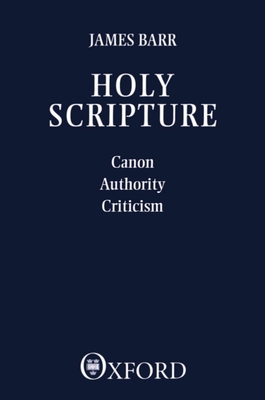
James Barr (1924-2006) was a renowned biblical scholar who, in part, made some of his life’s work pushing back against fundamentalist readings of Scripture and Christianity. I have found his work to be deeply insightful, even reading it 40 or more years after the original publications. One insight I gleaned recently was from Holy Scripture: Canon, Authority, Criticism (1982). Here, he made a clear argument for the need for freedom in biblical scholarship:
“Research requires freedom of thought; if this is lacking, it only means that the research will be less good, in extreme cases that it will dry up altogether. Freedom is not something that should have to be wrung from a reluctant grasp: the church should promote freedom because freedom is part of its gospel. The same is true of theology: it is in the interests of theology itself that it should not seek the power to control and limit, that it should recognize, accept, and promote the fact that there are regions of biblical study for which the criteria of theology are not appropriate; just as it is salutary for the church that it should not seek to dominate the nature of education…
“THe relations between freedom and religion are paradoxical. Freedom of religion is one thing, freedom within religion is another. Freedom of religion is often thought of as freedom of religion from coercion through the state, and that can sometimes be very important, though it is far from being the nucleus of the idea of Christian freedom. Religions can demand freedom of religion, while denying freedom within religion, which is much closer to the idea of Christian freedom…” (109-110).
Note that the last line is saying that it is closer to Christian freedom to have freedom within religion than the opposite. Barr is saying that biblical and theological scholarship–and Christianity generally–benefits from freeing its scholars to explore whatever fields or ideas they deem necessary or of interest. For one, this is because freedom is part of Christianity’s gospel itself–a point Barr makes in passing. For another, this freedom will benefit Christianity because additional insight into its truths coming from even non religiously motivated research is of great use (a point he explores on 110-111).
Thus, limiting research by strict doctrinal codes is not desired even as such doctrinal codes, standard, or confessions are permitted to exist and sometimes even bolstered by research. But where research might push back on such codes, standards, and confessions, Christians ought to welcome it as something that might offer a corrective and exemplification of the gospel rather than as something to be shunned and feared.
SDG.

 J.W. Wartick - Reconstructing Faith