human rights movement
Book Review: “Why It Doesn’t Matter What You Believe If It’s Not True” by Stephen McAndrew
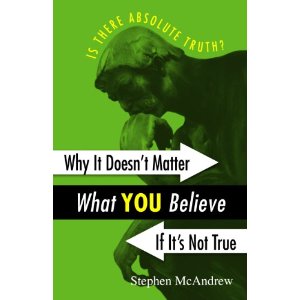 Is there absolute truth? Such is the topic of Stephen McAndrew’s new book, Why It Doesn’t Matter What You Believe If It’s Not True (hereafter DMYB).
McAndrew begins the work by noting that his book is an examination of a position and an affirmation of absolute truth. This is done because it is important to “examine even the most comfortable beliefs and leave standing only those that survive the disciplined assault of reason” (9).
He begins this testing by exploring some philosophical background, from Plato to positivism to relativism. These summaries are succinct, but provide a great background for those who haven’t read much on the topic. He turns next to a discussion of the effects of an abandonment of absolute truth. Relativism divorces one from any capacity to judge right and wrong. McAndrew notes, “These actions [such as the holocaust, racism, etc.] may brutally offend our sense of right and wrong, but the moral relativist cannot apply his or her values to others” (27).
What is interesting, however, is that McAndrew doesn’t stop at discussing relativism alone, but rather a conjunction of two beliefs: relativism and universal human rights. Many people, McAndrew notes, hold to relativism but also want to affirm universal human rights. In DMYB, he uses the discussion of the Nuremberg Tribunals–at which Nazis were tried for war crimes–as a case study for these conflicting views. He notes that “The defendants at Nuremberg argued that international law could only punish states and not individuals…. The Nuremberg court held that individuals could be punished for crimes against humanity under international law” (34).
Relativists, however, cannot consistently agree with the Nuremberg court, because “If there are no absolute truths, there can be no universal human rights” (35). These rights, if relative, are “contingent upon our cultural and historical position…” (ibid).
But relativism has a worse problem–it is contradictory. If all truth is contingent, then the statement “All truth is relative” is also relative, and therefore cannot be true for all people in all places (43ff). McAndrew next turns to the source for the “human rights urge”–the notion that all humans have certain universal rights. This source, argues McAndrew, is God (62ff). He makes a final case study when he turns to art–if there is no absolute truth, then there is no enduring beauty or truth in art (77ff).
The strengths of McAndrew’s book are readily apparent. He does a great job explaining difficult philosophical topics with terms and examples that anyone can understand. Not only that, but his discussion of Wittgenstein and the book 1984 give concrete, workable topics for those interested in the topic to use as talking points. My only criticism is that I believe I found a minor error. On page 85 McAndrew refers to the law of the excluded middle as the law that “propostion A and its direct contradiction–proposition B–cannot both be true at the same time.” This is in fact the law of noncontradiction. The law of the excluded middle is “For any proposition, it is either the case that the proposition is true or its negation is true.” This is a minor quibble, and one can derive the law of noncontradiction from the law of the excluded middle, but I thought I should note it.
Overall, the book may not convince everyone that there is absolute truth, but it will certainly force them to think about the positions they hold and wonder whether they can consistently cling to a relative absolutism. Those who already own a few books on the topic may wonder whether it is worth adding to their collection. Simply put, yes it is, if only to have at hand some great specific examples and talking points to discuss with relativists. It’s also a quick read that can be handed out to friends to open up the path for future discussion. I highly recommend DMYB.
Source
Stephen McAndrew, Why It Doesn’t Matter What You Believe If It’s Not True (Sisters, OR: Deep River, 2012).
Disclaimer: I was provided a review copy of this book by the author. My thanks to Stephen for the opportunity to review his book.
SDG.
——
The preceding post is the property of J.W. Wartick (apart from citations, which are the property of their respective owners) and should not be reproduced in part or in whole without the expressed consent of the author. All content on this site is the property of J.W. Wartick and is made available for individual and personal usage. If you cite from these documents, whether for personal or professional purposes, please give appropriate citation with both the name of the author (J.W. Wartick) and a link to the original URL. If you’d like to repost a post, you may do so, provided you show less than half of the original post on your own site and link to the original post for the rest. You must also appropriately cite the post as noted above. This blog is protected by Creative Commons licensing. By viewing any part of this site, you are agreeing to this usage policy.

 J.W. Wartick - Reconstructing Faith