InterVarsity Press
Book Review: “Thomas Cochrane and the Dragon Throne” by Andrew Adam
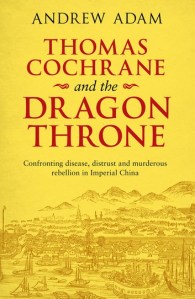 A while ago, I read a fascinating duology of graphic novels about the Boxer Rebellion that showed it from both the side of missionaries and from the side of the Boxers. They were entitled Boxers and Saints and moved me very deeply. I still think about them qutie a bit, and how the interplay of mission work, thoughtful Christianity, colonialism, imperialism, and more all got jumbled together in a mess that makes it difficult to discern any goodness at all. When I saw Thomas Cochrane and the Dragon Throne, I knew I wanted to read it to learn more about this fascinating, awful time.
The book is largely biographical, following the time Thomas Cochrane spent in China as a doctor and a missionary, which overlapped with the Boxer Rebellion and other key developments in Peking. It also features a large amount of fantastic background information for anyone who wants to learn about many different topics. For example, there’s a lot here about the medical practices in China in the early 20th century. There’s also no small amount of discussions of how colonialism from European powers combined with political maneuvering on the part of the Empress Dowager Cixi and others. And, of course, there are more historical details about the Boxer Rebellion. The book is not always for the faint of heart. Both medical information and historical information about the Boxer Rebellion is conveyed in an almost matter-of-fact style that includes graphic descriptions of things like foot binding, torture, and castration. These are all extremely important details, but, again, readers should be aware that they’re not glossed over.
Thomas Cochrane ended up in China at a young age with his wife, Grace, after being inspired by Dwight Moody to become a missionary. He wanted to go where he was needed most, and he truly had a passion for healing the sick, providing his service free of charge and, eventually, delivering a top of the line medical school to help train doctors in modern medicine in China. Throughout the section of his life outlined in this biography, he repeatedly felt like a failure as various ventures collapsed, but it is hard to see his work as not having a deeply positive impact on those with whom he lived. As he worked to both heal and convert people, the Boxer Rebellion broke out, and the Cochrane family was forced to flee. Adam reports this and other harrowing episodes with fascinating details that show the reality of the situation, both from Cochrane’s own writings and from his own firsthand knowledge as the son of Thomas Cochrane’s stepdaughter.
Eventually, Cochrane confronted a cholera epidemic in the Imperial City, managing to gain allies in court as he did so. This opened up new avenues and even allowed him to get help from the chief eunuch and the Empress Dowager. This, in turn, lead to his establishment of the Union Medical College in Peking, China. His vision was for this school to churn out doctors who also would be able to spread knowledge of Christ across the interior of China, but although the school became immensely prestigious, it ultimately became a major graduate school that departed from his vision. Cochrane’s legacy, like that of mission work in general, is complex. It would be hard to question whether his heart was in the right place, and fascinating details like how Cochrane adapted biblical stories to Chinese contexts show his avoidance of the major pitfalls of colonialism (see p. 47, for example, and how Cochrane added Chinese details to biblical stories). Adam has presented a portrait of a man who made a difference in many people’s lives, both temporal and eternal.
Andrew Adam has written a fascinating biography/historical piece that helps shed light on a terrible piece of history. I very highly recommend Thomas Cochrane and the Dragon Throne to any reader. It’s of interest to those who like history, want to learn about Christianity, are interested in China, in medicine, in politics, and more. It’s fantastic.
Disclaimer: I was provided with a copy of the book for review by the publisher. I was not required to give any specific kind of feedback whatsoever.
Links
Be sure to check out the page for this site on Facebook and Twitter for discussion of posts, links to other pages of interest, random talk about theology/philosophy/apologetics/movies and more!
Book Reviews– There are plenty more book reviews to read! Read like crazy! (Scroll down for more, and click at bottom for even more!)
SDG.
——
The preceding post is the property of J.W. Wartick (apart from quotations, which are the property of their respective owners, and works of art as credited; images are often freely available to the public and J.W. Wartick makes no claims of owning rights to the images unless he makes that explicit) and should not be reproduced in part or in whole without the expressed consent of the author. All content on this site is the property of J.W. Wartick and is made available for individual and personal usage. If you cite from these documents, whether for personal or professional purposes, please give appropriate citation with both the name of the author (J.W. Wartick) and a link to the original URL. If you’d like to repost a post, you may do so, provided you show less than half of the original post on your own site and link to the original post for the rest. You must also appropriately cite the post as noted above. This blog is protected by Creative Commons licensing. By viewing any part of this site, you are agreeing to this usage policy.
Book Review: “Evangelical Theological Method: Five Views” edited by Stanley E. Porter and Steven M. Studebaker
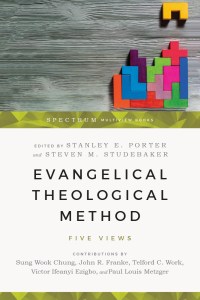 I love multiview books. I find them generally enlightening, filling in details about views I don’t hold (and sometimes didn’t even know existed) while also showing how my own view (or one like it) stacks up against others. Evangelical Theological Method: Five Views presents a multiview book on doing theology as an evangelical.* I found it to be highly informative, though I was somewhat perplexed by some aspects of the book.
The views presented here as different theological methods for evangelicals are “Bible Doctrines/Conservative Theology” presented by Sung Wook Chung, “Missional Theology” presented by John R. Franke, “Interdisciplinary Theology” presented by Telford C. Work, “Contextual Theology” presented by Victor Ifeanyi Ezigbo, and “Trinitarian Dogmatic Theology” presented by Paul Louis Metzger.
The Bible Doctrines view is essentially grounded in the notion that we use the Bible as a source to draw information from and then outline what the Bible teaches. The Bible is the data, theology is presenting and systematizing that data. Chung appeals to the historical grammatical view in support of this, arguing that while history and textual criticism may provide some correctives, the core is to ask “what does the Bible teach” and end the discussion there. The missional view does theology with a focus on the church lived/living its mission to make disciples of all nations. Thus, it is an inherently practical theology, looking to apply what the Bible teaches to the mission of Christ’s church. Interdisciplinary theology is an approach that utilizes any field of study, making theology the “queen of the sciences” while integrating insight from biology, psychology, literary studies, and more. Interestingly, Work does a case study based on homosexuality and Christianity, arguing that the question is not “Is homosexuality wrong” but rather what kind of people we ought to try to be to conform to the image of Christ. Contextual theology seeks to make the Gospel of Christ understandable and appealing to all people not by applying a one-size-fits all doctrinal mold or practice but rather by utilizing insights from cultures that exist to show the truth of Christ. The Trinitarian Dogmatic Theology chapter was the most difficult in the book, utilizing themes from Barth (along with Dietrich Bonhoeffer an Colin Gunton) to draw out a dogmatic theology for Christianity.
There is some clear overlap between a few of these views, particularly the missional/contextual view and the “Bible Doctrines”/Trinitarian views. The responses at the end of the book didn’t allow individual authors to respond back to the responses, something I did miss. It would have been nice to see, for example, I’d be curious to see how Ezigbo might respond to Chung on the challenge he offered to contextual theology and the possibility of syncretism or the authority of Scripture.
Ezigbo’s essay struck me as particularly insightful, and his responses were perhaps the best in the book. His challenge to Metzger, for example, is on point: “Clearly Metzger exhibits the characteristics of theologians whose theological reflections focus primarily on peer-driven questions… One could only wonder what Metzger’s study of Barth would like like if his aim were to discern Barth’s relevance to the contemporary christological questions that Christians with no formal theological education are asking today” (181-182). Ezigbo notes that he isn’t saying that peer-driven questions are irrelevant, “but if theologians expect their theological reflections to benefit all Christians… they should seek to develop skills and the patience required to exegete the… contexts that shape the life of Christians and their communities” (182). I found this a clear challenge for myself as well, as one who is very interested in the life and work of Dietrich Bonhoeffer. How do we ensure as people doing and discussing theology that our discussions actually have relevance? Of course, one could argue more abstractly that if Barth’s dogmatics are true, then in the broadest sense they are relevant for all people, no matter how obscure, in that truth impacts reality. But that seems cold comfort when the challenge is much more personal: why should Barth’s insights matter to me? It’s food for thought, I think.
One thing that was only addressed in passing by a few of the authors was the strangeness of seeing theological method as an either/or. As a good Lutheran, I love me some ‘both-and.’ It seems to me, as a reader, that these methods could each benefit from one another, and that trying to practice one exclusively would be detrimental. Dogmatics need context. Interdisciplinary studies need some mission. The Bible Doctrines approach could probably stand to acknowledge some of the inherent concerns there (eg. a tendency to assume that one’s own presuppositions of the text or “plain sense” reading is, in fact, correct, despite possible evidence to the contrary).
I found Evangelical Theological Method: Five Views to be a very interesting book, and one which raises many avenues for further research. Those interested in systematic theology, especially, ought to pick it up to read through it. The authors provide some challenges for each of the approaches in the book, and it is important that we do not become too simplistic in our working out of theology.
*I am a Lutheran (specifically of the Evangelical Lutheran Church in America) and although my denomination has “evangelical” in the name, Lutherans are generally different from what is considered broadly evangelical views, particularly in regard to the sacraments. Though, to be fair, Lutherans were the first to identify “evangelical” as a term to call themselves. I give this caveat to show my own outlook on the book.
Disclaimer: I was provided with a copy of the book for review by the publisher. I was not required to give any specific kind of feedback whatsoever.
Links
Be sure to check out the page for this site on Facebook and Twitter for discussion of posts, links to other pages of interest, random talk about theology/philosophy/apologetics/movies and more!
Book Reviews– There are plenty more book reviews to read! Read like crazy! (Scroll down for more, and click at bottom for even more!)
SDG.
——
The preceding post is the property of J.W. Wartick (apart from quotations, which are the property of their respective owners, and works of art as credited; images are often freely available to the public and J.W. Wartick makes no claims of owning rights to the images unless he makes that explicit) and should not be reproduced in part or in whole without the expressed consent of the author. All content on this site is the property of J.W. Wartick and is made available for individual and personal usage. If you cite from these documents, whether for personal or professional purposes, please give appropriate citation with both the name of the author (J.W. Wartick) and a link to the original URL. If you’d like to repost a post, you may do so, provided you show less than half of the original post on your own site and link to the original post for the rest. You must also appropriately cite the post as noted above. This blog is protected by Creative Commons licensing. By viewing any part of this site, you are agreeing to this usage policy.
Book Review: “Scars Across Humanity: Understanding and Overcoming Violence Against Women” by Elaine Storkey
 Warning: Some statistics related to domestic violence and sexual violence are discussed in this post.
[T]he… acts of violence to women aged between 15 and 44 across the globe produce more death, disability and mutilation than cancer, malaria, and traffic accidents combined (2).
Every three seconds a girl under the age of 18 is married somewhere across the world-usually without her consent and sometimes to a much older man (49).
Nearly 200 million women and girls worldwide are living with the traumatic consequences of female genital mutilation (30).
It is an alarming picture of mass termination: prenatal offspring, aborted for no other reason than they happen to be female (19).
There are some nonfiction books that have made me sit back upon finishing reading them, wondering about the world we live in, because the book has given me new eyes to see. Scars Across Humanity has become one of those books. Though I was aware of, broadly, some of the statistics of violence against women, I had no idea how completely pervasive it is at all stages of life. Nor did I fully comprehend or appreciate how totally violence against women has penetrated every level of nearly every society on Earth. Though the #MeToo and #ChurchToo movements have highlighted some of these issues, Storkey gets to the meat of the issue, giving enormous amounts of statistics and serious analysis of the totality of this horrific situation.
The bulk of Scars Across Humanity focuses on statistics and specifics. First, Storkey shows that violence against women is a “global pandemic.” There is no part of the world that is untouched by this blight upon humanity. Then, several chapters go over specific instances of violence against women. Abortion is the first level of violence against women. Sex-selective abortions are almost entirely chosen to kill unborn girls. This, in turn, fuels human trafficking as women are moved into those parts of the world where a serious imbalance of adult men and women exists, largely due to sex-selective abortions. Female genital mutilation is opposed by leaders of all major faiths, yet it continues across the world and cases of it in places like England and the United States are on the rise. Early and forced marriage is another global problem. Indeed, in the United States, very few restrictions exist on girls being married off to men–indeed, 20 states have no minimum age of marriage.
The misnomer of “honor” killings continue in some parts of the world and, where it is outlawed, enforcement is incredibly lax. Women are murdered or disfigured for the sake of male notions of “honor.” Domestic violence exists in the home and a stigma surrounds it such that it is underreported. Women are at the highest risk when they attempt to leave an abuser, and as many, many instances have shown, they are often not believed when accusations of abuse are made. To help stop the wave of violence in the home, we must work to end stigmas surrounding those who have been harmed by domestic partners, work with law enforcement agencies, and change laws as needed to provide for the greatest possible protection of those towards whom violence is directed. Human trafficking and prostitution are closely tied together and even in those areas where prostitution is made into “just another job,” evidence suggests that massive increases in trafficking occur. Rape is a worldwide epidemic and Storkey shows clear instances of how “rape culture” is a real thing that women must deal with when they report this sexual violence. A huge part of ending rape is to educate men and punish them where they perpetrate these vicious acts. War almost inevitably leads to sexual violence, as can be seen in the historical record as well as into today. Rape is sometimes even used as a weapon of genocide in cultural warfare. Women, time and again, are seen as pawns in conflicts and power dynamics of men.
By the end of Storkey’s analysis, I was left wondering whether there was any room for hope. Storkey does offer a few points, sometimes highlighting how laws have changed to help fight violence against women (though often noting alongside this the serious lack of enforcement of those same laws). However, it is in the last few chapters that Storkey offers her broader vision of overcoming violence against women. Largely, this includes working both internationally and locally (with specific guidelines and stories of how this has worked) to create and enforce laws and to spread and teach the Christian theology of the equality of all humanity.
From before women are born to their all-too-often violent deaths, women across the planet are attacked in often brutal ways. Scars Across Humanity shines a light upon this darkness and issues a serious, empowering call to end this horror of violence against women. If we are truly serious about men and women being made in the image of God, we must fight this gender-based violence on a global level. Storkey’s book is highly recommended.
Links
Be sure to check out the page for this site on Facebook and Twitter for discussion of posts, links to other pages of interest, random talk about theology/philosophy/apologetics/movies and more!
Book Reviews– There are plenty more book reviews to read! Read like crazy! (Scroll down for more, and click at bottom for even more!)
SDG.
——
The preceding post is the property of J.W. Wartick (apart from quotations, which are the property of their respective owners, and works of art as credited; images are often freely available to the public and J.W. Wartick makes no claims of owning rights to the images unless he makes that explicit) and should not be reproduced in part or in whole without the expressed consent of the author. All content on this site is the property of J.W. Wartick and is made available for individual and personal usage. If you cite from these documents, whether for personal or professional purposes, please give appropriate citation with both the name of the author (J.W. Wartick) and a link to the original URL. If you’d like to repost a post, you may do so, provided you show less than half of the original post on your own site and link to the original post for the rest. You must also appropriately cite the post as noted above. This blog is protected by Creative Commons licensing. By viewing any part of this site, you are agreeing to this usage policy.

 J.W. Wartick - Reconstructing Faith