J.W. Wartick
“Bonhoeffer and the Biosciences: An Initial Exploration” edited by Wüstenberg et al.
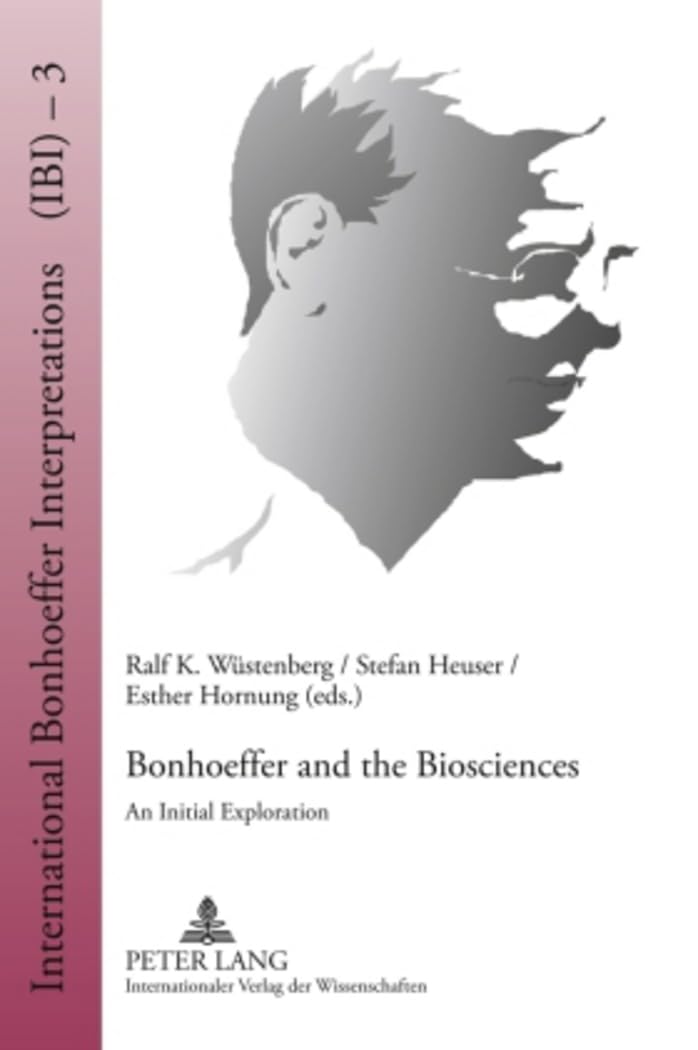
One of the wonderful things about burgeoning interest in Dietrich Bonhoeffer’s ethics, life, and theology is the way insights from him are being applied to an increasing number of fields and topics. Bonhoeffer and the Biosciences: An Initial Exploration edited by Wüstenberg, Heuser, and Hornung seeks to explore aspects of Bonhoeffer’s thought and life seeking insight from him in the realm of biosciences. What are the biosciences explored here? Topics like posthumanism, in vitro fertilization, abortion, ability and disability, and more are touched upon through the book.
The subtitle of “an initial exploration” is quite apt. The essays included here rarely provide what even feels like a rudimentary conclusion related to Bonhoeffer and biosciences. Instead, the essays are more akin to prompts for further exploration. And what prompts they are! Nearly every chapter brought numerous intriguing insights to bear and great scope for future research.
One example is in the discussion of genetic enhancement–what would this do to distributions of power and equality; what would enhancements mean about our desires; and how do we even make moral judgments about these (questions adapted from p.86)? Then there’s a chapter which ultimately calls for seeing caregivers and medical providers as being part of the “freedom for” the sake of the other (106-107). How could this help get applied to the Lutheran doctrine of vocation, which Bonhoeffer surely agreed with. “Caring for human life at its most vulnerable is… a practice that bears a unique promise: the promise to reconnect us with the truth and depths of our creaturely existence…” (106). Such insights are fascinating, and found throughout the book.
Bonhoeffer and the Biosciences: An Initial Exploration is a fantastic read, though it is one that leaves readers wanting more. Students of Bonhoeffer would do well to use it as a springboard for more discussion and exploration.
Links
Dietrich Bonhoeffer– read all my posts related to Bonhoeffer and his theology.
Be sure to check out the page for this site on Facebook and Twitter for discussion of posts, links to other pages of interest, random talk about theology/philosophy/apologetics/movies and more!
SDG.
——
The preceding post is the property of J.W. Wartick (apart from quotations, which are the property of their respective owners, and works of art as credited; images are often freely available to the public and J.W. Wartick makes no claims of owning rights to the images unless he makes that explicit) and should not be reproduced in part or in whole without the expressed consent of the author. All content on this site is the property of J.W. Wartick and is made available for individual and personal usage. If you cite from these documents, whether for personal or professional purposes, please give appropriate citation with both the name of the author (J.W. Wartick) and a link to the original URL. If you’d like to repost a post, you may do so, provided you show less than half of the original post on your own site and link to the original post for the rest. You must also appropriately cite the post as noted above. This blog is protected by Creative Commons licensing. By viewing any part of this site, you are agreeing to this usage policy.
Bonhoeffer’s Catechesis: Foundations for his Lutheranism and Religionlessness
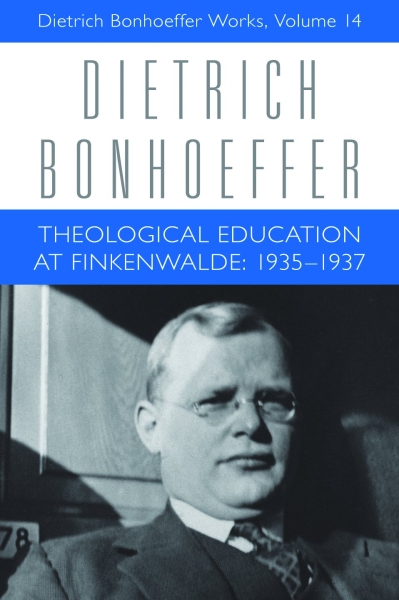
Dietrich Bonhoeffer was deeply involved in educating youths. He saw the need for it and was apparently quite skilled, building a reputation in Barcelona for caring for a rambunctious group of students. When teaching at the illegal seminary at Finkenwalde, one of the many subjects he touched upon was catechesis–basic Christian education. Bonhoeffer’s teaching on catechesis revealed that his thoughts on religionless Christianity were already quite embedded at this middle stage of his theology, and that his staunch Lutheranism held throughout his life.
When starting his lectures on catechesis, he began with some commentary on Christian instruction. However, this commentary was fronted with the notion that Christian instruction is embedded in proclamation. Conceptually, this is because those involved in catechesis have been baptized, and, due to their baptism, they are already Christian. Thus, Bonhoeffer declares that, related to the education of young people: “the struggle, the victory belongs to the church because God has long since brought the children into the church through baptism. Whereas the state must first make itself master [Herr], the church proclaims the one who is Lord [Herr].” Bonhoeffer goes on to clarify, “Christian education begins where all other education ceases: What is essential has already happened. You have already been taken care of. You are the baptized church-community claimed by God” (DBWE 14:538).
Because of the status of those learning from the church as the already baptized, Bonhoeffer argues, the church can proclaim from the start the reality that they are already in the church community. Baptism has made this happen, by the power of the Spirit. It would be hard to imagine a more Lutheran understanding of the starting point of Christian instruction than this. For Bonhoeffer, baptism was not an abstraction or a symbol: it was a very real status change of the person being baptized as becoming part of the church-community.
The same lecture series shows Bonhoeffer’s thoughts on religionless Christianity were not merely a late development while in prison. While commenting on “What makes Christian education and instruction possible…” Bonhoeffer notes that it is “baptism and justification” (DBWE 14:539). This obviously hearkens back to the discussion above; baptism as a reality-changing sacrament. But he goes on: “People may well argue about whether religion can be taught. Religion is that which comes from the inside; Christ is that which comes from the outside, can be taught, and must be taught. Christianity is doctrine related to a certain form of existence (speech and life!)” (ibid, 539-540).
Bonhoeffer here links religion with that that comes from within–something he not-infrequently links to idol-building. Religion in his own time is what allowed the German Christian movement to join and overwhelmingly support the Reich Church of the Nazis. By contrast, Christ comes from the outside, through baptism, and can and must be taught. Our religious ways are attitudes we shape and create, but Christ, the God-reality, comes from outside of us and must be proclaimed. And, ironically, this leads to true foundations of doctrine that entail a “certain form of existence” which Bonhoeffer clearly links to the reality of everyday life but also to resistance and calls to repentance for the church itself.
In this way, we can see the foundations, at the least, are here in Bonhoeffer’s thought for religionless Christianity. The fact that there is a contrast between religion and Christ is quite evident. The link between Christ, word, and sacrament is fully there. So while some may claim Bonoheffer’s religionless Christianity is anti-ritual, this cannot be further from the truth. Here, Bonhoeffer very clearly links religionlessness to sacrament and true faith. For Bonhoeffer, what signifies religion is not traditions or sacrament, but rather that which comes from within us and causes us to create our idols.
Links
Dietrich Bonhoeffer– read all my posts related to Bonhoeffer and his theology.
Be sure to check out the page for this site on Facebook and Twitter for discussion of posts, links to other pages of interest, random talk about theology/philosophy/apologetics/movies and more!
SDG.
——
The preceding post is the property of J.W. Wartick (apart from quotations, which are the property of their respective owners, and works of art as credited; images are often freely available to the public and J.W. Wartick makes no claims of owning rights to the images unless he makes that explicit) and should not be reproduced in part or in whole without the expressed consent of the author. All content on this site is the property of J.W. Wartick and is made available for individual and personal usage. If you cite from these documents, whether for personal or professional purposes, please give appropriate citation with both the name of the author (J.W. Wartick) and a link to the original URL. If you’d like to repost a post, you may do so, provided you show less than half of the original post on your own site and link to the original post for the rest. You must also appropriately cite the post as noted above. This blog is protected by Creative Commons licensing. By viewing any part of this site, you are agreeing to this usage policy.
Harmonization of Scripture, Inerrancy, and History- Can inerrantists harmonize like historians?
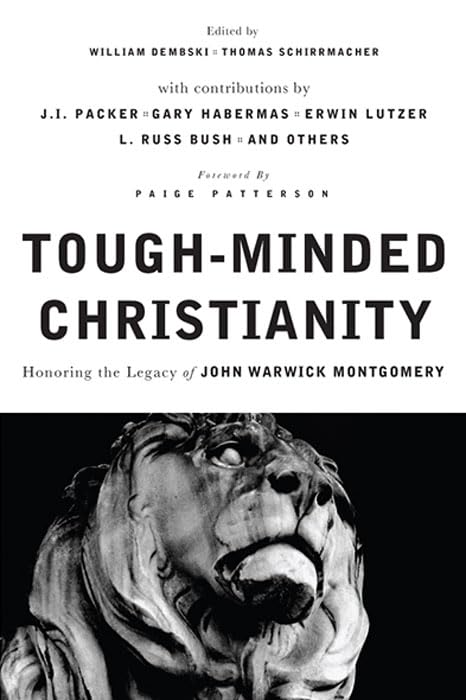
John Warwick Montgomery has been hugely influential on my own faith life, including in my development of theology while disagreeing with some of what he says. When he passed last year, I wrote a brief in memoriam. Since then, I’ve been rereading works by him and about him. One such work is Tough-Minded Christianity, a collection of essays in honor of Montgomery that was published in 2009 [1].
One essay in the collection takes on James Barr’s work, Fundamentalism. Barr was an extremely well-respected Old Testament Scholar who launched many a fusillade against fundamentalism and, in particular, against fundamentalist readings of Scripture. In particular, Barr wrote about how inerrancy would not work as a way of reading the Bible, and he especially attacked such a reading as impossible given the Bible we already have. Irving Hexham’s essay, “Trashing Evangelical Christians: The Legacy of James’ Barr’s Fundamentalism” clearly takes issue with Barr’s approach. Hexham frequently writes about Barr’s work in derogatory terms, such as calling it a “propaganda tract,” among other things. But Barr was a deep enough scholar to prompt Hexham to try to refute some of his arguments, and in doing so, I think he actually shows where Barr is right and evangelical defenders of inerrancy are wrong.
Hexham seeks to defend fundamentalist attempts to harmonize apparent contradictions in the Biblical text. One such example that he cites is the attempt to harmonize the cleansing of the Temple in John 2 with the same account in Luke 19, Mark 11, and Matthew 21). Barr writes about how some have argued that the best way to harmonize these passages is to assert that Jesus cleansed the temple twice, once at the beginning of his ministry and again near the end of his ministry. Barr writes that this harmonization is “simple but ludicrous.”
Hexham, by contrast, takes extreme issue with the use of the term “ludicrous,” and argues instead that it’s not unreasonable to make such an attempt at harmonization because, after all, we don’t have complete historical records. Hexham skirts around Barr’s incisive critique of the same evangelicals also attempting to harmonize two ascension accounts by arguing one is literal and the other is telescoping by asserting that Barr is just wrong to think fundamentalists can’t use both literal and non-literal techniques to read the Bible. At issue, however, is not whether one can defend inerrancy of Scripture by mixing ways of reading it; the issue is instead whether such readings are plausible or even necessary to begin with.
A more powerful critique from Hexham is the note that historians do this kind of harmonization all the time. And this is an extremely vital point. Hexham writes, “Harmonization, far from being an unhistorical attempt to explain discrepancies, is precisely what most traditional historians do every time they discover conflicting accounts in the archival record.” He goes on to cite others who note that historians often have “no external evidence as to whether the event recorded happened once, twice, or even three times…” and that in almost any historical writing, a selection effect is occurring which means the authors are intentionally highlighting aspects of the narrative at hand.
It is true indeed that no author can comprehensively write every detail of anyone’s life, nor do the Gospels claim to be doing so for Jesus. I think it’s also largely true that historians are quite comfortable harmonizing different stories to make them make sense. Indeed, it would quickly become impossible to write or engage with history if, every time there was a discrepancy between accounts, one simply said the account was unreal or did not happen. But there’s a huge gap between conceding that point and conceding that therefore the historical documents can be considered inerrant. Indeed, the opposite seems to be true.
When historians are harmonizing differing texts about an event, they aren’t doing so with the assumption that either text is completely without error. This is a far cry from what evangelical/fundamentalist readers of Scripture have to do in order to harmonize texts. Once one holds a doctrine like inerrancy, in which the entire Bible is supposed to be completely free from error, the process of harmonization takes on entirely new difficulties. One cannot, as historians do, harmonize two passages by simply stating one is mistaken. If one document says an event occurred at 14:00 and the other says it occurred at 04:00, the historian can do many things, such as find another source that might confirm one and deny the other. But the inerrantist cannot do that. They must come up with a harmonization that not only brings two passages together, but also makes them both somehow emerge from the harmonizing completely unscathed. And that is where things start to become absurd. Because for the inerrantist, the only way to harmonize the two times for the same event above is to multiply the event. After all, the times cannot be wrong; admitting one of the times is wrong is to admit an error into the text. Therefore, the event itself must have occurred at both times. And that is what Barr is getting at with his critique of fundamentalists readings as being ludicrous.
Certainly one may punt to the broad possibility that we don’t have the Bible telling us that a cleansing of the temple only occurred one time, but every indication seems to be that such an event was unique and powerful, not something that Jesus decided to do, say, every Tuesday or so. The ascension is even more absurd to multiply, which is what leads the inerrantist to suddenly abandon their attempt to read the historical narrative as historical reportage and instead read it as a telescoping timeline. That’s the only way to salvage the text–by turning it into something that is intentionally not reporting things in the exact timeline in which they occurred.
Hexham’s attempt to salvage inerrantist harmonization methods, then, fails. While it is still remotely possible that some events happened twice, allowing there to be a direct, historical reporting happening in both instances of an event; such a broad possibility is not all that matters. Not every harmonization can be achieved by simply multiplying instances of the event occurring. And no historian is attempting to harmonize other historic texts by assuming they are entirely without error. The parallel Hexham attempts to draw upon is undermined by his own prior commitments. Inerrantists aren’t mashing two texts together by using other sources to determine their accuracy or looking at the plausible explanations. No, they are absolutely committed to the assumption that any two (or more) Scriptural passages they are trying to harmonize are entirely without error, and therefore any harmonization must preserve that central assumption. There’s a vast chasm between those two methodologies, and one that makes the inerrantist reading seem, at times, ludicrous.
Notes
[1]It’s remarkable looking at the book now, with its foreword by Paige Patterson, who has since been implicated in covering up sexual abuse (see here), an essay by Ravi Zacharias (multiple allegations of sexual abuse here), and thinking about how highly touted this book was at the time. In apologetics circles, I remember seeing a lot of discussion, though I’ve rarely seen it mentioned since about 2014. This might be, in part, due to JWM not being as well-loved in those circles as some other apologists. In any case, this collection purports to carry on JWM’s “tough minded” approach to Christianity, one built upon strength of evidence and an apologetic approach of the same.
All Links to Amazon are Affiliates
Links
Be sure to check out the page for this site on Facebook!
Book Reviews– There are plenty more book reviews to read! Read like crazy! (Scroll down for more, and click at bottom for even more!)
SDG.
——
The preceding post is the property of J.W. Wartick (apart from quotations, which are the property of their respective owners, and works of art as credited; images are often freely available to the public and J.W. Wartick makes no claims of owning rights to the images unless he makes that explicit) and should not be reproduced in part or in whole without the expressed consent of the author. All content on this site is the property of J.W. Wartick and is made available for individual and personal usage. If you cite from these documents, whether for personal or professional purposes, please give appropriate citation with both the name of the author (J.W. Wartick) and a link to the original URL. If you’d like to repost a post, you may do so, provided you show less than half of the original post on your own site and link to the original post for the rest. You must also appropriately cite the post as noted above. This blog is protected by Creative Commons licensing. By viewing any part of this site, you are agreeing to this usage policy.
Biographies of Dietrich Bonhoeffer: An Ongoing Review and Guide
There is an ever-growing collection of biographies of Dietrich Bonhoeffer, the German pastor who was executed by the Nazis in 1945. This means that when people are looking to learn about Bonhoeffer, it can be difficult to know where to dive in. While I believe there’s no single strong answer to that question, I do think different biographies do different things well. This post will be a catch-all specifically for biographies about Bonhoeffer. I’ll highlight strengths and weaknesses of each one, in the hopes that this will let readers best choose from among the growing field of Bonhoeffer studies. This post will continue to be updated as I encounter additional biographies, and may be expanded to include related works.
Why am I qualified to do this post? I am not a Bonhoeffer scholar by any traditional means, and I think it is incredibly important to read those scholars. That said, I have read over 100 books by or about Bonhoeffer, his life, and his theology. By no means does this make me an expert, but I think I could at least offer some insights into questions about what biography to read.

Strange Glory: A Life of Dietrich Bonhoeffer by Charles Marsh
Marsh’s biography, published in 2014, presents Bonhoeffer’s life in a compelling fashion backed by scholarship. It is highly readable but doesn’t skip over details and controversies about Bonhoeffer’s life.
Advantages
-Written to effectively introduce readers to scholarship about Bonhoeffer while also telling his life’s story.
-Turns into a page-turner at times with Marsh’s effective writing style.
-Introduces readers to many topics related to Bonhoeffer’s life and theology in ways that can guide further reflection and study.
Disadvantage(s)
-Somewhat long for a reader attempting to get the basics of Bonhoeffer’s life, at more than 400 pages of text.
It’s For You If…
You want a one stop shop for Bonhoeffer’s biography. This is probably the single best biography in terms of combining scholarly insight, readability, and accuracy about Bonhoeffer’s life without being too dry.

The Faithful Spy: Dietrich Bonhoeffer and the Plot to Kill Hitler by John Hendrix
A graphic novel as a Bonhoeffer biography that caught me unawares in 2020. The art style is engaging, and the panels manage to tell the story without being too cluttered with text.
Advantages
-Extremely readable, with language that is easy to understand, even in sections on theology.
-It’s a graphic novel, I mean… come on. But really, this will appeal to adults who like graphic novels and can also be good reading for teens or tweens who want to engage with deeper topics.
-Probably the most unique biography in presentation.
Disadvantage(s)
-Doesn’t have a complete picture of Bonhoeffer’s life due to the focus on Bonhoeffer’s struggle with Nazism. While this is definitely a large part of his life, it doesn’t fully explain his theology or ethics. It’s a graphic novel, so expecting it to do so might be absurd, but it is worth noting that there is some hot debate in Bonhoeffer scholarship about just how involved he was in the plot to kill Hitler, or even whether he was involved at all. All nuance on this and related topics is basically lost with the format here.
-Relies a bit on Metaxas’s apocryphal work (see below).
It’s for you if…
You want a quick, easy read on Bonhoeffer that gives you at least a surface familiarity with his life and work. Or, you want something you could hand to someone who’s not interested in large tomes.

Bonhoeffer: Pastor, Martyr, Prophet, Spy by Eric Metaxas
This is by far the most popular biography of Bonhoeffer. There’s no doubt that Metaxas’s biography helped the burgeoning interest in Bonhoeffer along. That said, there are serious defects in this biography which lead me to strongly not recommend it as a work for anyone looking into Bonhoeffer’s life.
Advantages
-Popularity- popularity is not a bad thing. It’s great that Metaxas manage to shine a light on Bonhoeffer and encourage so many to read more about him.
-Great subtitle- Bonhoeffer’s life begs to be a major Hollywood blockbuster according to this subtitle.
Disadvantages
-Inaccuracy- I won’t nitpick various tiny facts that Metaxas got wrong. Any biographer can mess up geography or days. It happens. What is at issue is that Metaxas actually undermines much of Bonhoeffer’s own positions by substituting Bonhoeffer’s theology–that of a Lutheran theologian from Germany–with Metaxas’s preferred theology–that of right-leaning American Evangelicalism. For example, Metaxas doesn’t write anything about Bonhoeffer’s views on baptism or the Lord’s Supper, despite Bonhoeffer himself saying the Sacraments are necessary for the church. Why does Metaxas avoid it? Either he’s unaware of Bonhoeffer’s theology here–a major blunder given that Bonhoeffer is a Lutheran pastor–or he’s explicitly leaving it out to avoid offending the Evangelical-Baptist tendencies of his targeted audience, who would strongly disagree with Bonhoeffer’s sacramental theology. Bonhoeffer’s work in the resistance is not given the nuance the evidence requires. Bonhoeffer’s theology is devoid of challenging the reader in Metaxas’s reading. Bonhoeffer is made to be a biblical inerrantist, with Metaxas emphasizing his care for studying the Bible, despite Bonhoeffer’s own words noting that “the theory of verbal inspiration will not do” (DBWE 3:51). In short, Bonhoeffer’s life, theological views, and motivations are all slanted in Metaxas’s representation. Indeed, it shouldn’t escape most readers that Bonhoeffer’s viewpoints begin to seem eerily similar to those of Metaxas’s.
-Distorts the view of Bonhoeffer for many- due to the book’s popularity and its major inaccuracies, it has led to a distorted view of Bonhoeffer’s legacy. One example is the “silence” quote attributed to Bonhoeffer on the inside flap of the book. “Silence in the face of evil is itself evil. God will not hold us guiltless. Not to act is to act.” It’s a great quote, and sounds possibly like something Bonhoeffer would say. The problem is that he didn’t say it. The quote simply is not from Bonhoeffer. And yet it’s in the congressional record as something he said because of the popularity of this book. Now quote misattribution isn’t the end of the world, especially when the quote itself doesn’t necessarily run contrary to the person it’s attributed to. The problem is that Metaxas does things like this constantly. He presents Bonhoeffer as wholly alien to the context in which he operated.
-Somehow still too long for an introductory biography, weighing in at over 600 pages.
It’s for you if…
You’ve gotten a grounding in Bonhoeffer’s life and theology and want to see what the fuss is about. Or, you love writing critical reviews.
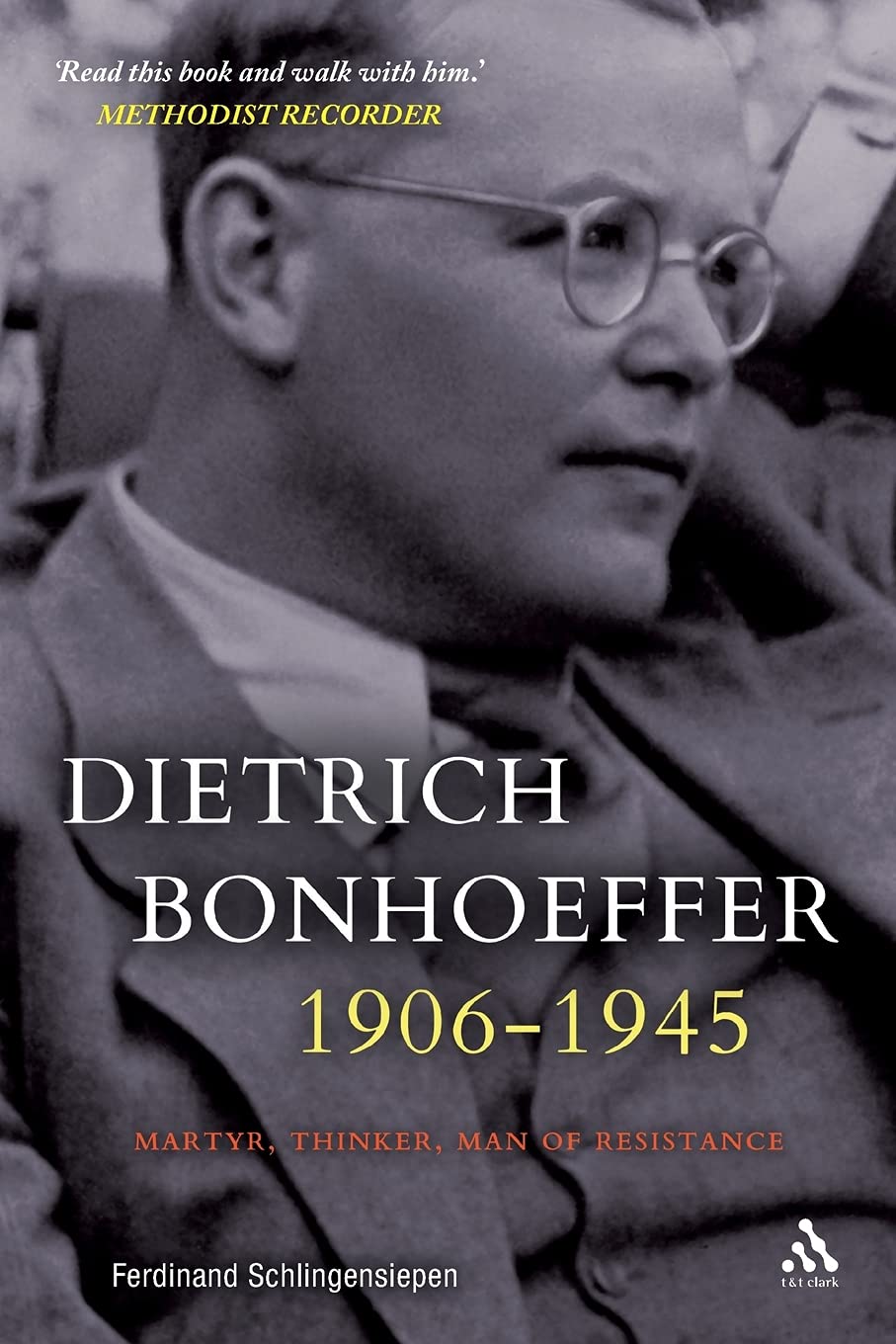
Dietrich Bonhoeffer 1906-1945: Martyr, Thinker, Man of Resistance by Ferdinand Schlingensiepen
Schlingensiepen’s biography is broad and intently focused upon Bonhoeffer’s intellectual development and production. It is an excellent work of Bonhoeffer scholarship but perhaps a bit less accessible for the lay reader.
Advantages
-Schlingensiepen’s academic experience and interpersonal connections make him imminently positioned to present an accurate accounting of Bonhoeffer’s life.
-The biography is not American-centric, as even the Marsh biography is in some ways. This biography is more historically based than it is theologically driven.
Disadvantage(s)
-The writing was originally German and the translation, while excellent, retains the dry tone and feel of the work.
-Schlingensiepen seems almost allergic to confronting modern concerns about theological questions that might arise from Bonhoeffer’s thought, making the biography more of a “just the facts, ma’am” approach than an attempt at relevance. This could also be seen as an advantage, depending on the reader.
It’s for you if…
You prefer a factual account of one’s biography to speculation about lesser grounded facts. Or, you would like to see a more modern German take on Bonhoeffer’s life. Or, you prefer to read one of the best scholarly treatments of Bonhoeffer’s life to anything more generalized.

The Doubled Life of Dietrich Bonhoeffer: Women, Sexuality, and Nazi Germany by Diane Reynolds
Bonhoeffer scholarship continues to broaden, and one great advantage of that is that scholars are driven to exploring corners of his life that would not otherwise have been explored. Reynolds here focuses specifically on Bonhoeffer’s life regarding the three subjects noted in the subtitle: women, sexuality, and Nazi Germany. (Full Review Here)
Advantages
-Insightful Commentary- Whether you agree or disagree with Reynolds’s conclusions, she makes a strong case in defense of her points. Truly, I think this biography deserves to be read by anyone who’s serious about engaging with Bonhoeffer’s life.
-Highlights lesser-discussed points- Women are constantly removed from history, but Reynolds puts women back into the narrative of Bonhoeffer’s life. She manages to show how influential many women were on Bonhoeffer’s life, leading to additional questions and avenues for exploration about Bonhoeffer. Additionally, the questions raised about Bonhoeffer’s sexuality elsewhere are highlighted here, with Reynolds deeply analyzing Bonhoeffer’s letters and life to make compelling, challenging arguments.
Disadvantages
-Primary focus is on the topics in the subtitle. Readers will get a fascinating look at Bonhoeffer’s interactions with women, interplay with Nazi Germany, and one of the deepest arguments about his sexuality found anywhere, but won’t have a full picture of his life.
-Highly controversial view of Bonhoeffer’s sexuality, which can be an advantage as it introduces readers to some of the best scholarly arguments on the topic.
It’s For You If…
You’ve read some about Bonhoeffer’s life and are interested in delving deeper into the background of some of his beliefs. You are curious about some of the hubbub surrounding Bonhoeffer’s sexuality in scholarly circles.
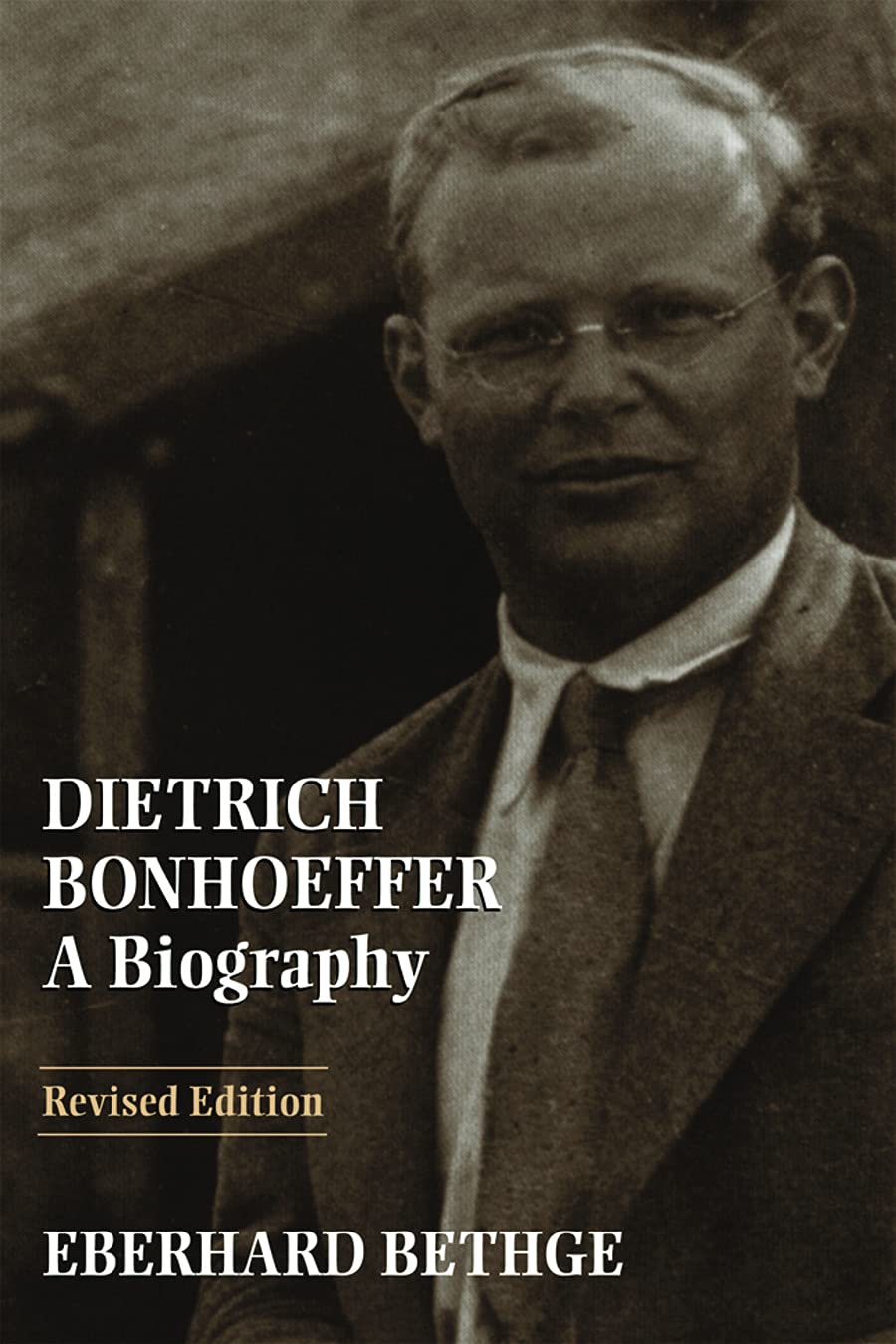
Dietrich Bonhoeffer: A Biography by Eberhard Bethge
Long seen as the definitive biography of Dietrich Bonhoeffer, this one is written by Bethge, Bonhoeffer’s great friend and confidant. It is voluminous in both content and commentary, providing key insights into Bonhoeffer’s thought from someone who knew him intimately.
Advantages
-The book feels absolutely comprehensive in its look at Bonhoeffer’s life.
-Bethge knew the subject well, personally, and this shows on basically every page.
-Bethge gives many insights into the “why” behind what Bonhoeffer was thinking, leading readers to deeper exploration and understanding of Bonhoeffer’s thought.
Disadvantage(s)
-It’s absolutely massive, weighting in at over 1000 pages (including notes/indices).
-There is some necessary bias from a friend of Bonhoeffer (Bethge) writing in a time in which Bonhoeffer wasn’t nearly as popular as he’s become now.
It’s for you if…
Want to feel like you know Bonhoeffer like a friend. Or, you’d like to see what serves as perhaps the baseline study for any student of Bonhoeffer’s life.
All Links to Amazon are Affiliates links
Links
Dietrich Bonhoeffer– read all my posts related to Bonhoeffer and his theology.
Be sure to check out the page for this site on Facebook and Twitter for discussion of posts, links to other pages of interest, random talk about theology/philosophy/apologetics/movies and more!
SDG.
——
The preceding post is the property of J.W. Wartick (apart from quotations, which are the property of their respective owners, and works of art as credited; images are often freely available to the public and J.W. Wartick makes no claims of owning rights to the images unless he makes that explicit) and should not be reproduced in part or in whole without the expressed consent of the author. All content on this site is the property of J.W. Wartick and is made available for individual and personal usage. If you cite from these documents, whether for personal or professional purposes, please give appropriate citation with both the name of the author (J.W. Wartick) and a link to the original URL. If you’d like to repost a post, you may do so, provided you show less than half of the original post on your own site and link to the original post for the rest. You must also appropriately cite the post as noted above. This blog is protected by Creative Commons licensing. By viewing any part of this site, you are agreeing to this usage policy.
Book Review: “Kierkegaard and the Changelessness of God” by Craig A. Hefner
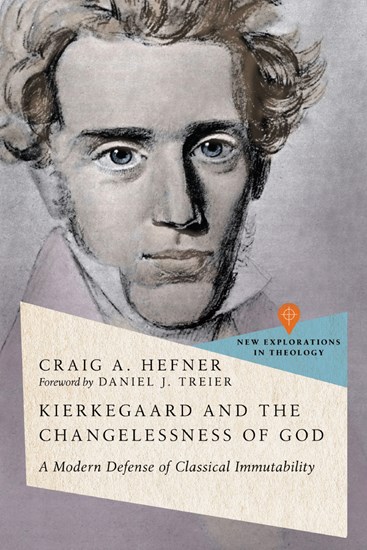
Kierkegaard and the Changelessness of God by Craig A. Hefner presents an unusual dynamic: Kierkegaard being used in defense of a core tenet of classical theology: divine immutability.
Hefner begins with a brief introduction to Kierkegaard and correction of misconceptions, including the notion that Kierkegaard was somehow out of tune with classical Christian theology. What Kierkegaard was reacting against was not Christian doctrine but rather than sleepy, comfortable way in which people were living in light of it. Kierkegaard united, rather than divided, traditional Christianity and existentialism.
Next, Hefner moves into four chapters that cover Kierkegaard and the doctrine of divine immutability or changelessness. What makes this defense of immutability unique is in part its focus on Kierkegaard’s existentialism as a defense of that changelessness. The two topics appear to be divergent, but Hefner argues the are in fact unified in Kierkegaard’s milieu. Kierkegaard’s existentialism provides a way to contrast God and humanity. The changing, “all flesh is grass” nature of humanity is contrasted with the immutable God.
Rather than simply relying on this contrast, however, Hefner with Kierkegaard argues that the Self can be reintegrated across change due to its relationship only with an immutable God. God, in other words, is the ground for the Self in a very real way. A whole chapter focuses on James 1:17 and Kierkegaard’s interpretation thereof. James 1:17 is often used as the core text for divine immutability, and Hefner draws on various interpreters to bring its insights to life.
Finally, Hefner argues that Kierkegaard’s conception of immutability doesn’t rely upon metaphysics but rather upon the concept of the self. I admit some of this section was a bit beyond me, because it seems to me that ultimately anything relies upon some kind of metaphysics. However, grounding the concept of immutability on the divine self was an interesting endeavor.
Kierkegaard and the Changelessness of God is an unexpected read. I found it refreshing despite being extremely dense. Recommended for readers looking for deep discussion of existential theology and its application to classical theism.
All Links to Amazon are Affiliates links
Links
Be sure to check out the page for this site on Facebook and Twitter for discussion of posts, links to other pages of interest, random talk about theology/philosophy/apologetics/movies and more!
Book Reviews– There are plenty more book reviews to read! Read like crazy! (Scroll down for more, and click at bottom for even more!)
SDG.
——
The preceding post is the property of J.W. Wartick (apart from quotations, which are the property of their respective owners, and works of art as credited; images are often freely available to the public and J.W. Wartick makes no claims of owning rights to the images unless he makes that explicit) and should not be reproduced in part or in whole without the expressed consent of the author. All content on this site is the property of J.W. Wartick and is made available for individual and personal usage. If you cite from these documents, whether for personal or professional purposes, please give appropriate citation with both the name of the author (J.W. Wartick) and a link to the original URL. If you’d like to repost a post, you may do so, provided you show less than half of the original post on your own site and link to the original post for the rest. You must also appropriately cite the post as noted above. This blog is protected by Creative Commons licensing. By viewing any part of this site, you are agreeing to this usage policy.
Why I Left the Lutheran Church – Missouri Synod: Points of Fracture: Women in the Church Part 2
The reasons I left the Lutheran Church – Missouri Synod were complex. Whether it was the science I was taught as a child not aligning with reality or the misogynistic and racist actions of pastors and those training to be the same, or any of a number of other issues I had, these all were contributing factors. Now, I am going to spend some time on perhaps the biggest reason I am no longer part of the LCMS, which is their views on women in the church and home. This is a deeply personal subject for me, and I have numerous personal stories related to it. Names and other details may be modified for privacy.
Points of Fracture: Women in the Church, Part 2
I wrote before about being confronted about the possibility of women being pastors when I was in college and dated a woman who wanted to be a pastor. I went straight to texts approved by the LCMS to try to prove that women could not be pastors. For a while, I was in a comfortable space thinking I was right, despite a few hiccups here and there. But one question that I’d never thought of before continued to plague me: why couldn’t women be pastors? It was one thing to read the texts a certain way and believe they excluded women from the ministry, but why would that be?
The answers I received when I asked LCMS pastors–who were plentiful at my school and the churches I attended in college–were unsatisfactory. With few exceptions, they boiled down to “Because God said so.” I could accept that. There were plenty of things I believed God had done or determined that I either couldn’t understand or hadn’t the information to even begin trying to comprehend them. But what bothered me more is that this didn’t seem to be the reason given until very recently. When I looked into why women were excluded from the ministry in older LCMS works or in church history, the answer continually came up that women had less ability to pastor. That is, they weren’t as smart, or they had some inferiority in them. Or, because of the curse from the fall, women had to submit to men. Another answer was a reading of 1 Timothy 2:14 (“Adam was not the one deceived; it was the woman who was deceived and became a sinner”) that claimed women were inherently more prone to being deceived.
These reasons, while they didn’t align with reality I observed, at least were reasons apart from “God said so.” As someone who was becoming increasingly interested in Christian Apologetics (a branch of theology in which people work to defend the Christian faith against objections and provide positive reasons for belief), I was especially sensitive to the “God did it” type of reasoning which many non-Christians accused Christians of appealing to when it came to questions of how the universe works. To me, having a reason why women shouldn’t be pastors, even if it was a poor and transparently misogynistic one, was better than having no reason other than a bare appeal to authority. But this reason didn’t stand up when I raised it to others. At one point, I recall even foolishly raising it to the young woman I was dating who wanted to be a pastor. She shot the reasoning down with all the scorn it deserved. After all, did I really, truly believe that men were any less inclined than women towards sinfulness? And didn’t the Lutheran confessions themselves teach that all people–men and women alike–are inherently sinful? How did men somehow get a free pass on this?
I realized that the reason I’d found didn’t work pretty quickly. Not only did it not match reality, but it also was blatantly misogynistic on a level with which I was uncomfortable despite the misogyny in my own background (see, for example, here). This left me adrift. I thought the Bible taught women couldn’t be pastors, but I could find no adequate as to why that should be the case. Then, one day, I walked into a Christian bookstore and came upon a book: Man and Woman, One in Christ by Philip Payne.
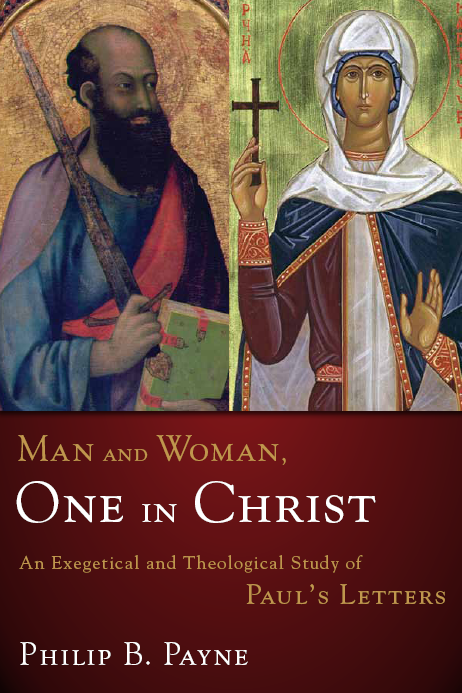
The first few pages of the book had the author talking about how he affirmed inerrancy but believed that men and women were equally gifted to serve and lead in the church. Here was someone who claimed to believe as I did about the authority of the Bible while still affirming women in leadership. I bought the book and over the course of the vacation I was on I read it, underlining copiously, looking up Bible passages (“Does it really say that!?”), looking at my Greek New Testament, and more. Payne focused on the Pauline corpus related to women in the church, but as that’s where the most significant “clobber passages” were drawn from in my own tradition, that made it a nearly comprehensive study of the topic. And what I found is what I’d begun to suspect: the reading I had been taught was mistaken. Not only did it ignore the cultural context of the text, which I’d been taught was important for understanding the true meaning of the words, but the readings were simplistic on the highest level. They relied, often, on English translations by people already inclined to exclude women from ministry in order to make their points. Payne’s analysis was insightful and absolutely cut the core out of my own view.
I still wasn’t ready to accept women as pastors, but I realized I had massively oversimplified the biblical debate. Then, one day, push came to shove.
My girlfriend had changed her career path because of my objections to her chosen field. She’d decided to study psychology and possibly do some kind of family counseling. But then she came to me telling me that her sense of call from the Holy Spirit into the pastoral ministry hadn’t gone away. Indeed, in some ways it had strengthened. Could I accept what she felt called to do?
I prayed fervently that God would show me the way. I believed–and believe–that God answers prayer, and I dedicated most of my free time for over a week to ask God to guide me. Finally, I prayed one night something like, “God, I know I should not test you, but even your servant Gideon asked for a sign[1]. Please, show me a sign.” I set my Bible on my bed, and flipped it open.[2] It landed on 1 Corinthians 12. I started reading, and became greatly agitated. There it was, about as plain as it seemed it could be, 1 Corinthians 12:28: “And God has appointed in the church first apostles, second prophets, third teachers, then miracles, then gifts of healing, helping, administrating, and various kinds of tongues.” The verse showed that God put an order in the church. That order seemed to be a kind of authoritative or hierarchal order. First were the apostles, second the prophets, third the teachers, and then other gifts. But those first 3 were numbered in an order form first through third. And every understanding I’d seen of pastors in the Bible would say the word “teachers” could be applied to pastors. And, while Junia was an apostle in the Bible, I hadn’t yet read enough on that topic to realize how important she was or even acknowledge that fact. No, what mattered is that women were prophets in the Bible. Absolutely no one could deny that. But if that was the case, then women prophets were set above teachers in the church by God Himself.
It can’t be emphasized enough how much this verse shifted my understanding of the topic. I had been taught that men were suppose to have more authority than women. Indeed, the word “authority” was absolutely essential to an understanding of the topic of women in the ministry. Women just weren’t supposed to have authority over men, they were supposed to submit to them in everything. But here was a verse that plain as day stated that prophets ranked above teachers–the word I’d been assured was one of the biblical words for pastors. And because women prophets existed and no one denies that, that meant that women could be above pastors in whatever sense the verse meant.[3]
It was a revelation, and one that had struck me at the very moment I’d been most fervently praying for a sign from God. There it was. What more could I do than acknowledge it? My mind had been changed, and not because I wanted it to be changed for the sake of my relationship. It hadn’t been changed by “the culture,” whatever that’s supposed to mean. It had instead been changed by prayerful consideration of the text and a strong adherence to carefully reading the same. My mind had been changed. Women could be pastors. I realized this was going to be a major life-changing event for me in a way that people outside some obscure theological debates might not be fully able to grasp. It truly was a paradigm-shifting moment in my life, and one about which I’d not yet realized the full implications and consequences that would follow.
[1] The book of Judges has been a longtime favorite of mine, ever since I was enthralled by the illustrated kids’ Bible in which the action hero nature of this book made it jump off the page. Gideon’s story can be found in Judges 6 and following. The part I was referencing was Judges 6:37-40.
[2] I realize some readers might be uncomfortable about thinking God works this way. So am I. I don’t think God typically works in such a fashion. I can only report what I experienced and my belief that, in the moment, God used a broken, mistaken understanding about how God works to bring me to a better understanding of the Bible.
[3] Obviously much more nuance is needed here, and I’ve since thought and read quite a bit about this issue. However, I’ve yet to see a complementarian answer about this specific verse that is able to read the words on the page without somehow subverting the order in the church as stated here.
Next: Women in the Church Part 3- I write about my experience within the LCMS on the other side of the issue of women in the church.
Links
Formerly Lutheran Church – Missouri Synod (LCMS) or Wisconsin Synod (WELS)– A Facebook group I’ve created for people who are former members of either of these church bodies to share stories, support each other, and try to bring change. Note: Anything you post on the internet has the potential to be public and shared anywhere, so if you join and post, be aware of that.
Leaving the LCMS/WELS– Not sure about whether to leave or thinking about leaving? Do you want to others who are thinking along the same lines? I created a group for those who are contemplating leaving these denominations, as well.
Why I left the Lutheran Church – Missouri Synod Links Hub– Want to follow the whole series? Here’s a hub post with links to all the posts as well as related topics.
Be sure to check out the page for this site on Facebook and Twitter for discussion of posts, links to other pages of interest, random talk about theology/philosophy/apologetics/movies and more!
SDG.
——
The preceding post is the property of J.W. Wartick (apart from quotations, which are the property of their respective owners, and works of art as credited; images are often freely available to the public and J.W. Wartick makes no claims of owning rights to the images unless he makes that explicit) and should not be reproduced in part or in whole without the expressed consent of the author. All content on this site is the property of J.W. Wartick and is made available for individual and personal usage. If you cite from these documents, whether for personal or professional purposes, please give appropriate citation with both the name of the author (J.W. Wartick) and a link to the original URL. If you’d like to repost a post, you may do so, provided you show less than half of the original post on your own site and link to the original post for the rest. You must also appropriately cite the post as noted above. This blog is protected by Creative Commons licensing. By viewing any part of this site, you are agreeing to this usage policy.
“It’s a Yes or No Question!” – Reconstructing Faith

On my faith journey one of the hardest things was when people I used to agree with would aggressively demand yes or no answers to what they thought were simple questions but that I thought were incredibly difficult and complex to answer.
Then they’d be angry about my hesitancy to answer. “It’s just a yes or no question!” they’d exclaim. Many continue to offer these questions to me as I consider questions about faith. The dichotomies that are offered are thought to be definitional, of deepest concern, and simple. But so often they’re not–they’re false dichotomies, they’re secondary issues, and they’re incredibly complex. Even trying to explain some of the difficulty with how complex these issues are would take much more than a single blog post. I’ll show a few examples of some of these dichotomies, some of which I actually did have offered as yes/no questions to me.
Do you believe that God created the heavens and the earth? Yes or no?
Do you believe in hell?
Do you believe we have souls?
Do you believe the Trinity is an essential doctrine?
Some readers might see some of these questions as quite simple–maybe even all of them, but here are some examples of the complexity:
Do you believe that God created the heavens and the earth? Yes or no?
What is meant by “created” here? Is it direct, fiat creation? Could God have used processes? What is meant by “heavens and the earth”?
Do you believe in hell?
What do you mean by hell? Do you mean endless, eternal, conscious torment? Do you mean literal fire? How does one “believe in” hell? Shouldn’t we all wish there were no hell and be hopeful that all might be saved, even if we don’t think all shall be?
Do you believe we have souls?
What is meant by the soul? Is it dualism? What kind of dualism–Cartesian, interactionism, emergentism? Could a Thomistic view of the soul be correct?
Do you believe the Trinity is an essential doctrine?
Yes, I do. But! What exactly does it mean to call it “essential”? Must one have it 100% correct in order to be saved? What does one make of the immense disagreement over subordination of the Son in recent debates, if so? What about questions of rejection of the Trinity being based upon rejection of colonialism?
Yes or no questions, intentionally or not, cut across sociological, theological, and philosophical lines without any precision and are seemingly designed to stop serious discussion and debate about a topic. They are used as a divisive tool, cutting apart people to show others what they’re right or wrong about? They’re traps that cut off discussion.
So yes, people will continue to get angry with me, but I refuse to allow some of these incredibly complex issues get boiled down to a yes or no question. It might make things simpler to boil down these topics to yes or no, affirm or deny type dichotomies, but it doesn’t help us get at truth. And that is what I desire: to seek truth.
Links
Reconstructing Faith– Read other posts as I search for truth and navigate the messiness that is faith.
Be sure to check out the page for this site on Facebook and Twitter for discussion of posts, links to other pages of interest, random talk about theology/philosophy/apologetics/movies and more!
SDG.
——
The preceding post is the property of J.W. Wartick (apart from quotations, which are the property of their respective owners, and works of art as credited; images are often freely available to the public and J.W. Wartick makes no claims of owning rights to the images unless he makes that explicit) and should not be reproduced in part or in whole without the expressed consent of the author. All content on this site is the property of J.W. Wartick and is made available for individual and personal usage. If you cite from these documents, whether for personal or professional purposes, please give appropriate citation with both the name of the author (J.W. Wartick) and a link to the original URL. If you’d like to repost a post, you may do so, provided you show less than half of the original post on your own site and link to the original post for the rest. You must also appropriately cite the post as noted above. This blog is protected by Creative Commons licensing. By viewing any part of this site, you are agreeing to this usage policy.
Faith is Messy

Longtime readers of this blog will know that I’ve taken a kind of hiatus from some kinds of posts. I’ve mostly been posting a ton of book reviews. Part of that is because I have been reading all the time, trying to expand horizons and learn more. Another aspect of it is that my views have been changing, meshing, melding, and morphing over time, to the point that I kept thinking I should post on things and then being loathe to confidently put forward ideas that I wasn’t convinced were true.
I am hoping that pattern stops now. I have a lot of things going on in my personal life, but I also have a lot I’d like to write on and reflect on with you. If you’re a longtime reader, thanks so much for sticking with me through this, and I hope you’ll continue to read and comment going forward! If you’re new here, welcome! I hope you’ll bear with me on this journey.
First, there are still going to be a lot of book reviews. It’s a thing I like doing and that I like to think I’m fairly good at. Second, I’m still very interested in a lot of the things I wrote on before: apologetics, science and Christianity, and theology (especially Bonhoeffer!). I’ll still be writing on those things.
Faith is messy. That’s maybe the biggest thing I’ve learned on my own walk. It’s easy to have a set list of specific, explicit instructions about how the way things ought to be. It’s easy to stay in the position that you’re right and everyone around you is, at best, mistaken, or at worst actively deceiving others. It’s easy to subscribe to a view and never let it be questioned. Some people can live with that–and I’m not trying to judge them. I can’t live that way, though. I have to question, to poke and prod and find out if the ideas work. I don’t want to spend my life living behind a set of doctrinal statements that I’ve not at least tried to confirm for myself. I’ll be writing a lot more about this going forward.
So what do I mean that faith is messy? I mean that, for me, many of the things I was taught at various levels–all the way through graduate school–turned out to be much more complex than I thought at the time. Questions about what it means to affirm inerrancy, questions about hell–and heaven!, questions about what it means to live as a Christian today. I asked questions about my own Christian identity, and what it means to be orthodox.
I lost a lot of friends. I don’t know if it was because I was asking questions that were too difficult, or if it was that I felt some anger and lashed out when the answers I received seemed too simple to deal with the complexity I saw. Either way, I don’t begrudge them–but it doesn’t make it any easier.
Those are just some of the issues I’ve struggled with, and the struggle has been highly formative. I hope you’ll join with me as I write about some of my faith journey, and maybe even comment, and walk with me. I hope to explore the faith even more fully as I write and reflect on my journey, and I want you to join me.
I’ve decided to rebrand my blog a bit, too. Instead of “Always Have a Reason” – I’m naming the site “Reconstructing Faith.” It is one thing to deconstruct faith–that’s easy to do. But here, I’m going to be doing the hard work, hopefully with your help, of reconstructing faith.
Junia and Bayesian Epistemology: Philosophical probability trumping Biblical scholarship?
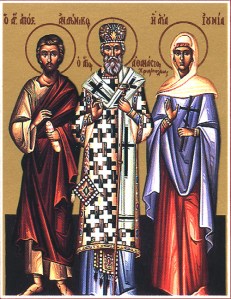 Alexander Pruss is one of the smartest people I’ve encountered. Though I don’t always agree with his conclusions, the sharpness of his intellect and his wit is always fascinating. His blog is frequently a place to flex mental muscles, as he offers small, one-off arguments to spur discussion. Recently, he wrote a post entitled “Junia/Junias and the base rate fallacy” Pruss argued that application of Bayesian analysis to biblical scholarship would help solve the question of whether Junia/Junias was an apostle. Apologies in advance for possible lack of care with terms like “factor,” “probability,” and “odds”; I tried to be careful but I’m tired.
The Argument
The preliminaries are explanations of Bayes’ Theorem and the meaning of the “base rate fallacy,” both of which are easily searched online, but I provided the links here (with all the caveats that a little bit of knowledge is a dangerous thing and Wikipedia articles don’t make anyone an expert). With that information in mind, we approach Pruss’s argument.
Pruss does fudge the numbers some, admitting he hasn’t explored the question on the actual numbers for some of these probabilities. So, for example, he begins by giving a 9:1 factor for Junia:Junias names in the early church. With that, and with the note that to avoid the base rate fallacy, we ought to assign a probability (he gives .9) to the question of whether this person was “among” the apostles, it yields a .19 rate of false positives for people who are not woman apostles to be assigned the notion of being a woman apostle. Moreover, if we say that there are 12 male apostles (the disciples) for every one female apostle (Junia), the probability of an apostle being a woman is now 1/13. Finally, because “not everyone Paul praises is an apostle” we have to assign a probability to whether Paul is praising an apostle here (Pruss gives it .3). This means that “the chance that a randomly chosen person that Paul praises is a female apostle even given the existence of female apostles is only about (1/13)×(1/3) or about three percent.”
Plugging in the .19 we got above for false positives and doing more math (read his post), we now discover that “even assuming that some apostles are female, the probability that Junia/s is a female apostle is at most about 14%, once one takes into account the low base rate of women among apostles and apostles among those mentioned by Paul.”
Pruss immediately notes the numbers are made up and could change the overall results.
Analysis
There are some significant problems with Pruss’s argument here. First, the fact is that there is no extant name “Junias/Junianias” found anywhere in lexical evidence whatsoever. Thus, instead of .9 for Junia being a woman, it should be 1. One comment pointed this out and Pruss pressed the argument that even in this case, the math would still be “significantly less than 50%” for Junia to be a female apostle. Doing the math is too hard for my tired brain, but let’s just say he’s right. The question still remains of why the chances for Junia to be a female apostle would be so low.
Looking at his other percentages, it seems a large part of the argument, once we’ve established Junia is female, turns on whether it is the case that she may not be “among” the apostles. Pruss’s position here falls into the goalpost moving arguments that complementarians have engaged in since the lexical evidence turning her into a man came up dry. Typically, this is how it goes:
Junia was not a man => Okay, Junia was not an apostle => Okay, Junia was not the type of apostle that was authoritative
The third stage above is one that is essentially a theological fiction supported almost entirely by punting to the fallacious importation of the semantic range of a word into a foreign context. When Paul wrote to say that Junia was an apostle, according to this argument, but she was one only in the semantic meaning of the word apostle as witness/sent one/messenger. Never mind that the word is used for an office in the New Testament, including in the writings of Paul (1 Corinthians 12:28). No, because it does not serve the purpose of continuing to prevent women from holding pastoral office, the entire semantic range of meaning for the word “apostle” must be imported in order to reduce Junia in status once again. This fallacious importation of meaning is a demonstration of an ad hoc explanation. (Unfortunately, Pruss himself succumbs to this goalpost moving argument in the comments on this post when he questions whether Junia as an apostle would be an authoritative apostle or not.)
But it is the second stage that is at question initially, and here, once again, it seems that the importation of complementarian assumptions into the text has occurred, for this reading goes against the earlier known readings from church fathers (see here, for example) which saw Junia as an apostle and did not import the lexical range of the word into “among” either. So, again, the factor needs to be moved from .9 to 1.
The proportion of male:female apostles is made up, as Pruss acknowledges. It’s possible that the reality is 1:1 or 100:1. So it would be possible to move numbers around to make it either extraordinarily likely Junia was a woman apostle or unlikely. It also seems to me the 1/3 possibility that Paul is praising an apostle seems high. So again, this would potentially lower the probability for Junia as a woman apostle. It could raise it, though that seems unlikely given the biblical text. Nevertheless, significant gains were made with “Junia” being established as the name and being among the apostles. And, the question of just how likely something ought to be in order to be epistemically justified in believing it is itself a matter of very hot debate. If, say, the likelihood for Junia being a woman apostle were 33%, would someone be justified in holding that belief? The answer to that question is very messy indeed.
But the most relevant evidence, the most clear counter-point to Pruss wasn’t even considered. That is this: using prior probability to determine the likelihood of an event does not matter if the event has already occurred. That is, if it is the case that Paul does name a woman apostle, then whether or not this was likely or unlikely given any number of other prior probability considerations does not change what Paul does in Romans 16:7. And while Pruss tries to say that his use of Bayesian theorem ought to somehow guide biblical scholars in their reading of this text, what he doesn’t consider is that highly improbable events do occur and that if they do, whether or not the event is improbable does not impact the event’s actually having occurred. Indeed, it is unclear as to why a biblical scholar should take such prior probability into account to begin with (apart from, potentially, taking caution with offering interpretations that are particularly unlikely). Suppose that the name were not Junia but Rebecca and the Greek text were so clear as to make it impossible to take it as anything but “among the authoritative apostles” (despite their being no use of this term in the NT and it being a demand for evidence by complementarians that they cannot meet for people they themselves admit to being apostles). What then? Would a scholar be justified in dismissing the sentence written by Paul that “Rebecca was an authoritative office-holding apostle” simply because of prior probabilities? It seems obvious the answer is no. So then the question is why should the biblical scholar be beholden to prior probabilities in a supposedly less clear case (and again, I by no means grant that it is unclear)? Again, the answer seems to be that the scholar ought not to worry about that, given the relevant data is directly in front of them.
Conclusion
Bayesian reasoning is interesting. I’ve enjoyed reading about it and learning about it from time to time. Whether or not it is helpful to theological questions is a concern for a different time, though it is a fascinating question to ponder (related questions such as how can we fill in sometimes arbitrary probabilities for certain events/people/etc. and still think the theological reasoning is sound would be interesting to explore in depth). In this specific case, though, it seems clear that Pruss’s argument fails for several reasons. All of these center around the actual meaning of the text (the name Junia and the meaning of “among the apostles”) which no amount of external probabilities can alter. Pruss’s argument is a fun mental exercise that need not undermine confidence in the data of the text itself: Junia was a female apostle. Pruss’s claim that biblical theologians ought to use Bayesian reasoning in their exegesis does not seem to be sustained by this example.
Links
A Brief Biblical Proof for Women Pastors– Read why 1 Corinthians 12:28 is an even bigger problem for complementarians, as it effectively guarantees women may hold the same or more authority than that of pastors.
On the Femnization of the Church– It is frequently alleged that the church is being “feminized” and that this is a bad thing. Check out this post, wherein I analyze this notion from a few different angles.
Women in the Ministry: The philosophy of equality and why complementarianism fails– I argue that the position in which women are excluded from church leadership entails inequality of being.
SDG.
——
The preceding post is the property of J.W. Wartick (apart from quotations, which are the property of their respective owners, and works of art as credited; images are often freely available to the public and J.W. Wartick makes no claims of owning rights to the images unless he makes that explicit) and should not be reproduced in part or in whole without the expressed consent of the author. All content on this site is the property of J.W. Wartick and is made available for individual and personal usage. If you cite from these documents, whether for personal or professional purposes, please give appropriate citation with both the name of the author (J.W. Wartick) and a link to the original URL. If you’d like to repost a post, you may do so, provided you show less than half of the original post on your own site and link to the original post for the rest. You must also appropriately cite the post as noted above. This blog is protected by Creative Commons licensing. By viewing any part of this site, you are agreeing to this usage policy.
“The Great Hunt” by Robert Jordan – A Christian (re-)Reads “The Wheel of Time”
 The Great Hunt is book two in Robert Jordan’s epic “The Wheel of Time,” a series that has sold more than 400 million copies. There will be SPOILERS, though I will try to limit those for later in the series. Fair warning, though, I may not.
Evil is Deceptive
I know this may seem obvious, but it bears thinking on more closely: evil is deceptive. The Dark One is a deceiver, just as Christian theology teaches about Satan. In The Great Hunt, this most clearly strikes home in the prologue, as a man who calls himself Bors is entertaining himself at a party, seeking out the deceptions within deceptions all around him. Ultimately, the Dark One–or perhaps a Forsaken?–makes an appearance, leading all to cower in fear, but also to wonder at the possibility of lies and plots even here. Evil, you see, is deceptive: it is dangerous even to itself, tricking other evildoers into great plots and twisted ends.
The deception of evil isn’t limited to the prologue, though. Perhaps the most clear example of evil being deceptive is one not revealed in this book. In fact, there are several threads that dangled in The Great Hunt without being fully revealed. Readers, get ready for some upcoming revelations! Some of them will take many books until we get to them.
Hatred and Justice
Some of the most poignant scenes in this book center around the Seanchan. I think that the scene in which Egwene is captured by the Seanchan and the subsequent scenes following her imprisonment are some of the most emotionally jarring in a book that I have ever read. I felt true loathing for the Seanchan and even though I knew the outcome of these events, having read the series before, I felt a true sense of dread throughout these scenes. The characters involved are no less emotional. Nynaeve says that the Seanchan deserve hatred, but also justice. I was struck by this. It is an almost offhand remark, made by Nynaeve in her efforts to get everyone moving out of a dangerous situation, but it is a statement offered unchallenged. Perhaps it is a commentary from Jordan on morality and justice as well.
For Jordan, there seems to be less room–if any–for mercy or forgiveness. Enemies are hated, justifiably, because they are evil. It’s almost as though he has painted a truly black-and-white world, one in which evil is evil and good is good and that’s all there is. The magical elements related to the evil powers help enforce this feel. I can’t remember if forgiveness becomes a theme later in the books, but I’m curious to read more. According to a few bios I’ve seen of Jordan, including one on Tor, the publisher’s page, he was an Episcopalian, so I’m wondering how much of his faith comes out in his books. On the other hand, it is clear he was drawing from many religious beliefs and myths to build his world, telling a story in the best way he knew.
Reincarnation
Time works differently in The Wheel of Time. From what we can tell so far, it seems to be a wheel, constantly repeating in a circle. Many scenes with Rand show us this theme, as he is attacked by the Dark One who constantly tells him he will fail “again” and “again.” Rand sees many possible (former?) lives in several different scenes. More and more, what this means becomes more clear. It is with this theme–reincarnation–that we see a more significant divergence from Christian belief. What does it mean for Rand to be Lews Therin reborn? What kind of ideas are involved in such rebirth and renewal? The future books will have to answer those questions.
The cyclical view of time seems to be quite different from a view of time from a Christian perspective. Though some Christian theologians through history can be found to hold to things like a B or Static theory of time, including an eternal universe, these are in the minority. Such musings about time take us far afield from what is clearly taught in the Bible, though. But reincarnation seems to be rather more clearly rejected. Though proof-texting out of context is a practice I tend to avoid, something like Hebrews 9:27-28 appears to go against reincarnation: “Just as people are destined to die once, and after that to face judgment, so Christ was sacrificed once to take away the sins of many; and he will appear a second time, not to bear sin, but to bring salvation to those who are waiting for him.” Though again, here, we see the thrust of the text is not on the point of dying once, but rather on Christ’s once-for-all sacrifice to take away sin. Other verses could be mustered, and the overall teaching within the Bible about humanity seems to be: life (not from eternity but born into time), death, judgment, and then final ends, whether eternal life or eternal death.
Links
Be sure to check out the page for this site on Facebook and Twitter for discussion of posts, links to other pages of interest, random talk about theology/philosophy/apologetics/movies and more!
Book Reviews– There are plenty more book reviews to read! Read like crazy! (Scroll down for more, and click at bottom for even more!)
SDG.
——
The preceding post is the property of J.W. Wartick (apart from quotations, which are the property of their respective owners, and works of art as credited; images are often freely available to the public and J.W. Wartick makes no claims of owning rights to the images unless he makes that explicit) and should not be reproduced in part or in whole without the expressed consent of the author. All content on this site is the property of J.W. Wartick and is made available for individual and personal usage. If you cite from these documents, whether for personal or professional purposes, please give appropriate citation with both the name of the author (J.W. Wartick) and a link to the original URL. If you’d like to repost a post, you may do so, provided you show less than half of the original post on your own site and link to the original post for the rest. You must also appropriately cite the post as noted above. This blog is protected by Creative Commons licensing. By viewing any part of this site, you are agreeing to this usage policy.

 J.W. Wartick - Reconstructing Faith