James Barr
Inerrancy Undermines Interpretive Method?

James Barr’s work, Fundamentalism (1977) remains incredibly relevant to this day. I have been reading through it and offering up thoughts as I go. I’m reading the chapter about the Bible and Barr has enormous insight into the Fundamentalist (and here it is okay to substitute in “Evangelical”) reading of the Bible.
I’ve already written about how Barr notes that fundamentalists do not have a consistent hermeneutic of the Bible because their adherence to inerrancy forces them to read passages in light of their own understanding of truth. Barr isn’t done firing his salvoes at this issue, though he also notes that many people misread fundamentalists on their use of literalism:
“It is thus certainly wrong to say… that for fundamentalists the literal is the only sense of truth. Conservative apologists are right in repudiating this allegation. Unfortunately, the truth is much worse than the allegation that they rightly reject. Literality, though it might well be deserving of criticism, would at least be a somewhat consistent interpretative principle, and the carrying out of it would deserve some attention as a significant achievement. What fundamentalists do pursue is a completely unprincipled – in the strict sense unprincipled, because guided by no principle of interpretation – approach, in which the only guiding criterion is that the Bible should, by the sorts of truth that fundamentalists respect and follow, be true and not in any sort of error” (49).
Here Barr notes first that fundamentalists/evangelicals are right to push back against the accusation that they simply see literalism as the only way to read the Bible. However, he goes on to point out that their approach is significantly more problematic, because they eschew all principles of interpretation other than the one that the Bible should not be found to be in error on any point.
Who determines how to interpret any given passage, then, and how? Pontius Pilate asked “what is truth?” and has been lampooned time and again–but the question could be posed to conservative readers of Scripture, who, in their attempts to define truth, go to extraordinary lengths to massage the word into what they need it to mean to preserve the Bible (the Chicago Statement on Biblical Inerrancy is full of this). Who determines what is an error?
In my own life, I experienced this unprincipled–again, using the word technically as meaning literally without principle–approach to reading the Bible. At a Lutheran Church – Missouri Synod college, I was taught that we needed to use certain principles of interpretation, specifically those following a supposed “historical grammatical” method of interpretation. This method, among other things, aims at attempting to find the authors’ original intent in meaning in the Biblical text. Yet, when I pointed out that our knowledge of the thinking of the Ancient Near Eastern world meant that interpreting the passages which depict a flat earth with four corners seem to be the right interpretation, I was told that we suddenly didn’t follow a method that went to the authors’ original meaning. Another pastor told me very specifically that we couldn’t know the authors’ original intent in writing the words of Scripture, but the same pastor later countered my doubting of young earth creationism by claiming that the author of Genesis knew the Earth was young–and so intended us to believe so as well.
The shifting sand of interpretation would seem entirely odd if it wasn’t placed in the context of inerrancy, which is the tail that wags the dog. All conservative interpretation now centers itself around this new doctrine. Reading books about the Canaanite conquest from conservative scholars is telling in this regard, as are questions about exactly what happened with certain miraculous events in the Bible. The debates often center around just how far one can push inerrancy without it breaking. Can one say that the walls of Jericho didn’t literally fall to pieces after being marched around and shouted at a certain number of times and still hold to inerrancy? It seems silly, but this is a real debate that is happening in literature right now. The same question is asked, time and again, for any number of things–whether Jonah was really swallowed by a fish (or a whale?)–whether one has to affirm Job was a real person to affirm inerrancy. The questions in evangelical and conservative scholarship related to the Bible are so often not about what the text is actually teaching us but rather on what exactly is allowed to be said in the context of inerrancy. And when someone does do some serious hermeneutical work that pushes at a supposed boundary of inerrancy, they are inevitably called to account in conservative academic journals.
Inerrancy controls the narrative, it controls the hermeneutic, and it strangles the interpretation of the Bible. It ought to be abandoned.
Fundamentalism continues to provide fruit for thought, almost 50 years after its initial publication. I highly recommend it to readers.
SDG.
How Inerrancy Displaces God
James Barr (1924-2006) was a renowned biblical scholar who, in part, made some of his life’s work pushing back against fundamentalist readings of Scripture and Christianity. I have found his work to be deeply insightful, even reading it 40 or more years after the original publications. His most controversial and perhaps best-known work was Fundamentalism (1977), in which he offered a survey and critique of fundamentalism, which applies incredibly strongly to Evangelicalism and conservative Christianity to this day.
One of the many incredible insights Barr provides is how the doctrine of inerrancy actually displaces God by making the Bible a or the primary focus of Christianity. We’re going to take an extended look at what he writes about the Bible under fundamentalism, along with some commentary, below [all these quotes are from pages 36-38 in the edition I have):
“For fundamentalists the Bible is more than the source of verity for their religion… It is part of the religion itself, indeed it is practically the centre of the religion, the essential nuclear point from which lines of light radiate into every particular aspect. In the fundamentalist mind the Bible functions as a sort of correlate of Christ. Christ is the personal Lord… the Bible is a verbalized, ‘inscripturated’ entity, the given form of words in which God has made himself known, and thus the Bible equally enters into all relations, its words cannot be quoted too often, its terms, cadences and lineaments are all to be held dear.”
Barr here starts his fusillade by noting that for the fundamentalist, the BIble is nearly on par with Christ. Why? Because like Christ, the Bible is in every relationship, and because it is visualized as verbally inspired–the very individual words God intended–it becomes in a way like the deity Christ-self.
“While Christ is the divine Lord and Saviour, the Bible is the supreme religious symbol that is tnagible, articulate, possessable, accessible…”
Christ is far off, almost mythical compared to the reality of the Bible one can just hold in one’s hand. Barr does moderate this a bit:
“From this point of view it is wrong to say, as is sometimes said, that they put the Bible in the place of Christ. But from another point of view the Bible is really more important: it is the Bible, because it is the accessible and articulate reality, available empirically for checking and verification, that provides the lines that run through the religion and determine its shape and character.”
So while it may be wrong to say the Bible is put in place of Christ, in reality the inerrantist almost makes the Bible even more important than Christ. Again, Christ is not immediately available, in their minds, to pick up and interact with. But the Bible is. So one can open the Bible and verify what is supposed to be reality.
“The Bible is thus the supreme tangible sacred reality.”
I think here of my own (Lutheran) tradition in which we believe we can experience sacred reality through Christ’s promises and literally being present in, say, the Lord’s Supper.
“…once the symbolic elevation of the Bible goes beyond a certain point it begins to alter the shape and character of evangelical religion altogether. Certain kinds of biblical criticism and theology are felt to threaten the status of the Bible as absolute and perfect symbol of the religion; and in order to protect that symbolic status of the Bible the religion itself has to be adjusted or distorted.”
I think here of the many, many times I heard inerrancy as the central part of Christianity. Not Christ; inerrancy. Because–it was reasoned–after all, if the Bible has an error, why trust it about Christ? And so you lose everything if even one error exists. And here we see how the Bible is absolutely the central religious symbol.
“The fundamentalist position about the infallibility and inerrancy of the Bible is an attempt to prevent this tradition from being damaged through modes of interpretation that make the Bible mean something else… Especially in its intellectual and apologetic work… [fundamentalism] finds that it gradually has to alter and even abandon essential elements in the very religious tradition form which it started out. When this happens it is valid to say that the Bible as symbol, rather than the Christ who speaks through the Bible, has become the supreme controlling factor.”
I think here of my background as a young earth creationist, in which certain elements of geology were seen as specifically threatening to my faith in a way that no Christians prior to the 1900s would have been able to even comprehend.
“This symbolic function of the Bible has a deep effect on personal behaviour… [such as] the incantational use of Scripture.”
This hits hard–the idea that merely repeating utterances of the exact wording of Scripture has some kind of power or reality-bringing for it.
“In a religion lacking in ritual, the citation of Scripture has often functioned as a practically ritualistc procedure. The Bible… undergirds and harmonizes with the fundamentalist tradition of religion. It is a matter of course that preaching will use biblical texts, celebrate the centrality and infallibility of the Bible, and quote it frequently. It is by no means, however, a matter of course that it will make a careful exegetical examination of the meaning of the passages. Most fundamentalist preaching merely reiterates the traditional evangelical point of view, quoting the accepted proof texts but not really asking openly after the meaning.”
Yes! I have found it deeply ironic that in the conservative Lutheran circles I grew up in, the attempt to actually find what the Bible means was avoided. While saying they wanted to use the “historical grammatical” method of interpretation rather than the “historical critical” method, I’d encounter pastors and theologians who would explicitly tell me I “shouldn’t” be using actual historical facts about the Bible or its setting in the interpretation thereof. It was far more important to affirm the tenets of conservative Lutheranism rather than ask questions about what the text might “really” mean. Indeed, asking what a text might “really” mean was compared to the snake in the Garden asking if God “really” said something.
I haven’t even gotten to Barr’s chapter in this book on the Bible itself, but it has already provided immense food for thought. Insisting on Biblical inerrancy not only undermines how Scripture works, but it also displaces God, making the Bible the ultimate symbol of faith.
SDG.
Freedom as an Essential Component of Biblical Research
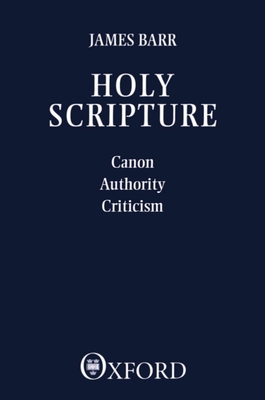
James Barr (1924-2006) was a renowned biblical scholar who, in part, made some of his life’s work pushing back against fundamentalist readings of Scripture and Christianity. I have found his work to be deeply insightful, even reading it 40 or more years after the original publications. One insight I gleaned recently was from Holy Scripture: Canon, Authority, Criticism (1982). Here, he made a clear argument for the need for freedom in biblical scholarship:
“Research requires freedom of thought; if this is lacking, it only means that the research will be less good, in extreme cases that it will dry up altogether. Freedom is not something that should have to be wrung from a reluctant grasp: the church should promote freedom because freedom is part of its gospel. The same is true of theology: it is in the interests of theology itself that it should not seek the power to control and limit, that it should recognize, accept, and promote the fact that there are regions of biblical study for which the criteria of theology are not appropriate; just as it is salutary for the church that it should not seek to dominate the nature of education…
“THe relations between freedom and religion are paradoxical. Freedom of religion is one thing, freedom within religion is another. Freedom of religion is often thought of as freedom of religion from coercion through the state, and that can sometimes be very important, though it is far from being the nucleus of the idea of Christian freedom. Religions can demand freedom of religion, while denying freedom within religion, which is much closer to the idea of Christian freedom…” (109-110).
Note that the last line is saying that it is closer to Christian freedom to have freedom within religion than the opposite. Barr is saying that biblical and theological scholarship–and Christianity generally–benefits from freeing its scholars to explore whatever fields or ideas they deem necessary or of interest. For one, this is because freedom is part of Christianity’s gospel itself–a point Barr makes in passing. For another, this freedom will benefit Christianity because additional insight into its truths coming from even non religiously motivated research is of great use (a point he explores on 110-111).
Thus, limiting research by strict doctrinal codes is not desired even as such doctrinal codes, standard, or confessions are permitted to exist and sometimes even bolstered by research. But where research might push back on such codes, standards, and confessions, Christians ought to welcome it as something that might offer a corrective and exemplification of the gospel rather than as something to be shunned and feared.
SDG.
Harmonization of Scripture, Inerrancy, and History- Can inerrantists harmonize like historians?
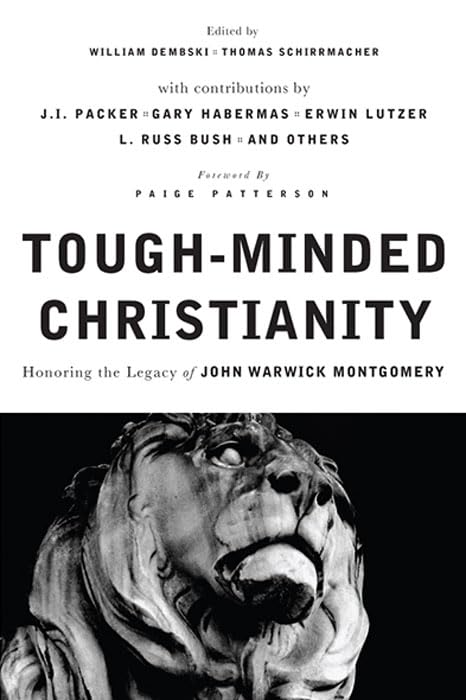
John Warwick Montgomery has been hugely influential on my own faith life, including in my development of theology while disagreeing with some of what he says. When he passed last year, I wrote a brief in memoriam. Since then, I’ve been rereading works by him and about him. One such work is Tough-Minded Christianity, a collection of essays in honor of Montgomery that was published in 2009 [1].
One essay in the collection takes on James Barr’s work, Fundamentalism. Barr was an extremely well-respected Old Testament Scholar who launched many a fusillade against fundamentalism and, in particular, against fundamentalist readings of Scripture. In particular, Barr wrote about how inerrancy would not work as a way of reading the Bible, and he especially attacked such a reading as impossible given the Bible we already have. Irving Hexham’s essay, “Trashing Evangelical Christians: The Legacy of James’ Barr’s Fundamentalism” clearly takes issue with Barr’s approach. Hexham frequently writes about Barr’s work in derogatory terms, such as calling it a “propaganda tract,” among other things. But Barr was a deep enough scholar to prompt Hexham to try to refute some of his arguments, and in doing so, I think he actually shows where Barr is right and evangelical defenders of inerrancy are wrong.
Hexham seeks to defend fundamentalist attempts to harmonize apparent contradictions in the Biblical text. One such example that he cites is the attempt to harmonize the cleansing of the Temple in John 2 with the same account in Luke 19, Mark 11, and Matthew 21). Barr writes about how some have argued that the best way to harmonize these passages is to assert that Jesus cleansed the temple twice, once at the beginning of his ministry and again near the end of his ministry. Barr writes that this harmonization is “simple but ludicrous.”
Hexham, by contrast, takes extreme issue with the use of the term “ludicrous,” and argues instead that it’s not unreasonable to make such an attempt at harmonization because, after all, we don’t have complete historical records. Hexham skirts around Barr’s incisive critique of the same evangelicals also attempting to harmonize two ascension accounts by arguing one is literal and the other is telescoping by asserting that Barr is just wrong to think fundamentalists can’t use both literal and non-literal techniques to read the Bible. At issue, however, is not whether one can defend inerrancy of Scripture by mixing ways of reading it; the issue is instead whether such readings are plausible or even necessary to begin with.
A more powerful critique from Hexham is the note that historians do this kind of harmonization all the time. And this is an extremely vital point. Hexham writes, “Harmonization, far from being an unhistorical attempt to explain discrepancies, is precisely what most traditional historians do every time they discover conflicting accounts in the archival record.” He goes on to cite others who note that historians often have “no external evidence as to whether the event recorded happened once, twice, or even three times…” and that in almost any historical writing, a selection effect is occurring which means the authors are intentionally highlighting aspects of the narrative at hand.
It is true indeed that no author can comprehensively write every detail of anyone’s life, nor do the Gospels claim to be doing so for Jesus. I think it’s also largely true that historians are quite comfortable harmonizing different stories to make them make sense. Indeed, it would quickly become impossible to write or engage with history if, every time there was a discrepancy between accounts, one simply said the account was unreal or did not happen. But there’s a huge gap between conceding that point and conceding that therefore the historical documents can be considered inerrant. Indeed, the opposite seems to be true.
When historians are harmonizing differing texts about an event, they aren’t doing so with the assumption that either text is completely without error. This is a far cry from what evangelical/fundamentalist readers of Scripture have to do in order to harmonize texts. Once one holds a doctrine like inerrancy, in which the entire Bible is supposed to be completely free from error, the process of harmonization takes on entirely new difficulties. One cannot, as historians do, harmonize two passages by simply stating one is mistaken. If one document says an event occurred at 14:00 and the other says it occurred at 04:00, the historian can do many things, such as find another source that might confirm one and deny the other. But the inerrantist cannot do that. They must come up with a harmonization that not only brings two passages together, but also makes them both somehow emerge from the harmonizing completely unscathed. And that is where things start to become absurd. Because for the inerrantist, the only way to harmonize the two times for the same event above is to multiply the event. After all, the times cannot be wrong; admitting one of the times is wrong is to admit an error into the text. Therefore, the event itself must have occurred at both times. And that is what Barr is getting at with his critique of fundamentalists readings as being ludicrous.
Certainly one may punt to the broad possibility that we don’t have the Bible telling us that a cleansing of the temple only occurred one time, but every indication seems to be that such an event was unique and powerful, not something that Jesus decided to do, say, every Tuesday or so. The ascension is even more absurd to multiply, which is what leads the inerrantist to suddenly abandon their attempt to read the historical narrative as historical reportage and instead read it as a telescoping timeline. That’s the only way to salvage the text–by turning it into something that is intentionally not reporting things in the exact timeline in which they occurred.
Hexham’s attempt to salvage inerrantist harmonization methods, then, fails. While it is still remotely possible that some events happened twice, allowing there to be a direct, historical reporting happening in both instances of an event; such a broad possibility is not all that matters. Not every harmonization can be achieved by simply multiplying instances of the event occurring. And no historian is attempting to harmonize other historic texts by assuming they are entirely without error. The parallel Hexham attempts to draw upon is undermined by his own prior commitments. Inerrantists aren’t mashing two texts together by using other sources to determine their accuracy or looking at the plausible explanations. No, they are absolutely committed to the assumption that any two (or more) Scriptural passages they are trying to harmonize are entirely without error, and therefore any harmonization must preserve that central assumption. There’s a vast chasm between those two methodologies, and one that makes the inerrantist reading seem, at times, ludicrous.
Notes
[1]It’s remarkable looking at the book now, with its foreword by Paige Patterson, who has since been implicated in covering up sexual abuse (see here), an essay by Ravi Zacharias (multiple allegations of sexual abuse here), and thinking about how highly touted this book was at the time. In apologetics circles, I remember seeing a lot of discussion, though I’ve rarely seen it mentioned since about 2014. This might be, in part, due to JWM not being as well-loved in those circles as some other apologists. In any case, this collection purports to carry on JWM’s “tough minded” approach to Christianity, one built upon strength of evidence and an apologetic approach of the same.
All Links to Amazon are Affiliates
Links
Be sure to check out the page for this site on Facebook!
Book Reviews– There are plenty more book reviews to read! Read like crazy! (Scroll down for more, and click at bottom for even more!)
SDG.
——
The preceding post is the property of J.W. Wartick (apart from quotations, which are the property of their respective owners, and works of art as credited; images are often freely available to the public and J.W. Wartick makes no claims of owning rights to the images unless he makes that explicit) and should not be reproduced in part or in whole without the expressed consent of the author. All content on this site is the property of J.W. Wartick and is made available for individual and personal usage. If you cite from these documents, whether for personal or professional purposes, please give appropriate citation with both the name of the author (J.W. Wartick) and a link to the original URL. If you’d like to repost a post, you may do so, provided you show less than half of the original post on your own site and link to the original post for the rest. You must also appropriately cite the post as noted above. This blog is protected by Creative Commons licensing. By viewing any part of this site, you are agreeing to this usage policy.

 J.W. Wartick - Reconstructing Faith