Judges 11
Jephthah, Human Sacrifice, and God: What should we make of Judges 11:29-40?
The story of Jephthah is one of the most difficult stories in the Bible. For those who don’t know it, Jephthah, an Israelite, is about to go to war against Israel’s enemies. He vows that if God grants him victory, he will sacrifice whatever comes from his door to greet him first. He wins the battle, and when he returns, his daughter runs out to meet him. She asks one last wish–that she may mourn her lack of marriage for two months. The story ends explaining that this is the reason Israelites (at the time of the writing of Judges) commemorate Jephthah’s daughter.
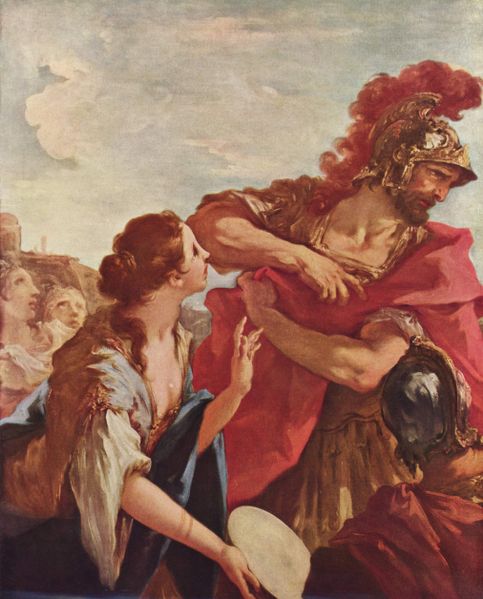
Understandably, the narrative raises many questions. I view the image here, a gorgeous painting by Giovanni Antonio Pellegrini, and it wrenches at my heart. Think of Jephthah’s anguish! The language in the Bible stirs the emotions:
When Jephthah returned to his home in Mizpah, who should come out to meet him but his daughter, dancing to the sound of timbrels! She was an only child. Except for her he had neither son nor daughter. When he saw her, he tore his clothes and cried, “Oh no, my daughter! You have brought me down and I am devastated. I have made a vow to the LORD that I cannot break.” (Judges 11:34-35)
The questions, as I noted, are many. Foremost of those which come to mind: “Why would God let this happen?” Another common question about this passage are “Does God allow human sacrifice?”
I’ve written on the passage before, but I think my responses were inadequate. Therefore, I have decided to reexamine this story and see what we can glean from it. Part of these thoughts are due to a conversation I had with an old friend.
Human Sacrifice
First, the question of human sacrifice. Throughout the Bible, God specifically condemns human sacrifice (cf. Leviticus 18:21; Lev. 20:2-5; Deuteronomy 18:10). One point some make is to try to draw the near-sacrifice of Isaac into the mix, but it is contextually clear that God did not intend for Isaac to be sacrificed (see Paul Copan’s excellent work on this story in his Is God a Moral Monster?). Furthermore, it is important to note that the book of Judges is a historical book, and it therefore is not prescribing the actions described therein, any more than other historical texts are prescribing the historical accounts depicted in them (see my “Description is not Prescription”). Yet those passages which are prescriptive all expressly forbid human sacrifice (again, see Lev. 18:21; 20:2-5, Dt. 18:10). Therefore, God forbade human sacrifice, He did not condone it.
Why Not Prevent It?- Context
It is therefore clear that God does not condone human sacrifice. Why, then, does God not intervene in the case of Jepthah and prevent this horrific event from occurring? As a friend noted, it would be quite simple for God to cause one of Jephtah’s servants or, indeed, anything else alive to have come from the door first. Why, then, does God not do this?
There is no simple response to this question. Instead, it is important to note several important points before I offer a possible answer. First, God has given humans free will. The nature of libertarian free will is such that it cannot be undone. Think of it this way: If God were to give us free will only until we tried to do something wrong, and in such cases God intervened and overcame our freedom to cause us to do good, we would not have genuine freedom. We’d really have a kind of pseudo-freedom. As long as we only chose what is good, we would be free, but we could not choose otherwise.
Second, think of what Jepthah had done to begin with. When he vowed that he would sacrifice the first thing to come out to meet him, it seems quite apparent that he had in mind human sacrifice, for a few reasons. It doesn’t seem likely that, for example, a cow walking through his doorway would count as coming to meet him. He specified that his sacrifice would be the first to come meet him. In fact, one might surmise he could have guessed it might be his own daughter–who is more likely to go running out to see him after a battle than his beloved child? There was no shortage of local cultures in the area who offered their children as sacrifices, and indeed the practice had corrupted Israel itself at a few points in history, so Jephthah may have been thinking of such a practice in order to bring about victory.
Third, Jephthah was an outcast. He had been driven from the land before because of his questionable parentage (Judges 11:1-3). The Israelites turned to him only in the time of their dire need, and Jephthah was clearly tempted by their offer to be their leader (Judges 11:4-11). Even given the small amount of context we have for this narrative, we can see that Jephthah desired greatly to be given headship over Israel. It is possible that, in his lust for power, foolishly made a vow to offer one of his household in exchange for the victory.
Fourth, we’ve already seen that it is expressly forbidden to offer human sacrifices. Yet Jephthah makes his vow with full knowledge of the likely consequences.
Finally, Jephthah’s vow offers a dilemma of sorts to a God who acts in history. If God wishes to prevent the human sacrifice, he must cause the defeat of Israel. This would not be just the destruction of Israel, but it would force God to go back on His promise to bring salvation through Israel, which it is impossible for God to do (Numbers 23:19). Not only that, but it would prevent God’s plan of redemption to take place. Yet if God does grant the Israelites victory, He knows that Jephthah will offer a sacrifice of whoever first steps from his house.
 Why not prevent it? -Solutions
From these quick thoughts we can see a number of possible answers. First, Jephthah made a vow which he would choose to fulfill in full knowledge that it would almost certainly be a human member of his household whom he would sacrifice. His vow was contingent upon the victory of Israel, whose defeat would have prevented God’s plan of salvation for all humankind. Therefore, Jephthah, by freely making this sinful vow, forced its conclusion. God did not prevent it from occurring because to do so would either destroy free will or prevent the Redemption.
Furthermore, some have argued that Jephthah’s vow to God superseded all else. (I myself made this argument in the original post.) I think this is wrong. God’s eternal moral commands would have superseded the vow. In fact, Jesus Himself commands His followers not to make vows, but rather to let their “yes” be “yes” and their “no” be “no” (Matthew 5:33-37). Jesus actually says that those who believe that a vow to God would supersede all else are wrong–they should not be making the vow in the first place! Thus, Jephthah’s vow was doubly sinful, because it essentially guaranteed a heinous act (human sacrifice) and because he should not have made such a vow to begin with. In fact, it should be noted that if Jephthah had acted in accordance with the Bible, he should have broken the vow! God expressly forbade human sacrifice, and when Jephthah saw that it was his daughter–or had it been any other human–who came to meet him, he should have realized his vow was made foolishly. One could even argue that God did indeed act in such a way as to try to get Jephthah to realize his error. The fact that it was Jephthah’s daughter who greeted him should not have only horrified him but made him realize that his vow was sinful to begin with, and so should not be upheld. Upon the realization that keeping his vow would cause him to break God’s Law, Jephthah should not have said “I must keep this vow” and therefore increase his sin–rather he should have said “I will break this vow, and prevent a horrific sin.” But again, with his freedom, he chose not to.
Jephthah’s story is, in fact, just the kind of story typified throughout Judges, and indeed throughout human history–that of God using sinful people to bring about His ends. Samson, another judge, was a violent and lustful man, yet God used him to save the Israelites on a number of occasions. In the Joseph narrative (Genesis 37ff), God used the evil actions of Joseph’s brothers to bring about a great good (Gen. 50:20). Similarly, Jephthah’s greed lead him to make a vow which he should not have kept which condemned at least one human to death.
Jephthah’s free decisions brought about the death of his daughter. That is why the Bible reports this stirring story–it teaches us that our free will has consequences. That is why the painting of Jephthah is so striking–we can relate to the horror of Jephthah’s realization of his own sinfulness. We’ve each committed our own sins and had to deal with the consequences. God is not a divine vending machine who will intervene when we make mistakes, or when we choose horrifying acts. He has already provided us with an objective reality–the discernment to tell what is right from wrong. Not only that, but He has also provided a Savior, His Son Jesus, to rescue us from all evil–even death itself. God has provided an infinite good to all human persons by providing a means for their salvation. Whosoever will be saved shall be saved.
The story also teaches us once more that God works through imperfect people. Although Jephthah was a sinful man with greedy intentions, he was still used by God to bring about a great good–the preservation of Israel, which itself paved the way for God’s redemptive act.
A Final, Philosophical Note
Those who may desire to press the objection still should investigate the philosophical basis of their claim. Presumably, they are arguing that:
P1- God is obligated to prevent evil (or some certain types of evil).
What justifies that claim? If God has given us free will, there are evils God cannot prevent–those which we choose to bring about. Further, what justifies the claim that God must intervene in every situation with x amount of evil? More specifically, why is God obligated to prevent Jephthah’s daughter from being the first to leave the house (again, I think that it was a series of free choices which brought Jephthah to this unfortunate event, and I disagree with those who think that God could just supersede free will whenever necessary, but I’ll grant it for a moment)? Is God obligated to prevent every evil?
I’m sure there are arguments that could be made to try to support the premise that “God is morally obligated to prevent all (or certain types of) evils” but I don’t think they would be more plausible than P2: “God has created free creatures” and P3: “Freedom cannot be limited.” I would accept a more restricted sense of:
P1′- God is morally obligated to prevent all evils which He is able to prevent and which do not provide for some greater good and which, if prevented, do not lead to other evils with similar or greater impact, etc.”
Those who would seek to continue objecting that God, in the Jephthah narrative, should have intervened, must defend their restricted sense of P1, while rebutting P2 and P3, and showing that P1 is more plausible than P1′. It therefore seems that philosophically, exegetically, and theologically, the Jephthah narrative, while poignant, does not threaten God’s character. God works through human history to bring about the Redemption, using imperfect, sinful people to bring about an infinite good. Furthermore, God has given us the good of freedom, but we choose too often to abuse it. Jephthah illustrates this misuse in a heart-rending fashion which serves as a definitive reminder to those who read it that they should heed God’s word and use their freedom not for greed or gain but for the furtherance of God’s Kingdom.
SDG.
——
The preceding post is the property of J.W. Wartick (apart from citations, which are the property of their respective owners) and should not be reproduced in part or in whole without the expressed consent of the author. All content on this site is the property of J.W. Wartick and is made available for individual and personal usage. If you cite from these documents, whether for personal or professional purposes, please give appropriate citation with both the name of the author (J.W. Wartick) and a link to the original URL. If you’d like to repost a post, you may do so, provided you show less than half of the original post on your own site and link to the original post for the rest. You must also appropriately cite the post as noted above. This blog is protected by Creative Commons licensing. By viewing any part of this site, you are agreeing to this usage policy.

 J.W. Wartick - Reconstructing Faith