Louise Anthony
The Ontology of Morality: Some Problems for Humanists and their friends

Louise Anthony did indeed present the case for secular metaethics. The problem is that this case is utterly vacuous.
It will be my purpose in the following arguments to show that secular humanistic theories which try to ground moral ontology fail–and fail miserably.
Recently, I listened [again] to the debate between William Lane Craig and Louise Anthony. Some have lauded this debate as a stirring victory for secular ethics. (See, for example, the comments here–one comment even goes so far as to say “I swoon when someone evokes the Euthyphro Dilemma and frown at the impotent, goal-post-moving, ‘Divine nature’ appeal.”) In reality, I think Louise Anthony did indeed present the case for secular metaethics. The problem is that this case is utterly vacuous.
I’ll break down why this is the case by focusing upon three areas of development in secular and theistic ethics: objective moral truths, suffering, and moral facts.
Objective Moral Truths
Louise Anthony and William Lane Craig agree that there are objective moral truths. Now, this is important because many theists take the existence of objective morality to demonstrate–or at least strongly suggest–the existence of God. Interestingly, other humanist/secular scholars have agreed with Anthony, claiming there are objective truths (another example is Sam Harris–see my analysis of his position contrasted with theism here). The question, of course, is “How?” Consider the following:
Louise Anthony seems to be just confused about the nature of objective morality. She says in response to a question from the audience, “The universe has no purpose, but I do… I have lots of purposes…. It makes a lot of difference to a lot of people and to me what I do. That gives my life significance… The only thing that would make it [sacrificing her own life] insignificant would be if my children’s lives were insignificant. And, boy you better not say that!”
Craig responded, “But Louise, on atheism, their lives are insignificant.” Anthony interjected, “Not to me!”
But then she goes on to make this confused statement, “It’s an objective fact that they [her children] are significant to me.”
Note how Anthony has confused the terms here. Yes, it is an objective fact that according to Louise Anthony, her children matter to her. We can’t question Anthony’s own beliefs–we must trust what she tells us unless we have reason to think otherwise. But that’s not enough. What Craig and other theists are trying to press is that that simple fact has nothing to do with whether her children are actually valuable. Sure, people may go around complaining that “Well, it matters to me, so it does matter!” But that doesn’t make it true. All kinds of things can matter to people, that doesn’t mean that they are ontologically objective facts.
It matters to me whether the Cubs [an American baseball team] win the World Series. That hasn’t happened in 104 years, so it looks like it doesn’t matter in the overall scheme of the universe after all. But suppose I were to, like Anthony, retort, “But the Cubs matter to me! It’s an objective fact that them winning the World Series is significant to me!” Fine! But all the Cardinals [a rival team] fans would just laugh at me and say “SO WHAT!?”
Similarly, one can look at Anthony with incredulity and retort, “Who cares!?” Sure, if you can get enough people around Anthony who care about her children’s moral significance, you can develop a socially derived morality. But that’s not enough to ground objective morality. Why should we think that her values matter to the universe at large? On atheism, what reason is there for saying that her desires and purposes for her children are any better than my desires and purposes for the Cubs?
Another devastating objection can be found with a simple thought experiment. Let’s say Anthony didn’t exist. In such a world, there can be no one complaining that her children matter “to me!” Instead, her children just exist as brute facts. How then can we ground their significance? Well, it seems the answer for people like Anthony would be to point to the children’s other family say “Those children matter to them!” We could continue this process almost endlessly. As we eliminate the children’s family, friends, etc. and literally make them just exist on their own, we find Anthony’s answer about allegedly objective morality supervenes on fewer and fewer alleged moral facts. Suddenly “Those children matter to themselves!” is the answer. But then what if we eliminate them? Do humans still have value? The whole time, Anthony has grounded the significance of her children and other humans in the beliefs, goals, and purposes of humans. But without humans, suddenly there is no significance. That’s what is meant by objective morality. If those children matter even without humans, then objective morality is the case. But Anthony has done nothing to make this the case; she’s merely complained that her children matter to her.
Now, some atheists–Anthony and Sam Harris included–seem to think they have answers to these questions. They seem to think that they can ground objective morality. We’ll turn to those next.
Suffering
One of the linchpins of humanists’ claims (like Anthony and Sam Harris) is suffering. The claim is that we can know what causes suffering, and that this, in turn, can lead us to discover what is wrong. We should not cause suffering.
But why not?
Most often the response I’ve received to this question is simply that because we do not wish to suffer, we should not wish to have others suffer or cause suffering for others. But why should that be the case? Why should I care about others’ suffering, on atheism? That’s exactly the question humanism must answer in order to show that objective morality can exist in conjunction with secularism. But I have yet to see a satisfactory answer to this question.
Anthony was presented with a similar question in the Q&A segment of her debate with William Lane Craig. One person asked (paraphrased), “Why shouldn’t I base morality as ‘whatever benefits me the most’?” Anthony responded simply by simply arguing essentially that it’s not right to seek pleasure at the expense of others, because they may also want pleasure.
But of course this is exactly the point! Why in the world should we think that that isn’t right!?
The bottom line is that, other than simply asserting as a brute fact that certain things are right and wrong, atheism provides absolutely no answer to the question of moral objectivity. People like Anthony try to smuggle it in by saying it’s objectively wrong to cause suffering [usually with some extra clauses], but then when asked why that is wrong, they either throw it back in the face of the one asking the question (i.e. “Well don’t you think it’s wrong?”) or just assert it as though it is obviously true.
And it is obviously true! But what is not so obvious is why it is obviously true, given atheism. We could have simply evolved herd morality which leads us to think it is obviously true, or perhaps we’re culturally conditioned by our close proximity to theists to think it is obviously true, etc. But there still is no reason that tells us why it is, in fact, true.
Moral Facts
Anthony (and Harris, and others with whom I’ve had personal interactions) centralize “moral facts” in their metaethical account. As a side note, what is meant by “moral fact” is a bit confusing but I don’t wish to argue against their position through semantics alone. They claim that we can figure out objective morals on the basis of moral facts. Sam Harris, for example, argues that there is a “continuum of such [moral] facts” and that “we know” we can “move along this continuum” and “We know, we know that there are right and wrong answers about how to move in this space [along the moral continuum]” (see video here).
Now it is all well and good to just talk about “facts” and make it sound all wonderful and carefully packaged, but Anthony and Harris specifically trip up when they get asked questions like, “How do we figure out what moral facts are?”
Anthony was asked “How do you determine what the objective moral facts are”, and responded by saying, “We do it by, um, testing our reactions to certain kinds of possibilities, um, thinking about the principles that those reactions might entail; testing those principles against new cases. Pretty much the way we find out about anything” (approximately 2 hours into the recorded debate).
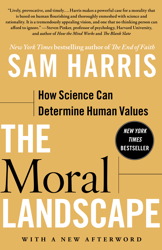 One must just sit aghast when one hears a response like that. Really? That is the way we discover moral truths? And that is the way we “find out about anything”? Now I guess I can’t speak for Anthony herself, but when I’m trying to find out about something, I don’t test my reaction to possibilities and then try to figure out what my reaction “might entail.” That is radical subjectivism. Such a view is utterly devastating for not just morality but also science, history, and the like. If I were to try to conduct scientific inquiry in this manner, science would be some kind of hodgepodge of my “reactions” to various phenomenon. Unwittingly, perhaps, Anthony has grounded the ontology of her morality in the reactions of people. But this error isn’t restricted to Anthony. Harris also makes this confounding mistake. His basic argument in the talk linked above is simply, “Science can tell us what people think about things, so it can tell us about morality.” This is, of course patently absurd. Suppose I tried to test these humanists’ theories on groups of people by sticking them in a room and having them watch all kinds of things from murder to the rape of children to images of laughter and joy. Now suppose I randomly sifted my sample among the population of the world, but somehow, by pure chance, got a room full of child molesters. As I observe their reactions, I see they are quite joyful when they observe certain detestable images. Now, going by Anthony/Harris’ way to “find out about anything” and thinking about what these people’s reaction entails, I conclude that pedophilia is a great good. But then I get a room full of parents with young children, who react in horror at these same images. Then, as I reflect on their reactions, I discover that pedophilia is a great evil. And I repeat this process over and over. Eventually, I discover that the one group was an aberration, but it was a group nonetheless.
What does this mean?
Quite simply, it means that both Harris and Anthony haven’t made any groundbreaking theory of ethics. Rather, they’ve just made a pseudo-humanistic utilitarianism. They ground moral ontology in our “reactions” to various moral situations. The only way for them to say something is morally wrong if people have different reactions is either to go with the majority (utilitarianism) or choose one side or the other, which essentially turns into a kind of Euthyphro dilemma against atheists. Either things are wrong because enough people think they’re wrong (in which case morality is arbitrary) or things are wrong because they simply are wrong, period (in which case the humanist has yet to provide an answer for moral ontology).
Conclusion
Given the discussion herein, one can see that those atheists, humanists, and/or secularists who desire to ground objective morality still have a lot of work to do. Louise Anthony’s best attempt to ground morality boils down into radical subjectivism. Sam Harris’ account fares no better. Those who are trying to ground objective morality within an atheistic universe will just have to keep searching. The solutions Anthony and Harris have attempted to offer are vacuous.
Image Source:
http://commons.wikimedia.org/wiki/File:SecularHumanismLogo3DGoldCropped.png
SDG.
——
The preceding post is the property of J.W. Wartick (apart from citations, which are the property of their respective owners) and should not be reproduced in part or in whole without the expressed consent of the author. All content on this site is the property of J.W. Wartick and is made available for individual and personal usage. If you cite from these documents, whether for personal or professional purposes, please give appropriate citation with both the name of the author (J.W. Wartick) and a link to the original URL. If you’d like to repost a post, you may do so, provided you show less than half of the original post on your own site and link to the original post for the rest. You must also appropriately cite the post as noted above. This blog is protected by Creative Commons licensing. By viewing any part of this site, you are agreeing to this usage policy.

 J.W. Wartick - Reconstructing Faith
