Lutheran theology
Book Review: “The Great Divide: A Lutheran Evaluation of Reformed Theology” by Jordan Cooper
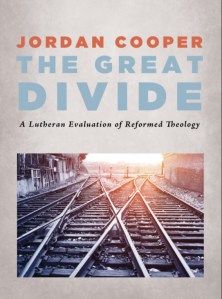 The Great Divide: A Lutheran Evaluation of Reformed Theology presents a broad-spectrum look at Reformed theology from a Lutheran perspective.* Cooper breaks this analysis up into three parts: Predestination and Free Will, Worship and the Sacraments, and Salvation. These parts are intended to show the greatest dividing lines between Reformed and Lutheran thought.
It is really quite exciting to see how well-read Cooper is on both Reformed and Lutheran thought. On the Reformed side, he frequently cites Calvin (of course), Bavinck, Edwards, Piper, Grudem, and more. On the Lutheran side, he draws from Luther, Chemnitz, Melanchthon, Kolb, and more. This thorough use of sources on both sides helps shield against bias, as Cooper continually cites the words of prominent theologians of each tradition.
Cooper provides in each chapter a presentation of Reformed thought on the topic, drawing extensively from prominent Reformed thinkers past and present, as well as various Reformed Confessions. Then, he provides a look at the Lutheran perspective, often quoting the Lutheran Confessions as well as prominent Lutheran thinkers. After providing this comparison, Cooper argues for the Lutheran position, noting the points of divergence along the way. At many points, this analysis is fairly robust. However, at other points Cooper does swiftly move from one point to another before providing enough to establish each point.
One of the things that comes to the front most clearly in the book is just how close Reformed and Lutheran thought are on a number of issues. Unfortunately, as close as the two traditions come on many areas, the chasm between the two remains vast. This is particularly clear in regards to the Sacraments and Predestination. I was also pretty surprised to see how different the Reformed and Lutheran view regarding worship is. The regulative principle within Reformed thought–that whatever is not commanded in Scripture ought not to be done in worship–was something that startled me. I hadn’t considered such a position, but Cooper showed the arguments for and against this position, coming down on the side of Lutheranism (again, he’s coming from that perspective), which sees worship as something that God allows for more leeway in than do Reformed thinkers.
It is truly amazing how much information Cooper manages to convey in just 200 pages. Readers are introduced to both Lutheran and Reformed perspectives on a number of important theological topics, treated to both exposition of those views and offered critique of the Reformed position all in a very clear style and form.
There are two minor critiques I’d offer of the book. The first is the continued use of the archaic “man” to refer to all people. There were, in fact, a few places in which I had to work to discern whether Cooper meant all people or just men when it came to what he was writing. A second critique is that because of the books relatively short length, some of the arguments on either the Reformed or Lutheran side seem extremely brief, leaving some of the arguments inconclusively demonstrated.
Jordan Cooper’s The Great Divide: A Lutheran Evaluation of Reformed Theology is a vast trove of information and analysis. Extensively researched and well-reasoned, it will provide readers unfamiliar with either Reformed or Lutheran theology (or both) an introduction to each tradition as well as a look at how they may interact with one another.
The Good
+Engages with prominent theologians from each group
+Historically informed
+Treats Reformed thought fairly
+Vast wealth of information
The Bad
-Continued use of archaic “man” etc. as inclusive
-Some points are breezed through very quickly
*It is worth noting my own bias here: I am a Lutheran who was raised Lutheran and, though I wandered a little bit, have become quite convinced of Lutheran theology in recent years.
Disclaimer: I was provided with a copy of the book for review by the publisher. I was not required to provide any specific kind of feedback whatsoever.
Source
Jordan Cooper The Great Divide: A Lutheran Evaluation of Reformed Theology (Eugene, OR: Wipf & Stock, 2015).
Links
Be sure to check out the page for this site on Facebook and Twitter for discussion of posts, links to other pages of interest, random talk about theology/philosophy/apologetics/movies and more!
Book Reviews– There are plenty more book reviews to read! Read like crazy! (Scroll down for more, and click at bottom for even more!)
Eclectic Theist– Check out my other blog for my writings on science fiction, history, fantasy movies, and more!
SDG.
——
The preceding post is the property of J.W. Wartick (apart from quotations, which are the property of their respective owners, and works of art as credited; images are often freely available to the public and J.W. Wartick makes no claims of owning rights to the images unless he makes that explicit) and should not be reproduced in part or in whole without the expressed consent of the author. All content on this site is the property of J.W. Wartick and is made available for individual and personal usage. If you cite from these documents, whether for personal or professional purposes, please give appropriate citation with both the name of the author (J.W. Wartick) and a link to the original URL. If you’d like to repost a post, you may do so, provided you show less than half of the original post on your own site and link to the original post for the rest. You must also appropriately cite the post as noted above. This blog is protected by Creative Commons licensing. By viewing any part of this site, you are agreeing to this usage policy.
Sunday Quote: Dietrich Bonhoeffer on Anthropomorphism and God
 Every Sunday, I will share a quote from something I’ve been reading. The hope is for you, dear reader, to share your thoughts on the quote and related issues and perhaps pick up some reading material along the way!
Dietrich Bonhoeffer on Anthropomorphism and God
Dietrich Bonhoeffer was a Lutheran theologian who was murdered by the Nazis. Many people don’t delve too deeply into his theology, but I have found reading his broader works to be quite rewarding. Here’s a passage from his Creation and Fall:
God… receives a very specific proper name, Yahweh… One could suppose that such a proper name is evidence of a very primitive idea of God… yet just at this point one must reply that anthropomorphism in thinking of God… is no more irrelevant… than is the abstract use of the generic term ‘deity.’ On the contrary, clear anthropomorphism much more plainly expresses the fact that we cannot think of ‘God as such’ whether in one way or another. The abstract concept of God, precisely because it seeks not to be anthropomorphic, is in actual fact much more so than is childlike anthropomorphism. (74-75, sections 69-70, cited below)
Here, then, Bonhoeffer’s point is that merely abstracting the concept of God and speaking of God “as such” actually does just as much damage to our understanding of God as does “clear anthropomorphism.” That is, when we make God into a kind of philosophical construct, we are just as far away from the relational, radically personal God of the Bible as if we were to be anthropomorphic in a childlike way. For, as he points out in the last sentence above, we put God into our categories rather than the categories of Scripture.
I think Bonhoeffer has a good point here, one that warns people like me who are philosophically minded to remember that our God is an active God. Although it seems clear Bonhoeffer would not deny something like saying God is omnipotent, what he is denying is that we can use those categories to reach “God as such” and fit God into them alone. God–Yahweh–is much more than that, and we need to remember that.
What do you think? Can anthropomorphism be a helpful way to understand God? What dangers, if any, might come from making an abstract concept of deity?
Links
Be sure to check out the page for this site on Facebook and Twitter for discussion of posts, links to other pages of interest, random talk about theology/philosophy/apologetics/movies and more!
Sunday Quote– If you want to read more Sunday Quotes and join the discussion, check them out! (Scroll down for more)
Eclectic Theist– Check out my other blog for my writings on science fiction, history, fantasy movies, and more!
Source
Dietrich Bonhoeffer, Creation and Fall Douglas Stephen Bax, Translator (Minneapolis, MN: Fortress, 2004).
SDG.
Bonhoeffer’s Troubling Theology? – A response to an article on Dietrich Bonhoeffer’s theological perspectives
Recently, Richard Weikart wrote an article entitled “The Troubling Truth About Bonhoeffer’s Theology.” Not surprisingly, this article called attention to some aspects of Dietrich Bonhoeffer’s theology which would be considered, well, troubling to evangelicals.
The article has much to commend it: it shows that we ought not to make any theologian into an idol or endorse everything anyone writes. Indeed, the conclusion of the article has little to question in it: “What then should we make of Bonhoeffer? While recognizing his many admirable traits—compassion, courage, commitment, and integrity—we should be wary of many elements of his theology.” I think this kind of critical perspective is something evangelicals–and Christians generally–ought to take to heart. We should always test theologians by what Scripture teaches us.
All of that said, there are some aspects I wanted to respond to in the article, particularly to give some more context for Bonhoeffer as well as his Lutheran theology. I’m sure Weikart is more studied on Bonhoeffer than I am, and I don’t claim to be an expert on Bonhoeffer’s thought. What I do know, however, is a good amount about Lutheran theology, and what I have read of and about Bonhoeffer. And all of that, I think, is enough to allow me to offer some areas of criticism regarding the article.
The Bible and Apologetics
There is no question that Bonhoeffer’s view of the Bible was heavily influenced by Karl Barth. Weikart is correct to note that this means that, for Bonhoeffer, Scripture is not inerrant. Indeed, he believes the Bible scientifically silly at points (see his Creation and Fall, for example). Scripture was, for both Barth and Bonhoeffer, important more for conveying truths about Christ than it is for being verbally inspired. Scripture conveys the revelation of Christ, rather than itself being revelation, according to both. This is, indeed, a weakness in their theology.
Later, Weikart critiques Bonhoeffer for his view of apologetics: “[Bonhoeffer] thought that the historical accuracy of Scripture was irrelevant. Barth (and Bonhoeffer) considered apologetics misguided, because it transgressed the boundaries separating the empirical and religious realms.”
I’m not sure about the first part of this claim. If, by “historical accuracy,” Weikart means the individual details of how events happened, or specific views of creationism and the like, then the statement is true. But the brush seems to be a bit too broad here; given Bonhoeffer’s view of the importance of Christ, the cross, and the Resurrection, to broadly say that none of these were seen as historical or were in fact irrelevant is to speak too strongly. Did Bonhoeffer think things like the length of creation days, the exact words spoken by the serpent at the Fall, and the like were historically irrelevant? Yes, pretty much. But that doesn’t mean he thought there was nothing of historical value therein, nor does it mean he rejected the usefulness of Scripture. This is a common error evangelicals make regarding the views of Christians who do not affirm inerrancy. Admittedly, it’s one I have made at times. Just because someone doesn’t affirm a form of verbal inspiration does not entail they think everything in the Bible is false or questionable.
Regarding the second part of the claim, it is easy to assume someone like Barth or Bonhoeffer completely rejected apologetics, and indeed each makes statements to that effect; but what they mean by apologetics largely means a kind of apologetics that puts humanity in judgment of God. Barth and Bonhoeffer would not completely reject any form of defense of the faith, but they would reject those that rely on natural theology and the like. Bowman and Boa’s book, Faith Has Its Reasons categorizes Barth as a “fideist” apologist. Delving into those issues would take too long, but it is safe to say that Bonhoeffer would not have been completely against any form of apologetics whatsoever. His own apologetic would have been personal and existential, and apologists ought not to dismiss this aspect of a holistic view of Christianity.
“Conversion Experience”?
Weikart writes, “Though he experienced some kind of conversion around 1931, he hardly ever mentioned it. Later he expressed distaste for Christians talking or writing about their conversions.” Later, he makes his aversion to Bonhoeffer’s Lutheranism plain: “Aside from his faulty view of Scripture, Bonhoeffer’s doctrine of salvation was also problematic. As a Lutheran he embraced baptismal regeneration.”
The multiple mentions about Bonhoeffer’s “conversion” reveal more about the author of the article than about Dietrich Bonhoeffer. Bonhoeffer was, like myself, a Lutheran and ought to be evaluated as such. Unless Weikart wants to dismiss all Lutherans as unsaved heretics–or at least as affirming “troubling” theology–he cannot simply dismiss Bonhoeffer’s view because he didn’t talk about his “conversion experience.”
The fact that Weikart continues to emphasize this makes me wonder just how inclusive his definition of “evangelical” is supposed to be. Lutherans do not have an emphasis on finding some specific event, date, or time that signify we converted to Christianity. Because of the emphasis in Lutheran theology on predestination and baptism, such language seems to us to imply a kind of work of conversion being done by the individual rather than by God. Indeed, for many Lutherans, if pressed to pick a moment of conversion, that would be whatever time they were baptized as an infant. This is not the place to delve into the debate over baptism, infant baptism, and the like. Instead, I’m giving context to Bonhoeffer’s theology and experience. Martin Luther himself affirmed vehemently that infants can have faith, and however absurd this might seem to many non-Lutherans, the reason is because faith is the act of the Holy Spirit–it is pure grace, not tied to some specific synergistic act or affirmation by a human. To critique Bonhoeffer because he wasn’t speaking to the expectations of whatever brand of evangelicalism Weikart subscribes to is to decontextualize his theology and, indeed, to effectively dismiss Lutheran confessions of faith.
Weikart most likely does disagree with much of the Lutheran Confessions, but this does not mean it is acceptable to critique someone like Bonhoeffer as though he is some kind of mainstream evangelical instead of being a Lutheran.
“Religionless Christianity”
Weikart quotes the somewhat infamous passage Bonhoeffer wrote of his resistance to “everything ‘religious.'” Such words tend to rile those who adhere to a narrative of a “culture war” between Christianity and… everything else. But, like Kierkegaard, who gets lumped in by Weikart along with other apparently “troubling” theologians, Bonhoeffer’s comments on religion must be read contextually. Eric Metaxas writes about this very same quote in his lengthy biography (and sometimes controversial) on Bonhoeffer, Bonhoeffer: Pastor, Martyr, Prophet, Spy:
The most tortured interpretations [of Bonhoeffer] have fixed on his reference to “religionless Christianity”… [Bonhoeffer] saw a situation so bleak… that he was rethinking some basic things and wondered whether modern man had moved beyond religion. What Bonhoeffer meant by “religion” was not true Christianity, but the ersatz and abbreviated Christianity that he spent his life working against. This “religious” Christianity had failed Germany and the West during this great time of crisis…. and he wondered whether it wasn’t finally time for the lordship of Jesus Christ to move past Sunday mornings and churches and into the whole world. (466-467, cited below)
The crisis, of course, was Germany in World War II–the same Nazi Germany which executed Bonhoeffer shortly before the end of the war. Weikart’s warnings about Bonhoeffer’s comments on “religion,” it seems, fall into the same trap that many fall into when discussing Kierkegaard–failing to take the historical context and particular usage of the term seriously. Though some have objected to Metaxas’ portrayal of Bonhoeffer, the historical context provided here can hardly be questioned, because it is exactly what Bonhoeffer was rejecting against.
Evangelical Lutheran Hero?
Did Bonhoeffer have some aspects of his theology that evangelicals will find troubling? Absolutely, and Weikart does a good job highlighting some of these. But the point I’m trying to make is that none of this means that Bonhoeffer needs to be rejected or thrown out as an evangelical (and/or Lutheran) hero. Indeed, for the Lutheran in particular, Bonhoeffer’s theology shows us how true it is that we are all but sinner-saints. Though chosen by God and saved by grace alone, that does not mean we will be perfect now, and it means that we may have ideas that will be mistaken throughout our lives.
Many of the greatest theologians of all time have aspects of their theology that evangelicals will find troubling. Obvious examples would include Calvin (who would be troubling to Arminians) and Arminius (whose theology is troubling to Calvinists). But, alas, no human is perfect, and even greats like Augustine, Aquinas, Mother Theresa, and the like will not withstand scrutiny to determine whether they were perfect or affirmed a perfect theology.
Conclusion
Go ahead, enjoy Bonhoeffer’s works, note how he was a hero, and talk about his legacy. But read his works as you would any others: with a critical eye. As far as this article is concerned, as a Lutheran I found it somewhat troubling myself. Does Weikart genuinely mean to imply that all Lutherans must be excluded from the fold of evangelicalism? I’m not sure, but at least some of his criticism leveled at Bonhoeffer would just as easily be applied to Lutheran theology, generally speaking. And that, as I said above, seems to reveal more about the author than about Bonhoeffer.
Sources
Richard Weikart, The Troubling Truth about Bonhoeffer’s Theology (http://www.equip.org/article/troubling-truth-bonhoeffers-theology/) accessed 1/24/16.
Eric Metaxas, Bonhoeffer: Pastor, Martyrd, Prophet, Spy (Nashville: Thomas Nelson, 2010).
Links
Be sure to check out the page for this site on Facebook and Twitter for discussion of posts, links to other pages of interest, random talk about theology/philosophy/apologetics/movies and more!
Eclectic Theist– Check out my other blog for my writings on science fiction, history, fantasy movies, and more!
SDG.
——
The preceding post is the property of J.W. Wartick (apart from quotations, which are the property of their respective owners, and works of art as credited; images are often freely available to the public and J.W. Wartick makes no claims of owning rights to the images unless he makes that explicit) and should not be reproduced in part or in whole without the expressed consent of the author. All content on this site is the property of J.W. Wartick and is made available for individual and personal usage. If you cite from these documents, whether for personal or professional purposes, please give appropriate citation with both the name of the author (J.W. Wartick) and a link to the original URL. If you’d like to repost a post, you may do so, provided you show less than half of the original post on your own site and link to the original post for the rest. You must also appropriately cite the post as noted above. This blog is protected by Creative Commons licensing. By viewing any part of this site, you are agreeing to this usage policy.
Another Problem for Book of Concord Inerrantists
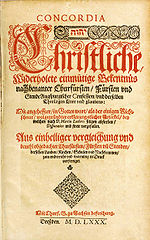
A title page of the Book of Concord
I have argued before that the stance of “confessional” Lutherans of having 100% agreement with the book of concord is unable to be maintained in the face of the evidence within the Book of Concord itself. That is, I believe that one must adhere to the Book of Concord “in so far as” it agrees with the Bible as opposed to “because” it agrees with the Bible. See my post on the topic for in-depth discussion of this distinction and its importance. I argued there, also, that the “because” position largely leads to a kind of inerrancy of the Book of Concord. After all, if the Book of Concord is to be agreed with because it agrees with the Bible, and the Bible is inerrant, it follows that anything that agrees with Scriptures 100% of the time will be without error.
Another example of defining Lutheranism according to strict adherence to the Book of Concord may be found in a recent post by Christopher Maronde entitled “What does the name ‘Lutheran’ mean?”:
Its meaning is simple: The name Lutheran refers to a person, congregation, or church body who unconditionally holds to the teachings contained within the Book of Concord, first published in 1580. A Lutheran is someone who declares that these specific documents rightly confess the truth of the Scriptures. It’s that simple; if you want to know what a Lutheran believes, if you want to know what that label means, you go to the Book of Concord. If you want to know if someone is using the label properly, you evaluate what they believe, teach, and confess according to the Book of Concord. (here)
These positions are generally considered to have a monopoly on the term “Confessional Lutheran” because they teach 100% affirmation of the Book of Concord and restrict any notion of Lutheran to that same adherence. My position, however, is that such a position cannot be maintained, nor should it have a monopoly on the term “Confessional Lutheran.”
Maronde’s definition above seems to provide a small loophole: it states that the Lutheran is to “unconditionally [hold] to the teachings contained within the book of Concord.” The key term here is “teachings.” At this point, if we grant this definition, one could argue that some purported errors in the Book of Concord may not be what the Book of Concord is teaching. However, later in the same quote, we see Maronde writes, “[I]f you want to know what that label means, you go to the Book of Concord…” which once again implies adherence to the totality, word-for-word truth of the Book of Concord. Yet the fact is the Book of Concord is not 100% true in every word-for-word instance.
I ran across another example of this in my readings the other day. In the Large Catechism, Martin Luther wrote,
This, I think, is why we Germans from ancient times have called God by a name more elegant and worthy than found in any other language, a name derived from the word ‘good,’ because he is an eternal fountain who overflows with pure goodness… [The Large Catechism, Part I, 25]
As Kolb and Wengert, editors of the critical edition of the Book of Concord published by Fortress Press note, the words for God and good in German (Gott and gut) are not derived from the same etymological root after all- “German: gut. This derivation is etymologically incorrect. The words for ‘God’… and ‘good’.. are not related in either Gothic or in Middle High German” (footnote 41 on page 389, cited below). Thus, within the very text of the Book of Concord, we have a clear error. Indeed, one that cannot be skirted around by arguing it is not something being taught therein; instead, it is clear that Luther is trying to teach about the meaning of God from an etymological derivation which is non-existent.
Therefore, it seems to me that the position of so-called “Confessional Lutheranism” and those who, like them, define Lutheranism narrowly to mean 100% adherence to the Book of Concord is clearly and demonstrably mistaken. The burden falls upon them to demonstrate that their position is actually viable in light of real, taught errors within the Book of Concord itself.
What does this mean for Lutherans–and indeed, Lutheranism? It certainly doesn’t mean we should all go chuck our Book of Concord editions in the trash. What it means is that, like any book, we should read the Book of Concord with a critical eye, checking it against God’s Word as found in the Scriptures and against the facts that we can discover in other studies as well. The Book of Concord is not inerrant, but that doesn’t mean a Lutheran cannot confess agreement with it so far as it agrees with Scripture, and, in doing so, remain a Confessional Lutheran.
Source
Robert Kolb and Timothy J. Wengert, eds. The Book of Concord: The Confessions of the Evangelical Lutheran Church (Minneapolis, MN: Fortress, 2000).
Links
Be sure to check out the page for this site on Facebook and Twitter for discussion of posts, links to other pages of interest, random talk about theology/philosophy/apologetics/movies and more!
Adhering to the Book of Concord “In So Far As” or “Because” it Agrees with Scripture?– I argue that Lutherans must hold the position that we adhere to the Book of Concord In So Far As it Agrees with Scripture.
Eclectic Theist– Check out my other blog for posts on Star Trek, science fiction, fantasy, books, sports, food, and more!
SDG.
——
The preceding post is the property of J.W. Wartick (apart from quotations, which are the property of their respective owners, and works of art as credited; images are often freely available to the public and J.W. Wartick makes no claims of owning rights to the images unless he makes that explicit) and should not be reproduced in part or in whole without the expressed consent of the author. All content on this site is the property of J.W. Wartick and is made available for individual and personal usage. If you cite from these documents, whether for personal or professional purposes, please give appropriate citation with both the name of the author (J.W. Wartick) and a link to the original URL. If you’d like to repost a post, you may do so, provided you show less than half of the original post on your own site and link to the original post for the rest. You must also appropriately cite the post as noted above. This blog is protected by Creative Commons licensing. By viewing any part of this site, you are agreeing to this usage policy.
Adhering to the Book of Concord: “In So Far As” or “Because” it agrees with Scripture?
A title page of the Book of Concord
Lutheran theology is derived from and reflective upon not just Martin Luther but also the Lutheran Confessions, as found in the Book of Concord. Within Lutheranism, there is much debate over exactly how tightly one must adhere to the Book of Concord. On one side, there are those who insist we must affirm the Book of Concord “because” it agrees with the Bible. On the other side, others maintain we should affirm it “in so far as” it agrees with the Bible.
Because it Agrees
Representative of the view that one must agree with the Book of Concord because it teaches what the Bible teaches is the following:
Authentically Lutheran churches insist on a subscription to the Confessions [The Lutheran Confessions/Book of Concord are used interchangeably] because they agree with the Bible, not merely in so far as they agree with Scripture. Otherwise, there would be no objective way to make sure that there is faithful teaching and preaching of God’s Word. Everything would depend on each pastor’s private opinions, subjective interpretations, and personal feelings, rather than on objective truth as set forth in the Lutheran Confessions. (Book of Concord (.org) FAQ)
Note some important aspects in this quote. First, the Book of Concord just does agree with the Bible. That is insisted upon. Second, the Book of Concord is said to be “objective truth” as opposed to the “subjective interpretations” of the individual. These considerations frame what I’d like to comment on regarding those who hold to the view that we must agree with the book of Concord “because…”
Because?
I’ll start with the second aspect noted above. There are, of course, all kinds of increasingly detailed issues people on either side of the debate might raise here. For example, how are “objective” and “subjective” being here defined? I’m going to set that kind of issue mostly aside and focus on a few difficulties I see.
The first is that one cannot simply read the words off the pages of the Book of Concord without going through the necessary step of interpreting them. That is, I as a reader of the Book of Concord must try to make sense of the words I am reading, and thus I am participating in the act of interpreting the Book of Concord. If, as the quote above states, the problem is the individual’s subjective nature, then the problem is completely unavoidable. Indeed, even if we grant that the Book of Concord is “objective truth” in its entirety, all we’ve done is moved the problem of subjective interpretation one step back. Now the reader must interpret the Book of Concord in order to get to the objective truth about Scripture found therein.
Another difficulty with this objective/subjective distinction is that it assumes the writers of the Lutheran Confessions were themselves either not subjective (which seems impossible) or explicitly guided by the Spirit to write out objective truth only. I would not dispute that the Holy Spirit could bring about a completely faultless writing, but the question is whether those who affirm the “because” position would like to argue this. The first thing we should do if they do want to argue this would be to see whether the writers of the Book of Concord assert the Holy Spirit did bring about such a completely objective, 100% correct work.
In the Preface to the Book of Concord, we can read:
Finally, with invocation of God Almighty and to his praise and glory and with careful deliberation and meticulous diligence through the particular grace of the Holy Spirit, they wrote down in good order and brought together into one book everything that pertains to and is necessary for this purpose. (Preface, 12)
Later, the Preface makes clear (15) that this Book was “the correct, Christian understanding of the Augsburg Confession…” In the closing of the Preface, we read (23) that those who signed on to it that they “are minded not to manufacture anything new… nor to depart in either substance or expression… from the divine truth… by the grace of the Holy Spirit we intend to persist and remain unanimously in this truth and regulate all religious controversies and their explanations according to it.”
These are all strong statements, and they clearly called upon God the Holy Spirit for guidance in the composition of the various works that make up the Book of Concord. But does it follow that they were explicitly, inerrantly inspired and guided by the Spirit to never once get a single thing wrong in this book? Those who affirm the “because” position must answer yes. There is no wiggle room.
But a close reading of the Preface seems to suggest that although the writers certainly believed everything in the Book of Concord to be without theological error (otherwise they would not have it regulate all controversies, etc.), I have yet to find anywhere that a claim could be made that the book is explicitly inerrant. It would have to be, however, for the “because” position to be true. This human composition would have to be 100% correct in every single minute detail down to the last proof text cited in order for it to be acceptable to affirm that we must agree with it “because” it agrees with Scripture.
Among other things, what follows from that is that anyone who subscribes to the Book of Concord “because” position must have read the entirety, looked up every citation, and assured themselves that every single interpretation, doctrinal position, and the like is 100% correct, lest they be saying that it is a human-made book without error on God’s Word without actually knowing every detail it contains.
The first issue raised above will be addressed in the section named “A Case Study,” below.
In So Far As
A supporting argument for the “In So Far As” position is that we should always only affirm that which is true. If we can agree that the Bible is true in all it teaches, then we should only agree with other writings about the Bible so far as they agree with the Bible. This seems like an obvious conclusion, but the whole debate centers on whether this argument is sound. It is difficult for me to figure out how to support this argument, not because I think it is a poor argument, but because it seems just intuitively clear.
It may help to use an analogy. Historians have debated how to write history and whether writers of history can ever fully get at the “true” history as it happened. Yet very few would deny that there is such a thing as a “true” history. There must be some absolutely correct sequence in which events occurred such that if we had a complete set of writings that simply reported those events, that would be the “true” history. Thus, there is an objectively true history, against which historians can be measured. Granting some of the hand waving involved in this thought experiment, suppose we had a book, The True History of the World, and we looked up the John F. Kennedy assassination therein. We would then have the objectively true report of that hotly-debated historical event as it really did happen. Now suppose I wanted to write a book about the JFK assassination based upon The True History of the World. However careful a historian I am, however excellent and detailed my mind is, however much guidance I may have had, would it be reasonable to say that you agree with my book, The Objective JFK Assassination “because” it agrees with The True History of the World or “in so far as” it does? It seems that the reasonable conclusion would be “in so far as” it does, because we know that The True History of the World is objectively true.
Though imperfect, this analogy gets at the argument written above. We can agree the Bible is inerrant. Thus, if I were to write a book entitled The Objective Bible, I think we can agree that we should only agree with my book so far as it agrees with the Bible, right? No matter how detailed I am, no matter how meticulous, no matter how large a group of thoughtful interpreters I got together to vet my work, it would be entirely reasonable to only affirm agreement with my book so far as it is biblical. Then why would such a standard not also apply to the Book of Concord? I see no reason why that standard would not.
Indeed, to argue against those who affirm the Book of Concord only “in so far as” it agrees with the Bible would mean that one would have to assert that the caution and respect for God’s word implicit in that position–that I would not want to affirm anything, even by mistake, as biblical if it is even possibly in error anywhere–are mistaken. That the care and caution necessary to say “I will only agree with any book in so far as it agrees with the Word of God” is mistaken, and that that the Book of Concord must also be included under the umbrella of books against which all others must be judged.
For the “because” position ultimately, unswervingly leads to the conclusion that we should only affirm any other book “in so far as” it agrees with the Book of Concord. After all, if it is true that the Book of Concord is affirmed because it agrees with Scripture, then it follows that the authority of the Bible is effectively equivalent to the authority of the Book of Concord. The Bible is God’s word, and the Book of Concord is the objective teaching of God’s word without even possible error. That is not simply rhetoric; it is what must follow from the “because” position. Any interpretation of the Bible must be judged against the Book of Concord; hence, any reading of the Bible must also be judged against it.
A Case Study
Finally, we are in position to ask whether the Book of Concord does indeed have any error therein. That is a crucial question, of course, and one not easily resolved by those who remain faithful Lutherans. If, however, there is even one incorrect use of a proof text in the Book of Concord, the “because” position fails.
In the Apology of the Augsburg Confession, Article XXIII (XI) on the Marriage of Priests, section 25, we read:
Therefore this law concerning perpetual celibacy is peculiar to this new pontifical despotism. Nor is it without a reason. For Daniel 11:37, ascribes to the kingdom of Antichrist this mark, namely, the contempt of women.
Daniel 11:37 reads (ESV) “He shall pay no attention to the gods of his fathers, or to the one beloved by women. He shall not pay attention to any other god, for he shall magnify himself above all.”
The whole passage is difficult to interpret given its prophetic message about the Kings of the North and the South. I’m not going to enter into whether this is specifically referencing “Antichrist” or “the kingdom of Antichrist” or anything of the sort. Instead, the issue is with the reading as “contempt of women.” The Reformers were obviously not using the ESV or anything in English. But older English editions like the KJV might support this text as a proof for contempt of women: “Neither shall he regard the God of his fathers, nor the desire of women, nor regard any god: for he shall magnify himself above all.”
But the problem is that critical editions of the Old Testament don’t support a reading as contempt of women. Without going into depths of detail, and because I’m not a Hebrew scholar by any measure, I would just point out that the Hebrew does seem to clearly state “the one desired by women.” So if we are to read 11:37 as a proof text for contempt of women, it doesn’t seem to be a right reading. It’s a minor difficulty, but one nevertheless. Did the citation above from the Book of Concord properly exegete the Bible? I would assert that the use of this proof text is mistaken. If we are to take “paying no attention” as “contempt”–itself a move that could be disputed, then the subject remains “the one desired by women” not “women.”
Now, if the Book of Concord should be agreed with because it agrees with the Bible, then how are we to take this? I don’t know. It seems to me that this is more an example of the way people read the Bible at the time and used proof texts–often stripped of context–in defense of their positions. A single dispute over a citation is not a paradigm shift; indeed, I think that the authors of the Apology were correct on this notion about the marriage of priests. But that doesn’t mean everything they wrote is correct.
Conclusion
I agree with and affirm the Book of Concord in so far as it agrees with Scripture. I think it is correct on a huge amount of the things it teaches. I am currently re-reading it (slowly) and checking citations as I go. I have found it to be edifying and a source of profound theological insight. But it is not the Bible, and I do not think that to be Lutheran–or even a confessing Lutheran–I need to affirm that the Book of Concord is without possible error.
Source
Robert Kolb and Timothy J. Wengert, eds. with Charles P. Arand, translator, The Book of Concord.
Links
Be sure to check out the page for this site on Facebook and Twitter for discussion of posts, links to other pages of interest, random talk about theology/philosophy/apologetics/movies and more!
SDG.
——
The preceding post is the property of J.W. Wartick (apart from quotations, which are the property of their respective owners, and works of art as credited; images are often freely available to the public and J.W. Wartick makes no claims of owning rights to the images unless he makes that explicit) and should not be reproduced in part or in whole without the expressed consent of the author. All content on this site is the property of J.W. Wartick and is made available for individual and personal usage. If you cite from these documents, whether for personal or professional purposes, please give appropriate citation with both the name of the author (J.W. Wartick) and a link to the original URL. If you’d like to repost a post, you may do so, provided you show less than half of the original post on your own site and link to the original post for the rest. You must also appropriately cite the post as noted above. This blog is protected by Creative Commons licensing. By viewing any part of this site, you are agreeing to this usage policy.
A Sacramental/Lutheran Response to Women in Church Leadership
 The debate over women in the church–and particularly in church leadership–often has a different tenor when it is carried out in those church bodies which are sacramental in nature. A recent post over at The Junia Project entitled “Women & Leadership in Sacramental Churches” written by Tim Peck highlighted some of the different issues that come up in these church bodies. Here, I will present a few objections that often come up to women in leadership in sacramental churches, using Peck’s post for some insights. Then, I will note how from a Lutheran perspective, the notion that women cannot perform the sacraments is unfounded.
In the Place of Christ
One common objection to women serving in the office of the pastor has been that the pastor is to serve in the place of Christ when presiding over the sacraments. Thus, it is inferred that because Christ is a man, the pastor must also be a man. A similar objection is that Christ is the bridegroom of the church, and the pastor acts as Christ to the church. Thus, the pastor must be male, it is argued, because of the union of bride (church) and groom (Christ/pastor). As one complementarian I spoke with on this issue asserted, if the pastor were a woman, it would mean the church is in a homosexual relationship with the pastor (the inference being that the bride [church] would then be ‘married’ to the woman pastor).
The first part of the objection is answered fairly easily by pointing out, as Peck does, that:
Jesus was ethnically specific (Jewish), gender specific (male) and class specific (poor). To focus on just one and ignore the other two for the presider to function sacramentally seems arbitrary.
The second, similar objection can be answered by pointing out that the literal interpretation being used to exclude women from the pastoral office should also exclude any number of others from the office as well. After all, to turn the analogy the complementarian used above, if the pastor were married, then the pastor would be in a polygamous relationship with the church! But of course this is absurd. The reason it is absurd is because an analogy–the pastor being as Christ to the church–is being pressed into service literally. But this literalism is selective at best.
The Levitical Priesthood
Another argument I’ve heard a number of times is that pastors are analogous to the Levitical priesthood and, since no women were in the Levitical priesthood, women cannot serve as pastors. Peck again answers this argument:
[T]he New Testament itself insists that any priesthood existing among Christians would differ significantly from the old covenant priesthood. This should be obvious, since the old covenant priesthood was passed on by heredity. Moreover, men who suffered disabilities such as deformities, blindness, or mutilation were forbidden from serving as priests in the old covenant.
He offers other reasons to undermine this argument as well, but I think this one pretty much clinches it already: there is, again, a selectively literal reading happening. When it’s helpful for the complementarian argument, texts are taken literally, but even in the same contexts the literalism is not applied consistently.
A Lutheran Appeal
The Lutheran Confessions and the Administration of the Sacraments
From a confessional Lutheran perspective, the documents contained in the Book of Concord are binding. Yet, the types of arguments already analyzed above are often presented alongside the notion that a woman cannot perform the sacraments by virtue of being a woman. The reason this is true often varies from person to person, but the core of the reasoning is that women are excluded from the pastoral office and so by necessity cannot perform the sacraments. This reasoning reveals a presupposition: the sacraments, if performed by a woman, are made invalid.
The Augsburg Confession in Article VIII, states “Both the sacraments and the Word are efficacious because of the ordinance and command of Christ, even when offered by evil people.” In The Large Catechism, Fifth Part, “The Sacrament of the Altar,” Martin Luther states “Our conclusion is: Even though a scoundrel receives or administers the sacrament, it is the true sacrament… just as truly as when one uses it most worthily. For it is not founded on human holiness but on the Word of God.”
Thus, we find the unified teaching of the Book of Concord is that the efficacy of the sacraments is not based upon the person performing them. Indeed, if they were, then surely our confidence in the sacraments would be destroyed, for what pastor has no sin? The sacraments, then, cannot be made invalid because they are performed by a woman.
Responses to the Argument Above
The most likely response to this kind of reasoning would be to appeal to the biblical text to argue that women shouldn’t be pastors. However, this type of response would be a red herring. A discussion of the biblical texts is both necessary and valuable, but the argument that Lutheran complementarians have presented suggests that somehow the sacrament cannot be performed by a woman. Yet, as was demonstrated above, the Lutheran confessions themselves contradict this. The efficacy of the sacrament is not–thank God–dependent upon the one performing the sacrament. Thus, to argue that women would somehow invalidate the sacrament would be to deny the confessions of faith that we hold most dear and, indeed, undermine the very basis for our confidence in the validity of sacraments to begin with.
No human is without sin; none has no blemish. Our confidence in the sacraments is found not in the person performing them but in the unfailing word of God.
Another possible response is to appeal to, for example, the Apology of the Augsburg Confession, Article XIV, section 1 in which it states that “no one should be allowed to administer the Word and sacraments unless they are duly called…” The appeal would then go on to suggest that no woman, by virtue of being a woman, can be “duly called” into the administration of the Word and Sacrament. This counter-argument begs the question from the beginning. Rather than offering an argument as to why women cannot be duly called, the complementarian has here simply assumed that women cannot be called and then applied this backwards to exclude women from performing sacraments.
If the appeal is then, again, made to the biblical text, then that is where the debate must play out. But notice that if one moves in this direction, they have already conceded the invalidity of the reasoning the argument began with. Instead, they must continually retreat from the reasoning used above and try to argue from proof texts through specific–often unquestioned–exegetical methods.
Conclusion
There are many arguments put forward in sacramental churches against the possibility of women being in the role of the pastor. An analysis of two primary arguments have shown they are faulty in that they are selectively literal. From a Lutheran perspective, we find that the Lutheran Confessions themselves actually work against anyone suggesting that the sacraments are invalid when performed by any variety of people. It is God working, not some magical formula that the human must perform.
We must instead go back to the texts and approach them with a cautious eye towards the fact that we have selectively taken parts literally that cannot, when pressed, hold up. The conversation within Lutheran circles–and indeed, within sacramental circles generally–should continue, but the arguments analyzed herein have been shown to be wanting.
Sources
Tim Peck, “Women & Leadership in Sacramental Churches” 2015, online at http://juniaproject.com/women-leadership-in-sacramental-churches/.
All citations of the Lutheran Confessions are from:
The Book of Concord: The Confessions of the Evangelical Lutheran Church (Minneapolis: Fortress, 2008).
The Image in this post is from Wikimedia Commons and published under Creative Commons licensing. It was created by John Snyder and may be found here. Please appropriate cite if re-used.
SDG.
——
The preceding post is the property of J.W. Wartick (apart from citations, which are the property of their respective owners, and works of art as credited) and should not be reproduced in part or in whole without the expressed consent of the author. All content on this site is the property of J.W. Wartick and is made available for individual and personal usage. If you cite from these documents, whether for personal or professional purposes, please give appropriate citation with both the name of the author (J.W. Wartick) and a link to the original URL. If you’d like to repost a post, you may do so, provided you show less than half of the original post on your own site and link to the original post for the rest. You must also appropriately cite the post as noted above. This blog is protected by Creative Commons licensing. By viewing any part of this site, you are agreeing to this usage policy.
Book Review: “Luther on the Christian Life” by Carl Trueman
 Carl Trueman’s Luther on the Christian Life
Understanding Luther, argues Trueman, means at least in part to understand his own life and the pressures that exerted on his thought. Thus, in the first chapter (and throughout), readers get a picture of what Luther’s own Christian life was like and how that impacted his thought. Then, Trueman traces Luther’s theology of Christian life through various themes including theology of the Word, Sacraments, righteousness, government, family, and more.
The insights into Luther’s life and theology abound throughout the book, and the way that Trueman skillfully weave the two together is impressive. This is a highly readable and, yes, entertaining book. There is much to learn, but it is a joy to read. Luther’s doctrine of the Christian life is intertwined not only with his own life, but also with his sacramental theology. Trueman draws this out in extended fashion, showing how these ideas are related to readers who may not be familiar with such a way of thinking about the world.
Trueman puts forward a tremendous effort to be sympathetic in his reading of Luther. The sacramental theology of Luther is put forward as part of his understanding of the Christian life without any efforts to undermine or thwart the power of that same message. Trueman is Presbyterian (or so I gather from his Introduction), and admits to serious disagreements with Luther on sacraments and other areas. But he presents in this book Luther’s view, not his own critique, and he does so generously with a spirit of trying to understand and convey Luther’s meaning. This is exactly the kind of Christ-like attitude towards those with whom we disagree that we should all have as Christians, and as a Lutheran I was taken aback by how well Trueman accomplished it.
Luther on the Christian Life
The Good
+Surprisingly sympathetic reading of Luther from a non-Lutheran
+Many insights into Luther’s broader patterns of thought
+Focus on Christian life in Luther’s work is highly interesting
+Constantly brings up strong insights
The Bad
-Not really anything to put in this category
Conclusion
Luther on the Christian Life
I received a review copy of the book from Crossway. I was not required to give any kind of review whatsoever. My thanks to the publisher for the book.
Links
Be sure to check out the page for this site on Facebook and Twitter for discussion of posts, links to other pages of interest, random talk about theology/philosophy/apologetics/movies and more!
Book Reviews– There are plenty more book reviews to read! Read like crazy! (Scroll down for more, and click at bottom for even more!)
Source
Carl Trueman, Luther on the Christian Life
SDG.
——
The preceding post is the property of J.W. Wartick (apart from quotations, which are the property of their respective owners, and works of art as credited; images are often freely available to the public and J.W. Wartick makes no claims of owning rights to the images unless he makes that explicit) and should not be reproduced in part or in whole without the expressed consent of the author. All content on this site is the property of J.W. Wartick and is made available for individual and personal usage. If you cite from these documents, whether for personal or professional purposes, please give appropriate citation with both the name of the author (J.W. Wartick) and a link to the original URL. If you’d like to repost a post, you may do so, provided you show less than half of the original post on your own site and link to the original post for the rest. You must also appropriately cite the post as noted above. This blog is protected by Creative Commons licensing. By viewing any part of this site, you are agreeing to this usage policy.
Really Recommended 1/2/15- 2014 books and movies, bread and wine, and more!
 The first “Really Recommended Posts” go-round of this year has a set of diverse posts to lure you in, dear readers. As always, let me know what you think of the posts, and be sure to let the authors know as well!
The Inevitable 2014 List: Books, Movies, and TV Shows Worth Noting– Empires and Mangers is a fantastic site that features discussions of YA Literature, movies, and books from a Christian perspective. I highly recommend you follow it, and that you also check out this awesome post on some of the best reads and watches from this past year.
Why Does God Come to Us in Bread and Wine?– There is a sense of terror related to the Holy in our interactions with deity. But what does this mean for the Lord’s Supper and the way we interact as a people of God?
Everyone is Religious (comic)– Everyone has a religion. What can Christianity say to this notion?
The Case of the Shrinking Comet and the Age of the Universe– Does the rate of water loss on comets like the one Rosetta landed on mean the universe must be young? Here, an argument from the Institute for Creation Research is analyzed.
Is silicon-based life a possible alternative for carbon-based life?– One of the proposed alternative origin-of-life scenarios to try to explain fine-tuning away is the notion that silicon-based life widens the scenario. Is this the case?
The Law Always Condemns, The Gospel Always Saves. Or, why I’m a Lutheran.
Comparing Holy Scripture with other writings, we observe that no book is apparently so full of contradictions as the Bible, and that, not only in minor points, but in the principal matter, in the doctrine how we may come to God and be saved… This riddle is solved when we reflect that there are in Scriptures two entirely different doctrines, the doctrine of the Law and the doctrine of the Gospel. C.F.W. Walther, The Proper Distinction Between Law and Gospel
, 6 (cited fully below)

How are Christians to view the relationship between Law and Gospel? The issue has generated countless views and debates. One recent work which illustrates the breadth of views on this topic is Five Views on Law and Gospel
C.F.W. Walther’s work, The Proper Distinction Between Law and Gospel
Law and Gospel
The most central point of all–that is, the point that I hope readers remember if nothing else–is this: The Law always condemns, the Gospel always saves. This point is emphasized throughout Lutheran theology. What does it mean? Simply put: it means that these two doctrines, found throughout Scripture, have entirely distinct meanings and usages. One cannot intermingle law and gospel while remaining true to either doctrine. Wherever the Gospel is presented as if it had requirements attached to it, there the Gospel is not rightly preached. Whenever the Law is preached as if it offered some kind of free gift, it is not rightly preached.
Law only has power to condemn. It cannot save. That is because none can keep God’s Law. All sin, and all fall short of the glory of God (Romans 3:23). The Law shows what God requires of us. It “issues only commands and demands” (Walther, Proper Distinction…, 9).
In contrast, the Gospel only gives offers without requirements attached (ibid). The Gospel shows us God’s promises and offer of grace.
At first face, one examines the whole of the Bible and finds these teachings throughout. The teachings seem so at odds with one another that one might suspect a contradiction throughout the Biblical teaching. However, the fact is that both doctrines are “equally necessary. Without the Law the Gospel is not understood; without the Gospel the Law benefits us nothing” (Ibid, 8). The reason this is so important is because Law and Gospel are not opposites working against each other. Instead, both “have their final aim [human] salvation” (Ibid, 7). They work together to present a full picture of how salvation comes unto men.
The Law, as we have noted, cannot bring salvation because none but God can fulfill it. That is, it gives the requirements for salvation but no one can meet these requirements! We would all be lost if this were the whole of Biblical teaching. Yet there is more to the story, for the Gospel offers only its promises. God has promised to save. He is mighty to save. God has accomplished our salvation. And this salvation does not come with requirements attached. Such is our hope.
Most simply put then, the purpose of the Law is to show our need for the Gospel because we cannot meet the requirements of the Law. The purpose of the Gospel is to show that God has already met these requirements for us in Jesus Christ and to offer us that fulfillment through Christ’s atoning work. So the Gospel, without the Law, would be empty promises. What need have we for Gospel if we are not sinners? Yet without the Gospel, the Law is only a terror which tells us that all are condemned.
 Some Distortions
A number of objections have been raised against this understanding of Law and Gospel. For example: “[The notion t]hat the law must be viewed as a single entity is one of the most common of all objections made against the Christian use of the Law” (Walter Kaiser, Jr., “The Law as God’s Guidance for the Promotion of Holiness,” 188, cited below). Kaiser then argues against viewing the Law as a single entity. He makes distinctions between Civil, Ceremonial, and Moral laws. I agree that we can make these distinctions, but they do not somehow mean it is impossible to refer to the “Law” as a whole entity with all of the commands God has issued.
Another common objection is that of dispensational thought. It is often charged that because we live in a new dispensation, the teachings of the Mosaic Law, for example, no longer apply to us. Without commenting on the plausibility of dispensationalism, I would simply answer that it seems extremely hard to reconcile the notion that the Mosaic Law has no applicability in our own context with Jesus’ words about the Law: “For truly I tell you, until heaven and earth disappear, not the smallest letter, not the least stroke of a pen, will by any means disappear from the Law until everything is accomplished” (Matthew 5:18). Note that this verse also shows Christ using the “Law” as a single, coherent entity.
Yet does this mean that everything recorded in the Mosaic Law has applicability exactly as written? No. A further discussion along this line of thought would take me too far afield, but I think that the Bible does clearly teach there is some discontinuity between the application of Mosaic Law to the Jew and the New Covenant with Christians (for example, the dietary laws do not apply to Christians). This hints back at the divisions Kaiser was keen to make within the Law, and I think the application to the Christian life can be viewed within the categories he discusses.
Conclusion
There is so much more worth saying about Law and Gospel, but in the interest of keeping this post at a readable length, I have had to set some aside. Interested readers should see the annotated sources below.
We have seen that the Law and Gospel must be properly divided in order to properly understand the whole of the Bible’s teaching. Why do I say that this is why I’m a Lutheran? I hope, at least, that other branches of Christianity teach these distinctions between Law and Gospel. But I have to admit that I have not seen it so consistently done as it is within the Lutheran perspective. Martin Luther was right to focus directly upon this teaching, and I believe it is central to the Reformation[s]. It touches upon soteriology, sanctification, the atonement, and more. Thus, I think it is vitally important to get this doctrine correct. In my studies, I have found no teaching so close to the Biblical truth as the Lutheran teaching on Law and Gospel. I’m not saying that everyone should go and become Lutherans. Instead, I think that everyone should benefit from learning the proper distinction between Law and Gospel and apply it to their lives.
The Law always condemns, the Gospel always saves.
Appendix: The Modified Lutheran View?
I think it is important to note that the view put forth as “The Modified Lutheran View” in Five Views on Law and Gospel
Those who have stuck with me this long should be able to immediately see how this is utterly different from the Lutheran view I proposed above. The distinction between law and gospel is not a temporal distinction whatsoever. The Law is still with us. Walther himself makes this explicit: “[W]e find both teachings in the Old as well as in the New Testament” (Proper Distinction… 62). There is no temporal dividing line between Old and New such that some new reality has dawned on Law and Gospel. Instead, the Law continues to condemn, while the Gospel continues to save.
Yet Moo goes so far as to say this is a point which needs to be “corrected” within the Lutheran view (ibid). He seems to think that Lutherans would deny that Jesus was able to speak law, while also mistakenly painting the Sermon on the Mount as being a preaching entirely of the Law. Indeed, Moo’s view seems to affirm many of the basic tenants the Lutheran view explicitly denies, such as mixing the uses of Law and Gospel.
I thus would say that Moo’s position is not at all the Lutheran view. It is not a modified Lutheran view at all. Instead, it seems to violate a number of the primary distortions noted above. That said, Moo does admirably to defend the notion of the Law as a coherent, cohesive whole. There is much to commend Moo’s essay, but it ultimately fails, I think, to provide a properly Lutheran view of Law and Gospel.
Links
Like this page on Facebook: J.W. Wartick – “Always Have a Reason.” I often ask questions for readers and give links related to interests on this site.
Annotated Sources
C.F.W. Walther, The Proper Distinction Between Law and Gospel
For a more succinct summary of what Walther argues in the above, see God’s No and God’s Yes: The Proper Distinction Between Law and Gospel
Five Views on Law and Gospel, ed. Stanley Gundry (Grand Rapids: MI: Zondervan 1999) – I specifically used the following essays: Walter Kaiser, Jr., “The Law as God’s Guidance for the Promotion of Holiness” in Five Views on Law and Gospel, ed. Stanley Gundry, 177-199, (Grand Rapids, MI: Zondervan, 1999); Douglas Moo, “The Law of Christ as the Fulfillment of the Law of Moses” in Five Views on Law and Gospel, ed. Stanley Gundry, 319-376, (Grand Rapids, MI: Zondervan, 1999). I found this book to be very helpful in outlining various views, but was disappointed with the “modified Lutheran view” (see my appendix here).
SDG.
——
The preceding post is the property of J.W. Wartick (apart from citations, which are the property of their respective owners, and works of art as credited) and should not be reproduced in part or in whole without the expressed consent of the author. All content on this site is the property of J.W. Wartick and is made available for individual and personal usage. If you cite from these documents, whether for personal or professional purposes, please give appropriate citation with both the name of the author (J.W. Wartick) and a link to the original URL. If you’d like to repost a post, you may do so, provided you show less than half of the original post on your own site and link to the original post for the rest. You must also appropriately cite the post as noted above. This blog is protected by Creative Commons licensing. By viewing any part of this site, you are agreeing to this usage policy.
Guest Post: Rev. Kent Wartick on “The Virgin Birth”
“Behold, the virgin shall conceive and bear a son,
and they shall call his name Immanuel”
(which means, God with us). Matthew 1:28 ESV.
Familiar words to most Christians, aren’t they? Along with His Death and Resurrection, the virgin birth of Jesus is among the most celebrated and unifying events in all of Christianity. Nativity scenes can be found in front of Roman Catholic, Lutheran, Baptist, Methodist, and all sorts of churches of all denominations. The virgin birth is counted as among the fundamental doctrines of Christianity, and was important enough to be counted as one of the twelve articles of the Apostolic Creed. For centuries, the account that Jesus Christ was born of a virgin woman, Mary of Nazareth, was undisputed, at least as far as any known challenges can be documented.
But, then, along came the Enlightenment. With it came the idea that science and reason were the test of Scripture and all truth, and not the reverse. Therefore, if Scripture says that Jesus was born of a virgin, and that is not logical nor scientifically provable, then it must be rejected. Thus, the Jefferson “Bible” excludes any reference to the virgin birth as well as Jesus’ miracles, Deity, resurrection, etc. As time went on, through the historical critical method and other destructive methods of using reason not to teach but to judge Scripture, the Enlightenment principle of reason and science over Scripture slowly infiltrated the thinking of many churches. Surveys confirm this infiltration.
1998: A poll of 7,441 Protestant clergy in the U.S. showed a wide variation in belief. The following ministers did not believe in the virgin birth:
- American Lutherans- 19%
- American Baptists- 34%
- Episcopalians- 44%
- Presbyterians- 49%
- Methodists- 60%
2007-DEC: The Barna Group sampled 1,005 adults and found that 75% believed that Jesus was born to a virgin. 53% of the unchurched, and 15% of Agnostics and Atheists believe as well. Even among those who describe themselves as mostly liberal on political and social issues, 60% believe in the virgin birth. (Source for surveys.)
It is a great travesty in the Church today that many clergy find themselves looking at their positions only as a job, and will say what they must to preserve their positions. From the source of the polls previously cited comes this quote:
“…one Hampshire vicar was typical: ‘There was nothing special about his birth or his childhood – it was his adult life that was extraordinary….I have a very traditional bishop and this is one of those topics I do not go public on. I need to keep the job I have got.’
Such hypocrisy and blatant deceit is unworthy of anyone, let alone one who claims to proclaim the Word of God and represent Him to the people. yet such is the state of much of the clergy, as indicated by the above polling figures. No wonder the Church is in such disarray, and seems so powerless in the world today!
If Christianity is only a “nice” way of life that is only about love and compassion, then I suppose the virgin birth is not so essential, But if Christianity is an intimate and personal relationship by faith with the Creator of the Universe, then Who that Creator is makes all the difference. And if being born of a virgin is something He says about himself, even once, in His Book, then it might be best if we believe it. After all, wouldn’t you like to know a bit about, say, the pedigree of a dog or horse that you were to buy, or even more so, wouldn’t you like to know all about a future spouse that you profess to love before marriage? (Please forgive the analogy, which is not meant to cheapen God, spouses, dogs, or horses).
The virgin birth of Christ—and I would say, the historical fact that Jesus was conceived by a miracle like unto creation itself—does not travel alone. It ties intimately into other doctrines-the Holy Trinity, the Deity of Christ, the substitutionary atonement, the inspiration, inerrancy, and infallibility of Scripture, and more. “Scripture cannot be broken”, Jesus said in John 10:35. Even so, the most basic teachings of the Christian faith cannot be broken off and accepted like items on a buffet table. They are all one. Accept all of them-or none of them. That is the challenge that the catechumen, the seeker, the growing disciple of Christ is faced with. Finally, you see, the importance of the virgin birth is found, like all things, bound in the Person and Work of Jesus Christ.
As far as the prophecy quoted by Matthew, namely Isaiah 7:14, much ink has been spilled on this by scholars with more degrees than I have. Some modern Bible translations, notably the NRSV, CEB, TEV and others use “young woman” to translate the Hebrew word almah. Others, such as the NASB, ESV, NKJB, TNIV (=NIV 2011), use the more traditional “virgin.” The LXX also translates the word “virgin.” While the matter is not as simple as some might make it, certainly I would think that the Septuagint scholars would have known Hebrew and Greek well enough to have chosen a different word besides the Greek word for “virgin” if “young woman” would have been indicated. They had no agenda to support a virgin birth or not. The same cannot be said of some modern translators. The sainted Dr. William Beck wrote a study on this subject, available at www.wlsessays.net/.
Human reason helps us put all of these things together systematically from Scripture; but human reason cannot accept and believe them itself. That, too, is a special creative work of the Holy Spirit. What a delight to know that God wants everyone to know Him as He reveals Himself in Scripture. It is through the very words of Scripture that God creates faith. Through those Holy Spirit given and empowered words He keeps one in the faith. As I stand in awe that God chose this supernatural way to join our human race, so I stand in awe that He created faith in my heart, and has kept that faith to this day. All glory and praise to Him forever!
Finally, though, the virgin birth is a matter of faith. For the individual, it is a matter of personal faith whether one accepts what Scripture says about the miraculous conception and birth of Jesus or not. But the virgin birth is also a matter of THE Faith; that is to say, it is an article of Christian doctrine that is beyond dispute. To accept it is to accept a fundamental, essential doctrine of all Christianity. To reject it is to put one outside the bounds of the Christian faith. I pray that this Advent and Christmas season you will join with me, and with all the Christian world, in celebrating the supernatural way that God chose to enter our human race to bear our sin and be our savior.
Rev. Kent Wartick is the pastor of Faith Lutheran Church in Kent, Ohio. He has been preaching for over 26 years in the Lutheran Church – Missouri Synod. He’s my dad, and an inspiration for the faithful.

 J.W. Wartick - Reconstructing Faith
