Lutheran
Ecumenism and Lutheranism – Reformation 500
 2017 marks the 500th anniversary of what is hailed by many as the start of the Reformation: Luther’s sharing his 95 Theses. I’ve decided to celebrate my Lutheran Protestant Tradition by highlighting some of the major issues that Luther and the Lutherans raised through the Reformation period. I hope you will join me as we remember the great theological (re)discoveries that were made during this period.
Ecumenism and Lutheranism
Dietrich Bonhoeffer and Franz Hildebrand, two German Lutherans in the early 20th Century, wrote a catechetical statement in response to the question: “Why are there so many churches?”-
We are really supposed to be one church. In the midst of our incredible divisions we urgently seek communion among all Christians. It will only be possible for us humans ever to have it if we keep waiting and believing [in Christ] who is faithful to his church. (Cited in Schlingensiepen, 80, cited below)
Bonhoeffer and Hildebrand’s response is brief, but shows key aspects of ecumenism that we can continue to seek today. The first point is to realize that the true church of Christ ought to be one both in spiritual and in temporal reality. The second point is that we remain divided, but seek such unity. The third point is eschatological: we must realize that no human efforts will succeed in uniting the church; instead, we hope for Christ’s return to bring about the ultimate unity of His Church.
Elsewhere, Bonhoeffer points out that ecumenical movements must never disregard that real differences in belief and doctrine and practice exist among the present day church. Nevertheless, Bonhoeffer followed his own catechetical statement and urgently sought unity and communion among all Christians. Ecumenism does not mean ignoring all differences or agreeing they don’t matter; instead, we acknowledge our differences and seek to find unity where it does exist.
The church body to which I belong, the Evangelical Lutheran Church in America, has recently made an ecumenical statement that both acknowledges continued difference and shows points of unity with the Roman Catholic church: the Declaration on the Way. I believe this document is an important one, particularly as we continue to celebrate the 500th anniversary of the Reformation. The ultimate prayer for ecumenism, I believe, is “Come quickly, Lord Jesus!”
Sources
Ferdinand Schlingensiepen, Dietrich Bonhoeffer: 1906-1945: Martyr, Thinker, Man of Resistance translated by Isabel Best (New York: Continuum, 2010).
Links
Be sure to check out the page for this site on Facebook and Twitter for discussion of posts, links to other pages of interest, random talk about theology/philosophy/apologetics/movies and more!
Please check out my other posts on the Reformation:
I discuss the origins of the European Reformations and how many of its debates carry on into our own day.
The notion of “sola scriptura” is of central importance to understanding the Reformation, but it is also hotly debated to day and can be traced to many theological controversies of our time. Who interprets Scripture?
The Church Universal: Reformation Review– What makes a church part of the Church Universal? What makes a church part of the true church? I write on these topics (and more!) and their origins in the Reformation.
The Continuing Influence of the Reformation: Our lives, our thoughts, our theology– I note the influence that the Reformation period continues to have on many aspects of our lives.
SDG.
——
The preceding post is the property of J.W. Wartick (apart from citations, which are the property of their respective owners, and works of art as credited) and should not be reproduced in part or in whole without the expressed consent of the author. All content on this site is the property of J.W. Wartick and is made available for individual and personal usage. If you cite from these documents, whether for personal or professional purposes, please give appropriate citation with both the name of the author (J.W. Wartick) and a link to the original URL. If you’d like to repost a post, you may do so, provided you show less than half of the original post on your own site and link to the original post for the rest. You must also appropriately cite the post as noted above. This blog is protected by Creative Commons licensing. By viewing any part of this site, you are agreeing to this usage policy.
Indulgences are Worse than Useless: Reformation 500
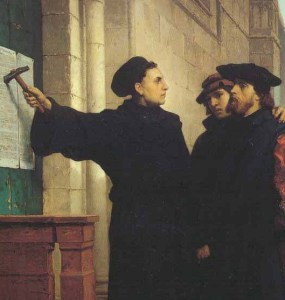 2017 marks the 500th anniversary of what is hailed by many as the start of the Reformation: Luther’s sharing his 95 Theses. I’ve decided to celebrate my Lutheran Protestant Tradition by highlighting some of the major issues that Luther and the Lutherans raised through the Reformation period. I hope you will join me as we remember the great theological (re)discoveries that were made during this period.
Indulgences are Worse than Useless
Luther’s critique of indulgences was a typical (for him) combination of insight and invective. He sought to clearly condemn not just the sale of but also the use of indulgences, which means parts of his critique remain quite relevant today. Here we will draw primarily from Luther’s explanations of his 95 theses.
Luther argued that the pope actually has no power over purgatory and, moreover, that if the pope did have this power, he ought to exercise it:
If the pope does have the power to release anyone from purgatory, why in the name of love does he not abolish purgatory by letting everyone out? (81-82, cited below)
The question cuts straight to he heart of the system in which the pope is exalted as having power over souls in purgatory. It is clear that Luther did not at this point denounce the doctrine of purgatory. What his point is directed at instead, is the claim that the pope does have such power. After all, if the pope does have such power, then why would he not simply release all the souls from purgatory immediately, thus granting a most generous and wonderful reprieve? The fact that the pope of Luther’s time did not do so and was in fact selling indulgences for coin spoke volumes about the doctrine itself and the need for reformation.
But the point still has relevance today, as one might ask the question: if the pope today currently has the power over purgatory, why does he not simply release all those who are suffering there? One possible answer might be because it is just that people undergo such suffering or bettering of themselves in purgatory that they might truly be, er, reformed. But then the question of the two kingdoms comes to mind. After all, such a response effectively strips the pope of the power that has allegedly been granted him, for if the spiritual benefits of purgatory are so great, why does he ever exercise the power he is said to hold? The argument can proceed indefinitely in a circle, which seems to show that the initial point is valid.
Luther, however, did not stop there. Rather than questioning the power of the pope to grant indulgences, he also noted the great spiritual harm such indulgences do:
Indulgences are positively harmful to the recipient because they impede salvation by diverting charity and inducing a false sense of security… Indulgences are most pernicious because they induce complacency and thereby imperil salvation. Those persons are damned who think that letters of indulgence make them certain of salvation. (82)
Indulgences, by granting pardon from sin or the consequences thereof, produce a false sense of security of salvation that may lead rather to damnation. For once one believes that because someone else has told them future or past sins are paid for by some collection of merit of others, they may believe that they are forgiven, when they have not confessed and repented of that sin to God. Thus, a false sense of security is gained, but in reality the person may be condemned, not having received full and free forgiveness of their sins.
Links
Be sure to check out the page for this site on Facebook and Twitter for discussion of posts, links to other pages of interest, random talk about theology/philosophy/apologetics/movies and more!
Please check out my other posts on the Reformation:
I discuss the origins of the European Reformations and how many of its debates carry on into our own day.
The notion of “sola scriptura” is of central importance to understanding the Reformation, but it is also hotly debated to day and can be traced to many theological controversies of our time. Who interprets Scripture?
The Church Universal: Reformation Review– What makes a church part of the Church Universal? What makes a church part of the true church? I write on these topics (and more!) and their origins in the Reformation.
The Continuing Influence of the Reformation: Our lives, our thoughts, our theology– I note the influence that the Reformation period continues to have on many aspects of our lives.
Source
Quotes from Luther are from Roland Bainton, Here I Stand: A Life of Martin Luther (New York: Abingdon, 1950). It appears as though Bainton was either translating directly from a German edition or paraphrasing Luther.
SDG.
——
The preceding post is the property of J.W. Wartick (apart from citations, which are the property of their respective owners, and works of art as credited) and should not be reproduced in part or in whole without the expressed consent of the author. All content on this site is the property of J.W. Wartick and is made available for individual and personal usage. If you cite from these documents, whether for personal or professional purposes, please give appropriate citation with both the name of the author (J.W. Wartick) and a link to the original URL. If you’d like to repost a post, you may do so, provided you show less than half of the original post on your own site and link to the original post for the rest. You must also appropriately cite the post as noted above. This blog is protected by Creative Commons licensing. By viewing any part of this site, you are agreeing to this usage policy.
Bonhoeffer As Reliable Guide?
 I seem to have made it something of a pastime explaining to others things about Lutheran belief, and often this pertains to discussions of Bonhoeffer. Almost everyone is trying to make Bonhoeffer in their own image. Whether it is the notion of calling Bonhoeffer an evangelical, or recruiting him to various other schools of thought, Bonhoeffer is enduring a kind of celebrity right now. That celebrity comes with its share of difficulties, including pushback. Some evangelicals have labeled Bonhoeffer dangerous. A recent article by William Macleod questions whether Dietrich Bonhoeffer may be a “reliable guide” when it comes to Christianity: Bonhoeffer – A Reliable Guide? That blog post levels a number of criticisms at the Lutheran theologian, and I would like to respond to this article, which I think misrepresents Bonhoeffer in many ways. I’ll not respond to every point, because Macleod overlaps points I’ve responded to before.
Methodological Notes
At the outset, I must point out a major problem with the article is that there is a distinct lack of citation throughout. Indeed, the only footnote is a reference to an article about Bonhoeffer, not a reference to Bonhoeffer’s works at all. Moreover, though many assertions are made about what Bonhoeffer wrote–as well as a few quotations–no references are provided, which makes it at many points impossible to easily track down the reference and so provide a full response. It is disturbing to me to see such lack of citation in an article that purports to correct evangelical thought on this theologian. How are we to evaluate an article that makes it difficult to even double-check the facts?
Second, Macleod does not define evangelical in this article, or provide a clear reference to what he means. Because there is great difficulty with the definition of “evangelical” in its modern and historical usage. Indeed, Bonhoeffer’s German Lutheran church historically simply referred to itself as evangelical–a tradition carried on to this day in my church body, the Evangelical Lutheran Church in America. The problem is that the term “evangelical” often means different things to different people, a problem acknowledged in many circles. The article would have been helped had Macleod provided exactly his meaning of evangelical to compare his statements to.
Bonhoeffer as Liberal Theologian?
Macleod alleges, “Far from being an evangelical, Bonhoeffer was more liberal than Barth. He considered himself a ‘modern theologian who still carries the heritage of liberal theology within himself’.” Here we already see a difficulty with the methodology–where is this quote from Bonhoeffer to be found? A search online turned up other blog posts that give this same quote, but this one, for example, writes a citation [5] in brackets but then there is no referent for [5]. I finally managed to possibly track down a reference on a different article, but don’t have the book in front of me at this point so I can’t confirm it. However, even granting he said that, I’d love to see the context. After all, he could have been saying it in the sense of saying that he has been influenced by liberal theology, which was certainly found all around him in Germany. But of course Bonhoeffer himself, at the end of his life, explicitly argued against liberal theology at multiple points.
Bultmann seems to have somehow found Barth’s limitations, but he misconstrues them in the sense of liberal theology, and so goes off into the typical liberal process of reduction – the ‘mythological’ elements of Christianity are dropped… My view is that the full content, including the ‘mythological’ concepts, must be kept… this mythology (resurrection etc.) is the thing itself… (Bonhoeffer, Letters and Papers from Prison, 328-329)
Those are Bonhoeffer’s words, written in 1944 from prison. Does that look like an acceptance of liberal theology? Bonhoeffer does engage liberal theologians, of that there is no doubt, but he explicitly notes the deficiencies of their theology and argues the opposite position. Macleod’s attempt to poison the well here fails.
Bonhoeffer as Martyr
Macleod, amusingly, questions whether Bonhoeffer was a martyr:
When we think of Christian martyrs we think of the early Christians thrown to the lions for refusing to worship Caesar. We think of Reformers like Patrick Hamilton and William Tyndale burnt at the stake for preaching the gospel and for translating the Scriptures into the language of the people. In no sense were these men involved in conspiracies against the state. Bonhoeffer died for being involved in a plot to assassinate Hitler… his death was not because of his beliefs, but rather for his ‘crime’ of conspiracy to murder.
I actually found myself chuckling here. I don’t know Macleod, and I know nothing about him. What I do know, and have seen many times, is a lack of understanding of church history among those broadly identifying themselves as evangelicals (I’m not the only one who bemoans this, on a different end of the spectrum than me stands James White, who I’ve heard on his podcast multiple times speak of the lack of knowledge of church history in evangelical circles). I preface that remark because Macleod’s comment about martyrs shows a bit of ignorance. If he wants to say Bonhoeffer’s not a martyr because he died for political reasons, perhaps he should go back and see that the worship of Caesar for which Christians were killed was, itself, a political killing. Virtually every book I’ve ever read on this early period of Christianity confirms this. For just one reference, check out the interplay between pagan and Christian apologists found in Apologetics in the Roman Empire.
Moreover, Macleod’s comment is amusing because the separation of belief from action is a very modernist/postmodernist separation, and one that could just as easily be used to say “the early Christian martyrs weren’t killed for their beliefs, they were killed for refusing to worship Caesar, a political act.” But of course that refusal is based on belief, just as Bonhoeffer’s ethical stance regarding Hitler was based on belief. Belief put into practice remains belief. The attempt to tarnish Bonhoeffer’s legacy as, yes, Christian martyr here bespeaks both lack of historical awareness and the overall tone of the article.
The Cross
Macleod accuses Bonhoeffer of decentralizing the cross because, according to Macleod, he did not believe in substitutionary atonement. More damningly, Macleod charges Bonhoeffer with seeing the cross as “an example and an inspiration.” I was astonished to read this from Macleod. Aside from the fact that Bonhoeffer wrote an entire book about Jesus Christ being the center not just of our faith but as the center of human history (Christ the Center, 59ff), he also repeatedly emphasized this in his other writings. Macleod stated, “For evangelicals the cross is at the centre of their faith.” I’m not at all sure why he thinks he should disagree with Bonhoeffer here, unless he just hasn’t read Bonhoeffer’s body of work.
Conversion
I’ve responded to this elsewhere, but Macleod’s words about conversion regarding Bonhoeffer are deeply troubling to me:
As a Lutheran he embraced the doctrine of baptismal regeneration – you are automatically born again when you are baptised. Around 1931 Bonhoeffer experienced a ‘conversion’, when he, as he puts it, discovered the Bible… Yet it was not what evangelicals normally call conversion, or what the Scriptures describe as the new birth. He rarely referred to it… He wrote, ‘We must finally break away from the idea that the gospel deals with the salvation of an individual’s soul’.
A number of things are problematic here. First, Macleod blatantly misrepresented the Lutheran view of baptismal regeneration by couching it in terms borrowed from Baptist theology. Baptismal regeneration is not about “automatically” being born again; it is about the gift of God that has been promised through baptism, even to infants. I’m not going to debate this rather obvious point here, but the fact that Macleod effectively dismisses Bonhoeffer simply because he’s Lutheran says something disturbing about his view of what it takes to be evangelical–apparently a view that excludes Lutherans entirely.
Moreover, Macleod once again conforms to modern American evangelicalism (not even sure if he’s from the United States, but the ideas he has are) by emphasizing the individual over the community. Any number of theologians have shown time and again that the evangelical focus on individual salvation is something born, historically, from a rather American emphasis on the individual rather than being something directly derived from Scripture. Not saying that individual salvation is not there, but as the primary theme? N.T. Wright, among others, has done some correction in this regard, and Bonhoeffer himself did in works like Life Together.
Universalist Bonhoeffer?
Macleod writes:
Bonhoeffer was a universalist, believing in the eventual salvation of all. He wrote that there is no part of the world, no matter how godless, which is not accepted by God and reconciled with God in Jesus Christ. Whoever looks on the body of Jesus Christ in faith can no longer speak of the world as if it were lost, as if it were separated from Christ. Every individual will eventually be saved in Christ.
There’s no citation here, or even a quote, so it is very hard to track down what he is referencing in Bonhoeffer’s writings. Of course, what he’s written here is not universalism, but rather a denial of limited atonement and, actually, the Lutheran view of incarnation. Luther himself emphasized that Christ is present in all of creation. With the incarnation, God is present with us. Macleod, again, doesn’t give a reference to track down, but based on the rest of the article I think he is just misunderstanding Bonhoeffer again. The Lutheran perspective denies limited atonement, and whether that is correct are not is hardly a specific accusation against Bonhoeffer. Of course, without a citation, all we can do is trust Macleod not to have misrepresented Bonhoeffer–something that, at this point, I’m unwilling to do. I haven’t read everything Bonhoeffer wrote, though I’ve read about 75% of his collected works at this point, and some of his books twice, and I don’t know of any reference that could be shown to be universalism explicitly rather than a denial of limited atonement. I await a citation.
Sabbath
Macleod again reveals how much he is reliant upon his presuppositions when he writes:
The Sabbath was given to man at creation. The command to keep the one day in seven holy was reiterated on Mount Sinai and written with the finger of God on tables of stone. Jesus kept the Sabbath and said that the Son of man is Lord of the Sabbath. Bonhoeffer, however, is quite happy to play table tennis on Sunday or to attend the theatre.
So, again, we have Bonhoeffer critiqued for being Lutheran. This is a pretty clear example of Macleod showing his stripes. It’s not so much Bonhoeffer that’s the problem; it is anyone who isn’t some kind of Reformed Baptist that’s the problem. Bonhoeffer was just a convenient target because people know who he is. Besides all that, Macleod’s words show very clearly that according to him, humans were made for Sabbath, not the other way around. But of course that makes gospel into law–and the proper distinction of law and Gospel is one of the central teachings of Lutheranism. But again, this is a debate for a different place. It’s fair enough to point out that Macleod’s argument here relies on a very specific presupposition, one that certainly not all evangelicals share, let alone Lutherans.
Conclusion
I have already written about twice as much as I meant to, and more could be said. It is clear that Macleod’s article is little more than a hit piece. There are no explicit citations to Bonhoeffer’s works (even when he is directly quoted, allegedly!), Macleod constantly condemns Bonhoeffer for clearly Lutheran views, and the whole article is based upon Macleod’s theological convictions, many of which I doubt he could demonstrate all evangelicals share. The pot shot at Bonhoeffer alleging he’s not a martyr shows the overall attitude Macleod has towards those he disagrees with, but it also–like many other points in the post–demonstrates a lack of historical awareness that pervades much of the church. Perhaps we can use his article in one positive way: rather than as a warning against Bonhoeffer–a faith-filled, Lutheran, courageous–yes–martyr–we can see it as a warning of the dangers of not taking history seriously.
Links
Be sure to check out the page for this site on Facebook and Twitter for discussion of posts, links to other pages of interest, random talk about theology/philosophy/apologetics/movies and more!
Bonhoeffer’s Troubling Theology?- A response to an article on Dietrich Bonhoeffer’s theological perspectives– I respond to a different article on Dietrich Bonhoeffer. We again see numerous misrepresentations and misunderstandings of Bonhoeffer and Lutheranism.
Eclectic Theist– Check out my other blog for my writings on science fiction, history, fantasy movies, and more!
SDG.
——
The preceding post is the property of J.W. Wartick (apart from quotations, which are the property of their respective owners, and works of art as credited; images are often freely available to the public and J.W. Wartick makes no claims of owning rights to the images unless he makes that explicit) and should not be reproduced in part or in whole without the expressed consent of the author. All content on this site is the property of J.W. Wartick and is made available for individual and personal usage. If you cite from these documents, whether for personal or professional purposes, please give appropriate citation with both the name of the author (J.W. Wartick) and a link to the original URL. If you’d like to repost a post, you may do so, provided you show less than half of the original post on your own site and link to the original post for the rest. You must also appropriately cite the post as noted above. This blog is protected by Creative Commons licensing. By viewing any part of this site, you are agreeing to this usage policy.
Book Review: “Justification” by N.T. Wright
 N.T. Wright’s views about the doctrine of justification have continued to be quite controversial, and his book Justification is a brief summary of his entire project. Essentially, Wright is attempting to go back to the Pauline corpus to see exactly what Paul means by the doctrine of justification. Part of this project, for Wright, is to become aware of the idea that we may be asking the texts the wrong questions from the get-go. We need to understand the context to which Paul was writing before we can even properly formulate questions.
Wright begins with a number of preliminary comments. He first outlines the difficulties faced by biblical interpreters when they do start with the wrong questions. He argues that a number of our interpretations are based less on the text than an interpretation of the text itself. He argues that the Reformation tradition ought to continue to lead us to question even Reformation conclusions about texts like Galatians–and Luther’s “mistaken” reading (according to Wright) thereof. In other words, we need to acknowledge that we could be deeply mistaken, and have been deeply mistaken, about the meaning of these texts for hundreds of years. It’s a tough pill to swallow, but one that ought to be taken seriously. Acknowledging the possibility that an interpretation is based less on the text than on tradition or modern assumptions is one of the first steps to understanding the text.
Then, Wright proceeds to show the context to which Paul was writing. Specifically, much of the context he was writing to makes certain parts of the text make a lot more sense than they may otherwise. When you realize what was happening in the early church it becomes easier to understand some of the basic questions Paul was asking and answering. Next, Wright outlines his view of justification, which is admittedly never distilled (so far as I can tell) down to a single sentence. It is thus difficult to say exactly what his view is without an extended excursus longer than a book review, but the bare-bones basics, at risk of being overly simplistic, is that justification is God’s work through Israel of bringing the whole world to himself, declaring it righteous not through imputed righteousness, but through a law court declaration of righteousness. Yes, before those who understand Wright’s position better than I do, this is very simplistic and misses some key points of his doctrine. Yet, I have to make the attempt to summarize as best I can what he was arguing.
Finally, Wright concludes with lengthy exegesis of a number of Pauline passages. Though he himself says these are but the first steps along the lines of understanding Paul, it ought to be noted that it is in this section of the book that Wright engages most thoroughly with critics of his position as well as providing a positive statement of his view. This new edition that I’m reviewing adds an additional introduction from Wright, which outlines the continuing debates over Pauline theology.
One difficulty with Wright’s approach that many may object to is the notion that it undermines the perspicuity of Scripture. Now, I’m one who hates throwing that term around, because perspicuity is used as a kind of battering ram doctrine to try to silence critics on all sorts of topics. However, the real doctrine of perspicuity of Scripture, yes, inherited from the Reformation, is that the Bible is clear in that which is necessary to understand for salvation. If, however, Wright is correct in saying that must understand a great deal of historical context before we can even get to the right questions for the doctrine of justification, this seems to make it quite complex indeed to get to the knowledge that people need for salvation. Of course, Wright would–and did–argue that this is already starting off on the wrong track, because Paul was not so much interested in individual salvation as he was interested in the plan of Salvation through Israel of the whole world. And that is a fair answer, though it does seem to–in some sense–undermine the clarity of Scripture as has been taught. Once again, Wright would probably accept this and argue that that idea is itself an inherited tradition that the Reformers themselves would call us to examine and test by Scripture.
Perhaps the strangest aspect of the book to me was the continued targeting of Luther and Lutheran theology by Wright. I know of some Lutheran pastors who have argued Wright’s position is not far at all from the Lutheran one, and others who believe he is as far from Lutheranism on justification as possible. Though this may simply show confusion within Lutheran theology, it may also show–and I think does–that Wright’s position (and probably Luther’s) is not so clearly stated as he thinks. Moreover, I am curious about the continued calling out of Lutherans (and, yes, Reformed thinkers) by Wright, considering that his position seems, on the face of it, so utterly close to what Lutherans do believe about justification, and much farther from some other denominational perspectives.
Justification is required reading for those interested in Pauline theology, whether one agrees with Wright or not. That said, it is unfortunate that a decent amount of the work seems to be polemical against perceived enemies rather than embracing potential allies.
The Good
+Leads readers to a deeper look at biblical texts
+Provides solid background to understanding Pauline corpus
+Outlines Wright’s ways in a concise fashion
The Bad
-Strangely focused on the Lutheran position
-Not always very clear
Disclaimer: I received a copy of the book for review from the publisher. I was not required to provide any specific kind of feedback whatsoever.
Source
N.T. Wright, Justification (Downers Grove, IL: InterVarsity, 2016).
Links
Be sure to check out the page for this site on Facebook and Twitter for discussion of posts, links to other pages of interest, random talk about theology/philosophy/apologetics/movies and more!
Book Reviews– There are plenty more book reviews to read! Read like crazy! (Scroll down for more, and click at bottom for even more!)
Eclectic Theist– Check out my other blog for my writings on science fiction, history, fantasy movies, and more!
SDG.
——
The preceding post is the property of J.W. Wartick (apart from quotations, which are the property of their respective owners, and works of art as credited; images are often freely available to the public and J.W. Wartick makes no claims of owning rights to the images unless he makes that explicit) and should not be reproduced in part or in whole without the expressed consent of the author. All content on this site is the property of J.W. Wartick and is made available for individual and personal usage. If you cite from these documents, whether for personal or professional purposes, please give appropriate citation with both the name of the author (J.W. Wartick) and a link to the original URL. If you’d like to repost a post, you may do so, provided you show less than half of the original post on your own site and link to the original post for the rest. You must also appropriately cite the post as noted above. This blog is protected by Creative Commons licensing. By viewing any part of this site, you are agreeing to this usage policy.
Book Review: “The Great Divide: A Lutheran Evaluation of Reformed Theology” by Jordan Cooper
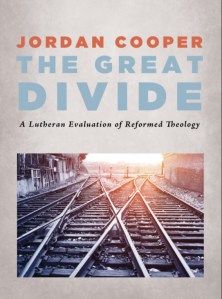 The Great Divide: A Lutheran Evaluation of Reformed Theology presents a broad-spectrum look at Reformed theology from a Lutheran perspective.* Cooper breaks this analysis up into three parts: Predestination and Free Will, Worship and the Sacraments, and Salvation. These parts are intended to show the greatest dividing lines between Reformed and Lutheran thought.
It is really quite exciting to see how well-read Cooper is on both Reformed and Lutheran thought. On the Reformed side, he frequently cites Calvin (of course), Bavinck, Edwards, Piper, Grudem, and more. On the Lutheran side, he draws from Luther, Chemnitz, Melanchthon, Kolb, and more. This thorough use of sources on both sides helps shield against bias, as Cooper continually cites the words of prominent theologians of each tradition.
Cooper provides in each chapter a presentation of Reformed thought on the topic, drawing extensively from prominent Reformed thinkers past and present, as well as various Reformed Confessions. Then, he provides a look at the Lutheran perspective, often quoting the Lutheran Confessions as well as prominent Lutheran thinkers. After providing this comparison, Cooper argues for the Lutheran position, noting the points of divergence along the way. At many points, this analysis is fairly robust. However, at other points Cooper does swiftly move from one point to another before providing enough to establish each point.
One of the things that comes to the front most clearly in the book is just how close Reformed and Lutheran thought are on a number of issues. Unfortunately, as close as the two traditions come on many areas, the chasm between the two remains vast. This is particularly clear in regards to the Sacraments and Predestination. I was also pretty surprised to see how different the Reformed and Lutheran view regarding worship is. The regulative principle within Reformed thought–that whatever is not commanded in Scripture ought not to be done in worship–was something that startled me. I hadn’t considered such a position, but Cooper showed the arguments for and against this position, coming down on the side of Lutheranism (again, he’s coming from that perspective), which sees worship as something that God allows for more leeway in than do Reformed thinkers.
It is truly amazing how much information Cooper manages to convey in just 200 pages. Readers are introduced to both Lutheran and Reformed perspectives on a number of important theological topics, treated to both exposition of those views and offered critique of the Reformed position all in a very clear style and form.
There are two minor critiques I’d offer of the book. The first is the continued use of the archaic “man” to refer to all people. There were, in fact, a few places in which I had to work to discern whether Cooper meant all people or just men when it came to what he was writing. A second critique is that because of the books relatively short length, some of the arguments on either the Reformed or Lutheran side seem extremely brief, leaving some of the arguments inconclusively demonstrated.
Jordan Cooper’s The Great Divide: A Lutheran Evaluation of Reformed Theology is a vast trove of information and analysis. Extensively researched and well-reasoned, it will provide readers unfamiliar with either Reformed or Lutheran theology (or both) an introduction to each tradition as well as a look at how they may interact with one another.
The Good
+Engages with prominent theologians from each group
+Historically informed
+Treats Reformed thought fairly
+Vast wealth of information
The Bad
-Continued use of archaic “man” etc. as inclusive
-Some points are breezed through very quickly
*It is worth noting my own bias here: I am a Lutheran who was raised Lutheran and, though I wandered a little bit, have become quite convinced of Lutheran theology in recent years.
Disclaimer: I was provided with a copy of the book for review by the publisher. I was not required to provide any specific kind of feedback whatsoever.
Source
Jordan Cooper The Great Divide: A Lutheran Evaluation of Reformed Theology (Eugene, OR: Wipf & Stock, 2015).
Links
Be sure to check out the page for this site on Facebook and Twitter for discussion of posts, links to other pages of interest, random talk about theology/philosophy/apologetics/movies and more!
Book Reviews– There are plenty more book reviews to read! Read like crazy! (Scroll down for more, and click at bottom for even more!)
Eclectic Theist– Check out my other blog for my writings on science fiction, history, fantasy movies, and more!
SDG.
——
The preceding post is the property of J.W. Wartick (apart from quotations, which are the property of their respective owners, and works of art as credited; images are often freely available to the public and J.W. Wartick makes no claims of owning rights to the images unless he makes that explicit) and should not be reproduced in part or in whole without the expressed consent of the author. All content on this site is the property of J.W. Wartick and is made available for individual and personal usage. If you cite from these documents, whether for personal or professional purposes, please give appropriate citation with both the name of the author (J.W. Wartick) and a link to the original URL. If you’d like to repost a post, you may do so, provided you show less than half of the original post on your own site and link to the original post for the rest. You must also appropriately cite the post as noted above. This blog is protected by Creative Commons licensing. By viewing any part of this site, you are agreeing to this usage policy.
Who is Worthy?- A reflection on closed communion in Lutheran churches

I do not claim rights to this image and was unable to find original source. Possibly here: http://thehandsomehansons.blogspot.com/2010/11/lutheran-seal.html
My wife and I have been refused communion on more than one occasion. In each instance it was in a Lutheran church that we were turned away. We are, ourselves, Lutherans, but the church bodies that did not commune us were different groups of Lutherans, and held that the divisions between us justified not giving us the gifts of the sacrament that Christ promised.
Here, I’d like to examine this practice of some Lutheran churches, often referred to as “closed communion.”[1] What do the actual Lutheran Confessions say about who may receive the Lord’s Supper? That is the question which must be asked by any claiming to be Lutheran.
We believe, teach, and confess that the entire worthiness of the guests at the table of his heavenly meal is and consists alone in the most holy obedience and perfect merit of Christ. We make his obedience and merit our own through true faith, concerning which we receive assurance through the sacrament. Worthiness consists in no way in our own virtues, or in internal or external preparations. (The Formula of Concord, Epitome, Article VII, Section 20)
The Lutheran Confessions leave no wiggle room here. What makes one worthy to receive the sacrament? Is it one’s preparation? No. Is it one’s denominational commitment? No. It is explicitly and clearly stated here: “the most holy obedience and perfect merit of Christ” which is itself made our own “through true faith.” Indeed, what does it mean to add the requirement of complete doctrinal agreement onto these words? Would not such a teaching be to make one’s “own virtues”–here of the doctrinal variety–what makes one worthy? It seems so. The teaching here, however, is that it is only faith in Christ’s words and works that make one worthy.
Just in case one wants to persist and allege that there may be some difficulty interpreting these words, Martin Luther himself states, in the Large Catechism:
Now we must also consider who the person is who receives such power and benefit [from the Lord’s Supper]… It is the one who believes what the words say and what they give, for they are not spoken or preached to stone and wood but to those who hear them, to those whom he says, “Take and eat”…All those who let these words be addressed to them and believe that they are true have what the words declare…
Now this is the sum total of a Christian’s preparation to receive this sacrament worthily. (The Large Catechism, The Sacrament of the Altar, section 33-36)
What does Luther himself teach here? “[T]his is the sum total of a Christian’s preparation…” (emphasis mine). And what is that sum total? Simply being one who “let these words be addressed to them and believe that they are true…” Once again, we see no mention of further conditions. There is no place here for refusing communion to those who believe the words are for them. The Christian must simply take hold of the words of Christ, which promise his body and blood to them. They need not be part of a specific denomination (which would have been historically impossible or at least unlikely at this point). It is the faith of the individual that makes them worthy, not their adherence to a set of doctrinal truths apart from those affirmed about the Lord’s Supper.
What do Lutherans who turn away other Lutherans from the sacrament say about their reasoning? Here is one example, from the Lutheran Church – Missouri Synod:
Because the Bible teaches that this Sacrament may also be spiritually harmful if misused, and that participation in the Lord’s Supper is an act of confession of faith, the LCMS ordinarily communes only those who have been instructed in the teachings of our church and who have confessed their faith in these teachings. (LCMS FAQ, cited below)
Here we see an unwarranted limit being placed on the sacrament of communion. What makes one worthy to receive this sacrament? The Lutheran Confessions make it explicit that that which makes one worthy is faith in the words of Christ. Here, however, an addition is made: “only those who have been instructed in the teachings of our church [the LCMS] and who have confessed their faith in these teachings” are “ordinarily” communed. Yet this limit is nowhere taught in the Book of Concord.
Counter-Argument
A possible counter-argument to the above is that there were no divergent Lutherans or Lutheran groups at the time the Lutheran Confessions were written, so they couldn’t have even addressed the issue. Apart from the fact that this is historically false (for parts of the Book of Concord were written to correct others within the folds of Lutheranism), it doesn’t change the Book of Concord’s teaching on the topic. The Lutheran Confessions make very strong statements. Phrases like “the sum total” and “alone” are used accompanying what the Confessions teach in regards to worthiness for the Lord’s Supper. These phrases are exclusive. That is, they affirm explicitly that no other expectations may be added. For what else might saying “sum total” or “alone” mean?
Conclusion
Those Lutheran groups who have added requirements for worthily receiving the Lord’s Supper stand against the Book of Concord’s own teaching on the topic. Time and again Luther and other confessors state that the only requirement for worthiness is to affirm the words of Christ and take hold of them by faith. Any who add requirements to receiving this sacrament have made their own words supersede those of the Confessions.
[1] Closed communion may also refer to simply keeping communion closed to those who affirm what the Book of Concord teaches regarding the Lord’s Supper. There is a fine line between this practice and making the additions to the Book of Concord’s teaching as noted in this post. I am not addressing this less stringent variety here.
Sources
LCMS Frequently Asked Questions Doctrinal Issues- The Lord’s Supper/Holy Communion (accessible here).
Robert Kolb and Timothy J. Wengert, eds. The Book of Concord: The Confessions of the Evangelical Lutheran Church (Minneapolis, MN: Fortress, 2000).
Links
Be sure to check out the page for this site on Facebook and Twitter for discussion of posts, links to other pages of interest, random talk about theology/philosophy/apologetics/movies and more!
Adhering to the Book of Concord “In So Far As” or “Because” it Agrees with Scripture?– I argue that Lutherans must hold the position that we adhere to the Book of Concord In So Far As it Agrees with Scripture.
Eclectic Theist– Check out my other blog for posts on Star Trek, science fiction, fantasy, books, sports, food, and more!
SDG.
——
The preceding post is the property of J.W. Wartick (apart from quotations, which are the property of their respective owners, and works of art as credited; images are often freely available to the public and J.W. Wartick makes no claims of owning rights to the images unless he makes that explicit) and should not be reproduced in part or in whole without the expressed consent of the author. All content on this site is the property of J.W. Wartick and is made available for individual and personal usage. If you cite from these documents, whether for personal or professional purposes, please give appropriate citation with both the name of the author (J.W. Wartick) and a link to the original URL. If you’d like to repost a post, you may do so, provided you show less than half of the original post on your own site and link to the original post for the rest. You must also appropriately cite the post as noted above. This blog is protected by Creative Commons licensing. By viewing any part of this site, you are agreeing to this usage policy.
Sunday Quote: Dietrich Bonhoeffer as Lutheran
Every Sunday, I will share a quote from something I’ve been reading. The hope is for you, dear reader, to share your thoughts on the quote and related issues and perhaps pick up some reading material along the way!
Dietrich Bonhoeffer as Lutheran
Dietrich Bonhoeffer is one of the most engaging characters of the 20th century as well as an immensely important and popular theologian. As time goes on, more and more people know who he is and acknowledge his influence on their work and lives. I have noticed, however, a strange lack of awareness or acknowledgement of Bonhoeffer’s Lutheranism. That is, many take what he says about discipleship, ecclesiology, prayer, and the like to heart, but divorce those ideas from their Lutheran context in his thought. Yet, for Bonhoeffer, his Lutheran theology was central to his understanding of Christianity. He wrote in The Cost of Discipleship:
How then do we come to participate in the Body of Christ, who did all this for us? It is certain that there can be no fellowship or communion with him except through his Body, baptism and the Lord’s Supper… The sacraments begin and end in the Body of Christ, and it is only the presence of that Body which makes them what they are. The word of preaching is insufficient to make us members of Christ’s body; the sacraments also have to be added. Baptism incorporates us into the unity of the Body of Christ, and the Lord’s Supper fosters and sustains our fellowship and communion… in that Body. (239, cited below)
These words can be found echoed in Bonhoeffer’s writings. His understanding of the universe was a Lutheran understanding, one which teaches Word and Sacrament. To do justice to his legacy, we need to acknowledge the fact that he isn’t just some theologian we can pull individual ideas from; instead, we must see him as Lutheran.
Links
Be sure to check out the page for this site on Facebook and Twitter for discussion of posts, links to other pages of interest, random talk about theology/philosophy/apologetics/movies and more!
Bonhoeffer’s Troubling Theology?- A response to an article on Dietrich Bonhoeffer’s theological perspectives– I have argued elsewhere that the broad evangelical understanding of Bonhoeffer may, indeed, be a misunderstanding of the fact that he is Lutheran.
Sunday Quote– If you want to read more Sunday Quotes and join the discussion, check them out! (Scroll down for more)
Eclectic Theist– Check out my other blog for my writings on science fiction, history, fantasy movies, and more!
Source
Dietrich Bonhoeffer, The Cost of Discipleship (New York: Touchstone, 1995).
SDG.
Made Perfect in this Life? – A Lutheran reflection on Methodist sanctification

I was visiting a United Methodist Church and the pastor preached on the doctrine of sanctification. She referenced the affirmation within the Methodist church that Christians can receive perfection in this life.
I’ve been curious about this assertion for some time, and I decided to explore some more. On the United Methodist Church’s website, in the section entitled “Our Wesleyan Heritage,” sanctification is defined, in part:
We’re to press on, with God’s help, in the path of sanctification toward perfection. By perfection, Wesley did not mean that we would not make mistakes or have weaknesses. Rather, he understood it to be a continual process of being made perfect in our love of God and each other and of removing our desire to sin. (accessed here)
The embedded link sends readers to a sermon from John Wesley. In that sermon, he talks about what he means by being made perfect in this life. He distinguishes between what, in his view, is not attainable in this life regarding perfection, as well as what is attainable. Christians, he argues, are not made perfect in knowledge in this life, nor will they become free from making mistakes, nor from illness, nor from temptations. Instead, Christian perfection in this life will lead to various blessings:
First, not to commit sin… Secondly, to be freed from evil thoughts and evil tempers…
Wesley, of course, goes into much more detail than that, and defends his positions from various objections. The length of the sermon makes it prohibitive for a detailed interaction, so I just want to focus on these aspects of Wesleyan/Methodist sanctification.
Sanctification Over Time?
The notion of achieving perfection over time is something that causes difficulty because it makes sanctification a biographical account. To clarify, a quote from Oliver O’Donovan in his chapter in the book Sanctification: Explorations in Theology and Practice entitled “Sanctification and Ethics,”- “Sanctification understood biographically [as occurring over the span of a life] has given encouragement to a belief in progressive and incremental moral improvement, to be attained with maturity and age” (155, cited below).
The implication of a view of continual sanctification that is progressive leads to the assumption that a more mature Christian ought to also be more sanctified. Yet this may lead to failed expectations related to the Christian life. If one is led to expect perfection in this life, and they continue to find themselves simul iustus et peccator (to borrow a very Lutheran phrase: simultaneously justified and a sinner [or a sinner and a saint, as it has come to be said]), they may lose their assurance of hope not just in sanctification but also in salvation. After all, their expectations of the Christian life are undercut.
It may be answered that the proper interpretation of Wesley is, rather, that he argued for instantaneous perfection. But this is a debate for a different time. (See the book Sanctification: Explorations in Theology and Practice for chapters related to this topic.)
A Lutheran Interaction
The Lutheran Confessions make it clear that sanctification is the work of the Holy Spirit (Formula of Concord, Article III, paragraph 41). In the Large Catechism, Luther refers to the basics of what could be considered a Lutheran view of sanctification:
…because holiness has begun and is growing daily, we await the time when our flesh will be put to death, will be buried with all its uncleanness, and will come forth gloriously and arise to complete and perfect holiness in a new, eternal life. Now, however, we remain only halfway pure and holy. The Holy Spirit must always work in us through the Word, granting us daily forgiveness until we attain to that life where… there will be only perfectly pure and holy people… (The Large Catechism, Second Part, section 57-58)
Thus, a Lutheran perspective of sanctification sees humans as part holy and part sinful. But what are we to make of this? Here, perhaps, is where the Methodist and Lutheran view of sanctification may split most sharply, for the Lutheran will note that what makes us holy is the Spirit through Word and Sacrament. That is, through the taking of Holy Communion and the receiving of absolution, we are daily made holy by the Spirit of God. Thus, holiness is, yes, in part works driven and completed by the Spirit, but it is also and perhaps mostly that which we gain through participation in the community of Christ, the church. For Lutherans, Word and Sacrament stand paramount.
Some object to this Lutheran position, charging Lutherans with a kind of antinomianism. After all, it can’t be that easy, right? Yet on the Lutheran view, sanctification is ongoing, but not in the sense that we discussed above. Instead, it is something that the Spirit works continually for us. Moreover, though the topic is hotly debated in Lutheran circles, the notion of the “third use of the law”–as a guide for Christian life–helps curb antinomianism and turn the Christian back to Christ for forgiveness.
Conclusion
I believe I have more to learn in this area, and I am interested to read on the topic further. I have a book on the topic I’m currently reading, so I’m hoping this will give me some more insight into the fascinating topic. For now, it seems to me that the primary division between the Lutheran and Methodist view here is centered not so much on the concept of perfection now (though that is an intriguing topic to explore), but rather on a view of sanctification through the Sacraments.
Sources
Robert Kolb and Timothy J. Wengert, eds. The Book of Concord: The Confessions of the Evangelical Lutheran Church (Minneapolis, MN: Fortress, 2000).
Oliver O’Donovan, “Sanctification and Ethics” in Sanctification: Explorations in Theology and Practice edited by Kelly M. Kapic (Downers Grove, IL: InterVarsity, 2014).
Other sources are linked above.
Links
Be sure to check out the page for this site on Facebook and Twitter for discussion of posts, links to other pages of interest, random talk about theology/philosophy/apologetics/movies and more!
Eclectic Theist– Check out my other blog for posts on Star Trek, science fiction, fantasy, books, sports, food, and more!
SDG.
——
The preceding post is the property of J.W. Wartick (apart from quotations, which are the property of their respective owners, and works of art as credited; images are often freely available to the public and J.W. Wartick makes no claims of owning rights to the images unless he makes that explicit) and should not be reproduced in part or in whole without the expressed consent of the author. All content on this site is the property of J.W. Wartick and is made available for individual and personal usage. If you cite from these documents, whether for personal or professional purposes, please give appropriate citation with both the name of the author (J.W. Wartick) and a link to the original URL. If you’d like to repost a post, you may do so, provided you show less than half of the original post on your own site and link to the original post for the rest. You must also appropriately cite the post as noted above. This blog is protected by Creative Commons licensing. By viewing any part of this site, you are agreeing to this usage policy.
Sunday Quote!- The Faith of Infants- Hermann Sasse
Every Sunday, I will share a quote from something I’ve been reading. The hope is for you, dear reader, to share your thoughts on the quote and related issues and perhaps pick up some reading material along the way!
The Faith of Infants – Hermann Sasse
One aspect of Lutheran theology that is often misunderstood is the notion of infant faith. It goes hand in hand with the Lutheran teaching of baptismal regeneration. Yet, time and again I have seen the accusation leveled at Lutherans that we somehow believe that faith is not required for salvation, because we believe infants are saved. Lutheran theology, however, teaches instead that infants do have faith. A brief quote from Hermann Sasse makes this more explicit:
[I]t is not merely avowed liturgical conservatism or even thoughtlessness when the Church for nearly two thousand years has thus baptized infantas as though they were adults, as though they could already confess with the outh and believe with the heart. This is not the ‘as though’ of mere fiction… God views us in Baptism as people who have already died and been raised… Thus he already views us as such who already believe, the poorest, weakest little child which we bring to Holy Baptism. (1197, cited below)
Sasse’s point here is that God views us eschatologically–as though we have faith, because that faith is the gift of God. Lutherans do not believe in salvation without faith; instead, a consistent application of the notion that faith is from God means God can impart that faith to whomever God chooses–whether one is elderly or newborn.
Source
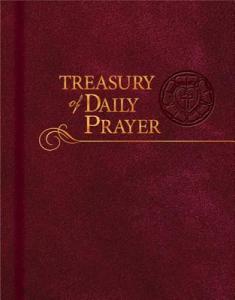
Herman Sasse, quoted in Treasury of Daily Prayer (St. Louis, MO: Concordia Publishing House, 2008). Quoting from Herman Sasse, “Circular Letter 4 to Westphalian Pastors,” in The Lonely Way: Selected Essays and Letters, translated by Matthew C. Harrison et al., vol. 2 (CPH, 2002).
Links
Be sure to check out the page for this site on Facebook and Twitter for discussion of posts, links to other pages of interest, random talk about theology/philosophy/apologetics/movies and more!
Sunday Quote– If you want to read more Sunday Quotes and join the discussion, check them out! (Scroll down for more)
Eclectic Theist– Check out my other blog for discussions about all kinds of topics including science fiction, history, fantasy movies, and more!
SDG.
Sunday Quote: Dietrich Bonhoeffer on Anthropomorphism and God
Every Sunday, I will share a quote from something I’ve been reading. The hope is for you, dear reader, to share your thoughts on the quote and related issues and perhaps pick up some reading material along the way!
Dietrich Bonhoeffer on Anthropomorphism and God
Dietrich Bonhoeffer was a Lutheran theologian who was murdered by the Nazis. Many people don’t delve too deeply into his theology, but I have found reading his broader works to be quite rewarding. Here’s a passage from his Creation and Fall:
God… receives a very specific proper name, Yahweh… One could suppose that such a proper name is evidence of a very primitive idea of God… yet just at this point one must reply that anthropomorphism in thinking of God… is no more irrelevant… than is the abstract use of the generic term ‘deity.’ On the contrary, clear anthropomorphism much more plainly expresses the fact that we cannot think of ‘God as such’ whether in one way or another. The abstract concept of God, precisely because it seeks not to be anthropomorphic, is in actual fact much more so than is childlike anthropomorphism. (74-75, sections 69-70, cited below)
Here, then, Bonhoeffer’s point is that merely abstracting the concept of God and speaking of God “as such” actually does just as much damage to our understanding of God as does “clear anthropomorphism.” That is, when we make God into a kind of philosophical construct, we are just as far away from the relational, radically personal God of the Bible as if we were to be anthropomorphic in a childlike way. For, as he points out in the last sentence above, we put God into our categories rather than the categories of Scripture.
I think Bonhoeffer has a good point here, one that warns people like me who are philosophically minded to remember that our God is an active God. Although it seems clear Bonhoeffer would not deny something like saying God is omnipotent, what he is denying is that we can use those categories to reach “God as such” and fit God into them alone. God–Yahweh–is much more than that, and we need to remember that.
What do you think? Can anthropomorphism be a helpful way to understand God? What dangers, if any, might come from making an abstract concept of deity?
Links
Be sure to check out the page for this site on Facebook and Twitter for discussion of posts, links to other pages of interest, random talk about theology/philosophy/apologetics/movies and more!
Sunday Quote– If you want to read more Sunday Quotes and join the discussion, check them out! (Scroll down for more)
Eclectic Theist– Check out my other blog for my writings on science fiction, history, fantasy movies, and more!
Source
Dietrich Bonhoeffer, Creation and Fall Douglas Stephen Bax, Translator (Minneapolis, MN: Fortress, 2004).
SDG.

 J.W. Wartick - Reconstructing Faith